“Russian port operator Rosmorport recently took delivery of Viktor Chernomyrdin, the largest diesel-electric icebreaker ever built by a Russian shipyard….Viktor Chernomyrdin boasts a length of 146.8 metres, a moulded beam of 29 metres, a minimum draught of 8.5 metres, a maximum draught of 9.7 metres, and a displacement of approximately 19,070 tonnes. Because the vessel’s draught is variable, it can sail in inland waterways and other shallow areas aside form its primary area of operations that encompasses the Baltic Sea and the Gulf of Finland.”
This ship is slightly larger than the planned Polar Security Cutter, but is apparently less powerful (33,600 HP compared to 45,200 for the PSC). Using the Coast Guard classification, she is a medium icebreaker. But unlike many other Russian Icebreakers, this one seems to be capable of transiting to Antarctica if required.
Incident Commander Chris Graff of Gallagher Marine Systems and U.S. Coast Guard Commander Efren Lopez, Federal On-scene Coordinator, observe lifting and pollution mitigation operations at the Golden Ray wreck site. St. Simons Sound Incident response photo.
The U.S. Coast Guard and the National Transportation Safety Board signed an updated memorandum of Uunderstanding (MOU). Marine Link has the story.
The Navy League’s on-line edition of their magazine “Seapower” reports on the Commandant’s testimony before Congress on June 23.
As might be expected, there was a pitch for the Polar Security Cutters. I was pleased to see that the Commandant sighted not only a need for greater presence in the Arctic, but also in the Antarctic. Sooner or later, disputed claims will come to the fore there. I don’t think the existing treaty will be continued after its current expiration date, 2048, and we might see conflict before that.
There was also an interesting description of Healy’s next voyage,
“He said the Coast Guard is sending the medium icebreaker USCGC Healy to the Arctic this summer for some scientific research for about 30 days, followed by a transit of the Northwest Passage over the north coast of Canada. Some Canadian researchers, British sailors and others will be on board the Healy for the voyage. Current plans call for a port call in Greenland and then return to Seattle via the Panama Canal.”
There does seem to be a misstatement in the report, probably the reporter confused Dutch and Danish,
“Shultz also pointed out that Coast Guard medium-endurance cutters have exercised with Dutch and French forces in the Arctic region.”
And the Commandant did not stop at recommending three heavy and three medium icebreakers. “… Four to six heavy icebreakers are what we really need, and we need some medium breakers.”
South China Sea claims map by Voice of America, 31 July, 2012
China’s continued incursions into the Philippines’ EEZ have been ratchetting up the tension in the South China Sea. Philippine President Rodrigo Roa Duterte attempted to work with the Chinese, but that has been unrewarding and it now appears the Philippines is beginning to push back.
On one hand we might say that, since we no longer have bases in the Philippines what does the US get out of our mutual defense agreement? But on the other hand, we don’t want to see the Philippines become a Chinese satellite.
While on one hand the Chinese impoverish these nations they then offer loans for projects that frequently fail, leaving the countries in debt to China.
This is why there is increasing recognition of the Coast Guard’s importance in cooperative fisheries enforcement.
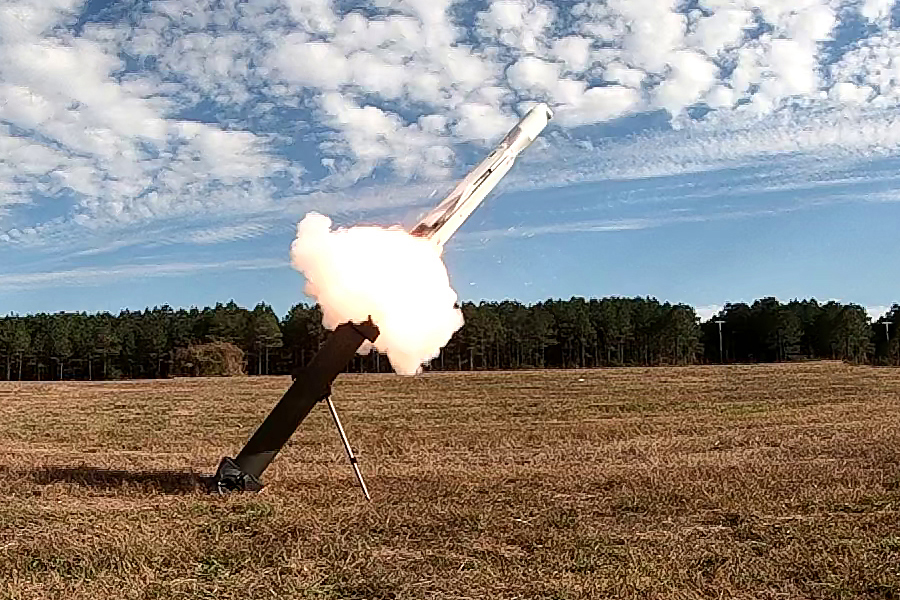
It appears a loitering munition, particularly suitable for Coast Guard use, is entering the Navy’s inventory. Essentially these “suicide drones” are small, short range, cruise missile with the unique feature of having a man in the loop who can evaluate the progress of the mission, switch targets, or abort the mission at his discretion. We talked about these earlier.
Naval News reports that the Marines are buying the UVision Hero-120 for installation on their Light Armored Vehicle-Mortar (LAV-M), Joint Light Tactical Vehicle (JLTV) and Long Range Unmanned Surface Vessel (LRUSV). The latter could be of particular significance to the Coast Guard in that the installation will be on a boat, unmanned, but still a boat, and in fact a relatively small boat.
UVision Hero-120 and canister launcher
The Hero-120 is relatively small.It is shipped and stored in a cannister that is also its launcher.
Weight: 12.5 kg (27.6 pounds) Warhead: 4.5 (10 pounds) Range: 40 km (21.6 nautical miles) Endurance (min): 60 Engine: Electrical
The Long Range Unmanned Surface Vessel (LRUSV) is being built by Metal Shark and apparently uses the hull of the Navy’s new 40 foot patrol boat.
While I think these weapons have a place on most of the larger Coast Guard patrol craft, for the purpose of destroying small, fast, highly maneuverable craft that might be used in a terror attack, they really look like a good upgrade for the Webber class being deployed to Bahrain.
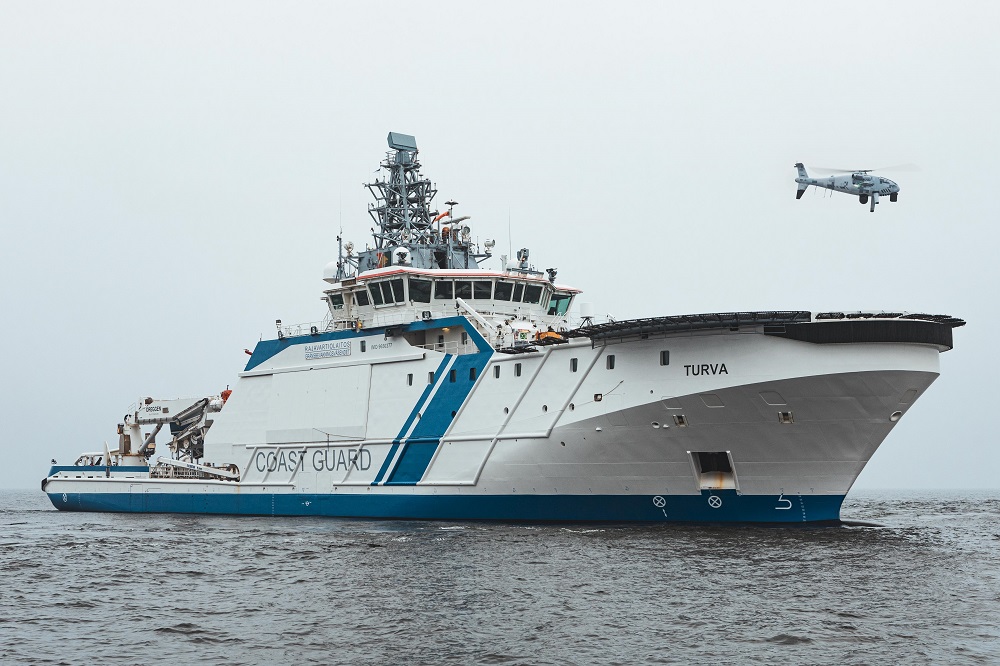
A short post in Naval News that reported the deployment of a Schiebel Camcopter UAS on a Finnish Coast Guard Cutter prompted me to look up the cutter involved, and it proved interesting for a couple of reasons,
its unique propulsion system and
the fact that it can break ice in spite of a bulbous bow.
Wartsila.com provides the information (excerpt below).
“TURVA is powered by three environmentally friendly Wärtsilä 34DF series dual-fuel engines capable of burning both diesel fuel as well as liquefied natural gas (LNG). For redundancy and safe return to port, the engines are arranged in two independent engine rooms divided by a watertight bulkhead. In the aft engine room, a 12-cylinder Wärtsilä 12V34DF producing 6400kW is mechanically coupled to a controllable pitch propeller. In the forward engine room, two 6L34DF generating sets with an output of 3000kW each produce power for two electrically-driven Azipull AZP120CP thrusters. If the forward engine room is damaged, the shaft generator coupled to the bigger engine can be used to produce electricity for the azimuth thrusters, which are required for steering the vessel as she has no separate rudders, and other onboard systems. Since the azimuth thrusters are powered by electric motors and the centerline shaft is mechanically coupled to the main engine, the propulsion system as a whole could be referred to as “combined diesel-electric and diesel” (CODLAD). TURVA is the first ship fitted with this type of propulsion arrangement – two azimuth thrusters and a centerline shaft – which was originally developed for icebreakers and icegoing LNG carriers. For maneuvering and DP2 class dynamic positioning, the ship has a transverse bow thruster and a retractable azimuth thruster in the bow.
“The service speed of the vessel will be 18 knots and despite her bulbous bow she will also be capable of breaking level ice up to 0.80m in thickness. With a bollard pull of approximately 100t, TURVA is capable of towing even the largest tankers regularly sailing in the Baltic Sea.“
Below is a news release from the Acquisitions Directorate (CG-9). The greater range and endurance will be particularly helpful for countering Illegal, Unregulated, and Unreported fishing in the Pacific.
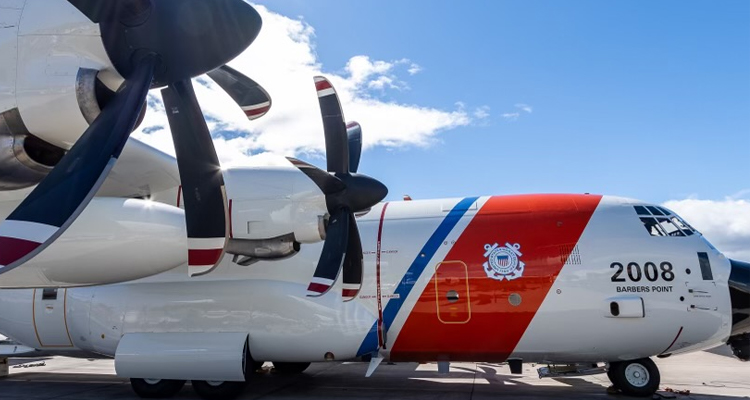
Coast Guard begins HC-130J operations at Air Station Barbers Point, Hawaii
June 17, 2021 —
CGNR 2008 arrives at Coast Guard Air Station Barbers Point, Hawaii, June 11, 2021. U.S. Coast Guard photo.
Coast Guard Air Station Barbers Point, Hawaii, received its first HC-130J Super Hercules long range surveillance aircraft June 11. The older HC-130Hs at the station are being replaced with the more capable Super Hercules aircraft; the current schedule has a fleet of four HC-130Js in Barbers Point by the end of summer 2022. Air Station Barbers Point will be the third of five air stations to transition to the Super Hercules.
The HC-130J features more advanced engines and propellers, which provide a 20% increase in speed and altitude and a 40% increase in range over the HC-130H Hercules. Another notable difference is the liquid oxygen system, which allows crews to fly at higher altitudes, providing a better vantage point for many missions. These aircraft have a modernized glass cockpit, the capability to execute GPS approaches, and are outfitted with the Minotaur Mission System Suite, which provides increased capabilities for use of the sensors, radar and intelligence-gathering equipment.
“These new capabilities of the HC-130J will be particularly helpful operating despite the tyranny of distance,” said Gerald Foreman, program manager of the HC-130J program. “The increased performance will improve range, on-scene time and airfield access to better execute long-range search and rescue, patrol and logistical support missions across the vast 12.2 million square miles of open ocean, atolls and island nations that comprise (Air Station Barbers Point’s) area of operations.”
The Coast Guard currently operates 13 HC-130Js as part of its long range surveillance aircraft fleet, with Coast Guard Air Stations Elizabeth City, North Carolina, and Kodiak, Alaska, fully converted. Two C-130Js are undergoing missionization with deliveries expected in September 2021 and June 2022. Three additional C-130Js are under contract, with delivery in 2023, 2024 and 2025. In addition to continued Minotaur missionization efforts on new aircraft, the service plans to complete the block 8.1 upgrade on all its HC-130J aircraft to maintain platform common configuration and meet modern airspace operations requirements.
The service’s fleet of HC-130Js is the Department of Homeland Security’s (DHS) largest airlift asset, carrying out many Coast Guard missions, including search and rescue, drug and migrant interdiction, cargo and personnel transport, and maritime stewardship as well as providing critical support to DHS partners. The aircraft also can serve as a command and control or surveillance platform capable of identifying and classifying objects and sharing that information with operational forces.
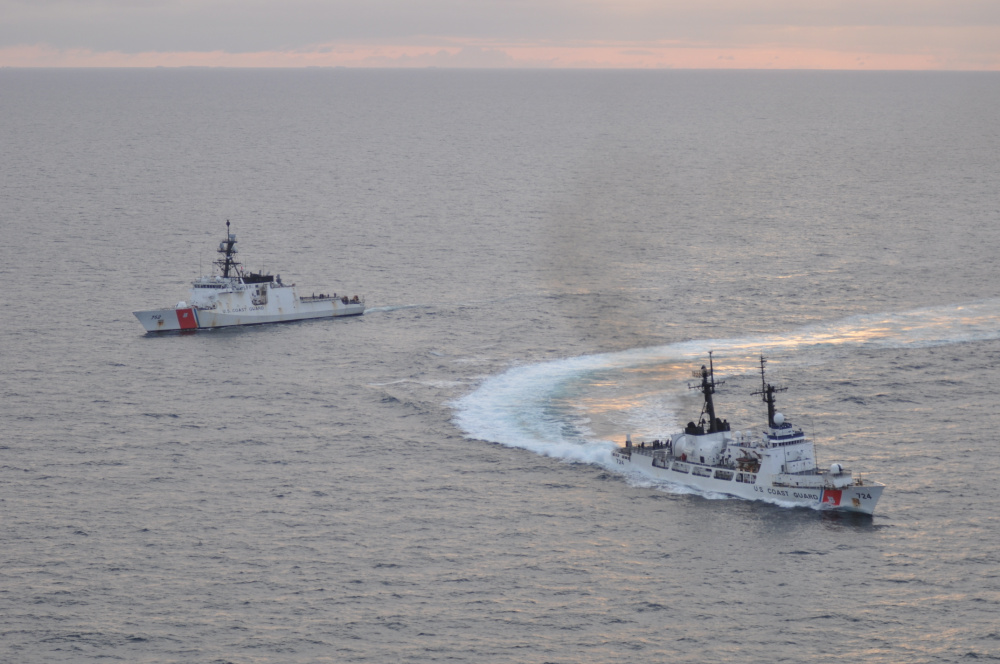
The Coast Guard Cutter Stratton’s (WMSL 752) crew relieves the crew of the Coast Guard Cutter Douglas Munro (WHEC 724) in the Bering Sea, March 12, 2021. The Douglas Munro was the Coast Guard’s last 378-foot high endurance cutter and was relieved by Stratton concluding their final patrol prior to being decommissioned April 24, 2021. U.S. Coast Guard photo.
The Congressional Research Service has again updated their report on Coast Guard cutter procurement. (The link will always take you to the most recent edition of the report.) I have reproduced the summary in full below. But first some comments.
Offshore Patrol Cutter:
From page 12–this could be a problem.
“On January 29, 2021, the Coast Guard released the RFP for the Stage 2 competition, with responses due by May 28, 2021. The Coast Guard plans to award the Stage 2 contract in the second quarter of FY2022. The contract is to be a Fixed Price Incentive Firm (FPIF) contract for detail design and construction of up to 11 OPCs, including Long Lead Time Materials (LLTM), as well as logistics, training, and life-cycle engineering. One observer stated on March 29, 2021, that,
“‘In the current 11-ship [Stage 2] proposal, the Coast Guard is giving interested shipyards an enormous amount of leeway to redesign the cutter’s innards, a tactic that, according to stakeholders, facilitates increased competition. Newly proposed ships must look generallythe same [as ESG’s OPC design] from the outside, but almost everything “under the hood”—outside of a few major components—can be changed, shifted or modified.‘”
Whether 2004 Program of Record Should Be Updated:
There is a considerable discussion of the need for a reexamination of the program of record, including a new “Fleet Mix Study” on pages 12-19.
It also appears we have failed to complete a report “…required by Section 8261 of the Elijah E. Cummings Coast Guard Authorization Act of 2020 (Division G of P.L. 116-283), which is due to Congress no later than 90 days after the date of enactment.” (p.19)
Budget Request History:
There are a couple of interesting tables of budget requests for PC&I funding. Table 1 looks at requests for funding ships. Table B-1 includes the full PC&I request. (Approved budgets were generally different.)
Table 1. Requested Funding in FY2013-FY2022 Budget Submissions (p.15)
Table B-1. Requested Funding in PC&I Account in FY2013-FY2022 Budgets (p.34)
Unwavering Support for Our Coast Guard Act (S. 1845):
The Senate has introduced a bill that would require a new Fleet Mix Study. (p.25/26)
The phase “Fleet Mix Analysis” is used no less than 22 times in this CRS report; the term “Fleet Mix” no less than 48 times. I think Congress wants us to do this. Hopefully DHS will not prevent publication.
Summary: (Below is the one page summary contained in the report–Chuck)
The Coast Guard’s program of record (POR), which dates to 2004, calls for procuring 8 National Security Cutters (NSCs), 25 Offshore Patrol Cutters (OPCs), and 58 Fast Response Cutters (FRCs) as replacements for 90 aging Coast Guard high-endurance cutters, medium-endurance cutters, and patrol craft. The Coast Guard’s proposed FY2022 budget requests a total of $695.0 million in procurement funding for the NSC, OPC, and FRC programs, including $597 million for the OPC program.
NSCs are the Coast Guard’s largest and most capable general-purpose cutters; they are replacing the Coast Guard’s 12 Hamilton-class high-endurance cutters. NSCs have an estimated average procurement cost of about $670 million per ship. Although the Coast Guard’s POR calls for procuring 8 NSCs to replace the 12 Hamilton-class cutters, Congress through FY2021 has fully funded 11 NSCs, including the 10th and 11th in FY2018. In FY2020, Congress provided $100.5 million for procurement of long lead time materials (LLTM) for a 12th NSC, so as to preserve the option of procuring a 12th NSC while the Coast Guard evaluates its future needs. The Coast Guard’s proposed FY2022 budget requests $78.0million in procurement funding for activities within the NSC program; this request does not include further funding for a 12th NSC. The Coast Guard’s proposed FY2022 budget also proposes rescinding $65.0 million of the $100.5 million in FY2020 funding for LLTM for a 12th NSC, “allowing the Coast Guard to focus investments on building, homeporting, and crewing Polar Security Cutters and Offshore Patrol Cutters.” The remaining $35.5 million appropriated in FY2020 for LLTM would be used to pay NSC program costs other than procuring LLTM for a 12th NSC. Nine NSCs have entered service; the ninth was commissioned into service on March 19, 2021.
OPCs are to be less expensive and in some respects less capable than NSCs; they are intended to replace the Coast Guard’s 29 aged medium-endurance cutters. Coast Guard officials describe the OPC and PSC programs as the service’s highest acquisition priorities. OPCs have an estimated average procurement cost of about $411 million per ship. The first OPC was funded in FY2018. The Coast Guard’s proposed FY2022 budget requests $597.0 million in procurement funding for the fourth OPC, LLTM for the fifth, and other program costs. On October 11, 2019, the Department of Homeland Security (DHS), of which the Coast Guard is a part, announced that DHS had granted extraordinary contractual relief to Eastern Shipbuilding Group (ESG) of Panama City, FL, the builder of the first four OPCs, under P.L. 85-804 as amended (50 U.S.C. 1431-1435), a law that authorizes certain federal agencies to provide certain types of extraordinary relief to contractors who are encountering difficulties in the performance of federal contracts or subcontracts relating to national defense. The Coast Guard is holding a full and open competition for a new contract to build OPCs 5 through 15. On January 29, 2021, the Coast Guard released a Request for Proposals (RFP) for this Stage 2 contract, as it is called. Responses to the RFP were due by May 28, 2021. The Coast Guard plans to award the Stage 2 contract in the second quarter of FY2022.
FRCs are considerably smaller and less expensive than OPCs; they are intended to replace the Coast Guard’s 49 aging Island-class patrol boats. FRCs have an estimated average procurement cost of about $65 million per boat. A total of 64 have been funded through FY2021, including four in FY2021. Six of the 64 are to be used by the Coast Guard in the Persian Gulf and are not counted against the 58-ship POR quantity for the program, which relates to domestic operations. Forty of the 64 have been commissioned into service, and others have been accepted by the Coast Guard and are awaiting commissioning. The Coast Guard’s proposed FY2022 budget requests $20.0 million in procurement funding for the FRC program; this request does not include funding for any additional FRCs
A very impressive, relatively cheap, long range, high endurance, unmanned air system. Its already a record breaker, having flown over five days and 7000 miles before landing with substantial fuel still on board.
This looks like it might be a candidate for the Coast Guard’s land based Maritime Domain Awareness (MDA) Unmanned Air System (UAS).
Defense News reports on the participation of the system in the Navy’s recent exercise focusing on unmanned systems.
“The drone is marketed as being capable of 10 days of flight with 30 pounds of internally stored payloads, or several days of flight with up to 150 pounds of internal and external payloads (three times the max take off weight of ScanEagle–Chuck) in a multimission heavy-lift mode. Those specifications well exceed both the endurance and the payload capacity of its peers in Group 3…” (DOD’s drone classifications here–Chuck.)



 Chuck Hill's CG Blog