Top Six Coast Guard Innovations of 2020

A quick video look from the Acquisitions Directorate (CG-9) at the “Top Six Coast Guard Innovations of 2020,” including, where can I take a leak?

A production focused around the winners of the U.S. Coast Guard 2020 Capt. Niels P. Thomsen Innovation Award at Coast Guard Headquarters, Washington DC, April 30. 2021. Six individuals or teams win the award annually for innovations that pushes the Coast Guard forward. (U.S. Coast Guard video by Petty Officer 2nd Class Ronald Hodges)

“USCGC Hamilton conducts exercises with Ukraine” –LANTAREA

Not unexpected. Here is the news release about Hamilton’s operations with the Ukrainian Navy.

U.S. Coast Guard Atlantic Area, news release

USCGC Hamilton conducts exercises with Ukraine

USCGC Hamilton conducts exercises with Ukraine
BLACK SEA — Ukrainian navy Island-class patrol boat Starobilsk (P 241) and the Ukrainian Sea Border vessel Kuropiatnikov (BG 50) maneuver in front of USCGC Hamilton (WMSL 753) after conducting communication, passing, and maneuvering exercises in the Black Sea, May 9, 2021. Hamilton is on a routine deployment in the U.S. Sixth Fleet area of operations in support of U.S. national interests and security in Europe and Africa. (U.S. Coast Guard photo by Petty Officer 3rd Class Sydney Phoenix)
USCGC Hamilton conducts exercises with Ukraine
BLACK SEA — Seaman Solis Headlam looks out to the Ukrainian navy Island-class patrol boat Starobilsk (P 241) aboard USCGC Hamilton (WMSL 753) after conducting communication, passing, and maneuvering exercises in the Black Sea, May 9, 2021. Hamilton is on a routine deployment in the U.S. Sixth Fleet area of operations in support of U.S. national interests and security in Europe and Africa.
(U.S. Coast Guard photo by Petty Officer 3rd Class Sydney Phoenix)

BLACK SEA — The Legend-class national security cutter USCGC Hamilton (WMSL 753) conducted a series of operational exercises with Ukraine, May 9, 2021, in the Black Sea.

Hamilton conducted maritime law enforcement, search and rescue, and ship handling operations with the Ukrainian navy vessel Island-class patrol boat Starobilsk (P 241). These operations were designed to increase interoperability as a part of a regional effort to bolster maritime partnerships with NATO partners.

“Hamilton was honored to conduct at-sea operations with the Ukrainian navy,” said Capt. Timothy Cronin, commanding officer of Hamilton, “Because we have shared interests, these events promote our strong partnership in ensuring safe and lawful activity in the Black Sea.”

The U.S. Coast Guard has a long and enduring partnership with regional maritime forces, particularly in strengthening maritime forces in Georgia and Ukraine. Hamilton conducted at sea engagements with the Georgian coast guard and a port visit in Batumi, Georgia, last week.

“This was a great opportunity to interact and share best practices with the Ukrainian navy,” said Petty Officer 2nd Class Jason Dunsavage, Hamilton crew member. “Both of our crews take pride in being professional mariners, and today, we proved that. We look forward to doing it again.”

Hamilton is the first U.S. Coast Guard cutter to visit the Black Sea since 2008. The last U.S. Coast Guard cutter to visit the Black Sea, USCGC Dallas (WHEC 716), sailed to the Black Sea twice, in 2008 and 1995.

Hamilton is the fourth national security cutter and is the fifth cutter named for the father of the U.S. Coast Guard – Alexander Hamilton, the first Secretary of the Treasury and advocate for the creation of the U.S. Revenue Cutter Service.

The U.S. Coast Guard remains operational during COVID-19, following all COVID-19 safety precautions and regulations.

The U.S. Coast Guard is conducting a routine deployment in the U.S. Sixth Fleet area of operations, working alongside NATO Allies and partners, building maritime domain awareness, and sharing best practices with partner nation navies and coast guards.

U.S. Sixth Fleet, headquartered in Naples, Italy, conducts the full spectrum of joint and naval operations, often in concert with allied and interagency partners, to advance U.S. national interests and security and stability in Europe and Africa.

USCGC Maui Fires Warning Shots

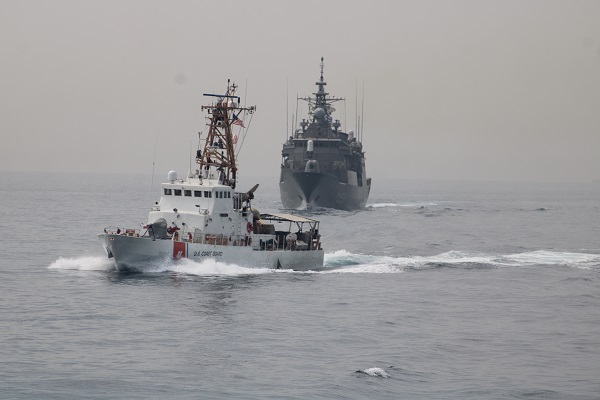
ARABIAN GULF (Feb. 25, 2021) The U.S. Coast Guard cutter USCGC Maui (WPB 1304) and the Greek navy guided-missile frigate HS Hydra (F452) participate in a passing exercise in the Arabian Gulf, Feb. 25, 2021. U.S. Coast Guard Patrol Forces Southwest Asia (PATFORSWA) is comprised of six 110-foot cutters, the Maritime Engagement Team, shore-side support personnel, and is the Coast Guard’s largest unit outside of the U.S. playing a key role in supporting Navy security cooperation, maritime security, and maritime infrastructure protection operations in the U.S. 5th Fleet area of operations. (U.S. Coast Guard photo)

The US Naval Institute news service reports that USCGC Maui twice fired warning shots totaling about 30 rounds of .50 caliber, first as two Iranian Revolutionary Guard boats out of a total of 13, closed to 300 yards and a second time as they continued to approach to about 150 yards.

Guided-missile cruiser USS Monterey (CG-61); patrol ships USS Thunderbolt (PC-12), USS Hurricane (PC-3) and USS Squall (PC-7), and Coast Guard patrol boats, USCGC Wrangell (WPB-1332) and USCGC Maui (WPB-1304) were escorting an Ohio-class guided-missile submarine USS Georgia (SSGN-729). USN helicopters were also overhead.

“The U.S. naval vessels were escorting Georgia as the submarine was transiting on the surface. Two Iranian vessels broke away from the larger group, transited to the opposite side of the U.S. formation, and approached Maui and Squall from behind at a rate of speed in excess of 32 knots with their weapons uncovered and manned,” 

USS Georgia was built as a ballistic missile submarine but was converted to carry cruise missiles and support special operations.

It seems likely that the composition of such escort groups will be more heavily weighted with Coast Guard patrol craft as the Navy decommissions their Cyclone class PCs, including the three that participated in this escort and as Webber class WPCs replace the Island class patrol boats like Maui and Wrangell.

“Coast Guard eyes expansion of Seattle waterfront base” –The Business Journals

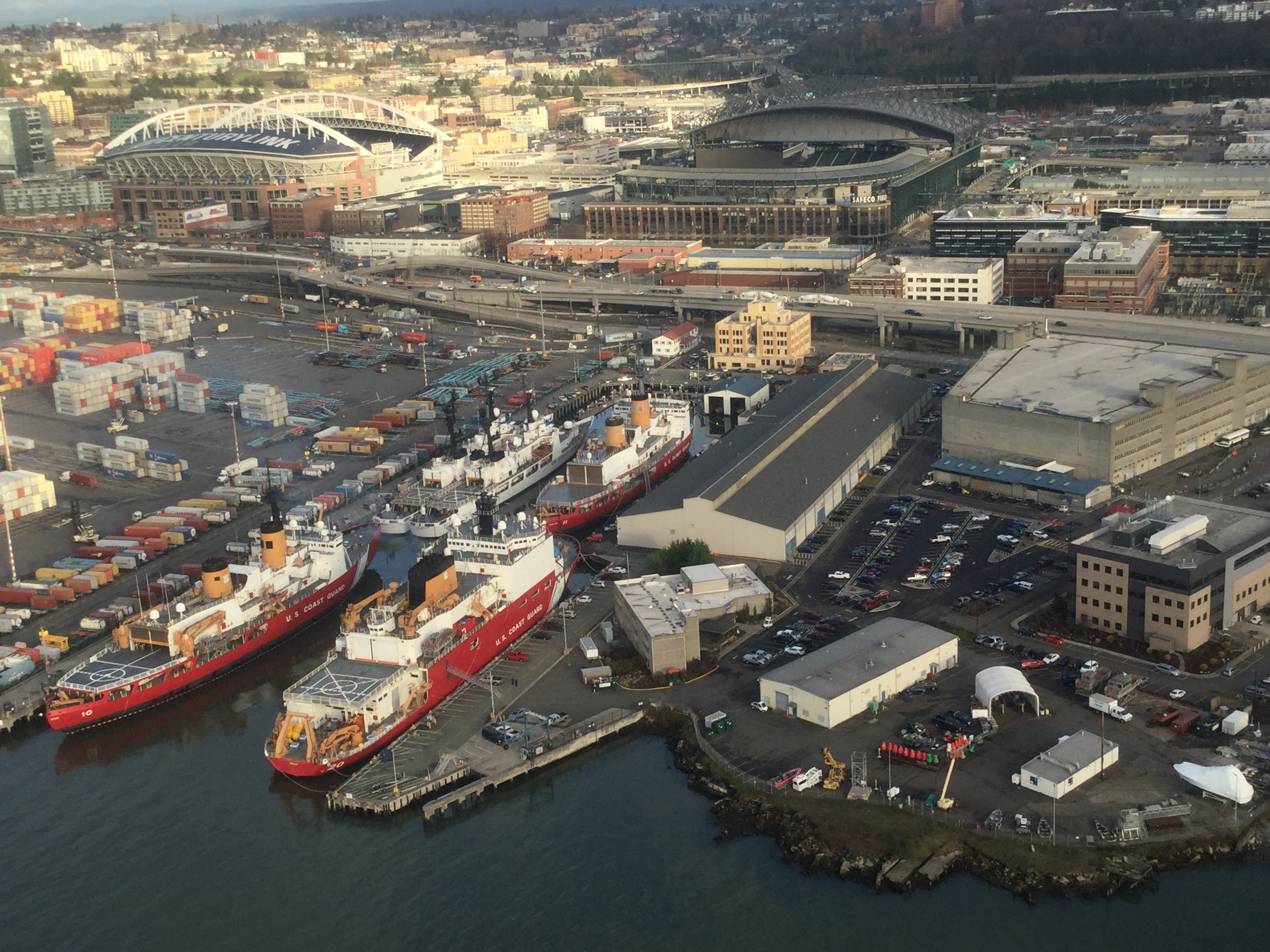
It appears, the Coast Guard intends to expand Base Seattle by 18 to 53 acres and will be adding at least a couple of new buildings and renovating others over the next ten years. There is a report by The Business Journals here. You can see the Federal Register announcement “Modernization of Coast Guard Base Seattle; Preparation of Programmatic Environmental Impact Statementhere, and you can get a better look at the three alternatives using the virtual displays here. It appears the Base will be getting at least two additional large berths.

In addition to basing the three currently planned Polar Security Cutters, the proposal refers to basing other cutters as well.

This suggests either the “Arctic Security Cutter” (medium icebreaker) and/or the Offshore Patrol Cutter. The OPC seems most likely, and we may see as many as three based in Seattle. If so, it probably means none in Port Angeles or Warrenton, OR. This would seem to follow the pattern of concentrating ships of a class together to facilitate support and maintenance.

Before the current round of recapitalization, beginning with the Bertholf class National Security Cutters, PACIFIC AREA had 13 large patrol cutters, 10 WHECs and three 210 foot WMECs. Three OPCs in Seattle, along with the two planned for Kodiak, two planned for San Pedro, and six NSCs in Alameda and Honolulu would restore that number.

Given the greater emphasis on the Western Pacific and Arctic, along with the fact that FRCs are performing missions that used to require WMECs, particularly in the 7th and 8th Districts, we might expect the number of large patrol cutters in the Pacific to increase, but the total number is now expected to shrink from 44 (or 42 depending on when you counted) to 36. Still 13 ships would only constitute just over one third of the total fleet. I would feel a lot more comfortable if we had three OPCs each in Kodiak, San Pedro, and Seattle, in addition to the six NSCs for a total of 15 large patrol cutters in PACAREA, and three ships of a class at a base makes good sense for the support point of view. .

Thanks to Mike for bringing this to my attention.

Something Different Here “Coast Guard Cutter Legare returns home after 50 day counter-narcotics deployment” –D5

Coast Guard Cutter Legare (WMEC 912) patrols in the Caribbean in April 2021. The cutter was deployed in support of Operation Unified Resolve/Martillo under the tactical control of Joint Interagency Task Force South (JIATF-S) and the Seventh Coast Guard District. (U.S. Coast Guard courtesy photo)

This would be a routine patrol except for this,

“While on patrol, the Legare provided surface support to Coast Guard MH-60 Jayhawk helicopters that were forward-deployed to Air Station Borinquen, which specialize in airborne interdiction tactics. With the combined efforts of JIATF-S and allied nation assets, the Legare disrupted over $23.5 million dollars in contraband while patrolling known smuggling routes south of the Dominican Republic.”

This may be in response to difficulties keeping H-65s operational. The 270s were always supposed to able to operate H-60s and the Coast Guard has recently added the tail fold feature to some H-60s that will make them easier to hangar. It is not clear if the MH-60 was hangared or if it even operated off Lagare.

Comments from those who may know would be welcomed.

“DHS and Coast Guard invite industry ideas to guide transportable mass rescue lifesaving device” –CG-9

Passing this along from the Acquisitions Directorate (CG-9).

DHS and Coast Guard invite industry ideas to guide transportable mass rescue lifesaving device

0PRINT  |  E-MAILMay 6, 2021 —


The Department of Homeland Security (DHS) Science and Technology Directorate (S&T) in collaboration with the Coast Guard Research and Development Center will hold a virtual industry day from 1-3 p.m. May 25 to support its Mass Rescue Operations (MRO) Lifesaving Device Broad Agency Announcement (BAA). Through the BAA, innovators, industry, academia and laboratories will be able to submit ideas for a large-capacity floating device to keep survivors out of the water during mass rescue operations. The May 25 industry day is being offered to socialize and refine MRO device concepts and facilitate collaboration with industry.

The Coast Guard is looking for an effective solution to provide short-term lifesaving and rescue assistance in the case of disasters that render existing systems such as onboard lifeboats inoperable or infeasible. To mitigate loss of life, the Coast Guard wants to develop a non-standard, one-time use, large-capacity, ultra-lightweight floating device that will be deployed from air or vessel during a mass rescue operation.

“The search and rescue mission has been at the forefront of the Coast Guard’s history for centuries,” said Monica Cisternelli, RDC project manager.  “As the years have passed we have successfully incorporated new technologies and capabilities to improve our ability to respond to those in distress, especially mass rescue operations. We also know that private industry and individual innovators continue to look at this issue and ways to respond to it.”

For example, if a large ferryboat or cruise ship is unexpectedly stranded or sinking, the ship’s crew may not be able to deploy the lifeboats. Coast Guard aircraft or vessels could respond and deploy mass rescue devices at the scene to better maintain passenger safety until all can be rescued. This device would not have to meet Safety of Life At Sea requirements since it is a single-use device.

 “The purpose of a large-capacity floating device is to solely keep survivors out of the water during an MRO,” said S&T program manager Angela Blair. “The commercial marketplace already has large flotation devices, but these are too heavy to be deployed from a USCG helicopter or easily lifted over a vessel’s bulwark for deployment.”

The Coast Guard Office of Search and Rescue says the service “is excited to work with industry to develop this cutting-edge, mission-critical lifesaving capability.”

Said Cisternelli:  “Industry day will provide a public forum for those organizations and people that have new ideas which we should consider. We owe it to the American people to be as ready as possible when the distress call is received or the emergency position indicating radio beacon is activated.”

To register for the virtual industry day, visit Mass Rescue Operations Lifesaving Device Broad Agency Announcement Industry Day on the S&T Events page. Visit the industry day announcement on beta.SAM.gov for more information about the “Mass Rescue Operations Lifesaving Device Broad Agency Announcement” requirement and details on submitting questions.

For information on Coast Guard R&D: Research, Development, Test and Evaluation program page and Research and Development Center page.

For information on DHS S&T opportunities: Work with S&T

Canada Announces They Will Be Building Two Polar Icebreakers –Press Release

Government of Canada announces Polar Icebreakers to enhance Canada’s Arctic presence and provide critical services to Canadians

From: Canadian Coast Guard

News release

May 6, 2021

Ottawa, ON – Canada has three oceans and the longest coastline in the world. Our nation’s blue economy depends on a strong Coast Guard fleet to keep mariners safe, protect our coasts and waterways, and deliver commercial goods and other vital services to Canadians.

The recent growth in commercial shipping, the serious impacts of climate change, and increased maritime activity in the Arctic have all highlighted Canada’s need for a renewed Coast Guard fleet.

Today the Minister of Fisheries, Oceans and the Canadian Coast Guard, the Honourable Bernadette Jordan, joined by the Quebec Lieutenant and Leader of the Government in the House of Commons, the Honourable Pablo Rodriguez, and the Minister of Environment and Climate Change the Honourable Jonathan Wilkinson, announced the Government of Canada will move forward with the construction of two Polar icebreakers under the National Shipbuilding Strategy (NSS).

Both new Polar icebreakers will have capacity and ability beyond that of Canada’s current largest icebreaker, the CCGS Louis S. St-Laurent, and will both be built by Canadian shipyards. Early estimates are that the construction of these ships will generate approximately 300 jobs per vessel at the shipyards, and 2,500 jobs across the marine supply chain. The construction of these new ships is in addition to the $17.49 billion in contracts already awarded to shipyards large and small across Canada under the NSS that have resulted in the revitalization of Canada’s shipbuilding industry, and the creation of thousands of jobs already.

Seaspan Shipyards in Vancouver, British Columbia, which has proven its shipbuilding capability with the completion of the first class of large vessels under the NSS, will build one of the Polar icebreakers. The other Polar icebreaker will be built by Davie Shipbuilding of Lévis, Quebec, pending the successful completion of the ongoing selection process as the third strategic partner for large ships construction under the NSS. Both shipyards are expected to be supported by many small and medium-sized Canadian businesses across the country, ensuring that the construction of these ships will be a historic, cross-country effort to help drive Canada’s economic recovery from COVID-19.

This procurement approach will ensure at least one polar icebreaker is delivered by 2030 when the CCGS Louis S. St-Laurent is expected to retire from service. Precise timing of icebreaker delivery will be determined once shipyard agreements are in place.

With their enhanced capabilities, these larger, more powerful Polar icebreakers will enable the Coast Guard to conduct year-round operations in Canada’s Arctic. Their greater endurance will ensure they can operate at higher latitudes for longer periods, and will allow the fleet to better support Indigenous Peoples and northerners, strengthen Arctic sovereignty, advance high Arctic science, and better respond to maritime emergencies. 

Today’s announcement represents a large step forward in ensuring the Canadian Coast Guard has the equipment it needs. It will also have a lasting impact on Canadian marine industry, its workers and their suppliers. Through their construction and service, the Polar icebreakers will contribute to growing Canada’s blue economy and create more opportunities in our coastal communities. They will strengthen our Coast Guard for the long-term, and ensure that maritime services and science platforms are available year-round in Arctic waters.

Quotes

“The new Polar icebreakers will be a game-changer for Canada’s marine industry–both in their construction and the difference that a stronger presence in the Arctic will make. Built by Canadian shipyards, these vessels will enable the coast guard to conduct critical science, supply and other missions in our Arctic region year-round. Under the National Ship Building Strategy, we’re putting thousands of Canadians to work building a fleet that will serve those communities for decades.”

The Honourable Bernadette Jordan, Minister of Fisheries, Oceans and the Canadian Coast Guard

“We are positioning Canada for the future by making investments today to build a more competitive economy. This includes investments to support the domestic construction of two new Polar icebreakers. The Industrial and Technological Benefits Policy will apply to these investments to strengthen Canada‘s shipbuilding industry and create good quality jobs for Canadians across the country.” 

The Honourable François-Philippe Champagne, Minister of Innovation, Science and Industry

“The know-how and expertise of shipyard workers in the Quebec City area is well established. By planning the order for a polar icebreaker, we confirm our confidence in them and support hundreds of jobs on site and throughout the supply chain in our regions. We are here to support the economic recovery and create good jobs for families in the national capital, in the Chaudière-Appalaches region, and in all regions of Quebec.“

The Honourable Pablo Rodriguez, Quebec Lieutenant and Leader of the Government in the House of Commons

“This is a good day for North Vancouver, for Vancouver, for British Columbia and it’s a good day for Canada. Two Polar icebreakers will give Canada a year-round presence in the Arctic to help protect mariners, safeguard our marine environments, ensure the safe and efficient movement of ships, and protect our borders. At the same time, we are continuing to build a thriving domestic shipbuilding industry, creating thousands of jobs and generating economic growth and prosperity in communities across British Columbia and Canada.”

The Honourable Jonathan Wilkinson, Minister of Environment and Climate Change

“Today’s announcement is further demonstration of the National Shipbuilding Strategy’s success in bringing together the Canadian marine industry to strengthen and renew our federal fleets. We are honoured to continue to support the delivery of modern, safe and effective vessels to members of the Canadian Coast Guard, which also creates jobs and supports our country’s shipbuilding industry. Thanks to the NSS, these ships will be built at home and support our communities from coast to coast to coast.”  

The Honourable Anita Anand, Minister of Public Services and Procurement

“This National Shipbuilding Strategy major investment marks an important step in renewing the Coast Guard’s fleet, and equipping our members with modern, safe and reliable ships so they can continue delivering critical services from coast to coast to coast. We look forward to the addition of two new Polar icebreakers to our fleet, which will extend the Coast Guard’s on-water Arctic operations all year long.”

Mario Pelletier, Commissioner for the Canadian Coast Guard 

“Five Reasons Why the Nation Should Keep Building the National Security Cutter” –Real Clear Defense

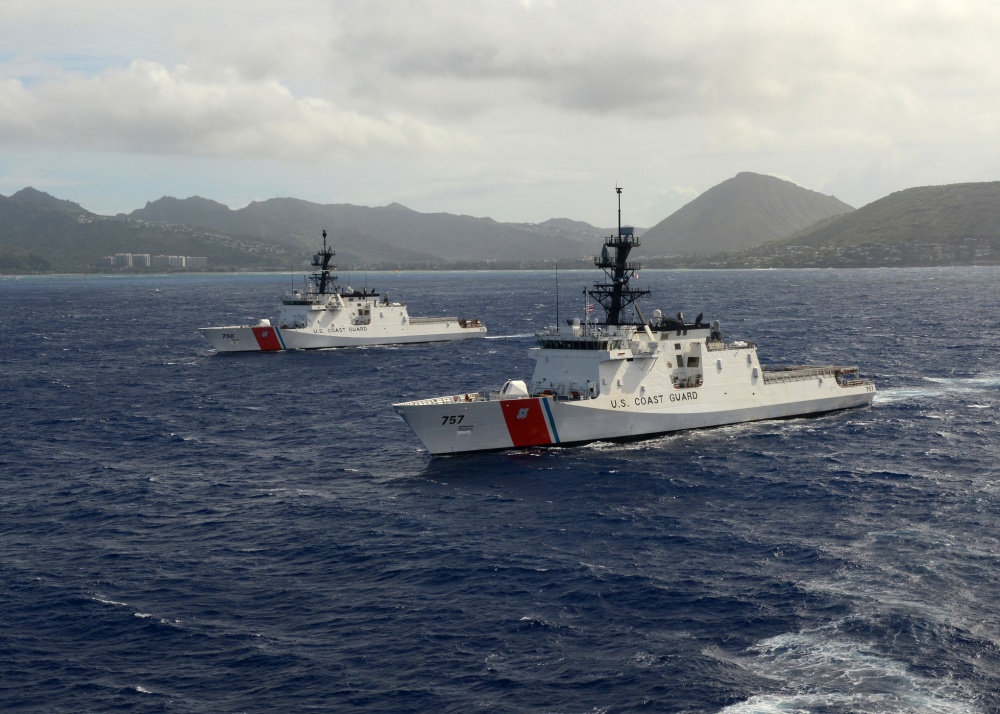
The crews of the Coast Guard Cutters Midgett (WMSL 757) and Kimball (WMSL 756) transit past Koko Head on Oahu, Hawaii, Aug. 16, 2019. The Kimball and Midgett are both homeported in Honolulu and two of the newest Coast Guard cutters to join the fleet. (U.S. Coast Guard photo by Petty Officer 3rd Class Matthew West/Released)

Real Clear Defense offers rationale for the continued construction of Bertholf class National Security Cutters.

Given the delay in starting the Offshore Patrol Cutter program, there is definitely reason to consider building NSC #12.

“The Fallacy of Presence” –USNI

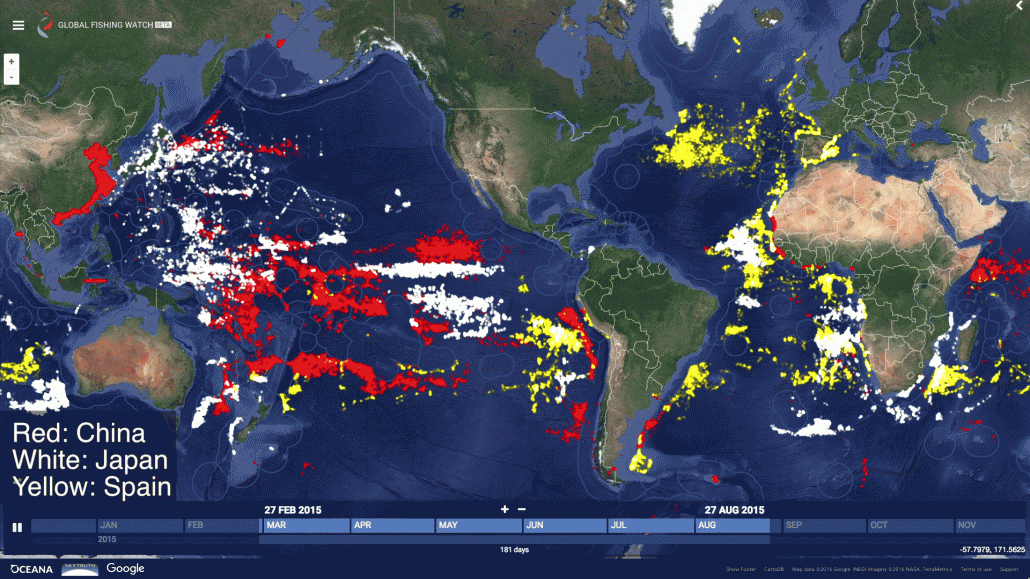
SkyTruth Fishing Watch. https://www.skytruth.org/mapping-global-fishing/

The US Naval Institute has selected an article by BMC Phillip Null, USCG as third place winner in their General Prize Essay Contest, “The Fallacy of Presence.”

(Always a good idea to consider the Chief’s opinion.)

The essay is currently a “featured article,” so I think it will be accessible to non-members, at least for a short time. The Chief explains the futility of simply being there, but having no authority to do anything about it.

The article particularly looks at the situation in the Gulf of Maine where a dispute between the US and Canada has resulted in the US Coast Guard essentially taking little or no action against Canadian or other foreign fishing vessels violating waters the US claims as part of its EEZ.

To me an immediate course of action seems obvious.

Take the Gulf of Maine dispute to the International Tribunal. Not only will this result in a resolution of the dispute, it will illustrate for the world that use of the International Tribunal is a proper course for intractable conflict resolution and that its decision should be respected.

Until the tribunal reaches a decision, the US and Canada should agree to continue to allow each others vessels to operate in the area

Meanwhile the US and Canada should agree to firmly enforce their laws against non-US and non-Canadian vessels operating in the area.

Enforcement outside EEZs: Ultimately the UN is going to have to manage fishing on the high seas, limiting it to sustainable levels, otherwise it seems illegal, unregulated, and unreported fishing is going to destroy an essential resource and result in massive food insecurity. How that is going to happen is clearly a long term diplomatic challenge.

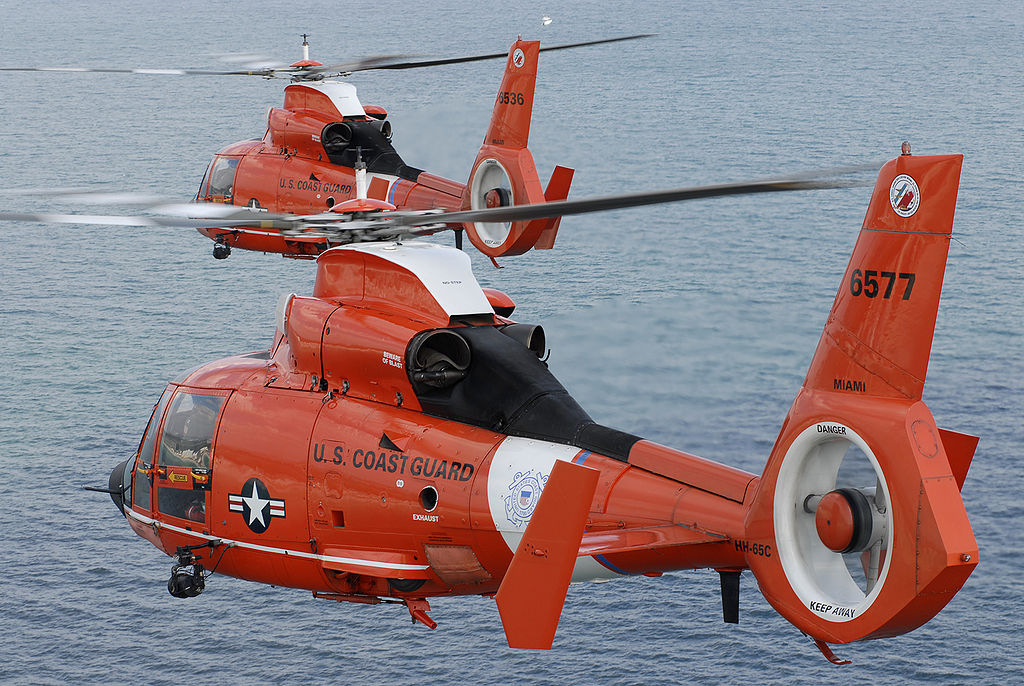
“Coast Guard Grounds Some Search-and-Rescue Helicopters As It Struggles to Find Spare Parts” –Military.Com

US Coast Guard photo, by PAC Dana Warr

Military.Com reports that,

“The Coast Guard’s short-range search-and-rescue helicopters are flying at 70% of their potential scheduled hours due to a parts shortage, a situation that could worsen as hurricane season approaches, the service’s top officer told Congress on Wednesday.

“Six Coast Guard MH-65 Dolphin helicopters are currently grounded, with four more expected to be out of circulation by June. That’s roughly 10% of the fleet, Commandant Adm. Karl Schultz told the House Appropriations Committee’s homeland security subcommittee April 28.”

The H-65s entered service with the Coast Guard 36 years ago. The Coast Guard is concurrently conducting both service life extension and electronic upgrades on the entire H-65 fleet. I had heard that a couple of airstations would transition from H-65s to H-60s, and that we would begin flying H-60s from cutters, but I was very surprised to see this,

“Schultz said the service must “take immediate action” to transition its entire rotary wing force over to MH-60 Jayhawk helicopters.”

While moving from H-65s to H-60s is something of an upgrade, a complete transition from H-65s to H-60s will be challenging and operating H-60s from 210s may be impossible.

There lots of Airbus 365 derived helicopters out there. Over a 1000 were sold to over 60 different customers. They are used by militaries and civilians all over the world. In 2015 it was announced that Korean Aerospace Industries would begin building new version with an upgraded gearbox. That program apparently resulted in their Light Civil Helicopter and Light Armed Helicopter.

I find it hard to believe we cannot find a source for replacement parts.

Thanks to Walter for bringing this to my attention.