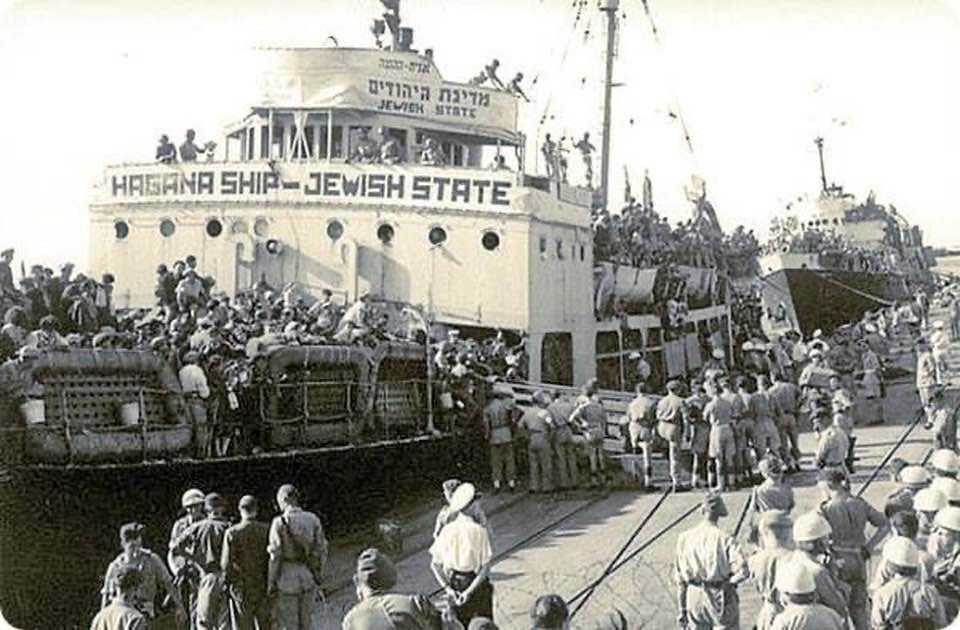
Former USCGC Northland as the Israeli refugee ship Medinat HaYehudim (Jewish State) impounded in Haifa, 1947.
An interesting bit of trivia. What US Coast Guard cutter became the first flagship of the Israeli Navy? Found the story in three Wikipedia entries: USCGC Northland (WPG-49) – Wikipedia, about the ship, Aliyah Bet – Wikipedia, about the attempts to land Jewish refugees on the shores of Palestine, and Israeli Navy – Wikipedia which provides the history of the Israeli Navy.
“Although sold for scrap 3 January 1947, Northland was renamed Jewish State (Medinat HaYehudim), and transported Jewish refugees to Palestine.“
“On 2 October 1947, the Medinat HaYehudim (2,664 passengers) was intercepted by the Royal Navy.‘ (It was then impounded in Haifa.)
(That they managed to get 2,664 passengers on a 217 foot long, 2,150 ton ship shows how desperate they must have been.)
“In 1948 she was renamed Eilat and became the flagship of the infant Israeli Navy. Later, the ship she became a training ship. In 1955, the ship was renamed Matzpen, serving as a barracks or depot hulk. The ship was scrapped in 1961.”
A nice description of one of the US Coast Guard’s partner agencies in the Caribbean. If the patrol boat in the picture above looks familiar, it is because these Damen Stan 4100 patrol vessels lead to the very popular Damen Stan 4207 patrol vessels, which lead to the Damen Stan 4708 which was the basis for the Webber class Fast Response Cutters.
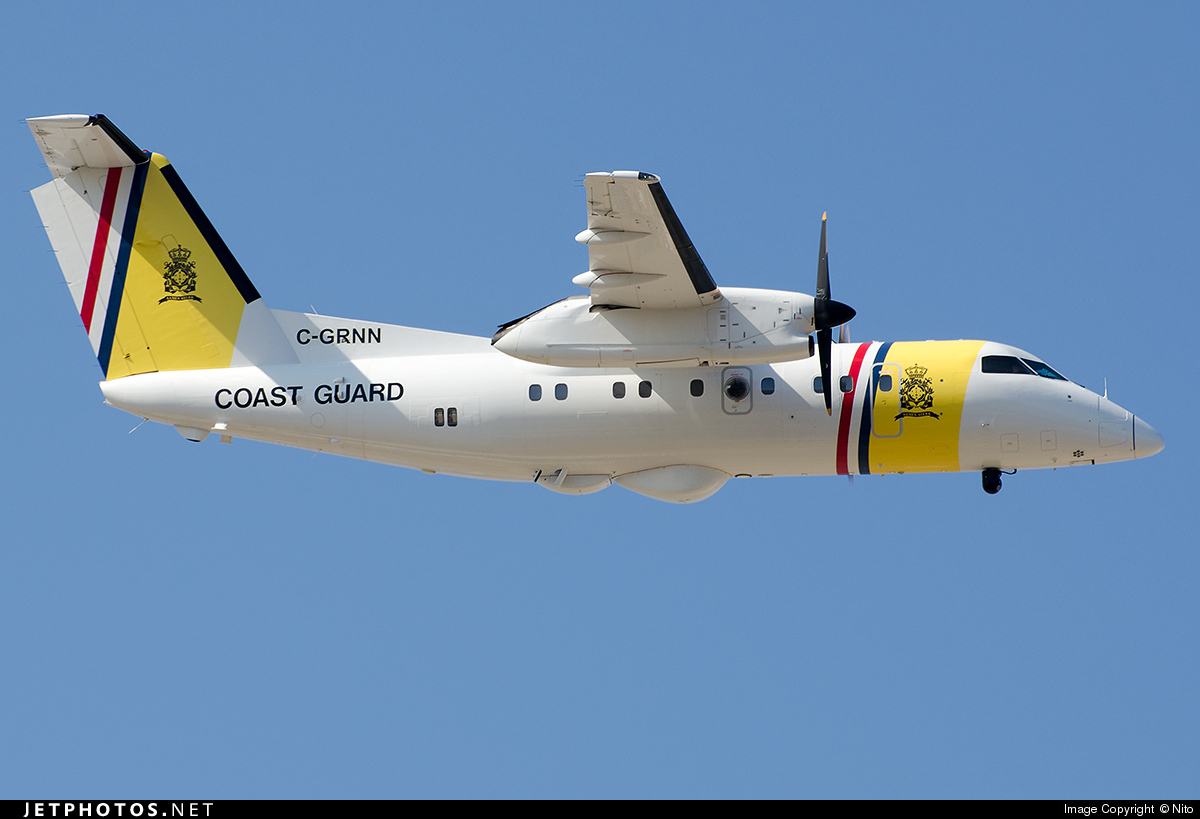
Back in 2015 there was a bit of a dust-up when Venezuela accused the US Coast Guard of violating their air space. Whether the plane actually violated Venezuelan airspace, the plane was almost certainly a Dutch Caribbean Coast Guard DASH-8 like the one pictured below.
Netherlands Antilles – Coast Guard (now Dutch Caribbean Coast Guard) Bombardier Dash 8-102. Sept. 7, 2014. Photo by Nito
I got a request today, from someone looking into the possibility that the Coast Guard may have flown “Hurricane Hunter” missions in the Western Pacific in the ’60s. Maybe a reader can help solve a mystery?
—
Hi Chuck
Hope you can help me.
I am an aviation writer, author & historian looking for US Coast Guard historical information, to confirm other historical information associated with the “USCG Western Pacific Logistic Support Air Group” at Barbers Point and specifically their detachment in Guam between 1960-66.
I made my original request to the Command PAO at 14th District (Hawaii) in January 2021. I rec’d a response directing me to the Pacific area Historian (Dr. Rosen) in early February 2021. I sent a immediate request to this historian with no Joy (and no response to date). I went back to the 14th Dist. PAO in March asking to be connected to someone else or other help with my request – with no response to date.
I‘m very frustrated that I can’t get anybody from the USCG Hawaii to respond to me. They all can be that busy (?)
Background to Request
I am writing a comprehensive book on the history of aircraft that have flown into tropical cyclones (hurricanes, typhoons and cyclones) for reconnaissance, surveillance and research purposes since before WWII to today.
I am currently drafting a sub-sub-section on typhoon reconnaissance in the 1960s, and then specifically about the period 1960-66 during the establishment and initial operations of the “Joint Typhoon Warning Center or JTWC” based in Guam at the time.
Not generally known is that that the JTWC was hit with a number of serious issues that hampered their typhoon forecasting mission right from the start. One of the major issues was the unavailability of dedicated typhoon reconnaissance aircraft. Given the lack of available TR aircraft, the JTWC sought and received approval to task (any) “other” US Gov Military aircraft within the Western Pacific to provide augmentation typhoon tracking support towards their typhoon forecasts and warnings. Thus, according to Navy, Air Force and JTWC typhoon tracking records, there were additional “other” aircraft occasionally utilized for the typhoon tracking mission.
It’s in this area where I suspect that US Coast Guard aircraft participated in tracking of typhoons for the JTWC.
Example: according to JTWC records; in 1965 a C-123 aircraft provided a typhoon radar tracking report to the JTWC during Typhoon Della (13-19 October 1965) on the 13th half way between Kwajalein and Wake Islands. The only C-123B in the Western Pacific were with the US Coast Guard.
Specifically the “USCG Western Pacific Logistic Support Air Group” detachment in Guam.
The USCG C-123Bs in Guam supported Western Pacific LORAN stations with logistical resupply. Their main area of LORAN resupply was within the area of the Trust Territories of Pacific Islands (TTPI) or what is now known as Micronesia.
With regards to the 1965 typhoon radar tracking report to the JTWC, this report’s position was right in the middle of the USCG C-123B’s operating area supporting LORAN stations.
Additionally; according to the USCG Western Pacific Logistic Support Air Group’s (online) mission statement;
“….the unit flew a variety of missions and carried a wider variety of cargo. In regard to the former, they engaged in search and rescue and law enforcement missions. After seismic events they flew earthquake assessment and tsunami warning patrols in addition to bringing supplies to stations that may have been disabled by such events. They also flew typhoon patrols and helped in the evacuation of those in the storms’ paths ….”
I’m particularly interested in the highlighted phrase “….They also flew typhoon patrols ….”
“typhoon patrols” is a WWII term for conducting “hunting” missions or flying synoptic weather patrols looking for low pressure fronts and areas of disturbed weather – that would develop into typhoons….. that would subsequently generate additional reconnaissance flights to track the storms, providing forecaster data to support storm forecasts and warnings.
The issue at hand here is that the US Coast Guard, historically, is not known for having “ever” conducted aerial typhoon reconnaissance or typhoon tracking missions.
SO – my request to the 14th District and the area Historian is; Did the USCG Western Pacific Logistic Support Air Group fly into Western Pacific typhoons
(1960s-70s) ?
If the WESTPAC USCG Air Group did, this is new historical information and needs reporting.
Do you have any direct contact with anybody that can help me ?
Do you know any members or organizations that encompass members of the USCG Western Pacific Logistic Support Air Group that served in the 1960s that can advise me ?
Naval News reports the delivery of, ARA Piedrabuena (P-52), the first of three new Offshore Patrol Vessels to the Argentine Navy.
“This delivery is part of the contract signed by Naval Group with Argentina in 2018 for the delivery of four multi-mission patrol vessels. A.R.A. Bouchard (former L’Adroit) was delivered last December, two months ahead of schedule.”
The video above discusses the progress of the program. These new ships are somewhat different from the former French ship L’Adroit, before its transfer to Argentina, in that they are ice-strengthened and somewhat better armed with a 30mm auto-cannon. A.R.A. Bouchard the former L’Adroit now carries the same weapon.
You might recall, that L’Adroit was used as an example of what we might achieve with a notional “Cutter X,” in that it is not much more complex than the Webber class Fast Response Cutters, but offers better seakeeping, longer range, two RHIBs, and a helicopter flight deck and hangar.
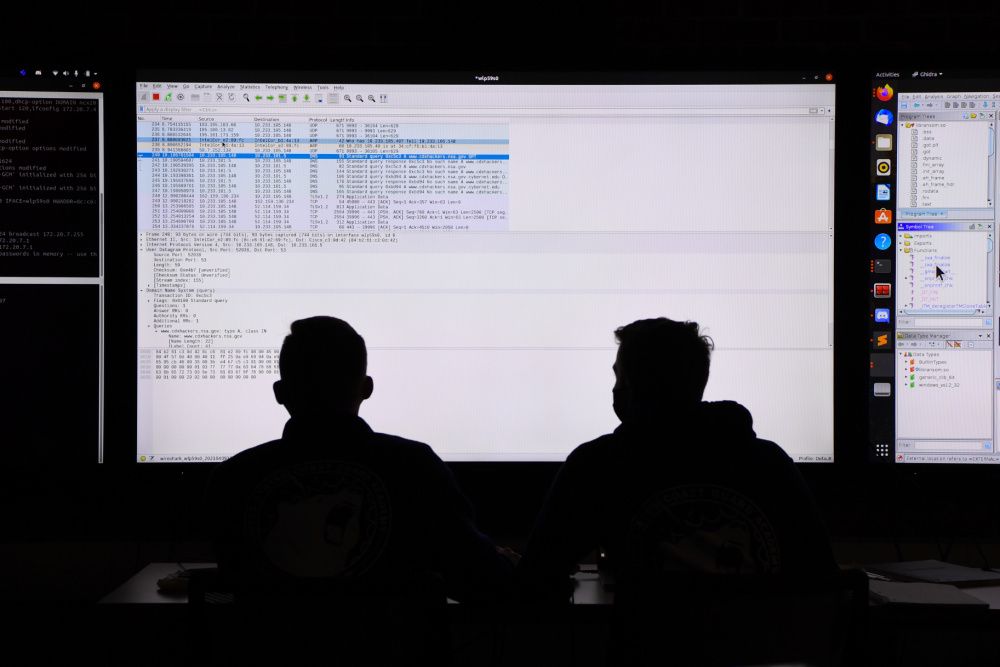
A team from the U.S. Coast Guard Academy participated in the National Security Agency’s 20th annual National Cyber Exercise (NCX), a three-day cyber competition that tests the offensive and defensive cybersecurity skills virtually, April 8-10, 2021. The Coast Guard Academy recently instituted a Cyber Systems degree to meet the needs of the services cyber security strategy of defending cyber space, enabling operations, and protecting infrastructure. (U.S. Coast Guard photo by Petty Officer 2nd Class Hunter Medley)
Below is a Coast Guard Academy news release. Almost titled this “Not your daddy’s Coast Guard.”
News Release U.S. Coast Guard Academy Contact: USCGA Public Affairs Office: (860) 444-8270 After Hours: (860) 857-5544 Academy online newsroom
Coast Guard Academy participates in 2021 NSA Cyber Exercise
NEW LONDON, Conn.– A team from the U.S. Coast Guard Academy participated in the National Security Agency’s 20th annual National Cyber Exercise (NCX), a cyber competition that tests offensive and defensive cybersecurity skills, held virtually April 8-10.
More than 200 women and men participated from U.S. Service Academies and Senior Military Colleges as well as civilian interns from NSA’s cyber-focused development programs in the three-day competition designed to develop and test cybersecurity skills.
During this year’s exercise, Coast Guard Academy cadets engaged with NSA personnel to execute and evaluate cyber mission strategies and complete cyber operation scenarios in real-time. Exercise scenarios included challenges that tested skills in forensics, cyber policy, cryptography, reverse engineering as well as attack-and-defend cyber exercise
.“The competition is an opportunity to build upon skills taught in academic classes such as cryptography, software reverse engineering, and digital forensics,” said Lt. Ryan Quarry, Cyber Systems instructor at the Coast Guard Academy. “Participating in NCX allows future cyber leaders of our service to stop malicious activity designed to disrupt, degrade, or destroy the nation’s critical maritime infrastructure.
”NCX demands that cadets exercise their training to operate effectively in teams as well as communicate and make decisions while evaluating complex technical data points.
Cyberattacks are invisible hazards that are capable of inflicting real physical damage. These threats target the infrastructure, information systems, networks, and personal devices we rely on every day.
The U.S. Coast Guard has a long-standing mission of protecting America’s maritime transportation system and critical infrastructure, as well as those who work on and live near the water. Cyberspace is an operational domain that integrates information and intelligence in support of Coast Guard operations.
The Coast Guard Academy recently instituted a Cyber Systems major to meet the needs of the service’s cybersecurity strategy of defending cyberspace, enabling operations, and protecting infrastructure. The major provides graduates with the computing skills and technical ability to meet the needs of the Coast Guard cyber mission.
Since 2001, the NSA has hosted the team-against-team competition that develops and tests teamwork, planning, communication and decision-making skills of the next generation of cyber talent.
More information about Coast Guard Cyber operations and missions can be found here.
Coast Guard awards contract for up to 20 OTH-IV boats and equipment
April 12, 2021 —
The Coast Guard today awarded a contract to Safe Boats International L.L.C. of Bremerton, Washington, for up to 20 over the horizon-IV (OTH-IV) cutter boats with supporting equipment. The fixed price contract has a total potential value of $8.8 million and includes an initial order for one OTH-IV and supporting equipment. This contract will enable the Coast Guard to meet equipment requirements for new cutters as the service prepares to transition to the OTH-V cutter boat platform.
OTH-IVs acquired through this contract will outfit new national security cutters (NSC), fast response cutters (FRC) and offshore patrol cutters (OPC) through April 2024. The new contract incorporates revisions to the navigation and communication systems to mitigate obsolescence concerns.
The Coast Guard has used OTH-IVs since 2013; it is the service’s standard cutter boat for missions that may extend 70 nautical miles from its parent craft. Two OTH-IVs are assigned to each NSC, one OTH-IV to each FRC, with OPCs capable of operating one to three OTH-IVs. OTH-IVs are 26 feet long and have a top speed of 40 knots. Compared to earlier generations, the OTH-IVs feature increased cargo space and seating, higher speeds and compatibility with both stern and side-davit launch and recovery systems.
Cutter boats deployed aboard cutters facilitate mission accomplishment in almost all mission areas, with emphasis in search and rescue, drug interdiction, alien migrant interdiction operations, living marine resources, defense readiness, and ports, waterway and coastal security.
C4IRSNET reports a new cooperative research agreement between the US, Canada, Denmark, Finland, Norway, Sweden and New Zealand.
“In November, the Pentagon signed a new memorandum of understanding for the International Cooperative Engagement Program for Polar Research effort. The ICE-PPR involves a group of seven nations that formalized efforts to cooperate on basic research projects and solve the “biggest challenges of safely operating in the extreme polar environment,” John Woods, deputy director of the International Engagement Office with the Office of Naval Research Global, told C4ISRNET.”
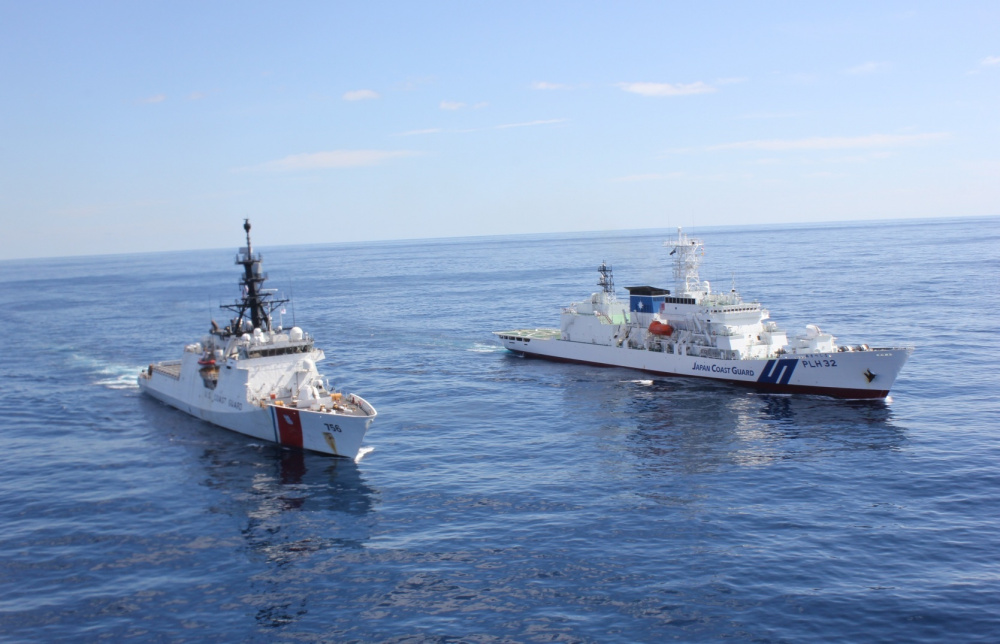
Ships from the U.S. Coast Guard and Japan Coast Guard conducted exercises near the Ogasawara Islands of Japan, Feb. 21, 2021. The U.S. Coast Guard Cutter Kimball and Japan Coast Guard Ship Akitsushima, two of the respective services’ newest and most capable vessels, operated alongside helicopters and unmanned aerial vehicles to practice interdicting foreign vessels operating illegally inside Japanese waters. (U.S. Coast Guard photo courtesy of the Coast Guard Cutter Kimball/Released)
Coast Guard Cutter Kimball returns home from expeditionary patrol in the Pacific
Editors’ Note: Click on images to download a high-resolution version.
HONOLULU — The crew of the Coast Guard Cutter Kimball (WMSL 756) returned to Honolulu Friday after completing an expeditionary patrol supporting Operation Blue Pacific, Op Rai Balang, and Op Aloha Shield in the Pacific.
During the 82 day patrol the cutter’s crew worked closely with partners and allied nations on numerous missions ranging from search and rescue to the prevention of illegal, unreported, and unregulated fishing (IUU) while promoting stability and security throughout the region.
“I’m tremendously proud of my crew’s exceptional performance, especially considering how their dedication and teamwork allowed them to overcome the many challenges associated with operating by ourselves for long periods of time in remote locations and the difficulties created by the global pandemic,” said Capt. Holly Harrison, the Kimball’s commanding officer. “They adapted and overcame every obstacle and challenge put in their way with ease, exactly what you’d expect from our phenomenal Coast Guardsmen and women.”
One of the main goals of the 20,000 nautical-mile patrol was to assist the United States’ partners in the region with combating IUU.
Throughout the deployment the cutter’s crew worked closely with the Pacific Islands Forum Fisheries Agency (FFA) during Op Rai Balang, a coordinated effort between partners in the region to combat IUU, while also enforcing Western and Central Fisheries Commission regulations on the high seas to protect the region’s fish stocks.
Fish stocks are a vital renewable resource for many nations in the Pacific. Because of the migratory nature of fish, efforts towards their conservation requires teamwork between the partner nations.
The multi-million-dollar IUU fishing industry represents a direct threat to the partners efforts to ensure these resources remain sustainable for years to come and throughout the patrol the crew of the Kimball worked with the governments of the Solomon Islands, Federated States of Micronesia, and Papau New Guinea to strengthen domain awareness and resource security within the nation’s economic exclusive zones.
During the patrol the crew queried 21 foreign fishing vessels, and boarded six generating vital information reports for the partners in their efforts to combat IUU.
“The National Security Cutters bring a capacity and capability into the Coast Guard which are truly game changing when it comes to curbing IUU in the Pacific,” said Rear Adm. Matthew Sibley, commander, Coast Guard 14th District. “Patrols such as the Kimball’s display these cutters ability to cover large swaths of the Pacific and support our partners in joint conservation efforts while contributing to the overall stability of the region.”
The Kimball is one of the Coast Guard’s newer 420-foot Legend-class National Security Cutter and boasts a wide array of modern capabilities helping the crew to complete their varied missions.
Throughout the patrol the crew utilized the cutter’s ability to deploy Unmanned Aircraft Systems (UAS) to collect observation reports on vessels of interest which were shared with Maritime Security Advisors and the FFA Regional Fisheries Surveillance Center.
The UAS was also utilized during both day and night searches for a missing mariner southwest of Guam displaying the versatility of the new technology and its potential in multiple types of missions.
Another key goal of the patrol was to increase interoperability between the Coast Guard and our partners in the region.
The Kimball’s crew participated in a number of exercises with partners in the region including training with a Royal Australian Navy Sea Dragon aircraft (Boeing P-8 Maritime Patrol Aircraft–Chuck) crew during the FFA Op Rai Balang, joint interdiction training with the Japan Coast Guard Ship Akitsushima, and an exercise with the USS Tulsa (LCS-16).
“Over the past 82-days, Kimball’s crew conducted joint operations with the Japanese Coast Guard, Royal Australian Navy, Pacific Islands Forum Fisheries Agency, and U.S. Navy.” said Harrison. “In each operation, we were thoroughly impressed with our partners’ professionalism, skill, and commitment to Oceania and regional security.”
MSN and Washington Examiner report on a new agreement between the US and Taiwanese Coast Guard. Despite the flashy headline the Coast Guard is not going to protect Taiwan from invasion by the PRC. It is really a lot more like the network of working arrangements we have with other countries, but China, of course, objected.
(With the help of Non-Governmental Organizations, we seem to be working toward an internationally shared system for tracking fishing activity and hopefully detecting Illegal, Unregulated, Unreported fishing that would benefit nations like Palau, one of the 15 nations that still recognize Taiwan.)
The Chinese have sought to isolate Taiwan in every way possible way so any kind of contact sets them off.
Meanwhile, China’s claim of sovereignty over most of the South China Sea has its routes in a claim made by the Nationalist Chinese government shortly after WWII, that Taiwan still supports. That puts them at odds with other nations including Japan.
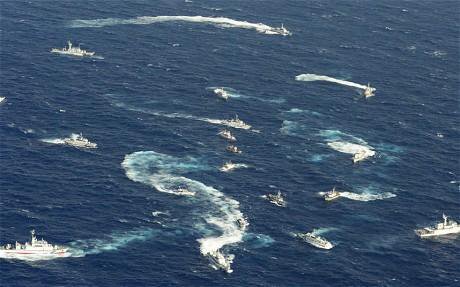
A water cannon battle between Taiwanese and Japanese Coast Guard vessels.
Royal Bahrain Naval Force fast attack craft RBNS Abdul Rahman Al-Fadel (P 22), Bahrain Coast Guard response boats Hawar 5 and Hawar 4, U.S. Navy guided-missile destroyer USS Mahan (DDG 72), patrol coastal ships USS Squall (PC 7) and USS Hurricane (PC 3), U.S. Coast Guard patrol boat USCGC Adak (WBP 1333) and two Mark VI patrol boats operate information during exercise Neon Defender in the Persian Gulf. (Picture source: US Navy)
Navy Recognition reports on a joint US/Bahrain exercise that included USCGC Adak and a Coast Guard Maritime Engagement team








 Chuck Hill's CG Blog