What Does It Take to Sink a Ship, another Illustration

We only have a limited sample of the effects of modern weapon systems, so I think they are worthy of consideration.

gCaptain has a report on the recent test launch of a Naval Strike Missile from LCS-4, USS Coronado, I would like to point out the video that shows the result of a hit by this type missile in an earlier test that is included in gCaptain’s report and posted above, and talk about not the damage that was done, but the damage that was not done.

The result, is shown on the video at time 0:55. The target of this earlier test was a decommissioned Norwegian Oslo class frigate. These are relatively small ships, 317 feet long and 2,100 tons full load, only a little larger than a Bear class cutter and considerably smaller than the average merchant ship.

The Naval Strike Missile has a 125 kG warhead, smaller than that of a Harpoon (just under 500 pounds), but still respectable. The explosion and the resulting smoke are impressive. The damage would almost certainly have caused a mission kill, wiping out critical command and control, sensor, and fire control systems.

On the other hand, it appears the hull is largely intact. In fact, the target did not sink, it was subsequently towed back into port. I have observed that sea-skimming anti-ship cruise missiles always seem to strike about 20 feet or more above the waterline. This may be necessary to ensure they do not strike waves as they make their final approach, but it also seems to limit hull damage. This kind of hit might not have damaged the propulsion or steering gear, particularly on a larger ship.

If the Coast Guard is required to stop a medium to large ship, bent on doing some mischief, I don’t think even a cruise missile like NSM, could assure immobilization of the threat.

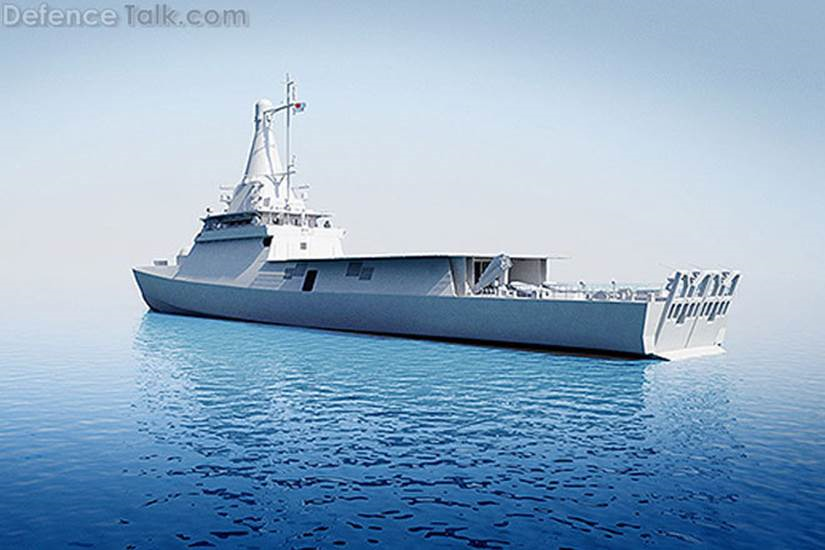
Singapore Builds “Cutter X”

SingaporeLittoralMissionVesselPortBow

Singapore is building a new class of patrol vessels that look very much like my proposal for “Cutter X”, trading some Webber class and some larger ships for an intermediate design, costing about half what an OPC would cost, basically putting the equipment and crew (with some augmentation) of a Webber Class into a larger more seaworthy hull, to allow them to be used for extended operation in environments that do not require the ice strengthened hull and ability to launch and recover helicopters and boats in sea state five provided by the OPC.

Singapore is building eight of the ships under the project name “Littoral Missions Vessel” to replace eleven smaller, 500 ton, Fearless class patrol vessels that are approaching 20 years old. These ships are reportedly 80 meters in length (262.5 feet), displace 1200 tons (probably a light displacement), have a beam of 12 meters (39.4 feet), a range of 5,000 nautical miles at 15 knots, and a speed of 27 knots, all with a crew of only 30, though they do include additional accommodations for 30 more. (more here)

SingaporeLittoralMissionVesselPortQuarter

It appears these ships will use the same engines as the Webber Class. It is not clear how many of these engines they are using. Two would give them almost 12,000 HP which would almost certainly be good for at least 24 knots, but it might require three or four engines to make 27 knots.  (reports now indicate the class has two engines totallin about 12,000 HP)

In some respects these ships are more capable than the proposed cutter, in that they will have a 76mm gun and firecontrol system, in addition to smaller remotely operated weapons. It also appears to have space reserved for a small AAW missile system. On the other hand, while the flight deck can handle an H-60, the ship, unlike the French L’Adroit which was my model for “cutter X”, has no helicopter hangar, although it might be possible to add one using the same solution employed on L’Adroit (putting it under the bridge).

Soon, I expect to do an update of the “Cutter X” proposal, based on where we are now in the cutter recapitalization program.

30mm Better Than 57mm?

The MK46 Mod 1 weapon system fires a round during a live-fire qualification exercise aboard the amphibious transport dock ship USS New Orleans (LPD-18). US NAvy Photo

The MK46 Mod 1 weapon system fires a round during a live-fire qualification exercise aboard the amphibious transport dock ship USS New Orleans (LPD-18). US NAvy Photo

The Navy has apparently made a decision I find incomprehensible. They have decided to alter the DDG-1000 design, replacing the two 57mm Mk110 mounts (the same gun on the Bertholf class and projected for the OPC) with two 30mm Mk 46.

According to the US Naval Institute News,

“The Navy has replaced two 57mm guns planned on the Zumwalt-class guided missile destroyer designed to fight off swarm boat attacks with a smaller pair of 30mm guns, Naval Sea Systems Command (NAVSEA) told USNI News on Monday.”

and later,

“A follow on 2012 assessment using the latest gun and munition effectiveness information, concluded that the MK46 was more effective than the MK110 CIGS. Based on that assessment, approval was received to change from the MK 110 CIGS to the MK 46 Gun System. In addition to the increased capability, the change from MK110 to MK46 resulted in reduction in weight and significant cost avoidance, while still meeting requirements. DDG 1000 is planned to have two medium range MK46, 30mm Close-in Gun Systems that will provide a robust rapid fire capability and increased lethality against hostile surface targets approaching the ship.”

The Mk 46 mount uses the Mk44 30mm chain gun that is derived from the same 25mm chain gun used in the Mk38 mounts. It looks like a small tank turret, but I understand it is not armored. It can be remotely controlled or manned by an on mount operator.

Comparing the two weapons,

Range of the 57mm is four or five times the range of the 30mm.
Projectile weight of the 57mm is about six times that of the 30mm.
Rate of fire is similar, 220 for the 57mm and 200 to 250 for the 30mm.

The only advantage I see for the 30mm is that it has more ready ammunition on the mount (not sure how much but apparently at least twice the number of rounds meaning it should be able to fire twice as long without reloading).

CIMSEC–Narco Subs

CIMSEC continues their series on “non-navies” with “Narco-Submarines: Drug Cartels’ Innovative Technology,” by Byron Ramirez. It provides an overview of the state of narco-sub development, employment, and countermeasures. It also announces the imminent publication of an unclassified study, “Narco-Submarines – Specially Fabricated Vessels Used For Drug Smuggling Purposes,” to be released by the Foreign Military Studies Office (FMSO).

Guided Weapons–Getting Closer?

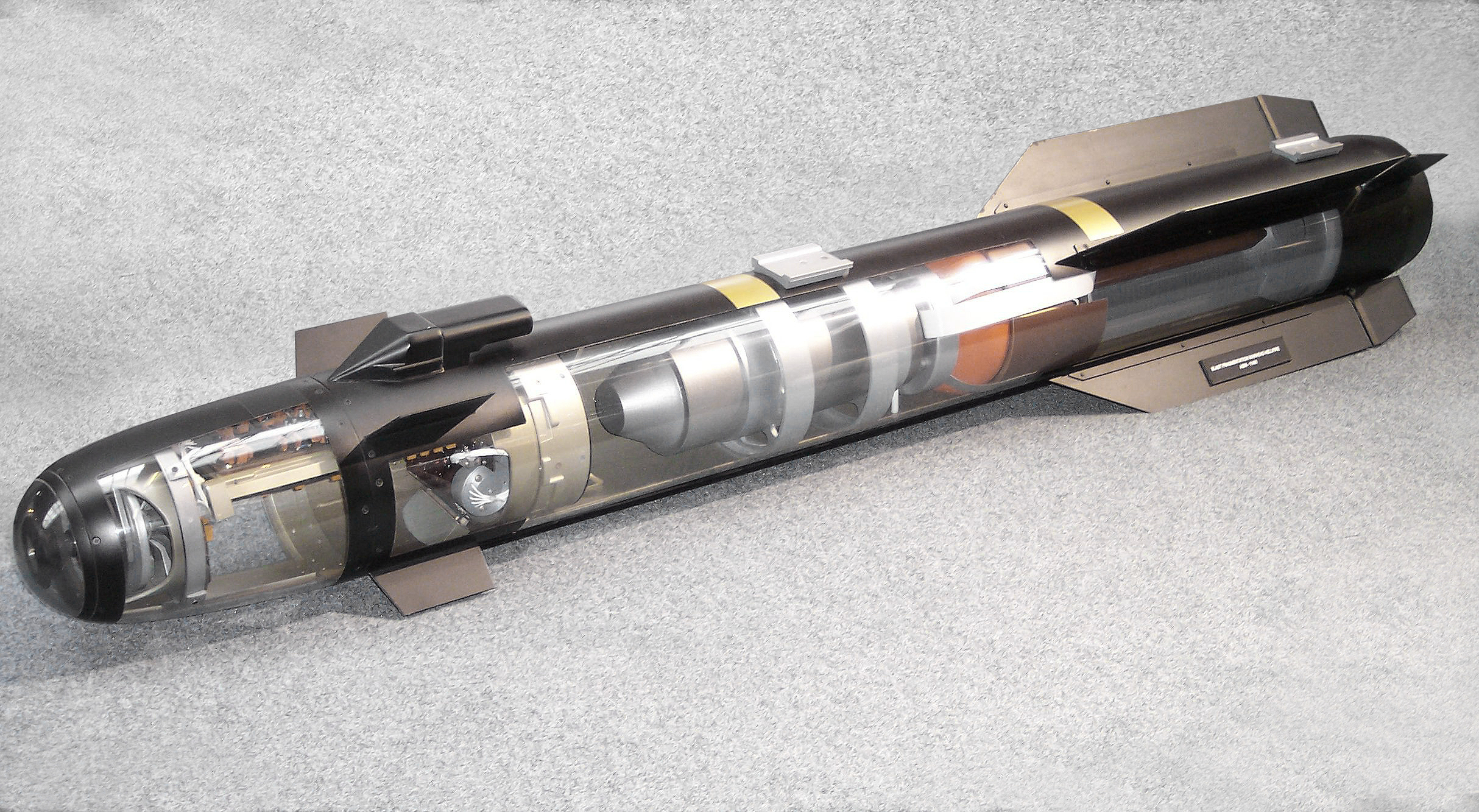
Lockheed Martin animation of Hellfire employment from an LCS

It looks like the Navy is beginning to field some weapons that are appropriate for the Coast Guard’s mission of preventing maritime terrorist attacks while addressing concerns that using weapons in US ports may cause collateral damage.

We talked about this concern recently.

I have always felt this mission had to devolve onto the smaller vessels, because the larger cutters don’t spend much underway time around US ports and when they are in port they usually cannot be gotten underway quickly. For this reason the WPCs need to be able to perform the mission.

Navy Recognition has news of progress on two of these systems, Dual Mode Hellfire and Dual Mode Brimstone.

The Longbow Hellfire is already present in the US inventory in large numbers and is being adopted for the LCS anti-surface module. The Brimstone is very similar in size, warhead, and range (about 8,000 yards), but has the advantage of a datalink that allows a “man-in-the-loop” which I think is desirable. Unfortunately, so far the USN is only looking at Brimstone as an air-launched weapon.

Test of Brimstone against two 40 foot maneuvering targets, discriminating between the targets and similar sized craft

Test of the Griffin. (Note limited damage)

A third system, SeaGriffin has a smaller footprint and warhead and has had a shorter range (only 43″ long, weighing 33 pounds, with a 13 pound warhead, surface to surface range of 5,500 meters), but it appears that the latest version may have a longer range, than either Hellfire or Brimstone, perhaps up to 18,000 yards (assuming they have, as reported, triple the previous range). The latest version of SeaGriffin does have a man-in-the-loop capability. Griffin is already being deployed on US Navy Cyclone class PCs. There are lots of photos showing the relatively small size of this system here.

I have never expected that extreme range was an important consideration for Coast Guard weapons, but for the anti-terrorism mission (or enforcing a blockade in wartime), we probably need the ability to engage from outside 4,000 yards (beyond the effective range of the 25mm Mk 38), because inside that range, there are a number of systems that might be added to a ship that could have a good probability of quickly disabling our vessels.

I still believe none of these weapons is capable of quickly and reliably stopping a medium sized ship or anything larger. For that I think we still need at least a light weight torpedo, but these weapons would significantly improve the chances against vessels of any size and particularly against small high speed maneuvering targets. Equipped with these, a Webber class cutter could be better able to fulfill this mission than a National Security Cutter with its 57mm guns.

Precision Machine Guns?

DefenseTech is reporting that the Coast Guard is looking for means of making its general purpose machine guns into precision weapons, so that if they have to use the weapons, the possibility of collateral damage can be minimized.

“The Coast Guard wants to make its deck-mounted machine guns accurate enough for crowded American harbors.

“To do that, Coast Guard gunners need a weapon mount that’s stable enough to turn an M240 machine gun – a weapon designed to kill area targets on the battlefield – into a precision tool capable of putting every round on target.”

Gratifying to see that the Coast Guard is thinking though how situations might develop where they will need to use deadly force in situations where there is a danger of collateral damage. Its easy to understand that using a machinegun on an unstabilized mount on a boat that is bouncing around might endanger the local population as well as the intended target.

The Navy may have already selected a stabilized machine gun mount: http://www.kongsberg.com/en/kps/news/2013/september/the-sea-protector-mk50-supporting-the-us-navy/

More here: http://en.wikipedia.org/wiki/Protector_(RWS)

But even that may be too large for some of our smaller boats.

There are smaller alternatives. Thanks to RStoner for bringing this option to my attention:

Looks like this might have trouble accurately firing bursts, but apparently it could accurately fire single shots and give boats some of the disabling fire accuracy of the airborne use of force units without the extensive training.

Still I hope the Coast Guard will look beyond simply making a more accurate machine gun. Any gun is likely to have a percentage of its rounds go astray, possibly endangering the innocent.

Perhaps the Coast Guard should continue this train of thought, applying the same concern on a larger scale. After all, we may need to stop much larger vessels inside US internal waters. Shooting 25mm or even 57mm inside Puget Sound or Chesapeake Bay is a poor option, but given the way cutters are currently equipped, it may be the only option available and ultimately they may be ineffective even for small targets.

Looking at true precision weapons, there are a whole range of options:

Griffin can be used for relatively small targets, here and here.

For larger targets Longbow Hellfire is already in the US Navy inventory or perhaps the largely American made BAE Brimstone/Sea Spear which appears to offer even more target selectivity.

Once the target gets larger than about 1000 tons it is going to be very difficult to stop. As noted earlier I think the answer to this problem is a light weight torpedo that can target a ship’s propellers.

Frankly I doubt we will have a major cutter (WMSL/WHEC/WMSM/WMEC) in the area if the Coast Guard ever suddenly finds itself needing to stop a maritime terrorist threat. They do not hang around US ports when they are underway, and when they are in port, they take too long to go from cold iron to underway. If this ever happens the largest Coast Guard vessel likely to respond is a Webber Class WPC. They are large enough to mount weapons capable of stopping even the largest ship. They really need to be properly equipped for the possibility.

Related:

Why Arm Coast Guard Assets?

New Light Weight Launcher

Warship Tour–Frigate Normandie

NavyRecognition has a video tour of the newly constructed French Frigate European Multi-Mission (FREMM) NORMANDIE. This is a relatively large frigate, a third again larger than the BERTHOLF class. It uses a single LM2500 gas turbine for high speed and electric motors for cruise up to 15 knots.


Early in the video you can see that the foc’sle deck looks very clear, no ground tackle or bollards, and no handrails. Frankly, it looks dangerous to walk around up there except in the most favorable conditions. At time 3:26 you see the foc’sle below the deck where these the fittings are located.

At time 5:06 you see the Combined Active and Passive Towed Array Sonar (CAPTAS)4. This system is being evaluated for the ASW module for the Littoral Combat Ship, and if we revived an ASW capability in the Coast Guard, it is likely this would be the sensor system used. There is a similar but smaller CAPTAS 2 by the same manufacturer.

At minute 5:55 you will see the MU-90 torpedo in the hangar and at minute 6:00 the surface vessel torpedo tubes that also launch the same torpedo. the MU-90 unlike US light weight ASW torpedoes (at least last I knew) has an anti-surface capability. I think is desirable.

At minute 6:58 you see the NATO frigate helicopter, NFH-90, a helicopter in the same class as the H-60 but with the advantages, relative to the existing shipboard versions of the H-60, of a cargo ramp in the rear and a shorter overall length without the complication of a folding tail.

Enhancing the Integration of USCG w/ USMC and USN–SLD

Second Line of Defense has an editorial “Enhancing the Integration of the USCG with the USMC and the USN: Synergy and Mission Effectiveness as Key 21st Century Efforts,” advocating a more “naval” Coast Guard. In particular, it supports the building of more large ships that might be used as adjuncts to the Navy/Marine Corps Amphibious Ready Group/Marine Expiditionary Unit (ARG-MEU) teams.

It also raises the question, can the MV-22 Osprey land and take off from our ships so that they might act as “lily pads.”

Another Weapon Option, Longbow Hellfire

File:Lockheed Martin Longbow Hellfire.jpg

Photo credit: Wikipedia, Stahlkocher, Lockheed Martin Longbow Hellfire.

The US Navy is looking at weapons to arm the Littoral Combat Ships (LCS) for operations against swarming small craft. These weapons will be relatively small and low cost, so they are potentially applicable to Coast Guard vessels as small WPBs. The first system selected was the Griffin, but while it may be improved, it currently has only a very short range.

Earlier, we talked about one of the contenders, the Brimstone, also called the Sea Spear. Another contender has surfaced, including both a missile and a firecontrol system that is already in the US inventory, the LONGBOW system employing the fire-and-forget LONGBOW HELLFIRE AGM-114L missiles. This missile is similar in size to the Brimstone, and like the Brimstone has a millimeter wave guidance, fire and forget capability.

Unlike the Brimstone, there is no claim of a man-in-the-loop capability, which would appear to be a desirable feature, particularly for the Coast Guard, where the target may be surrounded by innocent vessels that we would want to avoid targeting. On the other hand the vertical launch capability does appear to offer some packaging advantages. Lockheed claims “…Nearly 400 radars and more than 14,000 missiles have been contracted for the U.S. Army and international customers” so it is already an established product line with advantages in economy of scale. These systems are currently mounted on Attack Helicopters, so we can be assured that the weight and space requirements are not too demanding for installation on even relatively small craft.

NavyRecognition reports that the Army, Navy, and Lockheed Martin has demonstrated that these missiles can be vertically launched from a 65 foot Navy boat simulating a section of an LCS. The Navy may also want to fit this, or whatever system is ultimately chosen, to their new patrol boat.

Specifications for the AGM-114L Longbow Hellfire from Wikipedia:

  • Range: 8,000 m (8,749 yd)
  • Guidance: Fire and forget Millimeter wave radar seeker coupled with Inertial guidance, homing capability in adverse weather and the presence of battlefield obscurants
  • Warhead: 9 kg (20 lb) tandem shaped charge high explosive anti-tank (HEAT)
  • Length: 176 cm (69.2 in)
  • Weight: 49 kg (108 lb)

Here is Lockeed Martin’s description:

The LONGBOW system is built by a Joint Venture of Lockheed Martin and Northrop Grumman. U.S. Army testing shows integrated capabilities enhance the Apache lethality fourfold and survivability sevenfold. The mission equipment package is in production for the U.S. and several international customers. The Apache LONGBOW system is a proven force multiplier that has been battle-proven in Operation Enduring Freedom and Operation Iraqi Freedom. The LONGBOW Weapon System has been in full-rate production since 1996, with First Unit Equipped in 1998. Nearly 400 radars and more than 14,000 missiles have been contracted for the U.S. Army and international customers. For the Apache Block III upgrade, a new Radar Electronics Unit (REU) will replace two line-replaceable units. The REU will provide growth capabilities to the LONGBOW FCR and will reduce maintenance cost.

LONGBOW FCR
The LONGBOW FCR has a very low probability of intercept. It rapidly and automatically searches, detects, locates, classifies, and prioritizes multiple moving and stationary targets on land, water and in the air in all weather and battlefield conditions from standoff ranges. Target coordinates are automatically available to other sensors and weapons for target confirmation, rapid engagement, and reduced fratricide. Target data is digitally available through the data modem for real-time transfer to other platforms and command posts. The self-contained Radar Frequency Interferometer provides rapid and accurate identification and azimuth to enemy air defense units. High system reliability and two-level maintenance maximize operational availability and reduce support costs.

LONGBOW HELLFIRE Missile
The LONGBOW system employs fire-and-forget LONGBOW HELLFIRE AGM-114L missiles that can be launched from defilade, increasing battlefield survivability. The LONGBOW HELLFIRE missile locks on targets before or after launch and has been used in Operation Enduring Freedom and Operation Iraqi Freedom.

The M299 Smart Launcher has a fully digital interface to the Apache helicopter and fires all types of HELLFIRE missile.

Another Successful Laser Test

Business Insider reports another successful test of a laser weapon. This time by the Army from a truck mounted system. Nothing here about how the system recognized the incoming threat but apparently good enough for taking out inbound mortar rounds and UAVs,

Why do we care–

  • Makes the magazine essentially infinitely deep.
  • Don’t have to keep explosives on board that constitute a hazard of secondary explosion.
  • Maybe turn the power down when you need a non-lethal weapon.

Contrary to the report I don’t see the project’s seventh year, 2013 fiscal year $12.4 million budget as staggering. Don’t think this author has not covered a lot of DOD projects.