The U.N. human rights chief said Friday that U.S. military strikes against boats in the Caribbean Sea and eastern Pacific Ocean allegedly carrying illegal drugs from South America are “unacceptable” and must stop.
The U.N. High Commissioner for Human Rights Volker Türk called for an investigation into the strikes, in what appeared to mark the first such condemnation of its kind from a United Nations organization.
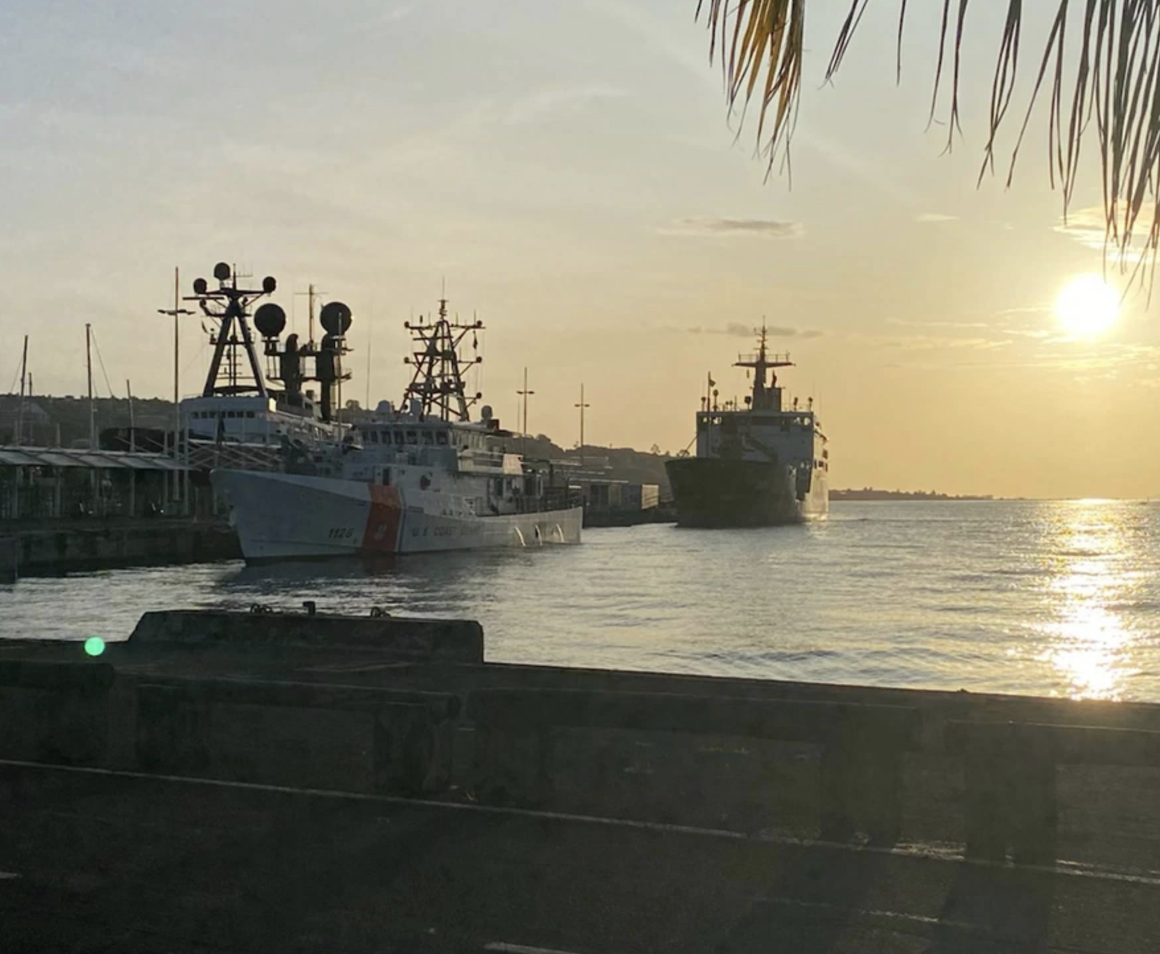
“Coast Guard cutter arrives at new homeport in Honolulu after restorative maintenance” –Coast Guard News
Significantly this is the last of the 16 WLBs to complete a Major Maintenance Availability. Which class will be next, the WLMs?
Watch the video. Always nice to see the crew reunite with their families.
Coast Guard cutter arrives at new homeport in Honolulu after restorative maintenance
Coast Guard Oceania District External Affairs – (808) 265-7748
Editor’s note: Click here to download video. Click here to download photos.
HONOLULU — The crew of Coast Guard Cutter Hollyhock (WLB 214) arrived at their new homeport in Honolulu Oct. 14 after 806 days of restorative maintenance.
The primary mission of the Hollyhock, a 225-foot Juniper-class seagoing buoy tender, is to maintain and deploy aids to navigation within the navigable waters of the main Hawaiian Islands, American Samoa, and Midway Atoll, servicing buoys that mark shipping channels, ports and hazardous areas.
Additionally, the Hollyhock’s presence in the region will support Operation Blue Pacific, the Coast Guard’s initiative to promote security, safety, sovereignty, and economic prosperity in Oceania. While deployed, the cutter’s crew will conduct law enforcement, fisheries boardings, and support maritime safety through the servicing of navigational aids throughout the region in cooperation with allies and partners.
Commissioned in 2003, the Hollyhock was originally homeported in Port Huron, Michigan, before entering maintenance at the Coast Guard Yard in Baltimore on July 31, 2023.
The Hollyhock crew departed for Honolulu on Aug. 31, 2025.
“The crew is excited to arrive in Honolulu and support critical operations throughout Oceania,” said Cmdr. Jessica McCollum, commanding officer of the Hollyhock. “Our arrival enhances the Coast Guard’s capacity to maintain vital navigational aids that facilitate the safe flow of maritime commerce. This is especially crucial in Hawaii, where more than 90% of goods arrive by sea.”
The Hollyhock is the last of the Coast Guard’s 16 seagoing buoy tenders to complete the major maintenance availability (MMA) program, ensuring the cutter achieves its full 30-years of designated service.
Maintenance work included completion of hull and structural repairs and replacement of obsolete, unsupportable or intensive maintenance equipment, including updates to the machinery control system, propellers, and heating, ventilation and air conditioning systems.
The MMA is part of the Coast Guard’s In-Service Vessel Sustainment (ISVS) program, a strategic class-by-class evaluation offering the most cost-effective solution for delivering essential maintenance and upgrades, ensuring Coast Guard surface vessels meet or exceed their expected service life.
“Pentagon Announces a New Counternarcotics Task Force in the Caribbean” –CSIS
The Center for Strategic and International Studies reports on the establishment of a new Joint Task Force under the Second Marine Expeditionary Force to address the drug problem in the SOUTHCOM AOR.
We discussed formation of this new task force earlier when it was first announced but this report goes into greater depth. There really is no clarification of how this new JTF and JIATF-S will interact, though this report raises that question also.
I would like to point out that the four key objectives of the new JTF were all also activities carried out by JIATF-S:
- Identifying narcotics trafficking patterns to interdict illegal shipments of narcotics before they reach the U.S. and partner-nation territories using intelligence, surveillance, and reconnaissance aircraft.
- Expanding real-time intelligence fusion among U.S. military, federal law enforcement, and partner-nation agencies.
- Conducting joint training to improve interoperability among U.S. military services and increase rapid-response posture.
- Enhancing partner-nation counter narcotics operations capacity through advisory teams and combined operations.
The only real difference seems to be that the new JTF is not offering any opportunity for the boat crews to surrender. Thinking back, I can’t remember a case where smugglers exchanged gun fire with a Coast Guard boarding party, since the end of Prohibition.
The legality of the strikes on boats allegedly carrying drugs is being hotly debated and is thought by many to be the reason for the early resignation of SOUTHCOM commander Navy Admiral Alvin Holsey. Neither Admiral Holsey nor DOD has made any public statement on his reasons for stepping down.
Thanks to David for bringing this to my attention.
Weapon Upgrade: Hellfire / JAGM
This is the second in a series about some of the weapons I thought would be most appropriate for cutters, particularly the Webber class WPCs, that would allow them to respond to range of threats including:
- Unmanned aircraft, from the smallest to converted light planes
- Small, fast, highly maneuverable surface craft including personal watercraft
- Merchant ships of any size
The first was about APKWS, this one is about Hellfire and its closely related replacement JAGM.

ATLANTIC OCEAN—A Longbow Hellfire Missile is fired from Littoral Combat Ship USS Detroit (LCS 7) on Feb. 28 2017 as part of a structural test firing of the Surface to Surface Missile Module (SSMM). The test marked the first vertical missile launched from an LCS and the first launch of a missile from the SSMM from an LCS. (Photo by U.S. Navy)
There is precedence for this, in that the Navy has equipped Littoral Combat Ships with Longbow Hellfire.
Like APKWS, Hellfire has demonstrated success against UAS and small watercraft. With a 20 pound warhead, it should be more effective than APKWS against shipping, but its ability to stop larger vessels is still limited, although it might be able to target selected parts of the ship (bridge, steering gear, engine room) using semi-active laser homing.
In some ways Hellfire and APKWS are similar. In their original form both were guided to their target by a reflected laser beam. Both were developed specifically for one type of target but were found useful for a variety of targets. Both have been used to take down UAS and have had some success against lower altitude sub-sonic aircraft in the surface to air mode.
Hellfire is now more than 40 years old and has seen progressive improvements. APKWS adds a recently developed guidance section to previously unguided rockets developed during World War II. Both weapons are now being made in huge numbers.
Costs are around $30K for an APKWS, about $150K for the current Hellfire, and over $300K for a JAGM MR.
Ranges are approximately 5,000 yards for the APKWS; 8,700 yards for the current Hellfire; and 17,500 yards for the JAGM MR.
Weight varies for APKWS, but a typical weight is 32 pounds. Weight for Hellfire and JAGM is 108 pounds.
Hellfire/JAGM are bigger and more expensive so you are probably going to have fewer of them, but with the improvements (dual or triple seeker, new propellant) it will perform better, particularly in conditions of poor visibility, and will have a greater range. The latest JAGM MR has a range of 16km. It would be a significant asset even for the NSCs and OPCs, providing an upgrade in Anti-Air as well as Anti-Surface capability.
Longbow Hellfire test against small targets 12 November 2018
While the original Hellfire would be a major improvement, the JAGM MR would give us both the dual seekers of the Longbow Hellfire and greater range.
JAGM’s multi-mode seeker provides an improved Semi-Active Laser (SAL) sensor for precision-strike and a fire-and-forget Millimeter Wave (MMW) radar for moving targets in all-weather conditions. These new sensors have been integrated into the JAGM guidance section and mated with the AGM-114R missile bus and demonstrated during multiple guided flight tests.
Fire-and-forget engagement modes significantly increase JAGM user survivability against threat defenses in GPS denied and austere communications environments. JAGM can engage multiple stationary and moving targets, in the presence of adverse weather, battlefield obscurants and advanced countermeasures. Laser and radar guided engagement modes allow JAGM users to strike accurately across wide target sets and reduce collateral damage.
While we might see Hellfire/JAGM or APKWS as an either or choice, some remote weapon stations might be able to handle both.
This type of launcher would be appropriate for the NSCs and OPCs. The possibility of vertical launch provides flexibility in location while allowing 360 degree targeting.
Weapon Upgrade: APKWS and the Vampire C-UAS System
Earlier I said I would talk about some of the weapons I thought would be most appropriate for cutters, particularly the Webber class WPCs, that would allow them to respond to range of threats including:
- Unmanned aircraft, from the smallest to converted light planes
- Small, fast, highly maneuverable surface craft including personal watercraft
- Merchant ships of any size
The APKWS is the first and it has proven particularly useful against drones and should be similarly effective against small watercraft and small ships. Its ability to forcibly stop or sink medium or large ships is limited, but I would say the same about the 57mm. Reportedly systems hurriedly shipped to Ukraine have shot down hundreds of drones and now APKWS are being made in very large numbers. For a guided munition, costs are very low, $15K to 20K for the guidance section and a few thousand for the very old tech 70mm Hydra rockets.
I could see the four round launchers mounted where the .50 calibers are mounted forward of the bridge on the O-1 deck, on the Webber class WPCs.
The basic APKWS requires full time laser designation from launch to impact. The system is evolving. An infrared seeker has been developed. This would allow the user to more rapidly shift from one target to the next.
The Launcher and fire control system commonly associated with surface launched APKWS is the L3Harris VAMPIRE. The US Naval Institute assures us that a naval variant is being developed and The War Zone shows us how ubiquitous this system is becoming and how it might develop.
“BOLLINGER SHIPYARDS DELIVERS FRC 1161 OLIVIA HOOKER TO U.S. COAST GUARD” –Bollinger News Release
Below is a news release from Bollinger Shipyards.
BOLLINGER SHIPYARDS DELIVERS FRC 1161 OLIVIA HOOKER TO U.S. COAST GUARD
USCGC Olivia Hooker to be homeported in Pascagoula, Miss.
LOCKPORT, La., — (October 23, 2025) – Bollinger Shipyards (“Bollinger”) today announced the recent delivery of the USCGC Olivia Hooker at Coast Guard Sector Key West. This is the 61st Fast Response Cutter (FRC) delivered under the U.S. Coast Guard’s current program and the 187th vessel built by Bollinger for the U.S. Coast Guard over a 40-year partnership. The Olivia Hooker will be homeported in Pascagoula, Mississippi.
“We are honored to deliver the Olivia Hooker to the U.S. Coast Guard, continuing our proud tradition of providing high-quality, mission-ready vessels,” said Bollinger President & CEO Ben Bordelon. “The FRC platform has proven itself time and again as a cornerstone of the Coast Guard’s fleet, excelling in a wide range of operational conditions. We’re confident this vessel will serve its crew well in their mission of defending our nation’s national security interests over a vast and challenging area of responsibility.”
Last month, Bollinger announced that the U.S. Coast Guard awarded the company 10 additional FRCs. The award was supported by the historic $25 billion funding included in President Trump’s recently enacted One Big Beautiful Bill Act, which provided $1 billion for additional FRCs and strengthened the Coast Guard in support of its Force Design 2028 initiative.
“With this award, the Coast Guard is doubling down on a proven platform and a proven team,” said Bordelon at the time of the award. “Our workforce has delivered nearly 200 cutters, including 60 FRCs, in our more than 40-year partnership with the Coast Guard. That performance is no accident. It reflects the dedication, precision and pride of the men and women of Bollinger, and our shared commitment to the Coast Guard’s mission.”
“This decision reflects our unwavering confidence in your capabilities, expertise, and longstanding commitment to excellence within the maritime industry,” said the U.S. Coast Guard in its award notification to Bollinger. “We continue to be particularly impressed by your track record in shipbuilding, your innovative approaches to maintaining a sustainable design, and your commitment to adhering to the highest standards of safety and compliance…This contract option award is a testament to the trust we place in your abilities and to the shared vision we hold for the future of our fleet. We look forward to a productive and successful partnership and to the delivery of ten world-class ships that will advance our mission and further strengthen our operational capabilities.”
To date, Bollinger has delivered 61 FRCs and had been under contract to build 67 vessels, with the final FRC previously scheduled for delivery in 2028. With the most recent award, the total program has increased to 77 vessels, extending the production line by approximately three years and ensuring uninterrupted deliveries to meet operational demand.
Earlier this year, to protect the taxpayer and preserve hard-won efficiencies, Bollinger went “at-risk” to sustain production momentum. The company procured long-lead materials and maintained full payroll to avoid costly restarts and schedule gaps. That proactive decision reduced risk, preserved skilled jobs, and enabled the government to stretch its investment further.
The FRC program continues to be a powerful economic engine. Since its inception, it has generated over $2 billion in material spending, directly supports more than 650 jobs in Southeast Louisiana, and has indirectly created 1,690 jobs from operations and capital investment, with an annual GDP impact of $202 million, according to the U.S. Maritime Administration’s data on the economic importance of the U.S. shipbuilding and repair industry. Each FRC comprises over 271,000 distinct items and approximately 282 million components and parts, sourced from 965 suppliers across 37 states, demonstrating the program’s broad national industrial footprint.
Each FRC is named for an enlisted Coast Guard hero who distinguished themselves in the line of duty. This vessel is named after Dr. Olivia Juliette Hooker (1915–2018), who made history as the first African-American woman to serve in the U.S. Coast Guard, enlisting in 1945 as a member of the SPARs during World War II. Dr. Hooker answered the call to serve, completing boot camp and yeoman training before processing discharges for returning Coast Guardsmen. After the war, Dr. Hooker earned advanced degrees in psychology, becoming a respected professor at Fordham University and a lifelong advocate for education, mental health, and civil rights. Her trailblazing service exemplified the Coast Guard’s core values of honor, respect, and devotion to duty, and her legacy endures as the namesake of USCGC Olivia Hooker.
ABOUT THE FAST RESPONSE CUTTER PLATFORM
The FRC is an operational “game changer,” according to senior Coast Guard officials. FRCs are consistently being deployed in support of the full range of missions within the United States Coast Guard and other branches of our armed services. This is due to its exceptional performance, expanded operational reach and capabilities, and ability to transform and adapt to the mission. FRCs have conducted operations as far as the Marshall Islands—a 4,400 nautical mile trip from their homeport. Measuring in at 154-feet, FRCs have a flank speed of 28 knots, state-of-the-art C4ISR suite (Command, Control, Communications, Computers, Intelligence, Surveillance, and Reconnaissance), and stern launch and recovery ramp for a 26-foot, over-the-horizon interceptor cutter boat.
ABOUT BOLLINGER SHIPYARDS
Bollinger Shipyards (www.bollingershipyards.com) has a 80-year as a leading designer and builder of high-performance military patrol boats and salvage vessels, research vessels, ocean-going double hull barges, offshore oil field support vessels, tugboats, rigs, lift boats, inland waterways push boats, barges, and other steel and aluminum products from its new construction shipyards as part of the U. S. industrial base. Bollinger has 13 facilities, all strategically located throughout Louisiana and Mississippi with direct access to the Gulf of America, the Mississippi River and the Intracoastal Waterway. Bollinger is the largest vessel repair company in the Gulf of America region.
“Coast Guard Will Get A New MH-60 Variant To Replace MH-65 Helicopters” –The War Zone

PACIFIC OCEAN (July 30, 2022) U.S. Navy Petty Officer 1st Class Humberto Alba, a naval aircrewman tactical-helicopter, attached to Helicopter Maritime Strike Squadron (HSM) 37, deployed on U.S. Coast Guard Legend-class cutter USCGC Midgett (WMSL 757), looks down at a USCGC crewmember after taking off during flight operations during Rim of the Pacific (RIMPAC) 2022. (U.S. Coast Guard photo by Petty Officer 3rd Class Taylor Bacon)
The U.S. Coast Guard is in line to get a new version of the H-60 helicopter based on the MH-60R Seahawk, which is in service with the U.S. Navy and other armed forces globally. The additional helicopters will supplement, at least initially, the Coast Guard’s aging MH-60T Jayhawks. The Coast Guard also plans to boost its overall capabilities by replacing its fleet of smaller MH-65s with H-60 variants.
Earlier this week, Naval Air Systems Command (NAVAIR) put out a contracting notice announcing its intent to award Lockheed Martin Rotary and Mission Systems a sole-source deal to design and produce an unspecified number of “MH-60R variant aircraft for the United States Coast Guard.”
The Contracting notice makes no commitment as to the numbers involved. One thing is clear. The Coast Guard is still also adding MH-60Ts so we are going to have a mixed fleet.
So how many of the new type, and how much of the Navy’s mission equipment will be retained? Will they be used much as the MH-60T or will they replace only the H-65s that provide air borne use of force (I can’t remember ever seeing a MH-60T deployed on a cutter for a drug enforcement patrol).
They could just not install any of the ASW and ASuW equipment. That would reduce weight and provide more interior room. It has a highly regarded radar that would be very useful for drug interdiction.
I think it is interesting that they chose the “Romeo” version rather than the MH-60S. The closely related MH-60S is the Navy’s combat search and rescue aircraft, but he MH-60S does not have radar that the “Romeo” has.
Probably not, but could this be a step in bringing back an ASW mission for the Coast Guard? In addition to operating from cutters, there is probably a good case to be made for giving Coast Guard Air Stations an ASW capability to keep submarines from being able to concentrate near US ports. Then we might actually guard the coast. Sorry, I couldn’t help myself.
Why the Atlantic Area’s AOR Should include the Eastern Pacific Transit Zone

United States Exclusive Economic Zone – Pacific centered NOAA map. https://www.gc.noaa.gov/documents/2011/012711_gcil_maritime_eez_map.pdf
For some time, I have thought that Coast Guard forces are under represented in the Pacific. Pacific Area’s responsibilities have grown. Because of the great distances in the Pacific they have greater need for ships with greater endurance, but rather than gaining long range ships, they now have fewer. Pacific Area has never had even half of our larger patrol cutters, but at one time they did have ten of our 12 WHECs.
When I retired in 1991, Pacific Area had ten WHEC and five WMECs, 15 large patrol ships. Now they have six National Security Cutters and three WMECs, 9 large patrol ships. The plan was that the first four OPCs would go to Pacific Area, presumably replacing at least two of the existing WMECs, but what will happen to the OPCs contracted to Eastern is still not clear, but near term there is no chance we will see more than one, which would presumably replace one WMEC. In short there is no chance we are going to see a significant increase in the PAC AREA large cutter fleet any time soon as a result of construction.
If you look at the distribution of the US EEZ as depicted above.
- Total US EEZ: 11,351,000 km2
- East Coast EEZ: 915,763 km2
- Gulf Coast EEZ: 707,832 km2
- Puerto Rico EEZ: 177,685 km2
- Total LANT Area EEZ: 1,801,280 km2 15.9%
- Total PAC Area EEZ: 9,549,720 km2 84.1%
The US EEZ in the Pacific Area is about 5.3 times as large as the US EEZ in the Atlantic Area, but the Pacific Area has only 28% of the Coast Guard’s large patrol cutters.
PAC AREA could have more cutter time for operations in the Western Pacific and Alaskan waters, without adding cutters, if LANT AREA took full responsibility for the Eastern Pacific drug interdiction effort. There are good reasons, that might be desirable, not the least of which are that LANT has the assets, the Eastern Pacific has the heaviest drug trafficking, and while it is counter intuitive, LANT AREA assets are actually closer to the Eastern Pacific drug transit zones than PAC AREA assets. But there is also an organizational reason.
The DOD and the Navy do not divide up the world the way the Coast Guard does, so the DOD and Navy commands charged with doing drug enforcement operations in both the Caribbean and Eastern Pacific end up talking to both PAC and LANT Areas.
US Atlantic Fleet includes all the even numbered fleets: 2nd, 4th, and 6th. The Pacific Fleet includes all the odd numbered fleets: 3rd, 5th, and 7th.
It would simplify coordination if a single Coast Guard Command was responsible for coordinating all drug enforcement operations in 4th Fleet, and that single command should be LANT AREA. This would also ease coordination in wartime.
Eighth Lethal Strike Extends Kinetic Strikes to the Pacific

A screenshot from video showing a U.S. military strike on an alleged drug smuggling vessel in the Eastern Pacific. Video released Oct. 22, 2025
“The Trump administration has extended its controversial military campaign against suspected drug-trafficking vessels into the Eastern Pacific, marking a significant expansion beyond operations previously concentrated near Venezuelan waters.”
Becoming a Better Armed Fighting Force
The new administration has said they will make the Coast Guard a better “fighting force.” I have some suggestions.
Having watched the 9/11 terrorist attacks and having learned how unprepared the Air Force was to deal with such an attack, I became concerned that the Coast Guard is also unprepared to deal with terrorist attacks.
We also should not assume that China will not open hostilities with unconventional attacks on US port facilities that are essential for support of a distant conflict.
If you are a regular reader of this blog, you know I feel the Coast Guard is not properly armed to perform its “Ports, Waterways & Coastal Security” and “Defense Readiness” missions and that furthermore there is no other force ready step in and address this shortfall in a timely manner.
The Navy no longer has Naval Districts and associated patrol craft. The Navy has surface ships home-ported in only five ports complexes, Norfolk/Little Creek, Mayport, San Diego, Seattle/Puget Sound, and Pearl Harbor. Not a single Navy surface vessel is home-ported on the East Coast North of Virginia, on the Gulf Coast, or in Alaska. Even where Navy ships are home-ported, how long would it take to get them underway and ready to take defensive action?
The Army no longer has any Coast Defense units. Since 9/11 the Air Force has a few units aircraft ready tor air-to-air combat, but I have never seen any indication they have aircraft and crews on alert, much less air borne ready to respond to a maritime attack.
The war in Ukraine has demonstrated how relatively unsophisticated short range systems can do significant damage and multiple attacks using these systems can be coordinated.
The Coast Guard needs to have weapons that can deal with a range of threats including:
- Unmanned aircraft, from the smallest to converted light planes
- Small, fast, highly maneuverable surface craft including personal watercraft
- Merchant ships of any size
Generally these weapons need to be light, easy to use, and should require minimum maintenance. They should also risk only minimum collateral damage since they may be being used inside an American harbor.
They should be installed on the larger patrol cutters, but they must also be installed on the Webber class cutters, because the Webber class WPCs are both widely distributed and have a large enough crew to provide the necessary security.
I would also like to see them installed on buoy tenders and a replacement class for the 87 foot WPBs that could serve as true fast response cutter for both SAR and defense. Because there are so many assets to protect, the systems must become ubiquitous.
Some thought should be given to how we might arm our Coast Guard aircraft for these missions too. It would not be too difficult to arm H-60s. It has been done.
Over the next few days I am going to talk about some of the weapon systems I think are most appropriate to fill this need: Hellfire/JAGM; APKWS; the Very Light Weight Torpedo; and the 30mm gun with airburst ammunition.