“India orders six next-gen offshore patrol vessels from Mazagon Dockyard” –Naval Today

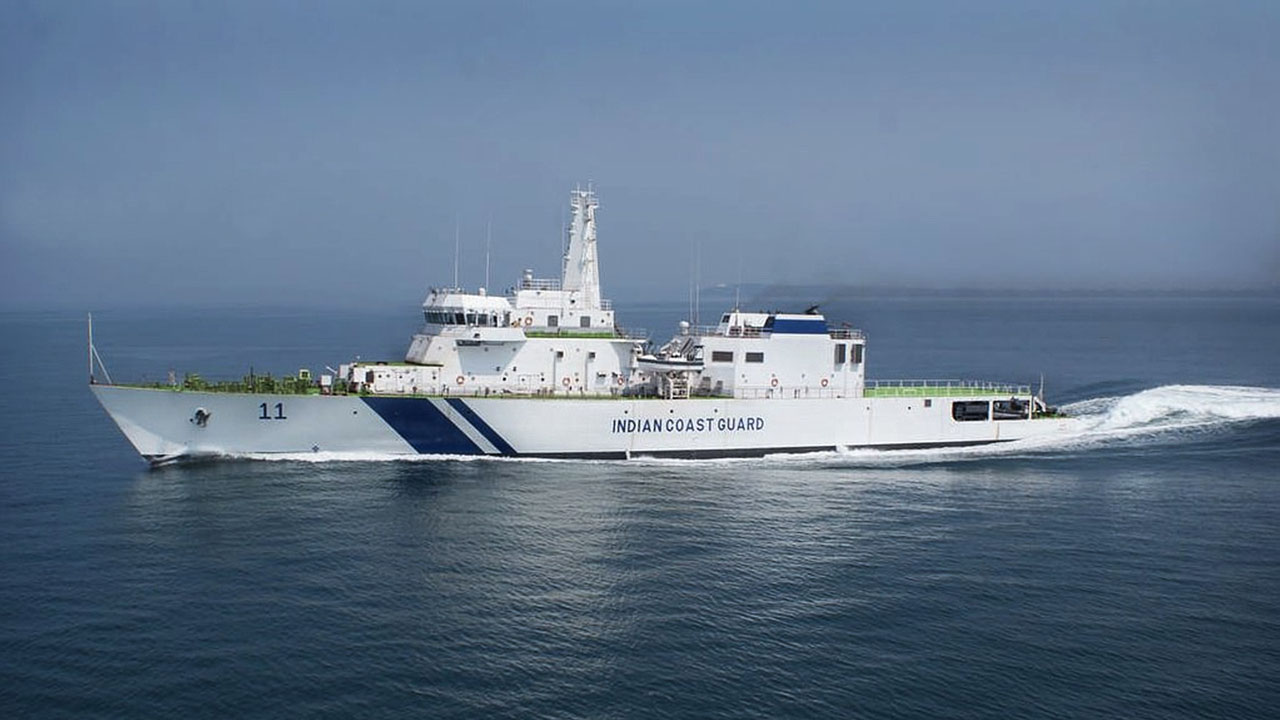
105 meter, Off Shore Patrol Vessel (OPV) ICGS Samarth, 10 November 2015, lead ship of a class of 11, photo Indian Coast Guard

Naval Today reports, “The Indian Ministry of Defence has signed a contract with Mazagon Dockyard Shipbuilders (MDL) for the construction of six next-generation offshore patrol vessels (OPVs).”

The six new ships are to be 115 meters (377′) in length, about the size of the Hamilton class cutters. I have not been able to find any additional information on their characteristics, but historically, Indian CG OPVs evolve from preceding designs, so I expect they will share many characteristics with the preceding 105 meter class pictured above and the 97 meter Vikram class; e.g. speed 23 to 26 knots; powered by two diesel engines; armed with a 30mm gun; hangar and flight deck for at least a five ton helicopter.

As for what they change, “Along with several high-tech advanced features and equipment, these 115m OPVS would be equipped with multipurpose drones, AI capability, and wirelessly controlled remote water rescue craft lifebuoy.”

The six ships are to be designed and delivered in 66 months. From contract to completion of six ships in five and a half years may sound like a tight schedule considering the US Coast Guard’s recent experience. Looking back on the previous class of eleven ships, procured in two batches, it looks possible. A $400M contract to build six vessels was awarded to GSL on 9 May 2012. All six were commissioned by 21 December 2017, less than 68 months after contract award. A follow-on contract for five ships was awarded in August 2016. The fifth ship was commissioned 16 March 2022, about 67 months from award to completion of five ships.

India benefits from the near continuous construction of Offshore Patrol Vessels (OPVs). Over the last ten years, 22 Indian built OPVs were commissioned, 18 for the Indian Coast Guard, two for the Indian Navy, and two for export.

In addition to these six OPVs, the Indian Navy is also building eleven similarly named but different 105 to 110 meter “Next Generation Offshore Patrol Vessels.

“Chinese Submariner Appointed Head of People’s Liberation Army Navy” -USNI

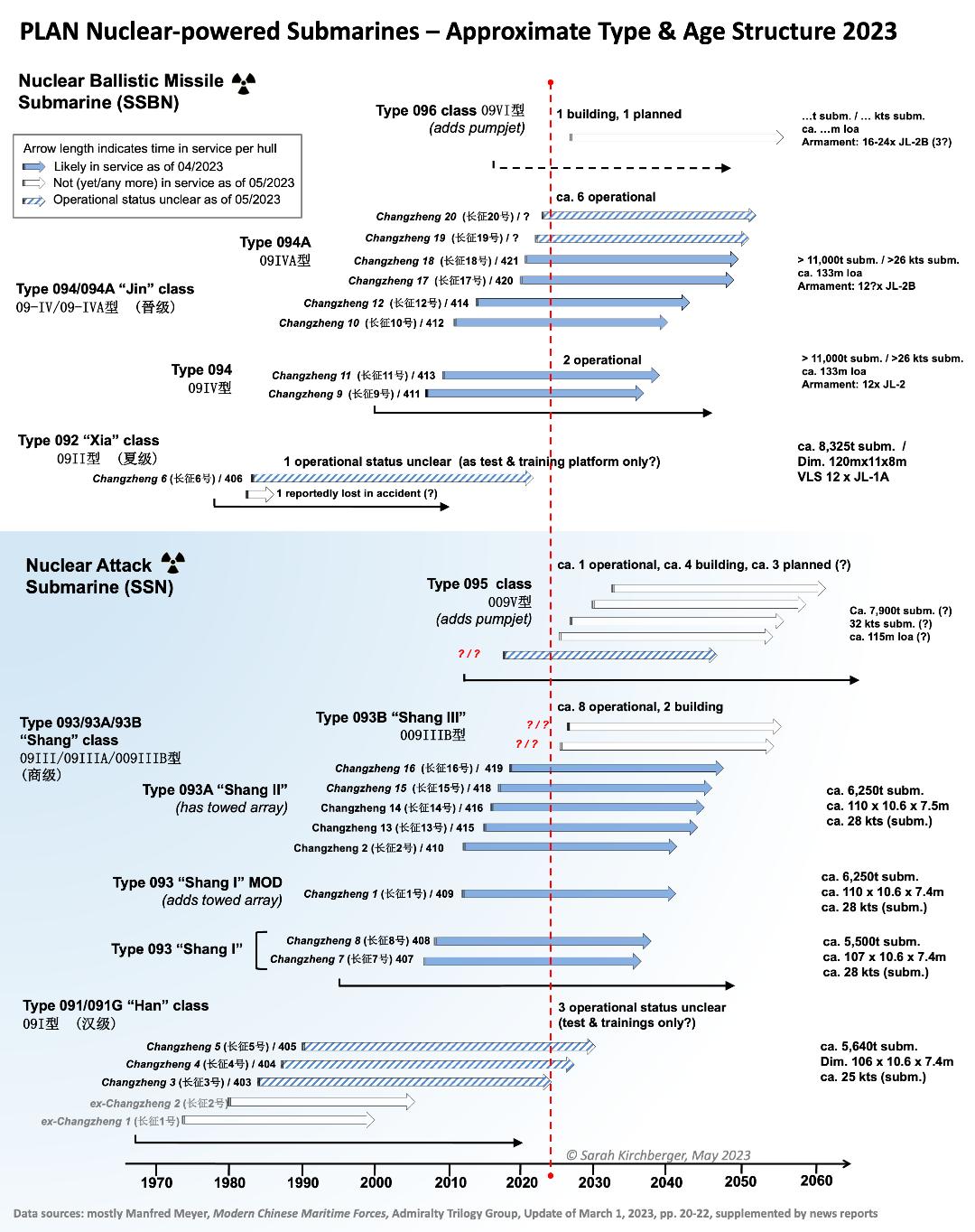
The infographic above is from a May 2023 post, “China’s PLAN Surface and Sub Order of Battle

The US Naval Institute News Service reports,

“China’s President Xi Jinping appointed a new Chief for the People’s Liberation Army Navy in a Monday ceremony in Beijing…Adm. Hu Zhongming…Hu was previously the PLAN Chief of Staff and is a submarine officer though details of his career are sparse, a Chinese media report in 2015 stated that Hu had a served in the PLA 92730 unit, which operates China’s nuclear submarine.”

I have not been able to confirm it, but as I recall the previous head of the PLAN was also a submariner.

It is worth noting that in October 2020 the USNI reported that China was doubling its nuclear submarine building capacity.

It appears that the Chinese intend to match or exceed the US’s normal two nuclear submarine per year build rate, while continuing to build a substantial fleet of conventionally powered air-independent submarines.

Meanwhile NORTHCOM says Russia is close to having cruise missile launching nuclear submarines cruising persistently off the US coasts.

It is becoming apparent, that in any future major conflict, submarines will be a threat, not just in distant waters, but in virtually any ocean right up to the US coast.

It is time for the Coast Guard and Navy to cooperate in redeveloping a Coast Guard role in ASW, whether it be permanently installed or containerized add-ons with Navy helicopter and personnel augmentation.

“Coast Guard Goes All-In on Zero Trust Architecture” –National Defense

A team from the U.S. Coast Guard Academy participated in the National Security Agency’s 20th annual National Cyber Exercise (NCX), a three-day cyber competition that tests the offensive and defensive cybersecurity skills virtually, April 8-10, 2021. The Coast Guard Academy recently instituted a Cyber Systems degree to meet the needs of the services cyber security strategy of defending cyber space, enabling operations, and protecting infrastructure. (U.S. Coast Guard photo by Petty Officer 2nd Class Hunter Medley)

National Defense reports,

“We need to focus on better identity management, focusing on the data side of that,” Capt. Andrew Campen, engineering services division lead at the Command, Control, Communication, Computer, Cyber and Intelligence Service Center at the Coast Guard, said at a panel at the Eastern Defense Summit in December. “[We must] realize that data is the piece that’s important, not the system itself. Identity management is key for us. Understanding data is key for us.”

“Zero Trust” is a concept that is frequently talked about, but for me at least, little understood. I don’t think I have mentioned the topic here previously.

Zero trust architecture refers to evolving cybersecurity paradigms that prioritize protecting data by repeatedly authenticating, authorizing and validating system, application and data access.

There is, of course, a desire to prevent sensitive data being stolen and a desire for operational security. Conversely there is a desire to make information usable and to act quickly on time sensitive information.

Operationally we don’t want forces diverted from an actual case by false information, but we also do not want a desire for validated information to filter out time critical but incomplete early indicators–we don’t want to be like the Duty Officer at Pearl Harbor who wanted “confirmation” before reporting USS Ward’s attack on a small submarine early on Dec. 7, 1941.

It all just sounds like good opsec, but it has been complicated by access to multi-user data bases. As the post notes, “Successfully implementing a zero trust architecture is incredibly difficult.”

UK Deploys OPV to Guyana, gCaptain/Reuters

The River-class offshore patrol vessel HMS Trent (P224) passes the Vorontsov Lighthouse while arriving in Odesa, Ukraine to participate in Exercise Sea Breeze 2021, July 2, 2021. Exercise Sea Breeze is a multinational maritime exercise cohosted by the U.S. Sixth Fleet and the Ukrainian Navy since 1997. Sea Breeze 2021 is designed to enhance interoperability of participating nations and strengthens maritime security and peace in the region. (U.S. Navy photo by Damon Grosvenor/Released)

gCaptain reports,

Britain will deploy a naval ship off Guyana later this month, its ministry of defense said on Sunday, as the South American nation faces a border dispute with neighbor Venezuela over the oil-rich Essequibo region.

The deployment follows a visit by a British junior foreign minister to Guyana earlier this month, intended to offer the UK’s support for the country, an ally and former British colony.

We have talked about Venezuela’s claim on territory internationally recognized as part of Guyana. There is a recent BBC report here.

I found it interesting that the Royal Navy is sending an Offshore Patrol Vessel to this region of potential conflict. HMS Trent is about the size of a 270 and is armed with a 30mm gun in what is essentially the same mount the US Navy is calling the Mk38 Mod4.

It is likely 4th Fleet will also have some units (probably CG cutters and maybe an LCS) in the area.

None of these ships is likely to be a match for the Venezuelan Navy, but the US could quickly have overwhelming amounts of airpower over the area.

“Struggling Austal USA Can Only Be Fixed By Big Changes…In Australia” –Forbes

Future USCGC Pickering (Image: Austal USA)

Forbes reports on, Offshore Patrol Cutter builder, Austal’s continuing difficulties.

The author, Craig Hooper, whom I regard as a friend of the Coast Guard, was at one time an Austal executive, departing in 2013. I would have to believe; he knows what he is talking about.

Thanks to Nick for bringing this to my attention.

“US Claims Huge Chunk of Seabed Amid Strategic Push For Resources” –gCaptain/Bloomberg

gCaptain reports the US has made its claim to Continental Shelf beyond its Exclusive Economic Zone.

Much of the area is in the Arctic. I am sure research conducted by scientists operating from USCGC Healy had a lot to do with researching this area.

There are overlaps in areas also claimed by Canada, the Bahamas and Japan that will have to be resolved.

“U.S. Coast Guard Cutter Polar Star departs Australia, en route to Antarctica” –CG News

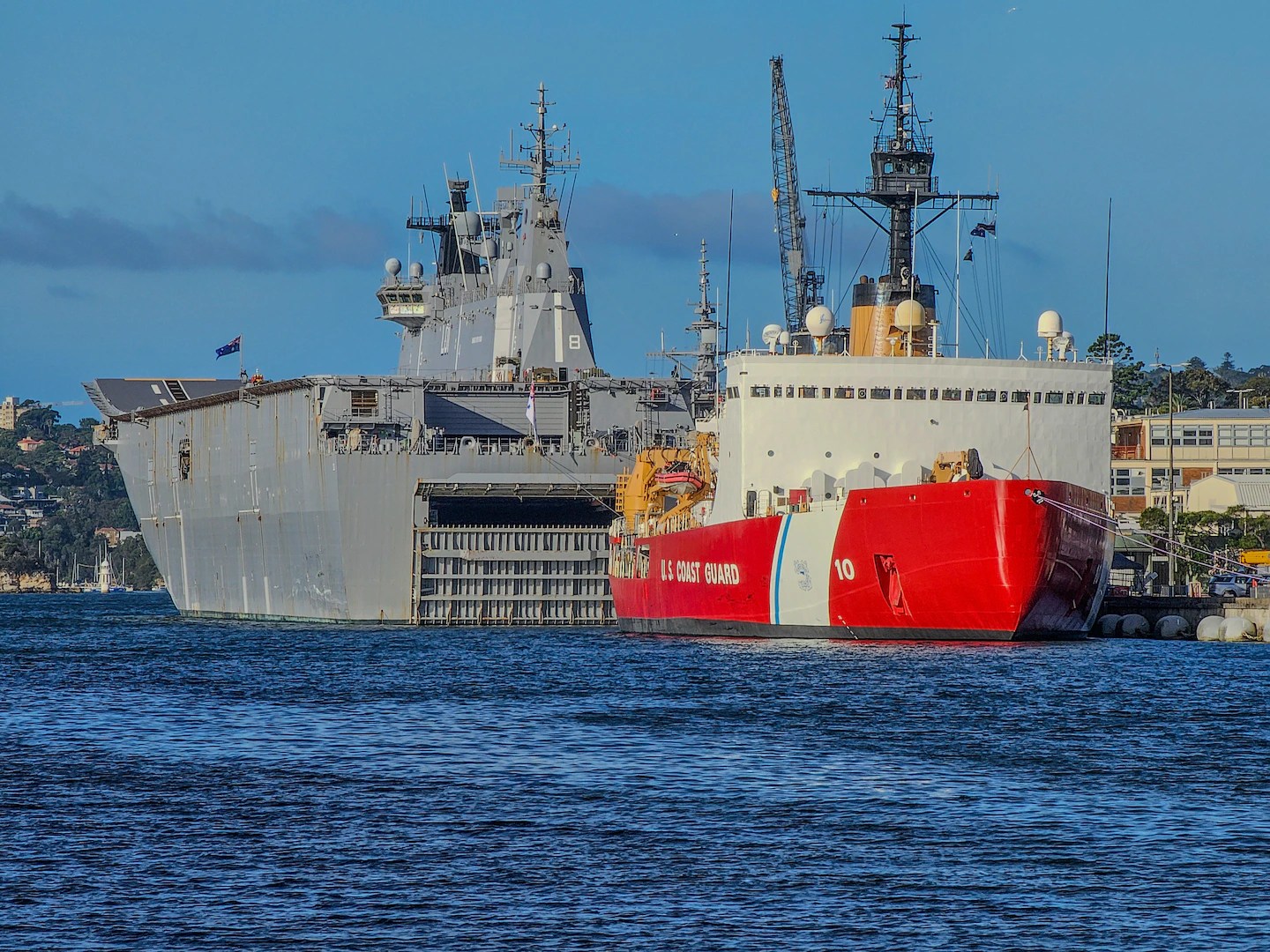
USCGC Polar Star moored in Australia, presumably at HMAS Kuttabul, in Sidney. The large vessel in the background is a Canberra class LHD, HMAS Adelaide (L01) I believe. While, with modifications, this two-ship class probably could operate F-35B VTOL fighters, I have seen no indication that they intend to do so. 

Just passing along this news release from Coast Guard News. More photos there. 


Dec. 21, 2023

U.S. Coast Guard Cutter Polar Star departs Australia, en route to Antarctica

Editor’s Note: To follow the U.S. Coast Guard Cutter Polar Star’s Operation Deep Freeze journey, click here for more imagery.

HOBART, Australia — U.S. Coast Guard Cutter Polar Star (WAGB 10) and crew departed Hobart, Wednesday, after a four-day port call in Hobart and an earlier stop in Sydney, to begin the journey across the Southern Ocean en route to Antarctica in support of Operation Deep Freeze 2024.

While in Hobart and Sydney, the crew hosted tours aboard the Polar Star for guests from the U.S. Embassy including U.S. Ambassador for Australia Caroline Kennedy and members from the Australian government, Royal Australian Navy, Tasmanian government, local industry partners, and local schools and universities.

“A sincere thank you to our Australian hosts and all our international partners whose incredible collaboration has defined the success of Operation Deep Freeze,” said Capt. Keith Ropella, commanding officer of Polar Star. “The cohesion among Antarctic programs reinforces the significance of our joint efforts, fostering a legacy of success for future scientific endeavors in this challenging environment.”

Operation Deep Freeze is a joint military service mission to resupply the United States Antarctic stations of the National Science Foundation, who is the lead agency for the United States Antarctic program (USAP). This year marks Polar Star’s 27th voyage to Antarctica. Every year, a joint and total force team work together to complete a successful Operation Deep Freeze season. Military members from the U.S. Air Force, Army, Coast Guard, and Navy work together through Joint Task Force-Support Forces Antarctica to continue the tradition of providing U.S. military support. Operation Deep Freeze works closely with other Antarctic programs to include those of Australia and New Zealand, as well as those Nations’ respective defense forces.

Leading up to and during the transit, the crew received training and prepared themselves to support this vital mission despite the austere environment. Operation Deep Freeze is one of the more challenging U.S. military peacetime missions due to the harsh environment in which it is conducted. Antarctica is the coldest, windiest, most inhospitable continent on the planet, and each trip requires careful planning and coordination.

“Through rigorous training and specialized preparations, our Coast Guard team stands ready for the challenges of Operation Deep Freeze,” said Lt. Cmdr. Don Rudnickas, operations officer of Polar Star. “The Coast Guard’s unwavering commitment underscores our dedication to the success of U.S. missions in the Polar Regions, ensuring the safety and efficacy of our operations.”

The Polar Star provides heavy icebreaking capabilities to facilitate sealift, seaport access, bulk fuel supply, and port cargo handling for three U.S. research stations in Antarctica with McMurdo Station being the largest. The cutter’s icebreaking capabilities enable the safe delivery of critical supplies to sustain USAP’s year-round operations and support international partnership in the harsh Antarctic environment. It’s vitally important that the U.S. maintains a maritime domain presence in Antarctica to protect uninhibited international access to the region.

When the Polar Star deploys in support of Operation Deep Freeze, they routinely spend the holiday season away from home. During the cutter’s first stop in Honolulu, the crew celebrated Thanksgiving while underway and moored alongside the U.S. Navy fleet at Joint Base Pearl Harbor-Hickam in Honolulu.

During the transit across the Pacific, the crew sailed through the position 0 degrees latitude and 180 degrees longitude, also known as “The X” marking the intersection of the equator and international date line. Crossing this exact position is a unique and rare opportunity among Coast Guard crews.

On December 10, the Polar Star moored at HMAS Kuttabul alongside several Royal Australian Navy ships close to the center of Sydney during a logistics stop for fuel and supplies.

The Polar Star departed its Seattle homeport November 15 and has traveled approximately 7,700 miles with stops in Honolulu, Sydney and Hobart.

The Polar Star is the United States’ only asset capable of providing access to both Polar Regions. It is a 399-foot heavy polar icebreaker commissioned in 1976, weighing 13,500 tons, 84-feet wide, with a 34-foot draft. The six diesel and three gas turbine engines produce up to 75,000 horsepower.

USCGC Diligence with SOAR Little Bird Attack Helicopter –Remembering Operation Prime Chance

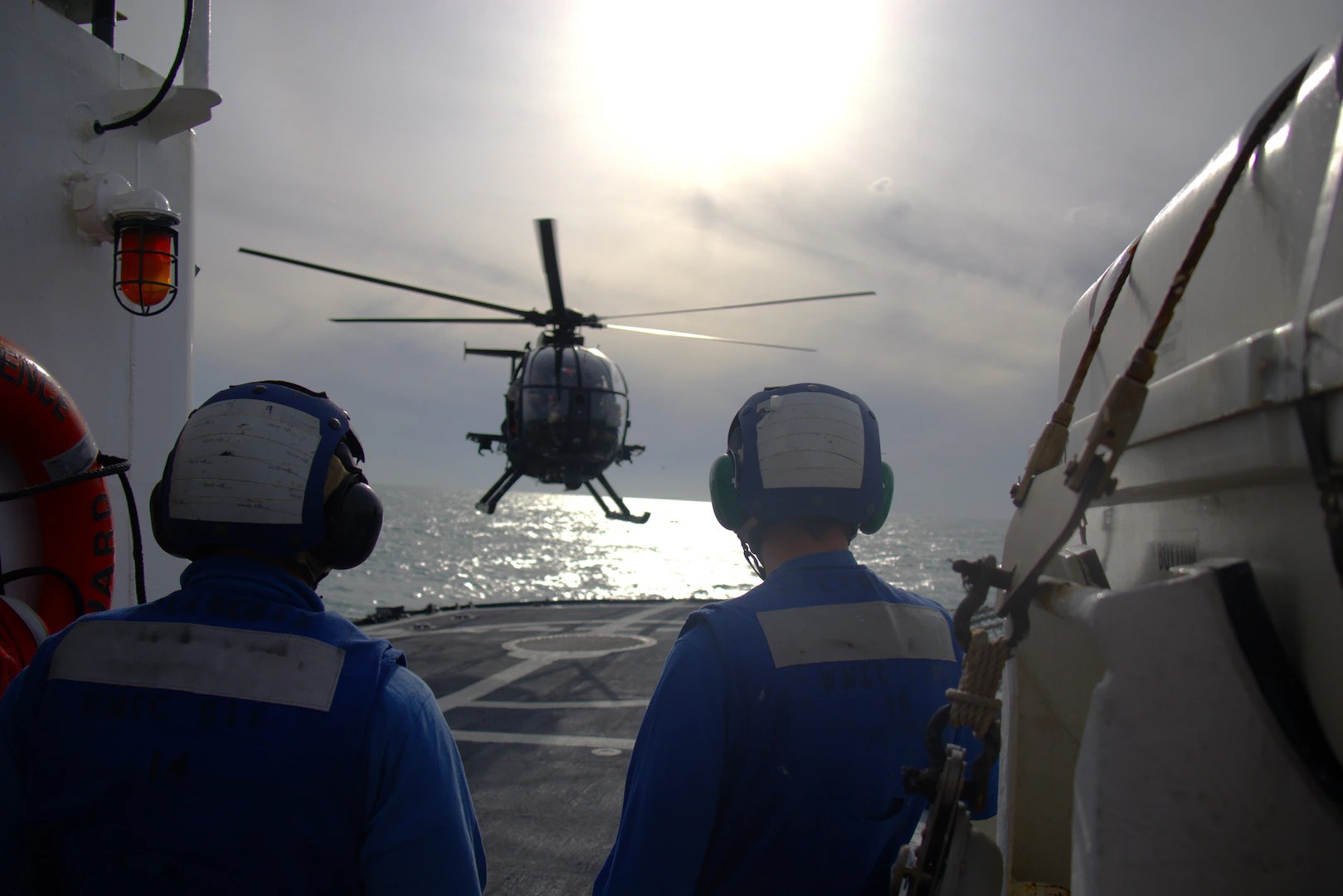
USCGC Diligence recently completed a 52-day counterdrug patrol in the Caribbean Sea. Mostly it was a typically successful patrol, but they did do something a bit unusual.

“Diligence also conducted a joint training exercise with the Army’s 160th Special Operations Aviation Regiment (SOAR). During the exercise, the Diligence crew and pilots from SOAR completed daytime and nighttime helicopter landing evolutions.”

The Helicopters were AH-6s. The 160th SOAR has a history of flying off of floating units.

Between 1987 and 1989 the U.S. Army’s 160th Special Operations Aviation Regiment, also known as “The Night Stalkers,” flew Little Bird helicopters from barges and Navy frigates in the Persian Gulf. Operation Prime Chance paired the U.S. Army helicopters with Navy SEALs, Marines, and Special Boat Units in an undeclared war against Iranian Revolutionary Guards units harassing civilian shipping. Six Little Birds, both MH-6 utility and AH-6 attack versions equipped with SEAL snipers, rockets, and machine guns, flew patrols as low as thirty feet.

This might be a reminder that Army and Marine helicopters could be operated from Coast Guard Cutters for limited periods for Special Operations, particularly in areas where there are few Navy assets such as the high North and 4th Fleet.

Wikipedia’s report on Operation Prime Chance here.

More photos of Diligence’s operation with AH-6 here.

Thanks to Peter for prompting me to write about this. 

“New court doc sheds light on Austal’s 2022 Offshore Patrol Cutter win” –Defense News

Future USCGC Pickering (Image: Austal USA)

Defense News reports,

“The court last month ruled against Eastern Shipbuilding, which had appealed the Coast Guard’s decision. The court unsealed the case documents Dec. 14, though with some redactions.”

There is a link to the 42-page court document, but really there is a lot more here than just the decision.

Eastern’s offer was judged better in several respects, but Austal’s price and indoor assembly facility were deciding factors.

“Ultimately, Austal’s proposal came to $3.22 billion, or about $292 million per hull, according to the unsealed documents.

“Eastern’s price is redacted in the documents but is characterized as a “very large price differential.””

It was noted,

“…only one OPC could be built in the indoor facility at a time, meaning the heel-to-toe production cadence could lend itself to “notable disruptions” to schedule.”

This suggests to me, that Austal might have trouble building more than two OPCs a year if the Coast Guard wanted to accelerate OPC production.

The paragraph below may refer to the same presentation by RAdm Jacoby discussed earlier, where he expressed a sense of urgency regarding the OPC program, but there is also an admission that maintaining the Medium Endurance Cutters has become problematic.

Coast Guard acquisition chief Rear Adm. Chad Jacoby said at a recent conference there’s no current plan to have both yards build concurrently into the future but that he’d be open to it if lawmakers increased annual OPC spending, since it’s “urgent” to get OPCs into the fleet to replace “the medium endurance cutters, which are struggling to maintain operational capability right now.”