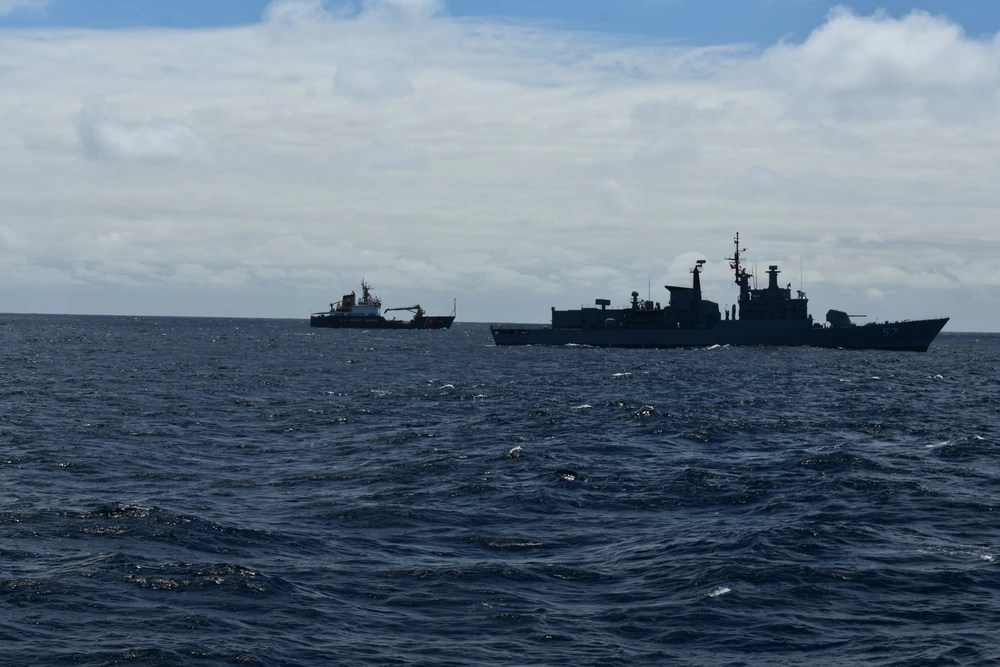
“Philippines, U.S. Launch Joint Patrols Near Taiwan” –gCaptain

gCaptain reports,

The Philippine military said three navy vessels, two FA-50 light combat aircraft and an A-29B Super Tucano light attack plane would participate, while the United States would send a littoral combat ship and a P8-A Poseidon maritime patrol and reconnaissance aircraft.

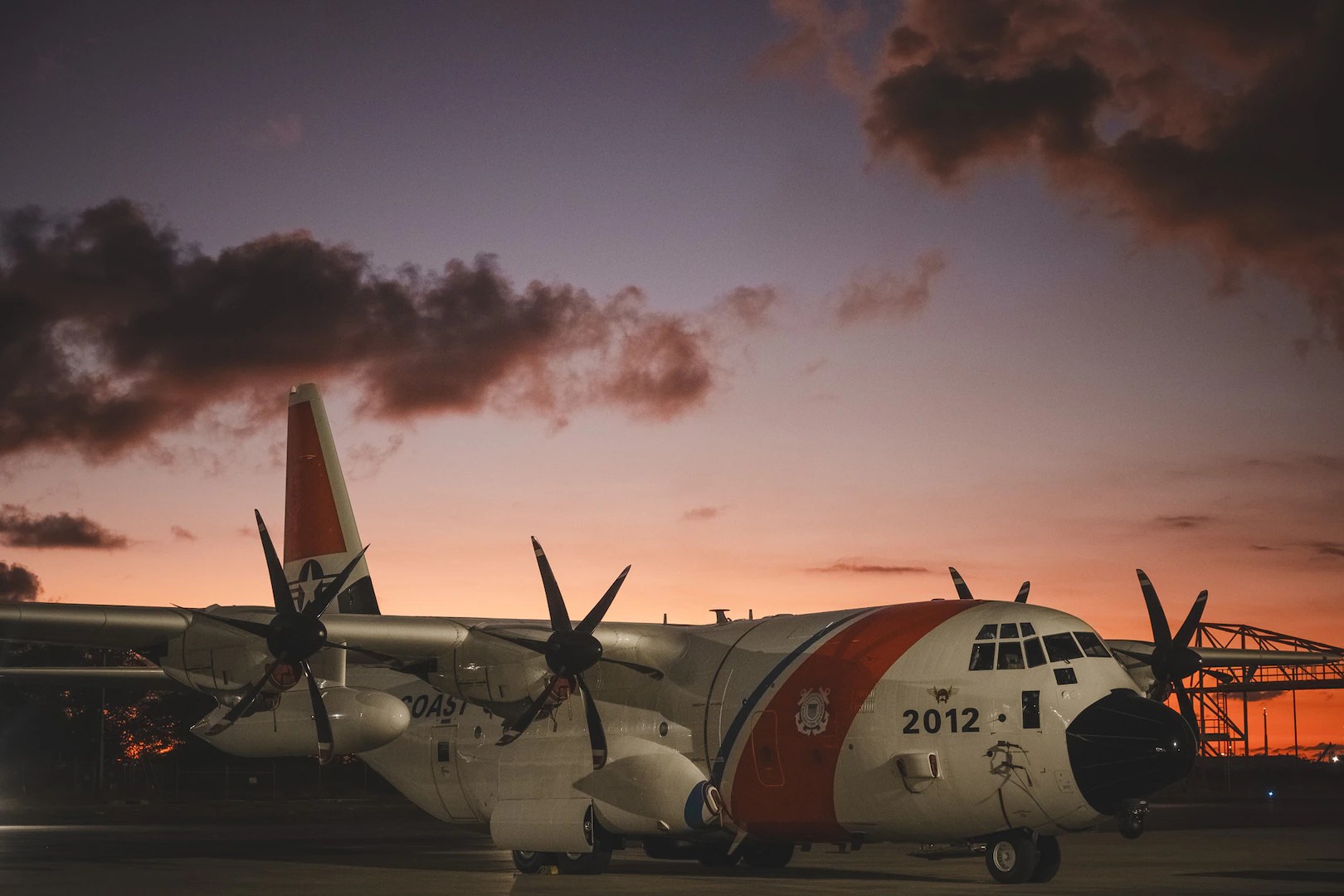
Perhaps significantly, unlike the photo above, on both sides, the units are not coast guard.


USS Dewey (DDG-105), bottom, steams in formation with the Philippine Navy offshore patrol vessel BRP Gregorio del Pilar (PS 15) while conducting a bilateral sail in the South China Sea, Oct. 21, 2023. US Navy Photo

The USNI has additional information here https://news.usni.org/2023/11/21/u-s-philippines-begin-three-days-of-joint-patrols-in-the-south-china-sea.

“Coast Guard completes two-week operation in Pacific region” –D14

Below is a D14 news release. Another step in the formation of an international fisheries enforcement alliance.


Nov. 20, 2023

Coast Guard completes two-week operation in Pacific region

U.S. Coast Guard District 14

HONOLULU – The U.S. Coast Guard has concluded Operation Kuru Kuru, an annually held comprehensive two-week operation in the Pacific region, highlighting the Coast Guard’s commitment to supporting international partners in the region.

Operation Kuru Kuru, executed from 22 Oct. to 3 Nov. 2023, is a collaborative effort with the Regional Fisheries Surveillance Centre, aimed at countering Illegal, Unreported, and Unregulated (IUU) fishing across the region.

The operation encompasses a wide array of objectives, including enhancing cooperative surveillance engagement between participating nations, conducting boarding activities at sea to combat IUU fishing, and utilizing remote sensing information to drive intelligence-led operations. This operation covers a combined area of 15 participating Pacific Island Country exclusive economic zones and the adjacent high seas pockets, approximating 8.2 million square miles, an area more than twice the size of the continental United States.

“The U.S. Coast Guard’s presence and contributions to Operation Kuru Kuru underscore our commitment to regional security and disaster response,” said Cmdr. Andrew Williams, enforcement branch chief for U.S. Coast Guard District 14. “We are honored to stand alongside our international partners as we work together to address challenges that impact the Pacific region.”

While engaged in the region, the Coast Guard offers a host of mission capabilities, including proactively supporting search and rescue operations, humanitarian  aid, and air and vessel surveillance to counter illegal, unreported and unregulated fishing across the region.

During this operation, a Coast Guard C-130 based out of Coast Guard District 14’s Air Station Barbers Point, responded to a request from the Maritime Rescue Coordination Centre Fiji to perform search and rescue operations in and around the Nonouti Island, Gilbert Islands, Kiribati. The C-130 was then rerouted following Tropical Cyclone Lola’s impact on Vanuatu to conduct post-storm assessments throughout the South Pacific island chain surrounding Vanuatu. These assessments were integral in gauging the extent of damage caused by the cyclone and facilitating the coordination of relief efforts.

Despite the operational challenges posed by Tropical Cyclone Lola, the C-130 was able to conduct aerial surveillance fishery patrols within the EEZs of Fiji, Tonga, American Samoa, and Vanuatu, providing several crucial observation reports to partner nations.

“Operation Kuru Kuru highlights the Coast Guard’s partnership with Pacific Island nations and how these collaborative efforts are vital in our mission to combat Illegal, Unreported and Unregulated fishing.” said Rear Adm. Michael Day, commander of U.S. Coast Guard District 14. “Together, we can protect our oceans, preserve marine resources, and ensure sustainable fisheries for future generations while addressing additional challenges that impact the Pacific region.”

Through operations like Operation Kuru Kuru, the Coast Guard remains dedicated to serving and safeguarding the international community, addressing IUU fishing, and responding to humanitarian crises. It reinforces the importance of multilateral cooperation and regional security to protect the resources and well-being of Pacific nations.

The Coast Guard is responsible for ensuring the safety, security, and environmental protection of the Pacific region. Its core missions encompass search and rescue, law enforcement, fisheries protection, and humanitarian assistance across a vast and diverse area of operations.

APKWS for Counter Drone

At about $30,000 each APKWS is a low-cost way to provide a precision counter to a number of threats.

We have already seen reports of the 70mm APKWS guided rocket being used against relatively small Class 2 unmanned aerial systems.

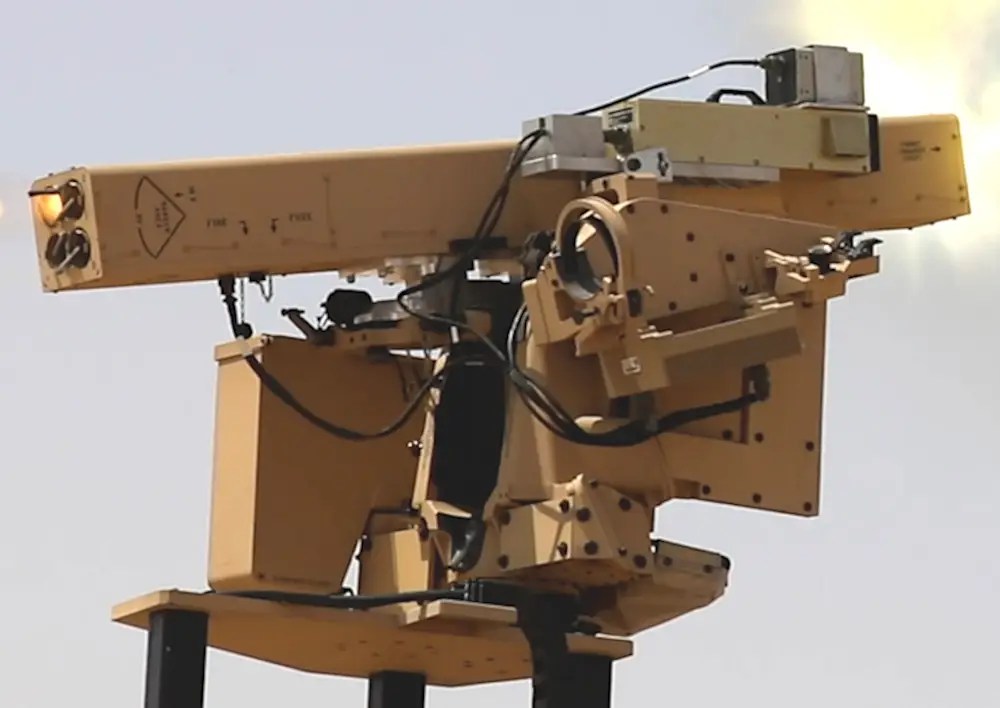
A close-up of the modified CROWS II, a small remote weapons system mount, fitted with the LAND-LGR4 launcher and the added sensor or other system (silver/gray rather than tan). US Army

Here we have a better picture of how the system might be deployed on the PATFORSWA Webber class patrol craft.

The PATFORSWA cutters already have the air search/detection or “hunter” part of a C-UAS system. Reportedly their Mk38 systems have been upgraded to 30mm capable of firing airburst munitions that can provide close in UAS kill capability. Adding a CROWS II RWS with LAND-LGR4 launcher and a laser designator mounted on the O-1 deck, above and behind the Mk38, would allow them to begin engaging UAS and other threats at triple the effective range of the 30mm.

“Navy secretary convenes first cross-department shipbuilders meeting” (at the Coast Guard Yard) –Defense News

Secretary of the Navy Carlos Del Toro, left, visits the Coast Guard Academy on Oct. 13, 2023. (Petty Officer 2nd Class Taylor Bacon/U.S. Coast Guard)

Defense News reports the Secretary of the Navy has initiated an attempt to improve commercial shipbuilding in the US by coordinating the efforts of all the federal agencies that fund ship construction including the Navy, Army and Department of Defense, the Coast Guard, the Maritime Administration, and the National Oceanic and Atmospheric Administration.

“He said the council will meet quarterly but that staff-level meetings will take place more regularly. The group will first establish metrics to measure their success and write and sign a charter to explain their mission.”

There are potentially many topics of interest, hopefully shipbuilders will be asked for their input as well. “How can we streamline the process?” Survivability requirements that drive up size and cost should be looked at for at least some classes.

I would propose a pilot project, development of a true small surface combatant, optimized as an ASW escort to protect sea lines of communication, that could be built in second line shipyards, in large numbers if required for mobilization and that could be a dual service ship, used by both the Navy and Coast Guard in peacetime with perhaps different weapons outfits. It might also serve as a design for foreign military sales.

Such a ship should be capable towing a towed array ASW sensor and operating an ASW helicopter like the MH-60R and a VTOL UAS capable of complimenting ASW search functions of both the ship and helicopter.

It should be possible to keep the size of such a ship under 4,000 tons. The Gibbs and Cox proposal for a light frigate for Australia might be a good starting point.

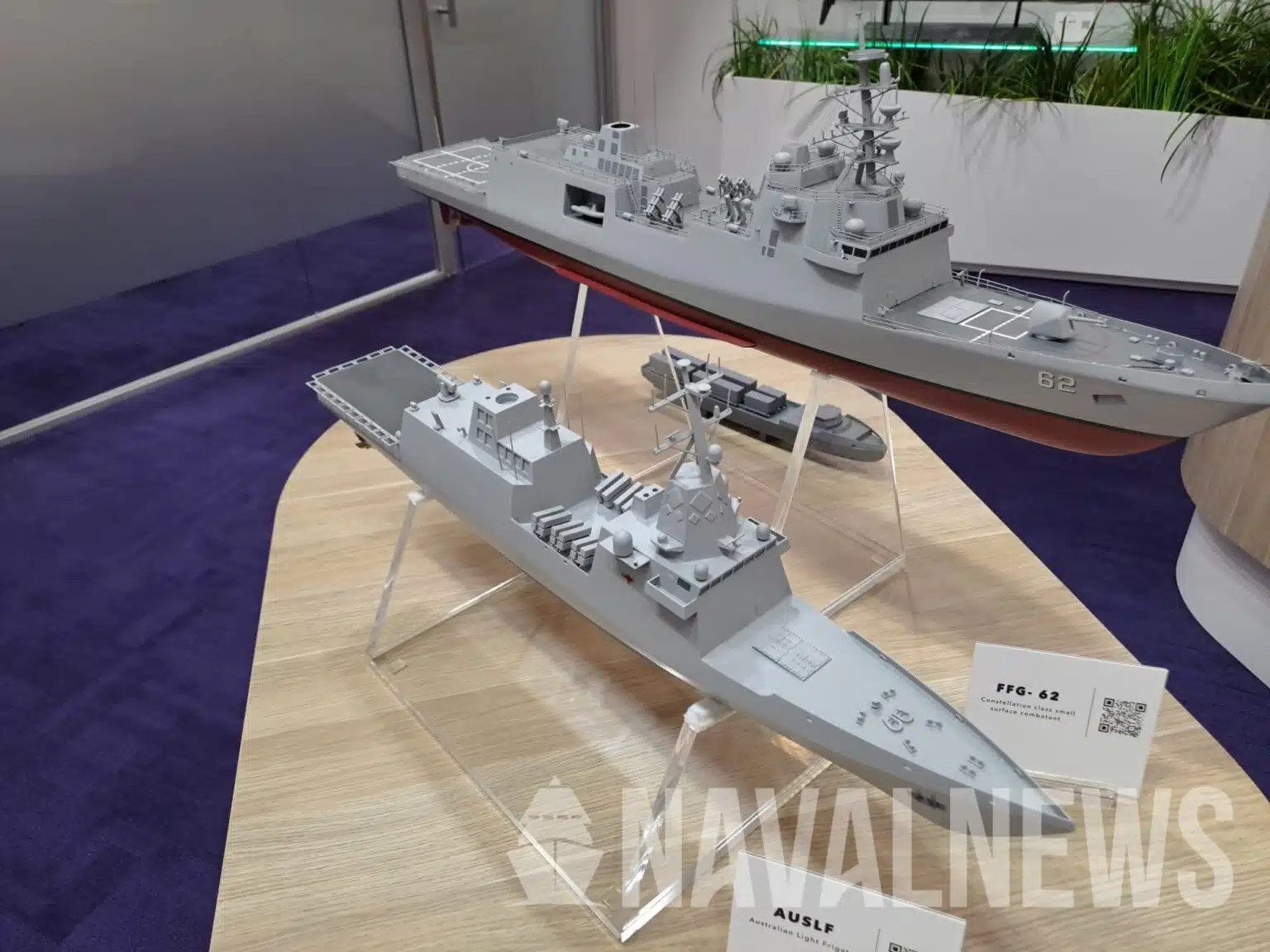
The Australian Light Frigate (foreground) and Constellation class (background) on the Gibbs and Cox stand during Indo Pacific 2023.

“U.S. Coast Guard Cutter Polar Star departs Seattle to begin Operation Deep Freeze in Antarctica” –CG News

USCGC POLAR STAR departs for Operation Deepfreeze, Nov. 16, 2023. US Coast Guard photo.

Below is a news release from Coast Guard news.


Nov. 16, 2023

U.S. Coast Guard Cutter Polar Star departs Seattle to begin Operation Deep Freeze in Antarctica

SEATTLE – The U.S. Coast Guard Cutter Polar Star (WAGB 10) and crew departed Seattle, Wednesday, and are scheduled to transit to Antarctica in support of Operation Deep Freeze.

Operation Deep Freeze (ODF) is an annual joint military mission to resupply the United States Antarctic stations in support of the National Science Foundation (NSF), the lead agency for the United States Antarctic Program (USAP). This marks the 27th year for the Polar Star to render support.

Each year, the Polar Star crew breaks a navigable channel through ice, allowing fuel and supply ships to reach McMurdo Station, which is the largest Antarctic station and the logistics hub of the USAP.

“Operation Deep Freeze is a unique and important mission that Coast Guard Cutter Polar Star undertakes each year,” said Capt. Keith Ropella, Polar Star’s commanding officer. “This mission requires year-round effort from the crew to prepare this 47-year-old cutter for the 20,000 nautical mile round trip and extreme environmental conditions we will face. We have an incredible and dedicated team; I couldn’t be more excited or more proud to make this journey with them.”

The U.S. Coast Guard is recapitalizing its polar icebreaker fleet to ensure continued access to the polar regions and to protect the country’s economic, environmental, and national security interests. Each year, the crew is asked to put forth an immense amount of time and effort to prepare the cutter for their annual deployment in support of ODF. The Polar Star completed the third of five planned phases of the service life extension project (SLEP), costing $15.6 million over a 132-day maintenance period.

“The U.S. Coast Guard is pleased to continue partnering with the National Science Foundation and the U.S. Antarctic Program to enable a durable U.S. presence on Antarctica and across the Southern Ocean,” said Vice Adm. Andrew Tiongson, Pacific Area commander. “Our commitment to the Antarctic region is unwavering, and we have been pleased to increase our maritime cooperation with like-minded members of the Antarctic Treaty, as well as investing in new technologies and vessels to ensure our presence is enduring.”

Joint Task Force-Support Forces Antarctica, provides Department of Defense support to the NSF and the USAP through ODF. Every year, a joint and total force team works together to complete a successful ODF season. Active, Guard, Reserve service members from the U.S. Air Force, Army, Coast Guard, and Navy work together to forge a strong JTF-SFA that continues the proud tradition of U.S. military support to the USAP. The U.S. Coast Guard provides direct logistical support to the NSF and maintains a regional presence that preserves Antarctica as a scientific refuge.

“Personnel Shortage At U.S. Coast Guard Sinks 10 Cutters & 29 Stations” –What is Going on With Shipping?

Above is one of a series of “What is Going on With Shipping?” videos done by Salvatore Mercogliano. Most are not directly Coast Guard related, but this one is spot-on.

Additional Comment

We did talk about this earlier, “Coast Guard adjusts operations plan to mitigate 2024 workforce shortage” –MyCG 

It should be noted that this is not because we have reduced the number of afloat billets, it is because the workforce has not grown as rapidly as the number of billets.

Also, we are not greatly reducing the number of ships compared to historic numbers or the “Program of Record,” The program of record was to provide 8 NSCs, 25 OPCs and 58 FRCs for a total of 91. With these changes we will have 10 NSCs, 23 WMECs, and 55 to 57 FRCs for a total of 88-90 and up to 98 or more as all 65 FRCs currently funded are delivered.

The problems are that the 210s should have been replaced decades ago and demand for Coast Guard assets has increased. The Missions we are doing with the FRCs in the Western Pacific should really be being done by a ship with better seakeeping and endurance and facilities for a helo and UAS, something like “Cutter X.”

“All survive Coast Guard helicopter crash on island near Sitka” –Must Read Alaska

Must Read Alaska reports,

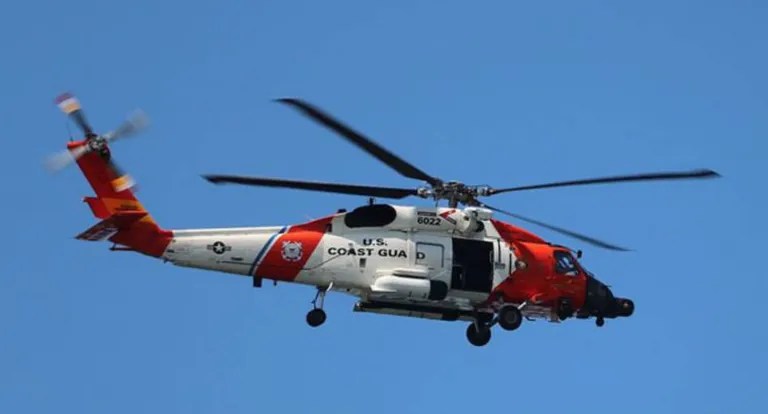
“A Coast Guard MH-60 Jayhawk helicopter air crew from Air Station Sitka crashed with four people aboard on Read Island during a search and rescue mission late Monday night. The crash took place while the helicopter crew was assisting a vessel that had taken on water.”

Thanks to David for bringing this to my attention.


Addition: Below is the a D17 News Release.


Nov. 14, 2023

Coast Guard helicopter crashes in Alaska during search and rescue response

D17 Public Affairs

JUNEAU, Alaska — A Coast Guard MH-60 Jayhawk helicopter air crew from Air Station Sitka crashed with four people aboard on Read Island during a search and rescue mission late Monday night.

Rescue crews from Alaska Wildlife Troopers and Petersburg Fire and Rescue arrived on scene at approximately 12:50 a.m., and a second MH-60 Jayhawk air crew from Air Station Sitka arrived at approximately 1:39 a.m. Together, they provided preliminary medical care to two crew members who were reported to have sustained serious injuries.

The four crew members were hoisted aboard the second Coast Guard helicopter and were transported to Petersburg for medical care. They were then transferred to Seattle via a C-130 Hercules aircraft from Coast Guard Air Station Kodiak for a higher level of care.

The watchstanders received notification of the crash at approximately 11:05 p.m. from the fishing vessel Lydia Marie, who was initially receiving search and rescue assistance from the aircrew due to flooding on their vessel.

“Our priority is to provide the highest level of care possible for our injured members and their families,” said Rear Adm. Megan Dean, commander of the Coast Guard’s 17th District. “We are grateful for the swift response and professional skill shown by the Alaska Wildlife Troopers and Petersburg Fire and Rescue members who answered our call for assistance during this critical time. We have opened an investigation into the cause of this event and will be forthcoming with the results as they become available.”

The U.S. Coast Guard Cutters Elderberry (WLI-65401) and Douglas Denman (WPC 1149) crews assumed responsibility for providing search and rescue assistance to the Lydia Marie and have established a security zone around the crash site.

The cause of the crash is currently under investigation.


An Update.


Nov. 14, 2023

Update 01: Coast Guard continues response to helicopter crash in Alaska during search and rescue case

D17 Public Affairs

JUNEAU, Alaska — Coast Guard crew members injured in the MH-60 Jayhawk helicopter crash Monday night on Read Island continue to receive medical care, and the search and rescue case for fishing vessel Lydia Marie is complete.

As of Tuesday afternoon, the four service members from Coast Guard Air Station Sitka involved in the crash were transported to the Harborview Medical Center in Seattle for a higher level of care via a C-130 Hercules aircraft from Coast Guard Air Station Kodiak.

The two Coast Guard members reported to have serious injuries were listed in serious condition, while the other two members were listed in good condition with minor injuries.

The crew of the U.S. Coast Guard Cutter Elderberry (WLI 65401) oversaw the de-watering of the fishing vessel Lydia Marie and escorted the vessel back to Petersburg. There, the crew of the U.S. Coast Guard Cutter Pike (WPB 87365) conducted a post-search and rescue boarding with no violations, closing the original search and rescue case.

On-scene weather at the beginning of the search and rescue evolution with the Lydia Marie was reported with wind speeds at 28-34 miles per hour and seas at four to five feet. Upon arrival at the scene of the crash, a second Coast Guard MH-60 rescue helicopter reported wind speeds of 46 miles per hour, visibility at one-quarter of a mile, and seas at one to two feet.

Four people were confirmed aboard the Lydia Marie, and their initial call for assistance was transmitted on VHF-FM channel 16 Monday night at approximately 8:06 p.m.

The investigation into the cause of the helicopter crash is ongoing.

Further requests for information by members of the media can be made by contacting the Public Affairs duty watchstander at D17-DG-PublicAffairs@uscg.mil.


Nov. 15, 2023

Update 02: Coast Guard continues investigation of helicopter crash, two released from hospital

D17 Public Affairs

JUNEAU, Alaska — Two Coast Guard crew members have been released from the hospital, and the investigation into the cause of an MH-60 Jayhawk helicopter air crew crash on Read Island continues, Wednesday morning. 

The remaining two crew members who were previously listed in serious condition have improved and are now listed in fair condition.

The investigation into the crash is still ongoing. 

Cutter Size Combatants for Australia

Australia is seeing an urgent need to augment the Strike capability of their Navy. This is reflected in a requirement for light frigate/corvette sized combatants with strong anti-surface (ASuW) and self-defense as well as ASW capability.

The resulting ships are about the size of the latest large US Coast Guard patrol cutters, the 4,600 ton Bertholf class National Security Cutter (NSC) and the 4,500 ton Argus class Offshore Patrol Cutter (OPC), in fact two are smaller. While this may not be an exhaustive list of potential competitors, all three proposals I have seen, are discussed in the video above and outlined below. Each includes 16 to 32 vertical launch system (VLS) cells for a variety of missile types and 16 to 24 deck launchers for Anti-Ship Cruise Missiles (ASCM, presumably Naval Strike Missiles). (As these designs are about a decade newer than the OPC, the winning design might form the basis for a future cutter class.)

Navatia’s offer, the Tasman class corvette, is the same length as the Argus class Offshore Patrol Cutters (110 meters / 360′), but considerably lighter at 3,600 tons full load (vs 4500 tons). This class is to be based on a class built for Saudi Arabia, which is in turned based on a class of Offshore Patrol Vessels built for Venezuela. The proposal includes 16 VLS and 16 ASCM launch tubes. Presumably they will be diesel powered with a speed about the same as the parent designs, 25 knots.

The Australian Light Frigate (foreground) and Constellation class (background) on the Gibbs and Cox stand during Indo Pacific 2023.

Gibbs and Cox proposal (pictured above), at 117 meters in length and 3,800 tons, this design is also smaller than the OPC by 700 tons. It takes the novel approach of deleting the usual main gun entirely in favor of 32 VLS and 24 ASCM launch tubes. CIWS would be provided by Phalanx or SeaRAM and close-in anti-surface and “shot across the bow” signaling would be provided by Mk38 gun mount or equivalent. (This may be taking the trend to smaller main guns to its logical conclusion.) Speed will be at least 30 knots using CODELAG GE LM2500+ propulsion.

TKMS offers MEKO A210 Frigate. This is a bit larger, at 4700 tons, 200 tons larger than the OPC and 100 tons larger than the National Security Cutter. The proposal includes 32 VLS and 16 ASCM. It is powered, like the earlier A200 frigates, by two diesels each driving conventional propellers and a gas turbine driving a central water jet, a system TKMS calls CODAG-WARP (WAter jet and Refined Propellers). Speed is likely 28-29 knots.

“AEROVIRONMENT’S JUMP 20 MEDIUM UAS DEMONSTRATES MARITIME AUTONOMOUS TAKEOFF AND LANDING AT VESSEL SPEEDS OVER 20 KNOTS” –News Release

Below is a news release from AeroVironment reporting autonomous takeoff and landing from USNS Burlington (T-EPF-10), pictured below, at speeds of over 20 knots. I also found the video above that shows operation from a smaller vessel and provides more detail of how the unmanned aircraft is operated and supported.

CARIBBEAN SEA (Aug. 25, 2021) The Spearhead-class expeditionary fast transport ship USNS Burlington (T-EPF 10) operates off the coast of Haiti, Aug. 25, 2021. Burlington is deployed to U.S. Naval Forces Southern Command/U.S. 4th Fleet to support humanitarian assistance and disaster relief (HADR) efforts in Haiti following a 7.2-magnitude earthquake on Aug. 14, 2021. (U.S. Navy photo by Mass Communication Specialist 2nd Class Jack D. Aistrup)

Another good video here:

It appears 4th Fleet is trying to fulfill their self proclaimed role as the Fleet for Innovation.


AEROVIRONMENT’S JUMP 20 MEDIUM UAS DEMONSTRATES MARITIME AUTONOMOUS TAKEOFF AND LANDING AT VESSEL SPEEDS OVER 20 KNOTS

NOVEMBER 07, 2023

ARLINGTON, Va., November 07, 2023 – AeroVironment, Inc (NASDAQ: AVAV) today announced the company’s JUMP 20 VTOL Medium UAS exceeded expectations during the recent U.S. Naval Forces Southern Command/4th Fleet Hybrid Fleet Campaign Event (HFCE) that demonstrated human-machine teaming in the maritime domain. The JUMP 20 provided ship-based intelligence, surveillance, reconnaissance, and targeting (ISR-T) support to USFOURTHFLT and USSOUTHCOM during the week-long, at-sea exercise onboard USNS Burlington. The JUMP 20 has previously flown over 130,000 land-based hours in support of U.S. Special Operations Command combat deployments, and the expansion of JUMP 20 operations into the shipboard environment allows AeroVironment to provide these services globally.

During HFCE, JUMP 20 showcased its ability to launch and recover at vessel speeds over 20 knots, with fully autonomous flight from takeoff to landing.  The JUMP 20 requires neither launch or recovery equipment, nor personnel on the flight deck during launch and recovery, maximizing operational safety and flexibility for users. JUMP 20’s vertical takeoff and landing (VTOL) capability, and class-leading endurance and payload capacity expand the operational capabilities of U.S. and allies to compete and win in the era of great power competition.  The JUMP 20 demonstrated how uncrewed systems will support distributed operations across multiple domains, supporting national security objectives and our warfighters.

“The shipboard flight environment is dynamic and challenging. JUMP 20 is a proven combat-effective platform, and the system’s performance during HFCE illustrates the value to maritime operations.  JUMP 20’s ability to launch and land at speed, and without personnel intervention, enhances the ship’s operational effectiveness and enables operators to focus on important mission tasking,” said Shane Hastings, AeroVironment’s vice president and product line general manager for Medium UAS. “As we continue to demonstrate and prove the effectiveness of the JUMP 20 platform, we look forward to getting this capability in the hands of our sailors, Marines, and allies operating in the maritime environment.” AeroVironment JUMP 20 is deployed to U.S. and allied militaries around the world, and it can be provided on a contractor-owned / contractor-operated (COCO) basis to maximize operational flexibility.

“U.S. Coast Guard Cutter Terrell Horne returns to home port following a 52-day multi-mission patrol in the Eastern Pacific” –CG News

PERU, 10.06.2023, Courtesy Photo, USCG District 11
The crew of the U.S. Coast Guard Cutter Terrell Horne conducts a patrol in the Eastern Pacific Ocean in support of Operation Southern Shield 2023, October 2023. The Coast Guard recently completed the first high-seas boardings and inspections off the coast of Peru under a newly adopted multi-lateral agreement to monitor fishing and transshipment operations within the South Pacific Regional Fisheries Management Organization (SPRFMO) Convention Area. (U.S. Coast Guard photo)

Below is a news release from Coast Guard News. This patrol was unusual enough to draw some special attention. It is not a typical patrol craft mission. It involved the pairing of a buoy tender with a “Fast Response Cutter” (FRC) to put two units far from their homeports. The Pacific Area has done this before in the Western Pacific, but I think this may be the first time it has been done in the Eastern Pacific off the West coast of South America. Pacific Area Webber class FRCs have previously conducted drug enforcement missions in the Eastern Pacific at least as far South as Central America. We talked about portions of this multiunit deployment earlier, “Buoy Tender, FRC, C-130 Used for International Fisheries Enforcement–Operation Southern Shield.” USCGC Alder, homeported in San Franciso, was the buoy tender involved.

The emphasis of the operation was international fisheries enforcement, but USCGC Terrell Horne still managed to do a bit of drug enforcement. I look forward to seeing the report of USCGC Alder’s portion of the operation.

09.25.2023, Courtesy Photo, USCG District 11
U.S. Coast Guard Cutter Alder (background) transits in formation alongside Peru BAP (Buque Armada Peruana) Bolognesi (FM-57) as it prepares for the next exercise during GALAPEX 2023, Sept.25, 2023. GALAPEX is a recurring multi-national maritime exercise led by Ecuador and included participation of delegates from Argentina, Brazil, Chile, Colombia, Costa Rica, the European Union, France, Italy, Mexico, Panama, Peru, the United Kingdom, and the United
States. (U.S. Coast Guard photo)

Nov. 8, 2023

U.S. Coast Guard Cutter Terrell Horne returns to home port following a 52-day multi-mission patrol in the Eastern Pacific

Coast Guard District Eleven

SAN PEDRO, Calif. — The U.S. Coast Guard Cutter Terrell Horne and crew returned to their home port in Los Angeles/Long Beach Tuesday after a 52-day patrol across the Eastern Pacific.

The crew of the Terrell Horne deployed in support of multiple missions, including Operations Green Flash, Albatross, Martillo, and Southern Shield, within the 11th Coast Guard District’s area of responsibility. During the patrol, Terrell Horne’s crew conducted a range of missions encompassing law enforcement, counter-drug operations, illegal, unreported, and unregulated fishing enforcement, and search and rescue operations.

“The crew of the Terrel Horne lived up to the cutter’s namesake in every way during this patrol. Operation Southern Shield allowed the cutter to showcase the versatility of the Fast Response Cutter. This operation brought a patrol boat and a buoy tender almost 4,000 nautical miles from home, conducting operations and international engagements with Mexico, Ecuador, Peru, and Costa Rica, said Chief Warrant Officer Jason Bussell, the commanding officer of the Coast Guard Cutter Terrell Horne. “The crew excelled in counter-illegal fishing missions, search and rescue, and counter-drug operations. Working alongside other Coast Guard assets, the crew was able to interdict a drug smuggling vessel and assisted in the seizure of nearly 2,000 lbs of contraband.”

The Coast Guard commissioned the Terrell Horne as the 31st Fast Response Cutter on March 22, 2019. Coast The cutter is named for Senior Chief Terrell Horne III, who died from injuries sustained while conducting maritime law enforcement operations off the California coast in December 2012. He was the executive petty officer aboard the Coast Guard Cutter Halibut at the time. For his heroic actions, the Coast Guard posthumously promoted Horne to senior chief petty officer.

For information on how to join the U.S. Coast Guard, visit GoCoastGuard.com to learn about active duty, reserve, officer and enlisted opportunities. Information on how to apply to the U.S. Coast Guard Academy can be found here.