President Biden is considering expanding the Pacific Remote Islands Marine Monument (PRIMNM). A major concern of the initiative (besides that it harshly impedes indigenous fishers), is it may allow foreign illegal fishing to take stronger hold inside U.S. Exclusive Economic Zones. Hawai’i Council member Matt Ramsey warns, “we need to consider that the whole monument boundary is surrounded by more than 3,000 foreign vessels that fish in the Western and Central Pacific Ocean.” If President Biden expands the PRIMNM, the region would require a significant increase in maritime security forces to ensure illegal fishing does not imperil U.S. resources and render the PRIMNM impotent.
The Pacific Remote Islands Marinte Monument was enlarged in 2014, making it six times larger than it had been previously. It is already as large as the entire US Atlantic Coast EEZ (considering the Gulf Coast separate). I noted at the time, that it would require additional forces to police the area, as a reserve without enforcement will only keep the honest people out.
The current threat of IUU fishing in the Western Pacific was not a significant consideration when the Program of Record (POR) was determined in 2004. That suggest that we may need more than the planned 64 Fast Response Cutters (58 in the original POR plus six more for PATFORSWA).
Three Webber class in Pago Pago, American Samoa is a good start, but it may not be enough. If we don’t add any more Bertolf class National Security Cutters in the Western Pacific, it seems likely we may need to add OPCs to mix.
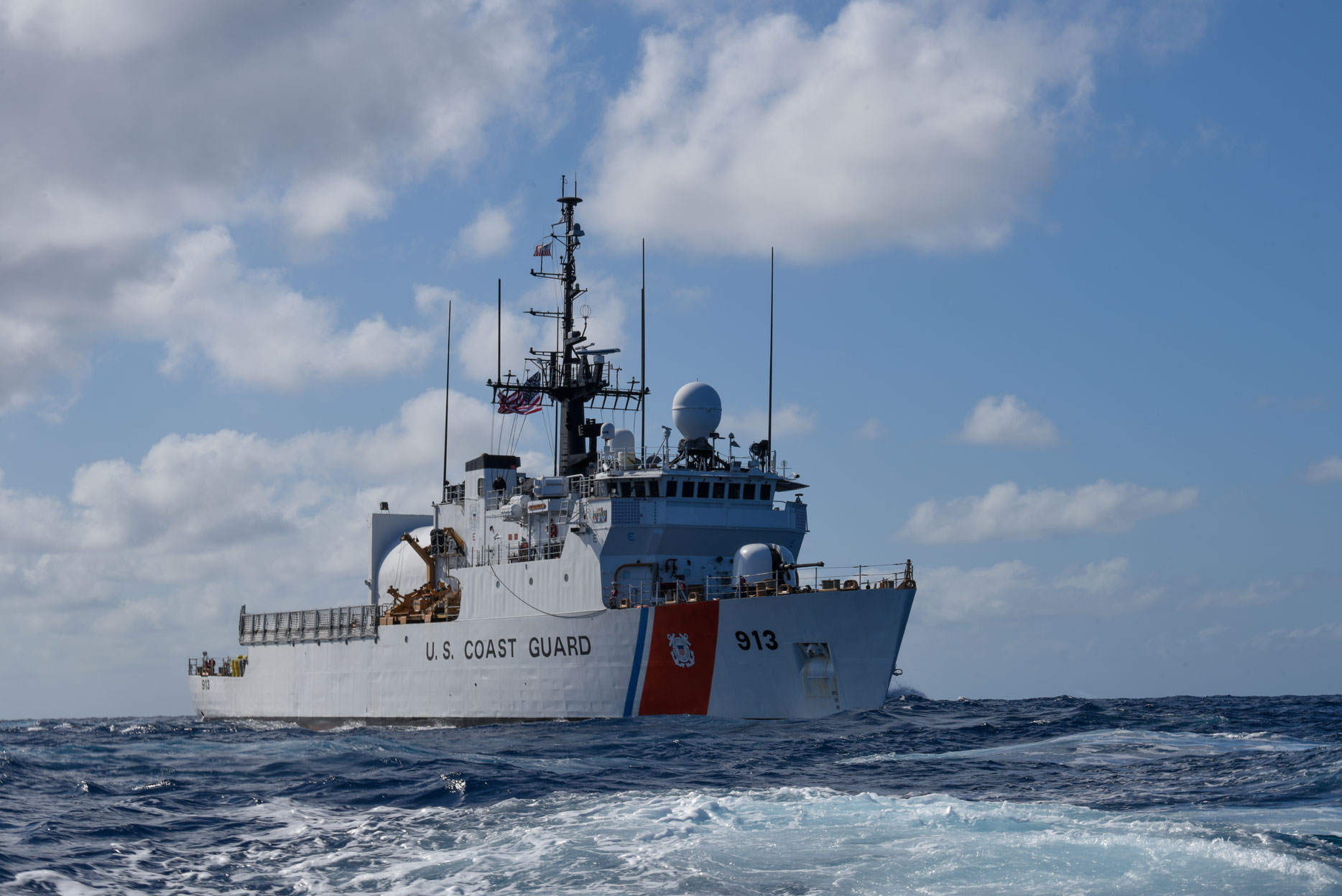
“Famous-class medium endurance cutter USCGC Mohawk (WMEC 913) arrived in Dakar, Senegal for a scheduled port visit, July 12, 2022…During the visit, Mohawk leadership will meet with U.S. embassy leaders to continue building on the United States’ strong maritime partnership with Senegal…This port visit also marks the first stop in Africa for Mohawk during their maritime patrol in the Gulf of Guinea. Mohawk is forward-deployed to the U.S. Naval Forces Africa (NAVAF) area of operations, while employed by U.S. Sixth Fleet.”
Mohawk had escorted the last pair of Webber class bound for PATFORSWA, USCGC John Scheuerman (WPC 1146), and USCGC Clarence Sutphin Jr. (WPC 1147), across the Atlantic. Before Mohawk goes home or the WPCs get to Bahrain, they are doing some relationship and capacity building. Earlier Mohawk had stopped in Lisbon. Meanwhile the Webber class cutters made one of probably several portcalls enroute Bahrain in Algeria.
Peruvian Navy corvette BAP Guise (CC-28) makes a pass during a ship maneuvering exercise during Rim of the Pacific (RIMPAC) 2022 on July 13, 2022. US Coast Guard Photo
At least two people were injured in a fire that burned for several hours on a Peruvian warship participating in RIMPAC 2022, a Navy official said Sunday…
Two personnel, in “critically stable” condition, were evacuated from the Combined Task Force surface vessel by a French helicopter from frigate FS Prairial (F731), Robertson said. They were taken to U.S. Coast Guard cutter USCGC Midgett (WMSL-757) then to carrier USS Abraham Lincoln (CVN-72) and then to shore.
Coast Guard Cutter Midgett is commanding Combined Task Force 175, which includes ships from France, Peru and the U.S. Navy, and is conducting air and missile defense, gunnery, mass rescue and anti-submarine warfare exercises.
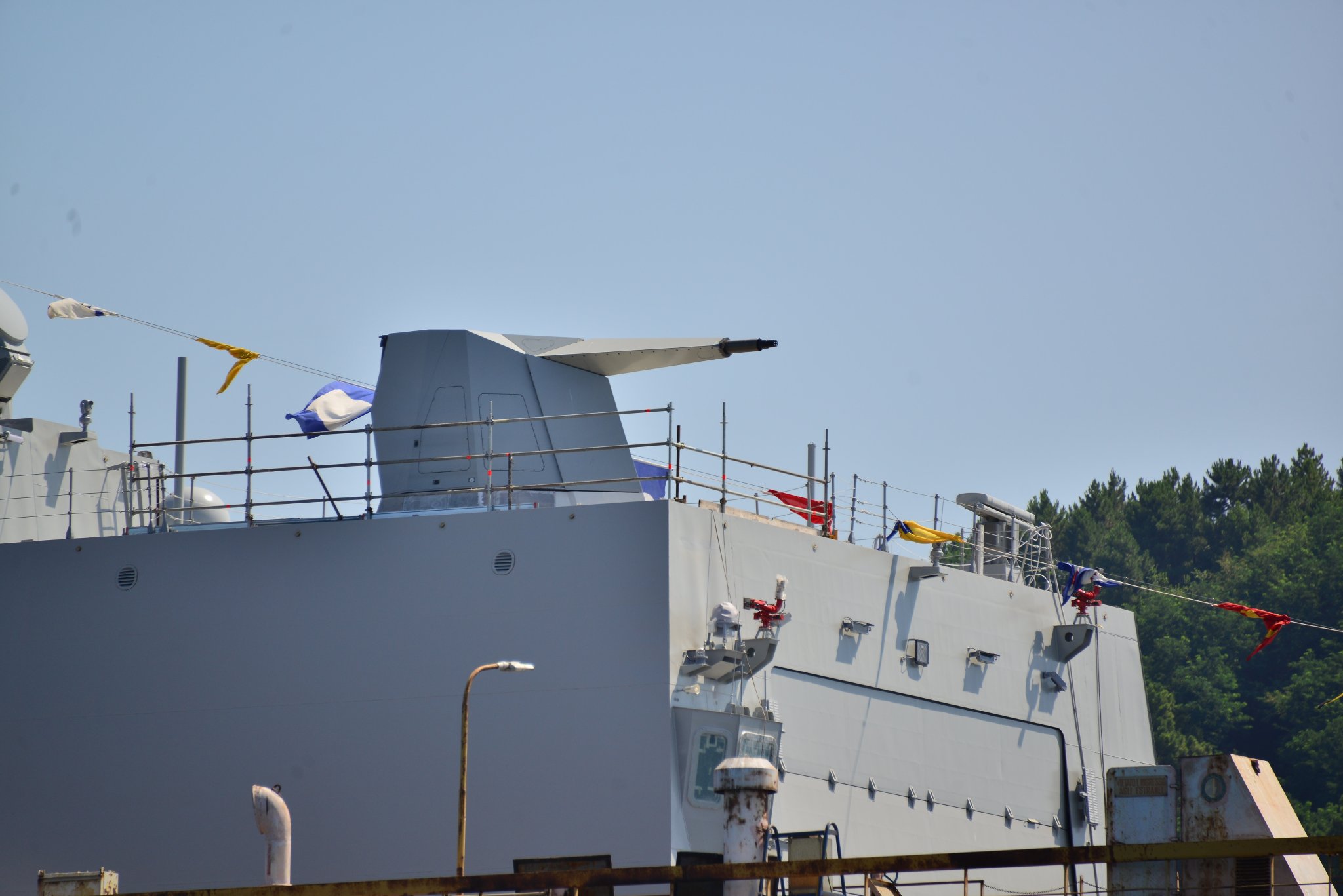
Leonardo 76/62 Sovraponte (Single Deck) naval gun system fitted on the helicopter hangar of the Italian Navy PPA type vessel.
Knowing that a ship will last decades into an uncertain future, when you consider how a ship should be armed.
You want at least two weapons capable of engaging each type of threat for redundancy.
You want the weapons separated so that one hit will not disable all your weapons.
You want to be able to engage more than one target at a time.
You want 360 degree coverage, particularly against air and swarming surface threats.
In addition to self defense, you may want to be able to hit targets on shore. (The Coast Guard did a lot of that in Vietnam.)
It helps both training and logistics if the weapons are versitile enoungh that we can minimize the number of weapon types required. Ideally you want one type of weapon that can do it all.
The 76mm/62 gun may be the most produced medium caliber gun since the 5″/38 of WWII fame, with perhaps more users than any naval gun in history. The Coast Guard still has this gun, the 76mm Mk75, mounted on the Bear class WMECs. Since then, a different, much improved “Super Rapid” (SR) mount has been developed specifically for anti-ship cruise missile (ASCM) defense. In fact, it is designed to deal with the simultaneous arrival of multiple ASCMs.
The Italian Navy considers the SR to be an effective anti-missile weapon and new ships are being built with this weapon in place of the twin “Fast 40” used on earlier ships in that role. OTO-Melara estimates that, combined with the Dardo FCS, the SR can begin engaging attacking missiles at about 6,600 yards (6,000 m), with the first rounds arriving on target at 6,000 yards (5,500 m). With these ranges, a single gun can deal with up to four subsonic sea-skimmer missiles, arriving simultaneously on courses 90 degrees apart, before any reaches 1,100 yards (1,000 m).
The Deck Mounting Advantage
Topside space on many ships is at a premium. Sensors, ECM, comms, and weapons compete for space. A gun normally enjoys pride of place on the bow, but it is more difficult to site weapons on the stern, particularly if they require ammunition handling space under the weapon.
This new mount should retain the capabilities of the SR mount (aside from fewer ready service rounds–76, almost as many as we had on the Mk75, but with the advantage of dual selectable feed) and adds the advantage that it does not require an ammunition handling space below the mount. A clever repackaging of the ubiquitous former Oto-Melara 76 mm gun looks looks like it could be the answer to a number of difficult weapon siting questions This means that it can be mounted in areas where the previous SR mount could not have been mounted, such as on the roof of helicopter hangars or on the fantail where steering gear is directly below (like where the Phalanx was located on the FRAMed 378s).
Frequently, the top of the hangar is to best location, but the space under the roof is already taken up. Weapons like the 25 mm Mk38, the 20 mm Phalanx, or the SeaRAM missle systems can usually find space aft, frequently on top of the hangar, because they don’t require deck penetration, but they do not have the versatility of the 76mm.
That might not matter much on more powerful warships that have a range of different weapons to address different threats, but for ships with a limited number of weapons, it can be critical.
The Alternatives
Looking at the US Navy weapons that are typically mounted on top of the hangar because they don’t require below deck ammunition handling space:
The Mk38 even in the anticipated Mod4 version is a short range (4400 yard max/2200 yard effective) weapon with only minimal anti-air capability and suitable for engaging only small surface targets.
The 20mm Phalanx is capable against ASCMs but it was designed to stop “leakers,” as a last ditch back up to more capable systems. It was never intended as a complete, stand alone ASCM defense systtem. If multiple ASCMs arrive simultaneously, it could probably successfully engage only one, or at most two. It does have limited short range counter drone and counter-swarm capability, but its projectile is a non explosive high velocity .50 caliber, so its effect on any but the smallest surface vessel is likely to be very limited and only then at very short range (1625 yard effective). Quoting from the link in this paragraph,
In recent years, the Vulcan 20 mm gun that is the heart of this weapon has increasingly been seen as not being effective enough against modern missile threats. However, the British Royal Navy did select Phalanx for their new Daring class Type 45 destroyers.
Phalanx is somewhat notorious for having maintenance problems, with the Navy’s Material Readiness Database for fiscal years 1997 through 1999 noting that Phalanx Block 1B (all mods) had an availability rate of between 72 and 81% for this time period.
The RIM-116 Rolling Airframe Missile (RAM and SeaRAM) is probably the best short range counter to anti-ship cruise missile (ASCM) in the USN inventory. I can understand why the Dutch chose it for the Karel Doorman upgrade. It has been modified to incorporate an anti-Helicopter, Aircraft, and Surface (“HAS”) capability. Range is reportedly 10,000 meters, about 11,000 yards, and it has a decent sized warhead, 11.3 kg (24.9 lb). That is far more than the range of the either the Mk38 or the Phalanx.
Each of these is designed for a particular threat. RAM is by far the most versatile but even it cannot match range and capabilities of the 76mm with its numerous ammunition alternatives.
Programable Fuze: Like the 57mm Mk110, the 76mm can use a programable fuze, the 3A-Plus programmable multi-role fuze. It is described as having several modes including a time mode for air burst and a number of proximity modes: gated proximity, anti-missile proximity, conventional air defence proximity and anti-surface proximity. The fuzing includes a digital signal processor which rejects ground/sea clutter and so is claimed to be capable of detecting a missile flying as low as two meters above sea level while being able to recognise a target at a 10-meter stand-off.
Guided munitions are being developed for the 57mm Mk 110 (ALaMO and MAD-FIRES). These technologies could also be applied to the larger 76mm round, but a capability that appears similar to MAD-FIRES has been available with the 76mm for about a decade, with the advantage that it includes a proximity fuze. Additionally, reportedly, extended range rounds that may be guided against both fixed and moving targets are or soon will be available for the 76mm.
DART (Driven Ammunition Reduced Time of Flight):
European Defense Review On-Line reports,
“…the Super Rapido is offered in the Strales (or Davide as identified by Italian Navy) configuration based on the DART (Driven Ammunition with Reduced Time of Flight) guided ammunition and a Ka-band guidance radar antenna required to generate the ammunition guidance beam installed on the gun mount. The sub-caliber DART projectiles demonstrated an effective range up to 8 km (in comparison with a 4.5 km requirement) and a 1,200 m/s initial velocity allowing to cover 5 km in 5 seconds. These performances together with the high maneuverability of the DART round allowed the system to demonstrate its effectiveness against present and future ASCM targets, at a fraction of the cost of a missile engagement but with equivalent performances, Leonardo claims.”
Quoting from Wikipedia:
The DART projectile…is a guided gun projectile with radio controls and a proximity fuze for low level engagement (up to 2 meters over the sea). DART is fired at 1,200 m/s (3,900 ft/s), can reach 5 km range in only 5 seconds, and can perform up to 40G manoeuvre.The DART projectile is made of two parts: the forward is free to rotate and has two small canard wings for flight control. The aft part has the 2.5 kg warhead (with tungsten cubes and the 3A millimetric wave new fuze), six fixed wings and the radio receivers.
The guidance system is Command Line of Sight (CLOS). It uses a TX antenna installed on gun. The radio-command for them is provided on a broadcast data-link (Ka Band).
The first lot of DART 76mm guided ammunition, produced by OTO Melara, was successfully tested at the end of March, 2014. The firing trials were conducted on board one of the Italian Navy’s ships equipped with Strales 76mm SR and Selex NA25 fire control system. The first firing trials of the DART ammunition bought by Colombia in 2012 were successfully conducted in the Caribbean Sea on 29 August from the 76/62 Strales inner-layer defence system fitted to its modernised FS 1500 Padilla-class frigates.
Above is a video of the DART validation tests, first against a low level, but essentially stationary targert to test the fuzing against a target in sea clutter and then against a moving target, in this case a Banshee target drone. I believe the antennae seen attached above the gun barrel were part of the test rig, as these are not normally present on the gun mounts.
Vulcano
I see the possibility that there may be a confrontation between Offshore Patrol Vessels (OPV) in the South China Sea or East China Sea in which a China Coast Guard (CCG) vessel fires warning shots and directs the OPV of another Asian nation (I will call AN) to depart a disputed area. The AN OPV stands it ground and refuses to leave. The CCG OPV having a longer ranged weapon (up to 76mm currently), remains outside the range of the AN OPV and fires a few rounds for effect in an attempt to drive the AN OPV away. Whether the CCG OPV scores any hits or not, the AN OPV now has three choice, none good, stay and perhaps take additional damage, run away, or attempt to close the CCG OPV to get in range for a fight they will probably lose.
In 2021 Russia claimed to have fired warning shots in driving a Royal Navy Destroyer from waters of Crimea. The claim was untrue, but for many audiances, the claim probably went unchallenged.
Range matters, in the scenario above, if the AN OPV had a weapon of equal or greater range than that of the CCG OPV, the CCG OPV would probably never have fired to hit, because it could not have done so with impunitity. Reportedly, 76mm Volcano rounds that will outrange conventional rounds from Chinese and Russia guns, not just 76mm but also 100mm (3.9″) and 130mm (5.1″) and reach any target within the visual and radar horizon (to over 40,000 meters)
The Vulcano family will actually include at least three different types of 11 lbs. (5 kg), extended range, sub-caliber discarding sabot projectiles.
Unguided Balistic Extended Range (BER) (range over 30 km/32,808 yards)
Guided Long Range (GLR) (range over 40 km/43,744 yards)
Guided Long Range with InfraRed Terminal Homing (GLR/IR)(range 40 km/43,744 yards)
a Guided Long Range with Semi-Active Laser (GLR/SAL) is in development
Leonardo advertises Vulcano rounds for the 76mm as if they are already available. But also advises it is still under development. Apparently development is expected to be complete this year.
The more recent development is the VULCANO 76 ammunition system. Basically, it is a scaled down version of the 127–155 mm Vulcano family of extended-range projectiles developed by Oto Melara; guided by Inertial Navigation System and Global Positioning Systems, it is capable of hitting targets twice the distance of normal 76 mm gun ammunition. GPS-IMU guidance and IR or SAL (Semi-Active Laser-Chuck) Terminal sensor. The Vulcano 76 GLR ammunition is expected to complete the development, test and qualification process by late 2022 with the delivery of production rounds to customers from 2023–24 onwards.
The Unguided Balistic Extended Range (BER) Vulcano round may already be operational. It would certainly be the easiest to develop. This high velocity sub-caliber discarding sabot round is usable for anti-air, anti-surface, or for Naval Gun Fire Support. At 5 kg (11 pounds) it is still about twice the weight of a 57mm Mk110 projectile. It has a multifunctional Fuze that provides options for altimetric, proximity, time and air burst, or impact and delayed impact.
Considering the Coast Guard’s implicit requirement to be able to forcibly stop even relatively large merchant ships, the combination of high velocity, semi-armor piercing, and delayed impact fuzing suggest that a BER projectile might have a better chance of penetrating the hull and delaying detonation until the projectile impacts the engine, compared to the other alternatives.
Guided Long Range (GLR):
These projectiles take the form of the unguided Ballistic Extended Range (BER) round and add GPS and inertial guidance to allow precision attack on fixed targets. The control surfaces allow a glide phase that extends the range another 10,000 meters to beyond 40,000 meter or about 22 nautical miles.
Guide Long Range with InfraRed Terminal Homing (GLR/IR):
These projectiles add a infrared terminal homing to the guided long range round so that it can target moving targets on land or water that have an infrared signature. The guidance system defines where the terminal homer will look for a target. It might be possible to defeat this round using IR decoys or obsurants (smoke).
Guided Long Range with Semi-Active Laser Homing (GLR/SAL):
Like the GLR/IR round this uses the form and function of the GLR round but instead of using IR homing, it uses semi-active laser homing, meaning some one or some thing has to illuminate the target with a laser designator. For shore bombardment the laser designator might be in the hands of a soldier on the ground. For targets afloat and ashore the laser designation might be done by an unmanned system.
For a Coast Guard cutter trying to forcibly stop a vessel, the cutter might well use a laser designator to target a particular part of the target vessel.
Conclusion:
If you are going to put only two gun weapon systems on a ship, be it a cutter, corvette, or a large auxiliary, two of these might be a very good choice if they perform as advertised. Range with volcano ammunition is outstanding. The range of ammunition choices make these systems effective against a wide range of threats from swarming small boats, to surface ships, to UAS, to anti-ship cruise missiles. It is essentially one weapon that can do it all, atleast within the visual and radar horizon and in some cases a bit beyond.
Seems a pair of these would be a nice replacement for the two 25mm MK38s that appear to be the planned armament for the the Polar Security Cutter. Would love to see a pair of these replace the 57mm Mk 110 and 25mm Mk38 or Phalanx on our new large cutters. Replacing the Mk38 or Phalanx with SeaRAM seems more probable, but still unlikely, unless things get a lot more tense.
ATLANTIC OCEAN (Feb. 23, 2021) — USCGC Charles Moulthrope (WPC 1141) conducted Astern Refueling at Sea training with the USCGC Venturous (WMEC 625). This evolution provides vital fuel to extend the endurance and range of FRC and provided an excellent training opportunity for both crews. (U.S. Coast Guard photo by Petty Officer 1st Class Sydney Niemi/Released)
US Naval Institute Proceedings has an essay that was chosen as third place winner in their “Midshipmen & Cadets Essay Contest,” written by now Ensign Logan Tobias. He contends, “The U.S. Coast Guard Academy is failing as a commissioning source for future leaders in the maritime domain. “
He suggests that the Academy has prioritized academics over professional training, and further that it is failing to graduate officers with “a love for the sea.” He also suggest that the class ranking system (military precedence average (MPA) calculation) which is weighted to consider suitability for service or military performance (MPI) as only 25% of the total undermines professional development.
The MPA formula ensures academics always take precedence even though it is widely understood that MPI better encapsulates what it means to be an effective officer. In fact, a study commissioned by the U.S. Military Academy demonstrated that the correlation between academic success and officer effectiveness “did not demonstrate a very high relationship.”
Pointing out that academic performance and leadership do not necessarily go hand in hand he suggests, an evaluative prioritization shift to 55 percent GPA, 40 percent MPI, 5 percent PDC will help cadets reassess their priorities, allowing them to pursue opportunities for professional development not as a tradeoff for MPA points, but to advance both their personal readiness and class rank at the same time.
It does seem like sea-going experience is taking a hit.
In total, cadets accumulate approximately 140 sea days before graduation: 6-weeks on board the USCGC Barque Eagle (WIX-327) during third-class summer, three weeks on board 44-foot sailing yachts during second-class summer, and 11-weeks on board a cutter during first-class summer. However, this practicum is of questionable efficacy, as sailing a yacht to Nantucket is only tenuously related to conning a Coast Guard cutter. Moreover, many first class go to drydocked cutters, never leaving the pier, or only go underway for 6 weeks rather than 11, opting instead for internships and air stations. In summer 2021, more than one third of first-class cadets were assigned to internships or air stations. This apportionment helped contribute to 42 percent of the class not having enough sea time to earn a 100-ton license as of November 2021.
Forgive me, I am going to indulge in a bit of “back in my day,” even though it was long, long ago in a galaxie far, far away.
My class and those of that now ancient era had an organized training cruise every year. Newly arrived “swabs” (4th class/freshmen) capped swab summer with a short two week cruise that also included the 2nd class cadets. 3rd class and 1st class cadet had a 10 week cruise. That is 24 weeks afloat compared to the current 20 weeks but there were other significant differences. Even then there were some departures from this typical schedule but these were normally only available to second and first class cadets.
First, we all knew our first assignment would be afloat, so it focused the mind.
The 10 week cruises were organized as a training squadron of several ships whose only mission was training cadets. None of them were tied up in port except for scheduled short port calls.
Academy officers were assigned to the ships to coordinate cadet training with the ships.
The first class cadets began to learn officer duties, OOD, CIC, Navigator, Damage Control and Engineering.
Perhaps most importantly, the third class cadets would stand watches with enlisted sailors as messenger, helm, BMOW, evaporator watch, generators, main prop, mess cook, radarman, quartermaster, etc. We lived in enlisted berthing and eat on the messdeck. We would lower and raise boats and served in the boat crews in different positions. We manned and fired the 5″ gun. We did man overboard drills. We laid out the hawser and did towing drills, towing and being towed. We worked maneuvering board solutions for stationing problems, learning a lot about relative motion. This gave us a good understanding of what we could and should expect of our enlisted personnel. This is something you don’t get on Eagle or on a 44 sloop.
That third class year long cruise may be the most important thing missing now. Being part of a good crew is a great part of the allure of sea duty. That cruise gave us a taste of that.
Bottom line, if the academy does not provide better trained and better motivated Coast Guard officers than other sources, it has no need to exist.
The author may be wrong in his assessment. Current requirement may make it impossible to train everyone to be ship drivers or marine engineers, but the background does provide a degree of credibility for marine inspectors and a better understanding for our aviators. I would think, at least for the first two summers’ training would strongly emphasize an afloat career path.
Mexican law enforcement were looking for someone with two warrants out for his arrest in Mexico and an extradition order for the United States, according to the release.
The loss was related to the capture of convicted Mexican drug kingpin Rafael Caro Quintero, wanted by US authorities for allegedly kidnapping and conspiring to murder Drug Enforcement Administration (DEA) Special Agent Enrique Camarena Salazar in 1985.
The Mexican Navy and Marine Corps have proven to be one of the most reliable and incorruptable institutions in Mexico. Hopefully the USCG will extend its sympathies to our partners in Mexico. We know how devastating such a loss can be.
Below is a news release from Eastern Shipbuilding, quoted in full.
FOR IMMEDIATE RELEASE
July 15, 2022
EASTERN SHIPBUILDING GROUP ANNOUNCES KEEL AUTHENTICATION FOR THIRD UNITED STATES COAST GUARD OFFSHORE PATROL CUTTER INGHAM (WMSM-917)
PANAMA CITY, FL – Today, Eastern Shipbuilding Group, Inc. (ESG) hosted the keel authentication ceremony for the U.S. Coast Guard’s future Offshore Patrol Cutter (OPC), USCGC INGHAM (WMSM-917), the third vessel in the new Heritage Class built at the Nelson Street facility. The presiding official for the U.S. Coast Guard was Rear Admiral Chad L. Jacoby, Director of Acquisition Programs & Program Executive Officer (CG-93). Congressman Neal Dunn (FL – 2nd District) was the senior official in attendance.
“Today marks another pivotal milestone in the legacy of the Heritage Class Offshore Patrol Cutters constructed here in Panama City as we now have three OPCs in full production on time and on budget. I’m proud of our workforce for delivering shipbuilding excellence to the men and women of the USCG,” said ESG President Joey D’Isernia.
The ship’s sponsor is Alaskan Senator Lisa Murkowski, a member of the Senate Appropriations Committee, and strong advocate for the national defense and coastal priorities in the Pacific and Arctic regions. USCGC INGHAM will be homeported in Kodiak, Alaska with Senator Murkowski’s signature welded on the keel. She has worked to ensure that those stationed there will have new housing, an updated Child Development Center, and a new fuel pier.
“Thank you to the U.S. Coast Guard and Eastern Shipbuilding Group for inviting me to join a maritime honored tradition—by serving as the ship’s sponsor to the newest Coast Guard Cutter Ingham. I commend the hundreds of skilled professionals at Eastern Shipbuilding Group there in Panama City, Florida building this vessel. You are experts at your craft and have shown true resilience through the pandemic, supply chain challenges, and a category 5 hurricane. The Offshore Patrol Cutter Ingham will have tremendous capabilities and will be protecting our interests in the Pacific Ocean for decades to come,” said Senator Murkowski.
Each of the new Heritage Class Offshore Patrol Cutters aptly represent a naval tradition of naming ships for previous vessels. Three U.S. Revenue Service Cutters and one highly distinguished U.S. Coast Guard Cutter bearing the name Ingham are etched in United States history. The first Ingham was named in honor of U.S. Secretary of the Treasury Samuel D. Ingham and was bestowed with the axiom “semper paratus” in 1836, nearly 60 years before the U.S. Coast Guard adopted this motto in 1896. The most recent, USCGC Ingham (WHEC 35), served for over 50 years from 1936 to 1988 in the North Atlantic, Pacific and Caribbean during World War II, executing vessel escorts, weather patrols and anti-submarine missions. It assisted weather stations and performed search and rescue during peacetime, and it conducted dozens of naval gunfire support missions during the Vietnam War. At her decommissioning, she was the oldest cutter in commission, the most decorated vessel in the U.S. Coast Guard fleet, the last active warship to sink a WWII U-boat, and was the only cutter to be awarded two Presidential Unit Citations. The future USCGC INGHAM (WMSM-917) will carry that legacy for the next forty years.
“Over the course of the life of the USCG there have been four vessels to proudly carry the name INGHAM. Those vessels were crewed by sailors that were hardened by the sea and strove to accomplish their missions to the best of their ability, often at their own peril. These feats were accomplished using knowledge, skill, and a desire to do the best in all situations. Excellence is the direct outcome of their culture and a legacy we pass to the newest vessel to bear the great name INGHAM; WMSM-917. Semper Paratus,” said Bruce “Beemer” Yokely, President of Ingham Association.
Joey D’Isernia was accompanied on the podium by Rear Admiral Jacoby and Karlier Robinson, the expert welder charged with welding the sponsor’s initials onto the ceremonial keel authentication plate.
The keel authentication, also known as keel laying, represents the ceremonial start of a ship’s life by commemorating the assembly of the initial modular construction units. Historically, to attest that the keel was properly laid and of excellent quality, the shipbuilder would carve their initials into the keel. This practice is commemorated by welding the ship’s sponsor’s initials into the keel authentication plate.
About Eastern Shipbuilding Group, Inc.
Eastern Shipbuilding Group, Inc. (ESG) is a leading shipbuilder with operations on the Florida Gulf Coast. ESG is the largest private sector employer in Bay County and is a 2017 recipient of the U.S. Department of Homeland Security Small Business of the Year award. They build world class vessels for national defense and commercial clients, including the U.S. Coast Guard’s Heritage Class Offshore Patrol Cutters. With three shipyards and a portfolio of over 350 vessels, ESG is known as one of the most diverse vessel construction companies. www.easternshipbuilding.com
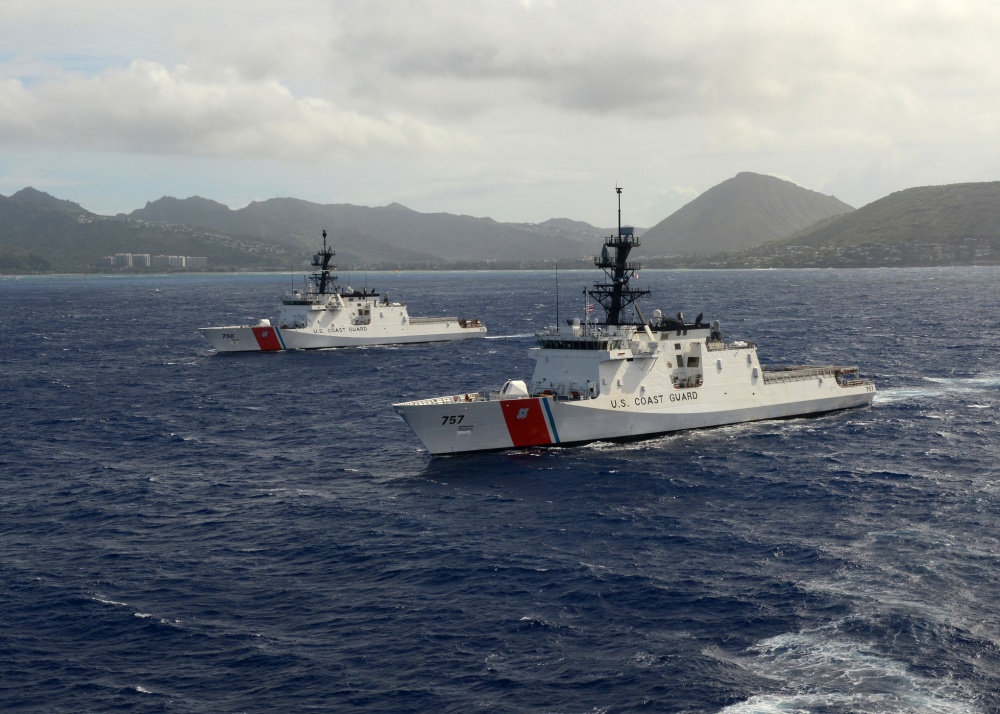
The crews of the Coast Guard Cutters Midgett (WMSL 757) and Kimball (WMSL 756) transit past Koko Head on Oahu, Hawaii, Aug. 16, 2019. The Kimball and Midgett are both homeported in Honolulu and two of the newest Coast Guard cutters to join the fleet. (U.S. Coast Guard photo by Petty Officer 3rd Class Matthew West/Released)
We are finally getting some information about the Coast Guard’s participation in RIMPAC 2022, and some of it may be a bit surprising.
A Coast Guard CO will command a task force,
Coast Guard Cutter Midgett is commanding Combined Task Force 175, which includes ships from France, Peru and the U.S. Navy, and is conducting air and missile defense, gunnery, mass rescue and anti-submarine warfare exercises.
The surprise, of course, is anti-submarine warfare. Midgett might simply simulate the high value unit to be protected, but Midgett will embark an MH-60R. The “Romeo” version is an ASW helicopter.
The 418-foot Midgett, a national security cutter and the largest class in the Coast Guard fleet, will also sail with a Navy MH-60R helicopter on board.
“Part of that is, how do you sustain that particular airframe? How do you support it for a long-range, two-month or three-month deployment?” he said. The Coast Guard is hoping to convert some of its airframes to ones used by the Navy going forward.
I might add, where do you store the sonobuoys, torpedoes, and other weapons?
(I have felt for a long time there are opportunities for attaching Navy Reserve units, that might include ASW Helicopters and their crews and sonar equipment and supporting personnel, to Coast Guard cutters as mobilization assets.)
Will the helicopter operate from Midgett as part of a Sink-Ex? Will Midgett get to participate in a Sink-Ex?
All the Sink-Exs seem to target ships of frigate size or larger. It would be good to have some smaller targets for less capable weapon systems.
What about the USCGC William Hart (WPC-1134), that will also be participating? Her only activity mentioned is to help set up a SAR exercise,
“As part of RIMPAC, the Hart will deploy two groups of mannequins at sea for the Midgett and a Japanese cutter to find and recover in a mass-rescue operation.”
Hope Hart and Midgett get to exercise against high speed small surface targets.
Exercise Argus 2022 participants USCGC Oak and HDMS Ejnar Mikkelsen (P571) meet off Greenland. U.S. COAST GUARD
Forbes gives us a look at Exercise Argus which was sponsored by Denmark and conducted off Greenland. Author Craig Hooper also looks at the challenges facing Greenland as tourism and offshore traffic increase exponentially.
Off Greenland, the Danish Joint Arctic Command just finished hosting Exercise Argus, an annual Danish-led training event. The exercise, designed to enhance search-and-rescue and marine environmental responses in the Arctic, offers the U.S. Coast Guard an opportunity to obtain some experience operating in Polar waters.
For the exercise, a range of U.S. Coast Guard elements, joined by units from France—an Arctic Council observer state—worked with Danish and Greenland-based assets. The international team prepared for a complex maritime accident, a catastrophe that most Arctic observers suspect will be inevitable in the years ahead.
Before the exercise commenced, a 225-foot seagoing buoy tender, the Coast Guard Cutter Oak (WLB 211) arrived in Sisimiut, Greenland, becoming one of only a handful of U.S. ships that have operated north of the Arctic Circle. At sea, the tender was joined by a French patrol boat, FS Fulmar (P740), and the capable Danish Knud Rasmussen-class patrol boat, HDMS Ejnar Mikkelsen (P571), as well as by smaller local law enforcement and pollution-response craft.
For a view of an earlier similar exercise, a comparison of the Knud Rasmussen class OPV with the 270 foot WMECs, and some great photographs take a look here.









 Chuck Hill's CG Blog