“A homage to sea duty in the Coast Guard – Successes, challenges, and being underway” –MyCG

This from the MyCG website. (Perhaps noteworthy, maybe because the interviewer was a woman, but most of the interviewees were women.)


A homage to sea duty in the Coast Guard – Successes, challenges, and being underway

By Shana Brouder, MyCG Writer
As a sea service, we celebrate the perseverance of our shipmates who serve in the cutter community. While many industries went dark or slowed in response to COVID-19, the missions of the afloat community have continued to protect our Nation’s interests, deterring threats around the globe and in an especially complex maritime environment.

This growing demand has continued amid the COVID-19 global pandemic, where cutter crews are experiencing pre-deployment restrictions of movement, a reduction in liberty port calls, and extended time underway, away from loved ones.

The Coast Guard has increased compensation as they address urgent challenges for the sea-going workforce, while also looking for new ways to thank our members for continuing the traditions of the service. This past year, the Coast Guard increased internet connectivity speeds underway and arranged for wifi internet connectivity inport for deployed cutters, which enable reliable communication with friends and families.

Despite the challenges the pandemic presented, Coast Guard ships interdicted either a go-fast boat or a semi-submersible boat on a near daily basis, sending boarding teams to confiscate contraband and apprehend suspected smugglers. Cutter crews across the enterprise have seen some of the greatest successes in 2020. Crews surged to support an enhanced counter-narcotics operation resulting in a 37% increase in cocaine and other drugs interdicted between April and September of last year.

What is it that keeps our members returning to sea? After interviewing several junior officers, and one commanding officer, three central tenants of sea duty were named: the adventurous nature of the mission, the simple beauty of the sea, and—most importantly—the people.

“Every day on the water presents a new challenge that I’m excited to overcome,” said Lt. j.g. Ryan Brumm, supply officer aboard Coast Guard Cutter Alert, a Medium Endurance Cutter.

Lt. j.g. Matthew Nagle aboard Coast Guard Cutter Munro, a National Security Cutter, discussed excitedly watching aerial footage of the small boats underway from a small unmanned aircraft with his shipmates. “Seeing the live-action video after six months of hard work preparing and testing the hardware was incredible.”

Brumm’s shipmate aboard the Alert, Ensign Erin Mullen, also loves the missions underway. A self-proclaimed ocean nerd, Mullen also discussed her love of nature as a reason she plans to keep returning to sea. “Being on the bridge, seeing thousands of stars reflecting off that calm ocean,” said Mullen. “It really takes your breath away.”

The number one reason given, however, for enjoying sea duty was the friendships formed, “It seems cliché to say,” said Lt. j.g. Brooke Harkrader, assistant navigator aboard the Coast Guard Cutter Munro, “but the reason I love sea duty is because of the people.”

Cuttermen discussed the atmosphere aboard cutters—the comradery found afloat—as a reason they keep returning. As Lt. Cmdr. Laura Foster, commanding officer of the Coast Guard Cutter William Hart, a Fast Response Cutter, puts it: “The reason I’ve gone back to sea so many times is because of the family atmosphere aboard. The comradery among shipmates is unbelievable. I’ve never found it anywhere else.”

Ensign Kimberly Bryon, aboard the Coast Guard Cutter Munro, described her favorite memory underway during an otherwise difficult year, “We were at a port call in Alaska, and because of COVID we decided to stop at these uninhabited islands,” said Bryon. “I and three others spent the day shuttling people to and from the islands. While we didn’t get to go hiking ourselves, I had the absolute best time with the small crew I was working with. The comradery I felt with them was something I really can’t describe.”

While members speak openly of their love of sea duty, there is no doubt life afloat is challenging. “Being underway is the hardest thing you’ll ever do, but it is hands down the most rewarding work,” said Harkrader who, despite struggling with occasional seasickness, plans to stay afloat as long as possible.

Sea duty inconveniences are not insignificant. Like many in the Coast Guard, Foster has to spend prolonged periods of time away from her family. In her most recent trip, she was underway for 144 days. While it can be difficult, Foster doesn’t shy away from the challenge. “I feel honored to be able to take this job, and show other females that it is possible to rise to the position you want, and have a family,” she said.

Pandemic operating conditions have presented challenges to our members afloat, further complicated by social distancing measures advised by the Center for Disease Control (CDC) are not always possible. Those aboard the Munro, for example, faced extra hardships when 19 members from their crew tested positive for COVID-19 prior to going underway. “Everyone’s morale suffers when the workload increases so much,” said Hakrader.

Harkrader, Nagle, and Bryon both applauded the efforts commanding officers took aboard the Munro to keep things underway. The cutter was able to keep operating in a COVID-safe and smart environment, working to push through modified conditions, completing a mission through the waters of Alaska not usually completed by the crew.

Taking into account the challenges posed by the pandemic compounded already demanding life afloat make the successes these crews saw this year nothing short of extraordinary. A short sample of successes cutter forces saw this year, as detailed in Sea Duty Readiness ALCOAST 016/21.

While going to sea may not always be the easiest choice, being underway is a rewarding experience with benefits not found with other duties. “The goodbyes never get easier,” said Foster. “But the hugs you get when you return home never get old.” The Coast Guard is thankful to have members with a passion for sea duty, who see their work as so much more than just a job.

Coast Guard Cutter Successes in 2020:

  • Coast Guard Cutter Tahoma, a Medium Endurance Cutter, participated in Operation Nanook with Canadian, Danish, and U.S. Navy Forces.
  • Coast Guard Cutter Campbell, a Medium Endurance Cutter, participated in the high-latitude Search-and-Rescue Exercise Argus off Greenland, operating alongside Canadian, Danish, and French Naval Forces.
  • Coast Guard Cutter Cheyenne, a river buoy tender, responded to record high flooding on the Mississippi River.
  • Coast Guard Cutter Axe, a construction tender, responded to multiple Gulf Coast hurricanes, that, alongside other black hull cutters, surveyed, serviced, and corrected thousands of aids to navigation, restoring the smooth flow of efficient maritime commerce.
  • Coast Guard Cutter Kimball, a National Security Cutter, recently supported Pacific Island nations in building organic capability and law enforcement expertise to combat illegal, unreported, and unregulated (IUU) fishing.
  • Coast Guard Cutter Oliver Berry, a Fast Response Cutter, just returned to its homeport in Hawaii supporting the Pacific Island Forum Fisheries Agency, a collaborative international organization to promote sustainable fisheries. The cutter traveled nearly 10,000 miles round-trip to strengthen maritime domain awareness within the exclusive economic zone of both the Republic of the Marshall Islands and Federated States of Micronesia.
  • Coast Guard Cutter Bertholf, a National Security Cutter, used its ScanEagle unmanned-aerial system to surveil a group of 350 Chinese fishing vessels and make right-of-approach inquiries near the Galapagos Islands, at the request of Ecuador. They identified 15 potential IUU indicators of that particular fleet.
  • Coast Guard Cutter Bear, a Medium Endurance Cutter, deployed to Cabo Verde and increased partnerships with a key U.S. ally at the request of our National Security Council, on extremely short notice.
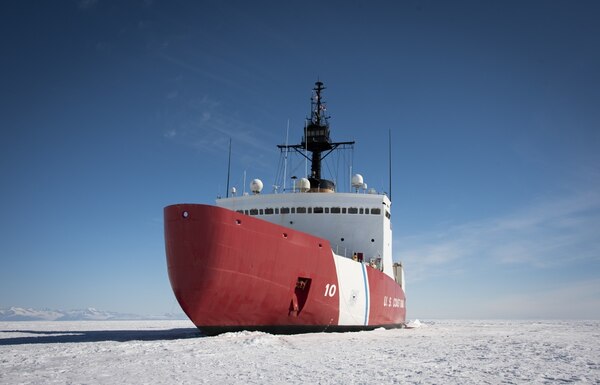
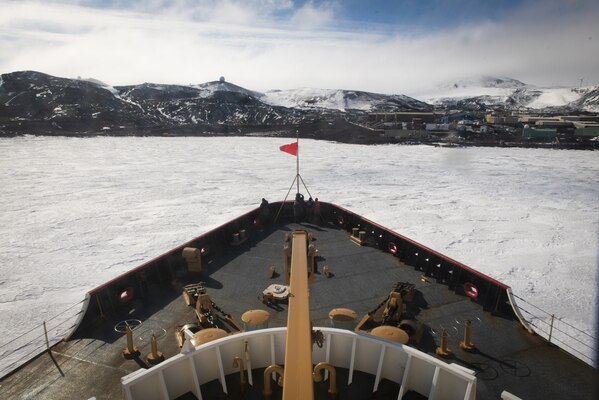
  • Coast Guard Cutter Polar Star, a Polar-class icebreaker, sailed for the first time in several years to the U.S. Arctic to project U.S. sovereignty.
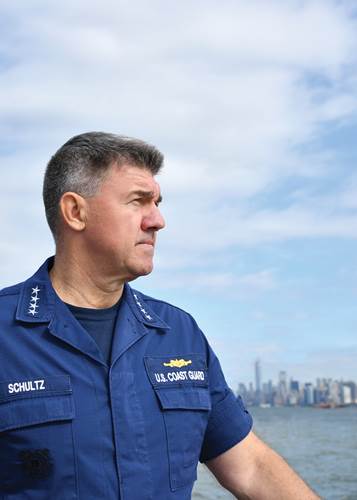
“SEA CONTROL 219 – USCG COMMANDANT ADMIRAL KARL SCHULTZ” –CIMSEC

Coast Guard Commandant Adm. Karl Schultz visits with Coast Guard crews stationed in New York City. U.S. Coast Guard photo illustration by Petty Officer 1st Class Jetta Disco.

(I meant to cover this earlier, but perhaps still worth a listen)

CIMSEC’s Podcast “SEA Control,” had an interview with the Commandant, Dec. 27, 2020. You can find it here.

At first I thought I had heard it all before, but toward the end, there were some surprises.

He talked about  Arctic, Antarctic, and IUU. He talked about the Arctic Strategic Outlook and the IUU Strategic Outlook.

Illegal, Unreported, Unregulated fishing got a lot of attention. He related that it was gaining visibility and had become a national security issue since overfishing has created food security issues for many countries. He pointed to Coast Guard Cooperation with Ecuador in monitoring a fishing fleet off the Galapagos Islands. Internationally he sees a coordination role for the USCG.

Relative to the Arctic he mentioned the possibility of basing icebreakers in the Atlantic and the need for better communications.

He talked about the Tri-Service Strategy and the Coast Guards roles in it, particularly in less than lethal competition.

More novel topics started about minute 38 beginning with Unmanned systems. He talked about the recent CG experiments with unmanned systems and went on to note that the CG will also regulated Unmanned commercial vessel systems.

About minute 41 he talked about the Coast Guard’s role in countering UAS in the Arabian Gulf. He added that we have a lead role in DHS in counter UAS. “We are in the thick of that”

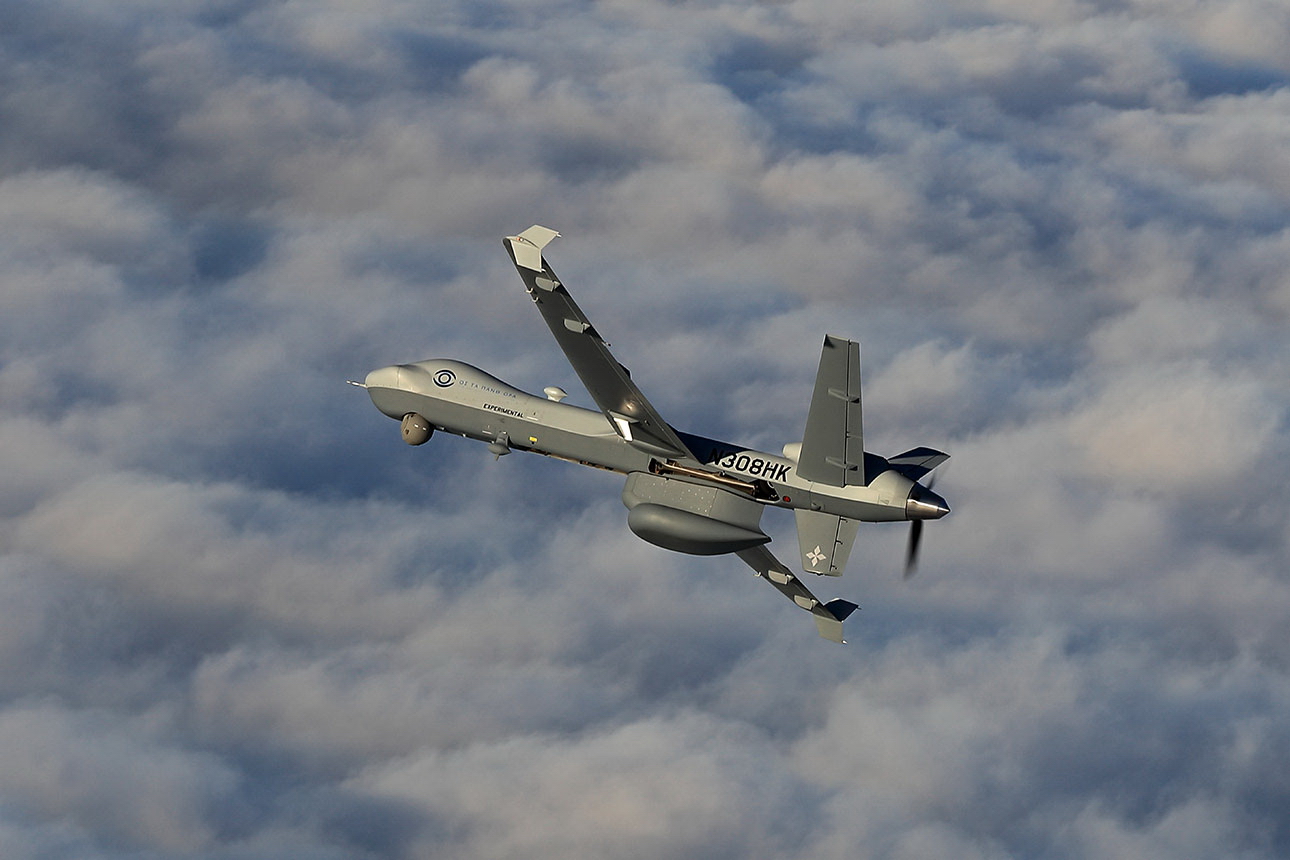
GA-ASI Concludes Successful Series of MQ-9 Demonstrations in Greece

He said the service was looking at MQ-9 maritime “Guardian” (minute 45)

When ask about reintroducing an ASW capability he said that while the Coast Guard was looking at it, the service would have to be cautious about biting off too much. (My suggestion of how the CG could have an ASW mission with minimal impact on its peacetime structure.)

He talked about balancing local and distant missions and concluded that the CG could do both (47), and that the Coast Guard was becoming truly globally deployable (48).

He noted that the first two FRCs for PATFORSWA would transit to Bahrain in Spring, followed by two more in the Fall, and two more in 2022. (49)

He noted technology is making SAR more efficient. “Hopefully we will put ourselves out of the Search and Rescue business.” 50

He talked about the benefits of “white hull diplomacy.” (52)

Asked about our funding for new missions he said it was sometime necessary to demonstrate the value of the mission first, then seek funding. (55)

He also talked about raising the bar on maintenance.

Advanced Precision Kill Weapon System (APKWS) –the Video

As I have suggested several times, there is a place for this system in the Coast Guard, here, here, and here, as a weapon that would allow even small units like patrol boats and FRCs to quickly and accurately deal with a range of threats, while minimizing the risk of collateral damage inherent in the use of our current weapons, e.g. 7.62mm, .50 cal., 25mm.

These weapons are not exotic. tens of thousands are produced annually.

Interesting to see how simply the pulse repetition frequency code is set to match it to the laser designator.

(I would also argue that the Coast Guard needs to have available laser designators in order to allow us to specifically identify threats for DOD aircraft that might be called in to help the Coast Guard deal with a threat.)

The first place to mount APKWS is on the FRCs going to PATFORSWA.

It is probably possible to mount launchers on the Mk38 gun mount. There is also the four round FLETCHER  launcher (see below) that can be fitted in place of a .50 cal.

Perhaps the Most Well Armed Cutter Sized Corvette in the World

Click on the illustration above for better view

More on the Israeli’s new Sa’ar 6 Corvette from Navy Recognition, particularly in regard to the C-Dome missile system (reporting a range of 250 km). It has been over six years since I did my first post on this class. At the time, I thought the Offshore Patrol Cutters might be close in size, but they are more than twice as large as the Israeli ships. Did a second post in Aug. 2015. and I have posted comments as additional details became available, but it is time for another look.

These will be the largest combatants in the Israeli Navy, but their dimensions are still quite modest:

  • displacement: 1900 tons
  • Length: 90 m (295.2′)
  • Beam: 13.5 m (44.3′)
  • Draft: 3.5 m (11.5)
  • Speed: 27 knots
  • Crew: 70

First of the class of four, INS Magen, has completed sea trials and the German shipbuilder has delivered it to the Israelis, who will install the Israel sourced weapon systems. The remaining ships are expected to follow at six month intervals.

Note, contrary to the labeling on the illustration, the 16 missiles amidships, shown in green, will be Gabriel V anti-ship missiles rather than Harpoons. (Gabriel V will also arm the new Finnish ice-capable corvette.)

Aviation facilities are also surprising. The ships are expected to support and hangar an H-60 ASW helicopter and may also support a vertical take-off Unmanned air system.

These ships are remarkable, for their size and crew strength (only 70), in being capable in all three primary warfare areas, ASW, ASuW, and AAW. Their capabilities exceed those of many frigates and approach those of DDGs four times their size.

With a total of eighty-eight missile launch tubes, assuming they are all filled, it seems these will be the most heavily armed ships of their size in the world.

“Nordic Allies Help Navy Improve Ship Ops in Icy Waterways as Arctic Competition Heats Up” –Military.com

http://www.state.gov/e/oes/ocns/opa/arc/uschair/258202.htm . This map of the Arctic was created by State Department geographers as part of the U.S. Chairmanship of the Arctic Council.

Military.com has a report on the Navy’s increased activity above the Arctic Circle, at least on the Atlantic side. (Still have not seen much from PACFLT.) Remarks are quoted from Adm. Robert Burke, commander of U.S. Naval Forces Europe-Africa and Allied Joint Command Naples. The discussion was primarily about working with allies, but he does not fail to mention the Coast Guard. 

“Responding to a question on whether the Navy needs to have icebreakers or hardened vessels as it increases its Arctic presence, Burke said he would leave the question “up to the force providers,” adding that ship drivers are getting good at maneuvering in the challenging Arctic environment.

“He said also that icebreaking is the U.S. Coast Guard’s “core business … today, anway,” and the Navy and Coast Guard work together in many areas worldwide.

“”We’ve got great partners in the U.S. Coast Guard. … You know, if it stays in their core mission or we do some sort of shared thing, it’s going to work great,” Burke said.”

The Coast Guard, with only two polar icebreakers, has none based on the Atlantic side. We have had some indication the Coast Guard intends to base one or more of its planned three medium icebreakers (aka Arctic Security Cutters) on the Atlantic side.

To put my comment above in context, LANTFLT has much more reason for operating in the high North than PACFLT. On the Atlantic side, Russia’s most important naval bases are above the Arctic Circle, off the Barents Sea. On the Pacific side, the primary Russian naval bases are over 800 nautical miles below the Arctic Circle around Petropavlovsk-Kamchatsky. So the difference is perhaps understandable.

“US Navy helicopters and Coast Guard snipers are firing on suspected drug traffickers ‘daily,’ top admiral says” –Business Insider

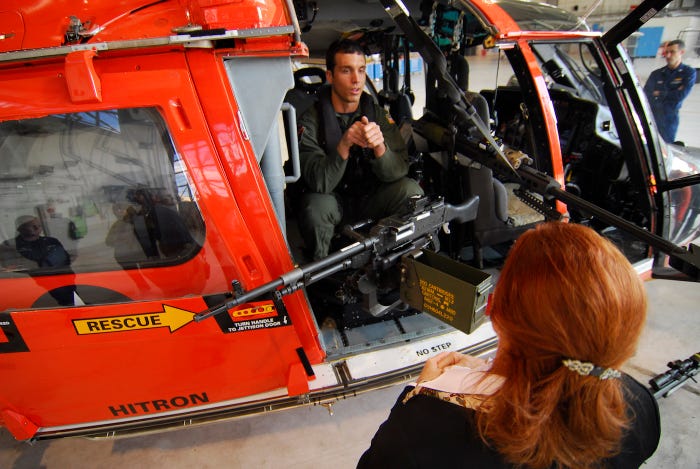
Petty Officer 2nd Class Anthony Phillips, a precision marksman at Helicopter Interdiction Tactical Squadron, displays the weaponry used by a HITRON during missions, February 23, 2010. US Coast Guard/Petty Officer 1st Class Bobby Nash

Business Insider has a story touting the success of the Navy/Coast Guard team effort in drug interdiction. This seems to be a report on Adm. Craig Faller’s (SOUTHCOM) remarks at the Surface Navy Association symposium in mid-January.

There is strong praise for the HITRON personnel.

“Coast Guard HITRON teams, which are sniper teams, have integrated into US Navy helicopters. So our Navy crews are involved in decisions to use … warning shots and disabling fire daily. I mean, it is a daily event,” Faller added. “We average numbers, sometimes large numbers, of events daily, and they’ve done it safely, effectively, completely in compliance with all the law of war and with precision. [I’m] very proud of that.”

I have to believe the “daily” claim is at least a slight exaggeration, since presumably HITRON was involved in all the cases and the report quotes Cmdr. Ace Castle, public affairs officer for US Coast Guard Atlantic Area, as saying they prosecuted 56 in 2020.

In any case, HITRON is getting a workout and proving their value. Worth noting that they and other Coast Guard law enforcement detachments, also serve on foreign ships working for SouthCom, including British, Canadian, Dutch, and French vessels.

“United States and Russia sign Joint Contingency Plan for pollution response in the Bering and Chukchi Seas.” –D17 News Release

Northeast Russia and Alaska are in close proximity. Photo: Shutterstock

Below is a Coast Guard District 17 news release.


United States and Russia sign Joint Contingency Plan for pollution response in the Bering and Chukchi Seas.


News Release

U.S. Coast Guard 17th District Alaska
Contact: Coast Guard Headquarters Media Relations
Email: mediarelations@uscg.mil
17th District online newsroom

United States and Russia sign Joint Contingency Plan for pollution response in the Bering and Chukchi Seas.

WASHINGTON – The U.S. Coast Guard and the Russian Federation’s Marine Rescue Service recently signed the 2020 Joint Contingency Plan of the United States of America & the Russian Federation in Combating Pollution on the Bering & Chukchi Seas.

On Feb. 1, 2021, the Acting Director Andrey Khaustov of the Russian Federation’s Marine Rescue Service (MRS) and the U.S. Coast Guard’s Deputy Commandant for Operations, Vice Adm. Scott Buschman signed the 2020 update to the Joint Contingency Plan (JCP), which is a bilateral agreement focused on preparing for and responding to transboundary maritime pollution incidents. The updated JCP promotes a coordinated system for planning, preparing and responding to pollutant substance incidents in the waters between the U.S. and Russia. The U.S. and Russian Federation have shared a cooperative bilateral agreement on trans-boundary marine pollution preparedness and response in this area since 1989. The newest JCP revision requires joint planning and trans-boundary exercise efforts to be coordinated by a Joint Planning Group led by Coast Guard District Seventeen and is guided by a non-binding two-year work plan. In addition, the updated JCP creates the new International Coordinating Officer role to help facilitate the critical sharing of information during coordinated response efforts.

“This is an important agreement between the U.S and the Russian Federation that ensures coordination between respective authorities and actively promotes the protection of our shared interests in these environmentally and culturally significant trans-boundary waters,” said Vice Adm. Scott Buschman, U.S. Coast Guard Deputy Commandant for Operations. “We look forward to continuing our necessary and productive relationship with the Marine Rescue Service and the opportunity to conduct joint training and exercises in the near future in order to ensure the protection of our nations’ critical natural resources.”

The shared maritime boundary between the U.S. and Russia in the Bering and Chukchi seas has notoriously poor weather conditions and limited resources to respond to pollution incidents. This plan primarily addresses international collaboration matters and as such is meant to augment each Country’s national response system as well as state, regional, and sub-regional (local) plans. In the United States, the operational aspects of the plan fall under the responsibility of the U.S. Coast Guard’s Seventeenth District Commander and Sector Anchorage.

“Alejandro Mayorkas Sworn in as Secretary of Homeland Security” –DHS News Release

Below is a Department of Homeland Security news release.


Today, Alejandro Mayorkas was officially sworn in as the seventh Secretary of Homeland Security. Secretary Mayorkas took the oath this afternoon after the Senate voted to confirm him. As Secretary of Homeland Security, Mayorkas now leads the third largest federal department in the United States. (DHS Photo by Benjamin Applebaum/Released)

February 2, 2021

WASHINGTON – Today, Alejandro Mayorkas was officially sworn in as the seventh Secretary of Homeland Security. Secretary Mayorkas took the oath this afternoon after the Senate voted to confirm him. As Secretary of Homeland Security, Mayorkas now leads the third largest federal department in the United States, which includes the Cybersecurity and Infrastructure Security Agency, Federal Emergency Management Agency, Transportation Security Administration, U.S. Coast Guard, U.S. Customs and Border Protection, U.S. Immigration and Customs Enforcement, U.S. Citizenship and Immigration Services, and the United States Secret Service.

“DHS bears an extraordinary weight on behalf of the American people, the weight of grave challenges seen and unseen,” said Secretary Mayorkas. “It is the greatest privilege of my life to return to the Department to lead the men and women who dedicate their talent and energy to the safety and security of our nation. I will work every day to ensure that they have the tools they need to execute their missions with honor and integrity. The mission of the Department of Homeland Security is to safeguard the American people, our homeland, and our values. The United States is a welcoming and empathetic nation, one that finds strength in its diversity. I pledge to defend and secure our country without sacrificing these American values.”

Secretary Mayorkas is the first immigrant to serve in the role of DHS Secretary.  His parents arrived with him and his sister to the United States as refugees after fleeing Cuba in 1960. Secretary Mayorkas previously served as the DHS Deputy Secretary from 2013 to 2016. Prior to holding that position, he was the Director of U.S. Citizenship and Immigration Services, the agency charged with operating the largest immigration system in the world.

On February 2, 2021, Vice President Kamala Harris swore in Alajandro Mayorkas as Secretary of Homeland Security.

On February 2, 2021, Vice President Kamala Harris swore in Alajandro Mayorkas as Secretary of Homeland Security. Vice President Harris tweeted ‘Congratulations to @AliMayorkas, our new Secretary of Homeland Security. Secretary Mayorkas is a dedicated public servant with a wealth of experience, who will keep America safe while upholding our values.’ (DHS Photo by The White House/Released)