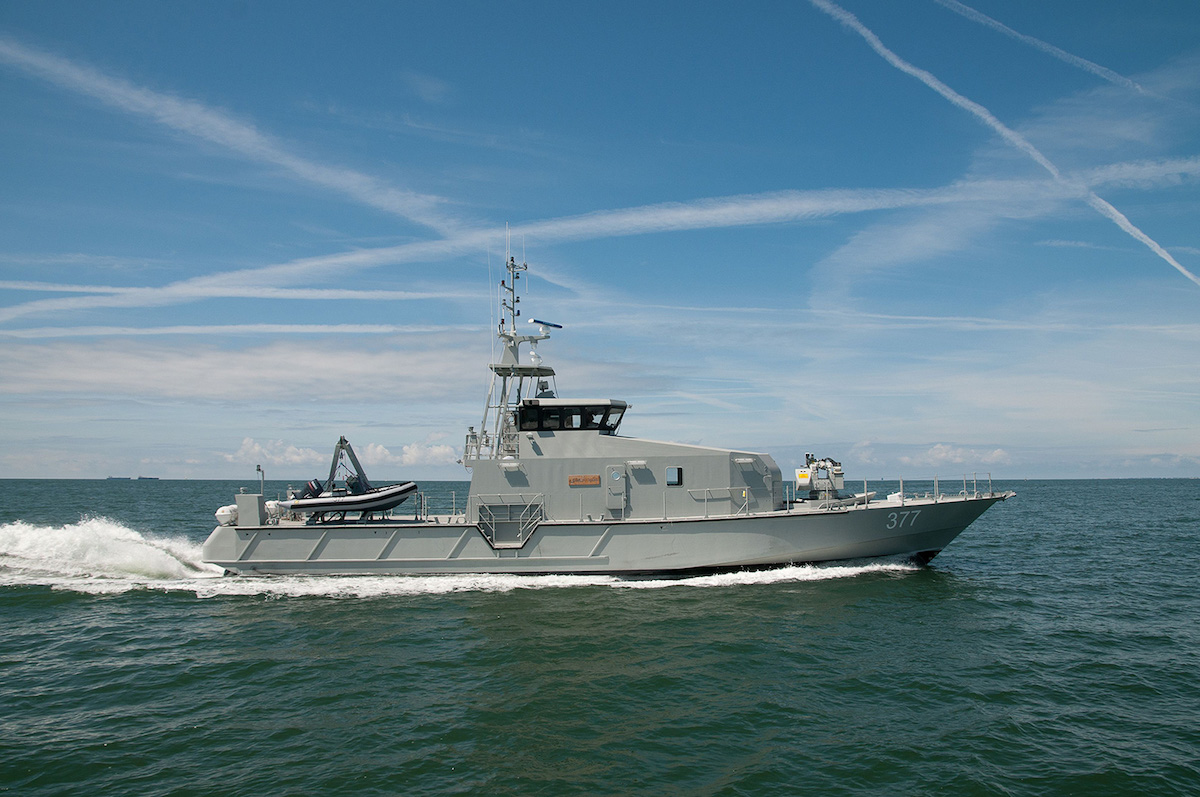
“Coast Guard releases draft statement of work for Offshore Patrol Cutter Program Industry Studies” –CG-9

OPC “Placemat”

The Acquisitions Directorate, CG-9, has issued a draft statement of work for Offshore Patrol Cutter Program Industry Studies.

The deadline for comments is short.

A draft statement of work (SOW) was released by the Coast Guard Nov. 22 in support of the Offshore Patrol Cutter (OPC) Program. The service is seeking industry feedback; responses to the draft SOW will be used to inform a future solicitation for industry studies to support OPC follow-on production.

The draft SOW can be found here.

The deadline to submit responses to this request is Dec. 6 at noon EST.

For more information: Offshore Patrol Cutter program page

Looking at the draft statement of work, one of the first things I noticed is that it describes the OPC as “360ft LOA and 4500LT.” I think that displacement should be full load. Even at that, it is significantly larger than previously stated. I had previously noted that dimensions and displacement did not seem to correspond, that the dimension for the OPC was larger than the Holland class OPV which are 3750 tons full load, but previous statements indicated that the ships would be 3730 tons full load. This was repeated in the Congressional Research Service Reports. If their full load displacement is actually 4500 tons, that means they are almost exactly the same size as the National Security Cutters which have been variously reported as 4500 or 4600 tons full load.

The draft SOW indicates, “The re-competed contract scope will be to complete the OPC Detail Design and to construct an initial OPC using that Detail Design, with options for constructing up to 10 additional OPCs.”

Section 2.2.2.2 does at least mention the possibility of a block buy.

 “The impact of block buys of OPCs as a cost reduction strategy shall be addressed in this section.”

The draft SOW states:

“References Available at Award.  The following references will be made available not later than award of the Industry Studies contract.

1. Updated draft OPC System Specification

2. List of Long Lead Time Materials (LLTM)

3. Selected Detail Design Deliverables for information only, including Functional Design artifacts, ABS design review information, Transitional (3D) Design artifacts, Production Design artifacts, Schedules, Test Procedures, and Test Reports.  The maturity of the Functional Design artifacts exceeds 95%.

4. Selected Construction Deliverables for information only, including: Equipment Configuration List, Test results, Engineering Change documents, and schedules

5. Selected Non-Proprietary Management Planning Deliverables for information only

6. USCG Notional OPC Detail Design and Construction (DD&C) Schedule

7. Placemat summarizing OPC Functional Design “

Frankly, I don’t see how you could bid on the contract without having this information first.

The notional schedule does not appear to have changed, meaning, if followed, the contract will not be awarded until the end of FY2022, and the first ship (OPC#5) will not be delivered until near the end of FY2026 and the last ship of the class will not be delivered until near the end of FY2037, three years after the previous plan. At that time the youngest 270 would be 56 years old. We will not have fourteen OPCs to replace the 210s until 2032, by which time the youngest 210 will be 63 years old. This is starting to look ridiculous, but it does looks like there may be some flexibility.

“Contractors will evaluate the referenced design artifacts and propose their most cost effective and schedule efficient plan to transition the Functional Design into a Production Design and to construct OPCs per the contract scope described above. “

This has to be very frustrating. We already went through a year of proposal evaluations, a year of competing preliminary designs, and a year of detail design, and now it looks like we are starting over almost from ground zero.

I anticipate these ships are going to cost considerably more than the original Eastern contract or the original benchmark cost. That, and the considerable delay, are a good argument for funding a 12th NSC in FY2020.

Hopefully the contractors would offer options that would depart from the notional timeline and allow earlier completion of the program as a cost reduction strategy.

On the other hand, if we are going to take this much time, maybe we could make the  ship a bit faster and better armed, since it appears we are firmly back in the great power competition mode.
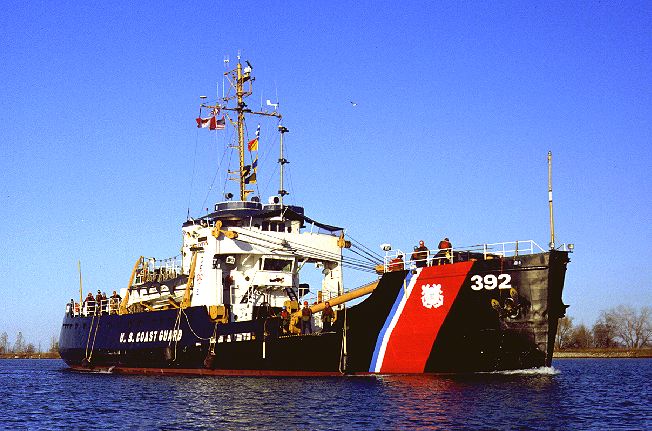
ex-USCGC Bramble Arrested, Now Up for Sale, Dec. 4

USCGC Bramble (WLB-392), USCG photo

Maritime Executive has as a short article about what has become of the former USCGC Bramble, a buoy tender that transited the North West Passage in 1957 along with USCGC Spar and USCGC Storis.

Museum ships are certainly desirable, but they are very hard to keep in presentable condition. Two very significant and unique museum ships, USS Olympia and USS Texas, have been constantly on the brink of failure. In addition to a fairly large number of light ships, we are fortunate to have Taney at the Baltimore Maritime Museum, in Baltimore, Maryland, and Ingham in Key West.

Thanks to Paul for bringing this to my attention. 

US Naval Institute General Essay Contest

Wanted to pass this along, and encourage participation. Note eligibility for USNI membership is essentially unlimited, so that should not be a barrier to participation. Deadline 31 Dec. The USNI page about the contest is here.

united states coast guard

R 211703 NOV 19
FM COMDT COGARD WASHINGTON DC//CG-5R//
TO ALCOAST
UNCLAS//N05700//
ALCOAST 366/19
COMDTNOTE 5700
SUBJ:  DEADLINE FOR U.S. NAVAL INSTITUTE’S 2019 GENERAL PRIZE ESSAY CONTEST
A. Coast Guard External Affairs Manual, COMDTINST M5700.13 (series)
1. This ALCOAST announces the U.S. Naval Institute’s 2019 General Prize Essay Contest.
2. Overview. Located at the U.S. Naval Academy in Annapolis, MD, the U.S. Naval Institute (USNI),
a private, non-profit, non-partisan organization, has provided an open forum for honest debate,
informed discussion, and professional development for members of the Naval Services since 1873.
The vision and mission of the USNI is to give a voice to those who seek the finest Navy, Marine
Corps, and Coast Guard by providing an independent forum for those who dare to read, think,
speak, and write to advance the professional, literary, and scientific understanding of sea
power and other issues critical to global security. USNI is known for its flagship magazine
Proceedings and a variety of historical and professional books.
3. USNI General Prize Essay Contest. Dating back to 1879, the General Prize is the Naval
Institute’s premier essay contest. Winning authors this year will join a long line of
great naval thinkers and innovators, including Commander Alfred Thayer Mahan, Rear
Admiral Stephen B. Luce, Lieutenant Ernest J. King, Lieutenant Commander James Stavridis,
and Commander James Winnefeld. This year’s General Prize Essay Contest invites you to
“dare to write to advance the professional, literary, and scientific understanding of sea
power and other issues critical to national defense.” Participate in this open annual essay
contest to discuss the most compelling issues, ideas, and solutions impacting the sea services.
There is no restriction on topic. All essays are judged in the blind by the Naval Institute’s
Editorial board composed of serving Sea Service professionals.
    a. Eligibility: Open to all persons eligible for membership (including existing members)
in the Institute (to include U.S. Navy, U.S. Marine Corps, and U.S. Coast Guard). The essay
must be original and not published or being considered for publication elsewhere.
    b. Length: 3,000 words maximum, excluding notes and sources.
    c. Prizes: First prize – $6,000. Second prize – $3,000. Third prize – $2,000.
    d. Submission Deadline: The deadline for entries is 31 December 2019. The winners will be
announced and published in the May 2020 Proceedings. Note: essays are submitted directly to
USNI and the U.S. Coast Guard plays no role in selecting the winning essays. Applicants shall
ensure entries conform to Chapter 6, sections (A) through (C) of REF (A).
    e. Additional details: submit the essay as a word attachment to essay@usni.org with “General
Prize Essay Contest” in the subject line. Include word count on the title page but do not
include your name on the title page or within the essay. Provide a bio and contact information
in a separate attachment.
4. Other Essay Contests and Writing Opportunities:
    a. Essay Contests. USNI hosts essay contests throughout the year on a variety of topics
including: Coast Guard, Cyber, Emerging and Disruptive Technology, Enlisted Perspectives,
Innovation & Risk, International Navies, Leadership, Marine Corps, Naval History, Naval
Intelligence, Naval Mine Warfare, and Naval Postgraduate School Foundation/USNI. For details
see: https://www.usni.org/essay-contests.
    b. Other Writing Opportunities. Authors can also submit articles for publication in
Proceedings or Naval History magazines, USNI Today (online), and USNI’s Blog (online).
For details see: https://www.usni.org/periodicals/proceedings-magazine/submission-guidelines.
5. RDML Douglas M. Fears, Assistant Commandant for Response Policy, sends.
6. Internet release is authorized.

“Maslow’s “Hierarchy of Needs” Rule and the Coast Guard During a Lapse in Appropriation” –USNI

U.S. Coast Guard photo by Petty Officer 1st Class Matthew S. Masaschi.

US Naval Institute has a short article discussing how delay of pay can undermine our efforts to inspire and retain good people, written by an active duty USCG commander.

This comes at a time when neither the DHS FY2020 budget nor legislation to guarantee continued pay for the Coast Guard in case of a government shutdown has been passed.

Three Missile Armed Cutter X for Senegal, 20 Patrol Boats for Ukraine

OPV 58 S from PIRIOU

Two posts from Naval News. French shipbuilders are doing well in the patrol vessel market.

First, “The Ministry of Armed Forces of Senegal and French shipbuilder PIRIOU signed November 17 a procurement contract for three OPV 58 S for the Navy of Senegal. The vessels will be fitted with missile systems, a first for this African navy.”

Second, “The Government of Ukraine gave its green light for the procurement of 20 FPB 98 patrol vessels made by French shipyard OCEA.”

The Senegalese OPVs:

The ships for Senegal fall into that class significantly larger than the Webber class, but significantly smaller than the OPCs. They will be even a little smaller than the 210s. It would be at the lower end of a type, I have called cutter X, vessels with a crew and equipment similar to that of a Webber class FRC, but with better sea keeping and longer endurance. Specifications are:

  • Length: 62.20 meters (204′)
  • Width: 9.50 meters (31.2′)
  • Draft: 2.90 meters (9.5′)
  • Speed: 21 knots
  • Range / Endurance: 25 days, 4,500 nautical miles @ 12 knots
  • Hull / Structure: Steel / Aluminum
  • Accommodations: 48 (24 crew + 24 mission personnel)
  • Stern ramp for two RHIBs

For an Offshore Patrol Vessel, it is very well armed with:

  • A 76mm main gun on the Foc’sle
  • 4x Marte MK2/N anti-ship missiles forward, between the gun and the bridge
  • 2x 12.7mm manned manchine guns on the bridge wings
  • 2x 20mm remote weapon stations (Narwhal by Nexter) at the back of the bridge
  • A SIMBAD-RC surface to air system

The Marte MK2/N missile weighs 310 kg (682#) and is 3.85 metres (12.6′) long. The warhead weighs 70 kilogram (154 pound). The missile, has “an effective range in excess of 30 km, is a fire and forget, all weather sea skimming missile with inertial mid-course navigation through way points and active radar terminal homing. These missiles give these boats a range almost double that of the 57mm or 76mm guns.

SIMRAD-RC is a remote weapons station for launch of two Mistral missiles. Developed as a shoulder launched, Man Portable Air Defense (MANPAD) system, Mistral is a short ranged (6km) IR homing missile. It is claimed to be capable against a range of air targets as well as small surface targets.

Ukrainean OCEA FPB 98 patrol boat:

OCEA FPB 98 patrol boat (Credit: OCEA)

This is a deal, we discussed in July, when it appeared likely. I will repeat the description here.

They have a GRP hull and are powered by two 3,660 HP Caterpillar diesels using waterjets. Specs for vessels of this type sold to Algeria.

  • Displacement: 100 tons
  • Length: 31.8 meters (104’4″)
  • Beam: 6.3 meters (20’8″)
  • Draft: 1.2 meters (3’11”)
  • Speed: 30 knots
  • Range: 900 nmi @ 14 knots
  • Crew: 13

They will probably be equipped with a 20 to 30mm gun.


“Russia Is Eying More Armed Icebreakers After Launching Missile-Toting Arctic Patrol Ship” –The Drive

The Drive reports that Russia is looking at building more icebreaker warships.

A Russian shipbuilding industry official says that the country’s plans for fleets armed icebreakers, such as the Project 23550 Ice class corvettes, are growing and that they may be able to carry more even weapons depending on their exact configuration.

When I originally posted on the Project 23550 class, I questioned whether we would ever actually see these vessels armed with missiles. After all, adding containerized missiles may be an option, but so far, the Russian Navy has not seemed enthusiastic about putting missiles on ships that do not also have defensive systems like electronic warfare and close in weapon systems. That is why, when this report talked about installation the Russian Pantsir-EM gun and missile defense system, it seemed to take on additional significance. But on reading it more carefully this was just speculation. The only upgrade actually mentioned by the “Russian shipbuilding industry official” was that the “This ship and others in its class may ultimately have a 100mm main gun, instead of a 76mm one as originally planned,”

Even with only a 76mm gun, this is the most heavily armed icebreaker in the world, but only because everyone else is virtually unarmed.

Both this ship and the Polar Security Cutter have space and weight provision for containers. The only real difference is that the Russians have a containerized missile system they are trying to sell, and it has been pictured on this class.

If we start actually seeing cruise missiles, electronic warfare systems, and hard kill self defense systems like Pantsir-EM on Russian (or Chinese) icebreakers it will be real wake up call. But so far, the way these ships are armed is not significantly different from the Soviet era Ivan Susanin class naval and coast guard icebreakers.

I would note that if we start to see conflict over Antarctica, these ships could be useful there. Not against the US since we could put an aircraft carrier within striking distance, but perhaps against some of the other claimants.

I really don’t think we need to mirror the Russian capability to put containerized missiles on our icebreakers, but the Polar Security Cutters will be valuable, almost irreplaceable auxiliaries, and unlike the Russians, we have very few icebreakers, so we need to be able to quickly upgrade their defensive capabilities

“Coast Guard Reshaping Body Fat Measurement Standard in Pilot Study” —

USS Zephyr (PC 8) and U.S. Coast Guard Law Enforcement Detachment Pacific personnel, conducting operations in support of JIATF-S Operation Martillo. U.S. Navy photo by MC3 Casey J. Hopkins

The US Naval Institute has post regarding the Coast Guard’s body fat measurement methods.

It sounds like the Coast Guard will use a decision tree with a lot of “if then” statements.

There is a weigh in. If you pass you are home free, if not, then to the taping.

The body fat screening involves taping males on their necks and waist, and females are taped on their necks, waist and hips. The member is now also taped with the abdominal body fat measure, Rooney said. If the member passes either of those two measurements, they are considered compliant.

…..

The Coast Guard standard for the abdominal circumference is a maximum of 39 inches for men and 35.5 inches for women.

For Coast Guard members who exceed both taping measurements, Rooney said they receive a medical screening to determine if they’re eligible to take a physical fitness test, involving a 1.5- mile run, push-ups and sit-ups. Standards are age-based.

“If they pass it, then they’ll be in compliance,” Rooney said. “If they are not eligible, refuse to take it, or they fail it, they will be screened as we already do for medical events that maybe we have missed, and if not there, they’ll be placed on medical weight probation.”

There is more in the original post. Sounds relatively easy to comply, but still sounds like the threat of separation is the only motivation for maintaining a healthy lifestyle. It might be said that motivation should come from within, but there are circumstances where the demands of the job discourage healthy lifestyles.

I always appreciated the fact that the Coast Guard generally gave me a place and time to exercise. Hopefully everyone is getting this opportunity and is encouraged to take advantage. For the unit this may be a short term sacrifice, but it pays long term dividends.

We might provide motivation for heathier choices by having physical fitness on fitness reports and enlisted marks and support of fitness for subordinates included on fitness reports and senior enlisted marks. 

Guided Rounds for the 57mm Mk110, ALaMO and MAD-FIRES, an Update

Comments on the recent post, “Defense Primer: U. S. Precision-Guided Munitions,” had enough new information to justify an update on the two smart rounds being developed for the 57mm Mk110, ALaMO and MAD-FIRES. We last discussed ALaMO on April 2, 2019 and MAD-FIRES, May 28, 2019.

This 24 July, 2019 report on MAD-FIRES confirms that, “If ordered, MAD-FIRES won’t be the first smart, guided ammunition for the LCS and FFG(X). The ALaMO round is preceding it. Designed by L3, ALaMO (Advanced Low-cost Munitions Ordnance) HE-4G is a low-cost 57mm guided smart munition being developed for the U.S. Navy’s Littoral Combat Ship, new Fast Frigate, and the U.S. Coast Guard’s National Security and Offshore Patrol Cutters. (emphasis applied–Chuck)

A 2017 report that suggests MAD-FIRES might be applied to the Mk38 mount and discusses earlier development of guided bullets as small as .50 cal. under the EXACTO program.

This 2018 contract tells us that development of the MAD-FIRES should be completed in May 2020. No indication that the Coast Guard will get MAD-FIRES, but it is probably premature to expect that. 

This 27 Sept. 2019 contract, indicates this is still a DARPA program, meaning it is still in development.

The Raytheon Co., Raytheon Missile Systems, Tucson, Arizona, has been awarded an $11,133,688 cost-plus-fixed-fee contract modification (P00017) for a within-scope change to previously awarded contract (HR0011-15-C-0081) to develop long-lead, high-risk items in preparation for the MAD-FIRES Phase III program. Fiscal 2019 research and development funds in the amount of $11,133,688 are being obligated at the time of award. Work will be performed in Tucson, Arizona (61%); McKinney, Texas (22%); and Karlskoga, Sweden (17%), with an estimated completion date of January 2021. The Defense Advanced Research Projects Agency, Arlington, Virginia, is the contracting activity.

Some speculation: 

MAD-FIRES

The video above seems to show a couple of things about the MAD-FIRES round. First that is expected to “hit to kill” rather than being a proximity fused round. Second that It is a subcaliber round, you can see the discarding sabot parts fall away as the round leaves the muzzle. The discarding sabot suggest it will be a higher velocity round than the current unguided 3P round and that it may have a longer range.

The use of  a different discarding sabot or perhaps none, may mean the same projectile could be fired from either larger or smaller caliber weapons.

The MAD-FIRES program often seems to be linked to an earlier program called EXACTO that created a guided .50 caliber round. That program used a form of laser guidance, which may be the case with MAD-FIRES.

There are reports that the British Type 31e frigate will use the MAD-FIRES round. This is logical in that this will be the first ship in the Royal Navy to use the 57mm gun, but there is also something unusual about this design. In addition to the 57mm, the ship is armed with 40mm guns, one forward and one aft on top of the hangar, in lieu of Phalanx or another CIWS. The 40mm gun, like the 57mm is a Bofors design, marketed by BAE. It may be that the 40mm guns will also be equipped with MAD-FIRES. A 40mm so equipped could start engaging incoming anti-ship cruise missiles at much longer range than Phalanx could. This could be the CIWS of the future.

ALaMO

ALaMO is apparently intended primarily to target smarms of small boats. To at least some extent it can be used against air targets, but the developer has not been making any claims regarding countering anti-ship cruise missiles which may be telling. It may be that ALaMO is not as fast, as maneuverable, or long ranged as MAD-FIRES. It is almost certainly cheaper.

“Defense Primer: U.S. Precision-Guided Munitions” –CRS

The Congressional Research Service has issued a three page, “Defense Primer: U.S. Precision-Guided Munitions.” (Thanks to the USNI news service for bringing this to my attention.)

The remarkable thing is how pervasive these systems have become.

The U.S. military has become reliant on PGMs to execute military operations, being used in ground, air, and naval operations. In FY2020, DOD requested approximately $5.6 billion for more than 70,000 such weapons in 13 munitions programs. DOD projects to request $4.4 billion for 34,000 weapons in FY2021, $3.3 billion for 25,000 weapons in FY2022, $3.8 billion for 25,000 weapons in FY2023, and $3.4 billion for 16,000 weapons in FY2024.

What has this got to do with the Coast Guard? The Coast Guard is a military organization. We are an armed force at all times. We are armed, but we are not really armed for the realities of the 21st century.

Precision guided weapons have the potential to provide the capabilities we need on a wider range of platforms, with increased effectiveness, at lower costs, with less likelihood of collateral damage.

One of the Coast Guard’s core peacetime capabilities should be the ability to forcibly stop a vessel of any size. Earlier I discussed why I believe we are not capable of doing this, here in 2011, and in fact not as capable as we were in the 1920s and 30s here in 2012.

If we are to make a meaningful contribution in any future conflict, we need to be equipped with modern weapons.

Precision guided munitions are no longer reserved for capital ships. Littoral Combat Ships, the Navy combatants that are closest to our large cutters, were built with Rolling Airframe Missile (RAM) systems and Naval Strike Missiles are being added. There is not a single class of US Navy surface combatants, down to, and including the Cyclone class patrol craft, that is not equipped with some form of precision guided munition.

It is time for an upgrade.

Guided weapons can give even relatively small platforms a heavy weight punch. Anti-ship cruise missiles and torpedoes have been successfully fitted to numerous classes of vessels of less than 300 tons full load (e.g. smaller than the Webber class).

Certainly precision guided weapons, be they missiles or torpedoes, cost more on a per round basis, but a gun system that can inflict comparable damage requires an expensive gun, a large quantity of ammunition that is expensive, heavy, and a potential danger to the ship itself, extensively trained technician maintainers and operators, and frequent live training. The launchers for smart munitions by contrast may be simpler. The weapons are most frequently “wooden rounds” that require no maintenance, and training programs are frequently incorporated in the launch system software.

Lastly, if we are going to engage targets, potentially within the confines of U.S. harbors, we want to make sure rounds don’t go astray and hurt innocent Americans. Guided weapons are far less likely to cause unintended damage.

The document briefly describes twelve systems. This is certainly not all the systems in the US inventory. I presume, only these are described, because these are the systems that are included in current budget deliberations. I am reproducing the description for the systems that I think are most likely to be applicable to the Coast Guard, preceded by comments on how they might be used by the Coast Guard. The document divides missiles into “Air Launched,” “Ground Launched,” and “Naval,” but as we know, several of these missiles can be launched from ships as well as from the air or ground.

Hellfire, a good candidate for countering small, fast, highly maneuverable surface threats. Also capable of inflecting serious damage on larger targets if multiple rounds are used. Damage is roughly comparable to a shell from a WWII cruiser. Versions are now being used to arm Littoral Combat Ships. They appear to be a good fit for vessels as small as WPBs.

Army Multi-Mission Launcher (MML) firing
(IFPC, “Indirect Fire Protection Capability”) Launching Hellfire missile

Hellfire Missile. The first Hellfire was introduced into service in 1982 on the Army’s AH-64 Apache, using laser guidance to target tanks, bunkers, and structures. Hellfire missiles have a maximum effective range of 4.3 nautical miles. During the late 1990s and early 2000s, Hellfire missiles were introduced on the MQ-1 Predator, and later the MQ-9 Reaper, enabling unmanned aerial vehicles to provide a strike capability. Hellfire missiles have become a preferred munition for operations in the Middle East, particularly with increased utilization of unmanned aircraft like MQ-1s and MQ-9s. 

JAGM, a possible direct replacement for Hellfire. same size and shape:

Joint Air-to-Ground Missile (JAGM). The Joint Air-to-Ground Missile is designed to replace the Hellfire, TOW, and Maverick missiles. JAGM uses a new warhead/seeker paired with an existing AGM-114R rocket motor to provide improved target acquisition and discrimination. JAGM underwent testing starting in 2010, declaring initial operating capability in 2019 having successfully been integrated on the AH-64E Apache and AH-1Z Super Cobra attack helicopters.

Naval Strike Missile, chosen for the Littoral Combat Ship and new frigate, this would seem to be a natural fit for the National Security Cutter and Offshore Patrol Cutter. I would prefer the LRASM because of its longer range and much larger warhead, but this system does have a smaller foot print so might fit where the LRASM could not. This is the first time I have seen a maximum range of 300 nautical miles quoted.

A Kongsberg Naval Strike Missile (NSM) is launched from the U.S. Navy littoral combat ship USS Coronado (LCS-4) during missile testing operations off the coast of Southern California (USA). The missile scored a direct hit on a mobile ship target. 23 September 2014.
U.S. Navy photo by Mass Communication Specialist 2nd Class Zachary D. Bell

 Naval Strike Missile (NSM). The NSM is an anti-ship low observable cruise missile capable of flying close the surface of the ocean to avoid radar detection. The NSM is designed to fly multiple flight profiles—different altitudes and speeds—with effective ranges of between 100 and 300 nautical miles at a cruise speed of up to 0.9 Mach. The Navy has integrated the NSM on its Littoral Combat Ship, which deployed to the Pacific region in September 2019.


LRASM, this would be my preferred option to arm the NSC and OPC. It has sufficient range to almost guarantee that if there were a terrorist attack using a medium to large ship, we would have a vessel underway, ready, and within range to engage it. Its warhead is almost four time the size of that of the NSM, so it would be much more likely to get a mobility kill with a single round. It, like the NSM, can be launched from deck mounted inclined canisters.

US Navy photo. A U.S. Navy Long Range Anti-Ship Missile (LRASM) in flight during a test event Dec. 8, 2017 off the Coast of California.

Long Range Anti-Ship Missile (LRASM). LRASM was conceived by the Defense Advanced Research Projects Agency, using a JASSM missile body to replace the AGM-88 Harpoon. Flight testing began in 2012 with the B-1B and the F/A-18E/F Super Hornet. LRASM uses radio-frequency sensors and electrooptical/infrared seekers for guidance.


If you want to dig deeper into this, the Congressional Research Service has done a much more in depth study of the procurement issues.