“Panama authorizes US armed forces to operate from three key air and naval facilities” –Navy News

Screen grab from Google Earth

Army Recognition’s Navy News reports,

On April 9, 2025, a Memorandum of Understanding (MoU) was signed between the Ministry of Public Security of the Republic of Panama and the Department of Defense of the United States of America. The document establishes a framework for cooperative security activities in Panama and formalizes mutual understandings related to the presence and operations of U.S. personnel and contractors in specific Panamanian installations. The memorandum enters into effect on the date of the last signature and is valid for an initial period of three years, renewable for additional three-year terms. Either party may terminate the agreement by written notice with six months’ advance notice.

This might be good news for Coast Guard drug interdiction efforts. FRCs could rotate into and operate out of the naval base on the Pacific side of Panama.

Long term the Coast Guard probably should seek to replicate PATFORSWA somewhere on the Pacific coast of Central and South America from Costa Rica to Ecuador.

Related: What About Panama?


“Estonian Navy Detains Russia-Bound Oil Tanker” –Marine Link

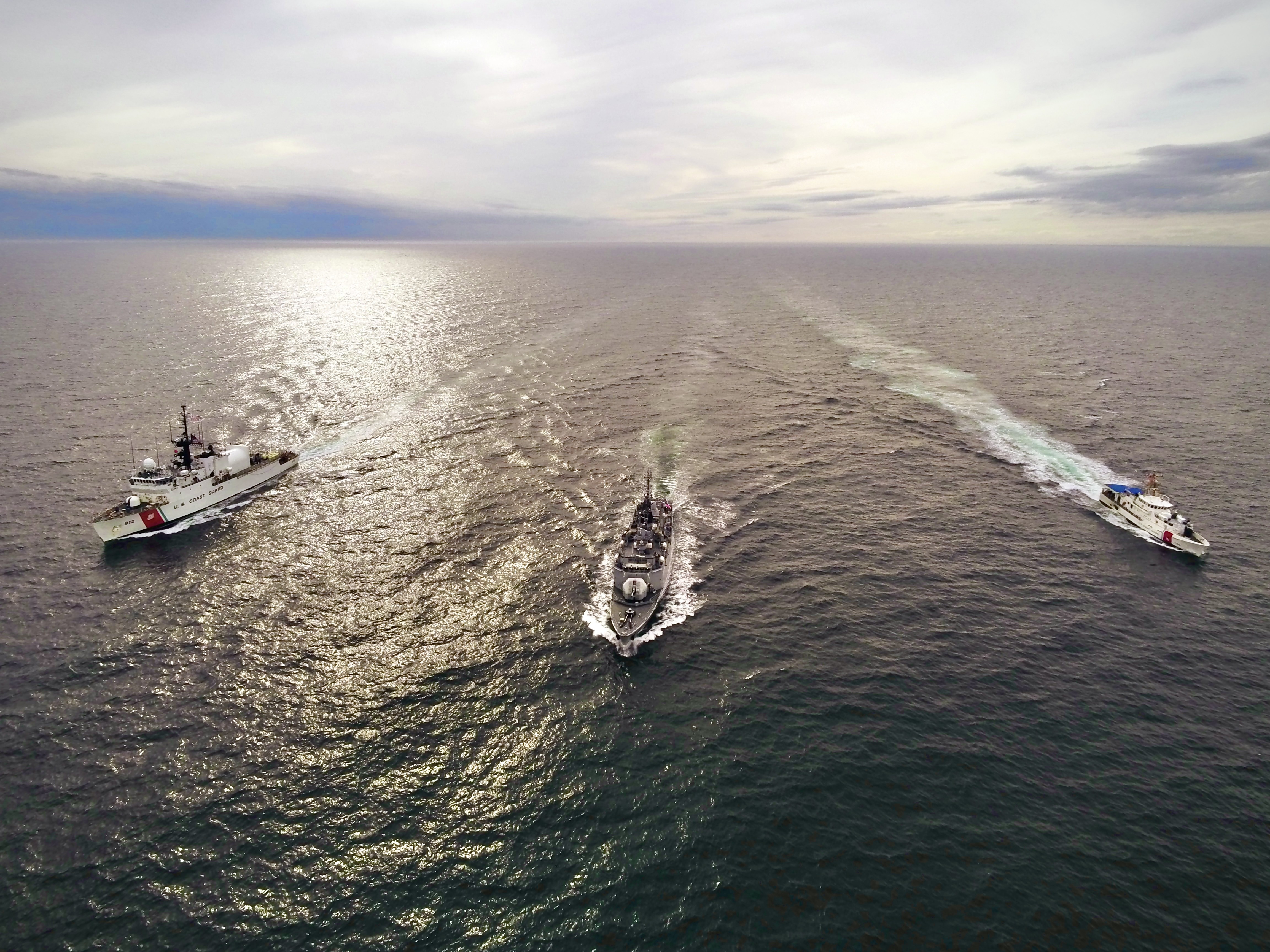
PVL-101 Kindral Kurvits in Kopli Bay Tallinn 24 May 2016.o Photo credit: Pjotr Mahhonin. At the time of the photo, this ship was part of Estonia’s  Police and Border Guard Board. Since then she and three other vessels were incorporated into the Estonian Navy. I don’t know if she still wears a stripe. She is the largest vessel in the Estonian fleet. 

Marine Link reports,

“The Estonian navy detained and boarded a Russia-bound oil tanker on an EU sanctions list on Friday, accusing it of sailing illegally without a valid country flag.

“The vessel, the Kiwala, has been under EU sanctions since February as part of Russia’s so-called “shadow fleet”, a term Western countries use for ships they say Moscow deploys to circumvent international sanctions.”

Estonian Navy was exercising a coast guard function, something the US Coast Guard might do.

The tanker was reportedly flying a Djibouti flag, but Djibouti said the ship was not registered with them, making the ship stateless. Which in turn means she is subject to the laws of any state that chooses to exercise the right.

“Bollinger Shipyards receives 9/11 steel” –Marine Log

Marine Log reports,

Bollinger Shipyards recently hosted a 9/11 steel transfer ceremony at its Lockport facility that saw the shipyard received two pieces of steel from the debris of the attack on the World Trade Center on September 11, 2001. The steel will be incorporated into two U.S. Coast Guard Sentinel-class Fast Response Cutters bearing the names of 9/11 Heroes Vincent Danz, a Coast Guard reservist and New York City Police Department (NYPD) officer, and Jeffrey Palazzo, a Coast Guard reservist and New York City Fire Department (FDNY) firefighter.

The cutters are USCGC Vincent Danz (WPC-1162) and USCGC Jeffrey Palazzo (WPC-1163).

From the Bollinger Shipyards’ Facebook page,

April 4: At a 9/11 Steel Transfer Ceremony at our Lockport facility, we honored Vincent Danz, Jeffrey Palazzo and all those who made the ultimate sacrifice on 9/11. Steel from the Twin Towers will be incorporated into vessels bearing their names—standing as a lasting tribute to their courage, sacrifice, and resilience.
“They were heroes then, heroes now, and their spirit will live on through these vessel. These ships will stand as a testament to the bravery for those that we have lost, not just Vincent and Jeffrey, but the other 2,977 Americans that perished that day.” – Master Chief Francis E. Gorman
Bollinger Shipyards is deeply honored to build the U.S. Coast Guard Sentinel-Class Fast Response Cutters Palazzo and Danz, ensuring the spirit and legacy of these American heroes lives on at sea.
and
March 28: Yesterday, Bollinger Shipyards had the privilege of paying tribute to two American heroes, Vincent Danz and Jeffrey Palazzo. Both men were U.S. Coast Guard reservists who were also NYPD and New York City Fire Department (FDNY) members who tragically lost their lives attempting to save persons trapped in the World Trade Center on 9/11.

Two pieces of recovered steel from the World Trade Center were escorted from NY/NJ and arrived at our Lockport yard aboard the “Spirit of Louisiana”. These sacred artifacts will be incorporated as centerpieces on USCG Fast Response Cutters currently under construction.
Standing alongside state and local law enforcement, Chief Bryan J. Adams, USCG Rear Admiral Dave Barata, Coast Guard District 8 Commander, and others, we reflected on their bravery and ultimate sacrifice. Their legacy will live on forever. Their courage will never be forgotten.

“MQ-35 V-BAT’s Capabilities Grow, Micro Guided Munitions Coming Next Year” –The War Zone

First know that the Coast Guard has adopted this system, but only for the National Security Cutters.

Potential $198.1M Contract Award for Cutter-Based V-BAT UAS.

The V-BAT in the video is in Coast Guard colors (love it).

The War Zone post that included the video above does not have much, if any, additional info in the text, but some of the comments may be interesting.

The Coast Guard organize deployable teams to operate these from WMECs that deploy without helicopters. Apparently USGCG Mohawk was recently deployed to the Eastern Pacific Drug Transit Zone for 70 days without either a helicopter or a UAS. We might also consider operating them from ashore. They say it only needs a 15’x15′ area for take-off and landing. That might even fit on a Webber class WPC on the O-1 deck forward of the bridge.  The beam of the FRCs is 26.6′. Part of the O-1 deck might be extended over the walkways on either side if necessary.

“Coast Guard offloads nearly $510 million in illegal narcotics interdicted in Eastern Pacific Ocean” –D7

A suspected drug vessel burns in the Eastern Pacific Ocean, Feb. 1, 2025. (U.S. Coast Guard photo)

Below is a news release from District Seven. I have highlighted some parts of the news release–mention of UAS, intercept locations, and sightings of multiple suspected smuggling craft. I went back and similarly highlighted the same information in the previous USCGC Stone offload report, which I will refer back to, because it shows a similar pattern.

A few things of note:

  • USCGC James, Stone, and Mohawk were all down in the Eastern Pacific drug transit zone simultaneously. All three began their patrols before the “surge.” All three are Atlantic Area ships, home-ported in Charleston and Key West. It may be counter-intuitive, but these bases are closer to the Eastern Pacific transit Zones, than any Pacific Area ports.
  • This news release lists three incidents where groups of suspected smuggling craft were sighted together. The earlier news release about Stone’s highly successful patrol was the first such report I have seen. Stone managed to bag all four vessels they observed on February 19. James managed to stop three on January 6. In two other cases (Jan. 30 and Feb. 3) only one of the group was intercepted.
  • In this report, UAS were mentioned as instrumental in completing the intercept in four out of eight incidents including one when James intercepted three go-fast boats. Looking back at Stone’s earlier report, UAS were mentioned as important in four of eight cases including the incident in which she intercepted four go-fast boats in 15 minutes. UAS appear to have been essential for maintaining contact with fleeing boats in those cases where multiple boats are being pursued simultaneously.
  • I have been surprised in both reports by how far offshore and how far South go-fast boats are being intercepted. In this report, all James’ intercepts were more than 200 miles off shore, including a report of multiple go-fast boats 380 miles off the coast of Peru. In the USCGC Stone report, an intercept was made 715 miles from shore. The screen grab below is from Google Earth. The line extending West from Peru is 500 km in length, about 270 miles. The Galápagos Islands can be seen near the left edge. They are 900 km (486 nautical miles) West of mainland Ecuador.


April 9, 2025

Coast Guard offloads nearly $510 million in illegal narcotics interdicted in Eastern Pacific Ocean

MIAMI – The crew of U.S. Coast Guard Cutter James offloaded more than 44,550 pounds of cocaine and 3,880 pounds of marijuana valued at approximately $509.9 million in Port Everglades, Wednesday.

This patrol resulted in 11 interdictions in the Eastern Pacific Ocean and the detainment of 34 suspected drug traffickers who were transferred ashore to face federal prosecution. All of these interdictions are tied to criminal investigations by federal partners and are linked to transnational criminal and foreign terrorist organizations including the Clan del Golfo, Sinaloa Cartel, and Cartel Jalisco Nueva Generacion.

“This is a key example of the Department of Justice working with our law enforcement partners to fight crime and keep drugs from flowing into America,” said Attorney General Pamela Bondi. “Thanks to the incredible work of the Coast Guard and FBI, these drugs will help lock up criminals instead of ruining lives.”

On Jan. 5, James’ embarked unmanned aircraft system (drone) spotted a suspicious vessel approximately 260 miles off the coast of Ecuador. James’ boarding team interdicted the vessel, apprehending three suspected smugglers and seizing more than 2,025 pounds of cocaine.

On Jan. 6, a maritime patrol aircraft spotted three suspicious go-fast vessels approximately 280 miles off the coast of Ecuador. James simultaneously intercepted the three go-fast vessels, with the help from the embarked UAS and Coast Guard Helicopter Interdiction Tactical Squadron aircrew, James’ boarding teams interdicted the vessels, apprehending nine suspected drug traffickers and seizing more than 13,960 pounds of cocaine.

On Jan. 7, a maritime patrol aircraft detected a suspicious low-profile go-fast vessel approximately 330 miles off the coast of Galapagos Islands, Ecuador. James’ embarked HITRON aircrew employed airborne use of force tactics to compel the non-compliant vessel to stop, and the boarding team apprehended three suspected drug traffickers and seized over 8,240 pounds of cocaine.

On Jan. 11, a U.S. Customs and Border Protection, Air and Marine Operations aircrew detected a suspicious go-fast vessel approximately 275 miles off the coast of Ecuador. James’ boat crew and Coast Guard Cutter Stone’s embarked HITRON aircrew interdicted the go-fast vessel, apprehending three suspected drug traffickers and seizing more than 3,385 pounds of cocaine.

On Jan. 18, Coast Guard Cutter Mohawk’s crew detected a suspicious go-fast vessel, approximately 185 miles off the coast of Ecuador. After the suspected smugglers jettisoned the presumptive narcotics into the water, James’ small boat chased down the fleeing go-fast from 60 nautical miles away while Mohawk’s crew recovered the jettisoned bales. James’ boarding teams interdicted the go-fast vessel, apprehending three suspected drug traffickers and seizing approximately 5,950 pounds of cocaine.

On Jan. 30, James’ embarked UAS crew detected multiple suspicious go-fast vessels approximately 380 miles west off the coast of Peru. James’ boarding team employed surface use of force tactics to interdict the go-fast vessel, apprehending three suspected drug traffickers and seizing more than 3,870 pounds of cocaine.

On Feb 1, James’ embarked UAS crew spotted a suspicious go-fast vessel operating approximately 280 miles off Ecuador. James’ boarding team interdicted the vessel, apprehending three suspected drug traffickers and seizing more than 3,630 pounds of cocaine.

On Feb. 3, James’ embarked UAS crew detected multiple suspicious go-fast vessels operating 215 miles off Peru. James’ boarding team interdicted the vessel, apprehending three suspected drug traffickers and seizing nearly 3,490 pounds of cocaine.

On Feb. 15, a CBP-AMO aircrew spotted a suspicious go-fast vessel, operating 260 miles off Costa Rica. James’ embarked HITRON aircrew employed airborne use of force tactics to compel the non-compliant vessel to stop. James’ boarding team interdicted the vessel, apprehending four suspected drug traffickers and seizing nearly 3,880 pounds of marijuana.

“I could not be prouder of the James crew and the teams who embarked with us to stand the watch over the holidays to keep our border secure and keep Americans safe,” said Capt. Thomas Rodzewicz, commanding officer of James. “Over a remarkable 72-hour period, our crews interdicted six go-fast vessels and one low-profile vessel across the vast ocean, culminating in the extraordinary seizure of over 24,000 pounds of cocaine and 15 suspected narco-traffickers. We delivered a substantial blow to narco-terrorism organizations, sending those attempting to bring drugs to our border to face federal prosecution, halting the profits criminals use to fuel the fentanyl trade, and most importantly, preventing deadly contraband from reaching American communities and families.”

The following assets and crews assisted James in the interdiction operations:

Detecting and interdicting illicit drug traffickers on the high seas involves significant interagency and international coordination. The Joint Interagency Task Force-South, based in Key West, is responsible for detecting and monitoring the aerial and maritime movement of illegal drugs. When an interdiction is imminent, the operation transitions to the law enforcement phase, with the U.S. Coast Guard taking control for the interdiction and apprehension stages. Interdictions in the Eastern Pacific Ocean are performed by members of the U.S. Coast Guard under the authority and control of the Eleventh Coast Guard District, headquartered in Alameda, California.

The Coast Guard continues increased operations to interdict, seize and disrupt transnational shipments of cocaine, marijuana, and other bulk illicit drugs by sea. These drugs fuel and enable cartels and transnational criminal organizations to produce and traffic illegal fentanyl, posing a significant threat to the safety of the United States.

These interdictions denied criminal organizations more than half a billion dollars in illicit revenue. They provide critical testimonial and drug evidence as well as key intelligence for their total elimination. These interdictions relate to Organized Crime Drug Enforcement Task Forces (OCDETF) Panama Express Strike Force investigations in support of Operation Take Back America. OCDETF identifies, disrupts, and dismantles the highest-level criminal organizations that threaten the United States using a prosecutor-led, intelligence-driven, multi-agency approach. Additional information about the OCDETF program can be found at https://www.justice.gov/OCDETF.

USCGC James is one of four 418-foot Legend-class national security cutters homeported in Charleston, South Carolina under U.S. Coast Guard Atlantic Area Command.

For breaking news, follow us on X (formerly Twitter). For additional information, find us on Facebook and follow us on Instagram.

Make a difference on land, at sea or in the air with the Coast Guard. Visit GoCoastGuard.com to learn more about active duty and reserve, officer and enlisted opportunities. Information on how to apply to the U.S. Coast Guard Academy can be found here.


“Epirus Introduces Leonidas H2O, High-Power Microwave System for Maritime Interdiction and UAV Protection” –Naval News

Naval News reports,

April 8, 2025—Epirus announced today the introduction of Leonidas H2O, a, high-energy, high-power microwave (HPM) system developed to counter boat motors, unmanned surface vessels (USV) and unmanned aerial vehicles (UAV). The system is built using the scalable Leonidas energy-based, high-power microwave technology platform.

Leonidas H2O demonstrated effectivity against vessel motors at record ranges during the U.S. Navy’s Advanced Naval Technology Exercise Coastal Trident (ANTX-CT) program, during which the system was tested against four commercially available vessel motors ranging from 40 to 90 horsepower at a multitude of ranges.

The Company website is here.

Watch the video. Looks like something the Coast Guard might be interested in.

“Coast Guard Force Design 2028” –News Release

The U.S. Coast Guard’s headquarters campus in Washington, D.C.

Below is a Coast Guard News Release.

It is too early to say where these changes will take the Coast Guard, but both the acting Commandant and the Senior Advisor to the Secretary for the Coast Guard (SASCG) Mr. Sean Plankey, are Coast Guard Academy graduates (class of 1987 and 2003). Both seem to be firmly grounded in the military nature of the Coast Guard. Both have spent a lot of time in close contact with DOD.

“Force Design 2028 is the way we will become a more agile, capable, and responsive fighting force (emphasis applied–Chuck) to best serve the American people,” ADM Lunday said.

Some of the steps outlined in Force Design 2028 appear specifically intended to move the Coast Guard closer to DOD.

–Align with the DoD’s “Rapid Force-Wide Review of Military Standards” for physical fitness, body composition, and grooming standards. We’ll follow DoD standards to the maximum extent possible and build processes that are necessary to ensure total force readiness.

–Increase Coast Guard engagement with the Defense Innovation Unit (DIU) to accelerate technology and capability acquisition and adoption by leveraging leading edge disruptive technology development in the private sector. This includes increasing our footprint at DIU and maximizing the number of training allowance billets available at the DIU Immersive Commercial Acquisition Program.

I certainly see a need for more attention to the Coast Guard’s Defense Readiness Mission and to Ports, Waterways, and Coastal Security.

My impression is that the Coast Guard will be increasingly focused on protecting the Maritime Transportation System, particularly in cyberspace.


April 3, 2025

Coast Guard Force Design 2028

By MyCG Staff

Acting Commandant Kevin E. Lunday recently announced Force Design 2028 (FD 2028). Directed by Department of Homeland Security Secretary Kristi Noem and led by the Senior Advisor to the Secretary for the Coast Guard (SASCG) Mr. Sean Plankey, FD 2028 is creating a blueprint to ensure the Service is ready for the future and the Nation’s demands.

“Force Design 2028 is the way we will become a more agile, capable, and responsive fighting force to best serve the American people,” ADM Lunday said.

FD 2028 is focused on four campaigns:

  • People
  • Organization
  • Acquisition and Contracting
  • Technology

Here are some details about each campaign, including some of the first steps already underway. Additional details can be found in ALCOAST 155/25.

People
We are building the Coast Guard’s future force, starting today. Increased national demand for our Coast Guard requires a larger, more capable military workforce. This campaign will improve training systems, boost access to medical care, and modernize both the Coast Guard Reserve and the civilian management system.

Early actions:

  • Align with the DoD’s “Rapid Force-Wide Review of Military Standards” for physical fitness, body composition, and grooming standards. We’ll follow DoD standards to the maximum extent possible and build processes that are necessary to ensure total force readiness.
  • Starting in Promotion Year 2026, best qualified selection boards will be required to employ in-zone reordering to the maximum authorized by law to reorder those officers of particular merit for promotion.
  • Remove administrative burdens on our members by reducing reporting and other requirements that are redundant and of little value. (See ALCOAST 145/25 for details.)
  • Restore maximum Commander and Officer-in-Charge discretion and flexibility in their use of non-judicial punishment (NJP) under Article 15 of the Uniform Code of Military Justice (UCMJ).  This change is consistent with the ultimate responsibility entrusted to commanders to maintain good order and discipline at their units.

Organization
As global security threats, technological advancements, and operational demands continue to evolve, the Coast Guard must adapt its organizational construct and internal decision making and governance processes to remain relevant, effective, and responsive.

Early actions:

  • Delegate operational authorities to the appropriate level of command to increase mission effectiveness and reduce risk to Coast Guard personnel. The recent delegation of non-compliant vessel use of force authorities to pursuit coxswains and cutter commanding officers is one example that empowers those at the tactical edge with the authorities, capabilities, and effective command and control needed to deliver operational results.
  • Establish a USCG HQ Director of Staff, reporting to the Vice Commandant, who is responsible for streamlining executive decision-making, enhancing agility and integration, aligning strategic messaging, and optimizing HQ processes.
  • Restructure the Deputy for Personnel Readiness (DPR) enterprise to optimize support for our most valuable resource-our people. This transformation establishes a comprehensive, people-centric approach across four business lines: accessions and training, total workforce management, workforce and family services, and healthcare delivery. We will separate policy/program management from service delivery to best meet the needs of our people.
  • Restructure the Deputy for Materiel Readiness (DMR) enterprise to focus on a systems approach to assets, ensuring the Coast Guard has the right capabilities, in the right place, at the right time. This transformation includes creating new business lines to oversee the total lifecycle management of our surface, air, C5I, and shore infrastructure, and integrating acquisition and sustainment functions for greater efficiency and effectiveness.
  • Establish the Assistant Commandant for Operational Integration and Response Policy (CG-3/5R) to align operational integration and planning at the Service level to increase decision-making speed and resource allocation to our operational commanders and advance national level planning and preparedness while increasing situational awareness for the Secretary, Department, Joint Staff, and Interagency partners.

Acquisitions and Contracting
Develop a high velocity acquisition and contracting system to rapidly deliver the assets the Service needs to fulfill its commitment to the American people.

Early actions:

  • Eliminate or minimize bureaucratic delays to delivering the assets the Service needs. An example is the recent elevation the Simplified Acquisition Procedures and micro- purchase limits to the maximum extent allowed by law and regulation, ensuring rapid distribution of goods and services to the field units charged with carrying out our front-line missions.
  • Increase Coast Guard engagement with the Defense Innovation Unit (DIU) to accelerate technology and capability acquisition and adoption by leveraging leading edge disruptive technology development in the private sector. This includes increasing our footprint at DIU and maximizing the number of training allowance billets available at the DIU Immersive Commercial Acquisition Program.
  • Improve the speed of contracting and procurement by empowering our contracting professionals in the field, reducing redundant and sequential approval and review process that add unwarranted mission risk.
  • Provide improved transparency and accountability in the contracting process through development of a quick-to-field contract tracking system and establish clear metrics and targets that consider mission impact.

Technology
The Coast Guard will accelerate the adoption of secure, state-of-the-market technologies to enhance data sharing, situational awareness, and operational effectiveness.

Early actions:

  • Leverage efficient industry solutions to dramatically accelerate the Authority To Operate (ATO) process for Information Technology systems and achieve the goal of ATOs in 30 days. This will begin with the Software Factory and minimize bureaucratic delays to deliver essential capabilities required for Coast Guard mission success.
  • Establish data teams in each mission domain to make sure we’re fully leveraging data to improve operations.
  • Establish a Rapid Response Rapid Prototype Team to transform how we deliver mission-critical technology solutions. This effort will span operations, engineering, acquisitions, finance, information technology, logistics, data science, and change management/integration – delivering proven innovation where it matters most.

How we will stay on course

An FD 2028 implementation team comprised of permanently assigned military and civilian personnel is being established and will report to the new Director of Staff.  The team will coordinate a Coast Guard wide effort to implement the Secretary’s intent on FD28 as well as continue the actions already started.

“We are executing transformational change to renew the Coast Guard,” said ADM Lunday.  “Force Design 2028 will ensure the Coast Guard remains Semper Paratus, Always Ready, to serve the American people.”

This Day in Coast Guard History, April 9

Based on the Coast Guard Historian’s timeline, https://www.history.uscg.mil/research/chronology/
With inspiration from Mike Kelso

April 9

Mark Twain, age 31, 30 September 1867

1859  Samuel Clemens, who later gained fame as a writer under the pseudonym Mark Twain, was issued a steamboat pilot’s certificate.

REVENUE CUTTER LINCOLN

1867  The Senate ratified a treaty to purchase Alaska from Russia.  The cutter Lincoln was dispatched with LT George W. Moore, USRM, as the first U.S. agent in the territory.

USCGC Northland, 1944

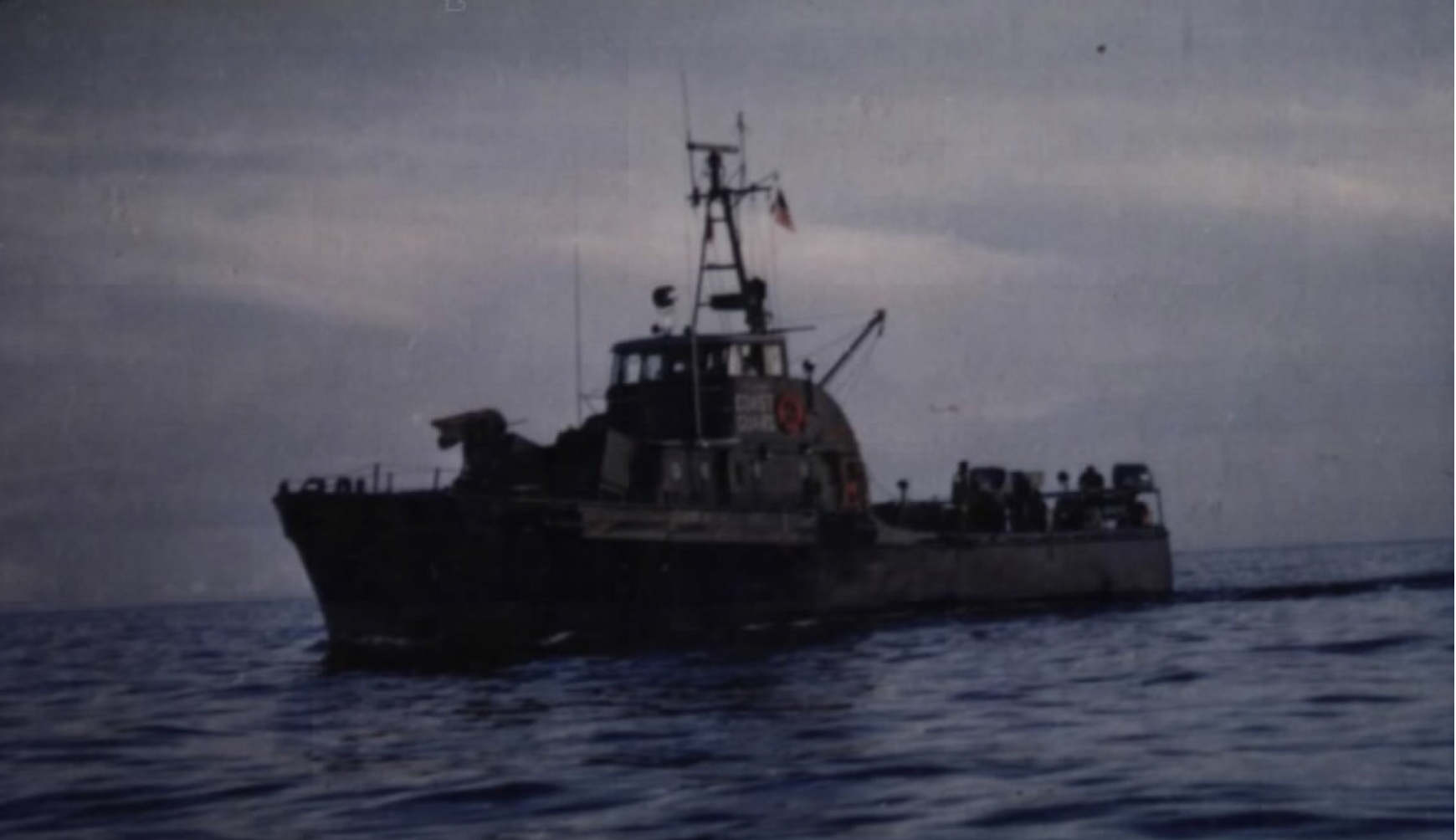
1941  The United States and Denmark signed an “agreement relating to the defense of Greenland.”  The Coast Guard, in part because of its experience in the Arctic environment, was the principal service used to carry out the agreement.  The first action seen by U.S. forces in World War II was the seizure of a weather station and a pro-German vessel in Greenland waters by CGC Northland just before the U.S. officially entered the war.

USCGC Cleat (WYTL-65615)

1974  The oil tanker Elias docked at the Atlantic Richfield Terminal in Fort Mifflin, Pennsylvania, caught fire.  CG-40412 responded and was first on scene and began SAR for any crew who jumped overboard.  CG-40412 crewman Kim Lee remembered: “The response for our crew on 40412 was looking for personnel off the ship Elias that might be in the water.  We were first on scene and I called back to base giving the update.  The request by us was to shut the Delaware River down to all traffic due to crude oil on fire extending completely across the Delaware River.  Captain of the Port (Capt. Goodwin) shut the river down which stopped all vessels traffic in the area.  A while had passed and we then received a distress call from the Coast Guard Cutter Cleat and we quickly responded toward the Cleat.  The crewmen from the Cleat were in the water and the Cleat was on fire and drifting into the Elias which was totally involved in fire.  My crew (Petty officer Joe Friel and Allen Mowbray) began pulling the crew out of the river.  We then attached a tow line on the burning Cleat and began towing it toward the middle of the channel.  At one point while towing the Cleat our engines on the 40412 stopped because of the ships (Elias) mooring lines in our props.  My crew quickly pulled up the mooring lines and cut them apart with a hand ax.  Freeing one engine we were able to pull the Cleat to safety and put out the fires on the Cleat.  All members of the Cleat crew were accounted for but one engine men who we found still down in the engine room trying to start the Cleat’s main.”

“Rolling Airframe Missiles To Arm Arleigh Burke Destroyer Fleet” –The War Zone / Will NSCs get the Upgrade? OPCs?

SeaRAM

The War Zone Reports,

The U.S. Navy plans to add RIM-116 Rolling Airframe Missiles(RAM) to the arsenals of its Arleigh Burke class destroyers to boost their defenses against incoming cruise missiles, drones, and other air and surface threats. RAM launchers will take the place of existing 20mm Vulcan cannon-armed Mk 15 Phalanx Close-in Weapon Systems (CIWS), but the exact final configuration will differ depending on the sub-class of ship.

Replacing the Phalanx with SeaRAM on National Security Cutters would be a major improvement in their ability to survive an air attack. It has much greater range and greater ability to deal with multiple targets, as well as much better anti-surface capabilities, than the Phalanx which has an absolute max range of about three miles and an effective range of about one mile.

It is an easy swap.

The SeaRAM combines the radar and electro-optical system of the Phalanx CIWS Mk-15 Block 1B (CRDC) with an 11-cell RAM launcher to produce an autonomous system—one which does not need any external information to engage threats. Like the Phalanx, SeaRAM can be fitted to any class of ship. Due to the common mounting, SeaRAM inherits the relatively easy installation characteristics of its gun-based sibling, with Raytheon stating that SeaRAM “fits the exact shipboard installation footprint of the Phalanx, uses the same power and requires minimal shipboard modification”. In 2008, the first SeaRAM system was delivered to be installed on USS Independence.

The Missile: 

RAM or Rolling Airframe Missile, RIM-116, is a relatively small, relatively cheap, quite  mature weapon system having its Initial Operational Capability in 1992. Fitting SeaRAM would bring the NSC’s weapons fit more in line with that of the LCSs which are also fitted with the 57mm Mk110 and RAM. RAM is currently fitted on virtually every US Navy surface combatants other than cruisers which will soon be decommissioned and the destroyers that will be getting the system.

Anti-Surface Capability:

RAM would also provide an enhanced anti-surface capability. SeaRAM would be an excellent complement to the 57mm Mk 110. The 57mm has a greater maximum range than the RAM, but effective ranges are similar, at five to six miles. SeaRAM has only eleven rounds immediately available, but it’s combination of high hit probability, Mach 2+ speed, 164 pound mass, and a 1.3 kg (24 lb 15 oz) warhead means it can inflict significant damage quickly.

(Eleven rounds times 164 pounds equals 1804 pounds. That mass is equal to 340 rounds of 57mm HE and the RAM probably has a higher hit probability.)

Why isn’t the Navy Converting all Phalanx?

The fact that the Navy is not replacing all Phalanx systems with SeaRAM might suggest they don’t believe RAM is necessary for all classes, but, actually, every US Navy combatant that has a Phalanx, also has a longer ranged missile system. If they don’t have the longer ranged Standard or ESSM missile systems, then they have RAM, many have more than one.

Hopefully all Coast Guard NSC Phalanx systems will be replaced by SeaRAM.

The Offshore Patrol Cutter:

For many potential naval missions, OPCs are interchangeable with the NSCs. They probably should be similarly equipped. If the NSCs need SeaRAM, the OPCs need it more.


This Day in Coast Guard History, April 8

Based on the Coast Guard Historian’s timeline, https://www.history.uscg.mil/research/chronology/
With inspiration from Mike Kelso

April 8

U.S.R.C. Onondaga, America’s Cup races, 1901. Library of Congress.

1902  President Theodore Roosevelt, Jr., and his party of 40 guests boarded USRC Onondaga in Charleston Harbor.  The cutter, which had been dressed in “rainbow fashion,” extended to the President “all honors as prescribed by the Regulations, Revenue Cutter Service.”  The cutter and its crew of transported them to Fort Sumter and back. The cutter expended “42 6 pdr saluting charges” by firing two separate 21-gun salutes.

1909  Race Point, Massachusetts: The sloop Keewaydin IV’s mast was carried away and the sloop anchored 2 miles SW of station, but dragged ashore.  Station crew was on the beach when she struck and the keeper rowed out surf and threw a heaving line on board.  One of the two men was rescued by this means.  The other jumped overboard and was pulled ashore by the keeper.  The sloop drifted up on the beach and became a total wreck.

USRC Seneca, 1908

1913 USRC Seneca, designed from the keel up as the nation’s first “derelict destroyer,” inaugurated the service’s participation in the International Ice Patrol.

SAULT SAINT MARIE, Mich. (Sept. 15)–The Coast Guard Cutter Katmai Bay (WTGB 101) is tied to the pier at Group Sault Saint Marie, Michigan. USCG photo by PA1 Harry C. Craft III

1978 CGC Katmai Bay was launched at Tacoma Boatbuilding Company, Inc., in Tacoma, Washington.  Katmai Bay was the first cutter in the Coast Guard’s new class of icebreaking harbor tugs.  The cutter was sponsored by Ms. Jeanmarie Griffin.

Coast Guard Cutter Polar Star (WAGB 10) visited Palmer Station, a United States research station on the Antarctic peninsula, March 3, 2023, after completing a successful deployment in support of Operation Deep Freeze 2023. This was the Coast Guard Cutter Polar Star’s first visit to Palmer Station in 35 years. Operation Deep Freeze is one of many operations in the Indo-Pacific in which the U.S. military promotes security and stability across the region. (U.S. Coast Guard photo by Petty Officer 3rd Class Aidan Cooney)

2023 CGC Polar Star returned to Seattle 8 April 2023 following a 144-day deployment to Antarctica. The deployment marks the ship’s 26th journey to Antarctica as part of Operation Deep Freeze, an annual joint military service mission to resupply the United States Antarctic stations. Polar Star departed Seattle on 14 November 2022, traveling more than 25,000 miles through the North Pacific, South Pacific, Indian, Southern, and South Atlantic Oceans. While en route, the crew made two stops in Australia. After arriving in Antarctica, the cutter broke a 15.3-mile channel through fast ice to create a route for cargo vessels to reach McMurdo Station. The cutter then departed the Antarctic region on March 2. On the return journey, the ship crossed the Drake Passage, rounded Cape Horn, and stopped in Chile. At the stop in Valparaiso, Chile the Polar Star’s crew conducted exchanges with the Chilean Navy and First Naval Zone members. “The completion of this mission is a testament to our crew’s hard work, sacrifice, and dedication,” said CAPT Keith Ropella, Polar Star’s commanding officer.