The blog “EagleSpeak” has a short post on leadership you might like.
Leadership Philosophy
Reply

The blog “EagleSpeak” has a short post on leadership you might like.
Thanks to Brad, we have a couple of local reports that the Sea Shepherds organization now has a couple of former USCG Island Class WPBs, the former cutters, USCGC Block Island and USCGC Pea Island, that were seen flying the Sea Shepherd pirate flag in Annapolis. The first report has some good photos. The second has a report of an informal interview at a local tavern.
Just published a new post on the FY2016 budget, but for some reason the software placed it behind an older post, so it is easy to miss. You can find it here. https://chuckhillscgblog.net/2015/02/04/fy2016-budget-first-look/

Click on photo to enlarge
The Australian Navy has had problems with their Armidale class patrol boats. These little ships, similar to the Coast Guard’s Webber Class WPCs (Fast Response Cutters), have been sent great distances to enforce Alien Migrant Interdiction Operations. They are really are not up to the task, so Australia has been planning a larger class. In addition to the fourteen Armidale patrol vessels, they hope to use the same class to also replace six Huon-class minehunter, two Leeuwin-class survey vessel, and four Paluma-class survey motor launch.
This projected class of 20 larger ships is referred to as the Offshore Combatant Vessel.
No design has been chosen yet as far as I can tell, but Austal is a local firm (with a shipyard in the US as well) that probably has an inside track. Their design referred to as a “Multi-Purpose Vessel,” is a bit unusual, but it might be appropriate to use as a USCG cutter to fill the space between the Offshore Patrol Cutter (OPC) and the Webber class WPCs, that I have been referring to as “Cutter X.”
It looks a bit like a scaled down Independence class LCS, not surprising since the Independence class are also made by Austal. It, like the Independence design, is a trimaran hull with lots of clear helicopter operating area and a hangar, as well as a large open area under the flight deck for modular systems, or perhaps in our case transporting migrants. Looks like they could also be very useful for Humanitarian Assistance Disaster Response (HADR) Mission.
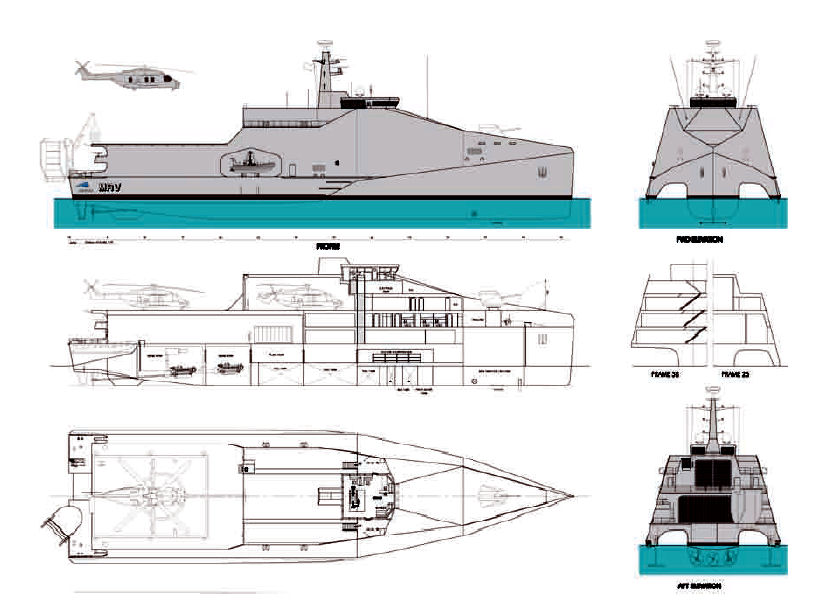
Austal 80 meter Multi-Role Vessel
Length overall 80 meters (262.5 feet)
Length (waterline) 78.8 meters
Beam (moulded) 21.1 meters (69.2 feet)
Depth (moulded) 6.7 meters
Hull draft 3.2 meters (10.5 feet)
Mission deck 500m2 (5382 sq.ft.)
Flight Deck area 290m2 (3122 sq.ft.)
Hangar 1 x NH-90 (a 23,370 lb gross weight helicopter) or similar
Complement 35
Crew accommodation 87 berth
Endurance 28 days
Range 4,500nm @ 12 knots
Speed (max) 26 knots
Main engines 3 x MTU 20V 4000 @ 4,300kW at 2,170 rpm Diesel engines
(Same engines used in the Webber class)
Propulsion 3 x fixed pitch propellers
Weapons and Sensors •Standard 25mm stabilized naval gun
(the artist concept actually shows a 57mm)
•4 x .50 cal general purpose machine gun mounts
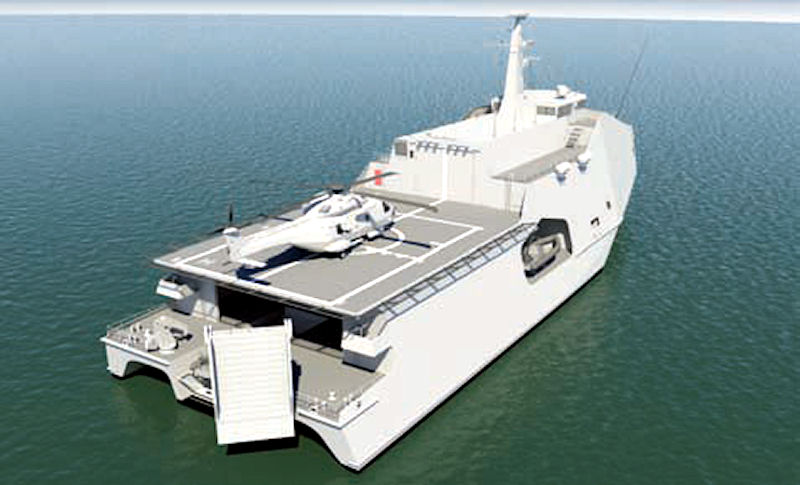
Austal 80 meter Multi-Purpose Vessel
Thanks to JamesWF for reminding me of this design.
We now have access to the proposed Coast Guard Budget for FY2016 in several levels of detail in the form of pdfs. These range from a one page “fact sheet” to over 500 pages of Congressional justification.
FierceHomelandSecurity, also gives us a quick overview including how it fits in the larger Department budget. The Department’s budget is up 7.3% while the Coast Guard budget is up by only 1.6%.
The good news is that the budget has increased, the bad news is that all the increase can be accounted for by the increase in retired pay. In real terms, it is another cut, though not a big one.
In support of the DHS’s strategic objectives, the FY 2016 Budget provides for the acquisition of six Fast Response Cutters, continues to invest in pre-acquisition activities for an affordable Offshore Patrol Cutter and funds vessel sustainment projects for two 140’ WTGB Icebreaking Tugs and a 225’ Seagoing Buoy Tender. The budget also continues sustainment and conversion work on legacy fixed and rotary wing aircraft, missionization of the C-27J aircraft received from the Air Force, and investment in Command, Control, Communications, Computers, Intelligence, Surveillance, and Reconnaissance (C4ISR) systems.
It is a bit surprising that the cut in the AC&I account is not larger than it is, considering the Coast Guard is not ready to fund any new large ships in 2016. The NSC program is just finishing up and there is a small amount for that and some money to prep the OPC program, but no new starts for major cutters.
The six Webber class “Fast Response Cutters” puts the program back on track to continue delivering four per year since only two were included in 2015. This program will be with us until far into the future, with the last delivered in 2026 at the current rate.
Major Renovations for the 140 icebreaking tugs have already begun. The Acquisition Directorate, CG-9, is reporting work on the second vessel, Penobscot Bay has begun. Looks like C-27J integration is getting a boost.
I still wonder when we will start doing something about the inland fleet.
Maritime Professional reports the Commandant’s address to the Passenger Vessel Association, Monday, Feb. 2, at Long Beach.
Apparently they were favorably impressed.
There is also some information for those planning a career in Marine Safety. Apparently you can expect more stability.
Thanks to Lee for the link.
Recently saw this on Bill Wells FaceBook page and thought it might be worth opening a discussion. I am republishing it here with his permission.
The current Coast Guard, and that of the immediate past, has relieved officers and enlisted men from command for any number of reasons. The “Relief for Cause,” or the “Loss of Confidence” reasons can mean anything and usually do. However, there is no legal process, the officer or enlisted man has little recourse and their careers as over. Many of the cases have devolved into using the “failure to abide by the Core Values.” It must be remembered that Core Values were implanted as part of the now defunct Total Quality Management System. The initial use of the values were to provide a guide for organizational conduct as shown in the Business Dictionary that defines Core Values as, “A principle that guides an organization’s internal conduct as well as its relationship with the external world. Core values are usually summarized in the mission statement or in a statement of core values.”
However, since inception the Core Values have been used as a hammer for punitive, extra-legal functions. The Coast Guard’s Core Values of Honor, Respect, and Devotion to Duty are claimed to have come from the Coast Guard’s history, but no one has pointed to that source. It is more faith and a belief system gone wrong. When first adopted no one could define just what the three words meant to the Coast Guard at large. So, explanatory paragraphs became additions to the words but these only confused the issue because the additional wording contained more core values, rules, and philosophical sloganeering. Still seeing the troops did not understand the additions, the Coast Guard added Twenty-Eight Competencies of leadership that all circled back to the Core Values providing more confusion.
So, how was the Old Guard tougher? They followed the prevailing rules. For example, in 1913 the Treasury Department charged Captain Horace B. West, USRCS, at a General R. C. S. Court with:
Neglect of Duty with six specifications.
Violating lawful regulations with eight specifications.
Conduct unbecoming an officer and gentleman with four specifications.
All these charges sound series until the reasons for the charges are known. West was found guilty on ‘neglect of duty’ and violating regulations and not guilty for unofficer-like conduct. His crimes consisted solely of his apparent dislike for paper work. West failed, according to the New York Times, to make “reply to several reports and communications transmitted to him from the Treasury Department. Although, the USRCS had had a service motto, “Semper Paratus,” since 1896, he was not charged being in violation of it and all it could have referenced was he was not ready to do paper work. The charges were not his first brush with not filing paperwork. In 1905, while in command of the cutter Woodbury at Portland, ME., he failed to submit assistance reports and for not having officers comply with a General Order. The assistance reports were more important because they provided the statistical data the Treasury Department used to justify the existence of the USRCS.
His sentence consisted of a suspension from the service for six months on half pay. A vacation of sorts and he resumed full service and his command with no real adverse effect on his career. Of course, West understood it all. He was an 1880 graduate of the Revenue Cutter School of Instruction (later the Coast Guard Academy).
The Treasury Department of West’s era would have never relieved him for cause. If they had specific charges and proof they brought the person to a legitimatize trial to exact that pound of flesh. Using the sloganeering of core values does little to inspire confidence in the ability of the Coast Guard’s leadership to address situations in a fair and military manner. Perhaps it is time to look at the Core Values and see that they do represent the Service beyond being a punitive cat o’ three tails.
“When the Hill passed its spending bill in December, it excluded DHS, instead putting the agency under a three-month continuing resolution while the Republican-controlled Congress sought to challenge President Barack Obama’s executive order on immigration.
“Asked about the DHS funds days after the Paris attacks, newly re-elected House Speaker John Boehner, R- Ohio, said “I don’t believe that the funding of the department is in fact at risk.” Meanwhile, Senate Appropriations Committee member Sen. John Hoeven, R-N.D, indicated “more has to be done” to prevent such attacks, which could include an increase of funds.” (Emphasis applied–Chuck)
Should the Coast Guard play the terrorism card in a push for increased funding?
I hate to push fear as a justification for funding but keep a couple of things in mind.
The Department of Homeland Security seems to have a fixation on terrorism that the Coast Guard seems to have viewed with some skepticism. As a result while Departmental funding has continued to increase, Coast Guard funding has actually declined. We have been out of step with Department priorities.
Perhaps it is time to embrace the Department’s priorities.
It does seem the world is becoming a more dangerous place.
The house is pushing a bill that would have DHS strengthen the southern border including more aircraft.
Are they really worried about the right threats? Really, we should be talking about what we should be afraid of, and that should include the introduction of a nuclear device which most likely to come by sea.
The Pentagon wants $350B to modernize Nuclear deterrents, new SSBNs, new ICBMs, and new nuclear bombers, none of which will have any deterrent effect on terrorists. And after all will $350B for deterrence be any more effective than $320B?
Perhaps it would make sense to spend $1B more a year on the Service that is most likely to be on the line if terrorists attempt to bring a weapon of mass destruction into the US, when most of that money is expected to be spent over the long term anyway.
If the Coast Guard is going to embrace counter terrorism as a priority, the service needs to act like it believes a terrorist attack is a possibility and ask to be armed appropriately to deal with terrorist threats, a 7.62 mm machine gun on a 25 foot boat will not cut it.
It the Coast Guard is to have a creditable capability, it will need small highly accurate missiles like Griffin, Hellfire, or Brimstone to deal with relatively small, fast, highly maneuverable threats and light weight torpedoes to deal with larger, hard to stop threats. We also need to get modern reliable patrol vessels or aircraft armed with these weapons spread out geographically to cover all our ports.
The Acquisitions Directorate is reporting purchase of equipment to complete the Nationwide Automatic Identification System. US regulations will require most vessels in US waters 65 foot and longer to participate.
This should be a boon to SAR. It has the potential to help the Coast Guard in many ways. Still we should not forget, the information is only as good as the cooperation of the participating vessels. Vessels that choose not to cooperate by either not transmitting, or by transmitting bogus data, for whatever reason, will either not show up at all or will be improperly identified.
The Coast Guard Compass notes the 100th anniversary of the consolidation of the Revenue Cutter Service (USRCS) and the Life Saving Service (USLS) to form the Coast Guard, noting the roles of Bertholf and his Lifesaving Service compatriot Sumner Kimball. Bertholf, of course, already has a cutter named for him and USCGC Kimball (WMSL-756) will be the seventh in the Bertholf class.
 Chuck Hill's CG Blog