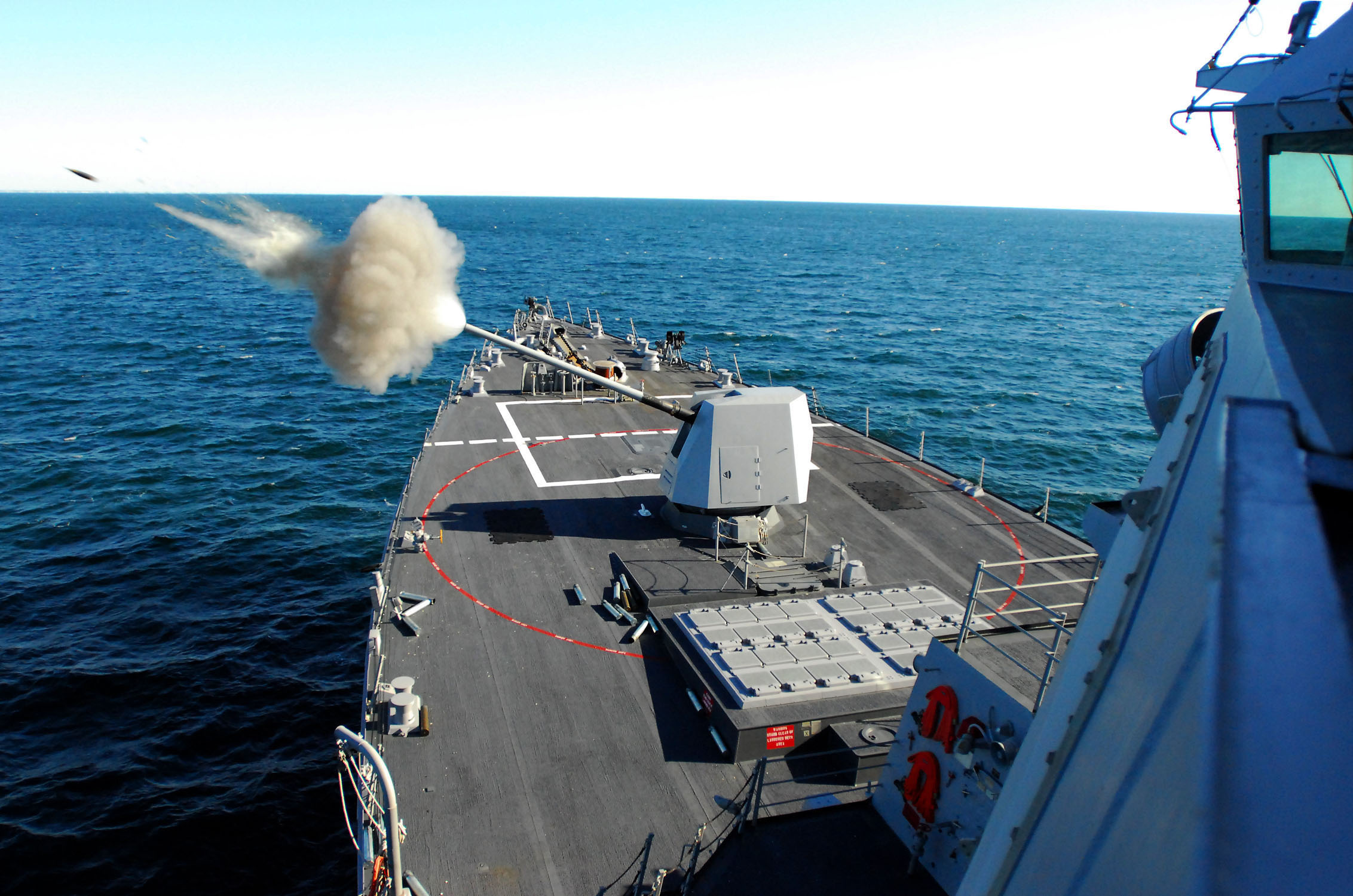
Currently the largest Coast Guard cutters are being equipped with the Mk 110 (BAE/Bofors 57 mm Mk3) gun mount. By all reports it is a good defensive weapon, effective against air threats and small fast surface vessels. But is this weapon also the most appropriate for the most likely scenarios?
The Choices: Given that we can only consider weapons supported by the US Navy, there are really only two choices, The Mk 45 5″ and the Mk110 57mm; three if you consider the Mk75 76 mm which seems to be going away.
Mk75 76 mm guns, are mounted on the once large, but now rapidly dwindling FFG-7 class in addition to 378s and 270s. There are currently roughly 50 systems installed, but that can be expected to rapidly decrease with no new installations planned. Still, this is based on perhaps the most successful post-WWII naval gun, the Oto-Melara (now Otobreda) 76mm, one that is still being installed on some of the most sophisticated new construction foreign made vessels. There has been some talk from USN sources that they may choose to install the Mk 75 on future LCS, but unless there is a change, it looks likely the 270s will be the last operational US vessels to use the Mk75.
The Mk110 57 mm, is found on the National Security Cutter (NSC) and the Littoral Combat Ship. It is also planned for the Offshore Patrol Cutter, and will be used as a secondary mount on the Zumwalt Class DDG. It is based on the Bofors 57mm Mk3, a competitor to the more successful Oto Melara 76mm. There are currently only about six units operational on US ships now, but if all four classes are completed as planned there will be 94 systems afloat.
The 5″ Mk 45, in its three mods, is the most numerous medium caliber gun in the USN inventory, and until the 155mm Advanced Gun System (AGS) becomes operational on the Zumwalt Class DDGs it is also the largest US naval gun. (Only 6 AGS on three ships are currently planned). There are currently about 106 USN mounts afloat. Numbers have declined somewhat particularly with the decommissioning of the Spruance Class. They are still being installed on new construction and planned Burke Class destroyers, but as DDGs with one mount replace cruisers with two, the number is likely to decrease further to between 80 and 90 mounts. It is also in service with ten foreign navies. It is the most successful mount of its class in the world.
The Advanced Gun System planned for the Zumwalt Class DDGs is simply too large to consider for use on cutters.
Why do we have guns on our ships at all?
- We use guns to signal, firing across the bow to tell a vessel to stop.
- We use guns to intimidate law breakers into complying, making it obvious it is futile to resist.
- To sink derelict vessels that may be hazards to navigation.
- To protect ports, waterways, coastal areas, and marine traffic from attack in peacetime (PWCS).
- To fulfill war time roles.
Self defense isn’t a requirement until it becomes necessary to accomplish one of these tasks.
Signalling or intimidating the typical drug smuggler doesn’t require even a 57mm. A .50 cal is usually adequate, and if not a 25 mm certainly is.
Derelict destruction is now rare, but it apparently was a common requirement at least into the ’30s. While rare, as the Anacapa found out, when it was tasked to sink an abandoned Japanese fishing vessel, it may be more difficult that might be expected. Even so, it is rare, and there are other ways to do this mission, so its not really a consideration in the choice of weapons.
The need for a larger weapon only surfaces for the last two purposes, protection of Ports, Waterways, and Coastal Security (PWCS) and wartime tasking.
Forcibly compelling compliance.
Both PWCS and war time roles are likely to require cutters to be able to board and inspect merchant vessels and the ability to forcibly stop or sink them if they do not comply with instructions, regardless of their size. This requirement is likely to surface across the entire range of possible military conflicts from helping an ally in a counter-insurgency to a wide spread multinational conflict including operations against a great power.
If there is a major conflict, we are going to have to quickly neutralize the adversaries merchant fleet, which might otherwise engage in mining, providing intelligence, dropping off agents, supporting submarines, or even have aboard cruise missiles: http://elpdefensenews.blogspot…
The Coast Guard, and the Revenue Cutter service before it, have always needed a capability to compel compliance. Has our ability kept pace with the increased size of merchant ships?
From the 1920s through the the mid ’80s, when the 378s were FRAMed, the weapon of choice for the larger cutters was a 5″, first the 5″/51 and beginning in World War II the 5″/38. The 5″/51 was developed as secondary armament for battleships and also armed light cruisers, and a small number of destroyers. It was larger than the 4″ guns typically found on destroyers before the 1930s, when the 5/38 was introduced. (Destroyers, of course, did also carry torpedoes as their main armament.) Both the four 240 ft Tampa class (completed 1921-22) and the seven 327 ft Secretary Class (completed 1936-37) were built with two 5″/51s and two 57mm six pounders. The ten 250 ft Lake Class (1928-32) Cutters were built with a 5″/51, a 3″/50, and two 57mm.

240 foot Tampa Class cutter, original armament, 2×5″/51, 2x6pdr
From the reports of submarine successes during WWII, based on numbers of ships and total tonnage sunk, I infer that the average merchant vessels of the period, was about 5,000 tons. 20,000 tons was considered a big ship.
I don’t know what the average size is now, but they have gotten a lot bigger. Anything less than 20,000 tons is considered small and they go up to over 20 times that.
Give that size is a primary factor in ship survivability, today’s merchant ships are likely to be much harder to stop than the ships of the 60 to 90 years ago. Are our ships correspondingly better armed?
The boarding scenario minimizes the relative importance of gun range and sophisticated fire control. If the vessel refuses, combat is likely to commence at short ranges. Modern systems are capable of much greater accuracy at a distance, but even in the ’20s, when ranges were even less than now, because boardings parties were transported by pulling boats, virtually every round would have been a hit. There are at least two ways we can compare hitting power, first we can compare the weight of rounds the systems could have put on target and we can also compare the destructive potential of the individual rounds in terms of muzzle energy.
For reference there are the characteristics I used for calculations.
System Projectile Weight Muzzle velocity Rate of fire
– (lbs/KG) (ft/sec and M/sec) rounds/minute
5″/51 50/23 3150/960 8.5
5″/38 55/25 2500/760 20
76mm Mk 75 14/6.3 3030/925 80
57mm Mk110 5.3/2.4 3400/1035 220
5″/62 Mk45 mod4 70/31.75 2650/807.7 20
In terms of potential for putting weight of projectiles on target, there is remarkably little difference if we compare the two 5″/51s that equipped the cutters of the ’20s and ’30s with a single mount of any of the modern systems. (Projectile weight x rate of fire)
- System pounds/minute
- two 5″/51 850
- 5″/38 1100
- 76mm Mk 75 1120
- 57mm Mk 110 1160
- 5″/62 Mk45 mod4 1400
I’m not sure this is the best metric for the task of disabling or sinking a ship. The projectiles need to reach the vitals of the ship. As ship have gotten bigger, the vitals become more difficult to reach and more damage resistant, which would favor the more powerful weapons.

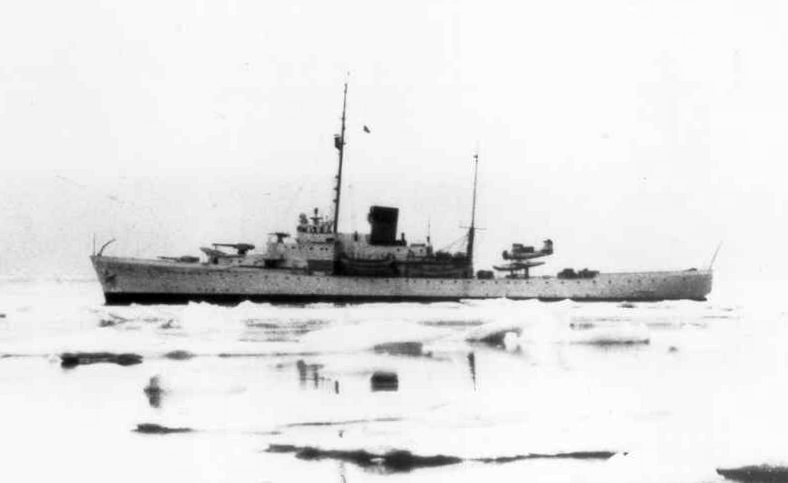
US Coast Guard Photo: The U.S. Coast Guard cutter USCGC Duane (WPG-33) in Greenland waters, circa 1940
The potential of the individual projectiles to penetrate and cause damage is reflected in the muzzle energy.
System Projectile Weight Muzzle velocity Muzzle energy
– (lbs and KG) (ft/sec and M/sec) MegaJoules
5″/51 50/23 3150/960 21.2
5″/38 55/25 2500/760 14.4
76mm Mk 75 14/6.3 3030/925 5.4
57mm Mk110 5.3/2.4 3400/1035 2.6
5″/62 Mk45mod4 70/31.75 2650/807.7 20.7
Here the oldest system is remarkable in that of all the systems considered, the 5″/51 had the highest muzzle energy. Only the 5″/62 Mk45 mod 4 is close.

USCGC Campbell (WPG-32) at the New York Navy Yard, in May 1940. USCG photo
Other Wartime Roles:
I have not been privy to war plans in a very long time, and as they say, plans seldom survive first contact with the enemy, but we have the experience of the past to draw on.
In the 67 years since the end of World War II, I do not believe any cutter has fired at an air target in anger. In fact, I know of no occasion when US Navy surface ships have engaged air targets with medium caliber guns. There have been some occasions when Navy vessels and even cutters have engaged surface targets with guns, but by far the most common use has been Naval Gun Fire Support (NGFS), now referred to by the more generic term Naval Surface Fire Support (NSFS). Cutters did it frequently in Vietnam, firing over 77,000 5″ rounds. The US Navy did it in the Korean War, Vietnam, Operation Praying Mantis (1988), and the First Gulf War. It was done during the Second Gulf War by British and Australian ships. The USN was apparently doing NGFS as recently 2007 in Somalia.
Naval Surface Fire Support (NSFS)
The US Navy has an acknowledged shortfall in NSFS capability. The number of ships capable of performing NSFS has dropped precipitously. For those that remain NSFS is a secondary mission to Ballistic Missile Defense (ABMD), AAW, or ASW. If there is a major conflict, they are likely going to be called upon for other missions that will leave them out of position to do NSFS.
The Zumwalt class destroyer with its 155mm advanced gun system was to have been the primary NSFS platform and there were to have been 32 of them, but the program has been cut back to only three.
If the Offshore Patrol Cutters were equipped with a Mk45 5″ they could provide a increase in US naval NSFS capability out of all proportion to the small marginal increase in cost.
More about the Mk45 5″

Photo: US Navy photo by Joshua Adam Nuzzo. USS Forrest Sherman (DDG 98) fires its five-inch gun.
The Mk 45 was originally designed as a direct replacement for the 5″/38 single mount. Destroyers the size of the OPC carried five 5′/38 mounts in addition to torpedoes and numerous 40 and 20 mm guns. Even in its latest version, the Mod 4, its 33 ton weight is not unreasonable for a ship the size of the OPC.
As the most numerous US naval gun a large variety of projectiles are available and there remains great potential for further development. The 5″ is effective against air targets, and special projectiles have been developed for dealing with small high speed surface targets. Add on GPS guidance can make them precision strike weapons in the NGFS role.
Conclusion:
In choosing the Mk110 57mm because it was seen as a better AAW weapon, a better anti-swarm weapon, as lighter, cheaper, easier to maintain or man, for whatever reason, the Coast Guard will have a weapon that is at best only marginally more capable, perhaps even less capable, of performing the most likely missions–stopping/sinking a surface target or performing NSFS–than the weapons of 60 to 90 years ago.
While the size, toughness, and survivability of merchant ships has increased dramatically, the Coast Guard has not provided its ships with a significantly improved capability to stop or sink a ship since the introduction of the 5″/51 in 1921. I still think the Coast Guard should add a light weight anti-surface vessel torpedo to its inventory as the cheapest way to have a truly effective ship stopper that can be made widely available. But until such a weapon becomes available, the Mk45 5″ is the best alternative available.
The 5″ Mk45 is a versatile weapon. Equipping the OPCs with this weapon make the ships more capable of performing both the PWCS and probable wartime mission and significantly enhances the NSFS capability of US Naval forces in a major conflict.

USCGC Cook Inlet (WHEC-384), USCG photo

USCGC Duane (WHEC-33) steaming home after completing her tour of duty in Vietnam, 1968. USCG photo
Photo: USCGC RUSH (WHEC-723) underway during Exercise Brim Frost ’85. photographer: SGT. Zachs

5″/38 fired from a Coast Guard 311 ft WHEC