Quick Video Tour of Morro Bay’s Engineroom

We have had a recent series from the Icebreaking tug USCGC Morro Bay (WTGB 106) as she deployed from her homeport in New York to the Great Lakes to help with icebreaking there. Here is a very quick video of her engineroom. Looking good for a 30 year old ship (Commissioned in 1981). The FY2012 budget request includes funds to renovate the first of her class.

Morro Bay is one of a class of 8. Here are their basic specs:

  • Displacement: 662 tons full load
  • Length: 140 feet (42.67 meters)
  • Beam: 37.6 feet (11.43 meters)
  • Draft: 12.5 feet (3.66 meters)
  • Two Fairbanks Morse main propulsion diesels that drive generators (engines and generators at their far end, are gray in the video)
  • Westinghouse electric drive motor
  • Single shaft
  • Two 125 KW ship service generators (they are yellow in the video)
  • 2,500 HP
  • Speed: 14.7
  • Endurance 1,800 nmi/14.7 knots, 4,000 nmi/12 knots (probably requires only one diesel)
  • Crew: 3 officers, 14 enlisted

Please, correct me if I am wrong, but I presume the ship service generators are forward of the main prop diesels.

Here are links to some of the previous posts about Morro Bay’s deployment:

Budget Realities Setting In?

The Marine Log is reporting “House Coast Guard and Maritime Transportation Subcommittee Chairman Frank LoBiondo (R-N.J.) set a no-nonsense tone when he opened up a hearing yesterday to review the Administration’s budget requests for the U.S. Coast Guard…’Congress must make extremely difficult decisions in the coming months to bring our spending under control and cut the deficit’…Chairman LoBiondo commended the service for uncovering some savings through efficiencies in operations and the consolidation of services, but wanted to know ‘if more operational savings can be found that will not adversely impact safety, security, and mission success.'”

He called the Coast Guard’s  five year Capital Improvement Plan “fantastic,” (not in a good way, as in, it is a fantasy) referring to a planned 66 percent increase in funding over the next three fiscal years. (Assuming we are talking about a 66% increase in AC&I over the FY2012 request ($1.4B) that is a $924M increase annually, approximately a 9% increase in the total budget.)

He also took the service to task for its failure to complete a “fleet mix analysis” that the Subcommittee requested over 13 months ago.  “I urge the Service, in the strongest possible terms, to satisfy our request for this document in short order…Second, the Service continues to lack the polar missions plan long sought by Congress. To add insult to injury, the Service intends to spend millions of unbudgeted dollars to refurbish the POLAR SEA’s engine and then decommission the icebreaker.  This is a classic example of throwing good money after bad.”

The Coast Guard is still projecting procurement planned under the discredited “Deepwater” program, almost ten years ago, that included replacing 12 WHECs with 8 multi-crewed National Security Cutters (NSC) and replacing 29 WMECs with 25 Offshore Patrol Cutters (OPC), a reduction of 20% in the number of hulls. Meanwhile, there is little evidence to prove multiple crewing of NSCs will work; UAVs, which don’t seem to be working out for reasons beyond Coast Guard control, were supposed to do a lot of the air surveillance work; drug runners are turning to semi-submersibles and true submarines that are increasingly hard to detect; and new responsibilities are coming with the opening of the Arctic to commerce. It is also possible to make a case that the South Pacific EEZ was never adequately policed. Things have changed and they justify more, not fewer assets. Continue reading

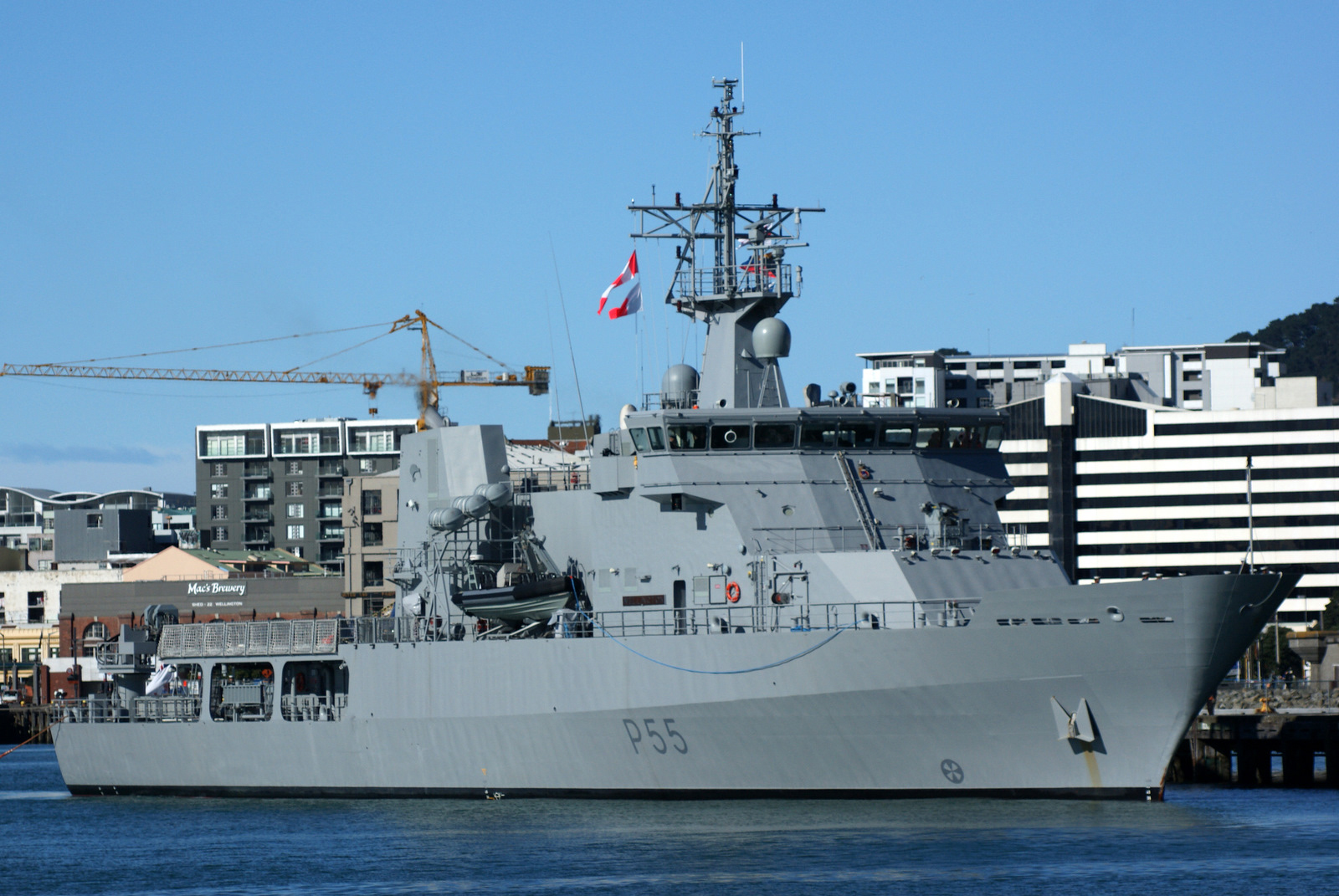
Arctic Patrol Vessel–New Zealand

New Zealand has produced a couple of Canadian designed ice strengthened offshore patrol vessels, HMNZS WELLINGTON and  OTAGO, that they intend to use to support their operations in the Antarctic. WELLINGTON has recently completed her first deployment to the antarctic.

File:HMNZS Wellington.JPG
HMNZS WELLINGTON visits Wellington for the first time; Author: Derek Quinn; Date: 2010-09-23
While I think we all recognize the need for a heavy icebreaker capability, we are unlikely to ever have enough to fulfill all our growing needs for presence in the Arctic. Ice strengthened Arctic patrol cutters similar to the WELLINGTON might provide a viable alternative to fill this need.

Fast Response Cutter Photos

The Cutterman facebook page has published some more photos of the Fast Response Cutter Webber (and possibly a bow on view of a follow-on ship). Unfortunately they are all taken from low on the starboard bow or directly on the bow so we don’t get views of the whole ship. Look forward to seeing the vessel emerge from the building shed and seeing the whole vessel.

Patrol Boats for Iraqi Navy–Ready to Take Over?

The Iraqi Navy has accepted the second and third of a projected class of fifteen 35 meter (115 foot) patrol boats that will ultimately take over security duties at their offshore oil terminals now provided by Coast Guard 110 foot and Navy Cyclone Class patrol craft.

The patrol boats are being built in Louisiana by Swiftships at a cost of about $20M each. The crews are also being trained in Louisiana.

https://i0.wp.com/gcaptain.com/wp-content/uploads/2011/02/PB-301-Iraqi-Navy-patrol-boat.jpg

Continue reading

Drug Running “How to” and Radioactive Shipping Containers

Eagle Speak has taken a break from his usual favorite topic of piracy to talk about drug smuggling and Port Security. Starting with reference to a Wall Street Journal book review (I Am the Market: How to Smuggle Cocaine by the Ton, In Five Easy Lessons, By Luca Rastello, Faber and Faber, 178 pages, $22), he ties in a report of a container of radioactive Cobalt 60 that has been sitting on a Genoa, Italy pier for 6 months because no one seems to know what to do with it. Lots of questions about the container and its contents which came from Saudi Arabia, ” Why did it take so long to detect the radiation? What does this say about port security in Saudi Arabia? Were the shipping documents falsified? Was anyone paid off to allow this shipment? What other shipments of hazardous materials would a small bit of Bakeesh allow to go unchecked?”–interesting reading.

The Battle for Convoy ON-166, 25 February 1943

The Navy History Center is featuring a short narrative and photos from this classic convoy battle between eight escorts lead by Coast Guard Cutters Spencer and Campbell and 19 U-boats during the critical winter months of 1943.

For more information on the Coast Guard’s battles against the U-boats, there are a series of extensively captioned photos of 327s here, an accounting of “U.S. Coast Guard Combat Victories of World War II” which also lists significant losses is here, and a twenty page pdf on the Battle of the North Atlantic is here.

File:USCGC Spencer WPG-36.jpg
USCGC Spencer (WPG-36) in 1942 or 1943. Spencer sank U-175 with assistance of USCGC Duane, on April 17, 1943.


The Brits are not pulling out the the Western Atlantic/Caribbean

Some of you may have seen reports such as this, that the Royal Navy is ending its warship patrols in the Western Atlantic and Caribbean. This would be significant for the Coast Guard, because of the long and successful cooperation between the Royal Navy and the Coast Guard in drug enforcement in the area.

While it is true that the Royal Navy will no longer send a warship into the area, they still plan to have a presence in the form of an RFA (Royal Fleet Auxiliary, roughly their equivalent of an MSC ship). This is not all bad. These ships frequently have very good helicopter facilities, they have had some significant successes catching smugglers, and they may be able to do more than a frigate or destroyer in the event of a natural disaster.