I Think We’re Going to Need More Lawyers — “Maritime Implications of Recent US Supreme Court Rulings” –Marine Link

Marine Link reports on, “Maritime Implications of Recent US Supreme Court Rulings.”

The impacts for regulatory agencies such as the FMC, USCG, and EPA could be widespread. As an initial matter, the Loper Bright ruling may open up the opportunity for regulated entities to challenge agency interpretations of ambiguous statutory provisions. The result of such potential increased litigation – and the lack of deference for an agency’s interpretation – is that maritime stakeholders will be increasingly reliant upon, and subject to, court interpretations of law. There is also an associated risk that, without deferring to agency interpretations, differing jurisdictions can more easily reach differing results when interpreting ambiguous statutes. As such, entities operating in multistate operations, such as maritime operators, may encounter greater difficulty in complying with the law when moving between jurisdictions.

There are also changes to the Statute of Limitations.

This is all well outside my wheelhouse, but feel free to comment and discuss the implications.

“Every Coast Guard Aircraft Type Pictured Together In Rare ‘Family Photo’” –The War Zone

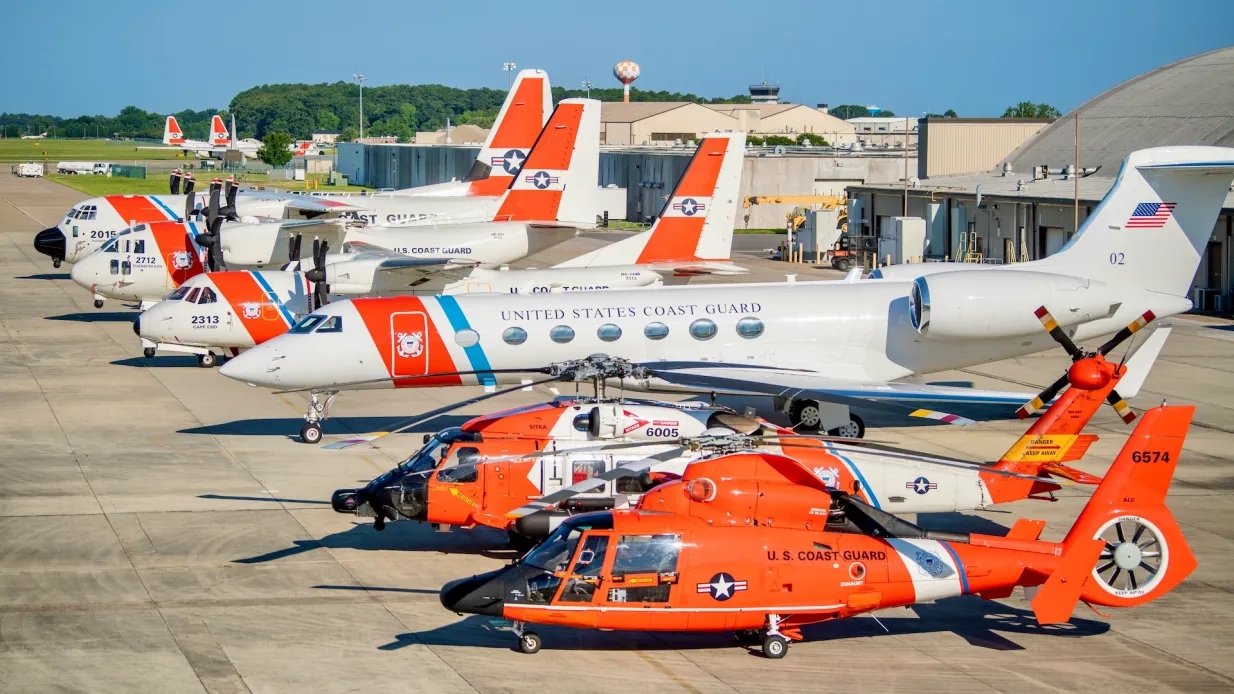
Every Coast Guard Aircraft Type Pictured Together in Rare ‘Family Photo’. Pictured: HC-130J, C-27J, HC-144, C-37B, MH-60T, MH-65E.

The War Zone offers a series of photos of a rare gathering of every current type of Coast Guard crewed aircraft at CGAS Elizabeth City, NC, along with a brief description of the Coast Guard air fleet.

“Groningen Makes Sixth Catch Since April” –Sea Waves / USCG Helo and LEDET Attached

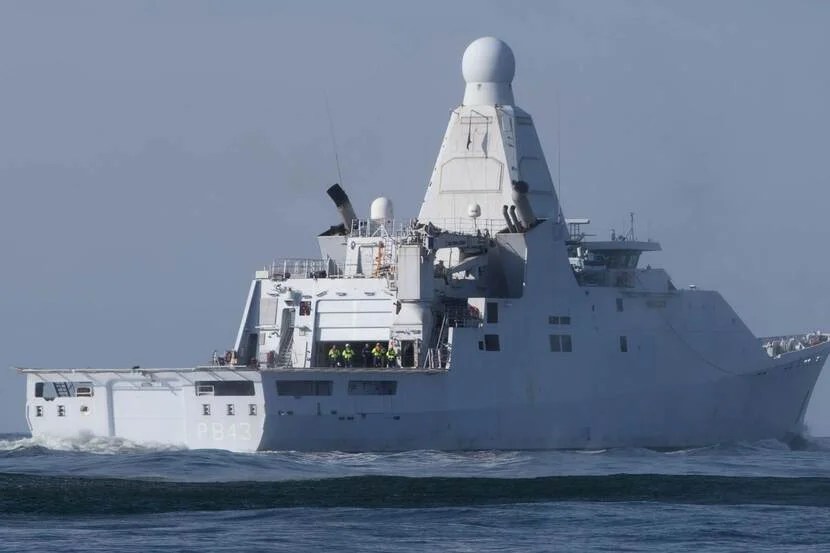
Netherlands OPV Groningen, 19 April 2017.

Sea Waves reports the Netherlands Navy offshore patrol vessel Groningen has made its sixth drug interdiction since April, when she relieved sistership Holland as Caribbean station ship.

Netherlands Antilles – Coast Guard (now Dutch Caribbean Coast Guard) Bombardier Dash 8-102. Sept. 7, 2014. Photo by Nito

The latest interception was initially spotted by a Dutch Caribbean Coast Guard Dash-8 maritime patrol aircraft. A USCG Helo assisted, and seizure was made by USCG law enforcement detachment personnel and Dutch Fleet Marines.

“Navy To Explore Arming Other Ships With Missiles Amid Constellation Frigate Woes” –Coast Guard, Raise Your Hand

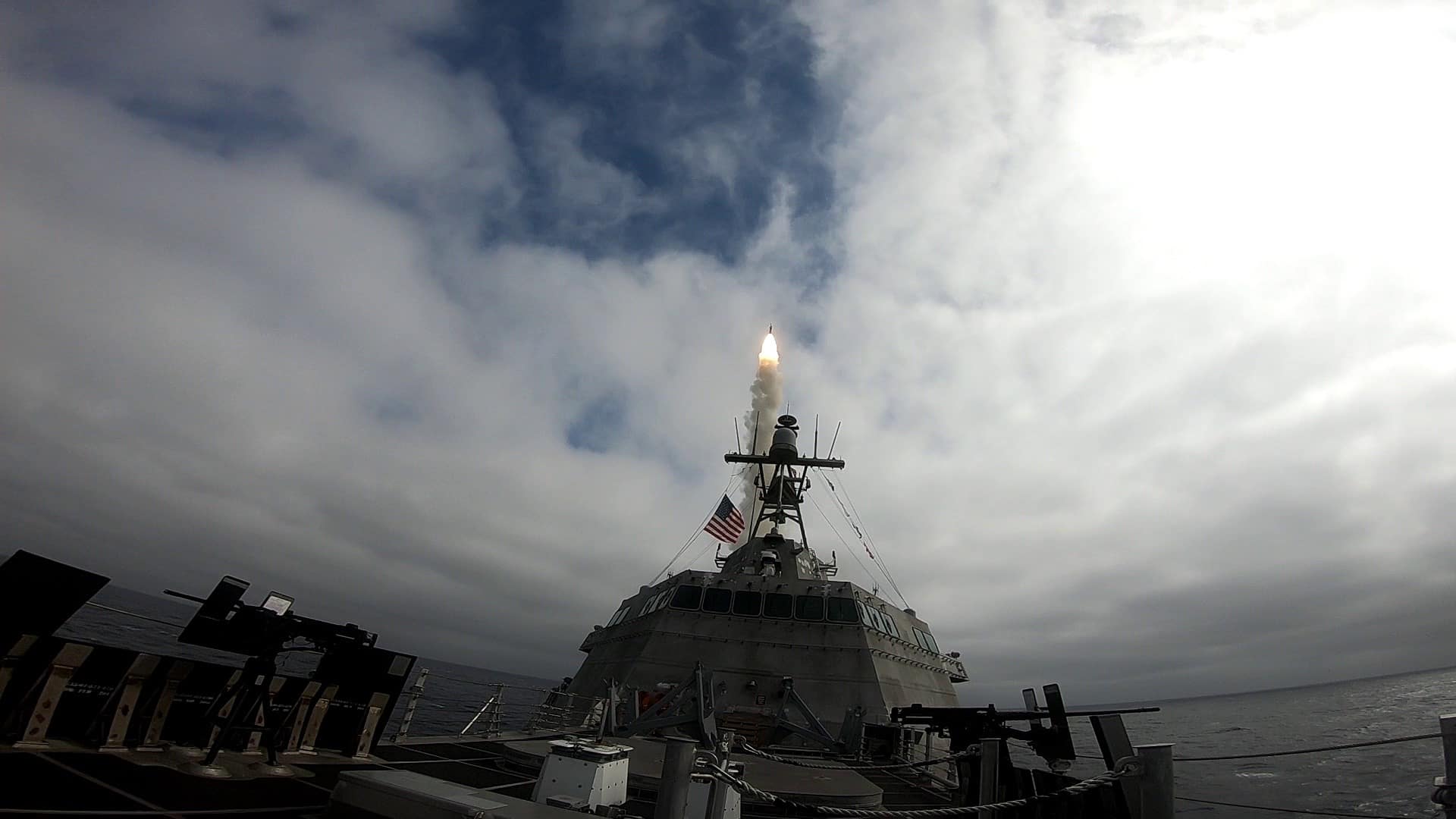
USS Savannah (LCS 28) conducts a live-fire demonstration in the Eastern Pacific Ocean utilizing a containerized launching system that fired an SM-6 missile from the ship at a designated target. 

The War Zone reports,

“Congress has demanded the U.S. Navy look into buying a new class of small warships loaded with missiles or adding bolt-on launchers to existing vessels…to help increase its combat capacity. Lawmakers ordered the study in response to major delays in work on the Navy’s future Constellation class frigates…”

The problem is simple. The Navy has been shrinking. Without a replacement in sight, they are rapidly decommissioning cruisers, each of which has 122 Vertical Launch Missile (VLS) tubes and eight Harpoon missile launch tubes. New DDGs, equipped with 96 VLS cells are coming online slowly and the new class of frigates, each of which has 32 VLS and 16 launchers for Naval Strike Missiles are long delayed and will also come out slowly.

Put simply, too few ships, with too few launch tubes.

It has been frequently proposed that missiles be mounted on Navy auxiliary ships. This is not likely to happen. These ships are not even armed for self-defense, beyond occasional crew served machinegun mounts. Most are limited to 20 knots, and they are busy scuttling supplies.

Few of the Navy’s MSC civilian manned auxiliary ships, are as well equipped for fitting into a Surface Action Group as the ten (soon to be eleven) National Security Cutters, with their higher speed, secure communication systems, data links, and Sensitive Compartmented Information Facility (SCIF). The Offshore Patrol Cutters will be only slightly less appropriate for the role.

The Coast Guard alone can’t fix this problem, but the Coast Guard can certainly help. It may not be necessary to mount missile launchers all the time. The Navy could build kits that could be quickly mounted on cutters. There are at least two options already available:

The Navy has already demonstrated use of the Mk70 containerized missile launcher on the flight deck of a Littoral Combat Ship.

The cutters would probably need a cooperative engagement capability (CEC), but that is probably also true of other platforms that might be used.

Each cutter could carry three or four containerized systems providing 12 or 16 launch tubes. Mk41 VLS mounted forward of the bridge, either conventionally or as Adaptable Deck Launchers could add eight more. Upon mobilization, there is potential for Navy or Marine Reservist to augment the cutter crews and operate the missile systems.

USS Savannah (LCS 28) Independence-variant littoral combat ship leaving San Diego with a U.S. Army MK 70 missile launcher on its deck – September 18, 2023. Photo Credit: WarshipCam.

Chile’s New Icebreaker

Chilian Icebreaker “Almirante Viel”.

Andrés Tavolari, a lawyer and Chilean Marine Reserve Officer, who wrote one of our most popular posts, Three Nations Share German OPV Design has stayed in touch and tells me, on July 3rd the Chilean Navy commissioned their new Icebreaker/Antarctic supply ship, “Almirante Viel”. This is how he described it.

The ship is a PC-5 icebreaker equipped with a flight deck and has a hangar for two medium helicopters of the Super Puma or Cougar type. The crew is 86 people + 32 scientists. It can transport 19 containers of 20 feet, 2,202 m³ of fuel, 153 m³ of fresh water, and 86 m³ of aviation fuel for the helicopters. Its maximum speed is 15 knots and 3 knots in ice 1 meter thick. Its range is 14,000 miles and it has an autonomy of 60 days. Its length is 111 meters, it has a beam of 21 meters, and a draft of 7.2 meters. Its propulsion plant is composed of 2 main engines of 6,303 hp and a bow thruster of 670 hp.
With Andrés’ help we did a 2016 post on the ship when it was in the planning stages that, with the attached comments, has a lot of discussion about the ship’s mission, Chile’s coast guard counterpart, the Chilean Navy and Marines.
Andrés sent along a link to the YouTube video of the commissioning ceremony I have posted below. It is off course in Spanish. He suggested that “…it is most interesting from minute 31 to minute 34 and from minute 57 up to the end.”
We see the crew board the ship beginning about 31:30. Something I have not seen at a USCG commissioning, the entire crew was singing beginning about 37:00 to 39:30. They sing again 57:50 to 1:00:00 during which the video shows some drone footage of the ship’s exterior and photos of interior compartments.
The Chilean Navy has a long association with the British Royal Navy. I think you can see it in their uniforms.

US, Canada, and Finland announced the Icebreaker Collaboration Effort, or ICE Pact

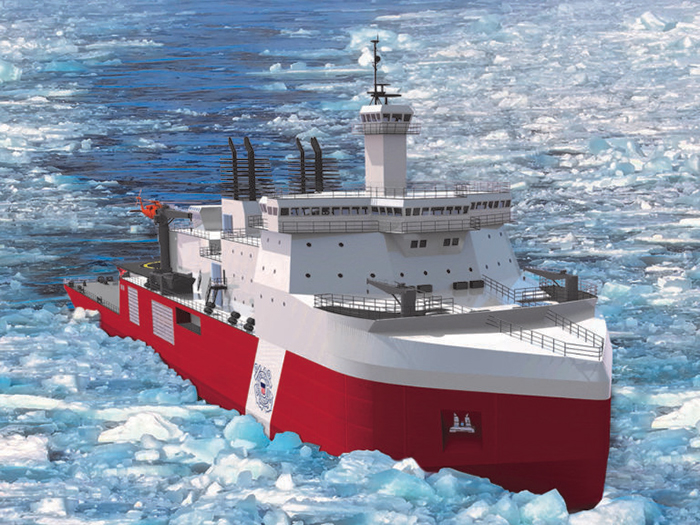
USCG Polar Security Cutter [Image courtesy Halter Marine / Technology Associates, Inc.]

Defense News reports,

“Bollinger Shipyards announced Thursday that its Pascagoula Mississippi shipyard now exceeds 1,000 employees, touting the milestone as it gears up to make the first heavy icebreaker in the U.S. in more than 50 years – vessels Washington is keen to produce more of as it partners with Canada and Finland in a pact to bolster icebreaker fleets.

“The three countries announced the Icebreaker Collaboration Effort, or ICE Pact, in a joint statement during the NATO summit in Washington on Thursday.”

Always good to partner with people who know what they are doing.

The US and Canada are at similar points in their efforts to build new heavy icebreakers. Having worked together on research, the two classes have many similarities. Davie, Canada’s shipyard tasked with building their new icebreakers, went to Finland for additional expertise. 

“Davie is a part of Group Davie, which in November 2023 acquired Finland’s Helsinki Shipyard, the world leader in icebreaker design and construction.”

Bollinger indicates they expect that, in addition to building icebreakers for the US Coast Guard, they will build for export. That would be a huge turn around.

Below is Bollinger’s press release.


BOLLINGER TO PLAY A CRITICAL ROLE IN NEW POLAR PARTNERSHIP (“ICE PACT”)

As the only U.S. builder of heavy polar icebreakers, Bollinger to provide expertise and capacity to NATO allies

Lockport, La., – July 11, 2024 – Bollinger Shipyards (“Bollinger”) today praised the White House’s announcement of the Icebreaker Collaboration Effort (“ICE Pact”), a trilateral agreement between the United States, Canada and Finland to contribute capacity and know-how for building polar icebreakers for the United States and its allies, and to counter the expanding presence of our nation’s adversaries and strategic competitors in the Arctic region.

The first and only shipbuilder in the United States to engineer and construct a heavy polar icebreaker in over 50 years, Bollinger will play a critical role in ICE Pact and its efforts to strengthen the polar capabilities of the United States and its allies through the creation of a fleet of polar icebreakers. Bollinger is currently under contract to build the Polar Security Cutter (PSC) heavy polar icebreaker for the United States Coast Guard.

“As the premiere builder of American-made polar icebreakers, Bollinger Shipyards is proud to support the United States and our NATO allies with our deep expertise and capacity,” said Ben Bordelon, Bollinger Shipyards President and CEO. “We have made, and will continue to make, significant, long-term investments in our facilities, infrastructure and workforce. Our goal is to create a world-class American-owned shipyard capable of producing the first fleet of American-made polar icebreakers in over half a century, and we’re honored that responsibility lies with Bollinger.”

Earlier this year, Bollinger’s Pascagoula workforce exceeded 1,000 employees – a substantial reversal of a decade-long trend of declining employment under the Pascagoula facility’s previous owner and reflects Bollinger’s commitment to growth, innovation, and investment along Mississippi’s Gulf Coast.

Bordelon continued, “Our success in reaching this milestone is a testament to the hard work and dedication of our employees, as well as the strategic initiatives we’ve implemented to expand and grow our workforce and operations. We are incredibly proud that Bollinger Shipyards is a critical part of the industrial base for our military and are honored to play a part in ensuring the national security of our nation.”

Since acquiring the Pascagoula facility in 2022, Bollinger has invested more than $40 million in upgrades to the facility’s infrastructure, technology, and personnel to establish a Center of Excellence in building world-class icebreakers. Bollinger has also launched innovative workforce development initiatives, such as its Shipfitter Bootcamp, a comprehensive 14-week workforce development program in partnership with Mississippi Gulf Coast Community College designed to equip current and future Bollinger employees with the essential skills and knowledge required to take their careers as shipfitters to the next level.

ABOUT THE POLAR SECURITY CUTTER (PSC) PROGRAM

The U.S. Coast Guard requires polar icebreaking capability to support the country’s economic, commercial, maritime and national security needs in the Polar Regions. The new Polar Security Cutters (PSCs) will be national assets that will ensure access to both polar regions and be capable of executing key Coast Guard missions, including defense readiness; marine environmental protection; ports, waterways and coastal security; and search and rescue. The ships will operate worldwide and face the range of extreme environmental conditions found in the polar, tropical and temperate regions.

ABOUT BOLLINGER SHIPYARDS 

Bollinger Shipyards (www.bollingershipyards.com) has a 78-year legacy as a leading designer and builder of high-performance military patrol boats and salvage vessels, research vessels, ocean-going double hull barges, offshore oil field support vessels, tugboats, rigs, lift boats, inland waterways push boats, barges, and other steel and aluminum products from its new construction shipyards as part of the U. S. industrial base. Bollinger has 13 facilities, all strategically located throughout Louisiana and Mississippi with direct access to the Gulf of Mexico, the Mississippi River and the Intracoastal Waterway. Bollinger is the largest vessel repair company in the Gulf of Mexico region. This year, Bollinger celebrates a 40-year history of building vessels for the United States Coast Guard.

What Project 2025 Says About the Coast Guard

You have probably heard of Project 2025, a controversial product of an influential conservative think tank. You can find it here.

I wanted to see what they had to say about the Coast Guard.

We are not going to talk about other parts of the document. I don’t want to get into a political discussion. The Coast Guard enjoys strong bipartisan support in Congress, so these are not necessarily exclusively the views of conservatives. Some of these proposals may be favored by more liberal members of Congress as well.

Even with only these few samples, you will also see that the document is not always definitive or internally consistent, particularly in regard to the Coast Guard’s proper place in the government bureaucracy. This is prompted in large part by a proposal to dismantle the Department of Homeland Security (p. 133), but continuance of DHS is still seen as a possibility and many changes to the Department are proposed.

There are suggestions that the Coast Guard should remain in DHS or be moved to DOD, DOJ, or Treasury.

I would certainly agree that the Coast Guard needs a long-term ship building plan and combining it with the Navy’s 30 year ship building plan would increase the Coast Guard’s visibility. I would also agree that we are not building enough large cutters (but they don’t have to be NSCs or OPCs) and we could use a base in American Samoa.

It suggests scaling back our mission set but offers no specific suggestions of which missions other than perhaps shifting the Arctic mission to the Navy, as if they could do it cheaper. We will probably just continue to try to do all eleven missions to the degree that offers the best return on investment within our budget.

I would like to see more coordination with the Navy in the determination of the characteristics required for Coast Guard assets, so that they are useful in wartime. I also see opportunities for synergies with the Navy Reserve.

I used “control F” to find everywhere the Coast Guard is mentioned and have reproduced each paragraph below.


The U.S. Coast Guard (USCG) be moved to DOJ and, in time of full-scale
war (i.e., threatening the homeland), to the Department of Defense (DOD).
Alternatively, USCG should be moved to DOD for all purposes. (p.134)


U.S. COAST GUARD (USCG)
Needed Reforms
The U.S. Coast Guard fleet should be sized to the needs of great-power competition, specifically focusing efforts and investment on protecting U.S. waters, all while seeking to find (where feasible) more economical ways to perform USCG missions. The scope of the Coast Guard’s mission needs to be focused on protecting U.S. resources and interests in its home waters, specifically its Exclusive Economic Zone (200 miles from shore). USCG’s budget should address the growing demand for it to address the increasing threat from the Chinese fishing fleet in home waters as well as narcotics and migrant flows in the Caribbean and Eastern Pacific. Doing this will require reversing years of shortfalls in shipbuilding, maintenance, and upgrades of shore facilities as well as seeking more cost-effective ship and facility designs. In wartime, the USCG supports the Navy, but it has limited capability and capacity to support wartime missions outside home waters.

New Policies
The Coast Guard’s mission set should be scaled down to match congressional budgeting in the long term, with any increased funding going to acquisitions based on an updated Fleet Mix Analysis. The current shipbuilding plan is insufficient based on USCG analysis, and the necessary numbers of planned Offshore Patrol Cutters and National Security Cutters are not supported by congressional budgets. The Coast Guard should be required to submit to Congress a long-range shipbuilding plan modeled on the Navy’s 30-Year Shipbuilding Plan. Ideally this should become part of the Navy plan in a new comprehensive naval long-range shipbuilding plan to ensure better coherency in the services’ requirements.

Outside of home waters, and following the Caribbean and Eastern Pacific, the
Coast Guard should prioritize limited resources to the nation’s expansive Pacific
waters to counter growing Chinese influence and encroachment. Expansion of
facilities in American Samoa and basing of cutters there is one clear step in this
direction and should be accelerated; looking to free association states (Palau, the
Federated States of Micronesia, and the Republic of the Marshall Islands) for
enhanced and persistent presence, assuming adequate congressional funding, is
another such step.

The Secretary of the Navy should convene a naval board to review and reset
requirements for Coast Guard wartime mission support. To inform and validate
these updated requirements, the Chief of Naval Operations and the Coast Guard
Commandant should execute dedicated annual joint wartime drills focused on
USCG’s wartime missions in the Pacific (the money for these activities should be
allocated from DOD). An interagency maritime coordination office focused on
developing and overseeing comprehensive efforts to advance the nation’s maritime interests and increase its military and commercial competitiveness should be established.

Given the USCG’s history of underfunded missions, if the Coast Guard is to continue to maintain the Arctic mission, money to do so adequately will be required over and above current funding levels. Consideration should be given to shifting the Arctic mission to the Navy. Either way, the Arctic mission should be closely coordinated with our Canadian, Danish, and other allies.

Personnel
USCG is facing recruitment challenges similar to those faced by the military
services. The Administration should stop the messaging on wokeness and diversity
and focus instead on attracting the best talent for USCG. Simultaneously, consistent with the Department of Defense, USCG should also make a serious effort to re-vet any promotions and hiring that occurred on the Biden Administration’s watch while also re-onboarding any USCG personnel who were dismissed from service for refusing to take the COVID-19 “vaccine,” with time in service credited to such returnees. These two steps could be foundational for any improvements in the recruiting process. (p.155-157)


Both the U.S. Coast Guard and the U.S. Navy are vital tools to ensure an unmonopolized Arctic. It is imperative that the Navy and Coast Guard continue to
expand their fleets, including planned icebreaker acquisitions, to assure Arctic
access for the United States and other friendly actors. The remote and harsh conditions of the Arctic also make unmanned system investment and use particularly
appealing for providing additional situational awareness, intelligence, surveillance,
and reconnaissance. The Coast Guard should also consider upgrading facilities,
such as its Barrow station, to reinforce its Arctic capabilities and demonstrate a
greater commitment to the region. (p.190)


MARAD would be better served by being transferred from DOT to the Department of Homeland Security (DHS). MARAD is the only DOT modal administration
that does not regulate the industry that it represents: The maritime industry is
regulated by the U.S. Coast Guard (ships and personnel) and by the Federal Maritime Commission (cargo rates and competitive practices). (p. 637)

MARAD, including its subordinate Service Academy (the U.S. Merchant Marine
Academy) should be transferred to the Department of Defense (if the Coast Guard
is located there because DHS has been eliminated) or to the Department of Home
land Security. In this way, the two agencies charged with oversight and regulation
of the Maritime sector—MARAD and the United States Coast Guard—would be
aligned under the same department where operational efficiencies could be realized more easily. (p. 638)

Finally, DHS as a department is experienced in administering and budgeting for
the operation of an existing federal service academy, the U.S. Coast Guard Academy,
which is similar to the U.S. Merchant Marine Academy in size. There would be
increased efficiencies and better alignment of the missions of these two institutions
if they were under one single department that has equity in the industries served
by these academies. (p. 638)


Transfer NOS (National Ocean Service–Chuck) Survey Functions to the U.S. Coast Guard and the U.S. Geological Survey. Survey operations have historically accounted for almost half the NOS budget. These functions could be transferred to the U.S. Coast Guard and U.S. Geological Survey to increase efficiency. NOS’ expansion of the National Marine Sanctuaries System should also be reviewed, as discussed below. (p. 676)


U.S. Coast Guard and the Bureau of Alcohol, Tobacco, Firearms, and Explosives. Congress should examine whether to return the Treasury’s former in-house law enforcement capabilities via the return of the United States Coast Guard and the Bureau of Alcohol, Tobacco, Firearms, and Explosives. Bringing these agencies back from the Department of Homeland Security and the Department of Justice, respectively, would allow Treasury, in the case of U.S. Coast Guard, to increase border security via a vigilance with respect to economic crimes (for example, drug smuggling and tax evasion). (p. 709/710)

 

“U.S. Coast Guard encounters People’s Republic of China military naval presence in Bering Sea” –D17

A Coast Guard Cutter Kimball crewmember observing a Russian Destroyer in the Bering Sea, September 19, 2022. Coast Guard Photo

Below is a District 17 (Alaska) news release. USCGC Kimball was doing the same thing two years ago. Last year the US Navy had four destroyers doing the shadowing. In 2021 it was Bertholf. Chinese warship operated legally off American shores back in 2015. NORTHCOM’s on-line magazine, The Watch, suggested how these visits should be viewed.

Two items of note, (1) this is a little earlier in the year than we have seen them in the past, (2) where are the Russians? Usually there are Russian ships with the Chinese.

This provides another example of how the National Security Cutters are taking on a role comparable to AGIs of the Soviet Era.

It is ironic and a bit funny that the Chinese are doing “freedom of navigation operations.”

I will note again that the nearest US Navy surface ship is probably at least 1000 miles away, probably in Japan.


July 10, 2024

JUNEAU, AK –The U.S. Coast Guard encountered multiple People’s Republic of China military ships in the Bering Sea, Saturday and Sunday.

The crew of U.S. Coast Guard Cutter Kimball (WMSL 756) detected three vessels approximately 124 miles north of the Amchitka Pass in the Aleutian Islands, and an HC-130J aircrew from U.S. Coast Guard Air Station Kodiak detected an additional vessel approximately 84 miles north of the Amukta Pass.

All four of the People’s Republic of China vessels were transiting in international waters but still inside the U.S. Exclusive Economic Zone, which extends 200 nautical miles from the U.S. shoreline.

“The Chinese naval presence operated in accordance with international rules and norms,” said Rear Adm. Megan Dean, Seventeenth Coast Guard District commander. “We met presence with presence to ensure there were no disruptions to U.S. interests in the maritime environment around Alaska.”

The Chinese vessels responded to U.S. Coast Guard radio communication and their stated purpose was “freedom of navigation operations.” Coast Guard cutter Kimball continued to monitor all ships until they transited south of the Aleutian Islands into the North Pacific Ocean. The Kimball continues to monitor activities in the U.S. Exclusive Economic Zone to ensure the safety of U.S. vessels and international commerce in the area.

The Coast Guard, in coordination with U.S. Northern Command, was fully aware of and tracked the Chinese naval presence. In September of 2021 and 2022, Coast Guard cutters deployed in the Bering Sea also encountered Chinese surface action groups.

The Kimball patrolled under Operation Frontier Sentinel, a Coast Guard operation designed to meet presence with presence when strategic competitors operate in and around U.S. waters. The U.S Coast Guard’s presence strengthens the international rules-based order and promotes the conduct of operations in a manner that follows international norms.

Coast Guard Cutter Kimball is a 418-foot legend class national security cutter homeported in Honolulu, Hawaii.

“Japan donates new patrol vessel to Indonesia’s Bakamla” –Army Recognition, Navy News

Japan CGC Oki (PL-1) prior to transfer to the Malaysian Coast Guard

Army Recognition’s Navy News reports,

“According to information published by Kompas on July 8, 2024, the Indonesian Maritime Security Agency (Bakamla) has received a new patrol vessel from the Japanese government.”

I am a bit confused by this report. It says Indonesia “has received a new patrol vessel.” Then it says,

Construction will take place in Japan, and upon completion, the ship will be officially handed over to Bakamla by the Japanese government through JICA and Japan Marine Science Inc. (JMS).

Acompanying the article is a photo of the former Japan CG cutter Oki (above, previous name Nojima, the only ship of its class) which was transferred to the Malaysia Coast Guard in 2017. (One of three JCG vessels transferred to the Malaysia CG.) Their caption even includes the Malaysia Coast Guard name for the vessel, KM Arau, without any explanation.

They report these specifics about the vessel,

The vessel, with a capacity for 70 crew members, measures 85.6 meters in length and can reach speeds of up to 22 knots.

The length does not correspond to any Japan Coast Guard vessel I have been able to identify.

A December 20, 2023, from the Asia Pacific Defense Journal, “Indonesia to receive large patrol vessel from Japan as part of aid” reported Japan would build a new ship for the Indonesian Maritime Security Agency (BAKAMLA), but that is more than six-month-old news.

Could it be than Japan has already handed over an existing Japan Coast Guard vessel and is also building a new one, or is this just the result of not proofreading an AI written story?

In any case, that Japan is helping not only the Philippines but also Indonesia and Malaysia (as well as Vietnam and others) is significant.

How Other Armed Forces’ Recruitment Efforts are Going

That the Coast Guard has had a workforce shortage is well known. Steps have been taken to improve recruitment and retention, but I have not yet heard how successful the efforts have been.

In 2023 the Army, Navy, and Air Force also had workforce shortages. Their shortages were proportionately smaller, but the problems were similar, lower propensity to serve, fewer qualified young people and a recently implemented health records system, except that unlike the Coast Guard everyone knows the Army, Navy, and Air Force exist and are employment options.

Navy Times reports the Army, Air Force, and Marines are on track to meet or exceed their recruiting goals, the Navy expects to fall short, but is doing much better than in 2023 despite an increase of 5,000 in their recruitment goal.

“We are seeing significant increases year over year as you saw,” Allchin said. “Right now, we’re projecting a miss of around 4,200 for our active enlisted mission of about 40,600.”

 MHS Genesis, the military’s new electronic health record has apparently complicated recruitment.

“Before the health system rollout, Goodyear said, getting 100 new Marine Corps contracts took 154 applicants; now it takes 181 applicants.

“The number of medical waivers being submitted for applicants has more than doubled, creating processing delays.

“The average time in military entry processing for recruits has increased from 10 days to 35 days…With an average of 120 days in the delayed entry program compared with 162 days before MHS Genesis, the boot camp dropout rate has increased, he said, from 11% to 12%.

“…in the Air Force…service officials estimate between 3,000 would-be recruits and 4,000 would-be recruits in 2023 simply walked away from service amid long medical processing wait times.

…“Often, extended delays require these individuals to pursue a different career path based on the financial realities of life.”