The Icebreaker Aiviq Saga

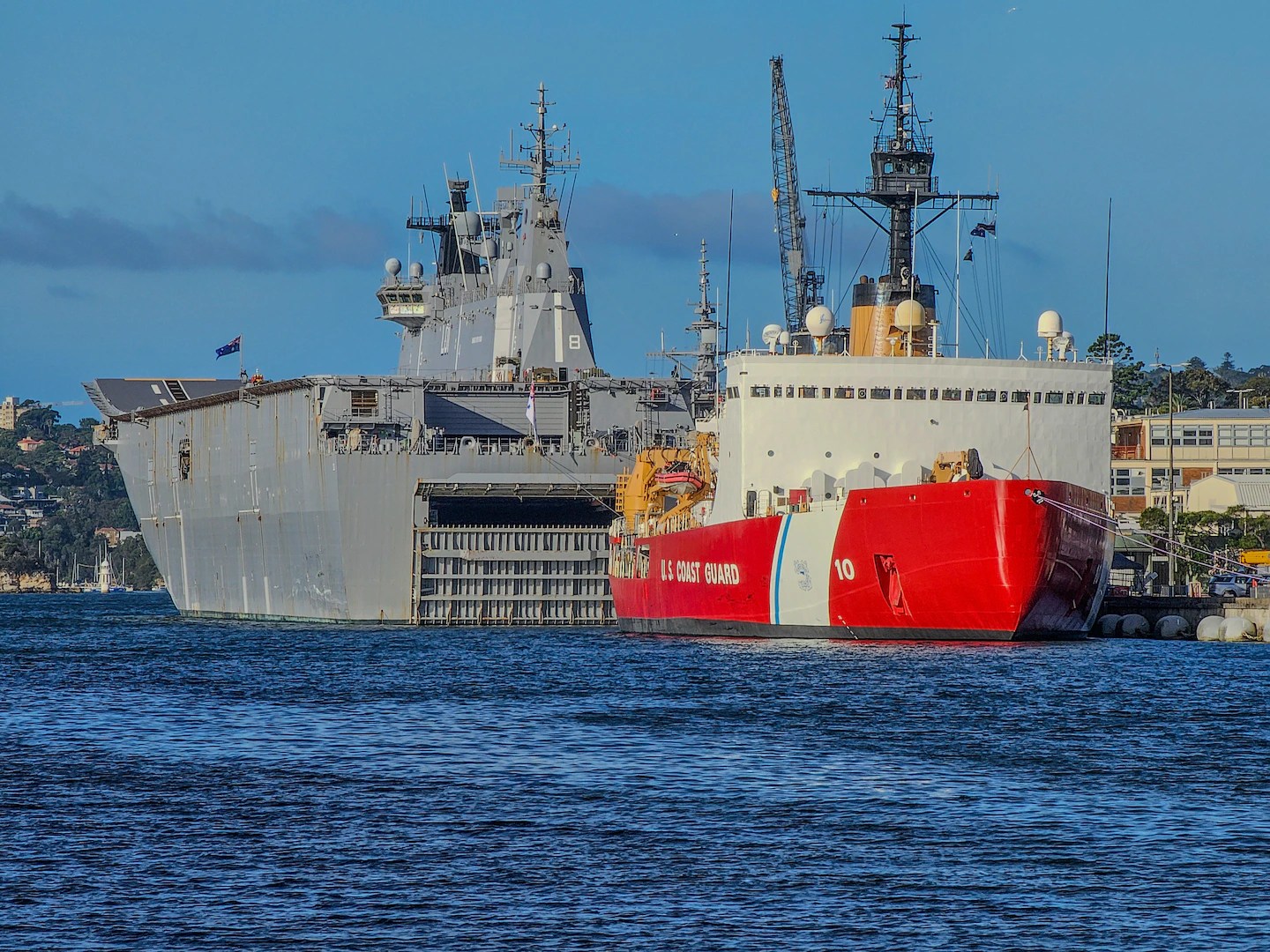
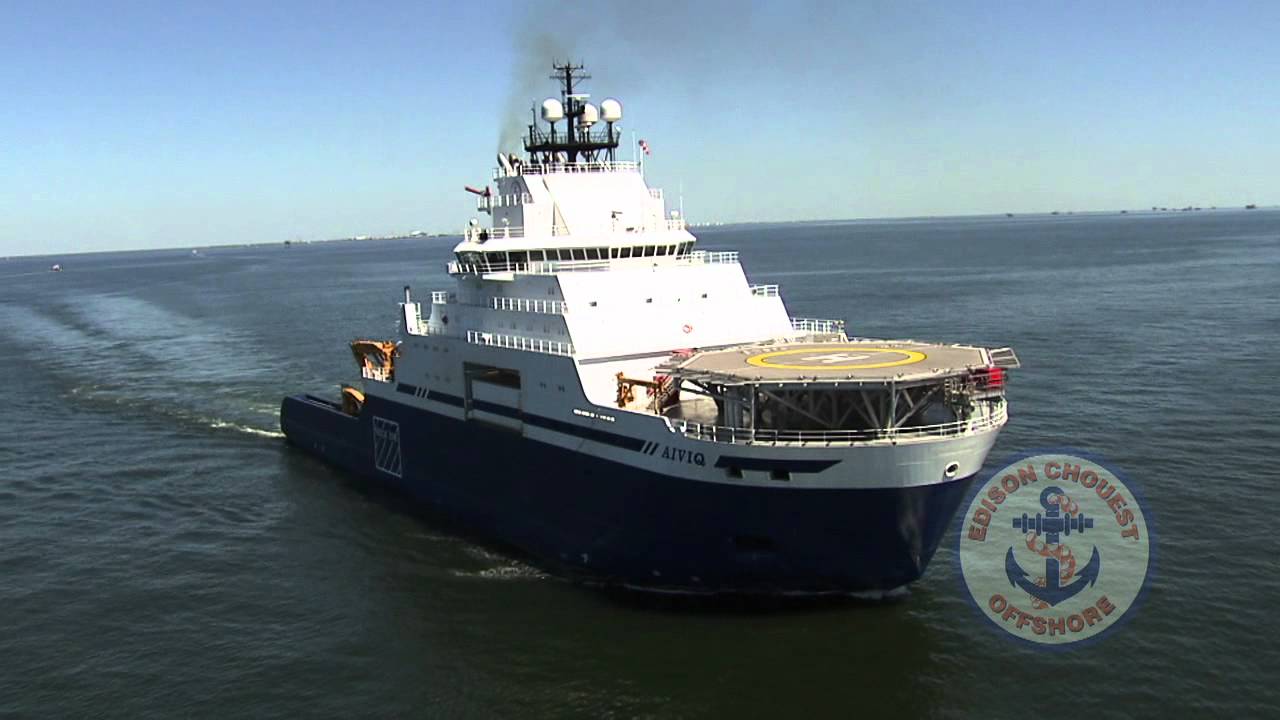
Icebreaking Anchor Handling Vessel Aiviq

It appears the Coast Guard is ready to purchase the privately owned icebreaking Anchor Handling Tug Supply (AHTS) vessel Aiviq.

We first heard about the Aiviq back in 2012.

A New Icebreaker This Year, The US will finish a new icebreaker this year, unfortunately it is not for the Coast Guard.

Aiviq was not the only icebreaker being built in the US. From 2015, Two More New Medium Icebreaker–Not for the Coast Guard

In October 2015 we learned that Shell had abandoned its ambitions to drill in the Arctic and that Aiviq was up for sale and that construction had been suspended on a second icebreaking AHTS, meaning it might also be available. I suggested, “This might be an opportunity for the Coast Guard to obtain one or two reasonably capable medium icebreaker in the near term on favorable terms.” Icebreaker Bargain?

In 2016 there was already consideration of buying or leasing the Aiviq for Coast Guard service. It was still being considered in 2017 (and here).

The ship was evaluated by the Coast Guard and the conclusion was rather lukewarm. There was concern about the use of direct drive diesels as opposed to diesel electric drive. (Sorry I could not find when this was reported.)

Nevertheless, we seem to have accepted that we need more icebreakers. We are willing to take whatever is immediately available, but only if it was made in the US.

In May 2022, Maritime Executive reports,

The U.S. Coast Guard released a formal request for information seeking to identify U.S.-built commercial icebreakers that might be available for purchase. With promises of funding from the Biden Administration and the U.S. Congress, the Department of Homeland Security published on May 3, the request for information as the first step in the possible purchase of a vessel to bridge the gap until the newly built polar security cutters, which are behind schedule, are commissioned and available for service late this decade.

As I recall the purchase was included in the 2022, 2023, and 2024 budgets. I’m not sure why it hasn’t happened already, but Aiviq has been supporting the Australian Antarctic program.

Meanwhile, the Canadian Coast Guard, in a program that began in 2018, purchased three similar but smaller icebreaking anchor handling tug supply vessels and converted them to icebreakers, CCGS Vincent Massey,CCGS Captain Molly Kool, and CCGS Jean GoodwillThese ships are 82 meters (276 ft) in length, 18 m (59 ft) of beam, and 18,300 HP.

“Houthi Attacks Turn Deadly” –gCaptain

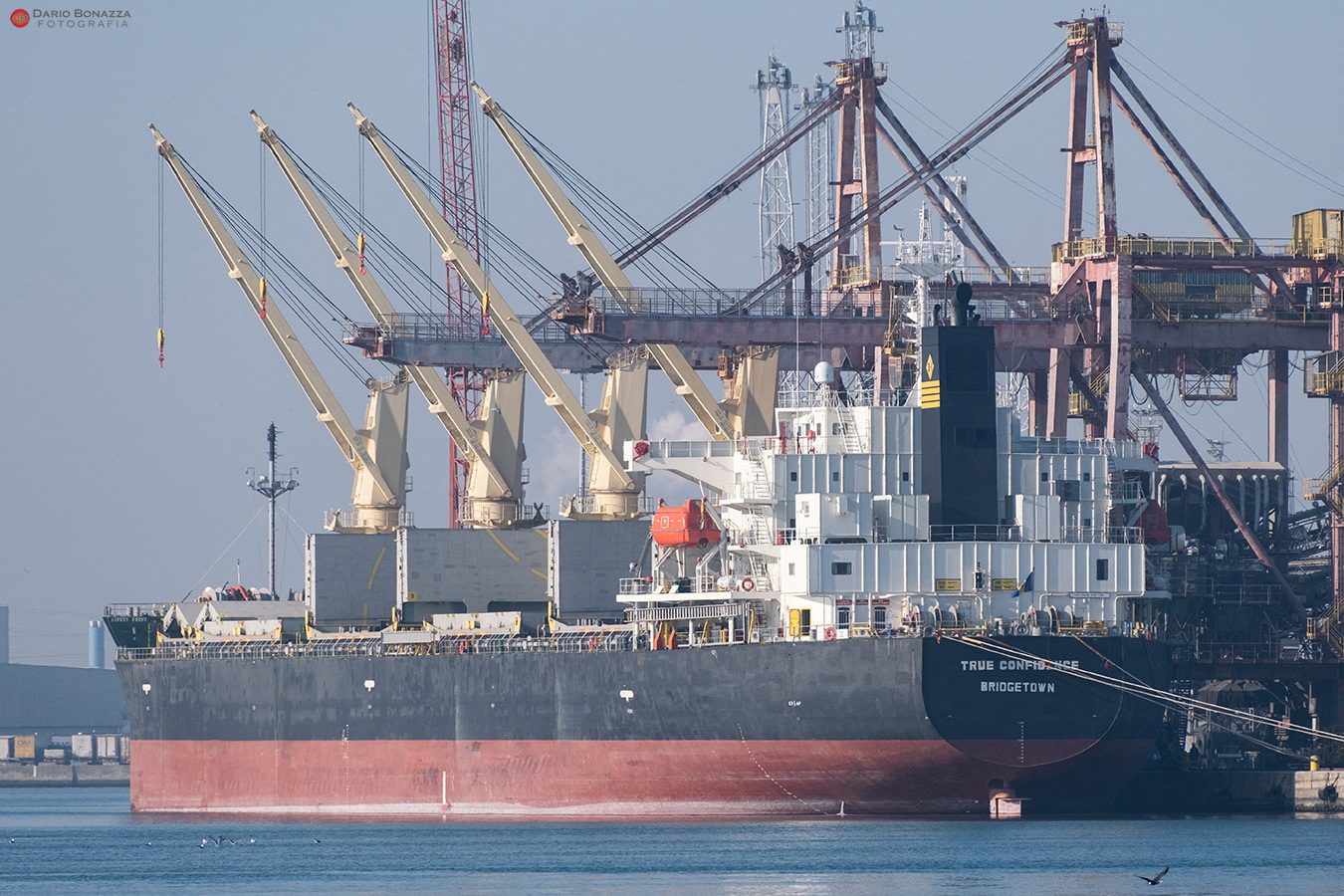
A view shows Barbados-flagged bulk carrier vessel True Confidence, in Ravenna, Italy March 10, 2022. Dario Bonazza/via REUTERS

gCaptain reports,

“British Embassy in Sanaa has confirmed two fatalities from the Houthis’ attack on the MV True Confidence, marking the first fatalities since the Iranian-backed Houthis began attacking merchant ships in November…Four mariners were severely burned and three missing after a missile hit a cargo ship off Yemen on Wednesday, a shipping source said, the first report of serious injuries since Yemen’s Houthi movement began attacking shipping…”

This should not come as a surprise. The only surprise is that it did not happen earlier.

Of the 23 on board, there were “15 Filipinos, four Vietnamese, two Sri Lankans, an Indian and a Nepali national.” All innocent, not an Israeli in the bunch.

Time for those who support the Palestinians, to call out the Houthi leadership. This criminal behavior is not helping. This is distracting from the situation in Palestine, and if anything, is hurting the Palestinian cause.

“U.S. Coast Guard conduct combined patrol with Marshallese partners under Operation Blue Pacific” –U.S. Coast Guard Forces Micronesia/Sector Guam

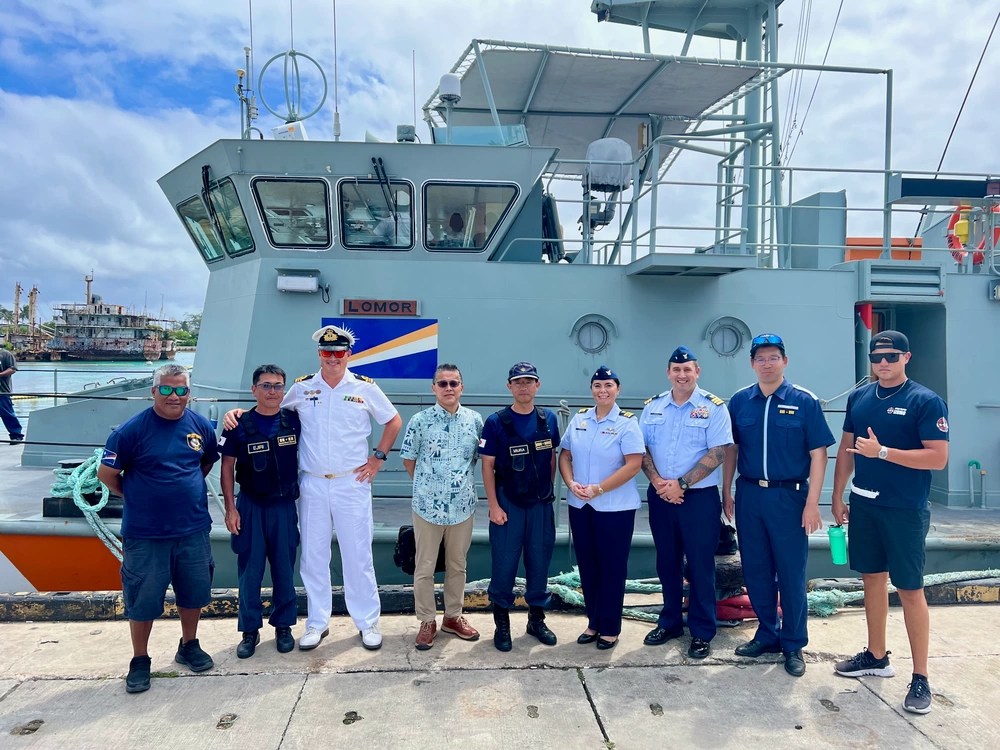
In Majuro, Republic of the Marshall Islands, on Jan. 26, 2024, U.S. Coast Guard Forces Micronesia/Sector Guam’s Cmdr. Ryan Crose, response department head, and Lt. Cmdr. Christine Igisomar, COFA maritime advisor, stand for a photo with Lt. Cmdr. Lachlan Sommerville, the Royal Australian Navy’s Maritime Security Advisor to the RMI Sea Patrol, and members of the RMI Sea Patrol. This visit marks a continuation of efforts to enhance the U.S. Coast Guard’s positive relationship with the Marshall Islands, particularly its maritime law enforcement entity, the RMI Sea Patrol. (U.S. Coast Guard photo)

Below is a U.S. Coast Guard Forces Micronesia/Sector Guam press release. 

It is noteworthy that the press release acknowledges the role of our friends from Australia. Australia has taken an interest in these Pacific Islands for several decades. The vessel in the background of the photo above is RMIS Lomor (03), one of 22 Australian built Pacific class Patrol Boats donated to twelve Pacific Island nations between1985 and 1997. More recently Australia has been producing and donating second generation patrol boats, the Guardian class. RMIS Lomor is expected to be replaced by a Guardian class patrol boat, RMIS Jelmae (537), in 2024.


March 5, 2024

U.S. Coast Guard conduct combined patrol with Marshallese partners under Operation Blue Pacific

MAJURO, Republic of the Marshall Islands — Following efforts with Kiribati partners, the USCGC Oliver Henry (WPC 1140) crew recently concluded the next leg of their expeditionary patrol from Feb. 20 to 27, 2024, spending time in Majuro, Wotje Atoll, and the Exclusive Economic Zone (EEZ) of the Republic of the Marshall Islands (RMI) working with partners, underscoring commitment to maritime security and international cooperation regionally.

Underway in support of Operation Blue Pacific, the cutter crew showcased the effectiveness of the U.S. and RMI maritime bilateral agreement, conducting a shared patrol with shipriders emphasizing collaborative efforts in maritime safety, security, and stewardship in terms of resource protection.

“The shared efforts in patrolling, enforcing maritime regulations, and sharing expertise contribute to maintaining a secure and sustainable maritime environment,” said Lt. Ray Cerrato, commanding officer of the USCGC Oliver Henry. “The U.S. and RMI shiprider operations under the bilateral agreement serve as a model for collaborative efforts between nations, fostering a shared commitment to protecting marine resources and building strong partnerships.”

During the patrol, Oliver Henry’s crew traveled throughout the RMI EEZ with two officers from the RMI maritime police force, the Sea Patrol, who provided a combined presence and conducted three successful maritime law enforcement boardings and three additional observation reports. The combined boarding team found all fishing vessel crews to be operating in compliance with international and Marshallese regulations.

The crew assisted the Marshallese government with transporting 4,000 pounds of essential grocery supplies from Majuro to Wotje Atoll, RMI. The visit to Wotje Atoll was warmly welcomed by Mayor Rithen Lajar, demonstrating the enduring partnership between the United States and the Republic of the Marshall Islands.

“We were incredibly humbled by our welcome from Mayor Rithen Lajar to visit Wotje Atoll,” said Cerrato. “His willingness to accept our cutter and crew into his home and to entrust us with the chance to bring in much-needed supplies to the atoll was incredibly heartwarming. Our crew couldn’t have been more excited and willing to support the mayor’s request for assistance.”

Additionally, Oliver Henry and RMI Sea Patrol conducted a collaborative session on damage control equipment setup and small boat launch and recovery, strengthening capabilities and fostering camaraderie between the two agencies. In further engagement activities, the crew enjoyed a friendly basketball game with Sea Patrol, won by Sea Patrol, and a BBQ with Royal Australian Navy partners, further strengthening bonds between the participating entities.

“The time patrolling within the RMI EEZ was incredibly effective,” said Cerrato. “We look forward to any chance to work with RMI and Sea Patrol during future engagements. We must brush up on our basketball skills before the next match.”

The success of the cutter crew’s mission reflects a commitment to the region’s well-being and reinforces the significance of such missions in maintaining a stable and secure maritime domain. Support from the staff of the U.S. Embassy in Majuro, as well as Royal Australian Navy and Marshallese Sea Patrol partners, was instrumental in the success of the patrol effort.

About the U.S. Coast Guard in the Pacific
The U.S. Coast Guard 14th District, based out of Honolulu, Hawaii, and U.S. Coast Guard Forces Micronesia/Sector Guam, continue to foster enduring partnerships with regional allies through Operation Blue Pacific, an overarching multi-mission Coast Guard endeavor to promote security, safety, sovereignty, and economic prosperity in Oceania. With humanitarian Service at its core, the U.S. Coast Guard remains committed to maritime safety, security, and stewardship, solidifying its longstanding reputation in the Pacific as a trusted partner.

About USCGC Oliver Henry
USCGC Oliver Henry (WPC 1140) is the 40th 154-foot Sentinel-class Fast Response Cutter named for Oliver T. Henry, Jr., an enlisted African American Coast Guard member first to break the color barrier of a then-segregated Service. Designed for many missions, including search and rescue, national defense, and maritime law enforcement, the Oliver Henry plays a significant role in safeguarding national interests and preserving good maritime governance.

“Coast Guard Cutter Bertholf arrives in Singapore”

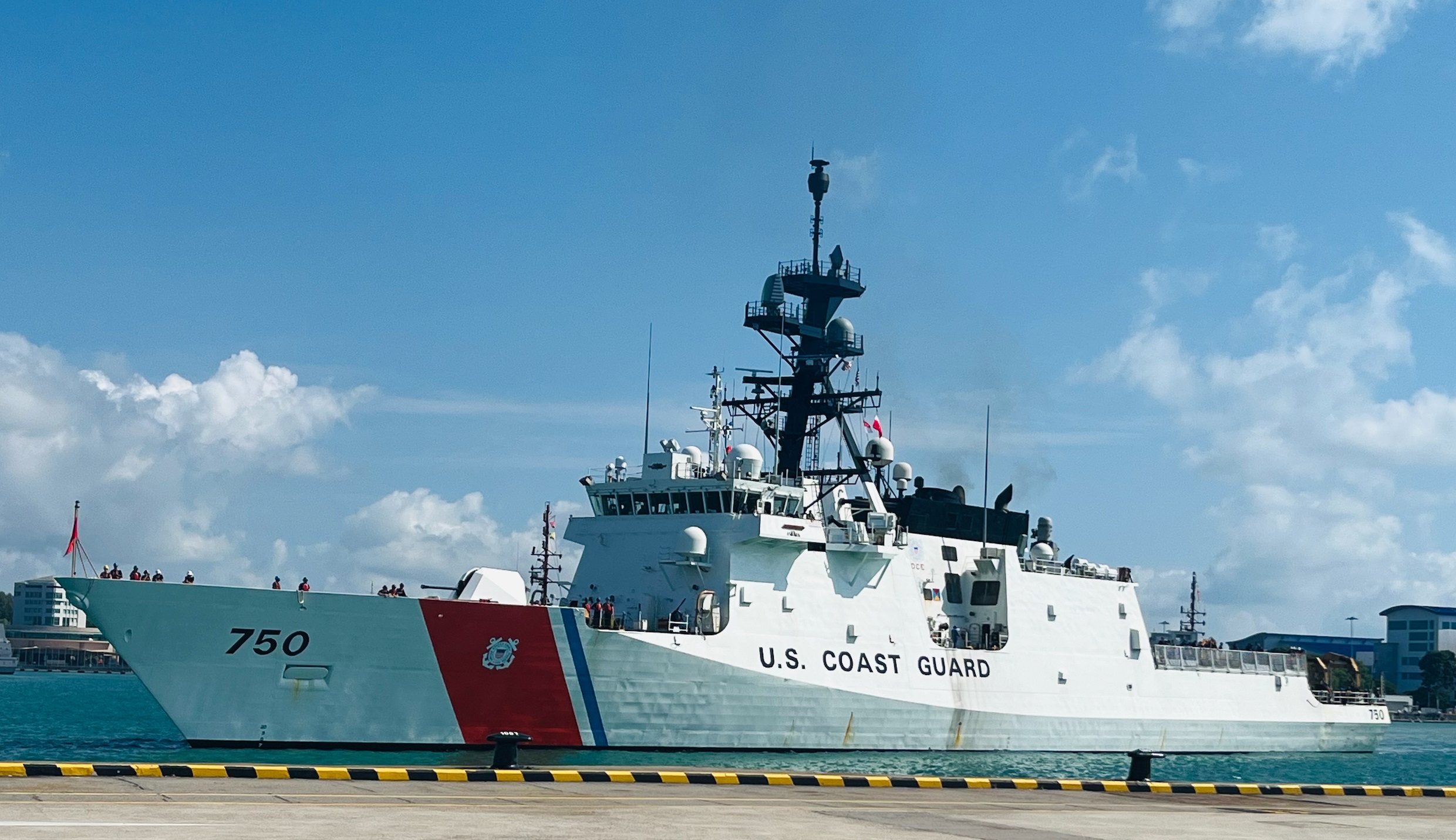
U.S. Coast Guard Cutter Bertholf (WMSL 750) arrives at Changi Naval Base in Singapore, Feb. 25, 2024. The Bertholf moored next to USS Gabrielle Giffords (LCS 10), a U.S. Navy Littoral Combat Ship, also in the region to support an open Indo-Pacific region. (U.S. Coast Guard photo by Cmdr. Trevor Parra)

Below is a US Coast Guard news release. You can find more photos at the link. 


March 5, 2024

Coast Guard Cutter Bertholf arrives in Singapore

SINGAPORE – U.S. Coast Guard Cutter Bertholf (WMSL 750) and crew arrived in Singapore, Feb. 25, after transiting more than 8,000 nautical miles over 30 days from San Diego, Calif.

During the visit to the Republic of Singapore, the crew of the cutter is scheduled to participate in several professional engagements and at-sea exercises.

The two-day professional meetings will allow for collaboration, exchanges of best practices, and operational planning for the scheduled two-day exercises at-sea with the Republic of Singapore Navy vessel, Guardian. In addition to the Republic of Singapore Navy, the crew of the Bertholf intend to work with the Singapore Police Coast Guard and Malaysia Maritime Enforcement Agency.

“The crew of the Bertholf is excited to be in Singapore and looking forward to the many events with the crew of the Republic of Singapore Navy, Police Coast Guard, and Malaysia Maritime Enforcement Agency,” said U.S. Coast Guard Capt. Billy Mees, commanding officer of the Bertholf. “The Indo-Pacific region is a dynamic environment and fostering partnerships with our allied nations helps ensure we improve maritime governance in these crucial economic waterways.”

Bertholf is one of four National Security Cutters homeported in Alameda. The U.S. Coast Guard currently maintains 10 National Security Cutters. Bertholf is operating as part of Commander, Task Force (CTF) 71, U.S. 7th Fleet’s principal surface force, promoting a free and open Indo-Pacific, strengthening partner networks, and enhancing maritime safety and security.

Bertholf is the first legend-class national security cutter and has a range of 12,000 nautical miles, endurance of up to 90 days and can hold a crew of up to 170. Coast Guard Cutter Bertholf is homeported in Alameda, Calif.

“Its Time for A Pacific Maritime Security Program for Southeast Asia” –Australian Institute of International Affairs 

Chinese fishing vessel fleet (Photo: The Maritime Executive)

Below is a publication of the Australian Institute of International Affairs. I think it makes a good case that crimes against international commerce can hurt a nation even if the crime is not committed within their territory or exclusive economic zone. Afterall, criminal organizations don’t respect national borders. Frequently they exploit them. Most nations have an interest in the free flow of commerce and protection of marine resources from overfishing. Sometimes, helping your neighbor also helps yourself.

The post rightly views these as primarily Coast Guard problems, that is as law enforcement problems.

Generally, law enforcement agencies recognize that they will never be able to afford to expand sufficiently to meet every contingency. Sometimes problems are simply overwhelming. To address those situations, US law enforcement agencies band together in contractual relationships referred to as mutual aid.

It would not be unreasonable for regional maritime law enforcement agencies to work out similar arrangements to handle those occasional overwhelming problems.

Earlier, I outlined a proposed Combined Maritime Security Forces Pacific as a standing pool of maritime law enforcement assets that would learn to operate cooperatively.

Combined Maritime Forces in the Middle East has emerged as an example of a law enforcement alliance, that might be replicated elsewhere.

While the most urgent need appears to be in Southeast Asia, law enforcement alliances that provide for mutual aid could be helpful in any region where surges in unlawful activity might overwhelm local capabilities.

Thanks to Paul for bringing this to my attention. 


It’s Time for A Pacific Maritime Security Program for Southeast Asia

01 FEB 2024

Southeast Asia’s maritime environment faces threats from piracy, slavery, and illegal, unreported, and unregulated (IUU) fishing. A maritime security program tailored for the region may address these issues while drawing partners closer to Australia.

Australia’s maritime trade geography consists of a confluence of lines to the nation’s north and through Southeast Asia. Around 40 percent of Australia’s trade is funnelled through these waterways and chokepoints, making the threat of maritime piracy, sea slavery, and illegal, unreported, and unregulated (IUU) fishing a challenging and complex issue. Australia must look for strategies to build maritime security in the important region to its north if it is to remain resilient and prosperous into the future. Improving the maritime stability and capacity of Southeast Asia and Australia’s partners in the region facing maritime threats will be essential in ensuring Australia’s long-term security.

Regional coast guards, navies, and other maritime law enforcement entities have limited resources to patrol and monitor illegal activities within their sovereign waters. These bodies further lack inter-state cooperation which has hampered collaborative responses to security threats such as maritime piracy.

Maritime piracy has the potential to significantly impact Australian shipping, but just sailing around the problem isn’t a viable solution; alternative routes increase travel time, require additional port stops, and may be too shallow for most container ships. Australia must further consider the danger of piracy dispersing to areas potentially less equipped to deal with these threats, such as the Pacific. The dangers of insecurity around maritime chokepoints have been illustrated in recent Yemeni Houthi attacks on commercial ships transiting the Red Sea, with vessels rerouting around the Cape of Good Hope. Disruption has caused shipping delays, additional costs in fuel and surcharges, and has overburdened ports unused to increased shipping traffic.

Sea slavery and IUU fishing provides for another challenge, and one that is increasingly likely to impact Australia as fish stocks continue to plummet in Southeast Asia. An estimated 17,000 workers on fishing vessels around Southeast Asia could be classified as slaves, an ongoing issue arising from interrelated economic factors such as declining fishing stocks caused by climate change and overfishing, along with rising oil prices, creating conditions ripe for crew exploitation. Sea slavery and IUU fishing are organised maritime crimes representing risks for Australia, notably, in that these enterprises are diminishing finite natural resources and are often linked to a myriad of other crimes that can disperse to other seas.

Many enterprises engaging in sea slavery and piracy are further interconnected with IUU fishing, which was described as the leading global maritime security threat by the US Coast Guard in its 2020 Strategic Outlook. Southeast Asian fishing vessels often illegally enter Australia’s maritime boundaries, and regional nations experienced a reported economic loss of over US$6 billion in 2019 from IUU fishing, with Indonesia in particular losing around US$201 billion from 2013-2018.

Regional governments have been unable to fully address these threats. Systemic issues such as poor socio-economic conditions in coastal communities, significant gaps in welfare and income between regional nations, and corruption and collusion with pirates within the regional maritime industry have until now provided substantial roadblocks to mitigation. This environment offers not only a risk to Australian maritime trade security, but an opportunity to work with partners to address these threats through a regional version of the Pacific Maritime Security Program (PMSP).

The PMSP is an AUD$2 billion Australian commitment to enhance the maritime capability of its Pacific neighbours, and includes the provision of patrol boats, long-term training, and maritime infrastructure such as wharfs. In-country advisors, maritime asset maintenance, and region-wide integrated aerial surveillance utilising targeted intelligence-driven patrols are also included. Sailors from participating countries can further undertake specialist studies in a TAFE Queensland Pacific Maritime Training Services program.

A 2021 Australian Parliamentary sub-committee inquiry into Australia’s defence relationships with Pacific Island nations found that these partners greatly benefitted from these provision. The relationship also directly enhanced their individual maritime security, as well as providing capacity to participate in regional patrol and surveillance operations. Regional interoperability and coordination have increased, and Australia has gained an additional avenue to develop long-term relationships and interoperability with partners in the region. Undoubtedly, this has increased Australia’s own maritime security.

The implementation of a similar Southeast Asian PMSP may offer an opportunity to deepen Australia’s existing regional partnerships and assist Australia in securing important trade routes. Funding could further be allocated towards addressing issues of regional governance and local investment to address the legal and economic causes of piracy, slavery, and IUU fishing.

Precedence for a Southeast Asian PMSP already exists in actions such as the 2015 gifting of Landing Craft Heavy Vessels to the Philippines and could be modelled upon examples of intraregional maritime security cooperation such as the Malacca Strait Patrol arrangement between Malaysia, Indonesia, and Singapore. This form of initiative could address concerns raised by Captain Michael Beard of the Royal Australian Navy that potential shortfalls in Australia’s maritime strategy produces risks to Australia’s shipping routes from foreign interference or aggression. Issues include a lack of focus on trade protection in current Australian naval strategy, limited interoperability with maritime industry, and the absence of maritime trade within the nation’s broader national security strategy.

A Southeast Asian PMSP would further add to regional coast guard capabilities that are currently under resourced. While countries such as Vietnam, Indonesia, the Philippines, and Malaysia have sought to expand their coast guard capabilities through vessel and sailor development programs, more is still required. The Philippines, for instance, have reached their goal of building a 30,000-sailor coast guard in 2023, with a further 4,000 to be recruited in 2024. Their aim is to establish a 100,000 strong coast guard, though to do so, it will need considerable support. Similar trends towards building coast guard and maritime law enforcement capability are evident in nations such as Vietnam and Thailand.

A regional PMSP involving coast guard engagement would undoubtably deepen partnerships with Australia and its partners and promote its commitment to maintaining stability and a rules-based international order. Such a commitment would join New ZealandJapan, and the US who have existing defence or coast guard cooperation arrangements with Southeast Asian nations. Further capability and institutional development in Australia would lend credibility to new minilateral or multilateral maritime arrangements. Such initiatives would go far toward enhancing maritime trade security, but also may become increasingly important for nations facing territorial encroachment from China within sovereign waters around the South China Sea. Security pacts such as AUKUS and the Quadrilateral Security Dialogue have formed to counter China’s growing hegemony and coercion, but smaller Southeast Asian nations do not possess the same ability to develop such powerful security groupings.

Southeast Asia is a region of strategic significance for Australia, not only for maritime trade but also as a security gateway to the nation’s north. Maritime insecurity arising from threats such as piracy, IUU fishing, and slavery in Southeast Asia has the potential to significantly impact Australia through trade disruption and through risks generated from organised transnational crime within the region’s waterways and dispersing into Australia’s environment. A Southeast Asian PMSP has the potential to assist partners address these threats individually and collectively, as well as improve their own security and capacity against foreign powers, generate prosperity, and allow Australia to build long-term, meaningful cooperation in the region.

Shaun Cameron is a public servant living in Canberra. He has a background in international relations, psychology, and teaching.

This article is published under a Creative Commons License and may be republished with attribution.

“Manipulated images do not show US-China maritime ‘clash'” –AFP Philippines

Manipulated images do not show US-China maritime ‘clash’
© Provided by AFP Fact Check

MSN reports an Armed Forces Philippines story,

YouTube videos viewed tens of thousands of times in the Philippines do not show a military confrontation between the United States and China in the South China Sea, a hotly contested waterway that has long been a source of tension in Asia Pacific. The videos included compilations of old warship photos — some of which were manipulated — and there have been no official reports of a US-China spat.

“US Coast Guard aggressively confronts a Chinese warship circling near Ayungin,” reads the title of a YouTube video posted on February 7, 2024

The video is no longer on YouTube, but undoubtably, it is still out there somewhere.

Someone created a video reporting an incident between the US Coast Guard and the China Coast Guard that never happened.

The story shows how the images were manipulated.

Teledyne FLIR Defense Unveils Advanced Thermal Weapon Sight at SHOT Show in Las Vegas” –News release

Below is a news release. Sorry that this is late, but I think still interesting. More on the system from Army Times here.

I am particularly concerned about the fact that the PATFORSWA‘s six FRCs have only .50 cal. machine guns to defend the vessels from attacks coming up the stern. While we have seen some indication, they may have been given improved sights (this looks like a lead computing sight), but as far as we know, those weapons have only iron sights. In view of the possibility of swarming surface and drone attacks, I would hope for some improvements. I would like to see remote weapon stations and/or APKWS, but if not, then at least improvements in the protection of the gunner and his ability to take out the maximum number of targets with the minimum number of rounds. Hopefully they will not have to stop to reload in the middle of an engagement.

Spray and pray is just not a good answer.

There are a number of improvements that might be beneficial. A sight like this would help with initial target detection and minimize the number of wasted rounds, especially at night. 

Not doubt it could improve the potential of any Coast Guard machine guns used for force protection or Ports, Waterways, and Coastal Security. It would improve the likelihood of effective disabling fire and minimize the probability of collateral damage.


New ThermoSight® HISS-HD is the ultimate sniper sight for precision shooters;

Can detect, identify and engage targets, day or night, at more than 2,200 meters

LAS VEGAS, January 23, 2024 ― Teledyne FLIR Defense, part of Teledyne Technologies Incorporated (NYSE:TDY), today unveiled its new long-range cooled thermal sniper sight, the ThermoSight® HISS-HD, at this week’s annual SHOT Show in Las Vegas. The lightweight, high-performance thermal weapon sight allows precision shooters to detect, identify and engage targets more than 2,200 meters away with unparalleled accuracy.

Designed for seamless integration, the HISS-HD clip-on thermal weapon sight easily mounts on any MIL-STD-1913 rail interface in front of an existing scope. HISS-HD can interface with various day scopes and weapon platforms, offering long-range optics and a high-definition display that delivers exceptionally clear imagery for snipers and machine gun crews.

“The new ThermoSight HISS-HD is the unmatched choice for precision shooters looking for a versatile, lightweight thermal sight that increases their range and accuracy,” said Rob Tarantino, vice president of Surveillance Strategy and Development at Teledyne FLIR Defense. “With HISS-HD, we’ve leveraged our world-class thermal imagiing technology to provide marksmen with a superior tool to identify and engage targets anywhere, in any environment.”

HISS-HD is an ideal option for long range snipers and missions involving reconnaissance, force protection, surveillance, and forward observation. With the added flexibility of an optional remote-control pendant, the HISS-HD enhances shooting stability, reduces revealing movements, and is configured for remote observation. This unique combination of stand-off range and long-range target engagement empowers shooters with unrivaled overmatch capability in any operational scenario.

“U.S. Coast Guard in Review” –USNI

The March 2024 edition of US Naval Institute Proceedings has a review of Coast Guard issues and actions during 2023. It is available online as well as in print.

There is one line that might be misinterpreted.

Final Note

The service presented two posthumous purple hearts in March. Captain Michael Kahle, commanding officer of Coast Guard Sector St. Petersburg, presented the awards to the families of James Frost and Angus Nelson MacLean. Both were lost in the sinking of the cutter Tampa during World War I—the service’s single largest loss of life. (emphasis applied–Chuck) The Tampa was sunk by a German U-boat while on convoy duty in the Bristol Channel, with the loss of 111 Coast Guard members and four Navy sailors.

The loss of the Tampa was in fact the largest US naval loss (Navy or Coast Guard) in combat during WWI, taking the lives of 111 Coast Guardsmen, four U.S. Navy sailors, and 16 British sailors and dockworkers, but was not the largest loss the Coast Guard ever experienced, that would be the Loss of USS Serpens (AK-97), Jan. 29, 1945 that resulted in the loss of 196 Coast Guardsmen plus 57 Army stevedores.

“AMO and partners conduct joint airborne resupply operations at sea” –Customs and Border Protection

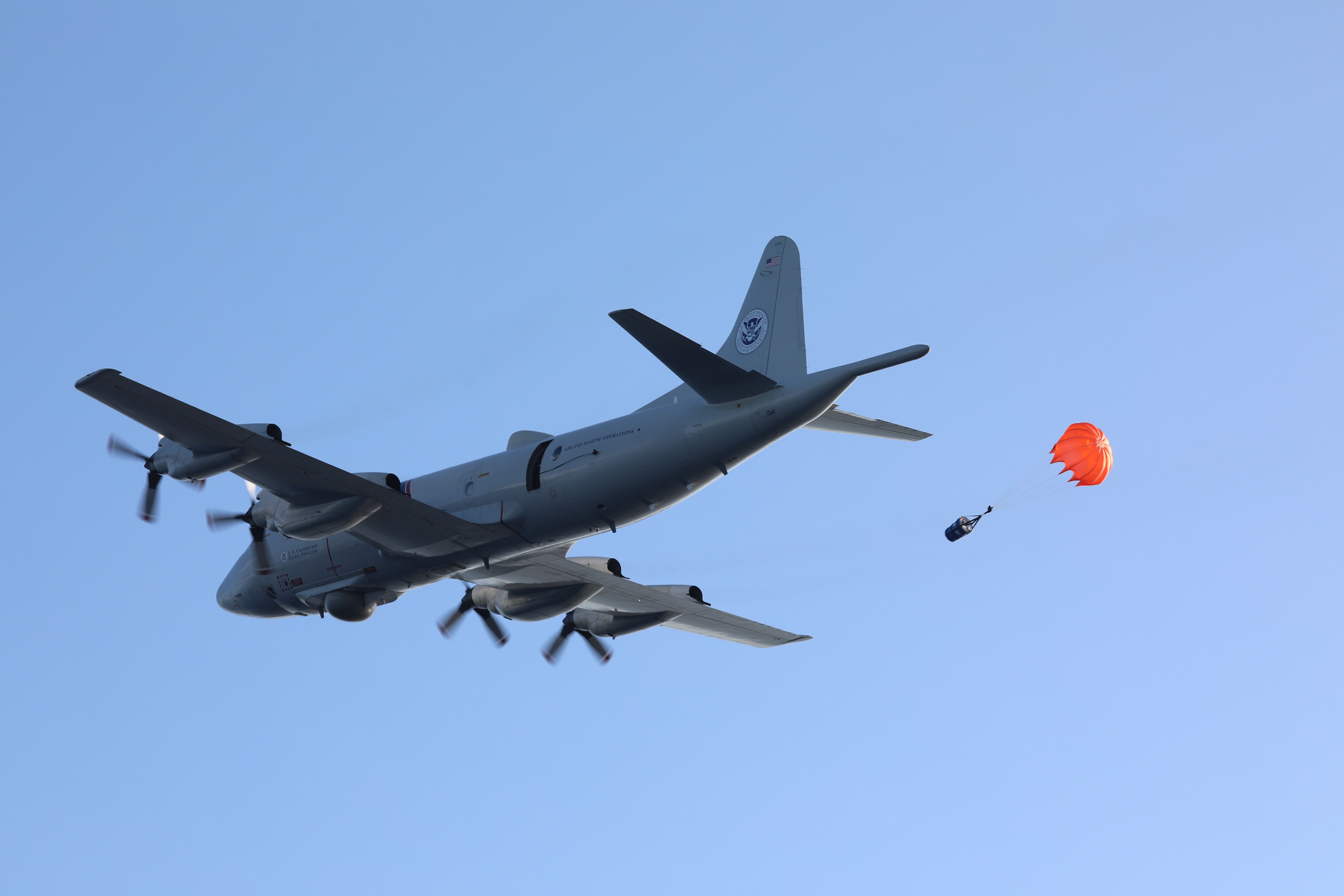
Airborne Deployable Delivery System (ADDS) at-sea resupply operations via the AMO P-3 enables U.S. Coast Guard cutter crews to remain on station and operational instead of returning to port to receive critical resources.

Below is a Customs and Border Protection news release that talks about what is apparently a new capability for them, that they have been using in support of the Coast Guard since March 2022. Presumably this is happening in the Eastern Pacific drug transit zone, perhaps in the Caribbean as well. Since the same aircraft is probably flying reconnaissance for the cutter, this can be very economical.

It is not clear what are being delivered or what weight or sizes can be dropped. Since the P-3s do not have a cargo ramp at the rear of the aircraft, like Coast Guard fixed wing aircraft, it appears the supplies are pushed out the door on the side of the fuselage. The Coast Guard has been air dropping parts to cutters for decades. Certainly, it is helpful. Cutter days are expensive, and we want to make the best of them. Always good to see interagency cooperation.

Thanks to David for bringing this to my attention.


Release Date Wed, 02/28/2024

JACKSONVILLE, FL— U.S. Customs and Border Protection (CBP), Air and Marine Operations (AMO) collaborated with several federal partners to test and implement new aerial resupply operations at sea, saving approximately $16 million since March 2022.

“The P-3’s responsive airlift capabilities enable deployment of time-sensitive, mission-critical supplies to our partners operating in the source and transit zones,” said Executive Director of CBP National Air Security Operations T.J. Emerick. “Aerial delivery via Airborne Deployable Delivery System is highly flexible, swift, and effective.”

AMO completed the resupply operation, known as an Airborne Deployable Delivery System, with the U.S. Coast Guard and Joint Interagency Task Force-South in the Eastern Pacific in January. The operation enables air transport of cargo and equipment to U.S. Coast Guard crews via parachute, helping to maintain task force operations.

The rapid delivery technique enables Coast Guard cutter crews to remain on station and operational instead of returning to port to receive critical resources, preserving both fuel and operational patrol time.

“Through detailed logistical planning and enhanced interoperability with our interagency and international partners, we can keep operational assets on station for longer periods of time,” said Coast Guard Rear Admiral Mark J. Fedor, director of Joint Interagency Task Force-South. “That means more drugs off the streets and rapid dismantlement of smuggling networks.”

Aerial resupply at sea via the airborne system saves approximately $1.3 million for each operation. AMO P-3 aircrews have conducted 16 airborne resupply missions with U.S. Coast Guard crews and task force teams since March 2022. These resupply missions have also allowed Coast Guard crews that would normally be required to travel to and from port to complete logistical supply runs to stay on station for approximately 75 additional days.

P-3 aircraft are high-endurance, all-weather, tactical aircraft. They are primarily used to conduct long-range aerial patrols and surveillance missions along the U.S. borders and in drug transit zones in Central and South America to prevent attempts to smuggle persons or contraband. P-3 capabilities are vital to AMO’s National Air Security Operations program and to the organization’s partnership with U.S. Southern Command. This partnership bolsters support to U.S. and international law enforcement through the sharing of information and intelligence to help detect and disrupt targets.

For additional news releases and other AMO information, visit www.cbp.gov or follow AMO on X (formerly Twitter), Instagram, and Facebook.

Last Modified: Feb 28, 2024

Suggested Reading

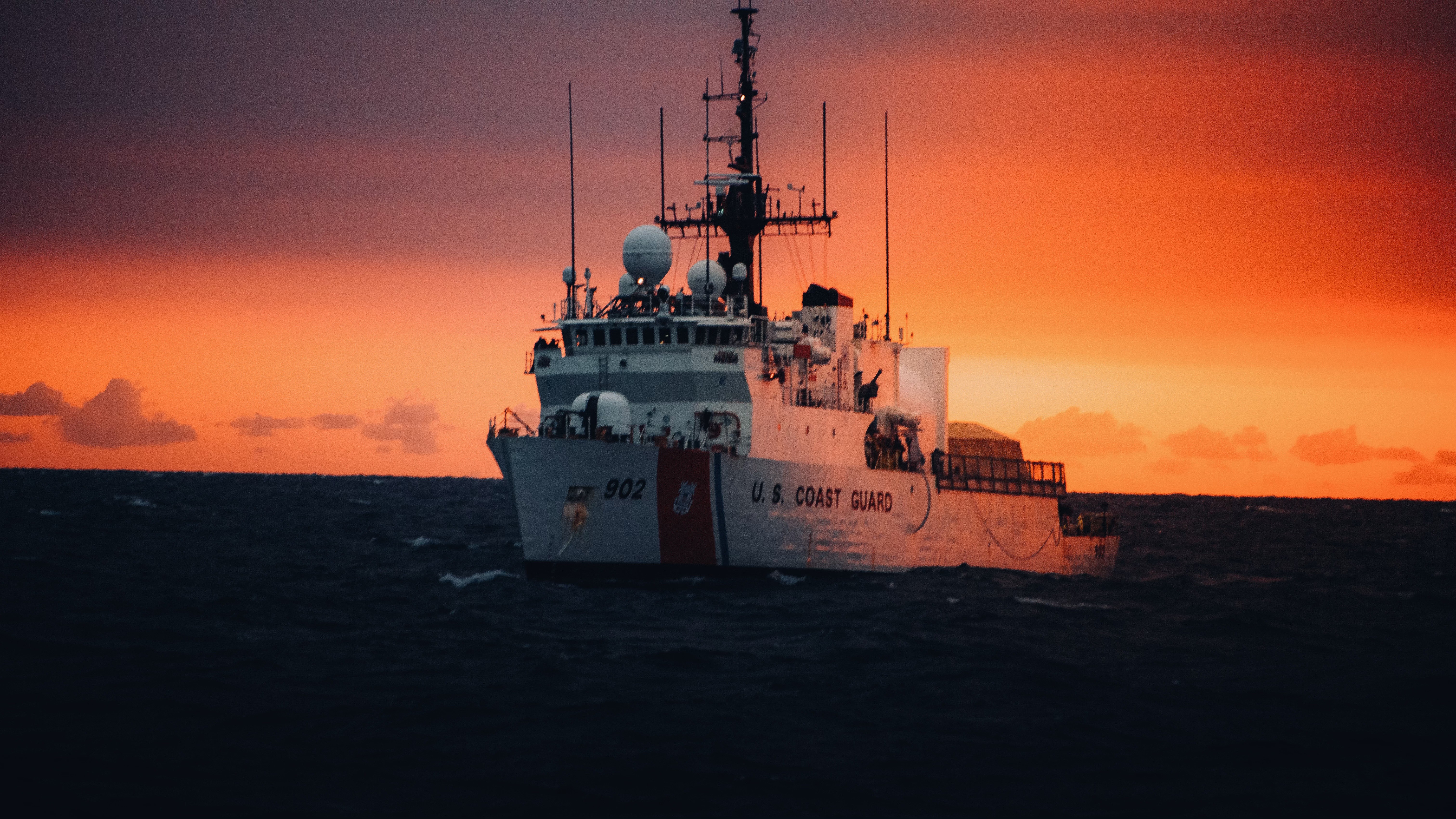
“The U.S. Coast Guard Cutter Tampa (WMEC 902) transits the Florida Straits on Feb. 4, 2024, supporting Operation Vigilant Sentry. Tampa is homeported in Portsmouth, Virginia.” (U.S. Coast Guard photo by Senior Chief Petty Officer Brodie MacDonald)

Below are three articles worth a look. Not ready to comment, but interesting.

Thanks to Paul and David for the recommendations.