Offshore Patrol Cutters (OPC), the Other LCS

This is another post I prepared for Center for International Maritime Security (CIMSEC) as part of “Corvette Week.”

The US Coast Guard is currently in the first part or a two part program to select a design for a planned class of 25 ships referred to as Offshore Patrol Cutters (OPC) also called the Maritime Security Cutter, Medium (WMSM). In many respects these might be thought of a third class of Littoral Combat Ships. They have different characteristics and different strengths and weaknesses, but there is considerable overlap in there characteristics. Like the LCS they will be small, shallow draft, helicopter equipped warships with the 57mm Mk110 gun. It seems likely the OPC will be 2,500 to 3,500 tons, similar in size to the Freedom and Independence class LCS.

The existing LCS classes emphasize adaptability, are faster and have more spacious aviation facilities. The cutters will emphasize seakeeping and will:

  • have greater range (minimum 7,500 miles @14 knots) and endurance using all diesel propulsion. Typical operations as outlined in the Concept of Operations (CONOPS) were 14 days between refueling, 21 days between replenishment, and 45-60 day patrols.
  • be ice-strengthened,
  • have ballistic protection over critical areas,
  • have a larger crew, and
  • be able to operate their boats and aircraft in higher sea states (through sea state 5).

The acquisition process:

A two step Acquisition process is being used. First, up to three contractors will be selected to develop their concepts into fully detailed contract proposals. This selection is expected by the end of the second quarter of FY2014. These three will then compete for a contract which will include all documentation, construction of the first OPC (expected delivery in FY2020) and options for up to ten follow-on ships.

Eight yards have submitted bids:

  • Bollinger Shipyards, Lockport, La.
  • Eastern Shipbuilding, Panama City, Fla.
  • General Dynamics Bath Iron Works, Bath, Maine
  • General Dynamics Nassco, San Diego
  • Huntington Ingalls Industries, Pascagoula, Miss.
  • Marinette Marine, Marinette, Wis.
  • Vigor Shipyards, Seattle; and
  • VT Halter Marine, Pascagoula, Miss.

There has been international interest in the project. VT Halter has partnered with French Defense Contractor DCNS. Vigor is allied with Ulstein, Bollinger is working with Dutch Ship builder Damen. It appears Eastern may have teamed with STX (supposition on my part, based only on their concept‘s similarity to the New Zealand Navy’s Protector Class OPV.

VT Halter Marine, Inc. (VT Halter Marine), a subsidiary of VT Systems, Inc. (VT Systems), today announced its partnership agreement with DCNS to submit a proposal to the Department of Homeland Security (DHS) for the design and construction of the U.S. Coast Guard (USCG) Offshore Patrol Cutter (OPC). VT Halter Marine will be the prime contractor and DCNS will be its exclusive subcontractor for the OPC platform design.

An early DCNS concept

The funding schedule is expected to look like this:

  • FY 2016 Detail Design
  • FY 2017 OPC #1 Construction
  • FY 2018 OPC #2
  • FY 2019 OPC #3
  • FY 2020 OPC #4 and #5
  • FY 2021 OPC #6 and #7
  • FY 2022 OPC #8 and #9
  • FY 2023 OPC #10 and #11

There was also a statement of intent to hold the maximum price of units four through nine to $310M each.

Specifications:

The ships are to be built to modified American Bureau of Shipping Naval Ship Rules excluding explosive or underwater shock hardening.

They are expected to operate in cold climates. They will be equipped “to operate in areas of broken plate, pancake, and sea ice ranging from 10 to 30 inches thick.”  There is also a required capability to operate an ice capable small boat and to have automated topside de-icers.

“The WMSM will provide increased protection for (sic.) small caliber weapons and shrapnel fragmentation around the bridge, CIC, and magazine spaces.”

It will tow up to 10,000 tons.

The ships are expected to be able to do Fueling at Sea (FAS), Replenishment at Sea (RAS), Vertical (Helicopter) Replenishment or VERTREP, and to refuel smaller vessels (apparently reflecting an expectation of sustained operations with smaller patrol vessels (WPCs or WPBs) at locations remote from their bases).

I did not have access to the latest specifications, but have deduced some details of the proposed equipment from the Allowance Equipage List included in the Draft RFP. All the systems below are referenced. (In a few cases there may be duplicate listing if different nomenclature is used for the same system.) The outfit, in most respects, repeats or even improves on that of the National Security Cutter:

Communications:

  • Military SAT com
  • Tactical Data Link System
  • IFF
  • SBU (presumably “Sensitive but Unclassified”) Network
  • SIPRNET (Classified Network)
  • NIPRNET (Unclassified Network)
  • Entertainment System

Sensors:

  • TSR-3D RARAD System, a multimode surface and air surveillance and target acquisition radar
  • Electro-Optic/Infrared Sensor system
  • RADIAC

Weapons:

  • Mk 48 mod 1 Gun Weapon System (pdf), which includes the Mk 110 57mm gun, AN/SPQ-9B  Surface search and Fire Control Radar, Electro-Optical sensor system Mk 20 mod 0, the Mk 160 GCS Mod 12, and Mk 12 Gun Computer System
  • Mk 15 mod 21-25 CIWS (Phalanx) (apparently equipped for but not with)
  • Mk 38 mod 2 25 mm
  • Gun Weapon System SSAM (remotely controlled stabilized .50 cal)
  • Four crew served .50 mounts including Mk 16 and Mk 93 mod 0 or mod 4 mounts
  • Mk 46 optical sight

Electronic Warfare:

  • Mk 53 Decoy launcher
  • AN/SLQ-32 (v)2

Navigation:

  • Encrypted GPS
  • Electronic Chart Display and Information System

Intelligence:

  • Ships Signals Exploitation Space
  • Special Purpose Intel System

Aviation:

  • Hangar for helicopter up to and including Navy and Coast Guard H-60s (There may have been some backtracking on the requirement for a helicopter larger than the HH-65)
  • Facilities for the support of unmanned Aerial Systems (UAS)
  • TACAN
  • Visual Landing Aids

Coast Guard HH-65 Dolphins

Unresolved

Having watched this program develop over a number of years, it is remarkable that the specifications have moved from specific to general as the need to minimize cost has resulted in softening of the requirements. As with many contracts, threshold and objective characteristics were defined, but if there are incentives for going beyond threshold requirements, they have not been made public. For this reason there seems little reason to expect the capabilities to exceed the threshold requirement which include a speed of 22 knots (objective 25).

The aviation support requirements also seem to have gone soft and may result in the ability to support only smaller helicopters and UAVs

Potential Naval Roles

Weapons–A minimal projected fit has been identified, but the Commandant has stated that the ships will have space and weight reservation for additional weapons, but I have not been privy to the extent of this reservation. It may be limited to replacing the Mk38mod2 with a Phalanx, but there is reason to hope the ships have greater potential.

The ships do have an unusual specification. For the Alien Migrant Interdiction Operations, they are required to be able to feed and provide basic shelter for up to 500 migrants for 48 hours, all while keeping them on the main deck or above.  This actually constitutes a substantial weight/moment reserve for other missions. If we assumed 150 pounds for each person, that would equate to 37.5 tons.

Modules–While there was apparently no stated requirement to host mission modules or containers in the specifications, some of the foreign designed potential contenders may already include provision for taking containers. For instance, the Damen designed OPV 2600 (ton) has provision for five 20 foot containers. Others may use containers as part of their plan to meet the 500 Alien Migrant holding requirement.

Vigor Offshore Patrol Craft 01

Vigor concept with its Ulstein X-bow. It was reported to have a length of 328 feet, a beam of 54 feet, a draft of 16.5 feet, and a max speed of 22knots. It included a reconfigurable boat hangar.

Manning:

The Coast Guard’s latest Manpower Estimate for the Offshore Patrol Cutters (OPCs), completed 18 March 2011, was 104 (15 officers, 9 CPOs, 80 E-6 and below) plus an aviation detachment (five personnel) and Ship’s Signals Exploitation Space (SSES) detachment (seven personnel) for a total of 116. Accommodations are planned for at least 120 (threshold requirement) and hopefully as many as 126 (“objective”). The manning assumes four section underway watches.

Unlike the two current LCS classes, the OPCs are expected to train junior personnel: “The Coast Guard depends on cutters to expose our junior personnel, officers and enlisted, to our wide mission set. With this real world experience derived from a first tour operational assignment, these sailors populate critical billets such as law enforcement detachments, independent duty corpsmen, and XOs on patrol boats.”

These ships, like the LCS are expected to have multiple crews, with four crews for a group of three ships, allowing them to operate up to 225-230 days away from home port per year. (I personally don’t like the concept as proposed)

Survivability: The preliminary manning documents assumes that two full Repair Lockers (27 crew members in each locker) plus a Rapid Response Team (RRT) will be constituted for General Emergency Situations, but only one full Repair Locker and the RRT will be available at General Quarters. Two engine rooms will provide a degree of propulsion redundancy.

LCS Council:

The CNO saw the need for high level coordination of the introduction of the LCS to insure that they made the most of their potential. Since established they have added oversight of the Joint High Speed Vessels.

I see a need for the Coast Guard to also have a seat the Council to

  • share experiences with multiple crewing and other lessons learned
  • maximize the wartime potential of the Offshore Patrol Cutters by exploiting commonality with the LCS
  • ease coordination of Navy’s LCS and JHSVs partnership station, drug interdiction, and constabulary efforts which often involving Coast Guard detachments.

LCS 2.0, or a Missed opportunity?:

I keep hearing that many, including former undersecretary Bob Work, may not be entirely happy with the characteristics of the existing LCS designs, but that because they are the design we have, we should continue to build them. I have hoped that the Offshore Patrol Cutters would offer a possible alternative for an LCS 2.0. It may be that cost considerations and program choices will make them unsuitable, but at the very least, the eight design proposals and the three fully developed contract proposals should make interesting reading for those who would like to consider alternatives to the existing designs.

In addition, these ships, or designs developed from them, may offer a cheaper alternative basis upon which to offer our allies interested in American built corvettes or OPVs.

If I had my druthers:

If I had my druthers these ships would be designed, but not necessarily equipped, from the start, for wartime roles including ASW and NSFS.

Background: “What might Coast Guard cutters do in wartime.”
What is a Corvette? and What Next?

I wrote this for another blog, Center for Maritime Security or CIMSEC, where I was asked to coordinate a week of discussion on corvettes. What does that have to do with the Coast Guard? Essentially the only difference I see between large CG cutters and corvettes is a bit of equipment. I explain below. Couldn’t hep but put in a little Coast Guard history. Anyway the discussion will continue there, but I will cross post my two posts here. Later in the week I’ll talk about the “Offshore Patrol Cutter, the other Littoral Combat Ship.”

———————————————————————————————————–

Classification of surface warships as cruisers, destroyers, frigates, or corvettes, has become like pornography. There are no generally accepted definitions, but “I know it when I see it”–except that everyone sees it a little differently.

Since this is “Corvette Week” what are we really talking about?

(Note: unless otherwise specified, lengths are over all and displacements are full load)

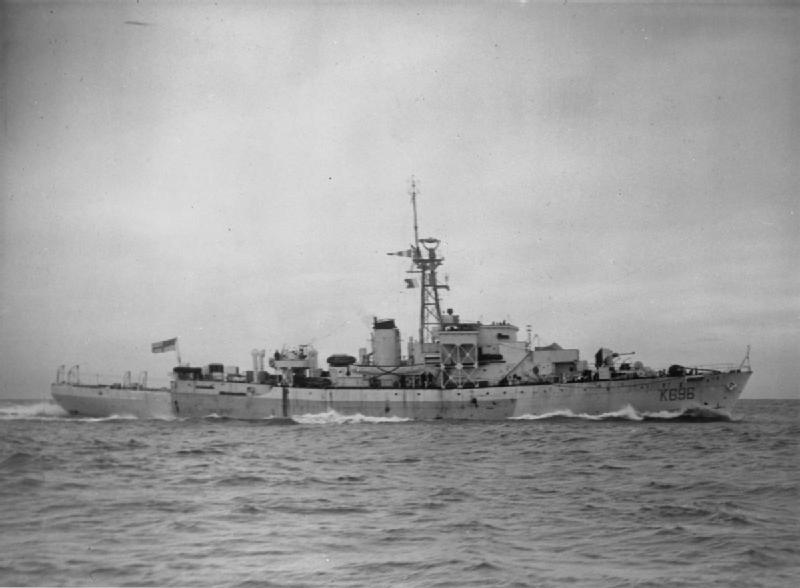
My Combat Fleets of the World, 16th Edition, which I have used here extensively for reference, defines Corvettes as, “Surface Combatants of less than 1,500 tons but more than 1,000 full load displacement–essentially, fourth rate surface combatants.”  but goes on to note that “…the designation as used here essentially refers to smaller frigates and does not correspond to the European concept of corvettes as any warship larger than a patrol craft but smaller than a frigate.” I feel to confine the definition within a 500 ton range is too restrictive. in fact it would have excluded the Castle class corvettes of WWII as too large, and other corvettes as too small.

File:HMS Denbigh Castle IWM FL 6032.jpg
Royal Navy Photograph of Castle class corvette HMS Denbigh Castle (K696)

Pre-WWII

During the age of sail, corvettes were originally warships typically smaller than a frigate, but larger than a sloop, usually with guns on a single deck. Some ships continued to be called corvettes as steam was introduced, but in the Royal Navy, in 1877, corvettes along with sloops and frigates were subsumed under the new designation “cruisers.” Corvettes, as a type, essentially disappeared from the English naval lexicon until 1939. The term was kept alive in some navies (including the French, German, and Italian) as a rank that translated corvette-captain, a rank generally equal to Lieutenant Commander.

World War II:

Corvettes as a type reemerged just prior to WWII. As it became clear that U-boats would be a major threat, Britain saw the need for an escort vessel that could be built quickly and in large numbers, in yards that had not been considered capable of building warships. Just before WWII, they ordered the first of 267 “Flower Class” corvettes that were built in the UK and Canada. They modified the design for a whale catcher named Southern Pride, enlarging it to 205 feet overall and a displacement of 1245 to 1390 tons. They were terrible warships, weakly armed, cramped, uncomfortable, and slow. Single screw, reciprocating steam propulsion gave them a maximum speed of only 16.5 knots, a knot slower than a typical (Type VII) surfaced U-boat. They were originally intended only for coastal operations, but because of their long range, they were thrown into the Battle of the Atlantic, where they were by far the most numerous transatlantic convoy escorts for the critical early years, taking slow merchant convoys across the mid-Atlantic air gap, while the Home Fleet’s more capable fleet destroyers were generally held back to escort the battle fleet or met convoys only as they approached the British Isles.

File:HMS Polyanthus (K 47).jpg

Flower Class Corvette HMS Polyanthus, Source =www.oldships.org.uk, Author =Leidseplein Date =1943-09-

Reportedly Winston Churchill had a hand it designating this new class “corvettes,” probably in an attempt to make them appear more glamorous than the term “patrol vessels” which had been applied to similar vessels previously. Two years after the re-introduction of the term “corvette,” the term “frigate” was also resurrected to describe another war emergency escort program, this one more complex and more capable but still using reciprocating steam propulsion. Larger commercial yards converted to making frigates (301 to 307 ft, 1920 to 2420 ton), but smaller yards continued to make corvettes of the improved Castle class (252 ft, 1590 to 1630 tons), while naval yards continued to produce small numbers of sloops like the Black Swan class that were the true premier ASW escorts of the Royal Navy.

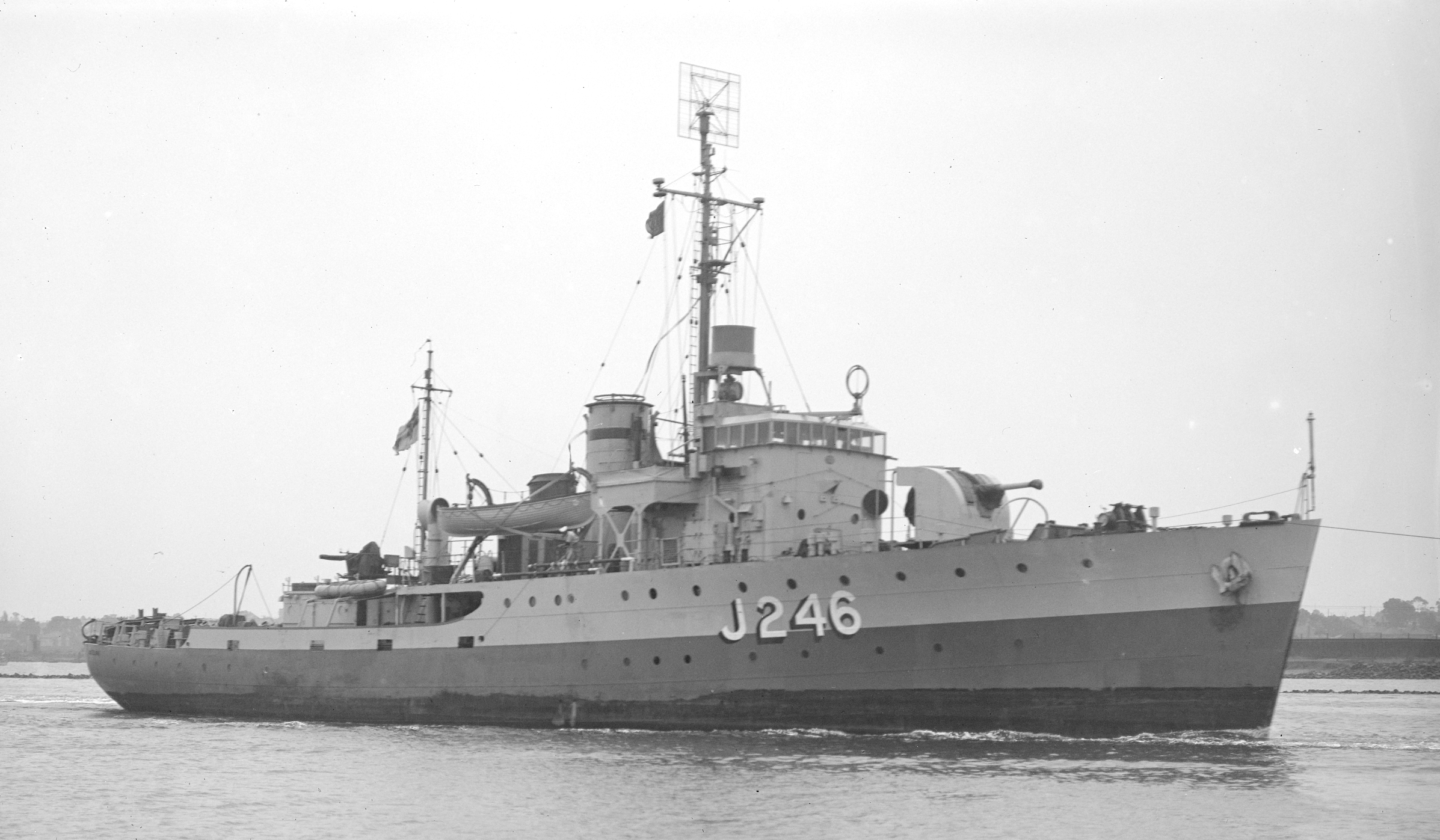
Australia also built corvettes, 60 ships of the similar but even smaller, slower Bathurst Class (186 ft). Initially they were classified as minesweepers, but found more employment as escorts, so were more frequently referred to as corvettes.

File:HMAS FremantleSLV Green.jpg

Bathurst-class corvette, HMAS Fremantle, State Library of Victoria

Japan, Germany, and Italy all made similar escort ships, but only the numerous Italian  Gabbiano class (193 foot, 728 tons, with combined diesel or electric propulsion no less),  were actually referred to as corvettes.

All of the WWII corvettes were primarily ASW escorts, but their were a number of classes of vessels, many built prior to the war, that share DNA with today’s missile armed corvettes. These were small, fast, torpedo armed vessels that resembled destroyers, but most had a standard displacement of 1000 tons or less. Usually they were referred to as “torpedo boats.”  Japan built twelve, The Germans built 48 (the last 15 were large enough to have been considered destroyers in other navies). The French Navy completed twelve. The Italians completed 69 (some of which were closer to frigates or destroyer escorts). The Italian Spica class (269 ft, 885 to 1,030 ton, 34 knots) may serve as an example.

File:Cassiopea-RM.jpg

Italian Spica Class torpedo boat

Generally, the war emergency programs had one thing in common. They were not the ships these navies would have chosen to build in peacetime. In wartime priorities change; planning horizons contract. Producibility may trump quality. They were all compromised in some fashion–in their speed, survivability, weapons, or economy of operation. Corvettes filled a need for large numbers of escorts, but after the war, most were quickly discarded.

The MCM Connection:

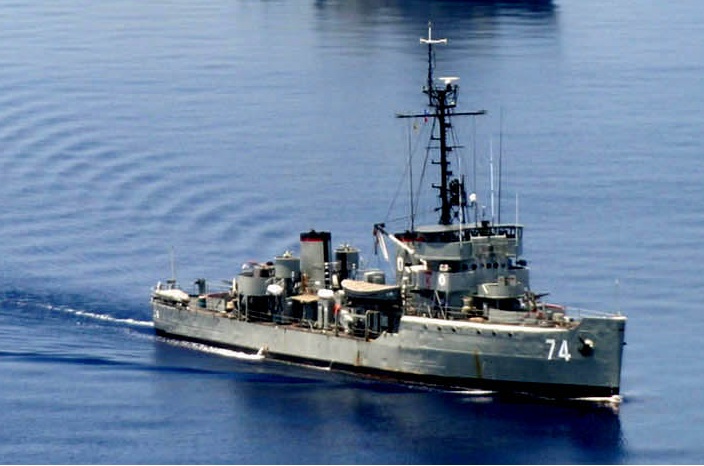
The Flower Class Corvettes were originally also equipped to sweep mines. As noted the Australian Bathurst Class began life as minesweepers. While the US built no “corvettes” during the war, the minesweepers of the Raven (220 foot/1040 tons), Auk (221 foot/1,250 tons), and Admirable ((180 foot) classes frequently functioned in this role. In fact, with minor modification Admirable class ships were redesignated PCEs (Patrol Craft, Escort). All these minesweepers were built with sonar. By the end of the war, most were equipped with hedgehogs, depth charge projectors (K-guns) and dual depth charge racks, having enjoyed priority for ASW equipment second only to destroyer escorts.

File:PS-74 Rizal.jpg

Former Auk class minesweeper still serving in the Philippine Navy as Corvette BRP Rizal (PS-74), US Government photo, 050822-N-6264C-145 Sulu Sea (Aug. 22, 2005)

Post WW II:

Since the end of WWII corvettes have generally fallen into two categories, with some designs attempting to incorporate elements both types. They tend to be either:
—Small, fast, missile armed vessels optimized for ASuW, like Sweden’s Visby Class (40 knots, 239 ft, 650 tons) usually expected to operate in groups, either with others of their kind or acting as flagships for even smaller missile boats, or
—Smaller versions of frigates with moderate speed optimized for patrol and presence in peacetime and escort during wartime like the Damen designed SIGMAs or  India’s Kamorta Class (25 knots, 358 foot oa, 3100 tons).

File:K33 HMS Haernosand Karlskrona Marindagen2008.jpg

Visby class Corvette, HMS Härnösand, Source: Xiziz at en.wikipedia

File:Kri-diponegoro-1600-1200.jpg

SIGMA class corvette

Largest Operators of Corvettes:

The largest operator of corvettes is Russia with approximately 53 (3 Buyan, 1 Buyan M, 7 Parchim II, 23 Grisha V, 4 Grisha III, 2 Dergach Project 1239, 13 Nanuchka) (80 if you count the 27 Tarantuls that fall slightly below the 500 ton threshold I have assumed).
India, China, South Korea, Indonesia, and Italy also maintain large numbers of corvettes.

File:Type 056 corvette 583 Ganzhou.jpg

Chinese Type 056 corvette 583 Ganzhou, by 樱井千一

Corvettes in the USN:

While the US Navy has never built corvettes for its own use, the type is not without precedence in the US.

In the early days of WWII, when the US navy was desperately short of escorts, 18 Flower class corvettes were transferred to the USN. Eight of those were manned by USCG crews.

File:USS Intensity (PG-93).jpg

Coast Guard manned Flower Class Corvette USS Intensity (PG-93), mid-1943. Former  HMCS Fennel (K194) [http://www.history.navy.mil/photos/images/h97000/h97406.jpg]

In the 50s the Navy was interested in experimenting with types that might be built hurriedly in an emergency. The result was the four ships of the Claude Jones class (DE-1033-1036) built by Avondale between 1956 and 1959. At 312 feet long and 2000 tons, they were essentially the same size as the preceding Dealey Class, but they were  simplified, diesel powered, slower, and more lightly armed. These ships were really a update of the corvette concept of a cheap simple escorts that lent itself to rapid construction. (Similarly about the same time the British were building 14 HMS Blackwood Class  (Type 14) that were “2nd Rate Frigates” of 1536 tons, powered by a single shaft steam turbine plant with no gun larger then 40mm.)

File:USS Claude Jones (DE-1033).jpg

USS Claude Jones (DE-1033), US Navy photo, http://www.navsource.org

In the late 1960s the US built four corvettes, given US hull numbers PF-103 to PF-106, that were immediately turned over to the Iranian Navy. They became the Bayandor Class (275 feet long, 1,135 tons).

In the early ’70s, two additional PF-103 class ships (PF-107 and 108), built to a modified design, were delivered to Thailand’s Navy. These were the Tapi Class.

Between 1977 and 1983 Tacoma Boat built a class of four CODOG powered “PCG” for Saudi Arabia, the Badr class, 245 feet, 1,038 tons, 30 knots.

Between 1983 and 1987 Tacoma Boat built two diesel powered “PFMMs” for the Thai Navy Ratanakosin class 252 foot, 960 tons, 26 knots.

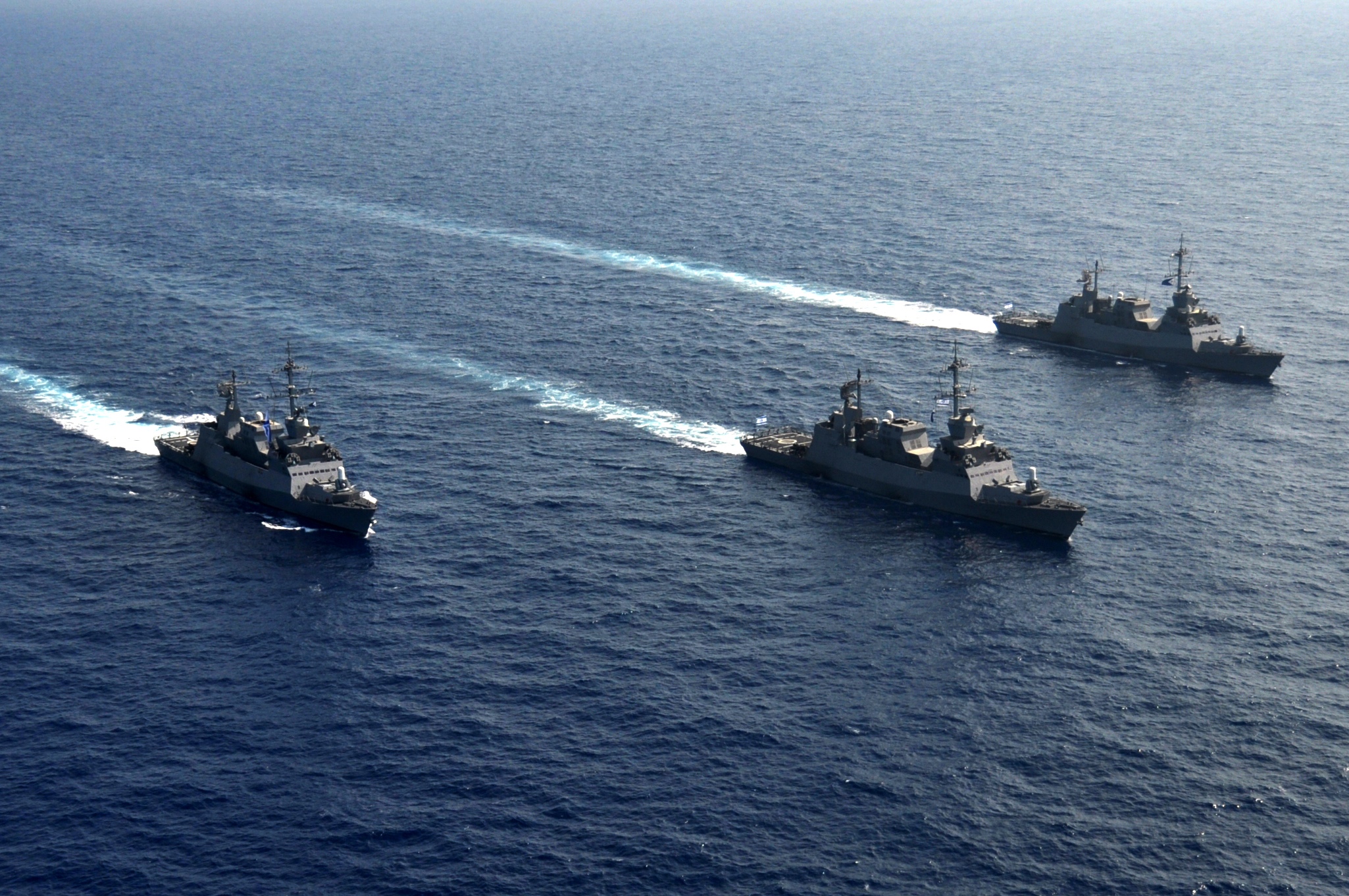
Between 1989 and 1995 Northrop Grumman Litton built three CODOG Corvettes for the Israeli Navy, the Sa’ar 5 class, (281 foot, 1,275 tons, 33 knots).

File:Three Sa'ar 5 Class Missile Corvettes Going For a Cruise.jpg

American built Israeli SA’AR5 corvettes, http://www.flickr.com/photos/idfonline/6871983192/in/photostream

Between 2008 and 2013, VT Halter Marine has been building a class of four missile corvettes for the Egyptian Navy, the  Ambassador MkIII class (205 feet, 700 tons, 41 knots). The first has already been delivered.

An undated photo of the ENS S. Ezzat, an Egyptian Fast Missile Craft. VT Halter Marine Photo

An undated photo of the ENS S. Ezzat, an Egyptian Fast Missile Craft. VT Halter Marine Photo

While the Littoral Combat Ships are not normally considered corvettes, on June 10, 2013, Rear Admiral John F. Kirby, the Chief of Information for the Navy called them Corvettes. Without a mission module or aviation detachment, they are really more like OPVs. But when the Mine Warfare module is mounted they become MCM vessels. When an ASW or ASuW module is mounted, they start to look like corvettes.

The Claude Jones class ships were transferred to the Indonesian Navy and continued in service there until 2006. Of the six PF-103 class ships, two Iranian ships were lost in combat with Iraq, but the remaining four are still in service with the Iranian and Thai Navies and have been updated. The Badr class and the  Ratanakosin class are still in service with their respective navies, and the Sa’ar Vs are still the most advanced surface ships in the Israeli Navy. All but the two Thai Navy Ratanakosin class (PF-107 and 108) have been equipped to launch anti-ship cruise missiles.

The Coast Guard Connection:

During WWII Coast Guard Cutters were frequently used as ASW escorts, some quite successfully, filling corvette and frigate roles. After the war, new construction frequently included provision for ASW systems either as built or as planned upgrades in the case of a major conflict.

The 16 Reliance class Medium Endurance Cutters (210 feet, 1,050 tons, 18 knots) delivered 1964 to 1969, were built with provision for adding sonar, hedge hogs, and torpedo tubes. They were originally to have been designated PCs. a designation shared with the sub chasers of WWII.

The 12 Hamilton Class High Endurance cutters (378 feet, 3,050 tons, 29 knots) completed 1967 to 1972, were built with ASW systems installed and their systems were upgraded and provision for harpoon installed 1989 to 1992. As built, they were not the equal of contemporary Destroyer Escorts with their AN/SQS-26 sonars, but were comparable to those built only a few years before. An argument can be made that these ships, as built and later modified, could be considered, if not frigates, at least corvettes.

USCGC Mellon after upgrades including Harpoon, CIWS, and support for LAMPS

The thirteen Bear class cutters (270 feet, 1,780 tons, 19.5 knots) completed 1983 to 1990, were built without ASW systems, but had provision for adding a towed array and supporting a LAMPS I helicopter. If these systems had been provided, then the ships might have also been considered corvettes.

The Coast Guard’s National Security Cutters, of the Bertholf class (eight ships planned, 418 ft/4,500 tons) have no installed ASW systems or ASCMs, but they do have excellent aviation support facilities and the ship has been marketed as the basis for a frigate program. Aside from Exocets carried by the French ships, they are in most respects more capable warships than the Floreal “light surveillance frigates” (307 ft/2950 tons) and similar to the French Lafayette Class frigates (410 ft/3,600 tons) which also currently have no sonar.

File:USCGC Waesche by Yerba Buena Island.jpg

USCGC Waesche, U.S. Coast Guard photo ID: 100228-G-2129M-004

File:Ventose 1.jpg
French frigate Floréal-class Ventôse (F733)

The Coast Guard is in the process of procuring a new class to replace its Medium Endurance Cutters. The resulting ship is likely to be similar to the Floreal class (90 to 100 meters in length and 2500 to 3500 tons) but faster and will share sensors and some weapons with the Bertholf class and the Littoral Combat Ships. Addition of ASW or ASCM systems would result in ships many would classify as light frigates or corvettes.

Bottom Line–What is a Corvette?:

Corvettes slot under frigates but above patrol boats or missile boats as a classification of surface combatants. To me, this means that they are the smallest or perhaps least capable ocean-going warships. This is a bit of a stretch for Corvettes like the Visby, but in fact the Swedes have deployed even smaller warships to the Indian Ocean for counter piracy operations. That sets the low end of the the displacement range at about 500 tons, but when we look for an upper limit, it seems a moving target, with no similar performance based limit.

The US and Britain already build destroyers the size of WWII cruisers. Germany and in the near future Britain will build frigates over 6,000 tons full load. Japan’s Coast Guard has OPVs displacing 9,350 tons full load.  If we tripled the displacement of WWII corvettes as we have done with WWII Frigates and Destroyers, Corvettes could displace almost 5,000 tons, so I don’t think displacement is a reliable determinant.

Strict naval vessel construction standards don’t necessarily distinguish a corvette from an OPV either. They were not applied to the original “Flower” class, and they don’t apply to the Damen designed Sigma class, built or building for Indonesia, Morocco, and Vietnam, or to the French Lafayette class (also operated by Taiwan, Singapore, and Saudi Arabia) and Floreal class (also operated by the Moroccan Navy) which are rated as frigates but which it might be argued are actually corvettes.

The only metric that doesn’t seem to have changed much over the last 70 years is crew size. Corvettes generally have crews of 120 or less, frigates from 120 to perhaps a bit over 200, while destroyer crews begin slightly under 200 and go up to about 350, and cruiser crews are larger still. The DDG1000s will apparently have a frigate sized crew, but their final crew may be larger than currently planned. OPV crews tend to be corvette sized or smaller.

Just as the difference between Spruance Class Destroyers and Ticonderoga Class cruisers was mission and associated equipment, not displacement, the differentiation between the various types of warships and between Offshore Patrol Vessels (OPVs) and corvettes may simply comes down to their missions and equipment. OPVs include a wide range of ships, but the common thread, generally accepted, is that they have no ASW weapons, no heavy anti-ship cruise missiles, and only a self-defense AAW capability. Adding an ASW capability and/or cruise missiles would convert an OPV into a corvette. Perhaps they would not make very good warships, but then the original Corvettes weren’t very good warships either, but they served a vital role. Conversely an old frigate or corvette, stripped of all its weapons except a medium caliber gun and heavy machine guns would become an OPV, even if it nominally retained its frigate or corvette designation as in the case of Portugal’s Joao Coutinho and Baptista de Andrade class or some of Italy’s Minerva class.

If we had no history, and we could start ship designations on “a clean sheet of paper” we might define ships types based on their missions and equipment, saying destroyers are vessels designed with robust capacity to perform well in all three major surface combatant warfare areas, AAW, ASuW, and ASW. Frigates are designed to perform well in only two missions areas  (with possibly modest self defense capability in the third). Corvettes would be single mission specialists with only modest capability in the other two missions (if at all). OPVs would be vessels equipped for missions that did not require robust capabilities in any of these three mission areas. All four types might be called generically “cruisers” which would bring that designation back to its original meaning, a vessel smaller than a ship of the line that can operate independently.

The Future of Corvettes:

WWII corvettes were small ships packed with crew and weapons.They were small because there was an urgent need for many ships that could not be met by the shipyards that normally built warships. They were a way of making the small commercial yards serve the war effort. If we are ever engaged in a prolonged conflict against a near peer adversary we may again resort to a similar expedience. If so, the resulting corvette is more likely to be based on a petroleum industry offshore support vessel rather than a whaling or fishing vessel.

But when ships are built in peace time, for a 20 to 40 year life, other factors beside construction cost start to dominate. In the West, crew costs weigh heavily, while increasing hull size appears less important, provided we do not load up the larger hull with additional systems which will in turn drive up crew costs. Larger hulls are more seaworthy, allow greater endurance, and may be made quieter. They may even be more economical to operate and maintain because of easier access.

Some European Countries that formally operated a number of Corvettes seem to have abandoned the type in favor of ships with more range and better seakeeping including The Netherlands, Denmark, and Norway. Denmark has instead produced frigates and a novel class of ships, the Absalon Class “support ships,” (450 ft/6,600 tons) that include a relatively large hull of modest speed, with a relatively small crew of about 100, and a large reconfigurable spaces–an open one topside midships where missile systems can be placed and a “garage” area under the flight deck that can accommodate vehicles and containerized loads. These ships are perhaps too large to be considered corvettes, but they are not nearly so well armed as the frigates of the similarly sized Iver Huitfeldt-class. They do have characteristics I would expect to see on future corvettes, a relatively commodious hull (because “steel is cheap and air is free”), a relatively small crew (because that is the most expensive component over the life-cycle of the ship), and reconfigurable spaces and weapon systems, that allow the ships to be adapted to different missions (because that is allow us to hedge our bets regarding what capabilities will be needed, while allowing that minimal crew over most of the life of the ship).

Because Corvettes are always compromised, they are likely to be controversial. Many will not agree with the compromises accepted. That is certainly true of the new American Corvette, the Littoral Combat ship.

In some respects the LCSs may be the prototype of the future corvette, in that it is not particularly small, but they were made cheap to operate with a minimal crew, and they are single mission ships, but with the advantage that the mission can be changed over time, although not as quickly as once advertised. Other aspects of the ship were perhaps not as well thought out, but they will serve a purpose, and perhaps the next generation LCS  or convertible corvette will better meet our needs.

Vietnam Builds a Damen OPC (OPV)

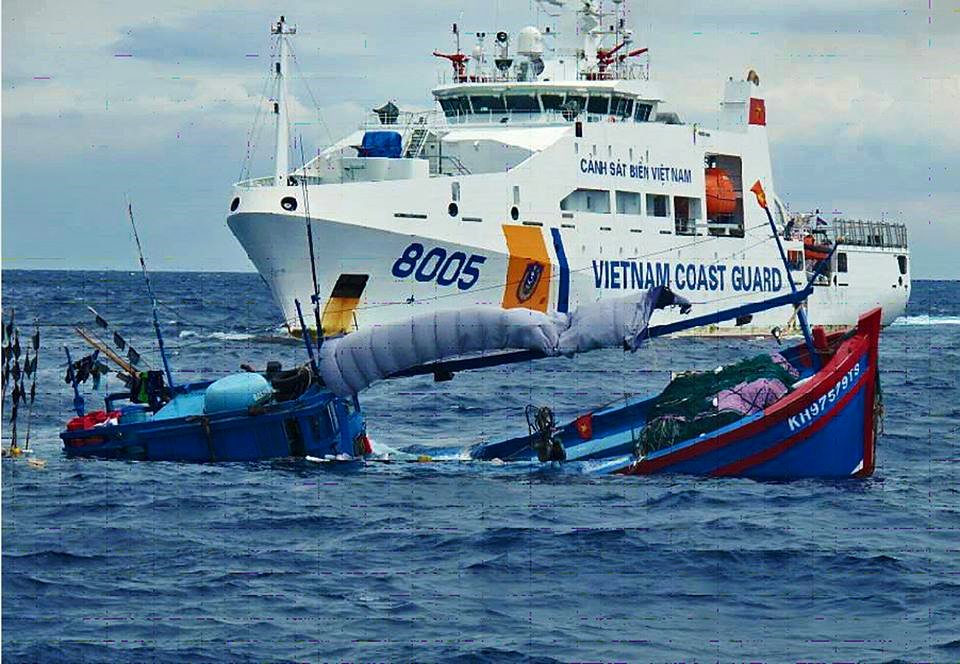
BairdMaritime provides information on a new Offshore Patrol Vessel (OPV) built in Vietnam for the Vietnam Marine Police (soon to be Vietnam Coast Guard) to a Damen design, that looks a whole lot like an Offshore Patrol Cutter (OPC). There is also information in the article about their developing relationship with the USCG.

She is reported to be 2500 tons, 90 meters (295′) in length, 14 meters (46′) of beam, 21 knots, with a crew of 70.

I think the Bollinger candidate for the OPC may be similar. This is apparently based on the Damen OPV2400. The OPC candidate is probably based on the slightly larger OPV2600 since it will probably need additional volume for fuel to provide the range the USCG requires, a couple of hundred tons heavier, 8 meters (26′) longer, and two or three knots faster because of its greater length (same horsepower).

More information about Damen designs for OPVs can be seen via the link below:

http://www.damen.com/en/markets/offshore-patrol-vessel

Vietnamese Coast Guard Damen 9014 Offshore Patrol Vessel. Photo: lancercell.com Photo added 2022.

OPC Builders Field Narrows–Unofficial

Selection of at most three shipbuilders to develop proposed contract designs for the Offshore Patrol Cutter is expected soon. MaritimeMemos is reporting the field has already been trimmed down to five.

“The unofficial word is that the Coast Guard has set the competitive range for the OPC program and has thereby eliminated at least three of the competitors – Marinette Marine, NASSCO and Vigor Industrial.  If this is the case, that leaves five yards still under consideration for up to three Phase I contracts – two from the “Big Six” – Bath Iron Works and Ingalls Shipbuilding – and three from the “Second Tier” – Bollinger Shipyards, Eastern Shipbuilding and VT Halter Marine.  My money’s on the three second-tier yards.  September 6,2013.

If you want to  review what has been published about the conceptual designs, you can see them in an earlier post here: “Offshore Patrol Cutter Concepts” Be sure to read the comments, there is more info there. I still have not seen any information on concepts from Bath or NASSCO.

Selling (and Saving) the Offshore Patrol Cutter Project

Since seeing indications the Offshore Patrol Cutter (OPC) program may be in jeopardy (here and here), I’ve been thinking about how the program might be “sold.” There are a number of approaches that might be considered.

Conceptual Rendering of the OPC

It Is a Money Saver

Get it started as an alternative to the NSC. As discussed in an earlier post (Rethinking the New Cutter Programs), we can get more new cutters on line more quickly if we truncated the NSC program at six and started the OPC program two years earlier. This could also be sold as a money saving step, in that we can probably get two OPCs for little more than the price of one NSC. There is very little the NSC can do that the OPC can’t. (If we include the features suggested below, the OPC will be able to do things the NSC cannot-further justifying the change.) This gets us “over-the-hump” of starting the program. Having built the first ships of the class it will be much harder to kill the project and much easier to revive it, if interrupted. The winning shipyard and their legislative representatives will work to keep the project going.  It will also mean the MECs and one HEC will be retiring at least a year earlier–the 210s will only be 54 to 56 years old.

Make the Consequences of Not Building Them Clear

Publish the decommissioning schedule. This should make the news in all the Congressional districts that will loose assets.

What is the performance difference. Publish an addendum to the latest “United States Coast Guard Fiscal Year 20XX Performance Report” showing the decrease in performance if there had been no MECs.

Publish a plan to scale back or delete missions if the the MECs are not replaced.

Pork with a Purpose:

An infrastructure (shipyard) program. It might be more expensive, but Congress can decide they want to spread the work around. They have been doing this, almost since the day the republic was formed. It would certainly be reasonable to say they wanted the construction contracted to more than one yard, perhaps even one West Coast, one East Coast, one Gulf Coast or some other split. As a stimulus program that also delivers a tangible good, building four a year, two each on the West and East Coasts would not be unreasonable. That this spreads the support base for the program wouldn’t hurt either. It might even promote some competition in the long term.

Mobilize our Allies

Mobilize the shipyards that hope to win contracts. They have political clout.

Get the fishing industry on our side. Some times they don’t like us, but we keep the foreign competitors out, and when there is a medical emergency or their boat starts sinking they’re mighty happy we are around.

Mobile the Navy League. Despite the name, this organization is a great ally of the Coast Guard as well, but I’ve yet to see us make the case for the OPC in the pages of their magazine.

Get the Navy to endorse the program. Not sure they will want to, but there are lots of reasons they should (Offshore Patrol Cutters, Why the Navy Should Support the Program), particularly if the design chosen has the potential to be a useful “low-end” warship. These are exactly the types of ships needed for partnership station, and they are the kind of ships many of our allies should include in their Navies and Coast Guards through Foreign Military Sales.

Strengthen the National Defense Angle

Bring back the ASW mission. Adding a passive towed array to the ship could help in our law enforcement mission, improving the chances of  detecting and tracking semi-submersibles, but the additional military capability could also make the ship easier to justify. Beyond the support for a passive sonar usable for law enforcement, the only additions needed for a credible ASW capability would be having magazine and other storage space for torpedoes, sono-buoys, etc. to support Navy MH-60R helicopters that would prosecute contacts. There is more than enough reason for rejuvenating American ASW assets. As illogical as a US/Chinese confrontation would appear, they have been acting increasingly bellicose. The Chinese Navy already has more submarines than the Germans had at the beginning of WWII, the largest submarine force in the Pacific, while we and our allies have far fewer escort ships than any time in at least the last 70 years. There seems to be a particular need for escort ships for the underway replenishment ships, normally unarmed and unescorted, as they move from the ports where they load their supplies, to the areas where they deliver them to forward deployed task forces. OPCs could perform that mission.

Use the LCS Module Concept. This is ideal for the Coast Guard because it makes the ships adaptable for war time roles without requiring the Coast Guard to maintain either the equipment or the people. It also potentially gives the ships greater flexibility to perform peacetime roles. This requires very little more than some open space, foundations, and bringing up connections for utilities.

The Back Story

As an alternative to the LCS. Not that we can take this as an official line, but if the LCS program continues to draw criticism, particularly if the OPCs are designed to accept mission modules, it is something friends of the Coast Guard can suggest. It has been suggested in the past:

On 5 July 2009, Retired U.S. Navy Adm. James Lyons, former Commander in Chief of the U.S. Pacific Fleet, senior U.S. military representative to the United Nations, and Deputy Chief of Naval Operations, suggested the LCS “program should return to its original target of $220 million per ship and combine with the U.S. Coast Guard to build a dual-purpose ship with a credible integral combat system that can meet limited warfare requirements. This very different ship should be built in large numbers as part of the coming Ocean Patrol Cutter Program…Such a change would achieve huge savings for both the Navy and the Coast Guard tied to large production numbers. The funding saved from canceling the LCS could be used to procure the most capable high-end combatant ship with margins enough to allow future modernization.” –This could ally us with those in the Navy who would like to divert Navy money from the LCS program to other purposes.

Coming Soon-How We Got In this Mess


Commandant on the Stump

Looks like the Commandant is going on stump to tell people how bad its has gotten, Commandant: Coast Guard Suffering Under Strain of Tight Budgets. While previous Commandants have gotten kudos for “doing more with less,” soon Admiral Papp is going to have to say we are doing less with less.

This is the second time I’ve seen reference to the OPC being killed. (First time here)

Not everything gets reported of course. The Commandant talked about the fact that even the newest ships, the 270s, are going to be over 40 years old when they are replaced, but he may have missed the opportunity to point out that even if we stick to the current plan, all the 210s are going to be 55 to 57 years old before they are replaced–I don’t think we should let people forget that.

What’s Wrong With This Picture?

What is wrong with this picture? Not the artist’s concept, the word picture painted by the description found at the acquisition directorate web site, that may be the first thing, perhaps the only thing, that a person learns about the OPC?

——————————————————————————————————–

Offshore Patrol Cutter

Conceptual Rendering of the OPC
(Disclaimer: The conceptual renderings posted on this website are for artistic display purposes only and do not convey any particular design, Coast Guard design preferences, or other requirements for the OPC.)

The Offshore Patrol Cutter (OPC) will complement the Coast Guard’s in-service fleet and next-generation cutters to extend operational capabilities across the mission spectrum. Learn more

Features

  • increased range and endurance
  • more powerful weapons
  • larger flight decks
  • improved Command, Control, Communications, Computers, Intelligence, Surveillance and Reconnaissance (C4ISR) equipment
  • will accommodate aircraft and small boat operations in higher sea states
  • will use “green” technologies and concepts to reduce environmental impact while underway

——————————————————————————————————————–

These ships are not nice to have. They are not gravy or icing on the cake. They don’t complement or extend the “fleet and next-generation cutters.” They are the next-generation cutters and in a very real sense they will be the fleet. That they are equipped, as ships are equipped in the 21st century, should be taken for granted, that is not the reason we are building these ships.

Where is the urgency? These ships will replace ships now long overage. We are 20 years behind in the procurement process, and without them, we will have almost no offshore capability.

Why aren’t we pleading our case, and not just on the web site? Where are the articles in the US Naval Institute Proceedings and the Navy Leagues’ Seapower?

We know the nations needs these ships. If we don’t make them understand why we need them, and need them yesterday, we are failing in our duties.

Offshore Patrol Cutter (OPC) Update, Nov. 2010

We have a bit more information since the last update in July. In addition to publishing a new conceptual design, the Acquisition Directorate held an industry day presentation and posted the slides as a pdf. If you would like to see the slides go here, and select “Industry Day Presentation.” Clearly they have not been sitting on their hands the last four months; there is substantially more specificity in the new briefing.

There is more detail on how they expect to award the contracts. The first ship is still expected in FY2019, which seems an awfully long way away. I might feel better about this, if we were making more progress on the National Security Cutter (NSC). If I understand the presentation (all subject to change of course), there will be two phases in the design process, first, up to three contracts will be awarded for competing preliminary designs (a two and a half year process), then after selection, a single contract will be awarded for detail design (a two year process) and construction of the first ship (a three year process with some overlap of the design process). This contract will also include options for ships 2-9. After #9 there will be another open competition for ships 10-25 (which you can bet, if they built the first nine ships the same yard will win). So it sounds like, as had been hoped, the Coast Guard will own the design and documentation shortly after the first ship is contracted, so there is a chance for real competition and the possibility of construction by multiple yards. This makes possible the sort of options discussed in “Rethinking the New Cutter Programs.”

There is a requirement the ships will be built for a projected Operational Tempo / Service Life of up to 230 deployed days for 30 years (this seems to imply multiple crewing); a fatigue Life of 30 years (threshold) –30 years +10 years (Objective); and a traditional monohull, hull form is specified, as is a steel hull and steel or aluminum superstructure.

Surprises and clarifications: Along with the the expected clarifications there were some surprises in the briefing,

  • There was a specific statement that there would be no stern launch boat ramp
  • The towing requirement now includes up to 10,000 LT through Sea State (SS) 2, in addition to equivalent tonnage through SS5
  • There is a cargo handling requirement for an organic capability to move single 5000 lb pallets between ship & pier and internally store 2 (threshold) / 10 (objective) 4’x4’x6’ high pallets
  • The requirement for total accommodations has increased to 120 (threshold) / 126 (objective) total racks capable of supporting mix gender crews with no more than 8 individuals (threshold) / 6 individuals (objective) per space
  • There is a requirement for .50 Cal ROSAM (and crew served machine guns) in addition to an aft minor caliber gun. ROSAM is a stabilized remote controlled mount and presumably the minor caliber gun will be a 25 mm Mk38 mod 2.
  • There is a requirement for a SCIF and a small space for signals intelligence exploitation. This is at least as important for law enforcement as it is for wartime.
  • In reference to the migrant interdiction mission, there is a requirement to embark, process and sustain up to 500 migrants for 48 hours and 300 migrants for 5 days; to provide a temporary shelter for protecting migrants from the elements in a tropical climate and which can be rigged on the forecastle (primary) and flight deck (secondary); and to be able to move migrants from embarkation point to holding location without entering interior spaces.
  • There is a “Rescue and Assistance” requirement to “Embark/debark large group of people directly from the water in SS3 (e.g. capsized migrant vessel with up to 150 people in the water)” and to “Bring individuals aboard that are injured or unable to move on their own.” I’m not sure what that translates to. Will it require an opening in the hull near the waterline line, like on the NSC, with its attendant maintenance problems, or are we talking about having something like a basket and helo style powered hoist, or just J-davits and stokes litters?

There were things I did not see that I expected to. They included:

  • UNREP/Replenishment at Sea. The brief talks about underway refueling, but this is not specifically alongside. They do talk about “CG astern refueling” but that is not defined. Is the OPC being refueled or is the OPC refueling a WPB?
  • There is no stated requirement for a Helo In flight Refueling (HIFR) capability.
  • There is no stated requirement for an Air Search Radar. Its possible this could be covered by the gun firecontrol system, but rudimentary air search capability is now relatively inexpensive so choosing not to provide it is surprising.

There were things I had hoped for but didn’t see:

  • There was no provision for the support of Navy MH-60 R/S helicopters such as storage space for their sonobuoys and weapons. If these spaces were provided, they could certainly be used for storage of other items in until it becomes necessary. The specified endurance for the OPCs is already on the high side. Identifying spaces for this purpose and providing the required security systems would not necessarily take up more space. It would simply mean that when these spaces were used for support of embarked Navy helos, we would trade off some endurance in other areas.
  • 25 knots should be a minimum requirement, rather than 22 knots threshold /25 knots objective. Less than 25 knots and the ship will not be able to catch a modern cargo ship or work with an amphibious ready group.
  • There is no provision for containerized mission modules. Basically 8x8x20 CONEX boxes, the Navy is developing ASW and Mine Warfare modules for the Littoral Combat Ship (LCS), but modules could also be developed to support Coast Guard missions. Looking at the conceptual design for the OPC, it looks like there might be room for three or four of the boxes on the stern, in lieu of the third boat, and if properly configured, the boat crane on the stern might also satisfy both the organic cargo handling requirement and be able to launch and recover the LCS Mine Warfare and ASW mission module unmanned vehicles. Additional modules, as well a the required cargo pallets might be positioned under the flight deck.
  • Certainly the constructions standards will include some weight-moment margins, but too often these quickly disappear. I was hoping the specifications would call out some additional reservation for growth, including additional weapons for possible contingencies. Still the requirement to take on up to 500 additional people and possibly temporarily house them on the flight deck may provide such a margin, if it is recognized in the stability calculations. You would have to figure 500 people, averaging 150 pounds is 75,000 pounds or 37.5 tons on the flight deck, in addition to a helicopter and UAV(s). A Mk-144 RAM Guided Missile Launcher (GML) unit weighs only 12,736 lb 2 oz and stores 21 missiles. A Mk 15 Phalanx CIWS weighs 13,600 pounds. Presumably an 11 round “SeaRAM” with self contained fire control system should weigh about the same. A single Harpoon anti-ship cruise missile, with booster, weighs only 1,523 pounds, so presumably eight rounds with launchers or an 8 round vertical launch system would weigh less than 16 tons. In exchange for the capability of having 500 migrants on the flight deck, in wartime, the ship could carry substantial additional armament. The gun forward might even be exchanged for a 24 round vertical launch system or a 5″/62 Mk 45 to provide naval gun fire support.

The briefing talks a lot about the set of specifications the ship will be built to, “the American Bureau of Shipping (ABS) Guide for Building and Classing Naval Vessels (NVR) w/Coast Guard Appendix.” Generally I don’t think we are giving up much by accepting a lesser standard (or no standard) for shock, noise, and chemical, biological and radiological protection. In a naval environment, any significant hit on a ship this small is likely to take it out of action, and any torpedo hit is likely to sink it rapidly. Still, while I don’t have the specifics (or even access to the standard), I find the reduced requirement for equipment redundancy troubling and I think we need to be careful with this. It effects survivability in case of fire, grounding, or collision as well as wartime circumstances.

Today the “Cutterman” website, that I follow on facebook noted, “16 Nov 1992: The CGC Storis became the cutter with the longest service in the Bering Sea, eclipsing the U.S. Revenue Cutter Bear which had held that distinction since 1929. The Bear was decommissioned in 1929 after serving…for 44 years and two months.” It looks like long before they are replaced, over half of our existing large cutters will have broken that record.

Making the OPCs as versatile as possible, including planning in wartime potential, costs very little and gives more reason for the ships to be built, as well as increasing the potential for larger scale production in terms of foreign military sales and even possibly US Navy versions.

Whats next?

  • Specifications are to be released by the end of 2010
  • Draft RFP and pre-solicitation conference by end of June 2011

The Briefing did not talk about the rate at which these ships will be built, but there is ample evidence the thinking is two a year. As previously discussed, I think this should be reevaluated and the program accelerated. When shipbuilders bid on the contract for the detail design and lead ship, in addition to offering options for the construction of units 2-9 at the rate of two a year, I hope they will also include the options of three or four a year even if unsolicited.

Offshore Patrol Cutter, Interested Ship Builders

The Coast Guard Acquisition Directorate (CG-9) has published a list, in pdf format, of the companies that have expressed an interest in the Offshore Patrol Cutter (OPC) project.

They list nine shipbuilders: AUSTAL, Bath Iron Works, Bollinger, Marinette Marine, Nassco, Northrop Grumman Shipbuilding, Todd Pacific Shipyards, and VT Halter Marine, Inc.

The complete list including contact information is available here.

Offshore Patrol Cutter Update

There seems to be some movement on the Offshore Patrol Cutter procurement and once again the requirements seem to have softened and become less specific. There are two recent news releases here and here. You can also access these and older news releases through the OPC website.

To review the basics, the Offshore Patrol Cutters (OPC) are a projected class of 25 ships intended to replace all 29 MECs (Medium Endurance Cutters) currently in service including:
 13 Famous Class, 270-foot (82.3 m), which entered service 1983-1990
; 16 Reliance Class, 210-foot (64 m), (including two already sold under military assistance) which entered service 1964-1969; Acushnet (1944); and Alex Haley (1968)

The issues I have with the program currently are as follows:

First, we are replacing 31 ships with only 25. Possible, perhaps, in ideal circumstances, but Murphy has not retired. There will be teething problems with the first few and these ships, like all the ships before them, will have their problems.  This may be mitigated somewhat by the additional capabilities of the Webber class, in that they can, to some extent, take up the slack.

Second, the first ship is not expected until 2019. By that time the oldest of the 210s will have been in service for 55 years, the Acushnet for 75.  If one ship is delivered in 2019 and three ships a year after that, the last one will not be delivered until 2027 when the newest existing WMEC will have been in service for 37 years. For a nation that designed, contracted, and built over 100 aircraft carriers in less than four years, this is pretty sad, but it seems reforms intended to make procurement efficient have made efficient procurement impossible. Even so, I think we need to do better.

Now to the ships themselves. The following is quoted from Offshore Patrol Cutter (OPC) Project CG-9322 | CAPT Brad Fabling | FEB2010 “Offshore Patrol Cutter (OPC)
Brief to ASNE”:

“Notional High-level Mission Requirements:

“Aviation –operate with CG/USN H-60, CG H-65 and UAVs

“Small Boats –Utilized multiple small boats for rescue and law enforcement operations

“Towing –up to equivalent tonnage

“Rescue –bring multiple individuals aboard directly from the water
–bring individuals aboard that are injured or unable to move on their own.

“Sea Keeping –Full operationally through SS5 (i.e. Aviation and Small Boat)
–Limited operations through SS7 and survive through SS8

“Maneuverability –at slower speeds and in smaller ports

“Endurance – 8500 NM/9500 NM at 14KTS sustained
– 14 days between refueling & FAS capable

“Speed –25 KTS/22 KTS
D

“AFHP / Service Life for 30 years –capable of 185 days (230 days surge)/40 years to fatigue

“Accommodations –104/90 racks & support mix gender crews w/6 persons/space or less

“Combat System –limited air defense, full surface combat, & anti-terrorism ready
**Classed to ABS NVR”

“In terms of engineering robustness, the needs of the modern USCG Cutter can be
considered similar to a small navy combatant, but for different reasons:

““Plus” aspects –increased range, seakeeping for Boat and Aviation operations, fatigue life (40 year), crewing number

“
“Minus” aspect –no need for shock, air defense, operations in Chemical, Biological, &
Radiation (CBR) environment”

I find very little to argue with here but there are some things that are left unsaid and considerable room for additional specificity.

In the Aviation requirement, when it says “operate with” Navy H-60s, I presume that means land and hanger them, but does it also mean that there will be magazine space for their weapons and storage for sonobuoys and other equipment? I think there should be.

The boat handling requirement is not specific. I would think at least two RHIBs including at least one long range interceptor using a stern ramp like that on the NSC.

The towing requirement is modest, but probably realistic in view of what we really do and the competing requirements for space on the stern.

I don’t really know what the Rescue requirement, “bring multiple individuals aboard directly from the water–bring individuals aboard that are injured or unable to move on their own” means in terms of the ship characteristics. Does this mean there will have to be an opening in the hull at the waterline with a platform like the NSC or are we just talking about “J” davits and tethered rescue swimmers?

The “Sea Keeping” and “Endurance” requirements seem about right.

Presumably the “Maneuverability” requirement just means there will some form of thrusters, we hopefully will be more specific here as to the ability to turn the ship against the wind or move the ship sideways.

If the speed requirement is “25 KTS/22 KTS,” then the requirement is 22 knots and that is probably what we will get. This is little better than what we have now and is inadequate to keep up with or catch many modern merchant ships and it is not quite fast enough to keep up with Navy amphibious ships. At the minimum we need 24 knots sustained.

The planned accommodations are certainly more reasonable than those provided for the Littoral Combat ship. Realistically we can probably run the ship with fewer people, but being able to accommodate more is a good hedge against future requirements.

When the  “Brief to ASNE”  says “’Minus’ aspect –no need for shock, air defense, operations in Chemical, Biological, & Radiation (CBR) environment” I presume they mean that there will be no pressurized, filtered NBC citadel as in the NSC not that there will be no Circle William fittings. (This is a change from previous descriptions of the OPC which included this capability.) Lets also hope that darkening ship will be a routine activity, with the proper fittings and door trips, that doesn’t require the ad hoc approach used on 210s.

I’m not sure what they mean by “limited air defense, full surface combat, & anti-terrorism ready.” I would think that this would imply at least a medium caliber gun and its associated firecontrol system. If it does not include a Close In Weapons System (CIWS) then it should at least include space and weight reservation for a future installation. To cover the rear of the ship and provide unit security and better situational awareness a couple of Mk 38 Mod 2 25 mm mounts like those on the Webber Class cutters, sited to cover as nearly 360 degrees as possible, would also be a useful addition, but they are not a replacement for the medium caliber gun.

There should be significant weight moment margins built into the design for future growth. The margins provided for the NSC were obviously not adequate. They have already been used up. We should anticipate that over the life of the ships they will acquire additional missions and associated equipment. It would be short sighted to think otherwise.

There is no mention of provision for use of mission modules (basically specially configured 8x8x20 cargo containers). This is an approach that is rapidly gaining acceptance and is incorporated in the LCS and Offshore Patrol Vessels being built by Spain and the Netherlands. Hopefully this will be included in the final specifications.  If not, it would at least be a strong selling point for contenders for the contract.

Unless we are awarding a multiyear contract for the full 25 ships, which I doubt would be possible, in order to avoid being tied to a sole source ship yard, all engineering drawings and the license to use them should be included as deliverables in the first contract, along with any modifications in future contracts.

Related posts:

Canadian Icebreaker/Offshore Patrol Vessel Procurement

Arctic Patrol Vessel

WMEC 270 to OPC

Guns for the Offshore Patrol Cutters

“Design” an Offshore Patrol Cutter Today