Philippine Coast Guard Upgrades

The Philippines is in the process of a substantial upgrade of its Coast Guard and it is getting a lot of help form Japan. They already have a contract for the delivery of ten 44 meter patrol craft, that fill a role similar to our own Webber class WPCs. The first of these can be seen on sea trials in the video above.

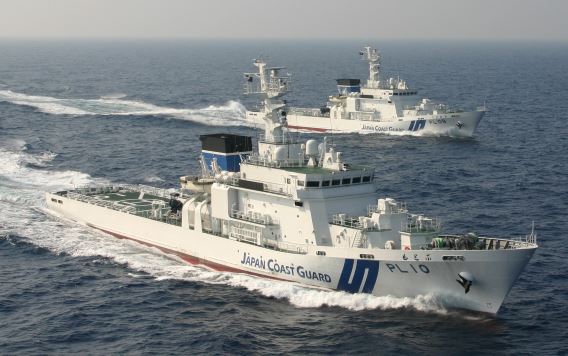
Now we have reports that the Japanese will be building two new much larger, 295 foot (90 meter) cutters for the Philippines. These may be an entirely new design, but it is more likely it will be closely related to a existing Japan Coast Guard design.

Which class seems likely? They will almost certainly be Kunigami class like the ships in the videos below.

Japan Coast Guard Kunigami class large patrol vessel TARAMA (PL-85) 

PL11 RISHIRI, Yard: MHI SHIMONOSEKI SHIPYARD & MACHINERY WORKS
Filmed date: 2016/7/27

I haven’t been able to find a speed for the class, but apparently they are 1,700 tons full load, 96.6 m x 11.5 m (length 317 feet, beam 38 feet). They have a helo deck, but no hangar. They appear to have three boats, two smaller ones on davits, and a larger boat launched by crane. The gun is probably a 20 mm Sea Vulcan Gatling gun.

None of the Philippine CG vessels have a weapon larger than an old 20 mm and almost all have .50 cal. (12.7 mm) M2 crew served machine guns and/or lighter weapons. If they wanted to mount something larger, the Mk38 mod2 (or 3) 25 mm is likely, since it recently entered service with the Philippine Navy.

Perhaps more importantly, the Japan Coast Guard ships also have a water cannon that might come in handy. 

12PL09kunigamiPL10motobu

“Fisheries as a Strategic Maritime Resource”–Midrats

HMNZS Wellington intercepts suspected toothfish poachers

HMNZS Wellington intercepts suspected toothfish poachers

CIMSEC “Midrats” blog radio show has an online interview with a State Department employee I was lucky enough to meet earlier, Scott Cheney-Peters, LCDR, USNR about international fisheries issues. You can find it here. Nominally it is an hour, but it took me a little longer than that because download was not seamless.

The discussion also touches on international networking/cooperation/enforcement, maritime domain awareness, human traffic, drug enforcement, and the ship rider program.

Coast Guard Cuttermen Association (CGCA)/Surface Navy Association (SNA) Agree to Merge

Recently recieved an email from the President of the Cuttermen Association. I am quoting it below.

Past and Present Members of the Coast Guard Cuttermen Association,

We are very excited that the Coast Guard Cuttermen Association (CGCA) and the Surface Navy Association (SNA) have agreed to merge their organizations.  This will bring new members to SNA, and will provide CGCA with the full time administrative support it needs in tracking its membership and in communicating with its members through email and online.  The potential merger was unanimously approved during CGCA’s Annual Meeting in January, and the details were approved by both organizations in June.  For those of you who have not been as deeply involved in the administration of our organization, you may not know that SNA provided significant assistance each year since our inception, and continues to do so.  There is an incredible synergy and purpose between our two organizations and our sea services, which makes this merger common sense.  We are much stronger together.

We will reach out to our membership periodically in coming months to provide more information on this effort and our progress and answer any concerns. CDR Tony Russell has volunteered to spearhead a membership drive with the chapters to encourage renewal of existing members and seek new members within our cuttermen communities.  We are planning a formal signing ceremony in September.

Through the merger agreement the CGCA will now be known as the National Cuttermen’s chapter of the Surface Navy Association, and the Washington Homeport of CGCA will now be the Anacostia chapter of SNA.  The New London Chapter will be become the New London chapter of SNA.  All financial resources of the National Cuttermen’s Association will be transferred to our new chapter within SNA under the signed agreement, and a final financial report will be made to our membership.

I am impressed by the efforts of Captain Tom Crabbs the prior President and his board to build towards this partnership with Surface Naval Association last year, which we have now finalized.  As your new CGCA President I am excited about the benefits of our merger with the Surface Naval Association for both organizations, and the opportunity that this effort presents to renew and grow our organization.  This partnership will resolve some of the significant administrative challenges that our organization has faced since conception.

LT Torrey Jacobsen was elected as our new Vice President.  Rear Admiral (Select) Eric Jones is our newly elected Treasurer.  Brian Perkins (CAPT, USCG ret.) serves in his new capacity as our Secretary, and has been the workhorse behind arranging this new SNA partnership.  CAPT Tom Crabbs continues to serve on our Board as our Past President.

In the next couple of days SNA will be sending an email with procedures on how past members can rejoin and current members can affiliate with a chapter of their choice.

If you have any questions please feel free to write me at Scott.W.Clendenin@uscg.mil.

Thank you for your continued interest and support of our organization.

Captain Scott Clendenin

President

National Cuttermen’s Chapter

This is probably a good thing. It another small step toward recognizing the the Coast Guard’s role in the National Fleet.  The Coast Guard is already well represented at the SNA’s annual symposium. For more information on the Surface Navy Association, their web site is here. Their next symposium, “Distributed Lethality: Enabling Sea Control,” is scheduled for January 10-12, 2017. Not sure the Coast Guard will have much to say about “distributed lethality” unless we start think about something like this.

Mexican Navy OPVs

MexNavyOPV

NavalToday reports the Launch of the sixth and last Offshore Patrol Vessel of the Oaxaca Class, the ARM (Armada Republica Mexicana) Hidalgo, for the Mexican Navy. These ships were designed and built by and for the Mexican Navy, but they would look quite at home painted white with USCG stripes and WMEC hulll numbers. Statistically they are very close to Coast Guard 270s.

Mexican-Navy-launches-final-Oaxaca-class-patrol-vessel-Hidalgo-1-768x491

  • ___________________Oaxaca Class_______________WMEC 270
  • Displacement (full load)  1,680 tons_________________1829 tons
  • Length                    282.2 feet (86.0 m)_______________270 feet (82 m)
  • Beam:                      34.4 feet (10.5 m)_______________38 feet (12 m)
  • Draft                         11.8 feet (3.6 m)________________14.5 feet (4.4 m)
  • Speed:                      20+ knots_____________________19.5 knots

The occasion prompted me to take a look at the Mexican Navy. While the Mexican Navy does have six former USN frigates, most of their missions are closer to what we do in the USCG, and most of their ships are offshore patrol vessels. They have 21 ships (soon to be 22 with Hidalgo) in five classes that look an awful lot like WMECs. These ships have evolved over time, with each class an incremental improvement over the previous ships. Only the oldest of these, the Uribe class ships were built in Spain by Navantia, the remaining 17 were built in Mexican Navy shipyards in Tampico and Salina Cruz with the first of the Mexican built ships being commissioned in 1991.

Photo: Uribe class OPV ARM Jose  Aueta (P-122)

The Uribe class were very similar in size and concept to the 210s, with a similar configuration of the foc’sle and flight deck on the O-1 deck. They did include a hangar, were 10 feet longer (67 m overall), and had more than twice the horsepower at 13,320 allowing a maximum speed of 21 knots. Its main gun was a single 40mm/7

The Holzinger or Aquila class were the first class built in Mexico. They stretched the design 24 feet to 244 feet (74.4 m), provided two main machinery spaces vice one, and retaining the same horsepower, achieved 22 knots. Originally they were to have had a 57mm, but because of stability consideration a twin 40mm/60 was used instead.

Holzinger-class patrol vessel

Sierra Class OPVs of the Mexican Navy


The Sierra, Mendz, or Holzinger 2000 class retained essentially the same dimensions as the preceding class, but introduced a number changes. The hull aft was extended upward to create a flush main deck at what had been the O-1 deck. A stern ramp was incorporated in the transom for launching a “chase boat.” The superstructure was given a more “stealthy” form with the RHIBs placed in enclosed pockets.  A Vosper fin stabilization system was also provided, and a 57 mm main gun was included. A max speed of 18 knots is claimed, but it is likely to be more than 22.

ARM_Durango

ARM Durango, Mexican Navy, 8 October 2008, photo by Apodemia.

The four ships of the Durango class were originally intended as units of the preceding Sierra class but the design was modified and is now considered a separate class although statistically they appear little different.

The Oaxaca are a bit larger. They seem to have decided that the “stealthy” superstructure is not worth doing. The 57 mm gun of the preceding class has been replaced by a 76 mm gun, but it is not the newest type so this may have been a case of the guns being available on favorable terms rather than a reflection of dissatisfaction with the 57 mm. There is also a auto-cannon aft (variously reported as 25 or 30 mm) and two remote weapon stations with .50 cal. Like US WMECs the range is substantial at 8,500 nautical miles. They have a crew of 77 and accommodations for 39 special forces and/or marines.

Given that the USCG is now responsible for maintenance of all US 76 mm guns and also operates the 57mm, the Mexican Navy’s choice of weapons suggests this may be an area of potential cooperation.

Auk class minesweeper

Auk class minesweeper now used as an Offshore Patrol Vessel by the Mexican Navy

Unfortunately not all of Mexico’s OPVs are relatively modern. They still have ten Auk  class 1,250 ton (fl), 221 foot, WWII vintage, steel hulled minesweepers that continue to function as patrol vessels. The ships are referred to as the Valle class in Mexican service. They are the same class as USCGC Tanager (WTR-885) that served as a CG Reserve training ship 1964 to 1972. They will certainly need to be replaced soon. Obviously their building program is not complete.

I find it interesting that Mexico with an EEZ of 3,144,295 km2,, with less than a third of the EEZ of the US (11,351,000 km2) has a fleet of OPVs that approaches that of the USCG.

Sea Glider Unmanned Surface Vehicles for MDA

Liquid_Robotics_Wave_Glider

There is an interesting bit of technology here, with implications for Maritime Domain Awareness.

The Wave Glider began its mission on November 27, 2015 in the South Pacific, where it helped the UK FCO protect the Pitcairn Island Marine Sanctuary against illegal fishing activities. After successfully completing its mission, the Wave Glider was remotely piloted more than 2,808 nautical miles (5200 km) — through strong equatorial currents, doldrums, and challenging sea states — back to port in Hawaii. Along the way, it collected 9,516 measurements of meteorological, oceanographic, and marine biodiversity data over expanses rarely traveled. This data was recently used to support the worldwide Fishackathon, a program sponsored by the U.S. Department of State to promote innovative ways to stop illegal and unregulated fishing. Altogether, the Wave Glider was continuously at sea, untouched, for 213 days while traveling a total of 7,205 nautical miles (13,344 km).

There is more about the Pitcairn Island mission here, but its potential is not limited to fisheries. Check out the segment of the video below beginning at 4m24s to 5m20s.

Thanks to Mike for bringing this to my attention. 

Are Cruise Ships Prepared for ISIS?–Jim Walker

It has been over 30 years since the seizure of the Achille Lauro by Palestinian Terrorists. Are cruise ships better protected? You would like to think so, and it is certainly possible steps have been taken that are not obvious, but there are doubts. CuiseLawNews discusses the question.

This in particular caught my eye.

“Just last month, the Miami-Dade County Police Department said: ‘We ended up concluding that now they’re targeting the cruise industry. We’re the cruise capital of the world. It’s the same possibility of having two planes crash into the World Trade Center.'”

From an earlier post that discussed the implications of various threats on the choice of homeports for major cutters, “Ruminating on Homeports While Playing the Red Cell,” the Top Cruise Ship Ports are:

  1. Miami, FL
  2. Fort Lauderdale, FL
  3. Port Canaveral, FL
  4. New York, NY
  5. San Juan, PR
  6. Galveston, TX
  7. Tampa, FL
  8. Seattle, WA
  9. Long Beach, CA
  10. New Orleans, LA
  11. Los Angeles, CA
  12. Baltimore, MD
  13. Cape Liberty, NJ
  14. Jacksonville, FL
  15. Charleston, SC

UAV for WPC Sized Vessels

Photo: Information systems technicians conduct pre-flight checks on a Puma unmanned aerial vehicle (UAV) aboard the coastal patrol ship USS Monsoon (PC 4). Photo: US Navy

NavalToday reports, the Navy has been testing a UAV, RQ-20A Puma AE (all environment), on the USS Monsoon, a patrol craft of the same size as the Coast Guard’s Webber class WPCs.

“Weighing approximately 14 pounds, the small unmanned aerial vehicle (UAV) can provide more than three hours of flight time with a range of 15 kilometers and operating altitude of 500 feet. Equipped with an electro-optical and an infrared camera, the Puma can be manually operated or by GPS.”

“… Puma is most commonly employed as a precursor search and overwatch platform to support her VBSS team…”


Israel Sees “Narco-Subs” as Threat

New Type Narco Sub--a "Snot Boat?"

DefenseNews is reporting the Israeli Navy is taking seriously the potential use of the same types of smuggling craft the Coast Guard has been dealing with to “transport more than just narcotics, [but] the movement of cash, weapons, violent extremists or, at the darkest of the spectrum, weapons of mass destruction.”

Among the defensive measures they are taking is the use of unmanned surface vessels.

Navy Adopts Willard Design for 11 Meter RHIB

WillardMarine11meter

MarineLog is reporting the Navy has licensed a Willard Marine design to serve as their standard 11 meter RHIB.

These are similar in size to the Long Range Interceptor (LRI-II) boat that deploy from the stern ramp on the Bertholf Class NSCs, but they lack the weather protection of the Coast Guard boats.

160730-N-KM939-031 PACIFIC OCEAN (July 30, 2016) - Coast Guardsmen, assigned to U.S. Coast Guard cutter Stratton (WMSL 752), make their way to the guided-missile destroyer USS Stockdale (DDG 106) for a rescue and assistance exercise during Rim of the Pacific 2016. Twenty-six nations, 40 ships and submarines, more than 200 aircraft and 25,000 personnel are participating in RIMPAC from June 30 to Aug. 4, in and around the Hawaiian Islands and Southern California. The world's largest international maritime exercise, RIMPAC provides a unique training opportunity that helps participants foster and sustain the cooperative relationships that are critical to ensuring the safety of sea lanes and security on the world's oceans. RIMPAC 2016 is the 25th exercise in the series that began in 1971. (U.S. Navy photo by Mass Communication Specialist 3rd Class David A. Cox)

160730-N-KM939-031 PACIFIC OCEAN (July 30, 2016) – Coast Guardsmen, assigned to U.S. Coast Guard cutter Stratton (WMSL 752), make their way to the guided-missile destroyer USS Stockdale (DDG 106) for a rescue and assistance exercise during Rim of the Pacific 2016. Twenty-six nations, 40 ships and submarines, more than 200 aircraft and 25,000 personnel are participating in RIMPAC from June 30 to Aug. 4, in and around the Hawaiian Islands and Southern California. The world’s largest international maritime exercise, RIMPAC provides a unique training opportunity that helps participants foster and sustain the cooperative relationships that are critical to ensuring the safety of sea lanes and security on the world’s oceans. RIMPAC 2016 is the 25th exercise in the series that began in 1971. (U.S. Navy photo by Mass Communication Specialist 3rd Class David A. Cox)


China to Build Nuclear Icebreaker, Ready in 2018

512px-Antarctica_CIA_svg

Maritime Executive is reporting China will build a nuclear powered Polar Icebreaker.

“The vessel will feature higher ice capabilities, better research capabilities and be more comfortable and environmentally friendly than Xue Long. It is expected to be 122.5 meters (400 feet) long and will be able to break ice of up to 1.5 meters (five feet) thick at a speed of around two knots. It will be able to operate bow or stern first using two ABB Azipod units with combined power of 15MW.”

This is what the Coast Guard would call at best a medium icebreaker. 15MW or about 20,000 HP is far less than even the Healy’s 22.4 MW, but while we don’t expect a new icebreaker for a decade, they expect theirs will be finished in two years.