NavyRecognition reports the commissioning of a new 4,860 ton medium icebreaker that is apparently intended for “domestic icebreaking” with the North Sea Fleet.
China’s New Icebreaker
5

NavyRecognition reports the commissioning of a new 4,860 ton medium icebreaker that is apparently intended for “domestic icebreaking” with the North Sea Fleet.
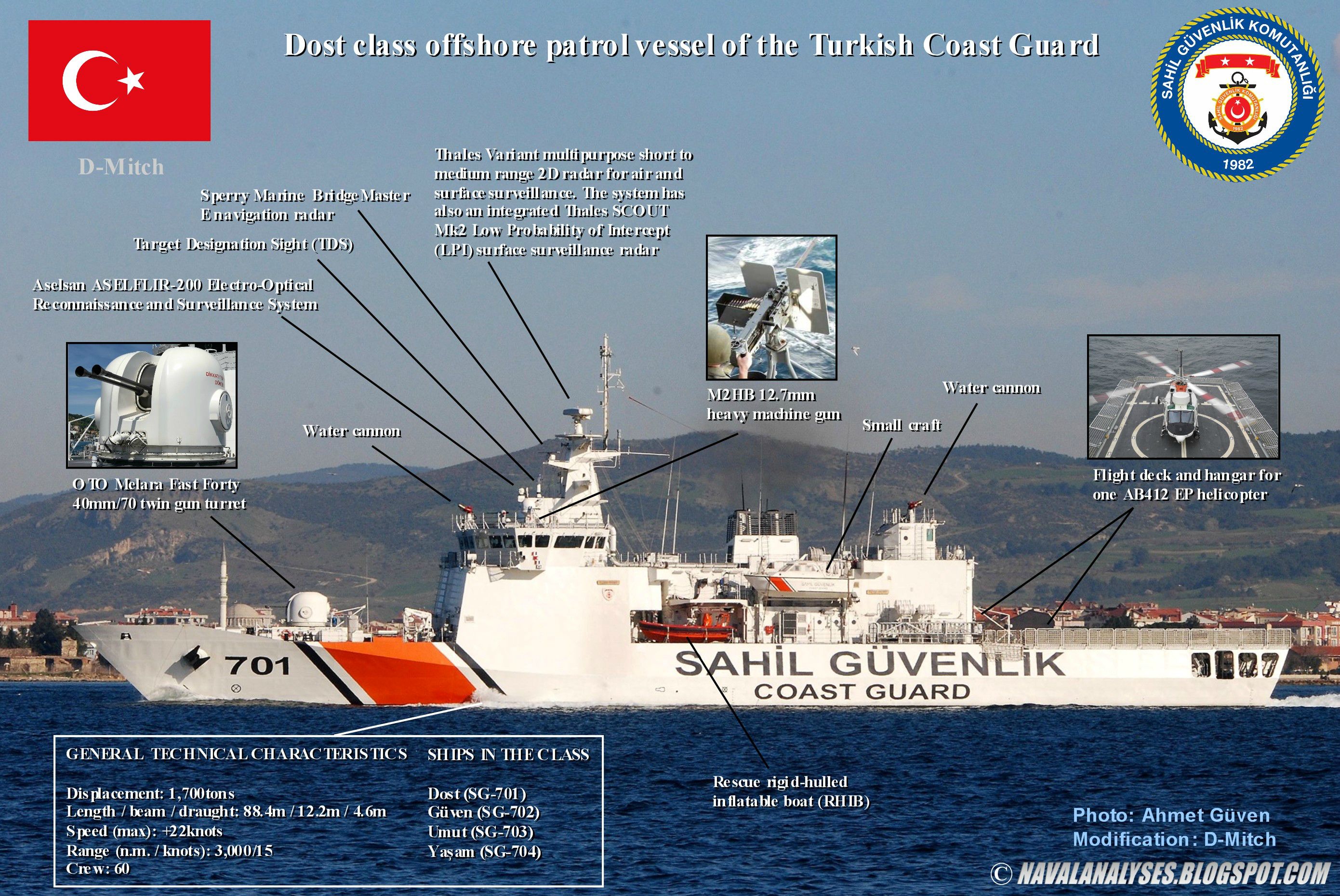
Photo: NavalAnalyses.Blogspot.Com. Click on the photo to enlarge
The German Navy Blog “Marine Forum,”
“5 January, Turkey, Acting on a tip-off / intelligence input, Turkish Coast Guard ships „Yasam“ and „Umut“ intercept Bolivian-flagged freighter „Joudi“ in international waters off Tobruk (Libya) … after receiving Bolivian government permission to board and search ship, boarding team finds 13 tonnes of cannabis.
“(rmks: first such action distant from Turkish waters; made feasible with induction of large DOST class patrol ships–emphasis applied–Chuck)”
So I looked up the class. The four ships of this class are the largest vessels in the Turkish Coast Guard. The next largest are only 210 tons. They are based on the Italian Sirio Class patrol vessels which operate under the Italian Navy but were paid for by the Transport and Navigation Ministry. I suspect the Sirio Class (appropriately modified) may have been the basis of the Marinette Marine’s OPC proposal.
Specs for the Turkish ships from my Combat Fleets of the World, 16th ed. with my translation to English units are:
The Gun: The Beda Bofors twin 40mm/70 gun is not a bad choice. It has been around for a while and it has improved over time. Current models are rated at 450 rounds per minute per barrel for 900 rounds per minute for the twin mount. That is faster than a .50 cal. M2 machine gun. The Italian Navy used this as a CIWS before switching to the improved 120 round per minute 76mm. It also has adequate range, 13,675 yards (12,500 m). This is less range than either a 57mm or 76mm, but adequate for most Coast Guard missions. There are at least four different projectiles available. The standard projectiles are about two pounds. There is also a high velocity solid tungsten alloy rod armour-piercing fin-stabilized discarding sabot (APFSDS) projectile that would probably be good for destroying fairly large diesel engines. .
If I read this correctly, the video is 380 rounds in 43 seconds.
Also from “Combat Fleets” this on the Turkish Coast Guard.
“Personnel: Approx. 2,200 total including 800 regulars and 1,400 conscripts, plus 1,050 on loan from the navy.
“Aviation: Coast Guard air assets include one Maule MX-7 light fixed-wing and three CASA CN-235 maritime patrol aircraft (the basic airframe for the HC-144, Chuck). Three Austa-Bell AB-206B Helicopters and thirteen search and rescue configured Agusta-Bell 412 helicopters. The aircraft are pained white with an orange diagonal stripe.”
http://issuu.com/faircountmedia/docs/uscg15#embed
DefenseMediaNetwork has published an online version of the new “Coast Guard Outlook.” I have not read it all, there is a lot there, 164 pages. Fortunately, it allowed me to embed it above.
It includes an interview with the Commandant, a story about the 100 year history of Coast Guard Aviation, one about the Coast Guard in Vietnam, and another about the Offshore Patrol Cutter, along with several others.
When I first brought it up, the print was too small to read comfortably on my laptop, but you have two ways to get a larger view. Clicking on the page twice enlarges it (maybe too large). There is also a slider at the lower left that changes the size of the page you are viewing. Unfortunately neither adjustment is carried over when you go to the next page.
Thanks to Lee for bringing this to my attention.
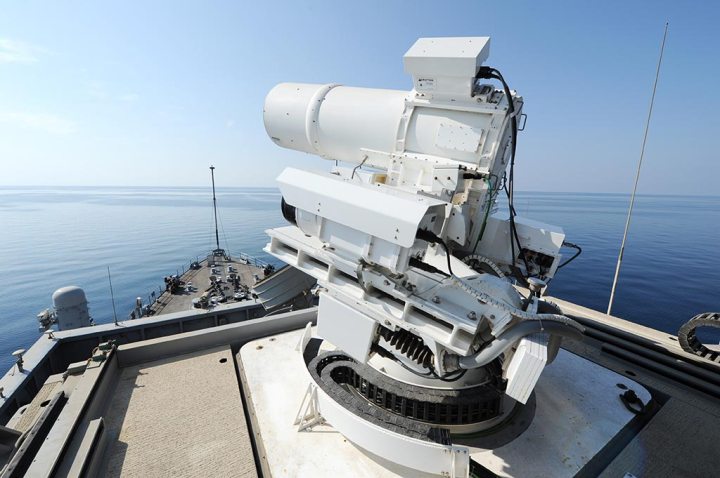
The Afloat Forward Staging Base (Interim) USS Ponce (ASB(I) 15) conducts an operational demonstration of the Office of Naval Research (ONR)-sponsored Laser Weapon System (LaWS) while deployed to the Arabian Gulf. U.S. Navy photo by John F. Williams
DefenseMediaNetwork has an interesting article about progress on weaponizing Lasers for use afloat. Some points that might be of particular interest to the Coast Guard were:
The Laser can be a less than lethal deterrent,.
“A laser offers scalable effects, from deter-and-dissuade to degrade or destroy. LaWS can address multiple threats using a range of escalating options, from non-lethal measures such as optical “dazzling” and disabling, up to lethal destruction of small attack boats and UAVs.”
The accompanying optics have other uses,
“The systems provide better high-resolution imagery than what existing shipboard EO/IR sensors provide now. With upgraded optics, a system like CLWS can bring targets as close as 1 kilometer or as far as 37 kilometers into clear focus. ‘The system enhances intelligence missions without engaging targets,’ …”
Now that it is over, looking back on 2015, I would like to thank the readers and contributors for making the effort very rewarding for me. This is a remarkably civil and knowledgeable group. Nice to see that all experience and knowledge levels are respected. Top five contributors by number of comments were x, Leesea, Tups, James WF, and Nicky. I got a number of suggestions by e-mail too.
The previous year, 2014, was a remarkably good year for the blog. The award of the preliminary Offshore Patrol Cutter contracts prompted a lot of interest, but still the blog enjoyed some growth. The blog had 213,556 views, 5.4% more last year.
In 2015, there were 277 new posts, growing the total archive of this blog to 1,452 posts. Top posts, by number of views were:
As you can see, nine out of ten of these were published in previous years. I hope this is not a reflection of declining quality, but it is gratifying to know that these posts are still of continuing interest.
I am told by WordPress that readers came from 169 different countries. I suspect some of these were just spammers. Still, 38 countries were reported to have at least 200 views. The top five, after the US, were the UK, Canada, the Philippines, Netherlands, and Australia.
I would also like to particularly thank Thinkdefence, the Center for International Maritime Security (CIMSEC) “Next War Blog”, Eaglespeak, for linking to this website and bringing more readers here.
Thanks for the interest.
Coast Guard Compass has once again held a competition for Coast Guard video of the year and the results are in. All ten are worth a look.
With New Years “Best of…” Lists are perhaps inevitable. This one, from NavyRecognition, while you might argue with the selection is at least interesting.
Perhaps most interesting for us are #6 BAE Systems Unveils the ORKA One Shot One Kill Round for 57mm Gun at Sea-Air-Space 20 and #3 Design of Future TKMS Built Saar 6 MEKO A100 Corvettes for Israeli Navy Unveiled.
#1 At NAVDEX 2015 Navantia unveiled its F-538 Frigate Design for the Peruvian Navy is interesting, as a cutter sized warship, but it is still only a proposal.
 Chuck Hill's CG Blog