“Enhancing the Royal Navy’s batch II OPVs” –Save the Royal Navy

The Royal Navy is looking at how they might increase the lethality of their new River Class Batch II Offshore Patrol Vessels. Save the Royal Navy looks at how they might be upgraded. “Save the Royal Navy” describes itself as “an online campaign but not an organisation as such,” so not an official voice of the Royal Navy.

HMS_Tamar4thRiverClassBatch2

Royal Navy’s new patrol vessel HMS Tamar is ready for action and will be based in Portsmouth. (Picture source: Royal Navy)

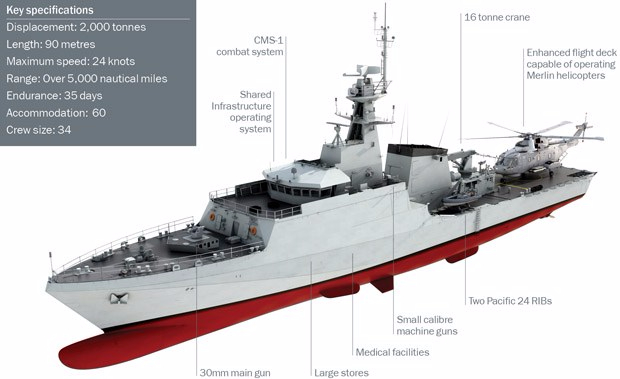
These are effectively the UK’s WMECs. They do fisheries, SAR, and drug enforcement, but they are looking to use them for a bit more. They have the three River class Batch I OPVs to do fisheries around the home turf, so they plan to use most of these in the overseas territories or providing presence in distant theaters of operation. One is currently deployed to the South Atlantic operating out of the Falklands and a second is tasked with operations upholding UK interests in the Caribbean, Gulf of Mexico, and Western North Atlantic. It is likely one will go to Gibraltar and another to the SW Asia/Persian Gulf/Indian Ocean Area.

Compared to our own WMECs, the River Class Batch IIs are bigger and faster than the Bear class.

  • 2000 tons vs 1800 tons
  • 297′ (90.5 meters) vs 270′
  • 24 knots vs 19.5 knots

But they are equipped more like a 210. They have no helicopter hangar and only a single 30mm gun in an optionally manned remote weapon station while the Bear class has a 76mm gun and radar fire control system and they have nothing like the Bear class’s SLQ-32 and decoy systems.

“Save the Royal Navy” considers upgrade packages that were labeled, in order of increasing complexity, “OPV Plus”, “OPV Max”, and “Corvette”.

“OPV Plus” includes a container based rotary wing UAS like the Schiebel Camcopter S100, two 30mm guns, a BAE Bofors 40mm/70 Mk4 with a possible fire control upgrades, and Long Range Acoustic Device (LRAD).

“OPV Max” includes a collapsible hanger for an Agusta/Westland AW-159 Wildcat helicopter, two 30mm guns, added Martlet LMM (Light Multirole Missile) to the 30mm mounts, and a BAE Bofors 57mm Mk110 and associated fire control system, but for some reason lost the LRAD.

“Corvette” traded the hangar for Anti-Ship Cruise Missiles (ASCM) and exchanged a RHIB for an armed Unmanned Surface Vessel. In addition to two 30mm guns with LMM Martlet missiles, and a BAE Bofors 57mm Mk110 and associated fire control system, it also adds an enlarged operations room (CIC), decoy launchers, and a multirole Artisan 3D radar.
Its easy to understand why upgrades might be in order when you consider some of the duties that these ships might be called upon to perform.
These ships will often be far from any backup. They might be escorting Russian warships through UK EEZ; facing off against Argentine OPVs in the South Atlantic or Spanish OPVs in Gibraltar’s EEZ. And of course operating in areas where the Islamic Republic Revolutionary Guard Corps’s Navy may be encountered is likely to raise your pulse rate. Not that shooting is expected, but it is a lot easier to stand your ground or perhaps intimidate the other guy if you have the weapons to back up your position.
I have always thought that the requirement to be able to land and refuel the very large Merlin helicopter (max gross weight 14,600 kg or 32,187 lb), that seemed to preclude a hangar was a poor choice. Having a helicopter aboard at all times, particularly an armed aircraft, could help the ship with both peacetime and wartime missions.
The 30mm gun is a close relative of the 25mm found on USCG cutters, but we know that it is more effective. Having more than one seems a good idea. If a helicopter hangar is added, they could have one on the roof of the hangar that could bear directly aft. That means they could have as many as four, one forward, one aft, and one on each bridge wing. They could put up to three guns on a target.
The Martlet LMM probably should be added to whatever 30 mm guns are mounted. It could make these ships much more lethal inside 5,000 yards.
I like the 40mm70 MK4. It could function to some degree as a counter to ASCMs, but I doubt the improvement is sufficient to justify replacing a 30mm/Martlet LMM combination considering it would require introducing a second gun, second ammunition, a fire control system, and additional training.  Being able to bear three 30mm and 15 Martlet LMM on a target would be very effective against a single target if within range. The combination could be useful against swarming boats as well. In the Straits of Hormuz, I would still worry about IRGC torpedo and missile boats that could engage from longer range, but the armed Wildcat helicopter with Martlet LMM should be effective against them.
The case for the 57mm is much more convincing than that for the 40mm, given the smart projectiles that are being developed for it.
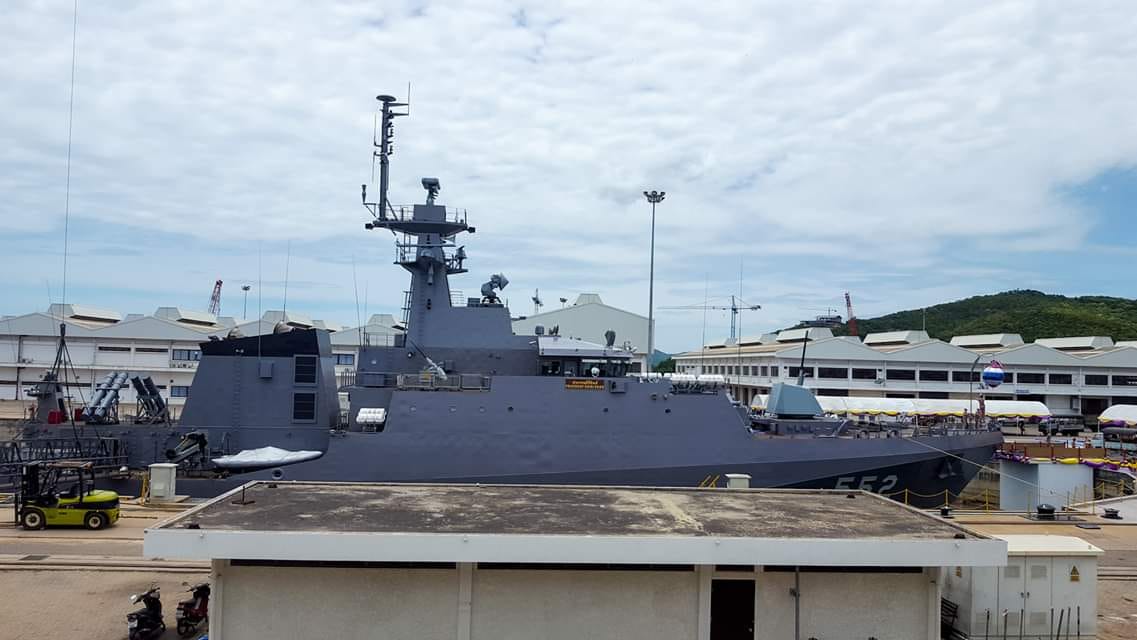
The author seems unenthusiastic about the corvette option, and since adding anti-ship cruise missiles would likely mean no helo hangar, and an armed USV replacing an RHIB needed for peacetime duties, I can understand his reservations. On the other hand, if they fail to add a hangar, being prepared to add ASCMs, quickly might be wise. We have already seen this done to a Thai OPV built to an earlier version of this design.
There is some indication that the Thais will attempt to sell their version of this design to the Philippines.

Royal Thai Navy’s second offshore patrol vessel based on the River class, HTMS Prachuap Khiri Khan (OPV 552) constructed by Bangkok Dock Ltd and poised for induction into service. Note RGM-84 Harpoon anti-ship cruise missiles fitted. Photo: http://thaidefense-news.blogspot.com/2019/07/blog-post_31.html
Navy Ships in Fourth Fleet

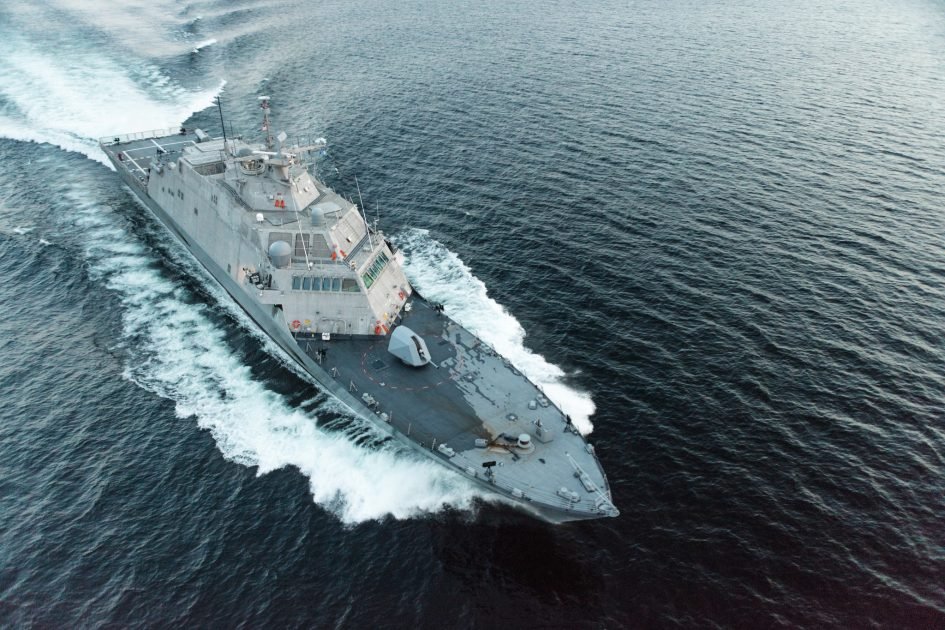
Littoral combat ship Little Rock (LCS 9) is underway during a high-speed run in Lake Michigan during acceptance trials. Lockheed Martin Photo

For the last several years, it has seemed that the Navy had all but abandoned the drug interdiction effort, and actual US Navy ships in the Fourth Fleet Area of Operations (Latin America) were very rare. That seems to be changing.

USS Detroit (LCS-7) deployed on Oct. 31, 2019 and returned to Mayport for a crew swap on Feb. 2, 2020. She had operated with a U.S. Coast Guard law enforcement detachment and an aviation detachment including a MH-60S Seahawk helicopter and two MQ-8B Fire Scout Vertical Takeoff Unmanned Vehicles. She is expected to redeploy to Fourth Fleet after the crew swap and a short maintenance period.

USS Little Rock (LCS-9) departed Mayport, FL, on Feb. 6, for operations with Fourth Fleet. Sounds like Little Rock, unlike Detroit, may try to do a crew swap away from homeport.

“Little Rock will also demonstrate its operational capabilities and allow the Navy to evaluate crew rotation and maintenance plans. While in the Caribbean, Central and South American regions, the ship will rotate deployments of two crews, Blue and Gold, who will rotate aboard every four to five months, maintaining consistency and allowing a continuous presence in the region.”

As a side note, the USS Little Rock is equipped with Laser weapon. Military and naval officers from friendly nations ought to find that interesting.

SOUTHCOM Commander Adm. Craig Faller is hoping to do more than just drug enforcement. He hopes to counter Chinese and Russian influence in Latin America. He also plans to exercise small scale Marine operations with these ships, in cooperation with the militaries of friendly nations.

There are some other interesting developments.

“…SOUTHCOM is in line for an Expeditionary Staging Base, the converted commercial tanker design that acts as a lily pad for mine-counter measures and special operations forces in U.S. Central Command. The command also is currently operating a Spearhead-class Expeditionary Fast Transport (EPF), which it is also using for presence, partner-building and counter-trafficking work. SOUTHCOM also claimed successes with the deployment of the Military Sealift Command ship M/V Kellie Chouest. The support ship deployed with a military detachment aboard and an unmanned aerial vehicle to provide additional capacity, to supplement the Coast Guard’s National Security Cutters for the interdiction mission….SOUTHCOM is pitching a plan to turn a Spearhead EPF into an LCS tender to keep the ships on station longer rather than going back to shore regularly for maintenance.”

Japan Coast Guard Grows and Grows

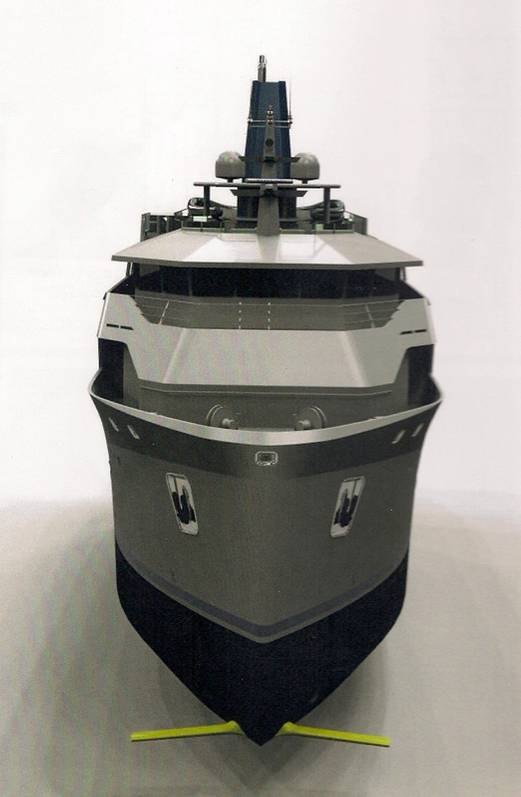
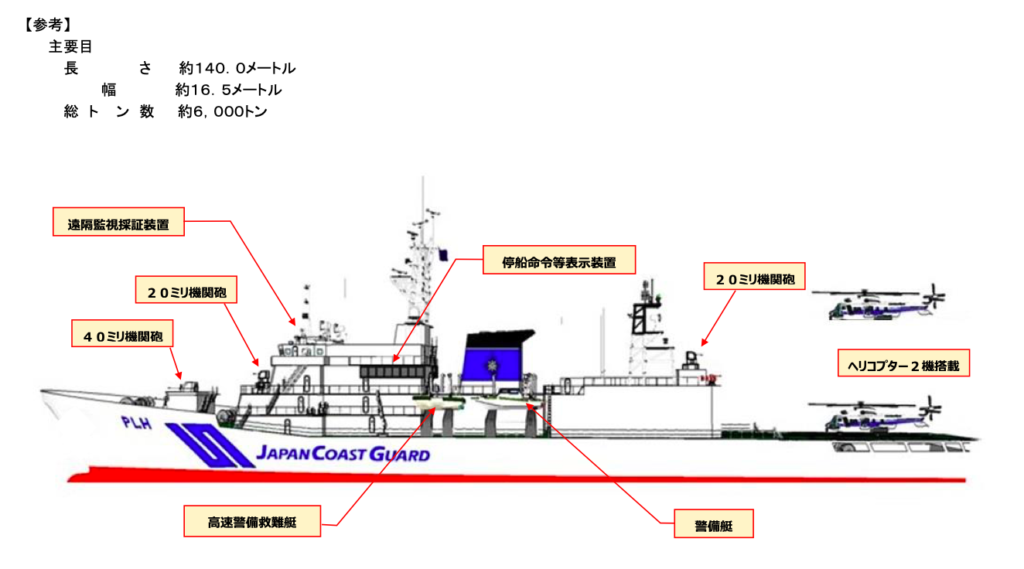
Technical drawing of the Mizuho-class patrol vessel (Credit : Japan Coast Guard)

Naval News reports the delivery of a second new very large cutter to the Japan Coast Guard.

We talked about these ships earlier. “Japan builds more XXLarge CG Cutters.” The odd thing about these ships is that they are essentially repeats of the Shikishima-class (first ship, Shikishima (PLH-31) commissioned 1992, second ship, Akitsushima  (PLH-32) commissioned 2013). The Shikishima class were in turn near repeats of the Mizuho class (first ship, Mizuho, now renamed Fusō (PLH-21), commissioned 1986, second, Yashima (PLH-22) commissioned 1988). The Reimei patrol vessel (PLH-33), referred to in the report is apparently the third member of the Shikishima class and was launched in March 2019. The two new ships are a new Mizuho (PLH-41) and Shunkō (PLH-42). Looks like they may have seven of these very large cutter, unless the new ships replace PLH-21 and 22. That is a good possibility as the Japanese replace their cutters much more rapidly than the USCG. When I last checked, they had not cutters more than 35 years old. 

Don’t let the reported displacement of 6,000 tons or 6,500 tons fool you. Asians tend to report light or empty displacement. Full load displacement is 9,300 tons, more than twice as large as the Bertholf class National Security Cutters.

There is some reported differences between the classes. The original Mizuhos were reported to be 130 meters in length, the Shikishimas, 150 meters, the new Mizuhos 140 meters. There are also differences in how they are armed. The newest ships introduce the BAE Bofors 40mm/70 Mk4.

The most interesting paragraph in the report was in regard to the rapid growth of the Japan Coast Guard.

In 2012, the JCG had 51 patrol vessels displacing more than 1,000 tons. The service has now 63 large vessels, and the goal is to operate 12 more ships by the end of FY 2023 to deal with new threats.

By comparison, the US Coast Guard, which patrols an EEZ more than two and a half times as large has only 39 patrol cutters larger than 1,000 tons and we plan to have only 36 (11 NSCs and 25 OPCs).

“Will the Golden Ray Salvage Threaten OPA 90” –gCaptain

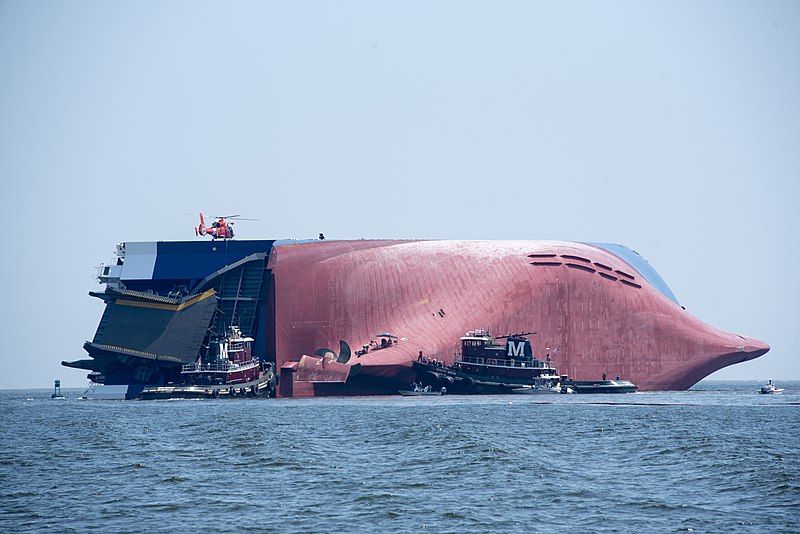
A Coast Guard Air Station Savannah MH-65 Dolphin helicopter rests on the side of the Golden Ray, a 656-foot vehicle carrier, to drop off supplies for Coast Guard crews and port partners who attempt to locate and rescue the remaining four crewmembers aboard the Golden Ray, Sept. 9, 2019, in St. Simons Sound, near Brunswick, Georgia. A Coast Guard Air Station Savannah MH-65 Dolphin helicopter aircrew, Station Brunswick boat crews and other port partners rescued 20 people the morning of Sept. 8, after it was reported the vessel was disabled and listing. (U.S. Coast Guard photo by Petty Officer 3rd Class Ryan Dickinson)

gCaptain has a significant editorial that questions the Coast Guard’s plan for the grounded car carrier Golden Ray. This is not in my wheelhouse, but sounds like they have valid reservations about the proposed method of salvage and its possible adverse environmental impact. (OPA-90 is the Oil Pollution Act of 1990.)

“This is OPA 90’s biggest test ever. The question is, will the United States Coast Guard allow OPA-90 to be manipulated by responsible parties? Will they rewind the clock to the days before Exxon Valdez when polluters managed their own environmental disaster recovery efforts?”

Thanks to Lee for bringing this to my attention.

For the Warship Geeks in the Group–China’s Type 055

Image Analysis of photo of Chinese shipyard showing multiple warships at various stages of … [+]H I Sutton, with permission from @Loongnaval

The US Naval War College Digital Commons has made available an evaluation of China’s new 12,000 ton cruiser, the type 055, and its place in the PLAN based primarily on Chinese sources. It looks to be balanced and talks about both the ships and the systems on board.

They are building a lot of these.


“Coast Guard releases request for proposal for Polar Star service life extension program” –CG-9, Time to change Homeport?

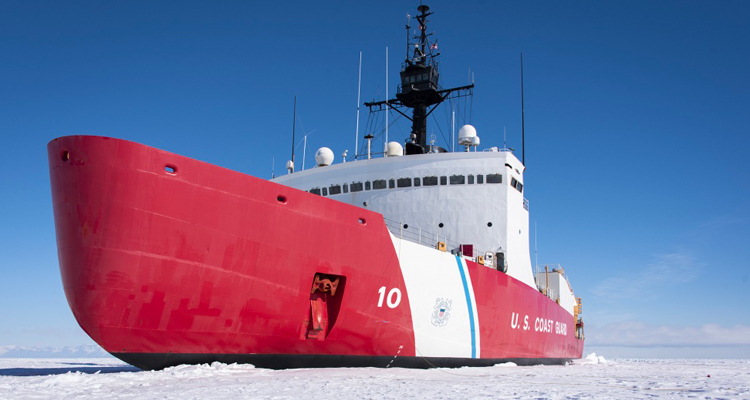
The Acquisitions Directorate (CG-9) has issued a request for proposal for a Service Life Extension Program (SLEP) for the Coast Guard’s only heavy icebreaker, USCGC Polar Star. This is expected to be done over a five year period.

There is a good chance that the winning shipyard will not be in the Seattle area, where the ship is currently homeported. The last few years, Polar Star has undergone extended annual availabilities in a shipyard in Vallejo, California. This has to have been a hardship on the crew and their families. Once the contract is awarded, we will be fairly sure where the ships will have her availabilities for the next five years. If the winner is not in the Seattle area, I hope the Coast Guard will consider changing the Polar Star’s homeport so that the families can be near the shipyard where the renovation will take place.

I have duplicated the CG-9 announcement below

ISVS RFP

Coast Guard Cutter Polar Star travels through the ice Jan. 2, 2020, approximately 20 miles north of McMurdo Station, Antarctica. The 399-foot icebreaker is the only ship in U.S. service capable of clearing a path through the Antarctic ice to escort one tanker and two cargo vessels to McMurdo Station during Operation Deep Freeze. U.S. Coast Guard photo by Senior Chief Petty Officer NyxoLyno Cangemi.


The Coast Guard released a request for proposal (RFP) Jan. 31 to support the Coast Guard Cutter Polar Star service life extension program (SLEP) as part of the In-Service Vessel Sustainment program (ISVS). When completed, the SLEP effort will recapitalize a number of major systems and extend the service life of the cutter until the second Polar Security Cutter (PSC) is operational. This future contract will include SLEP work items and recurring maintenance in a five-year phased production schedule between 2021 and 2025. The future contract will also include an award fee with potential to be earned for making the ship available ahead of schedule.

The RFP is available here. The deadline to submit responses is March 18 at 2:00 p.m. EDT.

The 399-foot cutter – commissioned in 1976 – is the Coast Guard’s only active heavy icebreaker. It supports nine of the 11 Coast Guard statutory missions. Each winter, the cutter travels to McMurdo Station in Antarctica as part of Operation Deep Freeze, which supports the National Science Foundation-managed U.S. Antarctic Program.

When the cutter is eventually decommissioned, its duties will be assumed by the planned PSCs. The Coast Guard and the Navy are working together for the acquisition, through an integrated program office. Delivery of the first PSC is planned for 2024.

For more information: In-Service Vessel Sustainment program page

Second Great Lakes Icebreaker?

Launch of USCGC Mackinaw (WLBB-30) on April 2, 2005. Photo by Peter J. Markham.

US Senators from Great Lakes states are again pushing for second icebreaker on the Great Lakes at least as capable as USCGC Mackinaw. A letter jointly signed by U.S. Senators Tammy Baldwin (D-WI), Gary Peters (D-MI), Debbie Stabenow (D-MI), Rob Portman (R-OH) Chuck Schumer (D-NY), Amy Klobuchar (D-MN), Tina Smith (D-MN), Dick Durbin (D-IL), Kirsten Gillibrand (D-NY), Sherrod Brown (D-OH), and Todd Young (R-IN) has been mailed to the Commandant and the acting Secretary of Department of Homeland Security.

Full text of the letter can be found below:

Dear Director Mulvaney, Acting Secretary Wolf, and Admiral Schultz;

As the Administration works to finalize its FY 2021 budget request to Congress, we urge you to include adequate funding to support the Coast Guard’s acquisition of a Great Lakes icebreaker.

Icebreaking capacity supports the movement through the Great Lakes of more than 90 million tons of cargo annually. According to a study commissioned by the Lake Carriers’ Association, businesses that depend upon the Great Lakes maritime industry lost over $1 billion in revenues because of delays caused by inadequate icebreaking during the 2018-2019 ice-season.  Vessel delays also resulted in the loss of 5,421 jobs dependent upon the efficient delivery of cargo throughout the Great Lakes Region.

The Coast Guard is required by law to maintain a heavy icebreaking capability on the Great Lakes to keep our region’s ports and harbors open and facilitate our nation’s free flow of commerce. However, the current maintenance condition of the existing icebreaking fleet has resulted in 182 lost operating days last winter primarily due to engine failures. To this end, Congress has authorized the Coast Guard to acquire a new Great Lakes icebreaker at least as capable as the heavy icebreaker the MACKINAW (WLBB-30), and has directed and provided funding for the Coast Guard to establish a major program acquisition office to support the design and procurement of a vessel.

We respectfully request adequate funding for the acquisition of a Great Lakes icebreaker in your FY 2021 budget request.  Thank you, in advance, for your consideration of our views.

Their concern is easy to understand. There is no redundancy for the USCGC Mackinaw. If she has a catastrophic failure, it could be disastrous for the economics of the Lakes area. Even with her, shortfalls in capability have cost area a great deal.

We have discussed this before.

The Lake Carriers’ Association claims economic loses cost the Federal Government enough in taxes to pay for a new icebreaker in as little as two years.

Thanks to Fred for bringing this to my attention. 

“All American Marine awarded Phase I deal for MLB SLEP program” –Marine Log

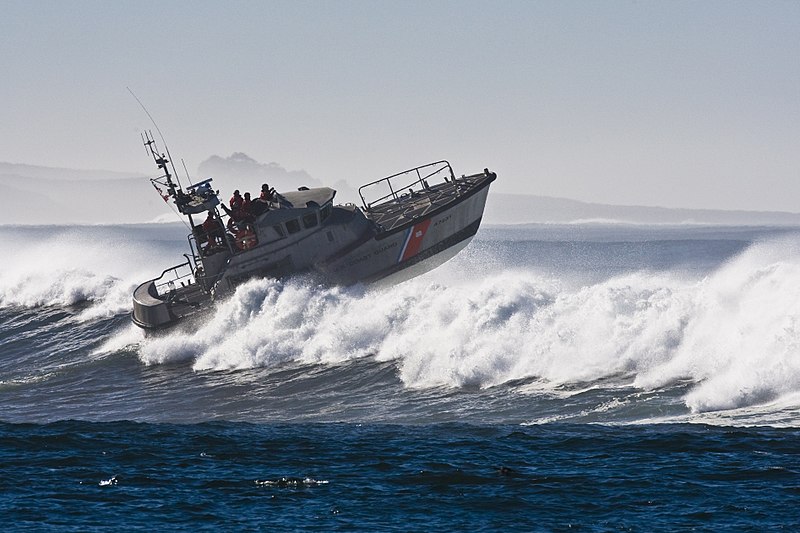
47-Foot Motor Life Boat (MLB) 47231 from Station Morrow Bay, 4 Dec 2007. Photo by Mike Baird

Marine Log reports that,

Birdon America, Inc. has named All American Marine, Inc. (AAM), Bellingham, Wash., as the West Coast shipyard for Phase I of the U.S. Coast Guard 47-foot motor lifeboat (MLB) Service Life Extension Program (SLEP).

Last August, Birdon America was awarded the prime contract to perform SLEO work on 107 of the 117 MLBs in the USCG fleet.

Regarding the scope of work.

Birdon America developed and proposed a solution to meet the Coast Guard’s SLEP requirements and included system replacements, performance enhancements in the areas of noise, seating, and reliability and addressed structural issues.

The main work will be on systems experiencing technical obsolescence: the main propulsion, electrical, steering, towing and navigation systems, as well as replacement of areas of the hull and structure that have demonstrated high failure rates. Additionally, efforts to enhance human system integration will be made where practical to do so.