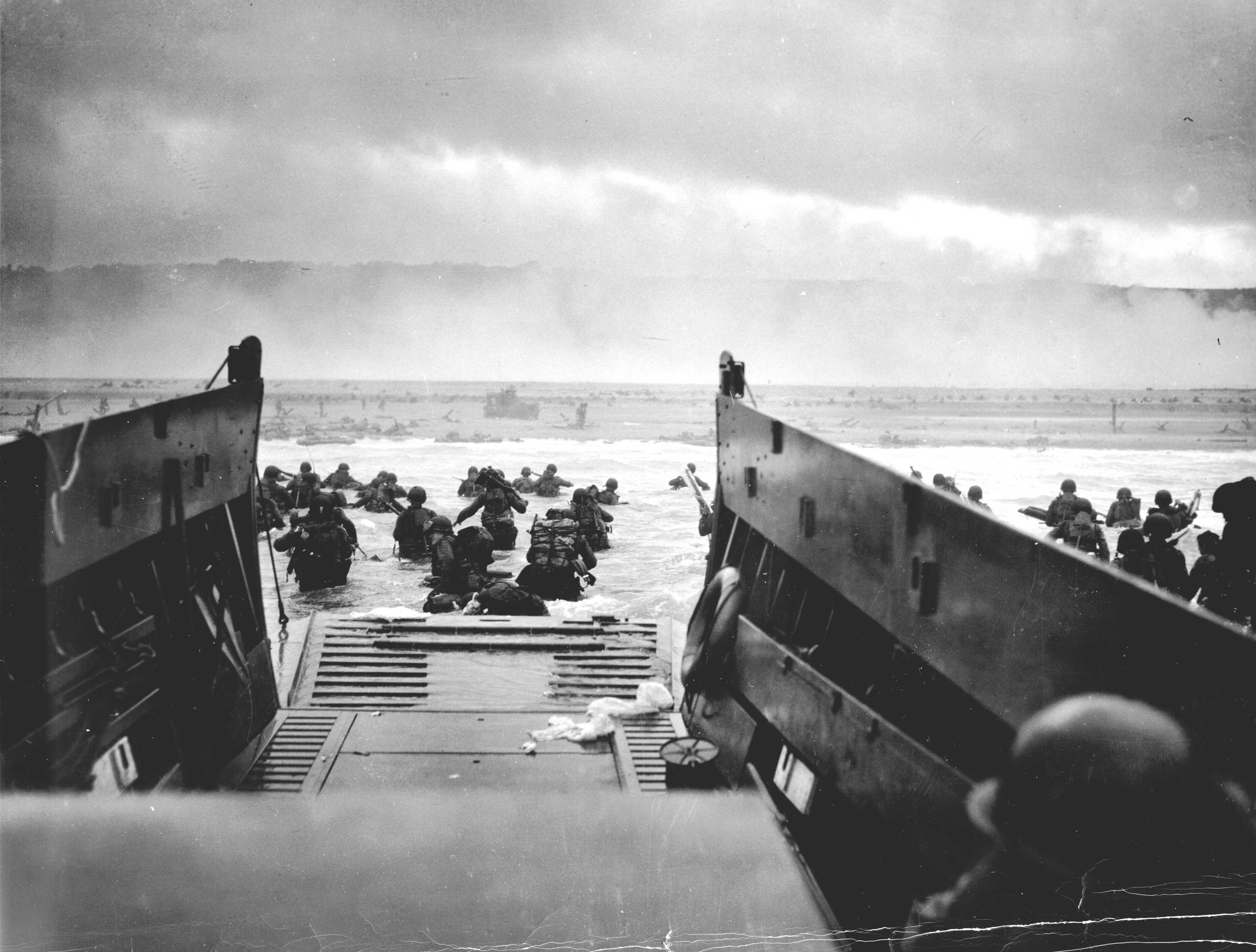
D-Day Anniversary

A LCVP (Landing Craft, Vehicle, Personnel) from the U.S. Coast Guard-manned USS Samuel Chase disembarks troops of Company E, 16th Infantry, 1st Infantry Division (the Big Red One) wading onto the Fox Green section of Omaha Beach (Calvados, Basse-Normandie, France) on the morning of June 6, 1944. American soldiers encountered the newly formed German 352nd Division when landing. During the initial landing two-thirds of Company E became casualties.

It is the anniversary of the D-Day landings on the beaches of Normandy.

The Coast Guard Compass has a story of one of the men rescued that day by the 83 foot cutters that provided rescue service.

We have remembered the day before.

To provide some measure of the part played by the Coast Guard, below are some of the citations accompanying awards for action in support of the operation. You will note it was a particularly rough day for Coast Guard manned Landing Craft, Infantry (LCI). We lost four.

FRITZCHE, Edward H. CAPT, USCG, WWII, Legion of Merit, For exceptionally meritorious conduct, both in the preparation and execution of the amphibious assault on the coast of France June 6, 1944. Captain Fritzche was in command of a main group of the Assault Force, composed of a mixed fleet of American and British transports and American landing craft. He brought these ships and craft to their predetermined stations in the transport area, successfully effected their prompt and efficient unloading and expedited the assault troops and equipment to the designated beaches.—Gold Star in lieu of a second Legion of Merit, For meritorious conduct as commanding officer of a Coast Guard transport prior to and during the amphibious invasion of Southern France August 15, 1944. He efficiently organized and trained his ship and boat group to execute the assigned mission of loading transporting to the assault area and landing the embarked Army assault units on the invasion beaches. His able conduct contributed materially to the effective establishment of the beachhead and to the over all success of the invasion.

A convoy of Landing Craft Infantry (Large) sails across the English Channel toward the Normandy Invasion beaches on D-Day, 6 June 1944. Each of these landing craft is towing a barrage balloon for protection against low-flying German aircraft. Among the LCI(L)s present are: LCI(L)-56, at far left; LCI(L)-325; and LCI(L)-4. Photograph from the U.S. Coast Guard Collection in the U.S. National Archives. Photo #: 26-G-2333

GISLASON, Gene R., LT, USCGR, WWII, Silver Star, For outstanding heroism as Commanding Officer of the USS LCI (L) 94, while landing assault troops in Normandy June 6, 1944. He successfully directed his ship through numerous beach obstacles to the proper beach, discharged his troops and retracted while his ship was seriously damaged from heavy enemy fire. Ship’s communications, engine telegraph and electric steering were disabled by direct hits on the pilothouse which killed three crewman and one screw and shaft were rendered inoperative by beach obstacles. By his coolness under fire and excellent seamanship, Lt Gislason overcame these difficulties and brought his ship off the beach on hand steering and one screw. He later supervised repairs and in four hours enable the LCI (L) to remain operative in the assault area for three weeks.

HENLEY, Coit T., LTJG, USCGR, WWII, Normandy invasion, Silver Star, For heroism as Commanding Officer of the USS LCI(L) 85 while landing assault troops in Normandy, France, June 6, 1944. Lt Hendley successfully landed his troops despite the mining of his vessel, fire in three compartment and concentration of enemy fire while unloading. His courage and seamanship in directing repairs and retracting from the beach resulted in saving the lives many wounded aboard.

IMLAY, Miles Hopkins, CAPT, USCG, WWII, Invasion of Sicily and Normandy, Legion of Merit, For exceptionally meritorious conduct as Commander of the Reserve Attack Group during the Sicilian invasion campaign. With outstanding skill and expert seamanship, Captain Imlay brought the group under his command to the scene of action and with speed and precision dispatched them to the designated beaches, as they were required. Following the initial assault, he assisted in the support of the Army at Licata, and later was temporarily Commander of the Advance Base at Porto Empedocles, participating in the opening of that port while under enemy gunfire.—Gold Star in lieu of Second Legion of Merit, For exceptionally meritorious conduct as Commander of the LST convoy of a Major Task Force during the assault upon Italy in September 1943. Charged with the difficult assignment of brining the vessels under his command safely through the hazardous course between Bizerte, Tunisia , and the Gulf of Salerno, Italy, Captain Imlay (the Commander) performed his essential duties with outstanding skill, successfully reaching the designated assault beaches at the assigned time despite extremely adverse weather conditions and fierce enemy aerial opposition.—Silver Star, For conspicuous gallantry as Deputy Commander of an Assault Group participating in the initial invasion on the coast of France , June 6, 1944. Undaunted by heavy enemy fire, Captain Imlay courageously took station close to the shore on the early morning of D-Day and throughout the most bitter period of the fighting, coolly and promptly made spot decision on the reorganization, grouping and dispatching of craft to the beach, subsequently relieving the Task Group Commander of his duties when he withdrew his transport from the assault area, immediately thereafter, he was placed in charge of operations afloat as assistant to the naval Officer in Charge of one of the beaches and discharging the duties of this responsibility with distinctive professional ability, contributed essentially to the rapid clearing of the backlog of ships.

OXLEY, Gene E., Sea. 1c [ Seaman, First Class], WWII, USCGR, Silver Star, For gallantry while on the USS LCI(L) 85 during the assault on the coast of France June 6, 1944 and for extraordinary courage in volunteering and twice taking a line ashore, in the face of heavy machine gun and shell fire in order to assist troops unloading from the ship to the bench through chest deep water.

SALMON, Robert M., LT, USCGR, WWII, Normandy invasion, Silver Star, For gallantry as commanding officer of a U.S. LCI (L) while landing assault troops in Normandy, France June 6 1944. He pressed the landing of troops despite the mining of his vessel a serious fire forward and heavy enemy gunfire. He supervised the unloading of troops, directed the fire fighting despite the loss of proper equipment and exhibiting courage of high degree remained with the ship until it was impossible to control the progress of the fire and it was necessary to abandon ship over the stern. After abandoning he directed a party searching for fire fighting equipment and subsequently fought the fire on another LCI (L) and assisted her commanding officer until she was abandoned.
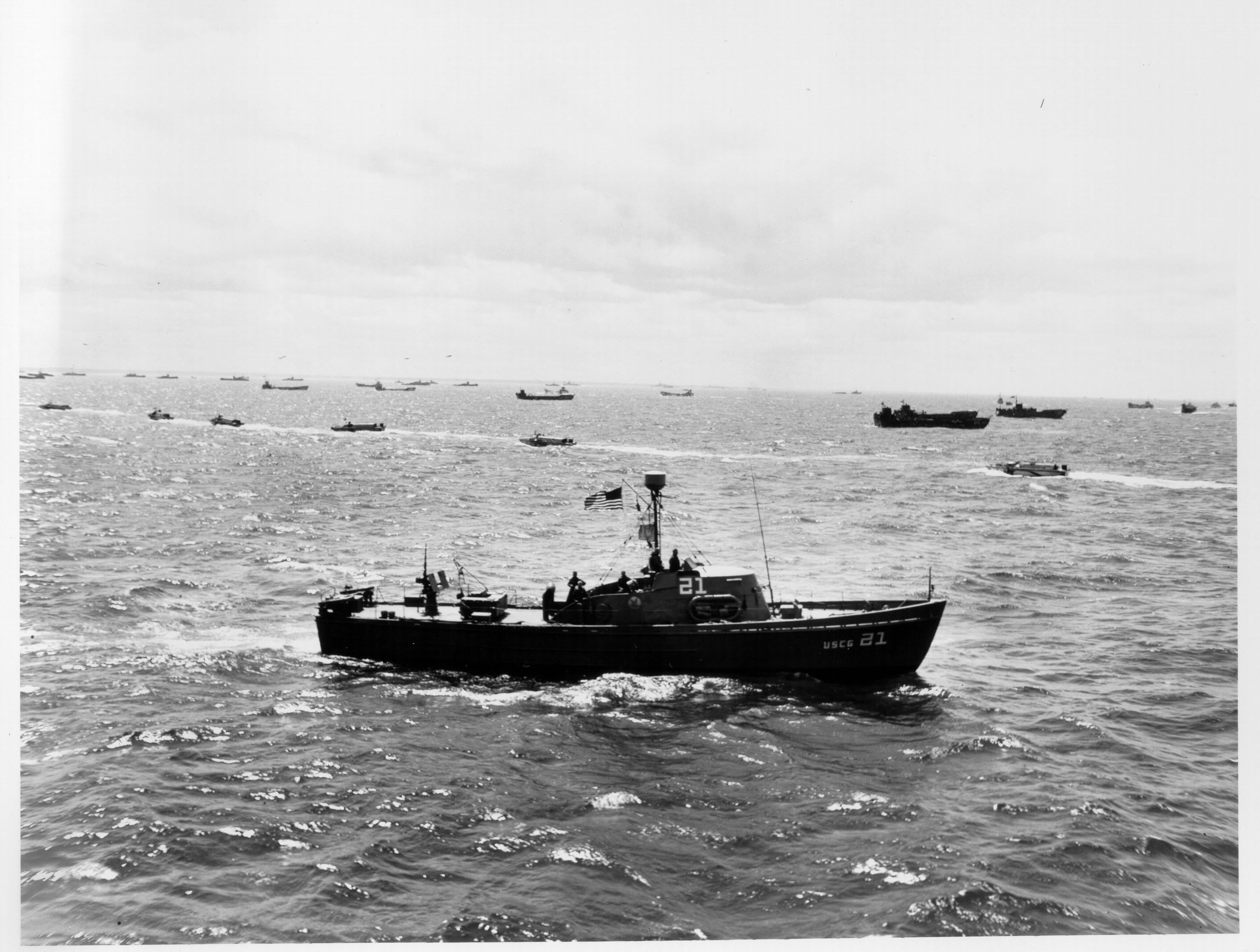
USCG 83 ft patrol boat, probably June 1944. Photographer unknown.

VERNON, Albert, LTJG, USCGR, Bronze Star, For meritorious service as Commanding Officer of a Coast Guard Cutter in rescuing survivors of the invasion off the coast of France June 6, 1944. During D-Day, his cutter rescued 97 men. Each rescue was effected in the face of constant enemy fire from the beach which was in no way allowed to deter the splendid rescue operations.

VYN, Arend, Jr., LTJG, USCGR, Silver Star, For gallantry in action as commanding officer of USS LCI 91 in the assault on the cost of France June 6, 1944. LTJG Vyn beached his ship and discharged the Army elements therein the face of murderous fire and a labyrinth of obstacles and mines. In spite of the fact that his ship was mined and repeatedly struck by artillery fire and small arm fire, he continued to land the army load in the face of certain loss of his ship. his determination to put the Army ashore was in keeping with the highest traditions of the offensive spirit of the U.S. Naval Service.

CLARK, George C., LTJG, USCGR, British Distinguished Service Cross, During the landing of Commandos at Quistreham by LCI (S) on 6 June 1944 Lt. Clark’s cutter was detailed to act as escort to LCI (S). HM LCI(S) 524 on clearing the beach after landing troops received a direct hit and blew up in a sheet of flames leaving a mass of blazing Octane petrol on the water. Although his cutter burned Octane petrol, he did not hesitate to steer his craft into the flames and rescue the commanding officer and some of his men.

The 83-foot Coast Guard cutter USCG 1 off Omaha Beach on the morning of D-Day, tied up to an LCT and the Samuel Chase

“Taiwan’s Coast Guard Launches and Christens its Largest Vessel to Date” —

Photo: CSBC Corporation

Like many Asian nations, Taiwan is rapidly expanding their Coast Guard Administration (CGA). Naval News reports that Taiwan has launched it’s largest Coast Guard vessel ever, “Chiayi” (CG-5001). This is only part of a general major expansion.

“CGA has a programme to build 141 coast guard ships from 2018 to 2027. The programme includes four 4000-ton class patrol vessels, six 1000-ton class patrol vessels, twelve 600-ton class patrol vessels, seventeen 100-ton class patrol boats, fifty-two 35-ton class patrol boats and fifty littoral utility boats. Taiwanese media also  reported that the CGA is considering to establish aviation units, and have sent a report on this issue to the parliament in April.”

Nominally these are 4,000 ton ships, but given the Asian tendency to use light displacement, its full load approach 5,000 tons. This may be reflected in the ship’s hull number, 5001, since, while most of their larger ships have three digit hull numbers, some of their smaller vessels have five digit hull numbers, where the first two or three digits that reflect their nominal displacement.

We talked briefly about these ships earlier. Interestingly the Taiwanese refer to these ships as frigates. The description says the “frigate is equipped with rockets and machine guns.”

After much searching, I finally found some more detailed information about these ships.

The Chiayi, which will be deployed at the CGA’s central base, is 125 meters (410 feet) long, 16.5 meters (54.1 feet) wide and can travel up to 10,000 nautical miles at a maximum speed of 24 knots, the CGA said.

In terms of its weapons system, it will be equipped with a 2.75-inch rocket launcher, two 20 millimeter cannons, and several water cannons with a range of 120 meters, the CGA said.

The Chiayi is one of four 4,000-ton CGA patrol ships commissioned to CSBC at a total cost of NT$ 11.74 billion (US$392 million), according to Hsieh Ching-chin (謝慶欽), head of the CGA Fleet Branch.

It appears they are at least as large as the Offshore Patrol Cutters and National Security Cutters, perhaps a little larger.

What is the 2.75 inch rocket launcher referred to above? I found reference to a “multi-barrel Zhenhai rocket system” in a post about their new 600 ton cutter with a wave piercing catamaran hull, that included the artist’s presentation, seen above, of the vessel with what appears to be multiple rocket launcher on the bow. These might be a Taiwanese equivalent of the APKWS guided rocket system. If the rockets were not guided, they would be relatively useless for Coast Guard applications.

There is a discussion of the history and missions of the Taiwan Coast Guard Authority from 2017 here..

The Taiwanese Coast Guard is about 1/3 the size of the US Coast Guard, even though its EEZ is only about 1/136th that of the US. It has at least 14 ships of over 1000 tons.

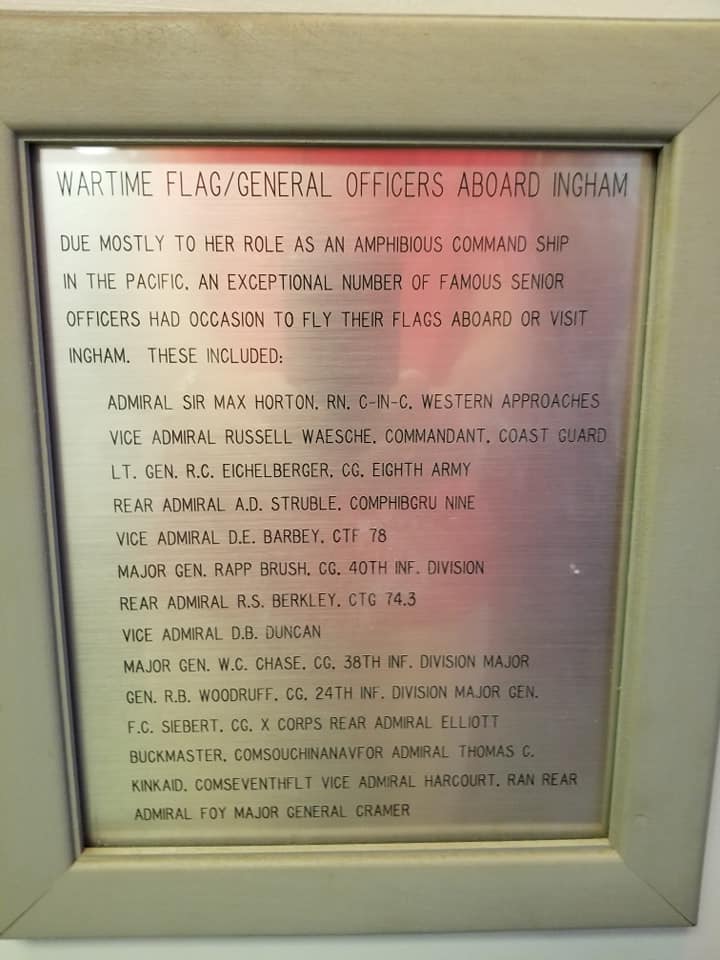
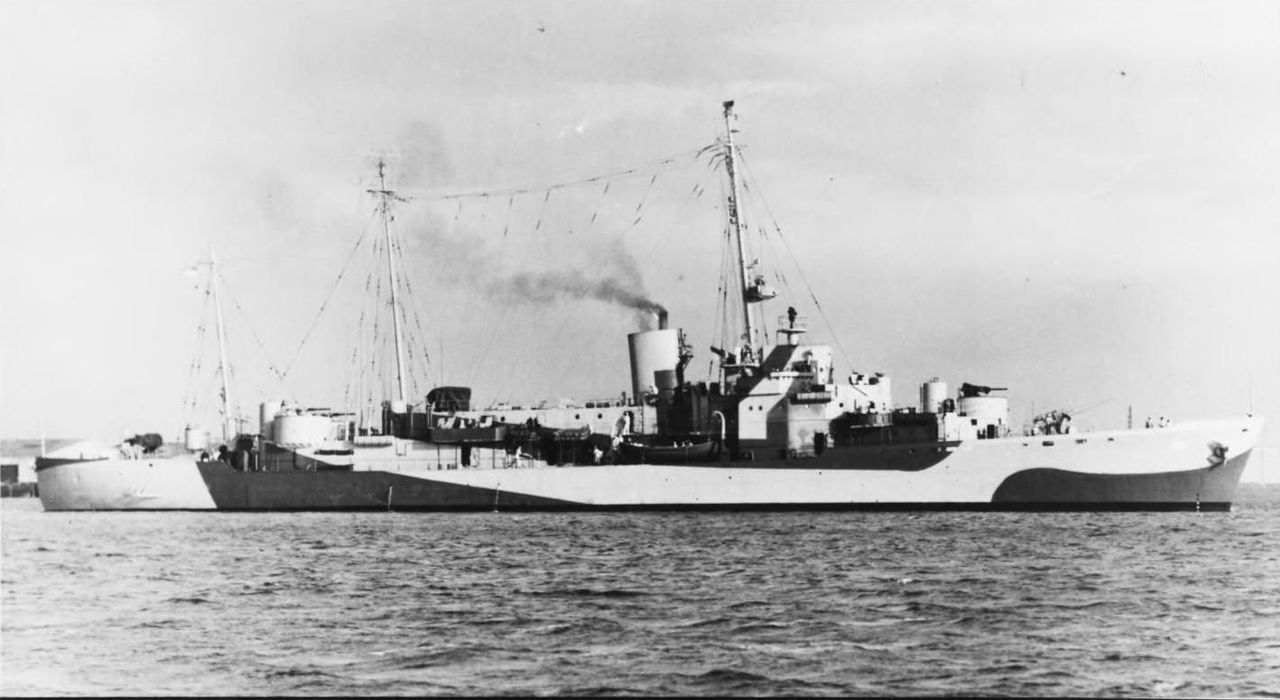
USCGC Ingham (WPG/WAGC/WHEC-35), Bit of Coast Guard History

Ran across the photo above at the “327 Sailors” Facebook page, part of a 65 photo tour of museum ship the former USCGC Ingham now in Key West, posted by Douglas Meier.

Two “Fletcher” class destroyers (left) and a “Cleveland” class light cruiser (right) standing off Corregidor Island as it is bombarded by ships and aircraft, prior to landings there, 16 February 1945. Other ship present (2nd from right) is force flagship USCGC INGHAM (WAGC-35). National Archives #80-G-273318

USCGC INGHAM (WAGC-35)


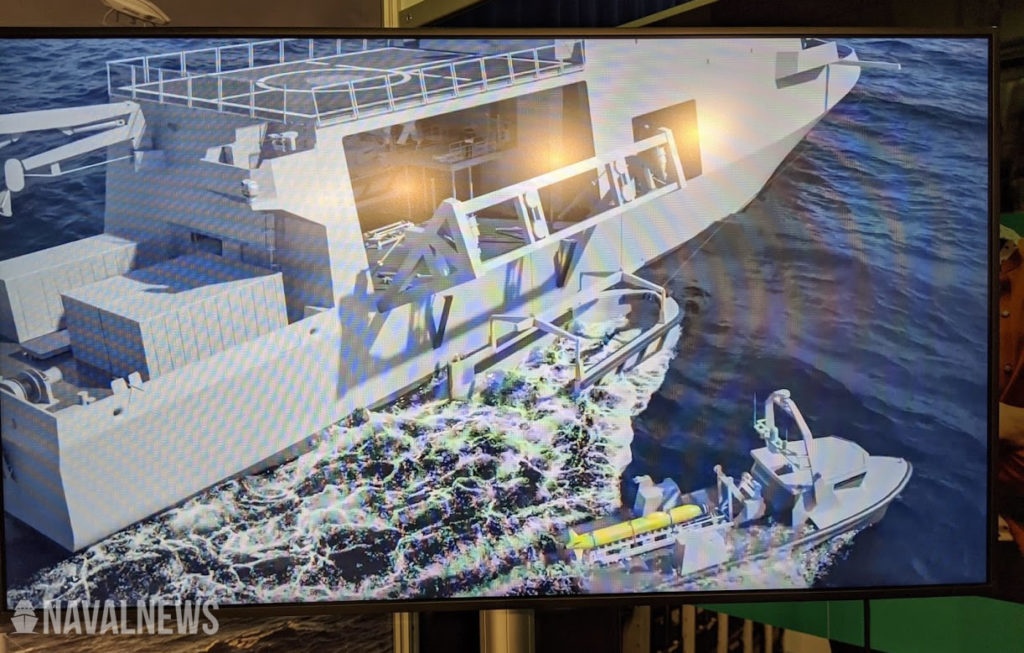
Novel Davit/Cradle System

NavalNews reports successful tests of a launch and recovery system (LARS) planned for a future class of Mine Countermeasures vessel for the Netherlands and Belgium Navies.

They claim impressive capability, an ability to launch and recover unmanned surface vessels in up to sea state five or a swell amplitude of four meters. Our requirements for the Offshore Patrol Cutter included the ability to launch and recover boats and helicopters in State Five seas, but I don’t believe that included the upper limit of Sea State Five. Boat operations are bread and butter to the Coast Guard so we probably would want to keep an eye on developments in the field.

This is what the Future Belgian & Dutch MCM Motherships will look like. The vessel is 81.4 meters in length with a beam of 17 meters. (Weapon on the bow is a 40mm.)

“Navy Lasers, Railgun, and Gun-Launched Guided Projectile: Background and Issues for Congress Updated May 29, 2020”

Artist’s rendering of Lockheed Martin’s HELIOS system. Image courtesy Lockheed Martin.

The Congressional Research Service has updated information on the Navy’s development of Laser and Railgun systems and gun-launched guided projectile.

I was a bit disappointed to find that neither ALaMO or MAD-FIRES, being developed for the 57mm Mk110 mounted on new large cutters, were addressed.

The report’s summary is reproduced below:

Summary

Three new ship-based weapons being developed by the Navy—solid state lasers (SSLs), the electromagnetic railgun (EMRG), and the gun-launched guided projectile (GLGP), also known as the hypervelocity projectile (HVP)—could substantially improve the ability of Navy surface ships to defend themselves against surface craft, unmanned aerial vehicles (UAVs), and eventually antiship cruise missiles (ASCMs).

The Navy has been developing SSLs for several years, and in 2014 installed on a Navy ship its first prototype SSL capable of countering surface craft and UAVs. The Navy since then has been developing and installing additional SSL prototypes with improved capability for countering surface craft and UAVs. Higher-power SSLs being developed by the Navy are to have a capability for countering ASCMs. Current Navy efforts to develop SSLs include

  •  the Solid State Laser Technology Maturation (SSL-TM) effort;
  • the Optical Dazzling Interdictor, Navy (ODIN);
  • the Surface Navy Laser Weapon System (SNLWS) Increment 1, also known as the high-energy laser with integrated optical dazzler and surveillance (HELIOS); and
  • the High Energy Laser Counter-ASCM Program (HELCAP).

The first three efforts above are included in what the Navy calls the Navy Laser Family of Systems (NFLoS) effort. NFLOS and HELCAP, along with technologies developed by other parts of DOD, are to support the development of future, more capable shipboard lasers.

The Navy has been developing EMRG for several years. It was originally conceived as a naval surface fire support (NSFS) weapon for supporting Marines and other friendly forces ashore. Subsequently, it was determined that EMRG could also be used for air and missile defense, which strengthened Navy interest in EMRG development. The Navy is continuing development work on EMRG, but it is unclear when production-model EMRGs will be installed on Navy ships. The Navy’s FY2021 budget submission requests $9.5 million in FY2021 for continued development of EMRG, but does not appear to program any additional development funding for EMRG in FY2022-FY2025.

As the Navy was developing EMRG, it realized that the guided projectile being developed for EMRG could also be fired from powder guns, including 5-inch guns on Navy cruisers and destroyers and 155 mm artillery guns operated by the Army and Marine Corps. The concept of firing the projectile from powder guns is referred to as GLGP and HVP. One potential advantage of HVP/GLGP is that, once developed, it can be rapidly deployed on Navy cruisers and destroyers and in Army and Marine Corps artillery units, because the powder guns in question already exist.

In addition to the question of whether to approve, reject, or modify the Navy’s FY2021 funding requests for SSLs, EMRG, and HVP/GLGP, issues for Congress include the following: 

  • whether the Navy is moving too quickly, too slowly, or at about the right speed in its efforts to develop these weapons;
  • the Navy’s plans for transitioning these weapons from development to procurement and fielding of production models aboard Navy ships; and
  • whether Navy the Navy’s shipbuilding plans include ships with appropriate amounts of space, weight, electrical power, and cooling capacity to accommodate these weapons.

“A Tale of Two FLIRs” –Naval News

“This image, captured with Coast Guard Cutter Bertholf’s forward-looking infrared, or FLIR, shows the national security cutter moving in on a suspect vessel. U.S. Coast Guard photo.”

Naval News has a post that discusses the advances in FLIR technology over the last two generations.

FLIR has proven very useful. Hopefully we are keeping up with improvements.

Visiting aboard a Webber class WPC, there was a FLIR mounted in the Mast. I ask about it, and was told that it was not as good as the one incorporated in the Mk38 mod3 mount.

“BAE successfully tests ground-launched APKWS rockets for first time” –Defense News

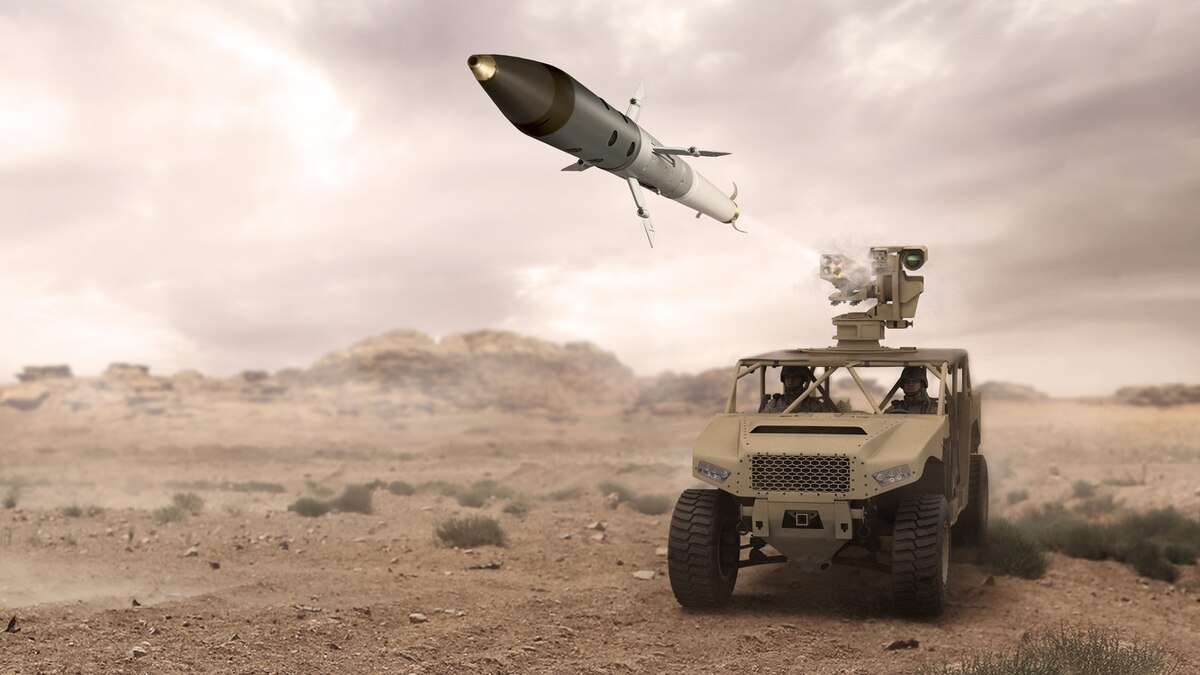
Concept art shows a ground vehicle launching an APKWS rocket. (BAE Systems)

Defense News is reporting that APKWS (Advanced Precision Kill Weapon System) has been successfully tested as a ground based weapon system. This is a small light weight missile produced by adding a guidance kit to the common and inexpensive 70 mm (2.75″) Hydra rocket. It has normally been used by helicopters.

As we have discussed previously, this looks like a weapon system that would give even relatively small Coast Guard craft a substantial punch, out to beyond 8,000 yards, with a minimal danger of collateral damage. And of course the Navy could use them against swarming fast inshore attack craft.

Notably:

The company delivered more than 35,000 APKWS units by the end of 2019 and expects to deliver 18,000 in 2020.