“Naval Special Warfare (NSW) Surface Support Craft (SSC) and U.S. Coast Guard Special Purpose Craft, Law Enforcement II (SPC-LE2) Vessels – Contract Update” –Seapower

The Navy League on-line magazine, Seapower, reports the Navy and Coast Guard are buying Ambar Series boats from SilverShips.

The $8.2 million delivery order is a Firm-Fixed-Price Indefinite Delivery, Indefinite Quantity (IDIQ) single award contract (N00024-21-D-2205) by the Naval Sea Systems Command for the construction and delivery of up to 110 Naval Special Warfare (NSW) Surface Support Craft (SSC) and U.S. Coast Guard Special Purpose Craft, Law Enforcement II (SPC-LE) vessels, in addition to other accessories, parts and training. The contract includes options that, if exercised, would bring the cumulative value of the contract to $51.6 million and production work would continue through 2026-2027.

11 meter SPC-LE

There is more information in this earlier post about the original contract. Coast Guard boats will be Open Center Console (Open) variant with three Mercury 5.7L V10 350 and 400hp Verado outboards.

Silver Ships also has a contract to make remote controlled surface targets for the Navy. The Coast Guard might end up shooting at some of them.

Thanks to Lee for bringing this to my attention. 

Hulai II WPC, China Coast Guard’s FRC

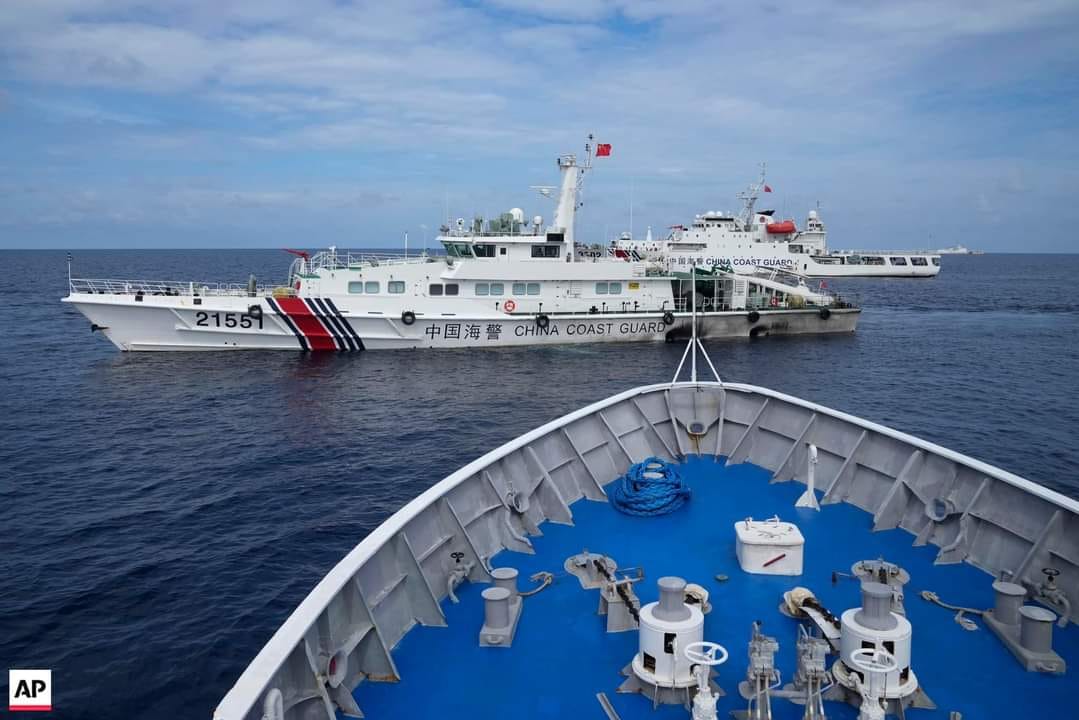
Philippine Coast Guard resupply mission encounters China Coast Guard

Philippine attempts to resupply Second Thomas Shoal, and Chinese effort to block those efforts have become common. Apparently, the Philippines succeeded recently. There was, in fact, a US Navy P-8 maritime patrol aircraft flying low overhead providing overwatch.

US Navy P-8 observing Philippine resupply mission

The resulting confrontation provided a lot of photos including ships of a class of China Coast Guard cutters that look a bit like US Coast Guard Webber class cutters.

China Coast Guard cutter attempts to block passage of Philippine supply vessel.

The only thing I have been able to find out about these little ships was from the Office of Naval Intelligence’s (ONI) Chinese People’s Liberation Army Navy, Coast Guard, Ship Identification Guide, which to my eye identifies them as the Hulai II class, which is reportedly 54 meters (177′) in length, with 30 units in the class. The length sounds right. They appear to be a bit longer than the Fast Response Cutters (47m/154′). I haven’t been able to locate any other information on the class.

Previously, China Coast Guard cutters guarding Second Thomas Shoal all seemed to be relatively large. Perhaps the Chinese realized their larger ships could be outmaneuvered and brought in these smaller ships as backup. Still the Philippines has again succeeded in resupplying the small garrison.

“Papua New Guinea leads joint maritime operations with U.S. Coast Guard” –Coast Guard News

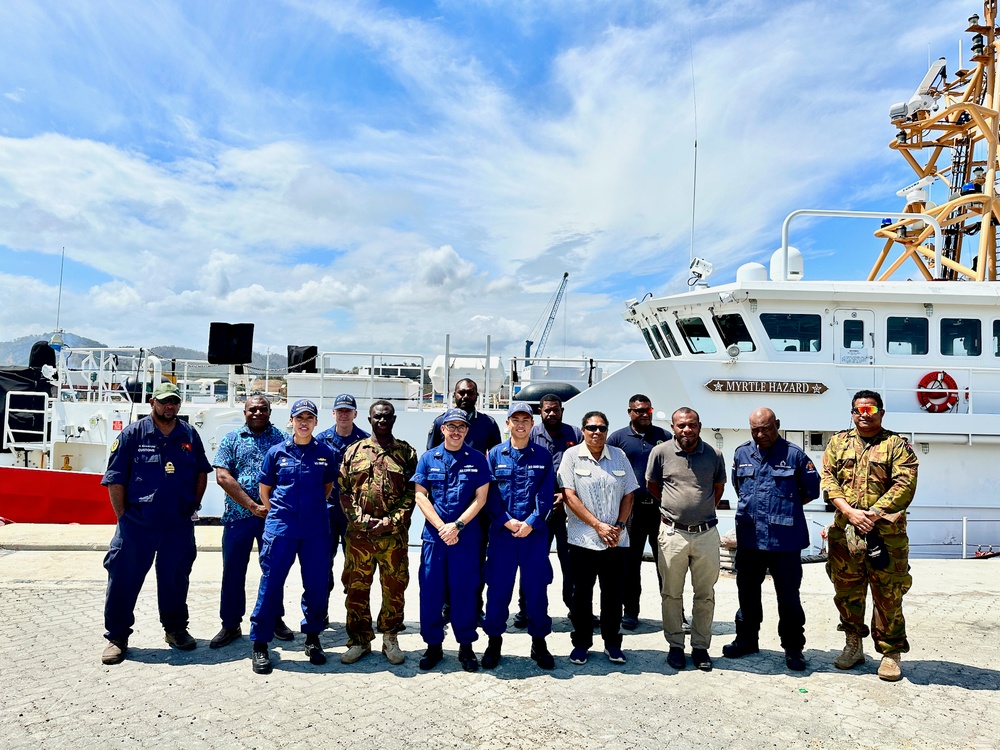
USCGC Myrtle Hazard (WPC 1139) hosts operational planning and subject matter exchange with partners in Port Moresby, Papua New Guinea

The USCGC Myrtle Hazard (WPC 1139) command stand for a photo with partners from the Papua New Guinea Defense Forces, Customs Services, National Fisheries Authority, and Department of Transport’s maritime security division following an operational planning and subject matter exchange with partners in Port Moresby, Papua New Guinea on Aug. 22, 2023. The U.S. Coast Guard is in Papua New Guinea at the invitation of the PNG government to join their lead in maritime operations to combat illegal fishing and safeguard maritime resources following the recent signing and ratification of the bilateral agreement between the United States and Papua New Guinea. (U.S. Coast Guard photo by Chief Warrant Officer Sara Muir) 

Passing along this from Coast Guard News. Like the fact that the Papua New Guinea government is taking the lead on this. We are helping them build capacity not doing the job for them.


Aug. 23, 2023

Papua New Guinea leads joint maritime operations with U.S. Coast Guard

Editor’s Note: For more images, please click here

PORT MORESBY, Papua New Guinea — Papua New Guinea (PNG) has invited the USCGC Myrtle Hazard (WPC 1139) to join their lead in maritime operations to combat illegal fishing and safeguard maritime resources during August 2023.

This collaborative effort marks the first time a joint patrol effort will be executed at sea since the signing and ratification of the recent bilateral defense agreement between PNG and the United States, which allows the U.S. to embark shipriders from PNG agencies aboard the ship to conduct at sea boardings on other vessels operating in the exclusive economic zone (EEZ) under their national agency authority. This is the U.S. Coast Guard vessel deployment first announced during Secretary of Defense Austin’s engagement with Prime Minister James Marape in July.

PNG’s lead in this mission aligns with their sovereign rights to protect the EEZ and emphasizes the country’s commitment to maritime domain awareness, fisheries regulation enforcement, and sovereignty protection. The PNG government requested the U.S. Coast Guard’s participation to utilize the platform and crew of the Guam-based 154-foot Fast Repones Cutter, currently on an expeditionary patrol, to expand coverage of the heavily trafficked maritime EEZ.

“Through our recent operational planning and subject matter exchange, the partnership between the Papua New Guinea Defence Force and the U.S. Coast Guard reached new heights. The spirit of collaboration and shared mission to ensure regional maritime security reflects our nations’ aligned values and commitment. This initiative fosters growth in our bilateral relationship and paves the way for innovative approaches to safeguard our waters and the sustainable use of our ocean resources. Working alongside the U.S. Coast Guard is an honor, and PNGDF eagerly anticipates our cooperative efforts’ continued growth and success,” said Commodore Philip Polewara, the Acting Chief of the PNG Defence Force.

The PNG-led patrol aims to observe activity and conduct boardings to reduce illegal fishing and illicit maritime activities in PNG’s EEZ. It’s part of a long-term effort to counter illegal maritime activity and safeguard the sustainable use of maritime resources.

This collaboration is vital to Operation Blue Pacific and augments ongoing efforts by the Pacific Islands Forum Fisheries Agency and Western and Central Pacific Fisheries Commission. It underscores the recent bilateral agreement, signed in May and ratified in the last few weeks, enabling the Myrtle Hazard crew to work collaboratively within PNG’s legal framework and strengthen relations with agencies with shared objectives.

The USCGC Oliver Henry (WPC 1140) crew was the first U.S. Coast Guard Fast Response Cutter to call on port in Papua New Guinea during their southern expeditionary patrol in the fall of 2022 to build relations, conduct engagements, and resupply.

The USCGC Myrtle Hazard’s crew is building on the work of their colleagues – already engaging with the PNG Defense Force through exchanges in the northern part of the country on this patrol, bolstering cooperation and understanding. This activity included subject matter exchanges with the PNG Defense Force Patrol Vessel Ted Diro crew and a port call in Rabaul, where the team engaged with the local community at the Rabaul Yacht Club. Additionally, the advance team and cutter crew conducted operations planning and subject matter exchanges across agencies in Port Moresby and ship tours for the embassy team and partners.

“We are deeply honored to collaborate with the Papua New Guinea Defense Force, Papua New Guinea Customs Services, Papua New Guinea National Fisheries Authority, and the Department of Transport’s Maritime Security Division at the invitation of the Papua New Guinea Government,” said Lt. Jalle Merritt, commanding officer of the USCGC Myrtle Hazard. “Our shared mission reflects PNG’s leading role in regional security, and we are committed to supporting their goals in this significant undertaking.”

For more information about this patrol and other related activities, please contact Chief Warrant Officer Sara Muir at sara.g.muir@uscg.mil or the respective agencies in Papua New Guinea.

“USNI News Fleet and Marine Tracker: Aug. 21, 2023”

USCGC Munro (WMSL-755) escorts USNS Fisher (T-AKR-301) in the East China Sea on Aug. 12, 2023. US Navy Photo

Looking at the latest US Naval Institute “Fleet and Marine Tracker,” I am a bit surprised to see there are still 3 Navy ships operating under 4th Fleet, presumably doing drug interdiction. This is an uptick.

Again, they report on atypical Coast Guard operations:

  • Legend-class National Security Cutter USCGC Munro (WMSL-755) departed South Korea last week and is in the Korea Strait. (As I mentioned earlier, there is a possibility, cutters may encounter the new North Korean corvettes.)
  • Coast Guard Cutter USCGC Healy (WAGB-20) continues its work in the Beaufort Sea. Healy is on a five-month deployment in partnership with ONR and the National Science Foundation.
  • Coast Guard Cutter USCGC Forward (WMEC-911) is currently supporting Operation Nanook. Operation Nanook is an annual Canadian-led exercise that fosters international cooperation and shared responsibility in the Arctic and the northern Atlantic Regions. The cutter recently made a port call in Nuuk, Greenland.

You can use Control F “USCGC” if you want to quickly find the Coast Guard cutters mentioned in the USNI posts.

PATFORSWA is mentioned again.

The link in the Healy entry, “U.S., Canadian Icebreakers Conduct Operation, Rendezvous en Route to Arctic Ocean” is interesting, plus there is more in the USNI post including an “adorable” polar bear photo.

“‘Strategic’ Cruise Missile Tested From North Korea’s New Corvette” (Corvette with Nuclear Capable Cruise Missile?) –The Drive

The Drive reports.

“North Korea’s state-run media has released new photos of the country’s most modern surface combatant, known in the West as the Amnok class corvette, which is also the largest operated by the Korean People’s Navy. Of particular interest is that the warship is armed with cruise missiles, which can likely be fitted with nuclear warheads, adding yet another platform to North Korea’s diverse and growing strategic arsenal.”

Cutters doing UN sanctions enforcement in the East China Sea might run into one of these.

This coast guard cutter sized vessel, one of four being built, which is reportedly 77 meters (253′) in length, is interesting for its combination of possible nuclear capability with old tech.

Aside from the cruise missiles, which may not have been accurate, this corvette includes four heavy gatling style machine guns (two 30mm and two 14.5mm) which would be very dangerous at short range. For mid-range, the mid 20th century 100mm gun looks rather crude, but it does throw a 34.4 lbs. (15.6 kg) projectile up to 24,323 yards (22,241 m). That is almost seven times heavier and about 6,000 yards further than the 57mm.

The portholes look out of place and may mean the ship is not fully airconditioned.

“U.S. Coast Guard Forces Micronesia Sector/Guam’s Fast Response Cutters bolster Pacific Partnership Strategy and strengthen Pacific Island Country relations” –USCG Forces Micronesia/Sector Guam

The Sentinel-class fast response cutter USCGC Oliver Henry (WPC 1140) crew arriving in Port Moresby for a port visit on Aug. 23, 2022, following a patrol in parts of the Coral Sea, the Solomon Islands and PNG Exclusive Economic Zones. The U.S. Coast Guard was conducting a routine deployment in Oceania as part of Operation Blue Pacific, working alongside Allies, building maritime domain awareness, and sharing best practices with partner nation navies and coast guards. (U.S. Coast Guard photo by USCGC Oliver Henry)

Below is a news release from U.S. Coast Guard Forces Micronesia/Sector Guam. Webber class cutters there are developing a new norm for Coast Guard assistance to Pacific Island nations. It is not clear if this is now the norm, or if this was an unusual period, but from June 21 to August 3, there was only one day (June 17) that they did not have an FRC underway for at least part of the day. This is what I believe should be the norm and probably the reason FRCs are so frequently based in groups of three or six. Typically three ships would be, one underway, one in maintenance, and one in workup/standby (I don’t know if they are employing standby). 

On the other hand, none of these patrols was more than 16 days long and the shortest only five, which suggest why, given the long transit distances, we need some cutters with greater endurance in the Western Pacific (I would say three to have one underway at all times and be able to surge two when needed).

Thanks to Paul for bringing this to my attention.

Aug. 18, 2023

U.S. Coast Guard Forces Micronesia Sector/Guam’s Fast Response Cutters bolster Pacific Partnership Strategy and strengthen Pacific Island Country relations

SANTA RITA, Guam — In a robust display of maritime commitment, U.S. Coast Guard Forces Micronesia/Sector Guam’s Fast Response Cutters conducted four patrols over 44 days, enhancing safety and prosperity in the Pacific Islands region while combatting illicit maritime activity, including illegal, unregulated, and unreported fishing and the illegal and unsafe transport of passengers.

The crews of USCGC Frederick Hatch (WPC 1143), USCGC Myrtle Hazard (WPC 1139), and USCGC Oliver Henry (WPC 1140):

– Conducted seven boardings and five observation reports.
– Completed over 20 training evolutions.
– Qualified 18 new shipboard members.
– Supported the investigation into the transport of 11 people aboard an overloaded vessel transiting to Guam from the Commonwealth of the Northern Mariana Islands on an illegal charter following their rescue by DoD partners.
– Supported operations such as Operation Blue Pacific, Operation Rematau, Operation Nasse, and Operation Koa Moana.

“Our Fast Response Cutter crews exhibit both efficacy and presence as a consistent and trusted partner in the region. Our Pacific Island Country partners’ warmth and regard for the Coast Guard is a testament to the strong connections we have nurtured over the years. It is our commitment to the people of the Pacific Island Countries to protect Oceania and its resources for them from undue strategic competition that would undermine those relationships and destabilize the region,” said Cmdr. Greg Sickels, deputy sector commander of U.S. Coast Guard Forces Micronesia/Sector Guam.

Operational Achievements and Highlights

– USCGC Frederick Hatch (June 21 – July 2 and July 18 – Aug. 3): Enhanced international relations, streamlined boarding processes, qualified new personnel, and improved communication with FSM Maritime Police.

– USCGC Myrtle Hazard (July 3 – 16): Strengthened connection with CNMI, ensured maritime law enforcement presence in less patrolled areas, and enhanced collaboration with customs and public safety departments.

– USCGC Oliver Henry (July 18 – 23): Increased U.S. presence, enforced fishing regulations, and fostered crew readiness with weapons proficiency and collaboration.

These accomplishments underscore the U.S. Coast Guard’s pivotal role in promoting maritime governance, ensuring good relations, and fostering strategic competition in the Pacific Islands region. The U.S. Coast Guard remains a consistent and reliable partner, working collaboratively with Pacific Island Countries to achieve shared objectives and bolster regional security.

Operation Rematau, an integral part of Operation Blue Pacific, is spearheaded by the U.S. Coast Guard Forces Micronesia/Sector Guam. This initiative fosters security, safety, sovereignty, and economic prosperity throughout Oceania. Rematau translates to “people of the deep sea” and embodies the Coast Guard’s unwavering commitment to safeguarding the people of this region.

The U.S. Coast Guard actively exercises 12 bilateral maritime law enforcement agreements with Pacific Island Countries, reinforcing maritime law enforcement operations and domain awareness in the region. In October 2022, the Service, on behalf of the U.S., signed the first enhanced bilateral agreement with the Federated States of Micronesia. This landmark agreement builds on the existing shiprider arrangement, allowing the U.S. Coast Guard to conduct boardings in the FSM’s exclusive economic zone with prior approval working with the FSM National Police, but without an FSM officer physically present. This expansion significantly amplifies the FSM’s capacity to protect its sovereignty and resources across an area spanning 1 million square miles and more than 600 islands. Boardings have already been conducted under this enhanced shiprider agreement, attracting interest in similar arrangements from other nations in the area.

In May 2023, the U.S. signed a new bilateral agreement with Papua New Guinea, richly endowed with natural resources like gold, copper, oil, and natural gas. While its formal sector focuses on exports of these commodities, most of its people rely on subsistence agriculture. As of 2020, agriculture, forestry, and fishing reportedly account for nearly 19 percent of PNG’s GDP. The agreement aligns with the PNG government’s efforts to safeguard their islands and 1.2 million square miles of EEZ, which are vital to their economic well-being. Recently ratified by their parliament, this partnership, at the request of the Papua New Guinea government, further extends the reach and impact of maritime law enforcement efforts. In line with this initiative, a U.S. Coast Guard cutter from Guam will be collaborating with Papua New Guinea to enact their new agreement shortly, continuing to foster security and collaboration across the Pacific.

U.S. Coast Guard Forces Micronesia/Sector Guam comprises more than 300 members based in Guam and the Commonwealth of the Northern Mariana Islands spread across shoreside and afloat units committed to maritime safety, security, and stewardship in Oceania.

For more information on the U.S. Coast Guard Forces Micronesia Sector/Guam’s operations and achievements, please visit the official DVIDS account at https://www.dvidshub.net/unit/USCG-FMSG.

“Japanese icebreaking research vessel project moves ahead” –Marine Log

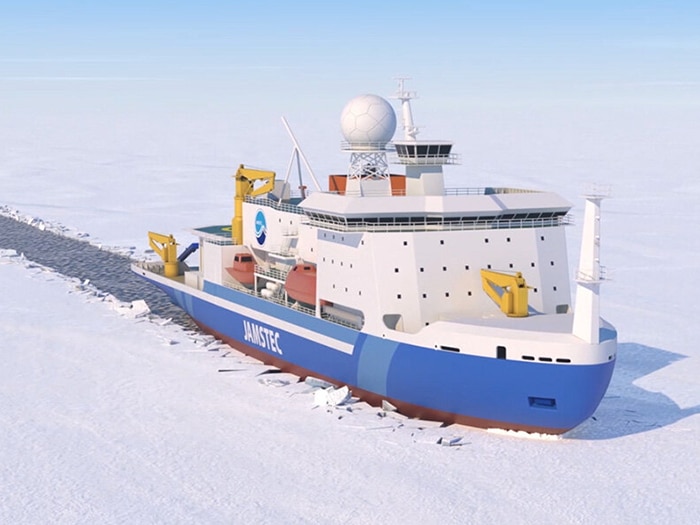
Icebreaking research vessel
MOL is to deploy an outfitting crew to the shipyard building Japan’s first icebreaking research vessel

Marine Log reports,

JAMSTEC (Japan Agency for Marine-Earth Science and Technology) has taken another step forward on the build of Japan’s first research vessel with icebreaking capabilities. The icebreaking research ship is on order at Japan Marine United’s Isogo shipyard in Yokohama where, as of last month, the design of the hull structure was nearing completion…The LNG dual-fueled Polar Class 4 ship will have a total length of 128 meters, a width of 23 meters, an international gross tonnage of about 13,000 tons, and a crew of 99 people. It will be to break sea ice with a thickness of 1.2 meters at a speed of 3 knots, and will be equipped with drones, unmanned probes, and Doppler radars used for weather observations.

That is 420 feet in length and 75’5” in beam. USCGC Healy is the same length, but 82′ (25 meters) in beam, and 16,000 tons, so they are pretty close. If I interpreted correctly, this would be considered at the low end of the medium icebreaker class by the USCG. Like Healy, this ship uses shaft driven propellers.

There are diagrams of the ship here.

How Bofors 57 mm Mk3/Mk110 Naval Gun Reload Works –Video

Thought this video was interesting enough to pass along.

This makes it clear why the nominal “220 round per minute” rate of fire for the 57mm Mk110 is only good for short periods. There can be up to 120 rounds on the mount but there may be interruptions to reload after 20 or fewer rounds. Frequently different types of ammunition are loaded in the left and right sides of the mount ammunition feed system, so there may be only 60 or fewer rounds of a particular ammunition type on the mount.

The linked information above includes a note for the 57mm Bofors 57 Mk2 which appears to share the same reload mechanism as the Bofors 57mm Mk3 (Mk 110 in US service) “Time to reload 120 rounds: 2 minutes”. It appears reloading the two 20 round ready service cassettes that move with the gun requires the gun to at or near maximum elevation. It is not clear if partially filled ready service cassettes can be topped off, I would hope that would be the case. The time to elevate, reload and return to firing position could be critical. Hopefully you will not wait until all 120 rounds on the mount are expended before reloading.

Thanks to Lee for bringing this to my attention.

“Coast Guard completes work on service life extension program prototype” –CG-9

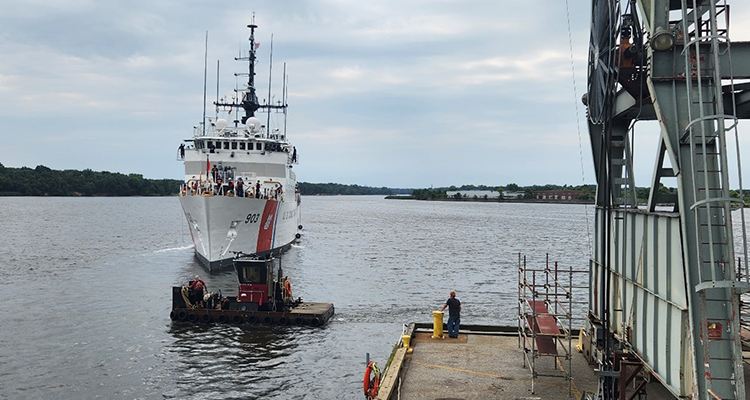
Coast Guard Cutter Harriet Lane departs Coast Guard Yard in Baltimore Aug. 3, 2023, after undergoing 15 months of In-Service Vessel Sustainment Program production work. The service life extension program for this cutter entailed 113 work items, worth $21 million, which included a new electrical system and an MK38 Mod 3 gun weapon system, a first for the medium endurance cutter class. Both Coast Guard Cutters Seneca and Harriet Lane served as medium endurance cutter prototypes for new electrical and structural work and Harriet Lane served as the gun weapons systems prototype.

For more information: In-Service Vessel Sustainment Program page


Above is an announcement by the Acquisitions Directorate (CG-9). As I noted in a July post about the WMEC270 Service Life Extension program, there are still some unknowns regarding the program. The photo above may answer some of those questions.

As expected, a Mk38 gun mount has replaced the 76mm Mk75. The CG-9 post indicates the installed mount is the 25mm Mk38 Mod3, and that there is one and only one mount. The Mk92 fire control system has apparently been removed and I see no apparent new radar that would replace its air search and approach control capability. It also appears the SLQ-32 has been removed.

It appears the Mk38 Mod3 is mounted on an elevated platform about four feet above the foc’sle deck. This should provide both a better field of fire and a degree of protection from green water coming over the bow, though I felt it should have been raised a full deck.

Harriet Lane was a prototype, but it wasn’t one of the six to get the complete SLEP. They are to be Spencer, Legare, Campbell, Forward, Escanaba and Tahoma.

Harriet Lane is expected to change homeports to the Pacific and be dedicated to operations in the Western Pacific.

I think it perhaps unfortunate, that the ship that may be placed in a position where it will need to face down China Coast Guard cutters armed with 76mm guns has lost hers. Perhaps it should not matter, but it may be more difficult to act boldly when your adversary can hurt you badly, from a distance, with impunity.

“The Coast Guard is investing in underway connectivity…and it’s paying off!” –MyCG

Below is news from MyCG. I am publishing it in full for convenience. It is a great advertisement for Starlink which has played a significant role in Ukraine’s Maritime Drone offensive against Russia, but the most surprising thing for me was this,

“…soon all users will have Dial-In Phone System (DIPS), a new capability that assigns a unique telephone number to every member of the workforce to last for the duration of their career. With it, you will be able to make and receive phone calls, and have voicemail, within DoD365 Teams….even underway! (Watch out for another MyCG article next week for more information about DIPS!)”

WOW!!


Aug. 16, 2023

The Coast Guard is investing in underway connectivity…and it’s paying off!

By AJ Pulkkinen, MyCG staff writer

The Coast Guard is aggressively adding Starlink commercial satellite communications on most cutters. This next-generation upgrade provides a twenty-fold increase in the speed of shipboard networks.

The C5I team already installed Starlink on 17 cutters and targets all major cutters (WMSL, WMEC, Polars) for completion by the end of this calendar year (CY) WLB (225s) and FRC (154s) are targeted during CY24, along with the 17 WPBs (87s) that have installed legacy commercial satellite communications.

Starlink technology provides the bandwidth and latency for shipboard users that is on par with those working at a desk in an office ashore.

Bandwidth and latency are two different aspects of network performance. Bandwidth is the amount of data that can be transferred over a network for a definite period of time. Latency is the amount of time it takes for a bits of data to travel from one point on a network to another.

Underway users already equipped with Starlink are experiencing drastic increases in connection capability, such as connectivity to CG applications including Direct Access, FSMS, SharePoint, OneDrive and the full suite of DOD365 apps, and the ability to seamlessly upload and download large media files.

Starlink’s performance more easily allows underway users to access personal email, banking and social media. And soon all users will have Dial-In Phone System (DIPS), a new capability that assigns a unique telephone number to every member of the workforce to last for the duration of their career. With it, you will be able to make and receive phone calls, and have voicemail, within DoD365 Teams….even underway! (Watch out for another MyCG article next week for more information about DIPS!)

Starlink also provides global coverage, notably in the high latitudes. The cutter Eagle experienced minimal to no loss in coverage while crossing the North Atlantic to the Azores. Capt. Jessica Rozzi-Ochs says, “Starlink has seamless transition from satellite to satellite, unlike the legacy system, which drops service while it looks for and tracks a new satellite. This was particularly impressive when we experienced heavy weather (20+ foot seas, hard rain, 40-50 knots of wind) and Starlink didn’t go down once.”

Gone will be the days of having to come back to port only to spend hours or days at the computer because you lacked connectivity while underway.

The Eagle’s crew reported great success with their Starlink. By having consistent access to the Financial System Management Solution (FSMS), Eagle’s supply office reduced the number of offline requisitions, which minimized human error in tracking commitments and expenditures underway. They were able to better communicate with vendors and partners, streamlining the acquisition processes and coordinating port services for their port calls. With this enhance communication, they procured parts essential for maintaining the cutter fully mission capable even when short turnaround times were necessary.

The Eagle’s crew was able to frequently upload pictures and video to social media accounts in near-real time while underway. These timely posts reached a wide audience, with several posts reaching over 45,000 views.

Starlink will help alleviate one of the greatest burdens on our cutter community: intermittent connectivity. This capability will transform shipboard life, and serve as an invaluable tool for recruitment, retention, and the sea duty attractiveness.