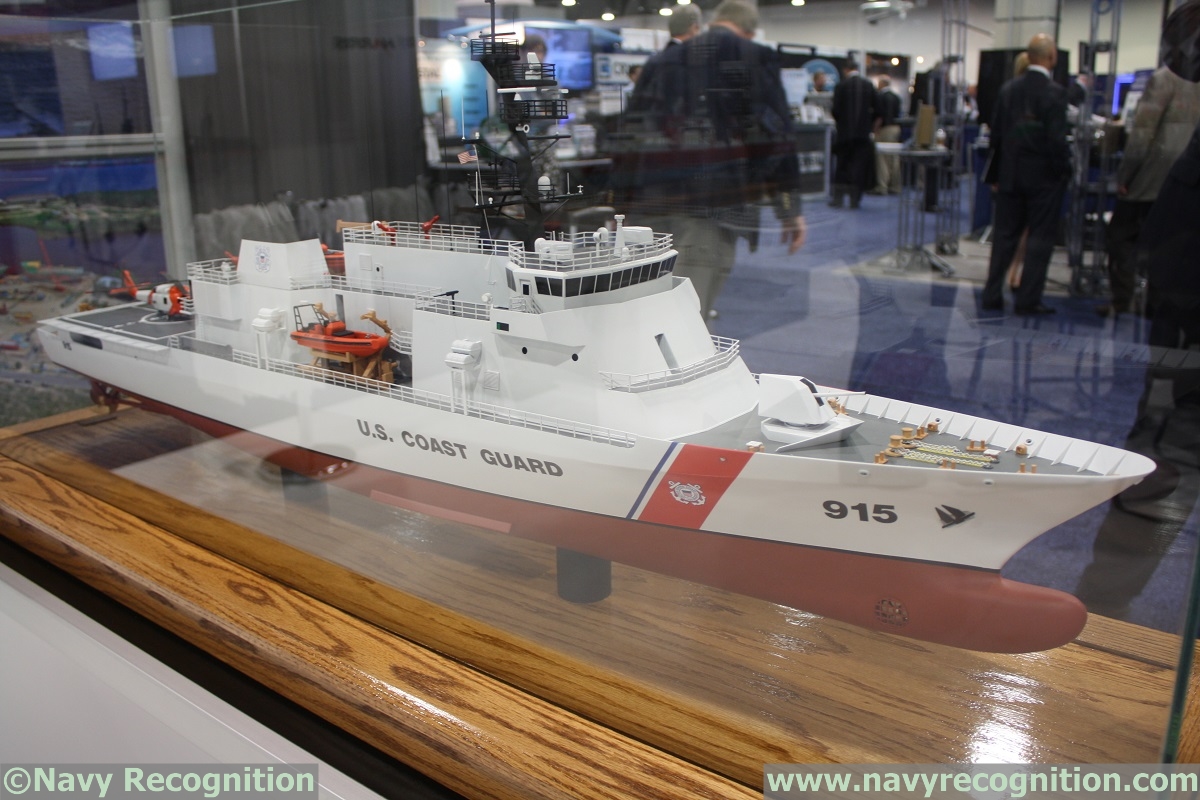
CG making progress in reducing acquisition risks for OPCs–DHS IG

IMG_4134

Photo: Eastern’s proposed Offshore Patrol Cutter (OPC) concept. One of three shipyards contending for the contract

FierceHomelandSecurity is reporting,

“An internal audit says that the Coast Guard is making progress in reducing acquisition risks of more than two dozen offshore patrol cutters, but it’s still too early to tell whether the service has fully implemented two risk mitigation recommendations that were previously made by the inspector general.

“One recommendation directs the Coast Guard to make sure it’s achieved a level of “design maturity” in its engineering plans, meaning that the designs are fully developed prior to construction.

“The other instructs the service to ensure that “low-rate initial production” – that is producing enough quantities of cutters to test, evaluate and approve before full production – are supported by an operational assessment. This assessment evaluates proposed cutter designs against operational requirements and identifies risks.

The Commandant has said they have looked so closely at the designs that they questioned the number of water fountains (scuttlebutts for the sailors). That sounds like design maturity, but then the purpose was to save money, not to ensure operational competence. I would hope we have done that as well. We are certainly taking long enough to make sure the designs are mature.

I would take issue with the statement, “Under a two-phase strategy, the service plans to acquire 25 OPCs to replace an equal number of medium endurance cutters.” These 25 ships are intended to replace 32 WMECs, four of which have already been decommissioned, 13 270s, 16 210s, the Alex Haley, Acushnet, and Storis. In 2000 we had 44 large cruising cutters; if the program of record is fully implemented we will have only 33. The misguided “Crew Rotation Concept” which, even if it works, will not give us the same number of ship days away from home port as 44 ships, even if we have to pay for 44 crews, is biting us. (Note, it appears to me this statement was made by FierceHomelandSecurity rather than as part of the IG report.)

The DHS IG report referred to, regarding the OPCs, is this document, “Verification Review of U. S. Coast Guard’s Acquisition of the Sentinel Class Fast Response Cutter (OIG-12-68),” that can be accessed through the FierceHomelandSecurity post.

The alarming aspect of this, is the insistence on “low rate production” until the design is tested. It seems we have been planning low rate production all along, with only one ship per year to be funded for the first three years, and no more than two per year after that, meaning with production of 25 ships, we will not see the last ship delivered until 2035. That sounds pretty low rate to me.

If we fund as expected (one per year for three years, then two per year), there will be a shift to funding two ships per year before the first ship has completed testing. Is two ships per year a high rate which the IG might oppose? Is there any possibility that after testing we might be able to build OPCs at a rate higher than two per year (as we really should)?

I have still heard no suggestion that the Coast Guard will take advantage of the multi-year/block buy procurement that Congress has authorized for the OPC, nor have they requested authority for Multi-Year procurement of the Webber class WPCs which certainly qualify as a mature and tested program.

There was a time when the Coast Guard took delivery of 28 ships in nine years.  It really looks like the we are going to need similar surge in the future to prevent a collapse of our capabilities.

GAO makes astounding discovery

With an amazing grasp for the obvious, the GAO has once again reported (pdf) that the Coast Guard is not getting, or expected to get, the money it needs to fund its program of record in a timely manner.

“…the Coast Guard’s acquisition needs are not affordable based on past and expected future funding levels.”

Basically they are repeating their findings for the past several years, and as always their solution to not making the goal, is to move the goal post.

“GAO found in June 2014 that budget officials have acknowledged that the Coast Guard’s current plan for developing new, more capable assets is not affordable given current and expected funding levels. For the past 5 years, GAO has found that the Coast Guard’s acquisition funding has fallen short of what it estimates it needs to fully recapitalize its assets. The Coast Guard has responded by annually delaying or reducing its capability. The Coast Guard and the Department of Homeland Security (DHS) have taken some steps to address these affordability issues, but as yet these efforts have not led to the types of significant trade-off decisions among resources and needs that would improve the long-term outlook of the Coast Guard’s acquisition portfolio.”

Frankly the Congressional Research Service, reports written by Ronald O’Rourke, are far more informative, and despite his position mandated neutrality, more supportive of the Coast Guard, but still this document does have some interesting observations.

Fixed Wing Aircraft

The Coast Guard has a Program of Record goal of 52,400 flight hours for its fixed wing assets. Currently the fleet performance is 38 percent short of this flight hour goal, but even if all currently planned assets are procured, we will still be 18 percent short of the flight hour goal. How come? First, instead of getting 36 C-144s we will be getting only 32 aircraft, 18 C-144s and 14 C-27J. The award winning C-144 acquisition program has been suspended even though the Coast Guard knew they were going to be at least four planes short. Second, instead of the 1,200 hours per year per Medium Range Search (MRS) Aircraft, the Coast Guard has decided it can expect only 1,000 hours per year.

The GAO reports the Coast Guard plans to complete a fixed-wing fleet mix analysis by 2019, which will revisit the current flight hour goal.

“The Coast Guard has begun to rewrite its mission needs statement and concept of operations and plans to complete this effort by 2016. The Coast Guard plans to complete its full fixed-wing fleet mix analysis, which includes the assets it estimates will best meet these needs, by 2019, but has not set forth specific timeframes for completing key milestones. We recommended in our March 2015 report that the Secretary of Homeland Security and the Commandant of the Coast Guard inform Congress of the time frames and key milestones for completing the fleet mix study, including the specific date when the Coast Guard will publish its revised annual flight hour needs and when it plans to inform Congress of the corresponding changes to the composition of its fixed-wing fleet to meet these needs. DHS concurred with our recommendation but did not provide specific time lines for meeting this recommendation. The bill for the Coast Guard Authorization Act of 2015, introduced in April 2015, requires a revised Coast Guard fixed-wing aircraft fleet mix analysis to be submitted to congressional transportation committees by the end of fiscal year 2015.”

OPCs/WMECs:

The report raises for the first time I have seen in official documentation, the possibility that some WMECs will have to be retired well before replacement. They report that currently there is no plan to extend the service life of these legacy assets and no money programmed in the five year capital investment plan. As a result the CG “faces a potentially significant capability gap.”

NSCs:

All though the National Security Cutters have all been funded, they may yet adversely effect future AC&I budgets.

As we also reported in June 2014,  further changes may be needed due to issues discovered through operating the NSC, which could result in the Coast Guard having to spend even more money in the future to ensure the NSC fleet meets requirements and is logistically supportable.

“For example, the cutter is experiencing problems operating in warm climates, including cooling system failures, excessive condensation forming puddles on the deck of the ship, and limited redundancy in its air conditioning system affecting use of information technology systems. According to operational reports from a 2013 deployment, the Commanding Officer of an NSC had to impose speed restrictions on the vessel because of engine overheating when the seawater temperature was greater than 68 degrees. In addition, cold climate issues on the cutter include a lack of heaters to keep oil and other fluids warm during operations in cold climates, such as the arctic. Further, Coast Guard operators state that operating near ice must be done with extreme caution since the ice can move quickly and the NSC could sustain significant damage if it comes in contact with the ice. In June 2014 we reported that while senior Coast Guard officials acknowledged that there were issues to address, they stated that the Coast Guard has not yet determined what, if any, fixes are necessary and that it depends on where the cutter ultimately operates.”

Webber Class WPCs:

In April 2015, the Coast Guard accepted delivery of the 13th of 58 FRCs and now has 32 of the cutters on contract. As we reported in April 2015, the Coast Guard is introducing additional competition into this purchase by recompeting the construction contract for the remaining 26 vessels; this contract is planned to be awarded in fiscal year 2016. According to the Coast Guard, the FRC has already been used to rescue over 400 undocumented immigrants, seize nearly $20 million in contraband, and apprehend several suspected drug smugglers. The fiscal year 2016 Capital Investment Plan includes $1.47 billion over the next 5 years to continue purchasing these assets by which time the Coast Guard plans to have fielded 42 FRCs.


The Future:

As I noted earlier, we have to look beyond these programs and the GAO addresses this concern.

“…senior Coast Guard officials have stated a need for over $2 billion per year, but the Coast Guard has received $1.5 billion or less over the past 5 years. The President’s budget requests $1 billion for fiscal year 2016. In an effort to address the funding constraints it has faced annually, the Coast Guard has been in a reactive mode, delaying and reducing its capability through the annual budget process but without a plan to realistically set forth affordable priorities. The Coast Guard, DHS, and Office of Management and Budget officials have acknowledged that the Coast Guard cannot afford to recapitalize and modernize its assets in accordance with the current plan at current funding levels. Efforts are underway to address this issue, but so far, these efforts have not led to the difficult trade-off decisions needed to improve the affordability of the Coast Guard’s portfolio. We recommended in 2014 that the Coast Guard develop a 20-year fleet modernization plan that identifies all acquisitions needed to maintain the current level of service—aviation and surface— and the fiscal resources needed to buy the identified assets. We recommended that the plan should consider trade-offs if the fiscal resources needed to execute the plan are not consistent with annual budgets. The Coast Guard concurred with our recommendation, but its response did not fully address our concerns or set forth an estimated date for completion.

“In June 2014, we also reported that the Coast Guard faces a potentially expensive recapitalization of other surface assets, such as the polar icebreakers and its fleet of river buoy tenders, as these assets continue to age beyond their expected service lives and, in some cases, have been removed from service without a replacement. These issues pose additional potential challenges to the affordability of the Coast Guard’s overall acquisition portfolio.”

Icebreakers—According to program officials, due to funding constraints, the Coast Guard chose not to invest in either of its heavy icebreakers as they approached the end of their service lives. Thus, both heavy icebreakers were out of service from 2010 to 2013 and the Coast Guard could not complete missions, such as resupplying a science laboratory in Antarctica. The Coast Guard has recently returned one of these heavy icebreakers back to service, but still has one fewer heavy icebreaker than it has historically operated and several fewer than it needs, according to the Coast Guard’s June 2013 heavy icebreaker mission need statement. The fiscal year 2016 President’s Budget asks for $4 million for continued preparatory studies to develop a cost estimate, among other things. The associated fiscal year 2016 Capital Investment Plan contains $166 million for polar icebreakers over the next five years but does not identify what this money is for, though it is far short of the estimated $831 million needed to build the vessel. The Coast Guard is currently working with several U.S. government agencies to develop requirements and establish a plan to build a heavy icebreaker that could be jointly funded by the U.S. government agencies that need the asset to accomplish its missions.

River Buoy Tenders—”The Coast Guard is facing a gap in its river buoy tender fleet and has yet to formalize an acquisition project to replace this fleet—a project estimated to cost over $1.5 billion.”

HH-60 and HH-65 Helicopter Fleets—”The HH-60 and HH-65 helicopter fleets will approach the end of their lifespans between 2022 and 2026 and will need to either be replaced or have a service life extension performed to keep them operational. Regardless of the future path, significant acquisition dollars will be required to maintain annual flight hours for the next 20 years, according to Coast Guard program officials.”

Observations:

When the GAO says, “We recommended in 2014 that the Coast Guard develop a 20-year fleet modernization plan that identifies all acquisitions needed to maintain the current level of service (emphasis applied, Chuck)—aviation and surface— and the fiscal resources needed to buy the identified assets” it gives the impression they are not looking at the benefit side of the cost/benefit equation. It also looks like they may be ignoring the changes in the world since the legacy fleet was built. After all, when the 210s and 378s were built there, was no Exclusive Economic Zone and the territorial sea was 3 miles. 9/11 was still decades in the future. Our Navy was many times larger and it had units based all along the coast in almost every major port.

On the other hand they may be giving us a criteria for defining how fast existing resources should be provided. If we say resource hours should never drop below those provided by the legacy fleet, then really it looks like we need to build faster.

The units that the Coast Guard is currently building are obviously more capable than the units they are replacing and with the possible exception of the National Security Cutter (NSC), they are also going to be more expensive to man and operate.

The Bertholf class NSCs are about 50% larger than the 378s, but at least they have a smaller crew.

The OPC appear to be likely at least 50% larger than the 270 and possibly as much as three times the size of the 210s. They will likely have crews at least as large as the 270s, and significantly larger than the 210s.

The Webber class are more than twice as large as the Island class and have a crew almost half again as large.

I do believe there are reasons for this apparent growth, but it means the Coast Guard does need more money than it has in the past. Coast Guard leadership may have felt that they had been assured that funding for these more expensive assets would be available, given approval of the original Deepwater program and the revised post 9/11 upgraded Deepwater program, but while the money may come, the most expensive part of the program, the offshore patrol cutter, is only being funded in dribs and drabs.

Too often it seems we emphasize the good things the service has done for the country and left unsaid the failures, lost opportunities, and the very real risks we take when the service is not properly funded.

It appears that for several years, perhaps more than a decade, the resource hours from Coast Guard assets, may fall below those of the legacy fleet, either because assets must be decommissioned without replacement, or because of unplanned maintenance requirements. If we could establish a consensus that at least resources hours available should not be allowed to fall below those that were provided by the legacy fleet, we would have a convincing argument for more reasonable funding levels.

Navy’s New Patrol Boat, PB-X

The Navy has initiated a “request for information” (not a request for proposal yet) for a new maritime security/force protection patrol boats about 40 foot (12 meters) in length to replace about 100 existing 25 and 34 foot boats. You can read the solicitation here.

Can’t help but think there would be some benefit if they selected a hull in common with the Coast Guard.

To some extent this sounds a bit like the Coast Guard’s Response Boat Medium (RB-M), but in has some specific requirements for transportability that might rule out a version of the RB-M.

The other CG boat that might provide a basis is the Long Range Interceptor.

The solicitation does include some requirement I don’t think were part of the CG specifications that would require some modification. Here are the specifics:

Mobility & Operational Responsiveness –
Note: The Navy desires to meet boat speed and endurance requirements as specified below and will allow for flexibility in payload requirements. Payload may be varied in order to meet boat speed and endurance requirements.
• Cruise Speed of 25 knots
• Sprint Speed of 40 knots
• 12 hours endurance at patrol to cruise speed
• Range: 250 nautical miles
• Capable of carrying mission payload of at least 4,000 pounds and up to 8,000 pounds (desirable); mission payload includes weapons, ammunition, crew, passengers, and any portable/removable mission systems
• Length: 40 feet (nominal)
• Capable of operating in seas with a 3 feet significant wave height; shall have reduced operating capability in up to 5 feet significant wave heights
• Crew: 2-Operators and 3-Gunners/System Operators; Additional seats and space are desired for up to four additional mission personnel; Shock mitigating seats required for all crew and mission personnel

Propulsion –
• Boat must be powered by diesel fuel and be capable of operating on JP-5 and JP-8
• Propulsion equipment should be suitable for operating in shallow water with vegetation, debris and obstacles

Survivability (Ballistic Protection) –
• At a minimum the craft requires protection against 7.62 mm ball rounds for personnel and critical equipment (e.g., propulsion system and controls)

Lethality (Armament) –
• Space and weight needed for three weapons mounts suitable up to .50 caliber guns
• Space and weight needed for a single station Stabilized Small Arms Mount (SSAM), suitable for up to a .50 caliber gun or MK 49 or MK 50 Gun Weapon Systems

Sustainability (Reliability) –
• The craft will allow for affordable Total Ownership Costs by leveraging hull, mechanical and electrical systems that are already in use by the Navy; Leveraging systems that will allow for increased PB-X buying power commonality with other NECC boats is desired
• Innovative hull, mechanical and electrical systems are of interest provided that they can be fielded and supported within the next 2 to 4 years, employ non-developmental technologies, and have proven reliability

Transportability –
• Sea
– Capable of being transported as deck cargo on Naval Amphibious and Military Sealift Command ships; Specifically, the craft will be launched and recovered; floated-on and off well-deck Amphibious type ships; or transported on a Roll-On/Roll-Off cargo ship with own trailer
• Land
– Must be road transportable on U.S. and NATO roads/highways and comply with applicable oversize load restrictions without escort
– Road transportable also includes off-road (dirt, gravel without significant obstacles) with rough terrain capable trailer
– Capable of launch and recovery from a road transport trailer on a boat ramp
– Capable of being towed by existing NECC prime movers such as a Freightliner FL80 tow truck (40,000 pounds tow) or Medium Tactical Vehicle Replacement MK36 Wrecker truck (22,000 pounds tow)
– In preparation for land, air, or sea transport the craft must allow for removal and stowage of fendering, masts, arches and platforms and weapons; transportation preparation should take less than 4 hours
– The craft shall have hoist fittings that allow for crane launching and external airlift

• Air
– Internal air transportable in a C-5 or C-17 (see Department of the Army Field Manual Number 55-9, Chapter 2. Air Mobility Command Aircraft for space and weight restrictions)
– External air transportable by the CH-53 (34,700 pound weight limit)

Other Desired Characteristics:
• Minimum operating depth of no greater than 5 feet with a target vessel draft of 3 feet or less
• The hull draft structural design shall be compliant with ABS High Speed Craft (HSC) or Det Norske Veritas (DNV) that are appropriate for the construction material, hull form and speed of the PB-X
• The following stability standards are desired: US Navy Standards for single compartment flooding; and, US Navy Small Craft Beam winds and rolling; passenger crowding standards
• The following electronics/systems will be provided by the boat builder: Commercial AIS,
GPS Chart plotter, Radar, Marine VHF, Emergency Positioning Indicating Radio Beacon (EPIRB), Law Enforcement lights/siren
• The craft should be capable of launching, operating and recovering unmanned systems such as a MK18 Mine Countermeasures Underwater Vehicle System Mod MK 18 Mod 2 (approximate dimensions: 10 feet x 12 inches; weight 500 pounds)
• Construction standards should allow for a service life of 15 to 20 years
• The craft should be outfitted with heavy duty commercial grade fendering/rubrails or strakes, or foam filled sponsons preferred.

(Thanks to Lee for bringing this to my attention.)

The Coast Guard’s Missing Links–the Commandant

The Coast Guard Compass has published a post by the Coast Guard Commandant Adm. Paul Zukunft arguing for Offshore Patrol Cutter. This is obviously a topic close to my heart, and I don’t think anyone will mind if I quote it here whole cloth.

“Twenty miles east of the Dominican Republic, the Coast Guard Cutter Charles Sexton rescued 117 people from a dangerously overcrowded 30-foot makeshift craft. Hours later, the Coast Guard Cutter Stratton interdicted $14 million worth of cocaine and apprehended three suspected smugglers. In two days, on two coasts, two assets proved the multi-mission might of the U.S. Coast Guard as crews saved lives, secured our border and severed cash flows to a transnational criminal enterprise.

“The Charles Sexton, a 154-foot fast response cutter, and the Stratton, a 418-foot national security cutter, are part of the Coast Guard’s persistent presence, patrolling and protecting more than 95,000 miles of coastline and 4.5 million square miles of the U.S. Exclusive Economic Zone – home to our Nation’s precious resources, including our oil, natural gas, fish and mineral reserves. The vastness of this area, paired with our array of missions, requires a network of Coast Guard surface and air assets on shore and at sea to preserve America’s security and prosperity.

“Missing from this network – the necessary link between the national security cutter’s open ocean endurance and the fast response cutter’s littoral presence – is the offshore patrol cutter. The offshore patrol cutter will promote governance and provide capability on our oceans – the gateway for U.S. economic growth, opportunity and prosperity. It is here, beyond 50 nautical miles from U.S. shores, where national interests in the U.S. maritime domain require the Coast Guard’s unique blend of authorities. And, it is the offshore patrol cutter that will protect our sovereign interests, enforce laws, save lives, protect fisheries, secure offshore energy resources and provide command and control for major response and contingency operations.

“Currently, the 1960s-era 210-foot and the 1980s-era 270-foot medium endurance cutters are the link between the Coast Guard’s national security cutters and fast response cutters. However, this link is under untenable strain, characterized by decreasing readiness and skyrocketing maintenance costs. In the last two years, four of these aging ships had to be pulled out of service for emergency repairs, straining our ability to support and maintain other ships and aircraft, impacting crew safety and quality of life and diminishing the Coast Guard’s ability to project U.S. authorities and respond to crisis in the maritime domain. This past weekend, I went aboard our newest medium endurance cutter, Coast Guard Cutter Mohawk in Key West, Florida. Mohawk was commissioned in 1991 and will continue to serve our Nation until it is replaced with the next generation of offshore patrol cutters close to five decades after she began her service.

“I carried these thoughts with me as I set foot aboard the Coast Guard Cutter Robert Yered, one of our newest fast response cutters. Leaping forward nearly half a century from our oldest ships, the Robert Yered’s modern, high-tech systems are fully interoperable with our partners in the interagency and international community as it executes missions across our littorals. This nimble fast response cutter is not, however, without its limitations. It cannot launch and recover aircraft – a necessary capability in the Coast Guard’s operational network of assets – and has limited range and endurance relative to our major cutters. The Coast Guard must have flight deck capable ships with robust command and control capabilities exactly where we need them, from the farthest reaches of the transit zone off of Central America to our northernmost borders off of Alaska. The offshore patrol cutter is designed to fill this need.

“Our aging platforms do not suffer from neglect. Coast Guard men and women consistently demonstrate exceptional commitment and innovation to sustain a medium endurance cutter fleet that has served admirably for more than five decades. In fact, our first medium endurance cutter went to sea the very same year the first Mustang rolled off Ford’s assembly lines. Unlike antique cars, however, which are often restored at great expense and used for the occasional fair weather Sunday drive, the increasingly expensive ships of America’s Coast Guard are painstakingly maintained and regularly put to work in the harshest maritime conditions.

“Indeed, not having reliable use of these aged medium endurance cutters, the linchpin of our operational network, puts us at a disadvantage at a time when we are needed most. Given the complex threats facing the Nation today, we simply do not have the luxury of storing them in the garage.

“The U.S. Coast Guard has a proud history spanning nearly 225 years. We have won federal acquisition awards, maintained clean financial audits and earned a reputation for responsible stewardship. We cannot afford to dull our operational edge and jeopardize our Service to Nation any longer. The Nation deserves better, and the offshore patrol cutter is the answer.”


USNI Support for the Coast Guard

The US Naval Institute has an opinion piece strongly supporting the US Coast Guard, written, perhaps surprisingly, by a retired US Navy Rear Admiral, Terence E. McKnight.

Being of a cynical nature, I suspected RAdm. McKnight might be employed by Huntington Ingalls (HII), since he was advocating more Bertholf class National Security Cutters, and he has advocated for other HII products in the past, but there is apparently no direct connection.

Since the first Offshore Patrol Cutter is not due to be commissioned until 2022 now (having slipped again), it certainly would not hurt to get a ninth NSC.

NATO Trains Boarding Teams

DefenseMediaNetwork has a story about how Visit, Board, Search, and Seizure (VBSS) training is being done at a NATO facility in Souda Bay, Greece, on the Island of Crete. The only reference to the US Coast Guard is identification of an individual in one of the photos as a USCG officer, but I suspect the Coast Guard was involved in developing the course.

Perhaps the most interesting revelation to me was that they have a vessel dedicated to the training.

“…the 2,500-ton ex-HS Aris (A 74), formerly the Hellenic Naval Academy cadet training ship, serves as a realistic platform for live training for a variety of boarding scenarios. The ship is equipped with smoke, flashing strobes, booby traps, noise to create confusion, and role players to be rescued, detained or captured. Trainees use weapons that fire small paint pellet rounds. During the course of training, the difficulty and complexity of the scenarios can be increased. There are numerous cameras to monitor progress of training evolutions, ensure safety, and provide video for debriefing. When the teams leave they take with them a DVD with the video of their training. Aris will soon be joined by a decommissioned mine countermeasures ship, the ex-HS Alkyon (M211), which is at NMIOTC now and being modified for live training.”

This sounds like a good idea that the Coast Guard might want to consider.

(Thanks to Lee for bringing this to my attention.) 

Citations from D-Day

Below are some citations for valor for Coasties who participated in the D-Day invasion.

CLARK, George C., LTJG, USCGR, British Distinguished Service Cross, During the landing of Commandos at Quistreham by LCI (S) on 6 June 1944 Lt. Clark’s cutter was detailed to act as escort to LCI (S) HM LCI(S) 524 on clearing the beach after landing troops received a direct hit and blew up in a sheet of flames leaving a mass of blazing Octane petrol on the water. Although his cutter burned Octane petrol, he did not hesitate to street is craft into the flames and rescue the commanding officer and some of his men.

FRITZCHE, Edward H. CAPT, USCG, Legion of Merit, For exceptionally meritorious conduct, both in the preparation and execution of the amphibious assault on the coast of France June 6, 1944. Captain Fritzche was in command of a main group of the Assault Force, composed of a mixed fleet of American and British transports and American landing craft. He brought these ships an craft to their predetermined stations in the transport area, successfully effected their prompt and efficient unloading and expedited the assault troops and equipment to the designated beaches.—Gold Star in lieu of a second Legion of Merit, For meritorious conduct as commanding officer of a Coast Guard transport prior to and during the amphibious invasion of Southern France August 15, 1944. He efficiently organized and trained his ship and boat group to execute the assigned mission of loading transporting to the assault area and landing the embarked Army assault units on the invasion beaches. His able conduct contributed materially to the effective establishment of the beachhead and to the over all success of the invasion.

GISLASON, Gene R., LT, USCGR, Silver Star, For outstanding heroism as Commanding Officer of the USS LCI (L) 94, while landing assault troops in Normandy June 6, 1944. He successfully directed his ship through numerous beach obstacles to the proper beach, discharged his troops and retracted while his ship was seriously damaged from heavy enemy fire. Ship’s communications, engine telegraph and electric steering were disabled by direct hits on the pilothouse which killed three crewman and one screw and shaft were rendered inoperative by beach obstacles. By his coolness under fire and excellent seamanship, Lt Gislason overcame these difficulties and brought his ship off the beach on hand steering and one screw. He later supervised repairs and in four hours enable the LCI (L) to remain operative in the assault area for three weeks.

HENLEY, Coit T., LTJG, USCGR, Silver Star, For heroism as Commanding Officer of the USS LCI(L) 85 while landing assault troops in Normandy, France, June 6, 1944. Lt Hendley successfully landed his troops despite the mining of his vessel, fire in three compartment and concentration of enemy fire while unloading. His courage and seamanship in directing repairs and retracting from the beach resulted in saving the lives many wounded aboard.

IMLAY, Miles Hopkins, CAPT, USCG, Silver Star, For conspicuous gallantry as Deputy Commander of an Assault Group participating in the initial invasion on the coast of France , June 6, 1944. Undaunted by heavy enemy fire, Captain Imlay courageously took station close to the shore on the early morning of D-Day and throughout the most bitter period of the fighting, coolly and promptly made spot decision on the reorganization, grouping and dispatching of craft to the beach, subsequently relieving the Task Group Commander of his duties when he withdrew his transport from the assault area, immediately thereafter, he was placed in charge of operations afloat as assistant to the naval Officer in Charge of one of the beaches and discharging the duties of this responsibility with distinctive professional ability, contributed essentially to the rapid clearing of the backlog of ships.

OXLEY, Gene E., Sea. 1c [ Seaman, First Class], USCGR, Silver Star, For gallantry while on the USS LCI(L) 85 during the assault on the coast of France June 6, 1944 and for extraordinary courage in volunteering and twice taking a line ashore, in the face of heavy machine gun and shell fire in order to assist troops unloading from the ship to the bench through chest deep water.

SALMON, Robert M., LT, USCGR, Silver Star, For gallantry as commanding officer of a U.S. LCI (L) while landing assault troops in Normandy, France June 6 1944. He pressed the landing of troops despite the mining of his vessel a serious fire forward and heavy enemy gunfire. He supervised the unloading of troops, directed the fire fighting despite the loss of proper equipment and exhibiting courage of high degree remained with the ship until it was impossible to control the progress of the fire and it was necessary to abandon ship over the stern. After abandoning he directed a party searching for fire fighting equipment and subsequently fought the fire on another LCI (L) and assisted her commanding officer until she was abandoned.

VERNON, Albert, LTJG, USCGR, Bronze Star, For meritorious service as Commanding Officer of a Coast Guard Cutter in rescuing survivors of the invasion off the coast of France June 6, 1944. During D-Day, his cutter rescued 97 men. Each rescue was effected in the face of constant enemy fire from the beach which was in no way allowed to deter the splendid rescue operations.

VYN, Arend, Jr., LTJG, USCGR, Silver Star, For gallantry in action as commanding officer of USS LCI 91 in the assault on the cost of France June 6, 1944. LTJG Vyn beached his ship and discharged the Army elements therein the face of murderous fire and a labyrinth of obstacles and mines. In spite of the fact that his ship was mined and repeatedly struck by artillery fire and small arm fire, he continued to land the army load in the face of certain loss of his ship. his determination to put the Army ashore was in keeping with the highest traditions of the offensive spirit of the U.S. Naval Service.

While this happened a little later, I have to add it as part of the invasion story.

WALSH, Quentin R., CDR, USCG, Navy Cross, For heroism as Commanding Officer of a U.S. Naval party reconnoitering the naval facilities and naval arsenal at Cherbourg June 26 and 27, 1944. While in command of reconnaissance party, Commander Walsh entered the port of Cherbourg and penetrated the eastern half of the city, engaged in street fighting with the enemy. He accepted the surrender and disarmed 400 of the enemy force at the naval arsenal and later received unconditional surrender of 350 enemy troops and at the same time released 52 captured U.S. Army paratroopers.

D-Day 71 years ago

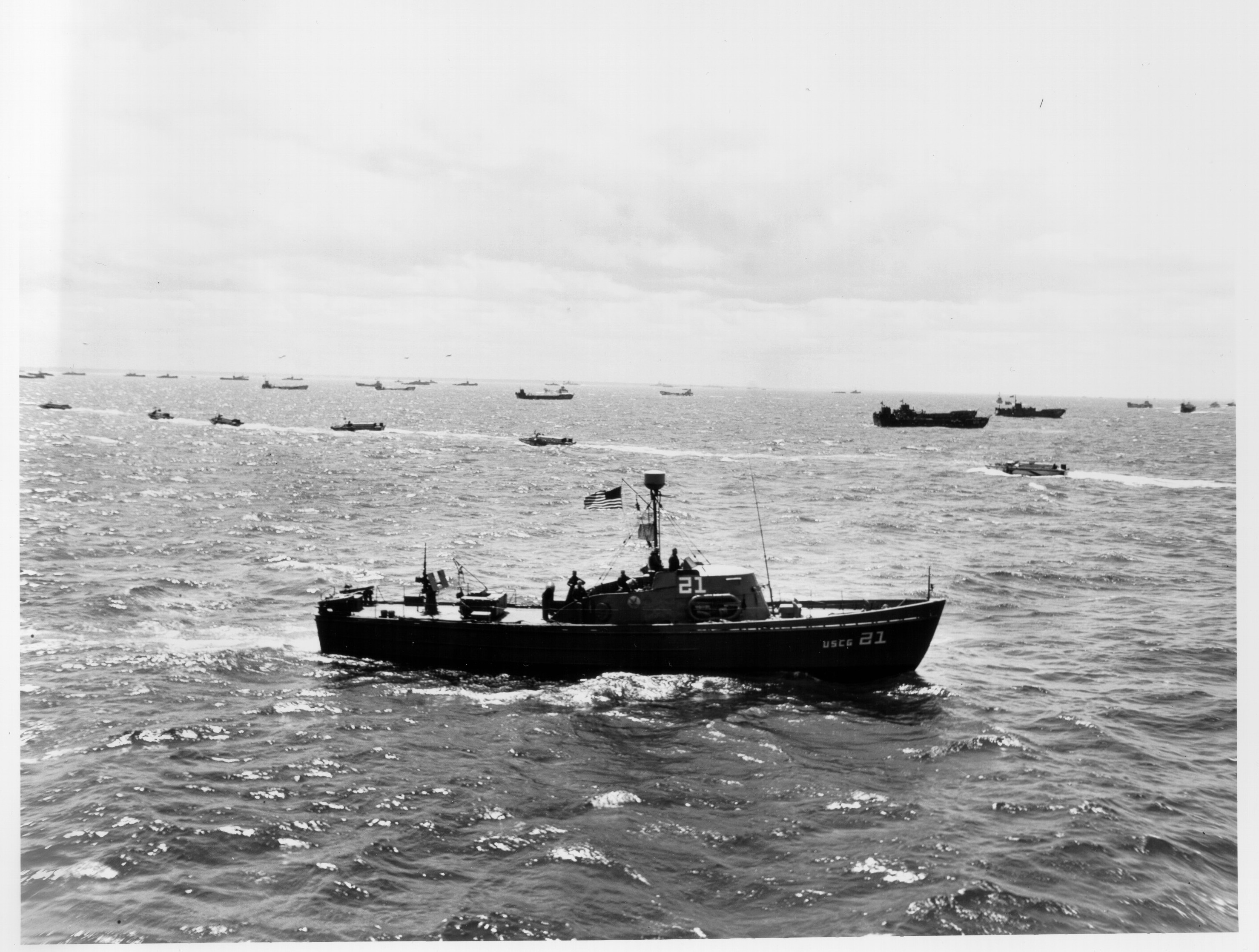
The 83-foot Coast Guard cutter USCG 1 off Omaha Beach on the morning of D-Day, tied up to an LCT and the Samuel Chase

The 83-foot Coast Guard cutter USCG 1 off Omaha Beach on the morning of D-Day, tied up to an LCT and the Samuel Chase

A long salute to the Coasties who were off (or on) the coast of France 71 years ago today. I will just point to a couple of previous posts.

D-Day, 6 June 1944

D-Day, Normandy Remembered

“Crew of CG-16 pointing to the tally board of 126 rescued soldiers.”
Photo courtesy of Terry Hannigan.
(NOT AN OFFICIAL USCG PHOTOGRAPH)

USCG 83 ft patrol boat, probably June 1944. Photographer unknown.

USCG 83 ft patrol boat, probably June 1944. Photographer unknown.