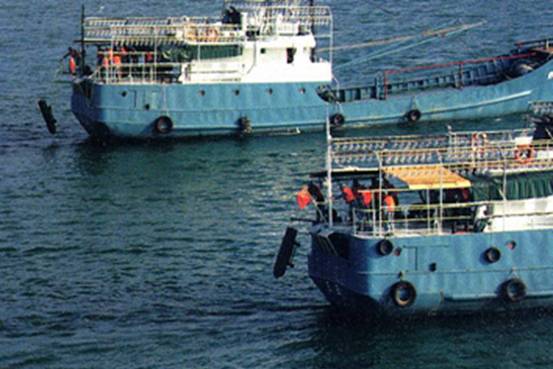
Janes is reporting Singapore’s Navy has recently acquired some new boats that are different to say the least. The 22 meter (72 foot) vessels are intended for base defense, force protection, and maritime security operations.
Oceans Beyond Piracy has launched the fifth installment of its annual reports detailing the economic and human costs of maritime piracy. “The State of Maritime Piracy 2014” examines both human and economic costs incurred as a result of piracy occuring in the Western Indian Ocean and the Gulf of Guinea, with a never before included analysis of the human cost of piracy in Southeast Asian waters.
A couple of things stand out. The number of seaman being held hostage is way down. The ocean areas around SE Asia are again the most significant areas of danger for piracy (or for robbery inside territorial waters, which is also included in the report, but not technically piracy). That is not to say that the probability of any particular vessel being attacked is higher off SE Asia than in the Gulf of Guinea given the volume of traffic through the waters of SE Asia.
Since before recorded history, merchant vessels have been adapted for offensive purposes by navies, pirates, and privateers to destroy enemy commerce or to launch attacks ashore. Frequently they employed disguise and deception. The UK employed Ships Taken Up From Trade (STUFT) during the 1982 Falklands War, the Malaysian Navy has converted two container ships into pirate hunters, and the US Navy has leased ships to support special operations, but I think the last time they were used to attack commerce was WWII. By the end 1943, it appeared that technology, primarily in the form of reliable radios, plus robust challenge-and-reply procedures, a comprehensive naval control of shipping organization, and a seemingly impervious blockade of the German coast, had made this type of warfare very dangerous, but new technology may now be working in favor of using converted merchant ships as clandestine warships.
The German Experience
During World Wars I and II, the German Navy achieved considerable success using armed merchant ships as clandestine merchant raiders. At small cost they sank or captured a large number of allied merchant vessels, tied down a number of warships searching for the raiders, and even managed to sink allied warships.
In World War I, three raiders, Wolf, Moewe, and Seeadler (a full rigged sailing ship), sank or captured 78 ships totaling 323,644 tons. In addition to the merchant ships they captured or sank directly, merchant raiders proved effective mine layers. One victim of a mine laid by the raider Moewe was the pre-dreadnought battleship EdwardVII, sunk on 6 January, 1915.
In World War II nine German Merchant raiders, Atlantis, Komet, Kormoran, Michel, Orion, Pinguin, Stier, Thor, and Widder, sank or captured 129 ships, totaling 800,661 tons. While this pales in comparison to the sinkings by U-boats, they were far more effective than the regular navy surface raiders, including the vaunted pocket battleships, heavy cruisers, and battleships Scharnhorst and Gneisenau, that managed to sink or captured only 59, totaling 232,633 tons. The merchant raider Kormoran even managed to torpedo and sink the light cruiser HMAS Sydney, before the Kormoran herself was also sunk.
Typically, the raiders of WWII were equipped with six obsolescent 5.9″ guns and large numbers of torpedoes to allow ships to be sunk rapidly. Most were also equipped with aircraft and some with torpedo boats. They were also equipped to change their appearance while underway.
Several of their voyages were extraordinarily long. Michel’s first voyage was 346 days. Orion’s was 510 days. Thor was away 329 days and managed to sink HMS Voltaire, an armed merchant cruiser. Pinguin for 357 days. Komet for 512 days. Kormoran for 350 days before her fatal encounter with HMAS Sydney. The ships were refueled and rearmed by supporting vessels that also took their prisoners. Raiders were also used to resupply submarines.
Perhaps surprisingly, none of these WWII raiders were underway when the war began, when they might have been most effective. They were sortied in two waves in 1940 and 1942.
END OF THE MERCHANT RAIDER
Despite their successes, by the time the last German raider at sea was sunk on 7 September, 1943, by a US submarine shortly after it had sortied from Japan, it had become impossible for ships to sortie from Germany and make it to open sea. Komet and a tenth raider were both sunk attempting to do so. Three of the nine, Atlantis, Pinguin, and Kormoran, were sunk in distant seas by British cruisers. One, Stier, was sunk by the Naval Armed Guard on the Liberty ship Stephen Hopkins. One was destroyed by a nearby explosion while moored in Yokohama. Two, Orion and Widder, survived their career as raiders long enough to return to Germany and be repurposed.
REBIRTH–Weapons and Sensors, Old and New
Technological changes in the form of containerized cruise missiles, satellites and UAVs and other Unmanned Vehicles may have made the merchant cruiser once again a viable option.
Cruise missiles mean that the raider no longer needs to come with visible range of the their victim. With sufficient range and use of way points, the shooter can be over 100 miles from its victim and the missile can come from any direction, not necessarily from the direction of the raider. Plus they can now attack land targets as well as ships. The US has begun to think seriously about the threat of a cruise missile attack on the US and innocent looking container ships are a possible source.
UAVs can provide over the horizon targeting and are likely to be undetected by the target.
Satellites may help or hurt potential raiders. If they have the support of satellites, it may help them find their pray. If the defenders are sufficiently sophisticated (and they are looking in the right place) they may be able to recognize a missile launch as the first step in finding, fixing and destroying the raider.
Similarly the Automatic Identification System may help the raider or the defender. It may help the raider find targets, but it may also help the defender react more swiftly to an attack or help him identify the raider from among all the other ships in the area. There is always the possibility the information may be bogus. Unmanned Surface Vessels might be used to create false targets. We might want to plan for a system of encrypted information for contingencies. Limiting use of the systems is an option that may require careful consideration.
Mines are still potentially effective. The large carrying capacity of cargo ships means they could potentially lay large mine fields. A raider could knowing a war will start soon might lay a large field to be activated when hostilities begin. If hostilities have already begun, the raider is unlikely approach a port closely enough to lay the mines itself, but mobile mines already exist, and Unmanned Underwater Vehicles or even simple semi-submersible unmanned vessels that can lay an minefield should be relatively easy technology.
China, Perpetrator or Target
From an American point of view, China with its huge merchant fleet and large inventory of cruise missile may appear a possible user of Merchant Raiders, but their large merchant fleet and need to import may also make them vulnerable to this this type of warfare if employed by weaker nations.
We know China has a Naval Militia. that will allow them to rapidly increase the size of their naval force. China has recently said it would require its ship builders to incorporate features that would make them usable for military purposes in wartime. These requirements are to be applied to five categories of vessels – container, roll-on/roll-off, multipurpose, bulk carrier and break bulk. What these additional features are to be, is not clear. This could mean upgraded communications, either external or internal. It could mean improved survivability, greater speed, or foundations for weapons upgrades. They may only be thinking of using these ships to support amphibious operations, but these improvements may also make a large number of ships potential merchant raiders.
China’s large merchant fleet and need to import raw materials may make her vulnerable to Guerre d’Course. In the kind of low intensity conflict we have seen between China and her neighbors, it has seemed China has had all the advantages, but if they are pushed too far, China’s neighbors might see this form of warfare as a way to push back.
Non-State Actors
There is also the possibility of terrorist organizations attempting something similar, but they are more likely to attack highly visible targets of a symbolic nature, such as port facilities or major warships. Cruise missile could of course be used to attack major landmarks. They may also be less interested in living to fight another day.
Conclusion: I don’t think we have seen the end of offensive use of Merchant vessels.
INS Saryu, the lead ship of her class of offshore patrol vessels of the Indian Navy. Indian Navy Photo
We have a report from Brahmand.com, there is at least a possibility India’s future Offshore Patrol Vessels (OPVs) will be built with Anti-Ship Cruise Missiles ASCMs).
India’s leading defence shipyard, Goa Shipyard Ltd (GSL) has submitted a proposal to the Indian Navy to construct offshore patrol vessels (OPVs) armed with missiles.
“We have submitted a proposal to the Indian Navy that all the future OPVs should be developed with the missile on board.
That will give more combat muscle to the vessel. If fitted with missile, the pricing of the vessel goes up only by ten per cent,”
Of course, that does not necessarily mean the proposal will be accepted, but it would make sense, if the Indian Navy is, like the US Navy, thinking in terms of “Distributed Lethality.” Or as it is sometimes expressed, “If it floats, it fights.”
I found the 10% additional cost estimate interesting, but I suspect adding an ASCM capability to the projected CG Offshore Patrol Cutters (OPCs) would probably be closer 5%, given the much higher cost of building the platform in the US. Manning requirement would probably increase at most three enlisted and an officer.
A photo published in a report on Chinese mine warfare by the U.S. Naval War College shows Chinese civilian fishing vessels practicing deploying sea mines at a naval base in Sanya in 2004. —Courtesy of U.S. government
The Wall Street Journal has an interesting story about China’s Naval Militia. It employs not only the crews of their fishing industry, but also their vessels, to support China’s Navy and Coast Guard. It certainly blurs the line between government and non-government vessels.
Presumably this organization also extends to include their ocean going vessels and their crews as well. This is all the more interesting because of China’s recent announcement that they would require the incorporation of military characteristics in newly constructed container, roll-on/roll-off, multipurpose, bulk carrier and break bulk civilian vessels.
India’s new buoy tender looks very different from those the USCG uses, looking more like an Offshore Support Vessel. Take a look at this report from Bairdmaritime. Maybe they are on to something.
Frankly, I have a hard time interpreting what this new law really means. But because it appears that it will extend enforcement authority over many ships that are not US flag, I presume this will bring the Coast Guard, as the primary Federal maritime law enforcement agency, additional authority and responsibilities. Here is a short review. I am unfamiliar with the source, so I can’t really vouch for it, but sounds like this may be important.
If any of the readers is knowledgeable on this topic, I would appreciate your perspective.
Federal Times is reporting the contents of the Coast Guards latest authorization bill, and there are some surprises.
The item I was particularly pleased to see, was a apparent interest in something I feel should be more closely watched, cutter days available.
Part of that requirement would be to implement a standard for tracking the number of days Coast Guard cutters are in operation at sea, and include days in which cutters are undergoing maintenance or repair.
That should be revealing. In considering what should be expected, I would suggest we look back a few years, say take a five year average from 1998 to 2002 as a baseline.
There are lots of other proposed changes, not the least is that it is to cover two years. I suggest you check it out.
An interesting chart showing the strength of various components of the Coast Guard’s personnel strength from the bottom of the post-WWII demobilization through FY2012.
In interpreting the chart, note that there are two different vertical axis scales.
A few things seem to stand out.
1. The Coast Guard has not been shrinking. There have been ups and downs but the size of the service is at or near an all time high. It is a little more than twice as large as it was in 1947, but to put that into perspective, the US population has also a bit more than doubled, so the number of Coasties as a percentage of the population is about the same, but not as high as it has been.
2. There was a dip in the number of auxiliarists about ten years ago, but this may be recovering.
3. Recently there has been a notable rise in the number of permanent civilian staff. Could these be (CG-9) Acquisitions staff?
4. The ratio of officers (O-1 and above) to enlisted has shown a steady rise. Where previously there were about one officer for seven or eight enlisted, there are now about one for six. Frankly this is not as much of a change as I thought it might have been.
We should stop saying the Coast Guard is smaller than the New York City Police Department. It is no longer true.
What we can say is, that the Coast Guard is, in terms of personnel, larger than the French Navy or Britain’s Royal Navy or any NATO navy, other than that of the US or Turkey.
I think it would also be true to say, that we have the oldest fleet, and not by just a little bit.