This Day in Coast Guard History, February 4

Based on the Coast Guard Historian’s timeline, https://www.history.uscg.mil/research/chronology/
With inspiration from Mike Kelso

February 4
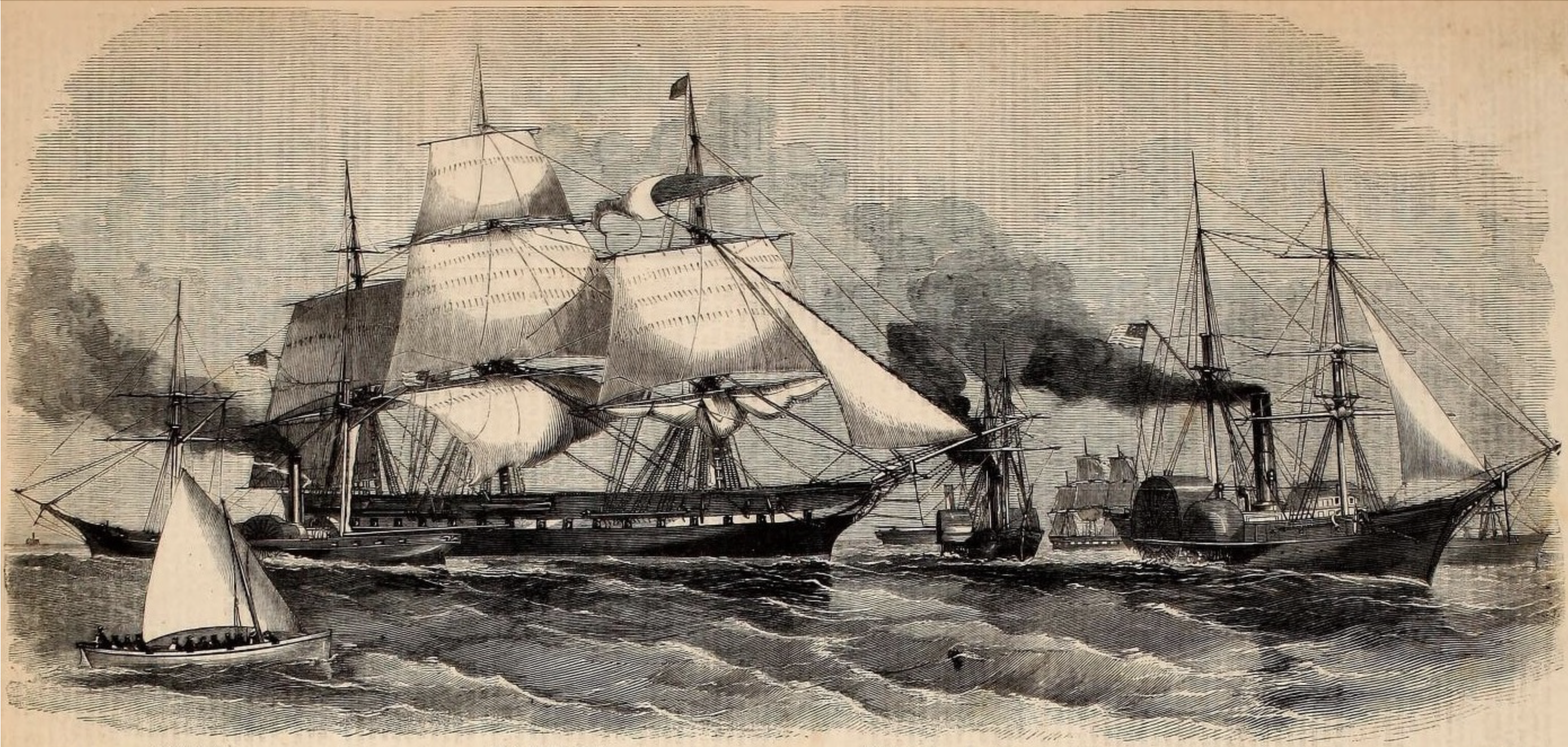
The Paraguay Squadron. Harper’s Weekly, New York, 16/10/1858

1859  The United States signed the “Treaty of Friendship, Commerce and Navigation” with Paraguay at Asuncion after the revenue cutter Harriet Lane, as part of a U.S. Navy expedition, forced the opening of the Paraguay and Parana Rivers.

1863  Commissioned officers of the Revenue Cutter Service were to be appointed by the President by and with advice and consent of the Senate.  This act contained the first statutory use of term “Revenue Cutter Service.”  Previous laws referred only to “revenue cutters”.
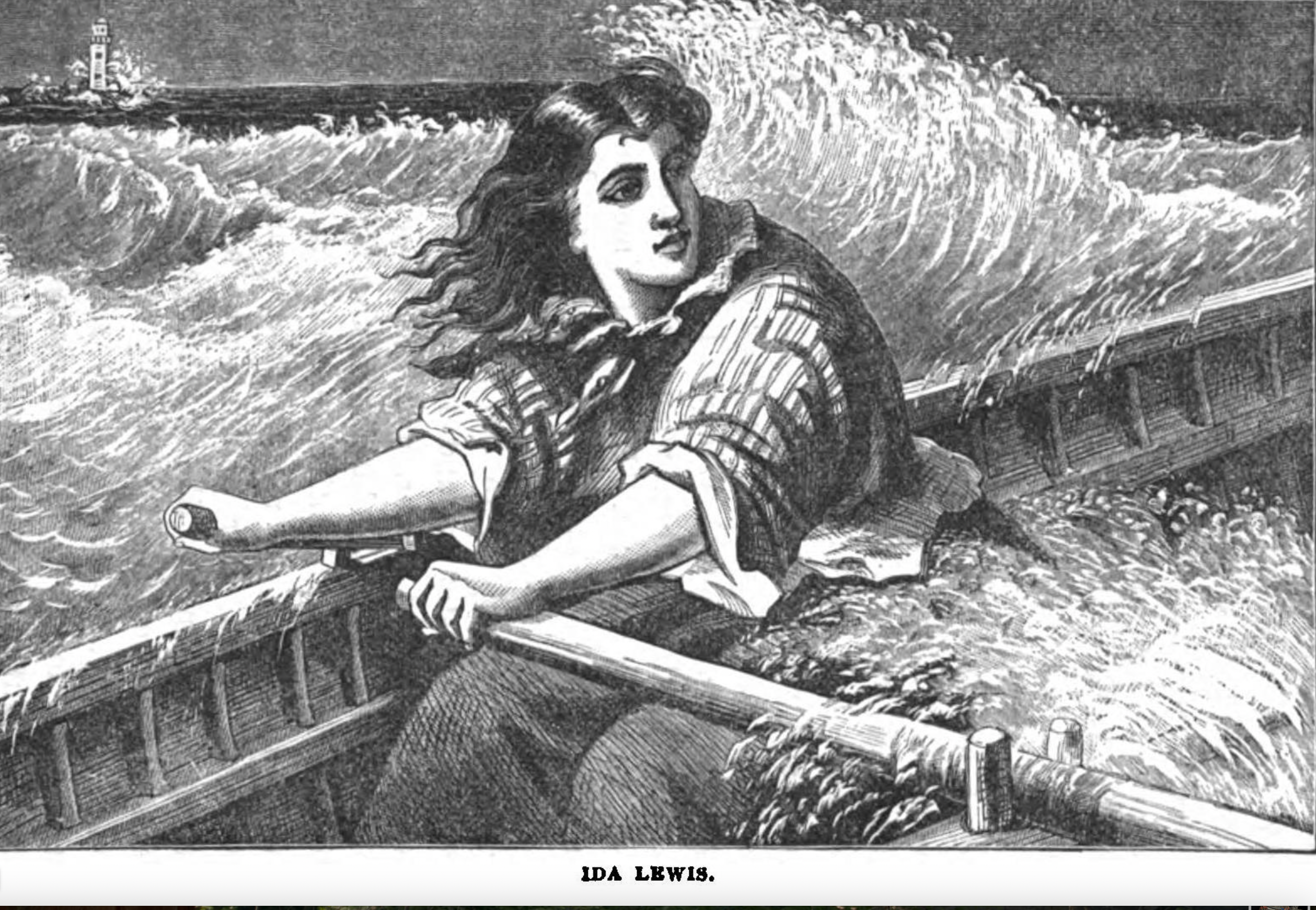
Woodcut of Ida Lewis, light-house keeper, Women of the century By Phebe Ann Hanaford 1876

1881  Keeper Ida Lewis, the head keeper of the Lime Rock Lighthouse, rescued two soldiers from Fort Adams who had fallen through the ice “at the imminent risk of Mrs. Lewis-Wilson’s life.”  For her heroic actions she was awarded a Gold Lifesaving Medal.  She was officially credited with saving 13 persons during her distinguished career with the U.S. Lighthouse Service “and it is understood that the number was probably much greater.”

1982  Attorney General William Smith declared at a press conference that Operation Tiburon was “the most successful international marijuana interdiction effort to date.”  The operation began in November 1980, and accounted for the seizure of 95 vessels.  It was a combined operation that included elements of the Coast Guard, the Drug Enforcement Administration, the Customs Service, and various state and local law enforcement agencies.

M/V New Carissa On February 4, 1999, the M/V New Carissa, a 639-foot bulk freight ship of Panamanian registry, went hard aground in heavy seas about 150 yards off a stretch of remote, undeveloped sandy beach three miles north of Coos Bay, Ore. The ship was intentionally ignited to burn the fuel oil and later broke in two. NOAA photo.

1999  The 639-foot freighter New Carissa ran aground north of Coos Bay, Oregon.  Coast Guard helicopter crews rescued 23 crewmembers, but the vessel remained firmly aground and attempts to refloat her failed.  A unified command made up of Coast Guard and Navy personnel, as well as marine salvors, attempted to prevent a catastrophic oil spill as the ship began breaking apart. The team decided to set the oil on board the New Carissa on fire so it would burn away before being spilled and fouling the shore.  It was the largest “in situ” burn ever tried in U.S. waters and it consumed a significant amount of the oil aboard the New Carissa.  The Coast Guard’s annual report for that year noted: “While some oil did spill out of the vessel, the unified command’s efforts greatly reduced the potential environmental damage to the Oregon coast.”  The ship eventually broke in two and her bow section was towed to sea and sunk by the Navy.

USCGC DILIGENCE returns to Pensacola.

2014  CGC Diligence returned to its homeport of Wilmington, North Carolina, after completing a 49-day patrol in the North Atlantic Ocean in support of Operation Atlantic Venture.  The combined efforts of Diligence and the other Coast Guard assets involved in the operation resulted in nearly 75 vessel inspections that identified numerous violations of federal safety and fisheries regulations.

This Day in Coast Guard History, February 3

Based on the Coast Guard Historian’s timeline, https://www.history.uscg.mil/research/chronology/
With inspiration from Mike Kelso

February 3

1801  Treaty of peace with France was ratified on this date, thereby ending the “Quasi-War,” in which cutters of the Revenue Marine had rendered valiant service.

1880  Date of a terrific gale on the New Jersey coast.  Six vessels came ashore with 47 persons on board; all but two survived.  Nineteen Life-Saving Service crewmen were awarded Gold Life-Saving Medals during the rescue of the persons aboard the wrecked George Taulane.

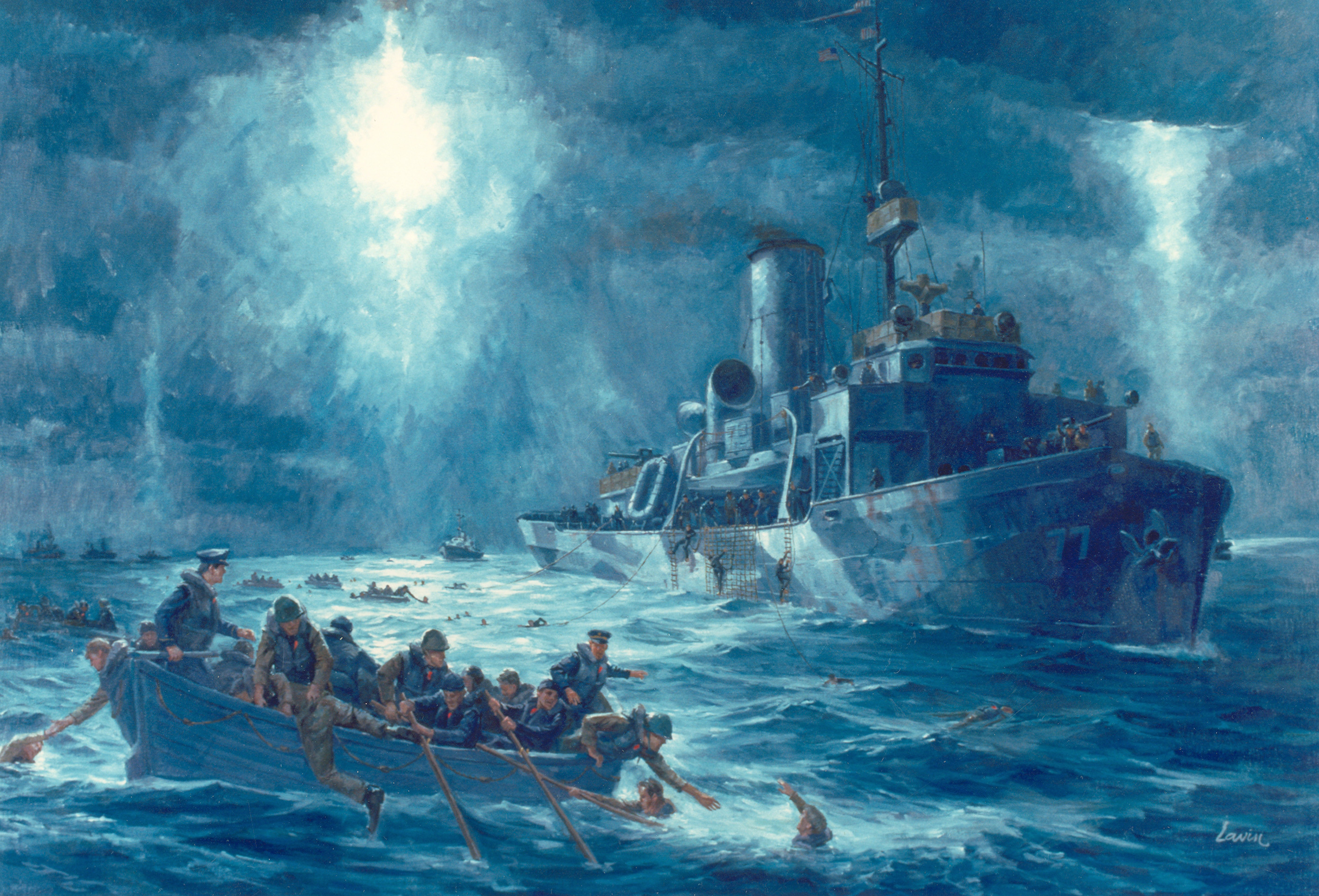
Escanaba rescuing survivors from USAT Dorchester. USCG Image.

1943  A U-boat torpedoed the transport USS Dorchester off the coast of Greenland.  Two of her escorts, CGCs Comanche and Escanaba, responded.  The crew of Escanaba used a new rescue technique when pulling survivors from the water.  This “retriever” technique used swimmers clad in wet suits to swim to victims in the water and secure a line to them so they could then be hauled onto the ship.  Although Escanaba saved 133 men (one later died) and Comanche saved 97, over 600 men were lost, including the famous “Four Chaplains” who gave up their lifejackets to those that did not have one and all four went down with the ship.

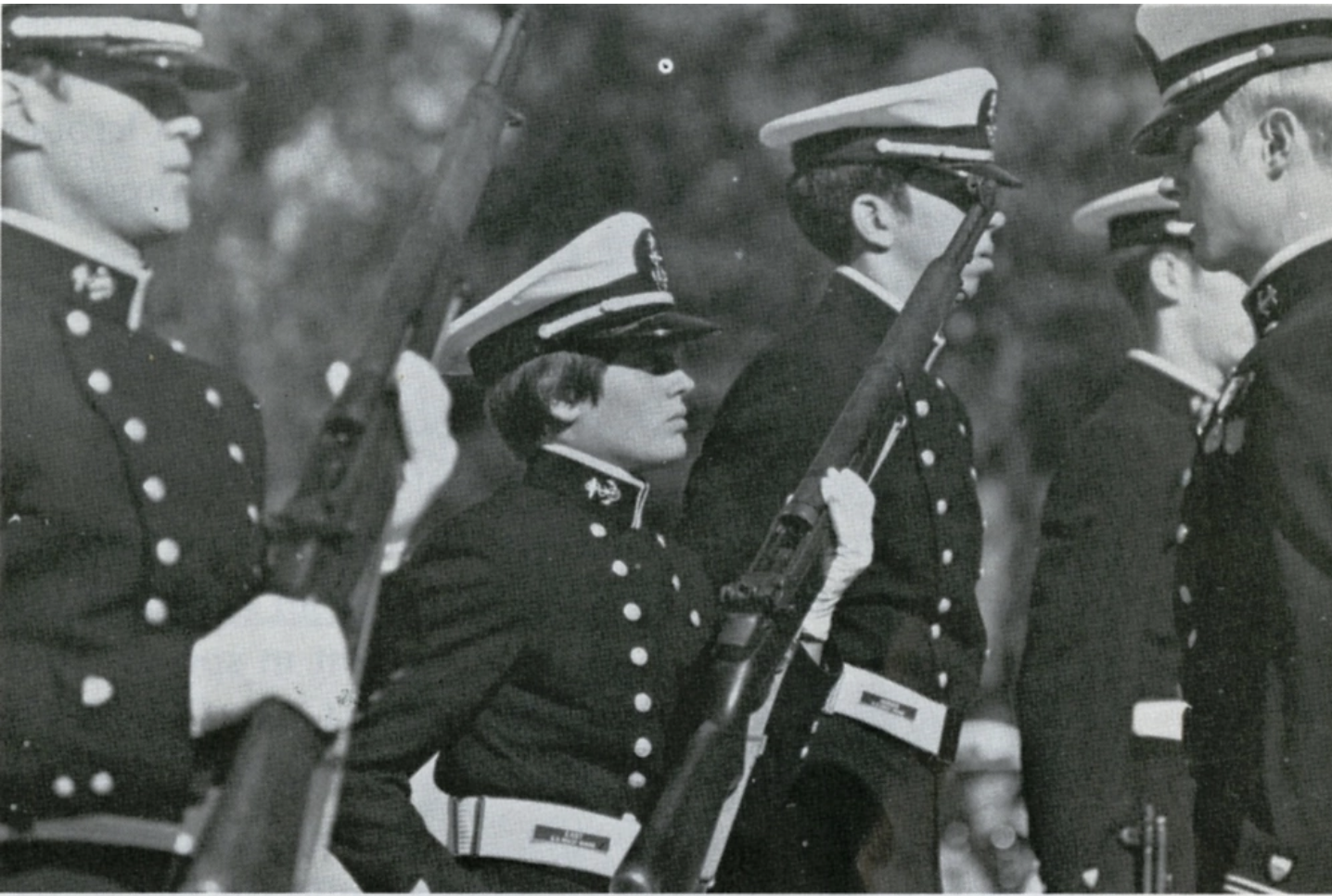
Cadet Mary Jane East in dress uniform during rifle inspection on the Academy parade grounds. (U.S. Coast Guard Photo) 11/24/2020

1976  The Coast Guard Academy first announced the appointments of 50 cadets to enter with the Class of 1980, including three women: Cathryn Lis of Bristol, Connecticut; Susan Kollmeyer of Groton, Connecticut; & Cynthia Snead of Melbourne, Florida.  The Coast Guard News Release published on February 4, 1976 regarding their announcement noted that: “Of the four largest federal service academies (Army, Navy, Air Force, Coast Guard) the Coast Guard Academy is the first to offer an appointment to a woman.” (USCG News Release No. 7-76; 4 February 1976).

1997  The 660-foot freighter Contship Houston ran aground on a coral reef 12 miles southeast of Key West in the Florida Keys National Marine Sanctuary.  The vessel, under Coast Guard supervision, was safely floated off the reef some 144 hours later.

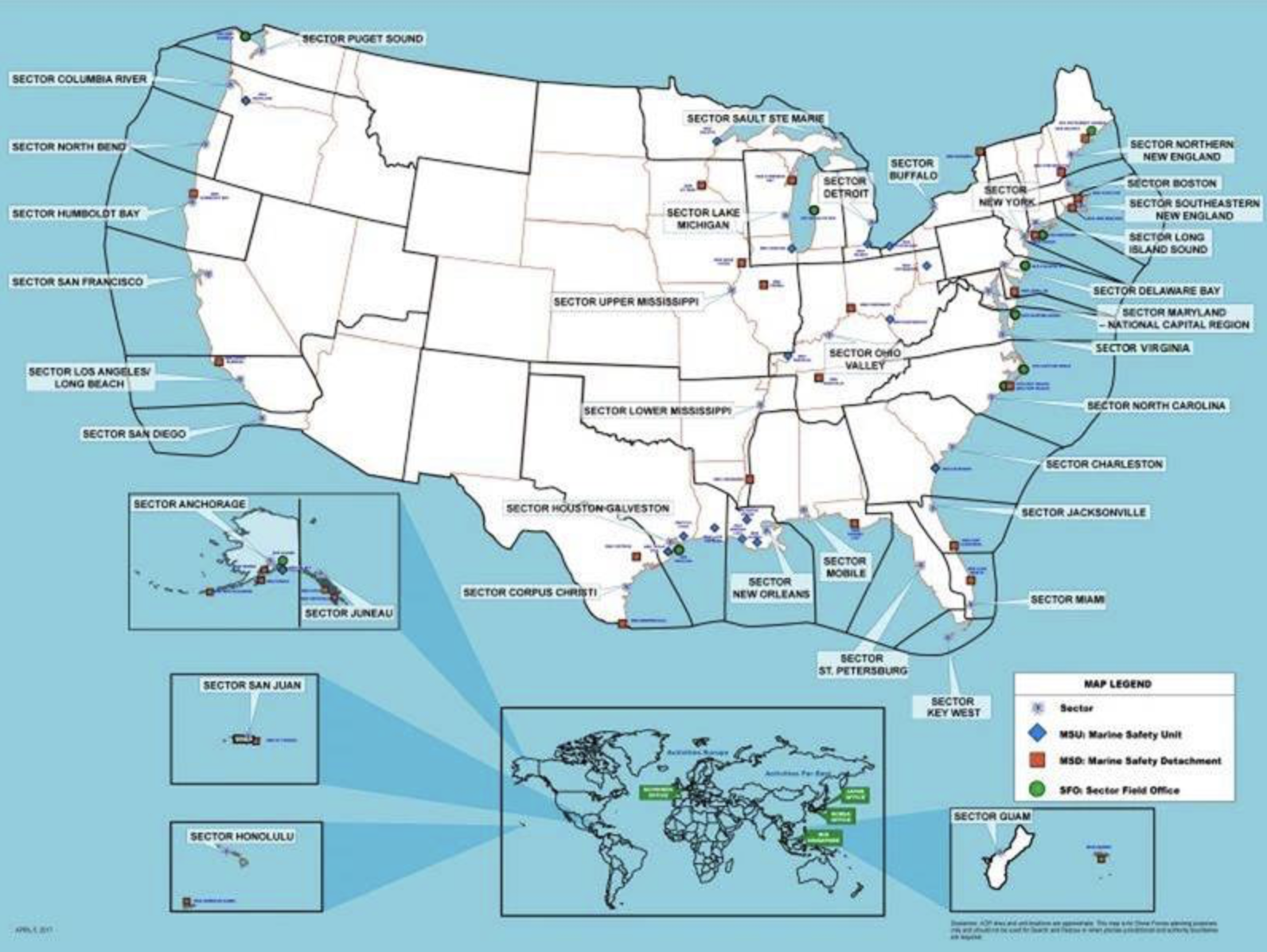
“Maritime Coastal Border Security and the Role of USCG R&D” –Marine Link

Map shows the locations of 37 Coast Guard Sectors. Source: https://homeport.uscg.mil/Pages/Sector-Map.aspx

Marine Link provides a post by Bert Macesker, Executive Director, USCG Research and Development Center and Dr. Joe DiRenzo, the Center’s Partnership Director, that discusses what the Coast Guard R&D Center is doing to enhance maritime border security in all its forms.

The National Naval Strategy

Five aircraft carriers and six big deck ampibs at Norfolk Naval Station

I will, for the moment step outside my accustomed role as a retired Coast Guard curmudgeon, and comment on the National Naval Strategy. Please forgive me, but this is the most “bully pulpit” I have. I got to thinking about this when the discussion of the Panama Canal noted that USN carriers cannot use the Canal and would take a very long time to join any naval conflict with China.

There is no longer any tactical or strategic reason that deployment of the US Fleet should be split 50/50 between the Atlantic and Pacific. 

Russia is a fading shadow of the former Soviet Union with a smaller GDP than Canada. Our Atlantic Sea lines of communication are essentially secure. Russia is by no means ready to take on all of NATO, They can barely handle Ukraine.

China on the other hand is increasingly aggressive. Their rapidly growing fleet enjoys a home field advantage in the Western Pacific, particularly while half our fleet is based in the Atlantic.

Most of our ships and all of our aircraft carriers should be based in the Pacific.

In Europe, we have plenty of land bases we can operate aircraft from. Nevertheless, Britain, France, and Italy should be encouraged to coordinate their carrier deployments so that one of them is always immediately available

Big deck amphibious ships like LHAs operating F-35Bs and MH-60R ASW helicopters can fill in for what little carrier aviation we need in the Atlantic and Mediterranean.

In the Pacific we have few permanent air bases close to where conflict is likely. Carrier based aircraft can be the difference between victory and disaster.

The situation is starting to look much like World War II, when virtually all US fast carriers were assigned to the Pacific Fleet

Right now we operate aircraft carriers singly, even in the Western Pacific. Singly an aircraft carrier can barely defend itself against Chinese anti-access systems, much less go on the offensive.

Operating aircraft carriers in pairs with augmented escorts gives them a much better chance of both surviving and going on the offensive. One can play defense while the other prepares a massive strike.

Ten carriers in the Pacific would mean we could have a ready pair in the Western Pacific at all times. They and their larger destroyer squadron could even work up together before deployment.

The current distribution of shipyards capable of doing maintenance on aircraft carriers may suggest basing all US aircraft carriers in the Pacific may be impossible. It might be necessary to open a new shipyard. Vallejo might be an option. A fourth USN Pacific operating base on US soil could be advantageous. If a new shipyard is developed in the Pacific, if it were government owned and operated it could speed emergency repairs, avoiding the delays of contract negotiations.

West Coast Migrant Interdiction

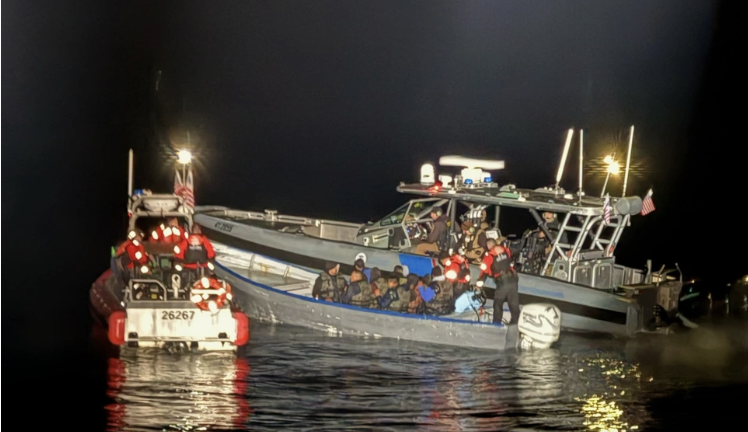
The Coast Guard Cutter Active and U.S. Customs and Border Protection interdict an alien vessel, approximately 15 miles off the coast of Mission Bay, California, Feb. 2, 2025. The crew of Active and CBP members worked together to interdict this alien panga-style vessel, which had 16 aliens aboard. (U.S. Coast Guard courtesy photo)

I don’t have any hard figures, but it seems West Coast migrant interdictions are becoming more common, perhaps even more frequent than in the Caribbean, though the number of migrants in each attempt seems smaller than in LANTAREA interdictions.

Feb. 2, 2025

Coast Guard interdicts 16 aliens near Mission Bay

SAN DIEGO — Coast Guard interdicted a vessel with 16 aliens aboard approximately 15 miles off the coast of Mission Bay, Sunday morning.

At approximately 12 a.m., U.S. Coast Guard Cutter Active notified Joint Harbor Operations Center of a 25-foot panga-style with around 15-20 people aboard approximately 1 mile south of their position.

The cutter Active and a U.S. Customs and Border Protection Air and Marine Operations boatcrew then launched boarding teams to assess.

The Coast Guard boarding team discovered 16 aliens aboard the panga. Initial interviews revealed that all the aliens claimed Mexican nationality.

The aliens were safely transferred to U.S. Border Patrol custody.

The Coast Guard remains committed to protecting lives at sea while working alongside our federal partners to combat illicit maritime activities. These operations highlight the coordinated efforts between agencies to secure our maritime borders.

Coast Guard Cutter Terrell Horne and partnership agencies intercept smuggler operated alien vessel, approximately 20 miles off the coast of Point Loma, California, Jan. 28, 2025. The crew of Guard Cutter Terrell Horne and U.S. Customs and Border Protection members worked together to interdict this illegal alien operation, which had 14 individuals aboard. (U.S. Coast Guard courtesy video)

SAN DIEGO — Coast Guard interdicted a panga with 14 aliens aboard approximately 20 miles off the coast of Point Loma, Tuesday night.

At approximately 4:45 p.m., U.S. Customs and Border Protection notified Coast Guard personnel at the Joint Harbor Operations Center of a panga-style vessel traveling north toward the maritime boundary line.

The Coast Guard Cutter Terrell Horne was diverted to the scene. The cutter launched a boarding team, and with CBP’s assistance, successfully interdicted the vessel.

The boarding teams discovered 14 individuals aboard the panga. Initial interviews revealed that all individuals claimed Mexican nationality.

The aliens were safely transferred to U.S. Border Patrol custody.

The Alien Migrant Interdiction Operations (AMIO) mission provides effective law enforcement presence at-sea and achieves three main objectives: deter undocumented migrants and transnational smugglers from using maritime routes to enter the U.S.; detect and interdict undocumented migrants and smugglers far from the U.S. border; and expand Coast Guard participation in multi-agency and bi-national border security initiatives. Strong partnerships and information sharing with other agencies, such as Customs and Border Protection (CBP), are critical to mission success. While the Coast Guard leads the interdiction mission on the high seas, partnerships with CBP and Immigration and Customs Enforcement are critical for successful shore-side interdiction operations.

Jan. 28, 2025

Coast Guard interdicts 21 migrants near Point Loma

U.S. Coast Guard District Eleven

SAN DIEGO — Coast Guard interdicted a panga with 21 individuals aboard approximately 20 miles off the coast of Point Loma, Monday evening.

At approximately 10:45 p.m., U.S. Customs and Border Protection notified Coast Guard personnel at the Joint Harbor Operations Center of a 40-foot panga-style vessel traveling north approximately 40 miles south of the maritime boundary line.

The Coast Guard Cutter Active and the Coast Guard Cutter Terrell Horne were diverted to the scene. Both cutters launched boarding teams and, with CBP’s assistance, successfully interdicted the vessel.

The boarding teams discovered 21 individuals aboard the panga. Initial interviews revealed that all individuals claimed Mexican nationality, although subsequent checks identified two passengers as Guatemalan and Salvadoran nationals.

The individuals were safely transferred to U.S. Border Patrol custody.

The Coast Guard remains committed to protecting lives at sea while working alongside our federal partners to combat illicit maritime activities. These operations highlight the coordinated efforts between agencies to secure our maritime borders.

Jan. 21, 2025

Coast Guard interdicts 26 migrants near Oceanside Harbor

U.S. Coast Guard District Eleven

OCEANSIDE, Calif. — Coast Guard crews interdicted a panga-style vessel carrying 26 individuals approximately one mile offshore from Oceanside Harbor, Monday morning.

At around 10:30 a.m., Oceanside lifeguards reported a disabled vessel with multiple people aboard that had run out of fuel. Assessing no immediate safety concerns, lifeguards notified Coast Guard personnel at the Joint Harbor Operations Center and remained on scene.

The Coast Guard Cutter Terrell Horne was diverted to assist. Terrell Horne’s crew deployed a boarding team and safely embarked the 26 individuals, who represented multiple nationalities, including those from Mexico, China, and Vietnam. The individuals were later transferred to U.S. Border Patrol custody.

The Coast Guard works closely with partner agencies to deter and respond to dangerous smuggling operations that endanger lives.

Jan. 17, 2025

The U.S. Coast Guard and partnership agencies interdicted a 25-foot panga-style vessel carrying 15 individuals approximately 25 miles off Point Loma, Thursday.

The boat crew arrived on scene and issued commands for the vessel to stop. The operator abandoned the steering console, which caused the vessel to drift erratically. Coast Guard gained control of the vessel and turned off the engine. During this process, the panga collided with the Coast Guard small boat, resulting in minor damage to the starboard railing.

The 15 individuals aboard the vessel were determined to represent multiple nationalities, including China, Uzbekistan, Mexico, Ecuador, Vietnam, and El Salvador.

One individual was observed experiencing hypothermia-like symptoms and was transported by emergency medical services to UCSD Hillcrest for medical evaluation, accompanied by Border Patrol agents.

All 15 individuals were safely transferred to U.S. Border Patrol custody.

The Coast Guard continues to work closely with partner agencies to deter and respond to dangerous smuggling operations that put lives at risk.


“Five Key Facts About the SHIPS for America Act” –Podcast

The “What’s Going On With Shipping” podcast is not normally about the Coast Guard but it is about the Marine Transportation System with which the Coast Guard is intimately intertwined so inevitably the Coast Guard will be mentioned from time to time.

For some reason I didn’t publish this when it came out, but the act, “The Shipbuilding and Harbor Infrastructure for Prosperity and Security (SHIPS) for America Act December 19, 2024,” has yet to be signed into law and it is expected to resurface in the near future.
This particular edition has a lot to say about the Coast Guard administered mariner credentialing beginning at time 14:45. The contention is that it is much more difficult than it should be.

Where is Our Air Cover?

I am not really suggesting this, but having some Air National Guard on call would be comforting.

There is a hole in US defenses and the Coast Guard is likely to be the first to see the threat, “Who yah gone call?”

  • MSN reports on the growing maritime role of Air Force A-10s.
  • A bit more on how A-10s have been used in a maritime role here and here
  • I also seem to remember seeing that A-10s based in S. Korea have also trained to counter N. Korean small boats. A-10s can be a powerful anti-shipping weapon system.

If a threat, in the form of a merchant ship with containers that may be filled with missiles, mines, terrorists, a dirty bomb, a nuclear bomb, or whatever horror the mind of man can imagine, should be headed for the US, the Coast Guard is the most likely agency to detect the threat. But then what?

Can your local sector commander or even district commander call for air support from a DOD unit poised to strike a target at sea in a timely manner? I don’t think so.

NORAD, the North American Aerospace Defense Command, does have a modest number of aircraft on standby, prepared to intercept air threats, mostly air national guard, but they are not trained, equipped, or prepared to take out maritime targets.

I have (several times) suggested that the Coast Guard needed at least the ability to forcibly stop any vessel, regardless of size. That would presumably allow DOD forces sufficient time to organize a response because we don’t have one pre-packaged.

I would feel a lot more comfortable if DOD units, assigned an anti-shipping role, were on standby, practiced and exercised, ready to respond to a Coast Guard call for help.

They might be Marine cruise missiles, Army attack helicopters, or Navy maritime patrol aircraft, but Air Guard A-10s look promising. This could also prepare these units for an anti-shipping role in wartime.

Target designation is always a problem in multiunit operations. Every Coast Guard unit should have at least a hand held laser target designator to allow them to mark a target for DOD units.

I know an attack using a merchant ship seems unlikely, at least in peacetime, but 9/11 was unlikely and look at the fallout from our failure to respond appropriately to the hijackings in progress, not just those killed on the ground on that day, but also two fruitless wars.

This Day in Coast Guard History, February 2

Based on the Coast Guard Historian’s timeline, https://www.history.uscg.mil/research/chronology/
With inspiration from Mike Kelso

February 2

1944  Coast Guardsmen participated in the landings at Saidor, New Guinea.

Elevated view of the loaded deck of a LST (Landing Ship, Tank) on the way from Goodenough Island to Saidor, New Guinea (present day Papua New Guinea). On the deck are many soldiers, jeeps, trucks, artillery and supplies. Tanks were probably in the hold of the ship. Another warship is in the distance. Robert Doyle wrote a caption for this image although it was not published at that time: “Packed with vehicles and soldiers, landing ship heads north for assault on Saidor, New Guinea, by task force consisting mainly of elements of Thirty-second Division. Landing was made at Saidor Jan. 2.”

US Coast Guard cutter Munro transits the Taiwan Strait with US Navy destroyer USS Kidd, US Navy

2014  The Coast Guard and Navy completed a joint mission in the Central and South Pacific under an agreement between the services to enforce fisheries laws and enhance regional security January 7 to February 2, 2014.  The partnership supported the Oceania Maritime Security Initiative, a Secretary of Defense program, which leverages Department of Defense assets transiting the region to increase the Coast Guard’s maritime domain awareness, ultimately supporting its maritime law enforcement operations in Oceania.  As part of Operation Persistent Presence and in conjunction with NOAA, a Coast Guard law enforcement team embarked the Arleigh Burke-class guided missile destroyer USS Kidd in San Diego to conduct law enforcement boardings while the vessel was in transit.  The Coast Guard-Navy team, including the two embarked MH-60R helicopters from Helicopter Maritime Strike Squadron 78, conducted 46 external visual inspections, and 13 boardings with internal inspections of fishing vessels across two separate jurisdictional areas in the Marshall Islands and Nauru exclusive economic zones.