Chuck Hill's CG Blog

Chuck Hill's CG Blog

“Coast Guard Cutter Kimball returns home following Bering Sea deployment” –CG News

U.S. Coast Guard Cutter Kimball (WMSL 756) conducts a passing exercise with the Royal Canadian Navy ship HMCS Regina while Kimball patrols the Bering Sea, July 18, 2024. During Kimball’s 122-day patrol, the crew also interacted with strategic partners in Victoria, Canada, strengthening relationships by focusing on shared interests in the Bering Sea and the expanding Artic region. U.S. Coast Guard photo by Ensign James Bongard.

Below is a Coast Guard News release. It wasn’t like the ALPATs I remember. For one thing it was four months long. There was the interaction with the Canadian Navy, shadowing Chinese warships, engagement and community outreach during a port visit in Nome, but this caught my attention.

Kimball’s crew was instrumental in conducting a proof of concept fueling at sea with the Coast Guard Cutter Bailey Barco (WPC-1122), a fast response cutter (FRC) homeported in Ketchikan, Alaska. This successful evolution extended the endurance of the Bailey Barco and resulted in Bailey Barco’s crew conducting over 10 vessel boardings in Bristol Bay, Alaska, an area not routinely accessed by FRCs due to logistical constraints.

Pacific Area has been pushing the envelope on employing the Fast Response Cutters, doing things never expected. A second set of eyes on patrol.


Aug. 7, 2024

Coast Guard Cutter Kimball returns home following Bering Sea deployment

HONOLULU — The crew of the Coast Guard Cutter Kimball (WMSL 756) returned to their home port at Base Honolulu, Thursday, after completing a 122-day patrol in the Northern Pacific, Bering Sea, and American Arctic.

Kimball’s crew patrolled in support of Operation Alaskan Groundfish Enforcer, Alaskan Sentinel and Bering Shield, promoting maritime governance by enforcing domestic fishery regulations while countering illicit maritime activity from foreign fleets along the maritime boundary line.

Kimball’s crew detected four Chinese surface combatants operating in vicinity of the Amchitka and Amukta Passage within the U.S. exclusive economic zone in early July. Under Operation Frontier Sentinel, Kimball monitored the Chinese vessels, meeting presence with presence to ensure there were no disruptions to U.S. interests in the maritime environment around Alaska.

Kimball’s crew interacted with strategic partners in Victoria, Canada, strengthening relationships by focusing on shared interests in the Bering Sea and the expanding Artic region. Kimball’s command cadre met with senior leadership from the Royal Canadian Navy at the Canadian Maritime Forces Pacific and Joint Task Force Pacific headquarters, participating in geopolitical analysis briefs and roundtable discussions on enhancing joint maritime domain awareness in the Arctic. The visit included tours of the HMCS Ottawa, HMCS Corner Brook and culminated later in the patrol with a passing exercise with HMCS Regina, promoting interoperability with the Royal Canadian Navy and simultaneously advancing the Tri-Service Maritime Strategy through U.S. sea-service engagements.

Showcasing law enforcement expertise, Kimball’s crew ensured fishing vessels in the Bering Sea were within compliance of all federal fishery conservation laws and safety requirements through the completion of twenty living marine resources boardings. Kimball’s boarding team identified one vessel operating in violation of U.S. fisheries regulations, resulting in a $4,500 violation from National Oceanic and Atmospheric Administration’s (NOAA) office of law enforcement.

Kimball’s crew protected U.S. economic interests monitoring foreign fishing vessels along the maritime boundary line, preventing U.S. economic exclusion zone incursions. Kimball’s law enforcement teams conducted a joint boarding with Customs and Border Protection and NOAA of a foreign flagged reefer vessel to inspect fish bait being imported into the United States strengthening federal partnerships in the region.

While operating in the Bering Sea, the crew demonstrated the multi-mission agility of the national security cutter’s advanced command-and-control capabilities by coordinating Alaskan based Coast Guard air and surface assets, forming dynamic force packages that dramatically enhanced the nation’s offshore search and rescue (SAR) abilities. Kimball operated with a forward deployed MH-60 Jayhawk helicopter and aircrew in Cold Bay, Alaska, and the District Seventeen command center to execute complex SAR exercises for improving, coordination, response times, and range of rotary Coast Guard assets to assist mariners in distress.

Additionally, Kimball’s crew was instrumental in conducting a proof of concept fueling at sea with the Coast Guard Cutter Bailey Barco (WPC-1122), a fast response cutter (FRC) homeported in Ketchikan, Alaska. This successful evolution extended the endurance of the Bailey Barco and resulted in Bailey Barco’s crew conducting over 10 vessel boardings in Bristol Bay, Alaska, an area not routinely accessed by FRCs due to logistical constraints.

During port visits in Alaska, Kimball’s crew engaged with local communities. In Nome, crewmembers engaged with the tribal leadership and conducted two community outreach events, including public training and engagements for “Kids Don’t Float,” a statewide initiative to prevent youth drowning incidents. Kimball crewmembers demonstrated the importance of proper life jacket use and cold immersion survival. While in Dutch Harbor, crewmembers volunteered for community events including staging tents and site facilities for summer cultural camps.

“This crew excelled at operating in one of the harshest maritime environments, rising to the challenge of meeting presence with presence when encountering strategic competitors, ensuring the safety and security of U.S. fishermen, engaging with local communities, and providing overarching SAR coverage throughout the Bering Sea” said Capt. Robert Kinsey, Kimball’s commanding officer. “The Coast Guard is a key domestic and international Arctic security leader, shaping the region to promote rule of law and prevent foreign malign influence. I couldn’t be more proud of the crew’s professionalism, dedication, and ability to work together with our partners, foreign and federal, to deliver mission excellence for the American people.”

Commissioned in 2019, Kimball is one of ten commissioned Coast Guard legend-class national security cutters and one of two homeported in Honolulu. National security cutters are 418-feet long, 54-feet wide, and have a 4,600 long-ton displacement. They have a top speed more than 28 knots, a range of 12,000 nautical miles, and can hold a crew of up to 170. National security cutters routinely conduct operations throughout the Pacific and Atlantic, where their combination of range, speed, and ability to operate in extreme weather provides the mission flexibility necessary to conduct vital strategic missions.

The namesake of U.S. Coast Guard Cutter Kimball is Sumner Increase Kimball, who was organizer of the United States Life-Saving Service and the General Superintendent of the Life-Saving Service from 1878–1915. The ship’s motto is “Wield the Paddles Together: Work Together.”
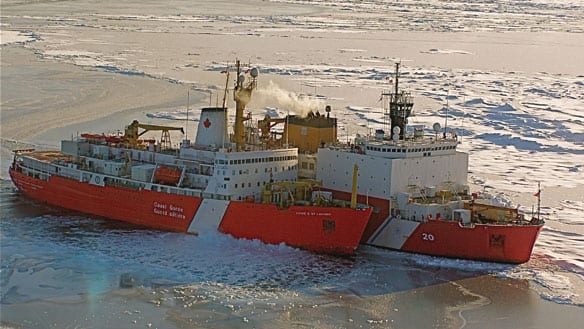
ICE Pact

USCGC Healy and CCGS Louis S St.Laurent

BreakingDefense has an article reviewing the Geopolitical situation in the Arctic and the rationale behind the Icebreaker Collaboration Effort Pact, or ICE Pact.

Notably missing from the article was any suggestion of the greater aims of the PACT. Apparently, there is much more to this than the currently planned icebreakers for the US and Canadian Coast Guards.

Several of Finland’s icebreaker vessels moored in the South Harbour at the port of Helsinki in Helsinki, Finland, May 3, 2023. Finland is among the most active builders of icebreakers. (Andrey Rudakov/Bloomberg via Getty Images)

From an earlier The War Zone report,

In an ambitious effort to counter Chinese and Russian influence in the High North, the U.S., Canada and Finland have created a resource-pooling plan to help meet a projected demand for as many as 90 icebreakers among allied nations over the next decade. These vessels offer a critical capability in a region with increasing strategic significance.

:…if we look at Allied nations that are trying to purchase icebreakers over the next decade, it’s 70 to 90 vessels.”

I don’t really see a market for 90 icebreakers that only break ice for other ships to follow. Neither report talked about potential changes in Antarctica, but both poles may see more research followed by mineral extraction and possible over-fishing. The ships building now will still be relatively young when the Antarctic Treaty is up for renegotiations in 2048, if it lasts that long, and establishing a strong negotiating position requires commitment between now and then. Allies in South America, Australia, and New Zealand will certainly be concerned about developments in Antarctica.

There may be a market for large numbers of ships that can safely transit the margins of the Arctic Ocean either as a short cut between the Atlantic and Pacific or for access to minerals in the Arctic.

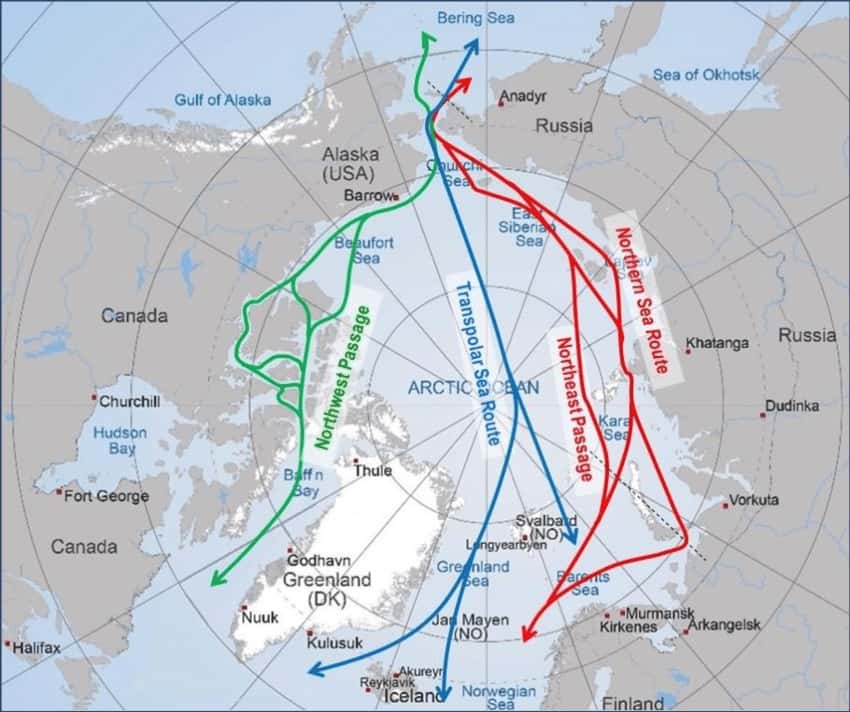
Theoretically there are three possible shipping routes through the Arctic. Only the Northern Sea Route is seeing significant commercial exploitation.

 “The distance from Shanghai to German ports is over 4,600km (about 2,900 miles) shorter via the Northern Route than via the Suez Canal.”

Russia sees the Northern Sea Route as a money maker charging fees for Russian pilots and Russian icebreaker support.

Naturally potential users may hope to avoid Russian fees by transiting areas just North of the Northern Sea Route. Icebreaking hulls might make that possible, but as long as they are transiting Russia’s EEZ, Russia is likely to demand use of their services and payment of the fees under the pretext of protecting the environment.

This is likely to result in raised tensions in the Arctic.

Other icebreakers might be warships, patrol vessels, tankers or container ships. They might be support vessels for mineral extraction industry. I doubt that many will be full-time heavy icebreakers.

Russia needs lots of icebreakers partly because they have ports serving a large mineral extraction industry in the Arctic. The US is already extracting oil from the North Slope but has not needed a lot of icebreakers to support that industry, because they built the pipeline to Valdez. Drilling for oil in the Arctic Ocean is going to be challenging for a very long time because of icefloes, but Canada has a lot of land area including many islands, in the Arctic where minerals might be found, so we might see development in the Canadian high north, similar to what we see in the Russian Arctic.

There is more here, Canadian Shipbuilder Davie Wants to Invest in the U.S.

“MQ-9B SeaGuardian Showcased at RIMPAC 2024” –News Release

An MQ-9 Sea Guardian unmanned maritime surveillance aircraft system flies over the Pacific Ocean during U.S. Pacific Fleet’s Unmanned Systems Integrated Battle Problem (UxS IBP) 21, April 21. UxS IBP 21 integrates manned and unmanned capabilities into challenging operational scenarios to generate warfighting advantages. US Navy Photo

The Coast Guard has an unfilled requirement for a shore based Uncrewed Air System (UAS) to provide Maritime Domain Awareness.

Below is a news release from General Atomics Aeronautical Systems, Inc.

Reading the news release, I see the system incorporated an “integrated Minotaur Mission System.” Minotaur is a system currently being installed on all Coast Guard fixed wing search aircraft as well as US Navy and Marine Corps platforms. It went on to say “For RIMPAC, the MQ-9B effectively passed ISR&T (Intelligence, surveillance, reconnaissance, and targeting–Chuck) information to various surface and air units, such as the Nimitz-class carrier USS Carl Vinson, Guided Missile Destroyers (DDGs), Littoral Combat Ships (LCS), frigates, patrol boats, P-8s, P-3s, and numerous other U.S. and foreign units that took part in the exercise.” Could that have included Midgett and her task force? The use of the MQ-9B to drop sonobuoys for the task force and their embarked ASW helicopters would have been an interesting experiment.


GA-ASI’s MQ-9B SeaGuardian® Showcased at RIMPAC 2024

Sonobuoy Dispensing System and LRASM Among the New Capabilities Featured

SAN DIEGO – 14 August 2024 – With the completion of the U.S. Navy’s Rim of the Pacific (RIMPAC) flight operations on July 28, 2024, the MQ-9B SeaGuardian® Unmanned Aircraft System (UAS) supplied by General Atomics Aeronautical Systems, Inc., self-deployed back to its home base in El Mirage, Calif., but only after introducing an array of new capabilities. The flight home followed close to 100 flight hours supporting RIMPAC 2024 over the four-week exercise in and around the Hawaiian Islands.

RIMPAC is the world’s largest international maritime exercise. RIMPAC 2024 featured 29 nations, 40 surface ships, three submarines, 14 national land forces, more than 150 aircraft, and 25,000 personnel.

SeaGuardian provided real-time Intelligence, Surveillance, and Reconnaissance (ISR) data feeds to the U.S. Pacific Fleet Command Center using Signals Intelligence (SIGINT) parametrics and full-motion video to the watch floor and intelligence centers for real-time dynamic tasking — just as it did for the RIMPAC 2022 exercise. This year, SeaGuardian delivered some new features and capabilities, including Long Range Anti-Ship Missile (LRASM) targeting and a new Sonobuoy Dispensing System (SDS) to support its Anti-Submarine Warfare capability. SeaGuardian was configured with a prototype SDS pod capable of deploying 10 A-size sonobuoys per pod (SeaGuardian can carry up to four SDS pods or up to 40 sonobuoys) and the SeaVue Multi-role radar from Raytheon, an RTX business. Upon dispensing, the sonobuoys were successfully monitored and controlled by the SeaGuardian’s onboard Sonobuoy Monitoring and Control System (SMCS).

SeaGuardian is a maritime derivative of the MQ-9B SkyGuardian® and remains the first UAS that offers multi-domain Intelligence, Surveillance, Reconnaissance, and Targeting (ISR&T) as an internal payload that can search the ocean’s surface and depths in support of Fleet Operations. At RIMPAC 2024, SeaGuardian showcased all operational payloads, which includes the SeaVue, SNC’s Electronic Support Measures (ESM) solution, an Automatic Identification System (AIS), and a self-contained Anti-Submarine Warfare (ASW) system.

SeaGuardian’s multi-domain capabilities allow it to flex from mission to mission and pass real-time sensor data directly to the Fleet. For RIMPAC 2024, SeaGuardian added Link 16 Joint Range Extension Application Protocol (JREAP) “C” (internet protocol) and an integrated Minotaur Mission System to provide real-time sensor data for the various Maritime Operations Centers, ships, and aircraft with Minotaur nodes.

“For RIMPAC, the MQ-9B effectively passed ISR&T information to various surface and air units, such as the Nimitz-class carrier USS Carl Vinson, Guided Missile Destroyers (DDGs), Littoral Combat Ships (LCS), frigates, patrol boats, P-8s, P-3s, and numerous other U.S. and foreign units that took part in the exercise,” said GA-ASI President David R. Alexander.

On July 31, 2024, SeaGuardian self-deployed back to GA-ASI’s Desert Horizon Flight Operations Facility in El Mirage, Calif.

About GA-ASI

General Atomics Aeronautical Systems, Inc. (GA-ASI), an affiliate of General Atomics, is a leading designer and manufacturer of proven, reliable RPA systems, radars, and electro-optic and related mission systems, including the Predator® RPA series and the Lynx® Multi-mode Radar. With more than eight million flight hours, GA-ASI provides long-endurance, mission-capable aircraft with integrated sensor and data link systems required to deliver persistent situational awareness. The company also produces a variety of sensor control/image analysis software, offers pilot training and support services, and develops meta-material antennas.

For more information, visit www.ga-asi.com     

Avenger, Lynx, Predator, SeaGuardian, and SkyGuardian are registered trademarks of General Atomics Aeronautical Systems, Inc.


“Japan Buys Two SeaGuardians from GA-ASI” –News Release

Below is a news release from General Atomics Aeronautical Systems, Inc.

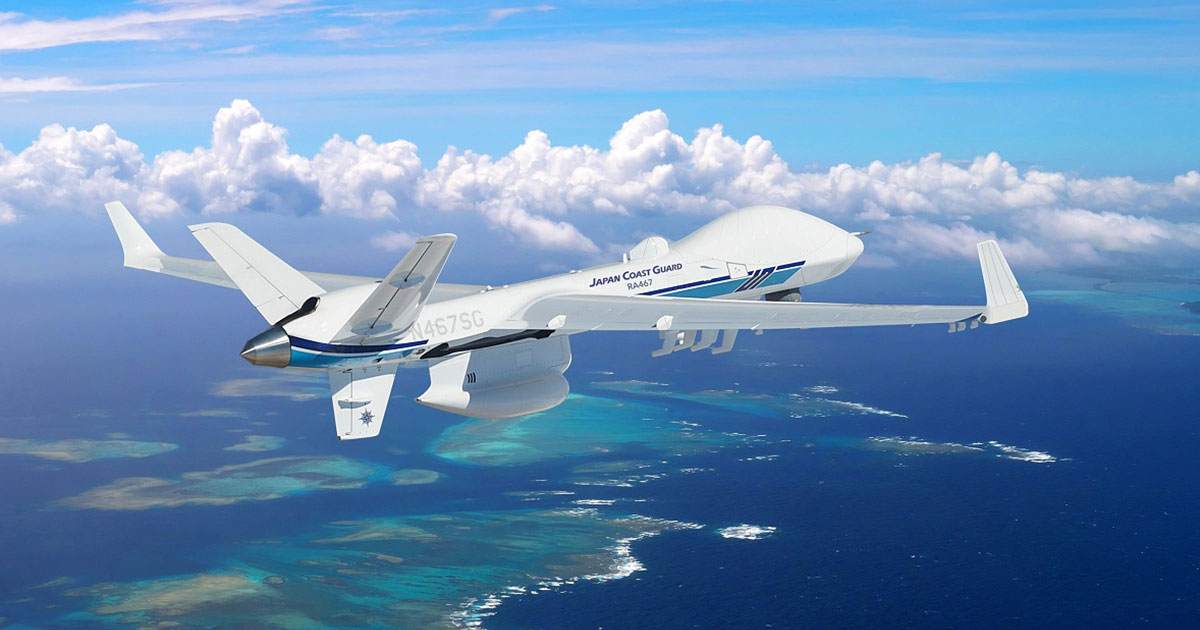
The SeaGuardian is a maritime variant of the MQ-9B that includes sense and avoid systems that allows it to operate safely in airspace with manned aircraft.

SeaGuardians are reportedly operated in a maritime role for Australia, Belgium, Canada, India, Italy, Japan, the Netherlands, and the UK.


Japan Buys Two SeaGuardians from GA-ASI

SAN DIEGO – 15 August 2024 – The Japan Coast Guard (JCG) has signed a contract for the purchase of two SeaGuardian® Remotely Piloted Aircraft (RPA) from General Atomics Aeronautical Systems, Inc. (GA-ASI), scheduled for delivery in 2025. This follows JCG’s ongoing Company-Owned, Contractor-Operated agreement with GA-ASI for operating SeaGuardian, which began in April 2022.

“Since JCG started operating SeaGuardians, they have been used for various JCG missions including supporting search and rescue and disaster response specifically during the 7.6 magnitude earthquake early this year near the Noto Peninsula of Ishikawa Prefecture and maritime surveillance during the 2023 G-7 Summit in Hiroshima, and the system has performed efficiently and effectively,” said GA-ASI CEO Linden Blue.

SeaGuardian is a medium-altitude, long-endurance RPA system that can fly for 24 hours or more, depending on the configuration.

GA-ASI has strengthened its Maritime Wide Area Surveillance (MWAS) for Japan with Optix+, which gathers information from the SeaGuardian sensors, as well as other data sources, displaying the full picture of surveillance information for its operator. This functionality makes it easy to task and direct its Intelligence, Surveillance and Reconnaissance (ISR) information in real time. GA-ASI’s Optix+ software suite rapidly correlates and exploits collected data into an easily shared common operational picture. Having multi-source correlated data enables automatic detection of anomalous behaviors over waters.

About GA-ASI

General Atomics Aeronautical Systems, Inc. (GA-ASI), an affiliate of General Atomics, is a leading designer and manufacturer of proven, reliable RPA systems, radars, and electro-optic and related mission systems, including the Predator® RPA series and the Lynx® Multi-mode Radar. With more than eight million flight hours, GA-ASI provides long-endurance, mission-capable aircraft with integrated sensor and data link systems required to deliver persistent situational awareness. The company also produces a variety of sensor control/image analysis software, offers pilot training and support services, and develops meta-material antennas.

“U.S. Coast Guard Cutter Healy arrives in Seattle following scientific research, onboard fire” –CG News

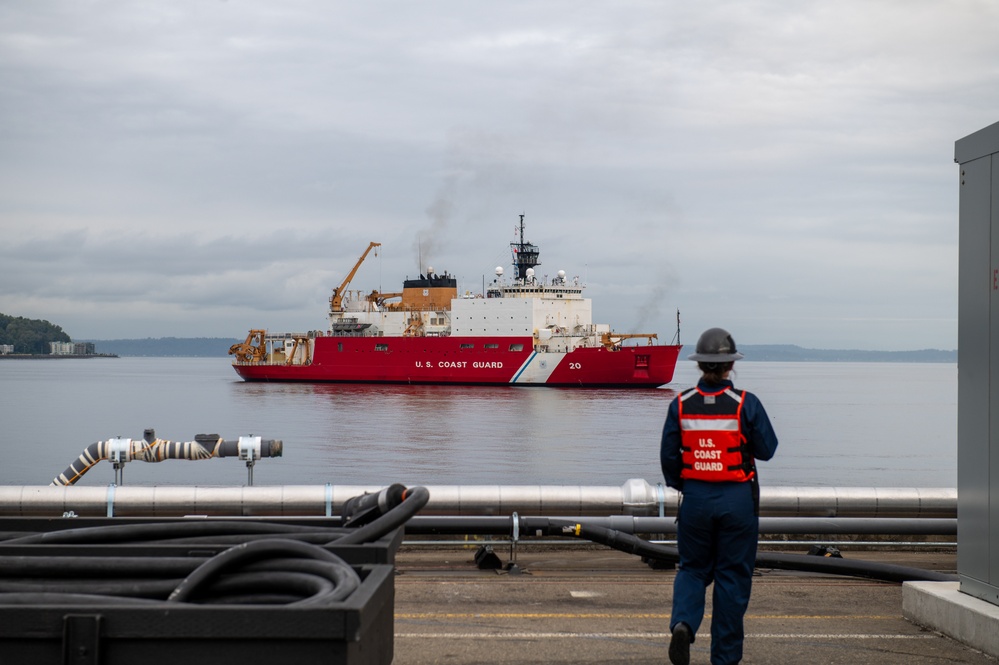
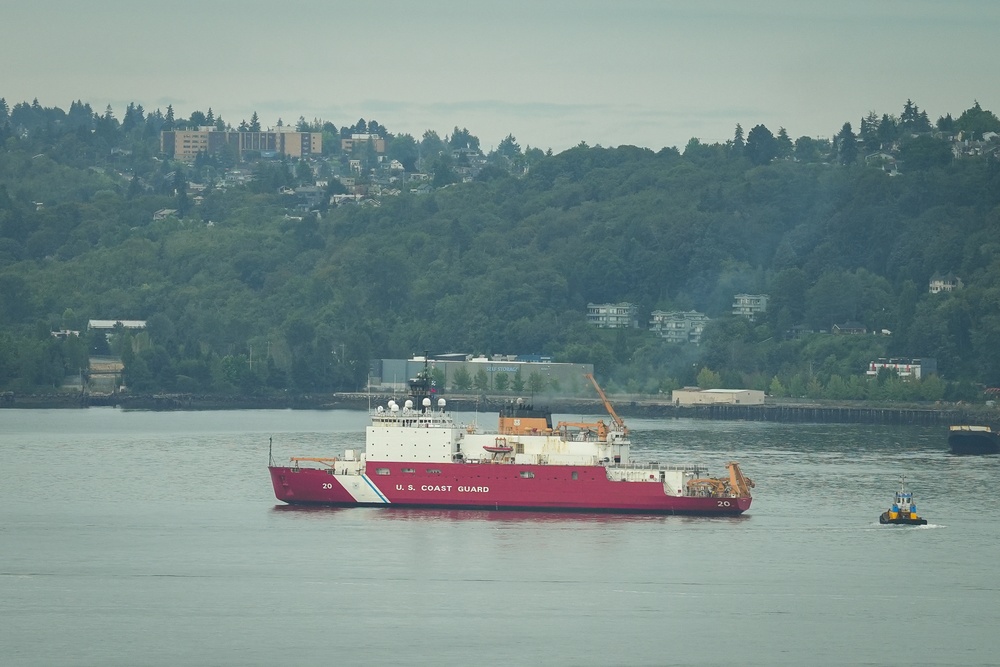
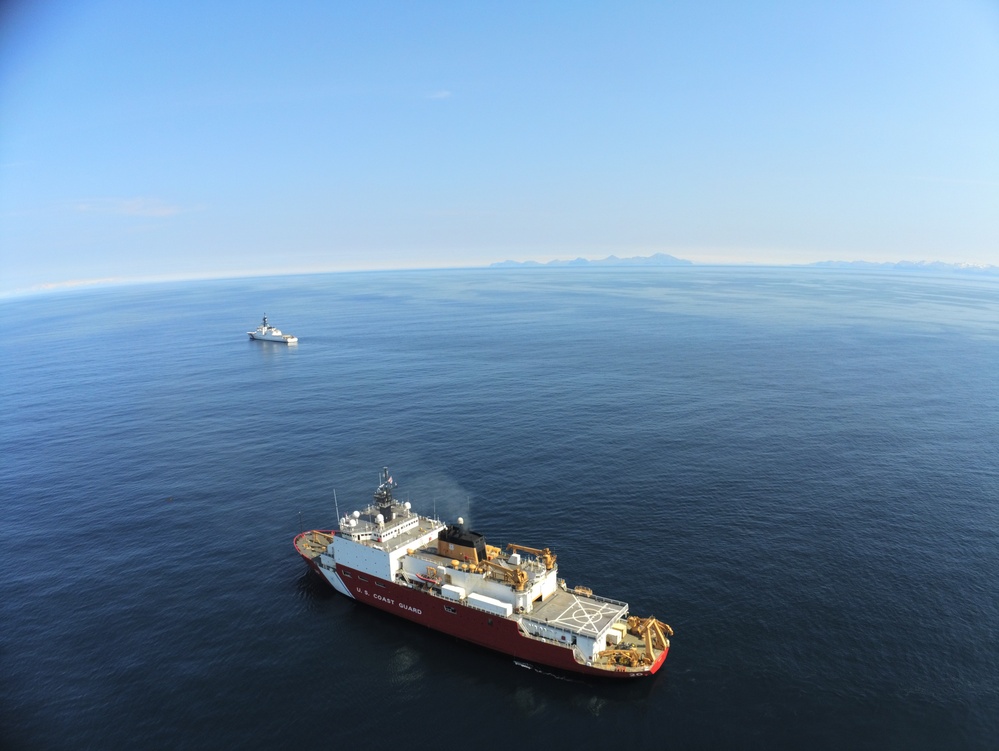
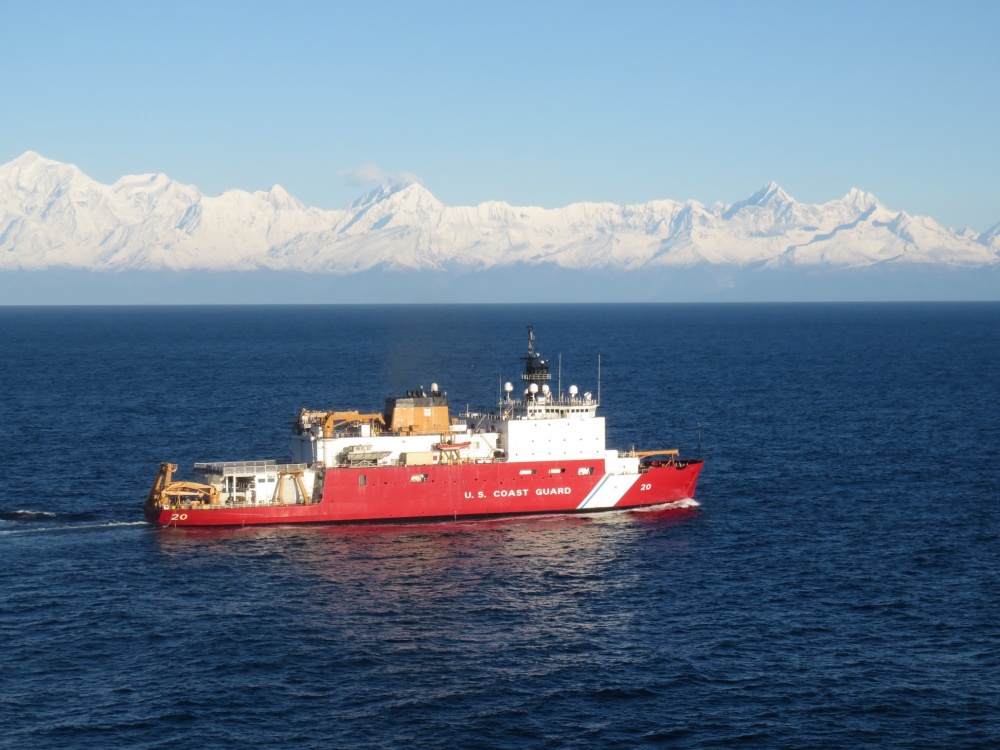
The Coast Guard Cutter Healy (WAGB 20) returns to Seattle following a two-month Arctic patrol, Aug. 16, 2024. The Healy is the United States’ largest Polar icebreaker and was commissioned in 2000. (U.S. Coast Guard photo by Petty Officer 2nd Class Taylor Tracy)

Below is a Coast Guard News release.

Actually, sounds like they got a lot of this season’s Arctic research completed.

Also appears the redundancy that frequent contributor “Tups” talked about in an earlier comment section kept both shafts turning. These were his comments.

“The general layout is pretty standard and inherently pretty redundant: a split power plant and main switchboard, cross-connected propulsion transformers, and double-wound propulsion motors. The design ensures that in the event of any single component failure — diesel generator, switchboard, propulsion transformer, frequency converter, or even some components within the propulsion motor — both shafts would remain turning. This is extremely important on an icebreaker as a non-rotating propellers can be easily damaged by ice. Of course the ship’s operational capability would be limited and a lower-priority mission would likely be cancelled.”


Aug. 16, 2024

U.S. Coast Guard Cutter Healy arrives in Seattle following scientific research, onboard fire

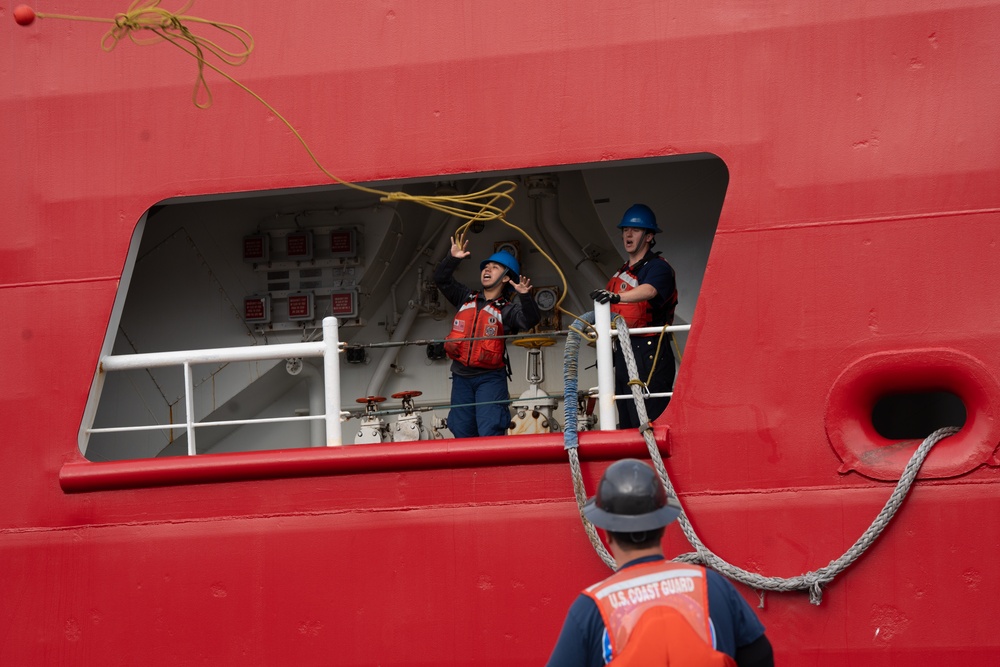
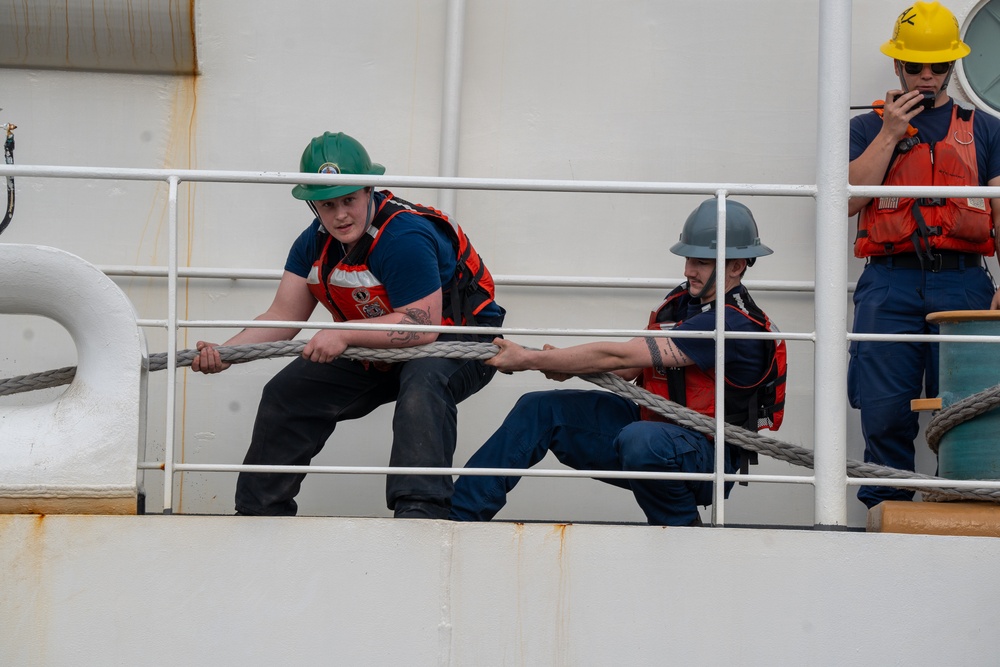
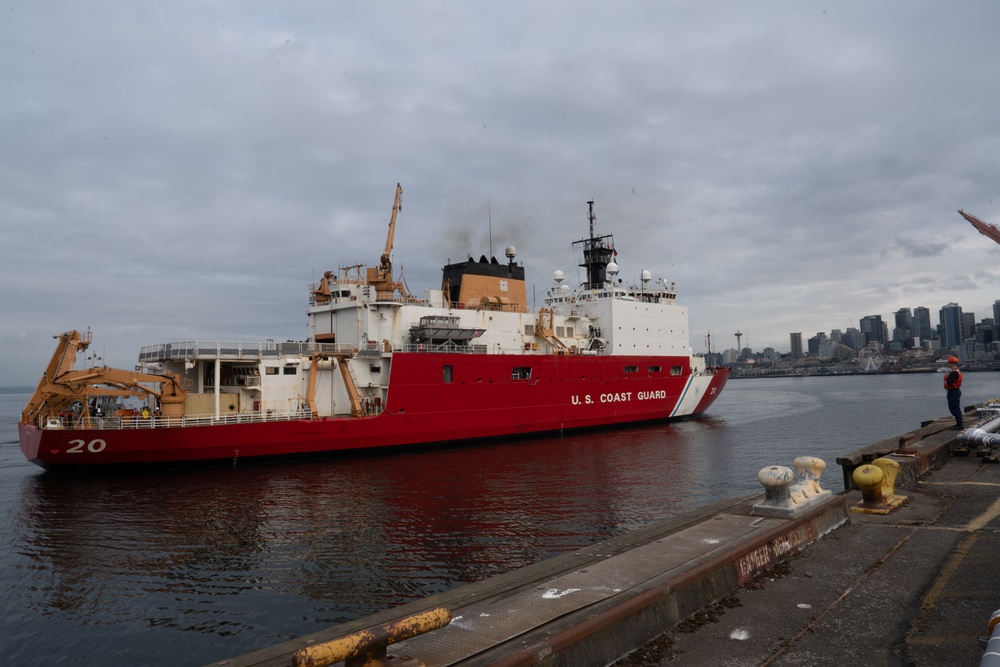
The Coast Guard Cutter Healy (WAGB 20) returns to Seattle following a two-month Arctic patrol, Aug. 16, 2024. The Healy is the United States' largest Polar icebreaker and was commissioned in 2000. (U.S. Coast Guard photo by Petty Officer 2nd Class Taylor Tracy) The Coast Guard Cutter Healy (WAGB 20) crewmembers conduct mooring operations after returning to their Seattle home port, Aug. 16, 2024. The Healy is the United States' largest polar icebreaker and was commissioned in 2000. (U.S. Coast Guard photo by Petty Officer 2nd Class Briana Carter) The Coast Guard Cutter Healy (WAGB 20) crewmembers conduct mooring operations upon returning to their home port at Coast Guard Base Seattle, Aug. 16, 2024. The Healy conducted a two-month Arctic patrol. (U.S. Coast Guard photo by Petty Officer 2nd Class Briana Carter) The Coast Guard Cutter Healy (WAGB 20) returns to Seattle following a two-month Arctic patrol, Aug. 16, 2024. The Healy is the United States' largest Polar icebreaker and was commissioned in 2000. (U.S. Coast Guard photo by Petty Officer 2nd Class Briana Carter)
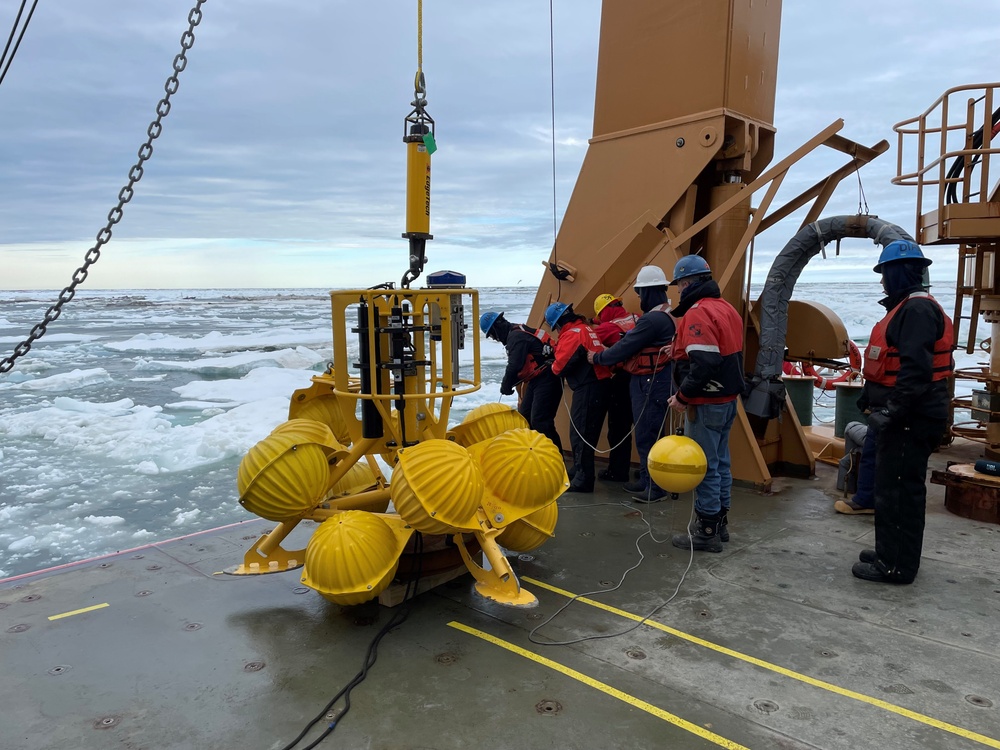
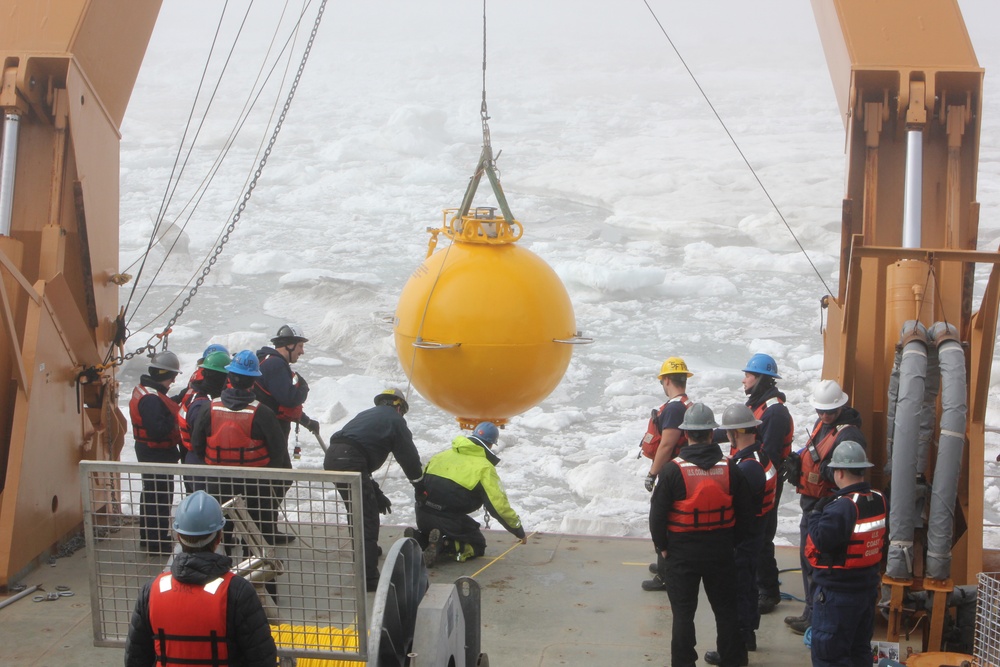
Members of the U.S. Coast Guard Cutter Healy (WAGB 20) deck department and the embarked science party aboard Healy deploy a subsurface mooring in the Beaufort Sea, July 14, 2024. This mooring is equipped with multiple sensors that collect oceanographic data pertaining to the physical, chemical, and biological properties of the Arctic Ocean. U.S. Coast Guard photo. U.S. Coast Guard Cutter Healy (WAGB 20) transits near West Seattle as the cutter approaches its homeport at Coast Guard Base Seattle, Aug. 16, 2024. The crew returned home following a two-month Arctic patrol. (U.S. Coast Guard photo by Petty Officer 1st Class Steve Strohmaier) USCGC Healy (WAGB 20) steams alongside USCGC Kimball (WMSL 756) near Unimak Pass, Alaska, July 3, 2024. Healy, a polar icebreaker, and Kimball, a national security cutter, patrol the waters around Alaska to maintain maritime safety, security, and stability in the region. U.S. Coast Guard photo by Chief Warrant Officer Brian Williams. Members of the U.S. Coast Guard Cutter Healy (WAGB 20) deck department and the embarked science party aboard Healy deploy a subsurface mooring in the Beaufort Sea, July 16, 2024. This mooring is equipped with multiple sensors that collect oceanographic data pertaining to the physical, chemical, and biological properties of the Arctic Ocean. U.S. Coast Guard photo by Ensign Daniella Tipton.

SEATTLE — U.S. Coast Guard Cutter Healy (WAGB 20) arrived in Seattle Friday after conducting scientific research in the Pacific sector of the Arctic Ocean in support of the Arctic Observing Network, funded by the U.S. National Science Foundation (NSF).

Healy’s crew and embarked researchers conducted more than 150 conductivity, temperature, and depth (CTD) casts to investigate the circulation and properties of the water, monitored for signs of harmful agal blooms, and collected observations on marine mammals and birds in the Bering, Chukchi, and Beaufort Seas.

Additionally, two subsurface moorings were deployed that are equipped with multiple sensors collecting oceanographic data on the physical, chemical, and biological state of the Arctic Ocean. This year’s work builds on more than two decades of research to improve understanding of the Pacific Arctic ecosystem in a changing climate.

On July 25, 2024, while underway in the vicinity of Banks Island, Northwest Territories, Canada, Healy experienced an electrical fire on a transformer impacting one of the ship’s two main propulsion motors. The crew swiftly extinguished the fire with no personnel casualties. Healy’s crew and contractors restored power to the affected motor. However, out of abundance of caution, the cutter returned to Seattle to ensure all redundant systems are fully operational before returning to the Arctic.

“Healy’s crew and scientific researchers completed valuable data collection throughout the Bering Sea and the eastern Beaufort Sea in support of the Arctic Observing Network,” said Capt. Michele Schallip, Healy’s commanding officer. “While transiting to a collection site, we suffered a fire on a transformer. I am immensely proud of the crew for quickly extinguishing the fire and limiting damage to that equipment. In the Arctic, there are few rescue resources, and ice-covered waters make it difficult for rescue assets. Crews operating in polar waters must be well-trained for emergency response, and responsible operation includes addressing any system degradation on a vessel before continuing operation in the high latitudes.”

Healy is the United States’ largest polar icebreaker and the Coast Guard’s only icebreaker designed and equipped with scientific instrumentation by the NSF to support Arctic research. The platform is ideally specialized for scientific missions, providing access to the most remote reaches of the Arctic Ocean. Healy is designed to break 4.5 feet of ice continuously at three knots and can operate in temperatures as low as -50 degrees Fahrenheit.

“Globally deployable Coast Guard units conclude participation in RIMPAC 2024” –Coast Guard News & Why No Missiles On Cutters?

U.S. Coast Guard Diver 2nd Class Connor Madsen, Regional Dive Locker West, cuts line, freeing a bundled chain to hook it onto a sunken buoy during a training exercise with the Republic of Korea Navy Underwater Construction Team divers off the coast of Oahu, Hawaii, July 18, during Exercise Rim of the Pacific (RIMPAC) 2024. Twenty-nine nations, 40 surface ships, three submarines, 14 national land forces, more than 150 aircraft, and 25,000 personnel are participating in Exercise Rim of the Pacific (RIMPAC) 2024 in and around the Hawaiian Islands, June 27 to Aug. 1. The world’s largest international maritime exercise, RIMPAC provides a unique training opportunity while fostering and sustaining cooperative relationships among participants critical to ensuring the safety of sea lanes and security on the world’s oceans. RIMPAC 2024 is the 29th exercise in the series that began in 1971. (U.S. Navy photo by Chief Mass Communication Specialist Kathleen Gorby)

Below is a press release from Coast Guard News.

RIMPAC 2024 was a big complex event. I had hoped to hear more about the Coast Guard’s participation, perhaps a release from each of the units, like the Pacific Strike Team did (linked in the news release), particularly news about the National Security Cutter (NSC) Midgett’s participation.

Was her CO a task force commander? Did she host a Navy helicopter? Did they do an anti-submarine exercise? NSCs did these things in the previous two RIMPACs.

This is what we got about Midgett’s role,

“Coast Guard Cutter Midgett conducted a broad spectrum of operations with the Canadian MV Asterix, Italian Navy offshore Patrol Vessel ITS Montecuccoli, Arleigh Burke-class guided-missile destroyer USS Kidd (DDG 100), Royal Brunei Navy offshore patrol vessels KDB Darussalam and KDB Darulaman, Mexican Navy frigate ARM Benito Juarez and the ROK Navy submarine Lee Beom-seok. Operations covered both national defense as well as humanitarian assistance and disaster relief missions.”

Seven surface ships, embarked helicopters, and a submarine. That looks like a task force and Midgett’s CO was probably the senior officer among the ships’ crews, but someone else might have been assigned to command the task force. The presence of a submarine suggests ASW exercises. Some of the photos that accompany the news release give us some clues.

The U.S. Coast Guard helicopter tie-down team aboard legend-class cutter USCGC Midgett (WMSL 757) secures a Mexican navy Panther Helicopter ANX 2161 during Exercise Rim of the Pacific (RIMPAC) 2024 off the coast of Hawaii, July 14.  (U.S. Coast Guard photo by David Lau)

Legend-class cutter USCGC Midgett (WMSL 757) hosts a multi-ship interdiction and boarding exercise with Italian Navy offshore patrol vessel ITS Montecuccoli (P 432), who fast-roped a boarding team of seven onto Midgett simulating an at-sea boarding of a suspected arms smuggling vessel during Exercise Rim of the Pacific (RIMPAC 2024), July 15, while underway in the Pacific Ocean. (U.S. Coast Guard photo by David Lau)

The press release linked above also has a photo of Midgett’s 57mm Mk110 gun firing. We can also be pretty sure Midgett did an underway replenishment.

Would love to hear more from people who were there.


I will make one observation. Of the six surface combatants, Midgett was the only one that did not have missiles of any sort.

  • Obviously, USS Kidd, a DDG, is well equipped with 96 VLS cells for very sophisticated missiles.
  • Italian offshore Patrol Vessel ITS Montecuccoli would probably be considered a frigate in any other navy. It is about a third larger than Midgett and has 16 full size VLS and eight ASCMs.
  • Mexican Navy ARM Benito Juarez , classified as a “long-range ocean patrol ship,” is about two thirds the size of Midgett and has eight Mk41 VLS and a SeaRAM system. 
  •  Royal Brunei Navy offshore patrol vessels KDB Darussalam and KDB Darulaman,  are a little more than one third the size of Midgett. Each can be equipped with four Exocet anti-ship cruise missiles. 

Of the five missile carriers, four are described as Offshore Patrol Vessels. That is what Midgett is.

The Coast Guard seems to be allergic to putting missiles on their ships, as if they are super weapons reserved only for the most sophisticated ships. Why I reported to the Academy in 1965, 59 years ago, that may have been the case, but now they come in all sizes and shapes. There is a good reason for this proliferation. They are effective. Many require very little training and little or no maintenance. They can provide an outsized effect at relatively low cost.

A common argument is that the price of a cannon projectile is far less than the cost of a missile, but that limited view misses the point that total lifecycle costs for missile systems may be much less than the cost of a gun system and its magazine load out of hundreds of rounds.

Maybe if you expect to do shore bombardment, firing thousands of ammunition at a target area, rather than a particular point, maybe guns are the smart choice, but the smaller the number of expected engagements, the smaller the number of rounds expected to be fired in each engagement, and the quicker you need to take out the threat, the more attractive missiles become.

Is seeing a missile system on a Coast Guard cutter going to make it look more threatening or aggressive, assuming we want to avoid looking like we can defend ourselves?

Guns, even as small as the 57mm Mk110 are pretty obvious and recognizable. Missile launcher can be much less obvious and may be overlooked entirely. Vertical Launch systems (VLS) barely protrude above the deck. Launchers for APKWS, Hellfire and similar systems may escape notice entirely. (My wife says most warship just look like a pile of junk.)

Guided weapons offer other advantages as well:

  • There is less likelihood of collateral damage.
  • We can put missiles on smaller platforms that could never mount guns with similar capability.
  • Visible missiles systems can be temporarily removed much easier that gun systems. (It can be very obvious whether or not a ship is carrying anti-ship cruise missiles like Harpoon or Naval Strike Missile.)

Aug. 10, 2024

Globally deployable Coast Guard units conclude participation in RIMPAC 2024

HONOLULU – Four Hawaii-based and two California-based Coast Guard units, all globally deployable, concluded operations at the Rim of the Pacific (RIMPAC) 2024 Exercise and returned to service of the residents of Hawaii and the Pacific region, Aug. 1.

U.S. Coast Guard Cutters Midgett (WMSL 757) and Juniper (WLB 201), the Regional Dive Locker Pacific, Port Security Unit (PSU) 311, the Pacific Strike Team and Maritime Safety and Security Team (MSST) Honolulu partnered with military members from Peru, Mexico, Republic of Korea, Italy, Brunei and Japan throughout the in-port and at-sea portions of the RIMPAC Exercise, which ran from late June to early August. The exercise marked a series of “firsts” for Coast Guard participation.

PSU 311 was the first PSU to deploy to a RIMPAC exercise, where they set up a forward-deployed security force on land and on sea. They conducted vessel escorts of high-value U.S. and partner nation ships and patrolled both on land and water. They hosted advisors from the Naval Cooperation and Guidance for Shipping group in their tactical operations center – an essential international service in protecting merchant ships traveling through hazardous areas. They also partnered with MSST Honolulu and divers from the Coast Guard and the Republic of Korea (ROK) Navy to conduct underwater port surveys following a simulated natural disaster, a key part of the port reopening process that is essential to saving lives in emergencies.

The Coast Guard Pacific Strike Team also completed a first-of-its-kind deployment, partnering with forces from Mexico and Peru to conduct urban search-and-rescue exercises on water and land. A full summary of their efforts is available here.

The Coast Guard Regional Dive Locker Pacific completed its most thorough humanitarian response exercise at RIMPAC to date, partnering with the ROK Navy to conduct harbor surveys, underwater pier inspections, and land and shipboard-based buoy salvage operations. Their collaboration will prove instrumental in speedy response to future disasters.

Coast Guard Cutter Midgett conducted a broad spectrum of operations with the Canadian MV Asterix, Italian Navy offshore Patrol Vessel ITS Montecuccoli, Arleigh Burke-class guided-missile destroyer USS Kidd (DDG 100), Royal Brunei Navy offshore patrol vessels KDB Darussalam and KDB Darulaman, Mexican Navy frigate ARM Benito Juarez and the ROK Navy submarine Lee Beom-seok. Operations covered both national defense as well as humanitarian assistance and disaster relief missions.

“The global maritime environment is too large and complex for any one nation to safeguard – we have always relied on strong international partnerships to serve the larger Pacific community,” said Vice Adm. Andrew J. Tiongson, Commander of Coast Guard Pacific Area and Commander of Defense Force West. “In RIMPAC and beyond, we continually work with our partners to remain integrated and prepared. Through exercises, real-world operations, and a spirit of collaboration, we work together for a free and open Indo-Pacific region.”

RIMPAC 2024 was the 29th exercise in the series that began in 1971. As the world’s largest international maritime exercise, RIMPAC combines force capabilities in a dynamic maritime environment to demonstrate enduring interoperability across the full spectrum of military operations.

“Q&A: Vice Admiral Andrew J. Tiongson, Commander, Pacific Area and Commander, Defense Force West, U.S. Coast Guard” –Seapower

Tiongson speaks at a press conference before the crew of the Coast Guard Cutter Waesche offloads 18,219 pounds of cocaine, worth more than $239 million, on Dec. 6, 2023. U.S. Coast Guard

The Navy League’s on-line magazine, Seapower, has an interview with the Pacific Area Commander. There is a lot of good information here.

HC-130Js (and C-27Js):

CGAS Sacramento will “transition” to HC-130Js. Pacific Area certainly needs the long range aircraft because, while 84% of the US EEZ is in Pacific Area they have only three fixed wing air stations (Kodiak, Barbers Point, and Sacramento) while Atlantic Area has five fixed wing air stations to cover only 16% of the US EEZ.

What will happen to the C-27Js? No mention was made of these. They might go to Guam. That would be helpful in providing fixed wing search aircraft in the Western Pacific. Recently there was a SAR case in the Western Pacific. A C-130 was dispatched from Barbers Point, but the flight was so long the crew needed a day’s rest before the aircraft could be used in the search. On the other hand, Guam might not be an optimal location since it is so far West. There are other options.

Fast Response Cutters:

As I read the statement, the intention is to have a total of six FRCs in Guam and add a fourth in Hawaii.

His discussion about these little ships clearly indicates that their nominal five-day endurance (same as the preceding 110 foot WPBs) is being exceeded regularly.

“The FRCs, first off, are game changers for the Coast Guard in general. Back in the day, we had patrol boats that were limited in terms of the sea states they could handle, the food that they could carry, the number of crew members and certainly their duration at sea. The FRCs have changed that.”

Six WPCs in the same port is not unusual. District 7 has three different ports, each homeport to six or seven Webber class, but this may be a move toward replicating a PATFORSWA type organization to support 7th Fleet in the Western Pacific.

Large Patrol Cutters:

There was a brief discussion of the Offshore Patrol Cutters, but no indication of when they are expected to arrive in PACAREA.

A second “Harriet Lane or Indo-Pacific support cutter” is on PACAREA’s unfunded priority list. For some reason, I think this may happen.

Commercial Icebreaker Procurement:

Plans for the commercial icebreaker (Aiviq) were discussed. It will be homeported in Juneau, as reported here in March, but still has not been purchased and it will take two years to complete changes to make it fully operational.

The admiral was asked, “Is the commercial icebreaker going to be crewed by Coast Guardsmen or by a contract crew?” and there was no definitive answer. Should the Coast Guard adopt a hybrid crew, as has been done by some Navy vessels it would be a major change in Coast Guard policy.

The Eastern Pacific Drug Transit Zone: 

Atlantic Area cutters are not assisting in Eastern Pacific drug transit zone interdiction efforts, as they normally would, because they are heavily engaged in migrant interdiction operations.

Trusted Partner:

The Area Commander talked a lot about what being a trusted partner meant, about partnerships with Asian coast guards, and the outsized effect of having a few good people in liaison positions.

“Coast Guard Cancels Icebreaker Healy’s Arctic Mission” –USNI

US Naval Institute News Service reports,

“An electrical fire in a transformer forced USCGC Healy (WAGB-20), one of two American icebreakers, to cancel its Arctic mission, USNI News has learned.”

The fire and Healy’s return to port have been mentioned in comments here at least a couple of time, but this clearly puts an end to any possibility the ship might be quickly repaired and return to the Arctic this year. “This is the second time in four years that a fire cut Healy’s summer mission short.”

The post talks a bit about “…controlled parts exchange with other ships at the pier. That’s a fancy term for cannibalization.” That helps keep Polar Star and the medium endurance cutters operational, but Healy is one of a kind so that is not even a possibility for some systems.

Keeping ships reliable and underway as they approach and pass 30 years of age gets increasingly difficult and possibly uneconomical. In this case, where we have no “bench strength,” it could be disastrous.

Cutter Size Ships Building in Latin America

Damen SIGMA 10714 for Colombia

Always interesting to see what other countries are doing in terms of ships that will perform coast guard style missions. In some countries, these are their largest warships.

Two recent reports from Latin America.

In both cases they have chosen to build ships with the assistance of experienced European shipbuilders. Both are smaller than either the National Security Cutter or the Offshore Patrol Cutter.

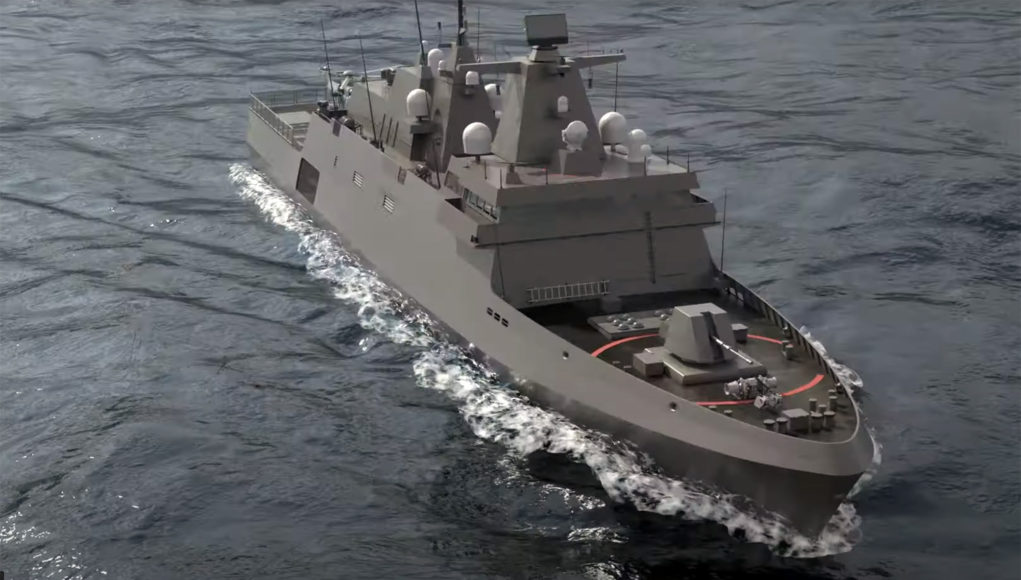
Brazil has launched the first of a planned eight Tamandaré-Class Frigates, pictured above, designed by ThyssenKrupp Marine Systems of Germany. It is evolved from earlier MEKO designs that include the German K130 Braunschweig class corvettes and the Israeli Sa’ar 6.

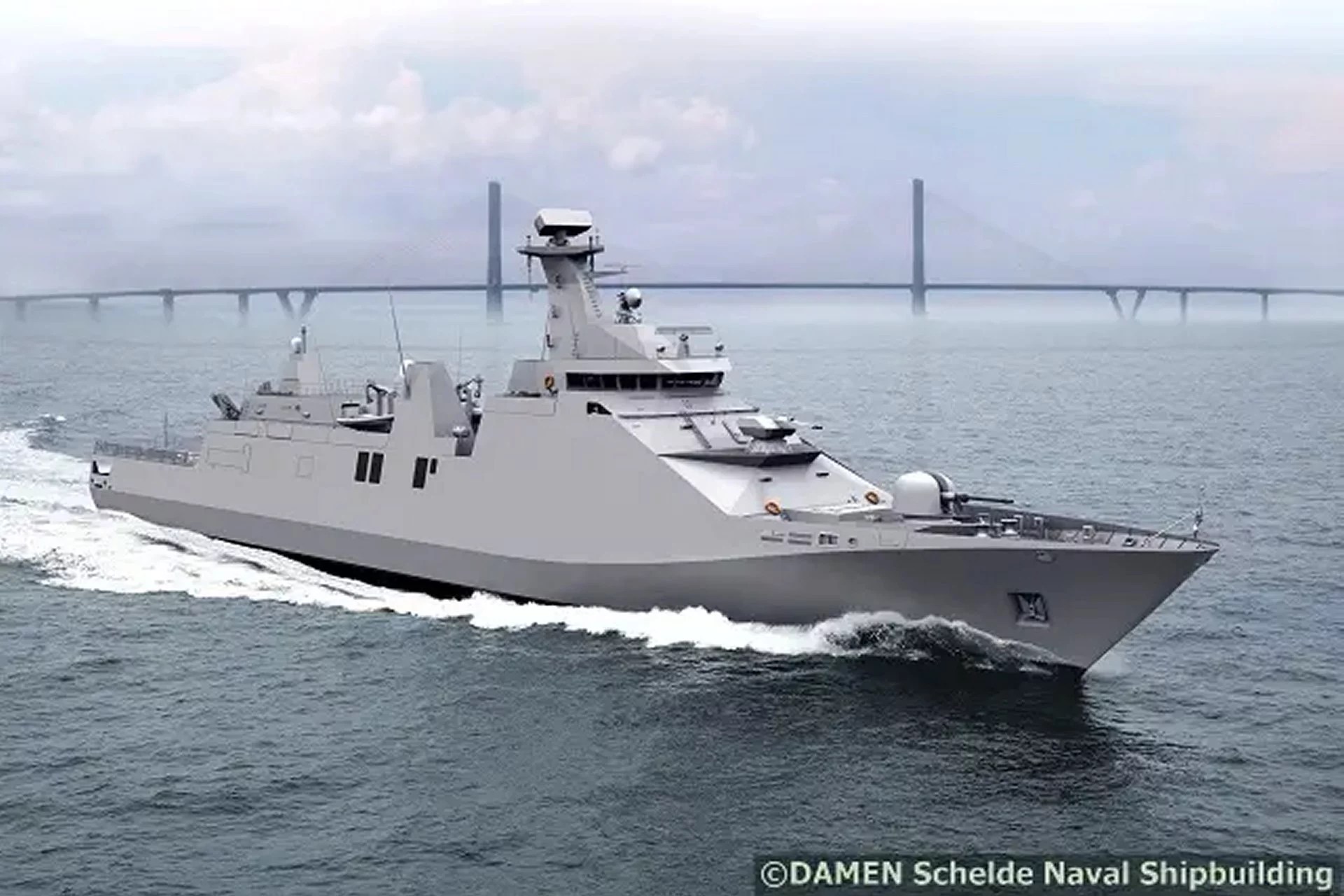
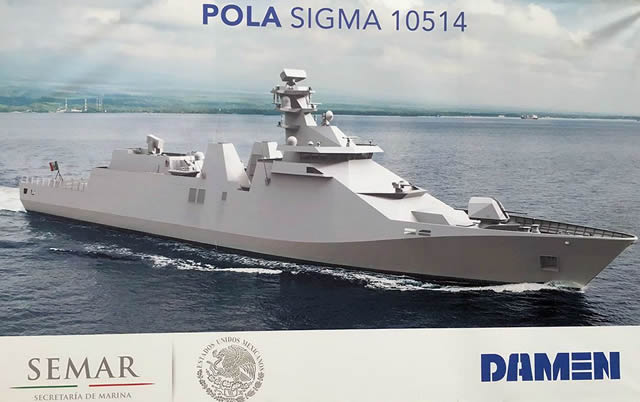
Colombia has contracted with Damen, designers of the USCG Fast Response Cutters, to help locally build the first of five planned light frigates that will replace four somewhat smaller sized Admirante Padilla class ships commissioned 1983/4. The design is a Damen SIGMA 10714 design, meaning it is 107 meters (353′) in length with a beam of 14 meters (46′). The design is closely related to ships built in Mexico (pictured below) and in Indonesia.

Mexico’s Damen SIGMA 10514, ARM Benito Juárez (POLA-101)

U.S. Coast Guard Cutter Waesche returns home following a 120-day Indo-Pacific patrol

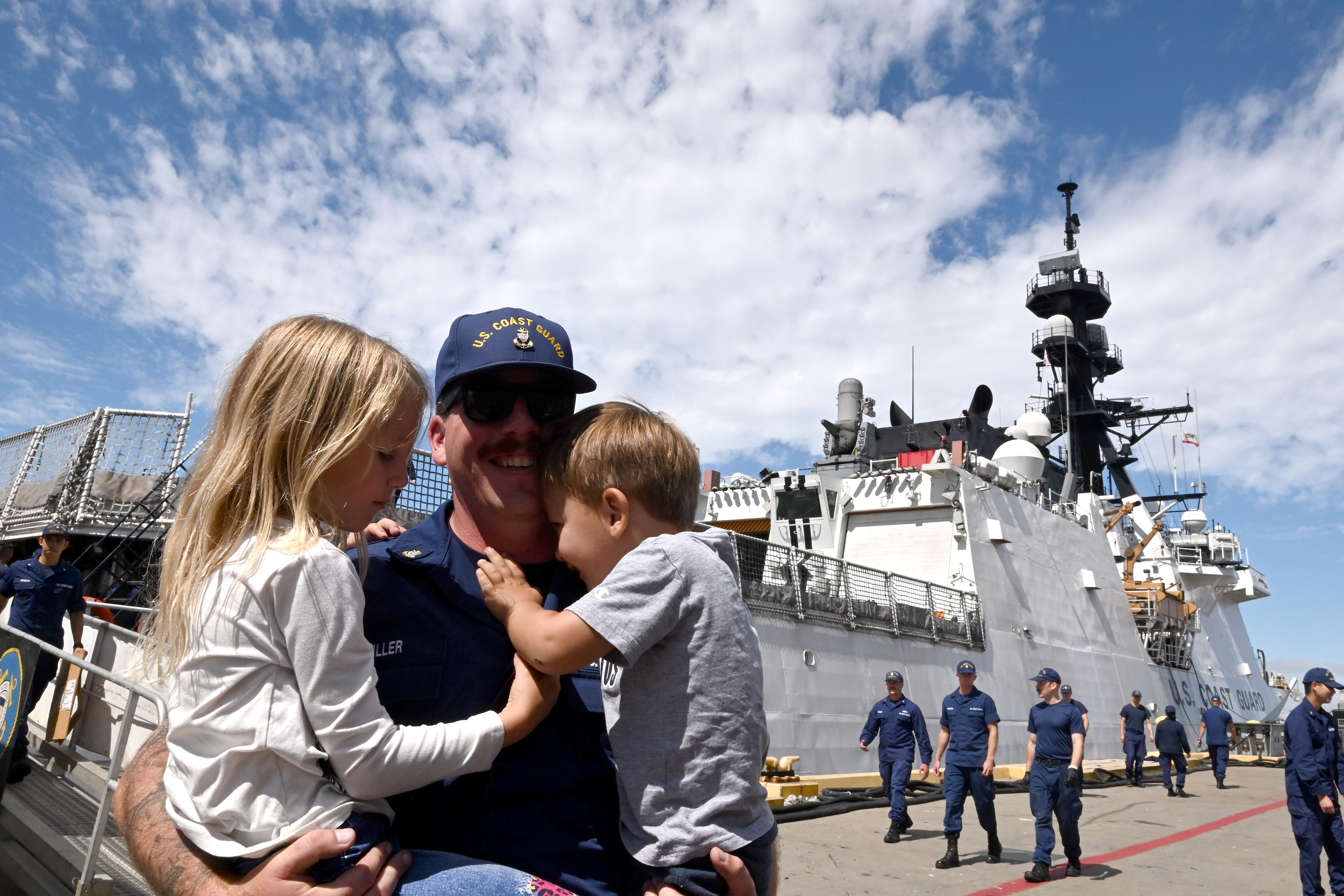
The U.S. Coast Guard Cutter Waesche (WSML 751) crew members reunite with family, friends and loved ones after returning to their Base Alameda, California, home port, Aug. 11, 2024, following a 120-day Indo-Pacific patrol. The Waesche participated in various engagements, exercises, and events throughout their deployment. U.S. Coast Guard photo by Chief Petty Officer Matthew Masaschi.

Below is a news release from Coast Guard News (more photos and a video there). Looks like the Coast Guard is aiming to keep at least one cutter in the Western Pacific at all times.

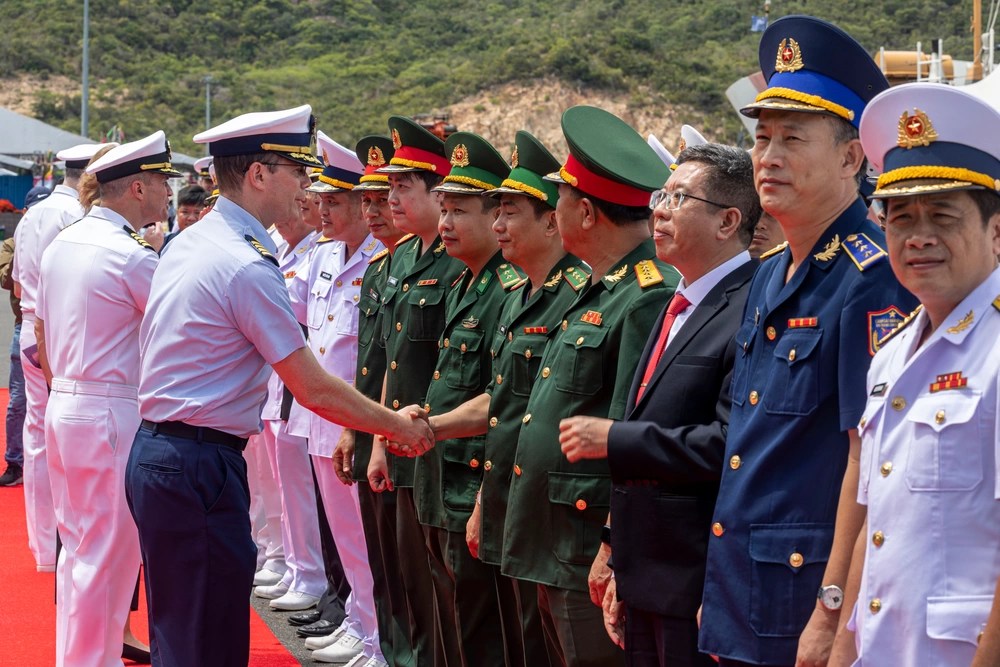
Those of my generation can’t help but see the irony of the friendly relations with the Socialist Republic of Vietnam as Waesche accompanied the 7th Fleet Flagship to Cam Ranh Bay.

U.S. Coast Guard Capt. Tyson Scofield, commanding officer of the U.S. Coast Guard Cutter Waesche (WMSL 751), shakes hands with leadership from the Vietnamese People’s Army during a reception at the Cam Ranh International Port in Vietnam, July 8, 2024. Leadership from the Vietnam Coast Guard and Vietnam Peoples Navy welcomed U.S. Sailors and Coast Guardsmen upon their arrival. Waesche is deployed to the Indo-Pacific to advance relationships with ally and partner nations to build a more stable, free, open and resilient region with unrestricted, lawful access to the maritime commons. (U.S. Marine Corps photo by Cpl. Elijah Murphy)

Aug. 12, 2024

U.S. Coast Guard Cutter Waesche returns home following a 120-day Indo-Pacific patrol

ALAMEDA, Calif. — The U.S. Coast Guard Cutter Waesche (WSML 751) and crew returned to their Base Alameda home port Sunday, following a 120-day patrol throughout the Indo-Pacific.

Waesche participated in various engagements, exercises, and events throughout their deployment.

The cutter’s leadership and crew met with officials and military personnel during port calls in Japan, Republic of Korea, Singapore, and Vietnam.

Following Waesche’s visit to Maizuru, Japan, Waesche joined crews from the Japan Coast Guard vessel Wakasa (PL 93) and the Republic of Korea Coast Guard patrol vessel Taepyongyang (KCG 3016) for a joint search-and-rescue exercise at sea.

Waesche’s crew also conducted a bilateral U.S.-Philippine search-and-rescue exercise with the Philippine Coast Guard in the South China Sea.

“We are thankful to have traveled safely home to our loved ones and to have completed a successful and meaningful patrol,” said Capt. Tyson Scofield, Waesche’s command officer. “Waesche’s patrol strengthened U.S. relationships with our partner nations to foster a free and open Indo-Pacific. The opportunity to work alongside our allies and partners in the Indo-Pacific through impactful engagements was an honor and a rewarding experience that the crew will remember for the rest of their lives.”

Tyson assumed command of the Waesche during a change of command ceremony held in Honolulu as the cutter transited to the Indo-Pacific.

Waesche deployed with a San Francisco-based MH-65E Dolphin helicopter and an aircrew from Air Station Barbers Point, Hawaii.

Waesche was assigned to Destroyer Squadron (DESRON) 15, the Navy’s largest DESRON and the U.S. 7th Fleet’s principal surface force. DESRON 15 regularly assumes tactical control of surface units operating in the area.

Commissioned in 2010, Waesche is one of four Legend-class national security cutters homeported in Alameda. National security cutters are 418-feet long, 54-feet wide, has a top speed of over 28 knots, a range of 12,000 nautical miles, endurance of up to 90 days, and can hold a crew of up to 170. The advanced technologies of the national security cutter class ships are designed to support the operations and missions in the Indo-Pacific region.