“U.S. Marine Corps And The New Long-Range Attack Munition” –Naval News

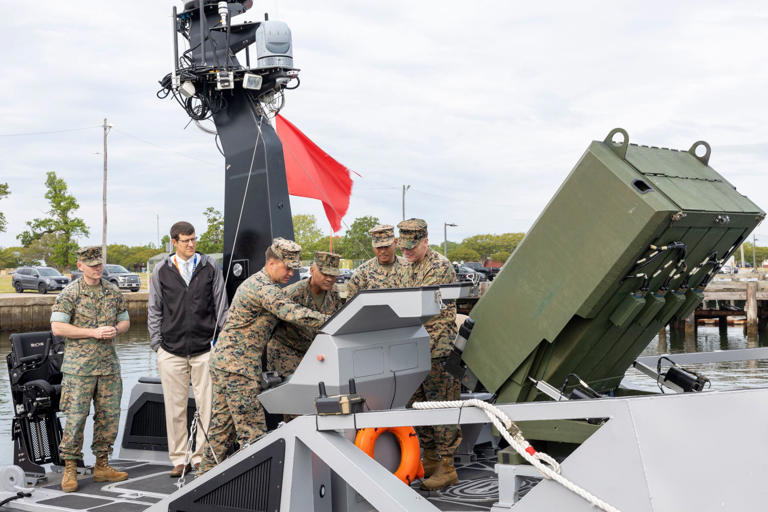
Not exactly the same, but you get the idea:   U.S. Marine Corps Lt. Gen. Brian W. Cavanaugh, the commanding general of Fleet Marine Force, Atlantic, Marine Forces Command, Marine Forces Northern Command, and Marines with 3d Marine Littoral Regiment, 3rd Marine Division, examine the manual controls to the Long Range Unmanned Surface Vessel, Joint Expeditionary Base Little Creek-Fort Story, Virginia, April 27, 2023. A LRUSV is an optionally manned vessel capable of extended travel and transporting loitering munitions that accurately track and destroy targets on sea or land. Metal Shark is designing, building, testing and implementing the LRUSV system under an other transaction authority aggrement with Marine Corps Systems Command to primarily serve as an intelligence, surveillance, and reconnaissance platform.
© Provided by The Drive

Naval News reports the Marines hope to develop a new long range loitering munition. It would take off vertically, be relatively inexpensive, be usable against both moving and fixed targets, on land or at sea, with a “minimum total payload weight capacity of 25 pounds (lbs) to include weapon seeker and warhead (but excludes fuel weight)” and have a range of about 150 nautical miles.

This might be something the Coast Guard could use. Single rounds should be effective against small, fast, highly maneuverable threats, while multiple hits might be effective against larger threats.  The relatively long range would mean it would not have to be widely distributed. A few, held as group assets, might be sufficient to deal with a terrorist threat.

“MDSU-1 DIVES THE ARCTIC WITH U.S. COAST GUARD” –Seapower

BEAFORT SEA (August 11, 2023) A military diver swims behind the icebreaker USCGC Healy (WAGB 20) during a scientific mission in the Beaufort Sea with USCG divers of Regional Dive Locker West and Navy divers of Mobile Dive and Salvage Unit (MDSU) 1 Aug. 11, 2023. Together, the Coast Guard and Navy conducted 42 military dives, totaling 656 minutes of bottom time to depths of 40 feet in the Arctic Ocean. As a component of Explosive Ordnance Disposal Group One, MDSU-1 provides ready, expeditionary, rapidly deployable mobile diving and salvage companies to conduct harbor and waterway clearance, salvage, underwater search and recovery, and underwater emergency repairs in any environment. (U.S. Navy Courtesy Photo)

The Navy Leagues online magazine, “Seapower,” reports Navy divers have deployed with USCGC Healy, now in the Beuford Sea. There was this interesting note,

“They [the Coast Guard] don’t have a decompression chamber, but they’re getting one,” said Hanson. “We let them use ours for this mission conducted for the Office of Naval Research (ONR), and we helped train the Coastguardsmen divers on the operation, maintenance and transport of a decompression chamber.”

and this nice quote,

“We’re trained to call the Coast Guard if a diver gets in trouble,” Hanson said. “But in this case, we were diving right off the side of a Coast Guard cutter, so we might have been in a super remote place, but the exact people we count on for help were right there.”

The description of diving under the ice is surprising.

“US Coast Guard cutter provides presence during Russian military exercise in Bering Sea ” –D17

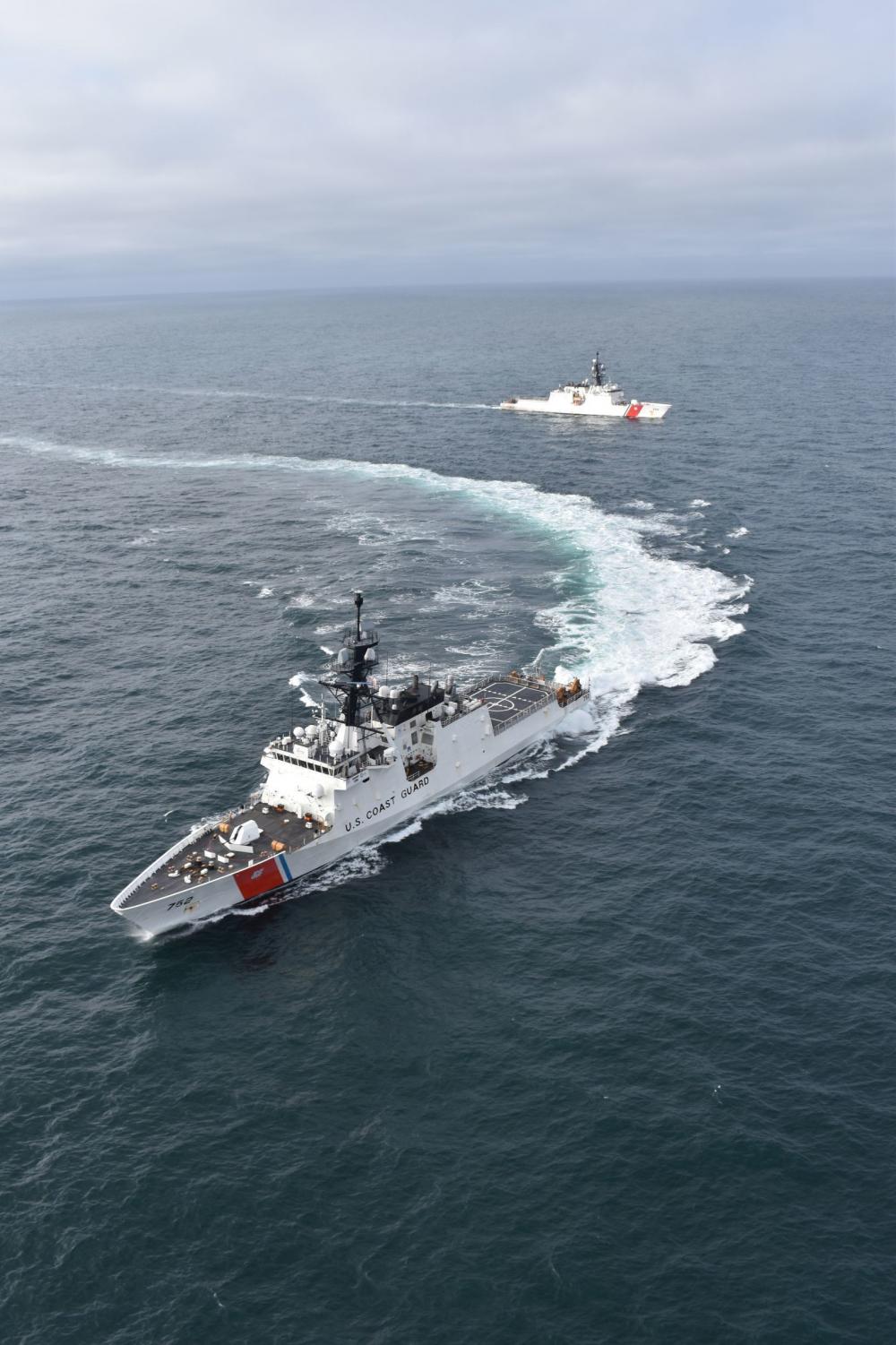
U.S. Coast Guard Cutters Stratton (WMSL 752) and Kimball (WMSL 756) steam in formation while patrolling the U.S.-Russian Maritime Boundary Line (MBL), in the Bering Sea, Sept. 26, 2022. This marked the first time two national security cutters jointly patrolled the MBL above the Arctic Circle. (U.S. Coast Guard courtesy photo).

Below is a District 17 (Alaska) News Release

Sept. 18, 2023

US Coast Guard cutter provides presence during Russian military exercise in Bering Sea

D17 Public Affairs

JUNEAU, Alaska – The crew of Coast Guard Cutter Kimball (WMSL 756), in coordination with U.S. Northern Command, provided U.S. presence during a Russian military exercise in the Bering Sea, Friday.

The Kimball patrolled in the vicinity of U.S. fishing vessels conducting their work in international waters within the U.S. exclusive economic zone (EEZ) during ongoing Russian military operations, which included the launch of a missile, approximately 300 miles southwest of St. Lawrence Island.

“Though military operations and exercises in international waters are lawful,” said Rear Adm. Megan Dean, Seventeenth Coast Guard District commander, “we will continue to ensure there are no disruptions to U.S. interests or commerce in the maritime environment around Alaska.”

On Sept. 10, an urgent warning of navigational dangers advisory message, known as a HYDROPAC, was released through the National Geospatial Agency regarding Russian military operations in the Bering Sea. The area of the HYDROPAC includes a portion of the U.S. EEZ southwest of St. Lawrence Island along the U.S./Russia Maritime Boundary Line and remains in effect through Sept. 24.

The Coast Guard notified vessels and the commercial fishing industry operating in the vicinity of the HYDROPAC, and made notifications to federal, state and tribal governments about the exercise. The Coast Guard continues to provide notifications throughout the maritime and fishing industry by all available means.

The Kimball, a 418-foot legend-class national security cutter homeported in Honolulu, Hawaii, is currently operating under the Seventeenth District’s Operation Frontier Sentinel.

Operation Frontier Sentinel is a Seventeenth Coast Guard District operation designed to meet presence with presence and ensure there are no disruptions to U.S. interests in the Alaskan maritime environment. The Coast Guard routinely patrols international waters under the service’s statutory authorities to ensure maritime safety and security of the U.S. maritime industry, to protect U.S. sovereign rights and to promote international rules-based order. Coast Guard presence ensures due regard for all lawful uses of the seas.

“Army Long Range Missile Launcher Spotted on Navy Littoral Combat Ship” –USNI

An Army MK 70 missile launcher on the flight deck of Littoral Combat Ship USS Savannah (LCS-28) in San Diego, Calif. Photo obtained by USNI News

The USNI News Service reports,

A portable missile launcher capable of firing a combination of long-range anti-ship and anti-air weapons was spotted this week undergoing testing aboard a Littoral Combat Ship in San Diego, Calif., according to photos provided to USNI News.

Based on a series of photos reviewed by USNI News, the launcher is a Lockheed Martin MK 70 containerized vertical launching system that is capable of firing both a Raytheon Standard Missile 6 and a Tomahawk Land Attack Missile. It was spotted on the flight deck of Independence-class LCS USS Savannah (LCS-28), which was pier-side in San Diego, according to a USNI News review of the images.

If you can operate Army missile launchers from an LCS you can also operate them from a Coast Guard cutter.

This could be particularly useful in Alaska where there are no Navy ships and limited road infrastructure. Launchers could be flown to meet cutters already in Alaskan waters long before Navy ships could reach the area.

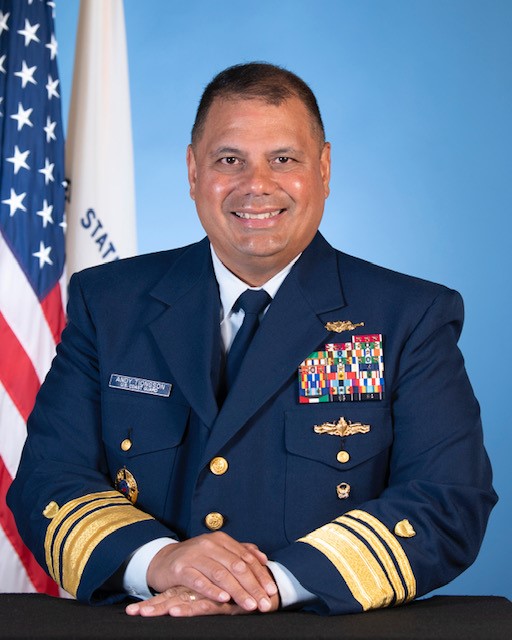
Proceedings Podcast EP. 351: USCG Pacific Area Commander on Maritime Governance

Vice Adm. Andrew J. Tiongson, Commander Coast Guard Pacific Area

The US Naval Institute has a pod cast interview of the PACAREA Commander.

Initially, there were questions about the Coast Guard’s response to the fires on Maui and Tropical Storm Hillary’s landfall in Southern California.

There was a lot of talk about the Coast Guard being a trusted partner, both internally and internationally, and the cooperative relationship the Coast Guard has developed with island nations in the Pacific, that have resulted in 13 bilateral agreements including some “enhanced” ship-rider agreements that permit the Coast Guard to act on behalf of island nations, even if there are none of their citizens aboard.

He said Harriet Lane should be in the Pacific before the end of the year.

He also talked about his potential role as Commander, Defense Force, West, under NorthCom.

There were some of surprises.

  • The Canadian Coast Guard has leased a commercial vessel and the USCG is providing a law enforcement detachment. I presume they are operating in the Western Pacific because there would be no reason to use a USCG LEDET in Canadian Waters.
  • That the House version of the budget includes four additional Webber class FRCs, three more for Guam and another for Honolulu.
  • The Coast Guard is opening a “Center for Excellence,” a regional activity center, in Hawaii, that will provide training in fisheries enforcement and environmental response for friendly nations. Should help form cooperative relationships across the Pacific.

I was also pleased to learn that VAdm. Tiongson had had a tour on USS NORMANDY (CG-60) as part of the U.S. Coast Guard – U.S. Navy exchange program. Apparently, it did not hurt his career.

The interviewer, Host Bill Hamblet, said he presumed PACAREA had the lion’s share of Coast Guard assets. VAdm. Tiongson did not answer that, but I can’t let it pass, because in my view the Coast Guard is still underrepresented in the Pacific.

About 84% of the US EEZ is in PACAREA, but LANTAREA will have 55% of the National Security Cutters. LANT has 81.5% of the WMECs (22 out of 27, counting Harriet Lane as in the Pacific), and 76% of the current 54 FRCs. Current plans are for PACAREA to have only 18 of the 65 FRC currently funded, less than 28%.

The situation may not be quite as bad as it looks, because LANTAREA assets are actually closer to the Eastern Pacific drug transit zones than PACAREA assets, so LANTAREA assets to operate frequently in the Eastern Pacific, but the asset distribution is still off, and PACAREA’s workload has been increasing with the emphasis on IUU fishing in the Pacific.

United States Exclusive Economic Zone – Pacific centered NOAA map

“NPS Research on Coast Guard Icebreaker to Enhance Arctic Readiness” –Marine Link

During a seven-week Arctic transit aboard the U.S. Coast Guard icebreaker USCGC Healy (WAGB 20), Dr. Nita Shattuck from the Naval Postgraduate School (NPS) will study the impact of the extreme environment on crew performance and potential mitigations. Additional research includes assessment of an Amos01 3D printer installed by David Dausen from NPS’ Consortium for Advanced Manufacturing Research and Education (CAMRE), and specially instrumented to measure the impact of adverse Arctic sea conditions.

Marine Link reports the Naval Post Graduate School is doing some interesting studies on the working environment experienced by USCGC Healy’s crew.

To study the effects of these conditions on a ship’s crew at sea, Shattuck and her team will collect physiological data from the Healy’s crew members. Using innovative wearable technology, they will continuously monitor physiological processes such as sleep, heart rate, heart rate variability, respiration, oxygen saturation, and skin temperature. Study participants indicate that the rings are an improvement over wrist-worn wearables. The team will also use other sensors to monitor ambient light, noise levels, motion, and vibration aboard the ship.

The report also mentions that Healy will be going to Tromsø, Norway. How they get there will be interesting. Will they go the Northwest Passage through the Canadian EEZ or the Northern Sea Route through Russia’s EEZ?

“U.S. Coast Guard Cutter Healy, National Science Foundation embark on Arctic Ocean mission”

News Release from Coast Guard News. There is a second video on the link showing the preparation and launching of an Unmanned Underwater Vehicle (UUV).


Aug. 26, 2023

U.S. Coast Guard Cutter Healy, National Science Foundation embark on Arctic Ocean mission

KODIAK, Alaska – U.S. Coast Guard Cutter Healy (WAGB 20) crew and embarked researchers departed Kodiak, Saturday, for the cutter’s second mission this year in the high latitudes of the Arctic Ocean.

Healy’s next mission takes the cutter west, where the crew and a new team of researchers will support work of the National Science Foundation and International Arctic Research Center by servicing the Nansen and Amundsen Basins Observational System (NABOS).  The month-long mission’s objective is to recover, service, and deploy nine long-term subsurface mooring arrays, stretching from the Eurasian Basin to the East Siberian Sea.

These moorings will give insight into the how water from the Atlantic Ocean is being introduced into the Arctic at the shelf water level, deep basin interior, and the upper ocean; as well as help develop an understanding of water circulation in the region. Another key capability Healy will provide is the ability to execute Conductivity, Temperature, and Depth (CTD) casts, sampling the water column in areas normally inaccessible due to pack ice.

“The Siberian Arctic, one of the regions of the Arctic where changes in sea ice and ocean are currently most noticeable, will be the area of this high-latitude mission onboard the Healy,” said Igor Polyakov, NABOS project lead. “However, this region is also one of the least observed, making this cruise crucial if we want to create a trustworthy observing and forecasting system.”

The NABOS project’s foundational goal since beginning in 2002 is to gain understanding of the circulation and the transformation of Atlantic waters into the Arctic Ocean. Missions from 2021 to 2025 are directed at quantifying the freshwater introductions and their impact on the transportation of heat from Atlantic waters into the region.

With these observations, NABOS looks to inform the scientific community and public on the potential impacts to Arctic sea-ice coverage and marine ecosystems, and the expanding effect on the mid-latitudes. The success of NABOS since its earliest days has always been reliant on international partnerships, researchers of diverse backgrounds, and assets like Healy achieving the results for which the project is known.

During July and August, the Healy’s mission supported and collaborated with the Office of Naval Research (ONR) experts from across a broad spectrum of disciplines, deploying and servicing instruments for ONR’s Arctic Mobile Observing System (AMOS) in the Beaufort Sea.

Under the leadership of U.S. Coast Guard Capt. Michele Schallip, Healy’s commanding officer and mission chief scientist, Dr. Craig Lee, Healy’s crew and research teams completed an array of science stations, including mooring very low frequency acoustic devices to the sea floor, deploying subsurface gliders, and conducting science equipment installations on ice floes.

The naturally hazardous environment of the Arctic required Healy to remain on-scene for lengthy periods to ensure proper function of instrumentation. In one instance, the ship was forced to send a repair part to the ice after a polar bear damaged equipment overnight. Healy’s unique capabilities are essential to the AMOS program, being the only U.S. platform able to provide researchers with access to the most remote reaches of the Arctic Ocean.

In addition to the NABOS and AMOS missions, the U.S. Coast Guard Research and Development Center is running and coordinating numerous scientific research efforts for the U.S. Coast Guard and partner research organizations. These projects will focus on several key areas pertaining to Arctic operations, including search and rescue, communications, crew performance, and atmospheric monitoring and characterization. The expanded knowledge base this research will provide will help the U.S. Coast Guard and partners improve Arctic operations and systems.

Healy is the Coast Guard’s only icebreaker specifically designed for Arctic research, as well as the nation’s sole surface presence routinely operating in the Arctic Ocean. The platform is ideally specialized for projects like NABOS; providing access to the most remote reaches of the Arctic Ocean; areas barricaded by pack ice and insurmountable by most research vessels.

The Healy deploys annually to the Arctic to support multiple science missions and Operation Arctic Shield, the service’s annual operation to execute U.S. Coast Guard missions, enhance maritime domain awareness, strengthen partnerships, and build preparedness, prevention, and response capabilities across the Arctic domain.

Commissioned in 1999, and homeported in Seattle, Healy is the largest ship in the U.S. Coast Guard at 420-feet with a displacement of over 16,000 tons. The crew compliment of 84 supports the ship’s primary mission of scientific support. It is one of two active polar icebreakers in the Coast Guard’s fleet. The Seattle-based Coast Guard Cutter Polar Star (WAGB 10) is a Polar icebreaker commissioned in 1976.

The Coast Guard is recapitalizing its Polar icebreaker fleet to ensure continued access to both Polar regions and support the country’s economic, commercial, maritime, and national security needs.

“USNI News Fleet and Marine Tracker: Aug. 21, 2023”

USCGC Munro (WMSL-755) escorts USNS Fisher (T-AKR-301) in the East China Sea on Aug. 12, 2023. US Navy Photo

Looking at the latest US Naval Institute “Fleet and Marine Tracker,” I am a bit surprised to see there are still 3 Navy ships operating under 4th Fleet, presumably doing drug interdiction. This is an uptick.

Again, they report on atypical Coast Guard operations:

  • Legend-class National Security Cutter USCGC Munro (WMSL-755) departed South Korea last week and is in the Korea Strait. (As I mentioned earlier, there is a possibility, cutters may encounter the new North Korean corvettes.)
  • Coast Guard Cutter USCGC Healy (WAGB-20) continues its work in the Beaufort Sea. Healy is on a five-month deployment in partnership with ONR and the National Science Foundation.
  • Coast Guard Cutter USCGC Forward (WMEC-911) is currently supporting Operation Nanook. Operation Nanook is an annual Canadian-led exercise that fosters international cooperation and shared responsibility in the Arctic and the northern Atlantic Regions. The cutter recently made a port call in Nuuk, Greenland.

You can use Control F “USCGC” if you want to quickly find the Coast Guard cutters mentioned in the USNI posts.

PATFORSWA is mentioned again.

The link in the Healy entry, “U.S., Canadian Icebreakers Conduct Operation, Rendezvous en Route to Arctic Ocean” is interesting, plus there is more in the USNI post including an “adorable” polar bear photo.

“Coast Guard detects 16 unauthorized drones during Seafair Weekend Festival” –CG News

Coast Guard members, in collaboration with the FAA, the Seattle Police Department (SPD), and Mercer Island Police Department (MIPD), employ Counter-Unmanned Aircraft Systems (UAS) capabilities to enforce the FAA-issued Temporary Flight Restrictions on Lake Washington during the 2023 Seafair Weekend Festival in support of the Airshow August 3, 2023. This was the first year Coast Guard Counter-UAS has been employed at Seafair. (U.S. Coast Guard courtesy photo)

Below is a news release from Coast Guard News.

We have seen counter UAS equipment added to the Webber class cutters in Southwest Asia, but this is the first time I have seen public acknowledgement of domestic counter UAS operations by the Coast Guard.

As a drone operator myself, I was happy to see that the effort was primarily educational, but the Coast Guard does need a robust domestic counter UAS capability for contingencies.


Aug. 9, 2023

Coast Guard detects 16 unauthorized drones during Seafair Weekend Festival

SEATTLE — The Coast Guard employed Counter-Unmanned Aircraft Systems (UAS) capabilities in collaboration with the Federal Aviation Administration (FAA), Seattle Police Department (SPD), and Mercer Island Police Department (MIPD) to enforce the FAA-issued temporary flight restrictions on Lake Washington during the 2023 Seafair Weekend Festival in support of the airshow.

This is the first year Coast Guard counter-UAS has been employed at Seafair.

The Coast Guard detected 16 UAS operators violating airspace restrictions during the H1 Unlimited Hydroplane Races and Boeing Air Show. Officers from SPD and MIPD were able to contact eight UAS operators and provide education on airspace restrictions as well as safe UAS operations.

One operator was cited for reckless endangerment by the Seattle Police Department.

“Unauthorized UAS can be extremely dangerous to airshow pilots, as well as spectators,” said Cmdr. Scott McGrew, the Coast Guard incident commander for SeaFair. “Our robust partnership with the FAA, Seattle Police and Mercer Island Police Department is vital to ensure unauthorized UAS operators are intercepted and educated on safe operations and reminded of the FAA Temporary Flight Restrictions in place to support the airshow.”

UAS operators are reminded to check tfr.faa.gov or the b4ufly app to verify the airspace is authorized for UAS flight.

“Russia and China Sent Large Naval Patrol Near Alaska” –Wall Street Journal

The Wall Street Journal reports,

“Eleven Russian and Chinese ships steamed close to the Aleutian Islands, according to U.S. officials. The ships, which never entered U.S. territorial waters and have since left, were shadowed by four U.S. destroyers and P-8 Poseidon aircraft.”

The Russians and Chinese have been doing these joint deployments into the Bering Sea for at least a few years, and normally it has been the Coast Guard that followed them. This time the Navy sent a capable force, in addition to P-8 Maritime Patrol Aircraft they sent USS John S. McCain (DDG-56), the USS Benfold (DDG-65), the USS John Finn (DDG-113) and the USS Chung-Hoon (DDG-93).

Previous reports: 

Coast Guard Cutter Kimball encounters Russia and People’s Republic of China military naval presence in Bering Sea” –D17, Sept. 2022

“Chinese Warships Sailing Near Alaska’s Aleutian Islands Shadowed By U.S. Coast Guard” –Small Wars Journal, Sept. 2021

Chinese Navy Operating Off Alaska, Sept. 2015

http://www.state.gov/e/oes/ocns/opa/arc/uschair/258202.htm . This map of the Arctic was created by State Department geographers as part of the U.S. Chairmanship of the Arctic Council.

Why are they there?:

Russia is easy to understand. This is very close to their territory and their Pacific Fleet base in Petropavlovsk, but why the Chinese?

Russia is China’s top crude oil source, and much of that oil comes from Russia’s Arctic. In any conflict China’s energy sources are likely to be a target and the Bering Strait is the choke point on the most direct route from the Russian Arctic to Chia.

I would note that China’s excursions into the Bering Sea all seem to be toward the end of summer, which is about as nice as it gets in the Aleutians.