PATFORSWA FRCs Recieve Maintenance in Theater

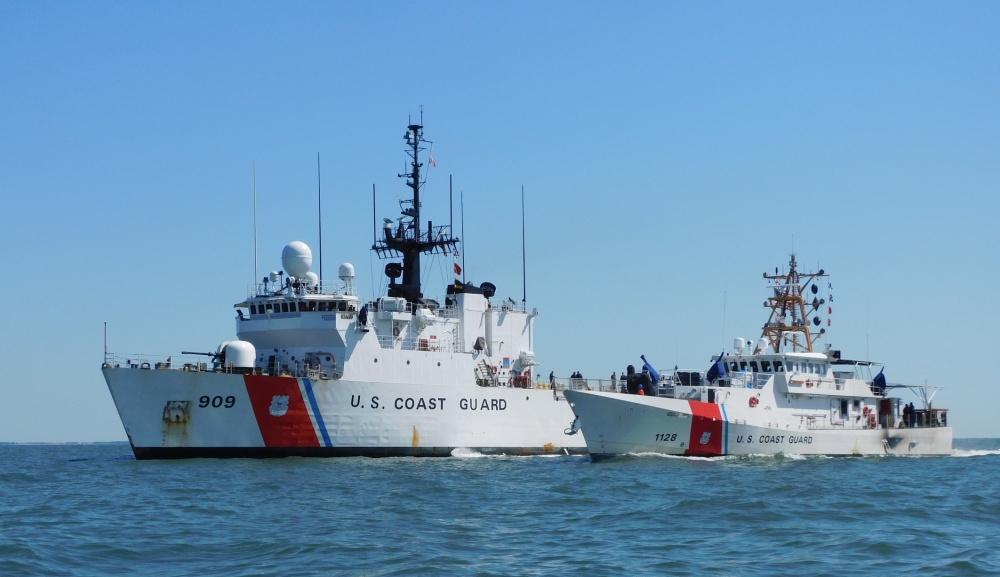
USCGC John Scheuerman (WPC-1146) and USCGC Clarence Sutphin Jr. (WPC-1147) enroute PATFORSWA

A US Naval Forces Central Command news release reporting change of Command of Destroyer Squadron 50 included this little tidbit,

“Coles also built maintenance capacity in a highly dynamic environment when he enabled the U.S. Coast Guard’s Patrol Forces Southwest Asia to execute maintenance on all five of their fast-response cutters in a forward logistics location. This kept the FRC fleet 100 percent ready for tasking.”

PATFORSWA has six FRCs, but maybe only five needed maintenance. Anyway, nice to know they can be maintained in theater rather than having to be rotated out. Not too surprising considering the older Island class cutters were also maintained in theater.

Helicopter vs USV

The War Zone reports what may be a first, an Uncrewed Surface Vessel apparently engaged an armed helicopter that was attempting to destroy it.
This may have some relevance for the Coast Guard in that at some point a Coast Guard helicopter might be called upon to destroy a USV being used in a terrorist attack.
It appears in this one-on-one engagement the helicopter had the advantage, being able to remain behind the USV out of the missiles field of view.
The USV had two launch rails, but both were pointed forward. Had one been pointed forward and the other aft, the helicopter would have had a much harder time staying out of the missile field of view.
Had it been two USVs vs a single helicopter, while the helicopter chased one USV it could be targeted by the other. The USV might employ something like the “Thatch Weave” that US Navy pilots employed against the more maneuverable Japanese Zero.
It is possible the missiles on USVs were never intended to be used against aircraft. The intention might have been to employ them against a surface target as a way to reduce the effectiveness of the defense, as the USV approached the target.
The article suggests that because the engagement occurred during the day, that the USV was attempting to bait the helicopter, but it might be that a long transit required some daytime transit to reach a distant port before sunrise.

Remembering DC3 Bruckenthal, “USS Firebolt Heroes Remembered, 20 Years On”

240424-A-RM303-1053 MANAMA, Bahrain (April 24, 2024) Vice Adm. George Wikoff, commander of U.S. Naval Forces Central Command, U.S. 5th Fleet and Combined Maritime Forces, speaks during the USS Firebolt (PC10) memorial ceremony onboard Naval Support Activity Bahrain, April 24. The ceremony honors the three crew members who died while conducting maritime security operations in the Arabian Gulf on April 24, 2004. Firebolt, a Cyclone-class patrol coastal boat, which was decommissioned in February 2022, was forward deployed to Bahrain. (Official U.S. Army photo)

Below is a news release by U.S. Naval Forces Central Command Public Affairs. Hard to believe it’s been 20 years. Notice the podium the Admiral Wikoff is standing behind bears the crest of Coast Guard PATFORSWA.

The Coast Guard has honored DC3 Bruckenthal in its own way.

The crew of the Coast Guard Cutter Bruckenthal participates in a fueling exercise with the Coast Guard Cutter Campbell on the Chesapeake Bay, April 11, 2020. The Coast Guard acquired the first Sentinel Class cutter in 2012, with the namesake of each cutter being one of the service’s many enlisted heroes. (U.S. Coast Guard photo by Petty Officer 3rd Class Isaac Cross)


USS Firebolt Heroes Remembered, 20 Years On

MANAMA, Bahrain — U.S. Naval Forces Central Command Public Affair

Sailors, Coast Guardsmen, and others gathered at Naval Support Activity Bahrain April 24 to observe the 20th anniversary of the lives lost when three USS Firebolt crewmembers thwarted an attack on critical Iraqi oil platforms during Operation Iraqi Freedom.

The ceremony honors the lives of U.S. Navy Sailors Boatswain’s Mate 1st Class Michael J. Pernaselli and Signalman 2nd Class Christopher E. Watts, and U.S. Coast Guard Damage Controlman 3rd Class Nathan B. Bruckenthal, who died while conducting maritime security operations in the Arabian Gulf on April 24, 2004. The three were stationed aboard the Cyclone-class patrol coastal boat USS Firebolt (PC 10).

The three were killed while intercepting a suspicious dhow headed for the Khawr Al Amaya Oil Terminal in the Northern Arabian Gulf. As their rigid-hull inflatable boat neared the dhow, the vessel exploded in an apparent suicide attack. This action prevented the dhow from hitting its intended target, but caused the RHIB to capsize, leading to the three service members losing their lives in the process.

“Their heroism in the waters of the North Arabian Gulf 20 years ago today inspires us still,” said Vice Adm. George Wikoff, commander of U.S. 5th Fleet, who spoke at the ceremony. “Even as we speak, Sailors not unlike these three young men are facing down anti-ship ballistic missiles and one-way attack drones in the Red Sea. Like these heroes from Firebolt, they sail unflinchingly into harm’s way, understanding theirs is no ‘routine mission.’”

Wikoff also noted that today, Sailors and Coastguardsmen in the Arabian Gulf and the Northern Arabian Sea provide assistance to mariners when needed, and board suspect vessels to ensure regional maritime security, interdicting illicit drug trafficking, and seizing weapons intended for malign actors.

“They, too, know it’s no ‘routine mission,’” he said.

The ceremony also included recapping the lives and accomplishments of the three service members as well as the playing of Taps and tolling a bell 11 times, symbolic of church bells which rang on the eleventh hour on the eleventh day of the eleventh month in 1918 to signal the end of the First World War.

Firebolt, which was decommissioned in February 2022, was commissioned in June 1995. It began conducting coastal patrol operations in the U.S. 5th Fleet in 2003. Prior to operating from Bahrain, the ship helped secure New York City’s harbor immediately following the September 11th terrorist attacks. Months later, Firebolt conducted coastal patrols in the Arabian Gulf during Operation Iraqi Freedom.

U.S. 5th Fleet area of operations encompasses about 2.5 million square miles of water area and includes the Arabian Gulf, Gulf of Oman, Red Sea and parts of the Indian Ocean. The expanse comprises of 20 countries and includes three critical choke points at the Strait of Hormuz, the Suez Canal and the Strait of Bab al Mandeb at the southern tip of Yemen.

APKWS Affordable Counter UAS System

The War Zone (TWZ) reports on a new NAVAIR contract for Counter UAS systems.

See the four fixed radar antenna on top of the cab? Look familiar?

From the Company web site: RPS-42 is an S-Band tactical hemispheric air surveillance radar system. It is a member of the non-rotating, solid-state, digital radar family Multi-mission Hemisphere Radar (MHR), developed by RADA Electronic Industries Ltd.
The RPS-42 is a pulse Doppler, software-defined radar platform, that can detect, classify and track all types of aerial vehicles – including fighters, helicopters, UAVs, transport aircraft, etc. at tactical ranges. A single radar platform provides 90º azimuth coverage. Hemispheric coverage is achieved when four radars are employed as a system. Mobile or stationary, the system can be integrated with any C⁴I system and other radars and sensors. The software is able for On-the-Move (OTM) Operation. The radar can operate either as a stand-alone or as part of a large-scale surveillance system.
The Antenna is an Active Electronically Scanned Array (AESA) based on Galliumnitrid (GaN) Amplifiers. Its diameter is 50.4 cm, the max width is 16.5 cm.
The achievable range for detection of the smallest drones (known as Nano UAV) is 3.5 km.

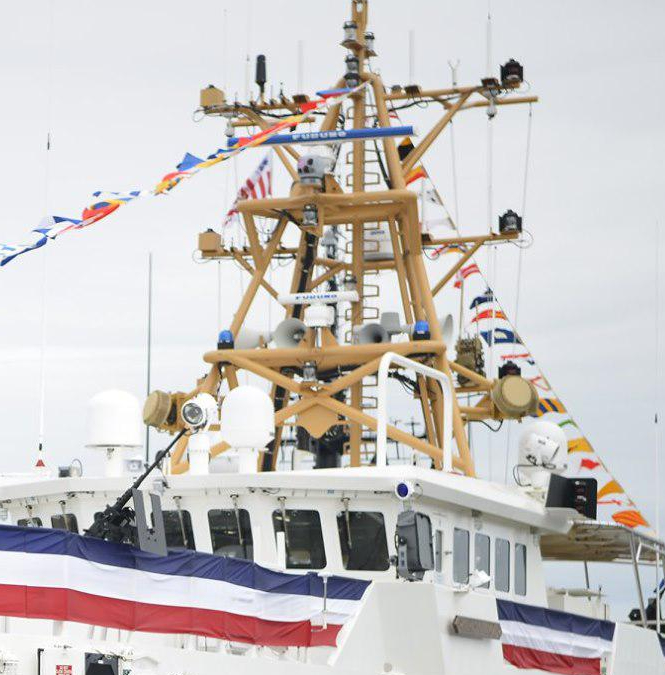
Looks like they or close cousins are on PATFORSWA cutters. (Click on the photo below to enlarge.) They are on the mast.

USCGC Charles Moulthrope (WPC-1141) prior to departure for PATFORSWA.

The TWZ post has a bit of cost comparison as well.

The laser-guided rockets are modular and low-cost, with the guidance section designed to slot in between existing standardized 70mm warheads and rocket motors. The unit cost of the APKWS II guidance section is around $25,000, with the warhead and rocket motor together typically only costing a few thousand dollars more depending on their exact types, according to Navy budget documents. For comparison, the cost of a single Coyote Block 2 interceptor, another counter-drone weapon currently deployed to help protect U.S. Forces in the Middle East, is reportedly roughly around $100,000. Current generation Stinger short-range heat-seeking surface-to-air missiles, which include new features to improve their effectiveness against drones, have a unit cost of around $400,000.

For comparison, an Alamo round of 57mm costs about $29,500.

The MSI news release is here. More on MSI’s Vehicle Integration Kit (VIK).

“Canadian-Led CTF 150 Seize Nearly 2,000kg of Narcotics in Two Interdictions in a Single Day” –Combined Maritime Forces

Apr 14, 2024
ARABIAN SEA – 240410-N-NO146-1005 ARABIAN SEA (April 10, 2024) Bags of illegal narcotics seized from a vessel are stacked on the deck of the U.S. Coast Guard Sentinel-class fast-response cutter USCGC Clarence Sutphin Jr. (WPC 1147) in the Arabian Sea, April 10. Clarence Sutphin Jr. was operating under Combined Task Force 150, one of five task forces under Combined Maritime Forces, the largest multinational naval partnership in the world. CTF 150 focuses on maritime security operations outside the Arabian Gulf. Crimson Barracuda counters terrorist and criminal organizations’ use of the high seas to smuggle narcotics, weapons, and other illicit substances in the Indian Ocean, Arabian Sea and Gulf of Oman.

Below is a news release from Combined Maritime Forces Public Affairs.

I would note two things about this particular incident. The use of “Canadian space-based intelligence” to cue the cutter’s interdiction, and second, that you can see Long Range Acoustic Devices mounted on the cutter in the photo above. Below is a close-up.

Long Range Acoustic Device.


MANAMA, Bahrain —The Canadian-led Combined Task Force (CTF) 150 carried out two drug interdictions at sea in a single day as part of Focused Operation Crimson Barracuda in the Arabian Sea, April 10. The two interdictions resulted in the seizure of a combined total of nearly 2,000 kg of drugs.

The Royal Navy’s HMS Lancaster, a Duke-class Type 23 frigate, seized over 800 kg of hashish, 390 kg of methamphetamines and 110 kg of heroine from a stateless dhow in the Arabian Sea. This was the crew’s first day of deployment after completing a crew swap a few weeks before.

“I am exceptionally proud of the entire team in Lancaster executing this interdiction on the first day of our deployment,” said Royal Navy Cmdr. Chris Sharp, HMS Lancaster’s commanding officer. “Complex interdictions in such a challenging environment require true teamwork across the entire ship’s company. This success is shared with our partners in CTF 150 who provided essential support to the operation.”

Then, using Canadian space-based intelligence, the Sentinel-class fast-response cutter USCGC Clarence Sutphin Jr. (WPC 1147) seized 257 kg of methamphetamines, 92 kg of heroine, 17 kg of amphetamines, 296 kg of hashish, and 15 kg of marijuana from another dhow in the Arabian Sea. After weighing and documenting the hauls, the crew disposed of the narcotics.

Clarence Sutphin Jr is forward deployed to Bahrain as part of a contingent of U.S. Coast Guard ships under Patrol Forces Southwest Asia (PATFORSWA). PATFORSWA deploys Coast Guard personnel and ships alongside U.S. and regional naval forces throughout the Middle East.

“These two interdictions have made a significant dent in criminal and terrorist organizations’ ability to use drugs to fund their activities,” said Royal Canadian Navy Capt. Colin Matthews, Commander Combined Task Force 150. “The collaboration of our assets and personnel allowed us to become a precise and highly effective team that not only undermined the efforts of these organizations, but also nearly 2,000 kg of drugs from hitting the streets.”

Crimson Barracuda counters terrorist and criminal organizations’ use of the high seas to smuggle narcotics, weapons, and other illicit substances in the Indian Ocean, Arabian Sea and Gulf of Oman.

CTF 150 is one of five task forces under Combined Maritime Forces, the world’s largest international naval partnership. CTF 150’s mission is to deter and disrupt the ability of non-state actors to move weapons, drugs and other illicit substances in the Indian Ocean, the Arabian Sea and the Gulf of Oman.

Combined Maritime Forces is a 42-nation naval partnership upholding the international rules-based order by promoting security and stability across 3.2 million square miles of water encompassing some of the world’s most important shipping lanes.

“CMF’s Combined Task Force 150 Seizes Nearly 400 Kilograms in Illegal Narcotics in the Arabian Sea”

Below is a news release from U.S. Naval Forces Central Command Public Affairs. USCGC Glen Harris has been busy. I know, she had at least seven successful drug interdictions since she joined PATFORSWA.


240404-N-NO146-1002 ARABIAN SEA (April 4, 2024) A Sailor removes illegal narcotics from the hull of a vessel seized by the U.S. Coast Guard Sentinel-class fast response cutter USCGC Glen Harris (WPC 1144) in the Arabian Sea, April 4. Glen Harris was operating under Combined Task Force 150, one of five task forces under Combined Maritime Forces, the largest multinational naval partnership in the world. CTF 150 focuses on maritime security operations outside the Arabian Gulf. Photo By: U.S. Coast Guard

MANAMA, Bahrain —April 08, 2024

A U.S. Coast Guard cutter, working in direct support of Combined Task Force (CTF) 150, of Combined Maritime Forces, seized nearly 400 kilograms of illegal drugs from a dhow in the Arabian Sea, April 4.

Crewmembers from the Sentinel-class fast response cutter USCGC Glen Harris (WPC 1144) discovered and seized 15 kilograms of heroin and 375 kilograms of methamphetamine aboard the dhow. After weighing and documenting the haul, the crew properly disposed of the narcotics.

“This is the second major interdiction of the USCGC Glen Harris and the CTF-150 team with a combined total of 1,160 kg of drugs seized to date, denying income to criminal and terrorist organizations from the profits of illicit narcotics,” said Capt. (N) Colin Matthews, commander of CTF-150. “This exceptional multinational cooperation between our two teams is an example of the impacts we can make when we work together.”

On March 5, Glen Harris, working in support of CTF 150, seized 770 kilograms of methamphetamines from a dhow in the Arabian Sea.

Glen Harris is forward deployed to Bahrain. The fast response cutter is part of a contingent of U.S. Coast Guard ships forward-deployed to the region under Patrol Forces Southwest Asia (PATFORSWA). PATFORSWA deploys Coast Guard personnel and ships alongside U.S. and regional naval forces throughout the Middle East.

CTF 150 is one of five task forces under Combined Maritime Forces, the world’s largest international naval partnership. CTF 150’s mission is to deter and disrupt the ability of non-state actors to move weapons, drugs and other illicit substances in the Indian Ocean, the Arabian Sea and the Gulf of Oman.

Combined Maritime Forces is a 42-nation naval partnership upholding the international rules-based order by promoting security and stability across 3.2 million square miles of water encompassing some of the world’s most important shipping lanes.

“India Rescues Iranian Fishing Vessel Hijacked By Pirates Off Somalia” –gCaptain

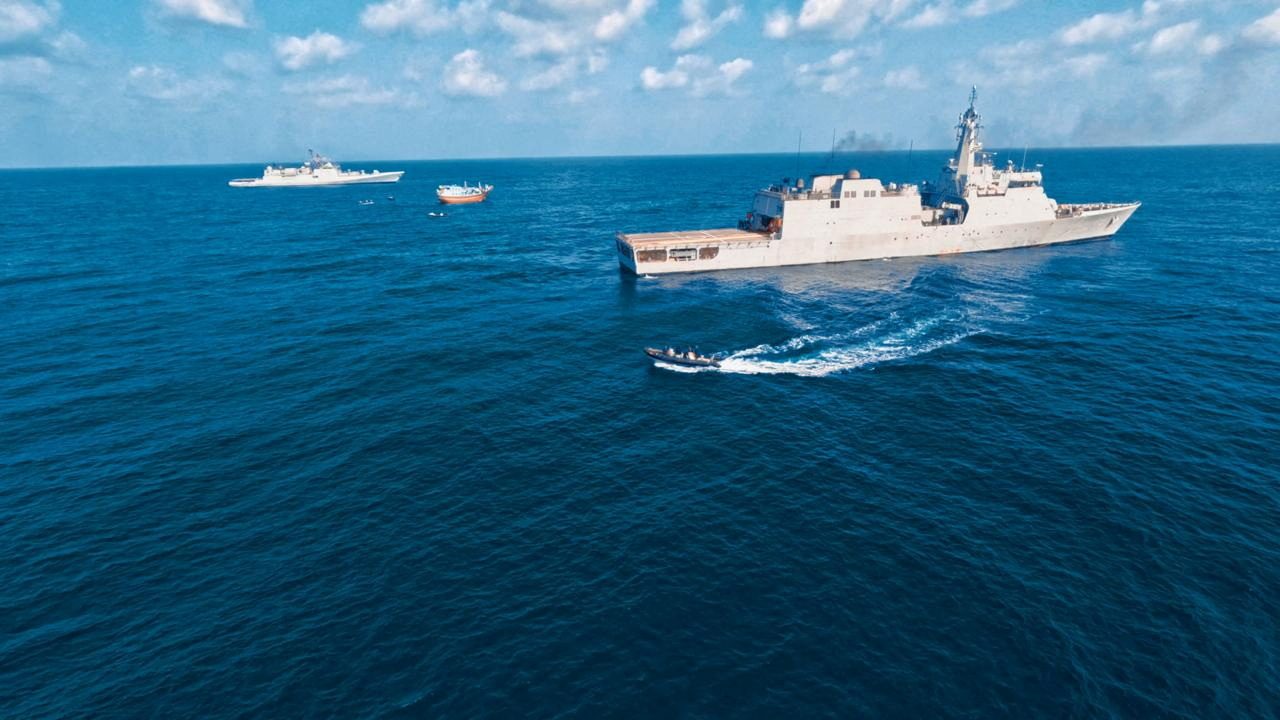
An Indian Navy carries out a rescue operation of an Iranian fishing vessel Al-Kambar 786 after it was seized by armed pirates off Somalia, in the Arabian Sea, according to a naval statement, in this handout photo released on March 30, 2024. SPOKESPERSONNAVY VIA X/Handout via REUTERS

gCaptain reports,

The Indian Navy said it had freed the 23-strong crew of an Iranian fishing vessel which was seized by armed pirates off Somalia….The vessel was intercepted by the navy’s INS Sumedha and INS Trishul, leading to “over 12 hours of intense coercive tactical measures” forcing the pirates to surrender…”

INS Sumedha (foreground in the photo above) is a Saryu-class 105 meter (344′) offshore patrol vessel, and was the first Indian vessel on scene.

Interestingly, the 23 member crew of this Iranian fishing vessel were all Pakistani nationals.

Helicopter Door Gunner Takes Down Kamikaze Drone

French Armed Forces via X

The War Zone reports, “A French Navy helicopter used machine gun fire to shoot down a Houthi drone over the Red Sea today.”

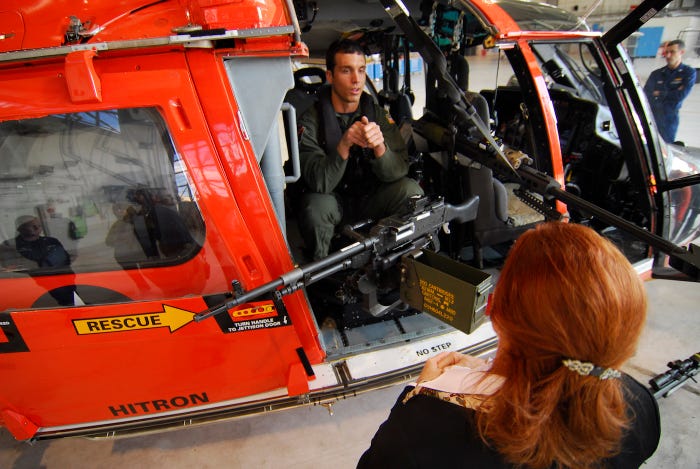
This is a potential Coast Guard capability, given its airborne use of force capability includes a door mounted rifle caliber machine gun, though I do not know if every Coast Guard Air Station has qualified gunners. The .50 caliber sniper rifle included in the package might even be more effective than the machine gun.

I am not suggesting the Coast Guard send helicopters to the Red Sea, but when the Coast Guard provides protection for vessels transiting to sea, it has generally been done with small boats with crew served rifle caliber machine guns. Ballistic Missile submarines have been an exception. They may be escorted by 82 foot patrol boats with .50 caliber machine guns in remote weapon stations. Perhaps the Coast Guard should consider providing an armed helicopter overwatch. An armed helicopter could be effective against hostile surface systems as well as air systems.

Petty Officer 2nd Class Anthony Phillips, a precision marksman at Helicopter Interdiction Tactical Squadron, displays the weaponry used by a HITRON during missions, February 23, 2010. US Coast Guard/Petty Officer 1st Class Bobby Nash

Below is a video taken by the French helicopter (an AS565 Panther, similar to the Coast Guard’s H-65s) as it shoots down the drone.

A US Navy helicopter demonstrated this capability over eight years ago. It is certainly less expensive than bringing down a drone with a missile. On the other hand, I would not want to be in a helicopter near a drone if the Navy decides to use a missile to destroy the drone.

“U.S. attempts to stop arms smuggling to Yemen with limited resources” –Is the Coast Guard the Answer?

US Coast Guard / CENTCOM released photo of weapons seized aboard an Iranian dhow on February 15 2024. The seizure included UUV and USV components. The annotations, highlighting possible UUV parts, have been added.

The Washington Post reports,

“The Biden administration is expanding efforts to surveil and intercept Iranian weapons being smuggled to Yemen, where Houthi militants have staged a deadly campaign of violence against commercial shipping that has proved resilient to six weeks of military strikes, said U.S. officials familiar with the matter.

The initiative seeks to map seafaring routes used by Tehran and stop the arms shipments while in transit, an acknowledgment that the Houthis are likely to pose a significant security challenge for the foreseeable future. It is part of a broader strategy that also includes sanctions and diplomatic pressure but faces constraint as essential military resources are in short supply.

This sound, to an old Coastie, a lot like what lead to the creation of Coast Guard Squadron One (ultimately 26 Point class 82-foot patrol boats) and Squadron Three (five to seven High Endurance cutters) during the Vietnam War.

At the very least expect more Coast Guard boarding teams to be operating with the Navy.

The Webber class Fast Response Cutters (FRC) are the weapon of choice here. The Navy never bothers to produce small ships suitable for the interdiction of clandestine coastal shipping, while this has always been a type common in the Coast Guard fleet. Six FRCs are already operating with the 5th Fleet out of Bahrain. They are already intercepting arms smugglers, as well as drug smugglers that finance Iranian proxy movements. The Coast Guard already has 55 FRCs and is procuring at least ten more.

Will we see more cutters assigned to 5th Fleet? They are also short of air assets. Will we see Coast Guard fixed wing aircraft searching the Arabian Sea?

“Gaza Pier Announced by the US, How the US Military Builds a Pier, Joint Logistics Over the Sea” –What’s Going on with Shipping

Above is a YouTube video, talking about the pier that is expected to be built to bring supplies into Gaza as announced in the President’s State of the Union address.

Reportedly this will not involve putting US “boots on the ground” in Gaza, but…the Coast Guard may be involved in providing waterside security, states-side load out, and perhaps in the processing of shipments through Cyprus.

The War Zone discusses the risks of the operation here, “This Is How The U.S. Could Set Up a Gaza Beachhead, But Not Without Risks.”

A US Army logistics ship is already on the way.

U.S. Army Vessel General Frank S. Besson (LSV-1) from the 7th Transportation Brigade (Expeditionary), 3rd Expeditionary Sustainment Command, XVIII Airborne Corps, departed Joint Base Langley-Eustis, Va., March 9, 2024, en route to the Eastern Mediterranean carrying the first equipment to establish a temporary pier to deliver vital humanitarian supplies. (U.S. Central Command photo)

Meanwhile, World Central Kitchens is working on its own possible solution. It is not unlikely other non-government organizations will want to bring in supplies as well. Presumably these supplies will also have to be processed through Cyprus where the Israelis have set up a check point.