“U.S. Coast Guard Cutter Stratton visits Singapore during Indo-Pacific deployment”

Passing along this news release. (More photos available through the link.)


May 31, 2023

U.S. Coast Guard Cutter Stratton visits Singapore during Indo-Pacific deployment

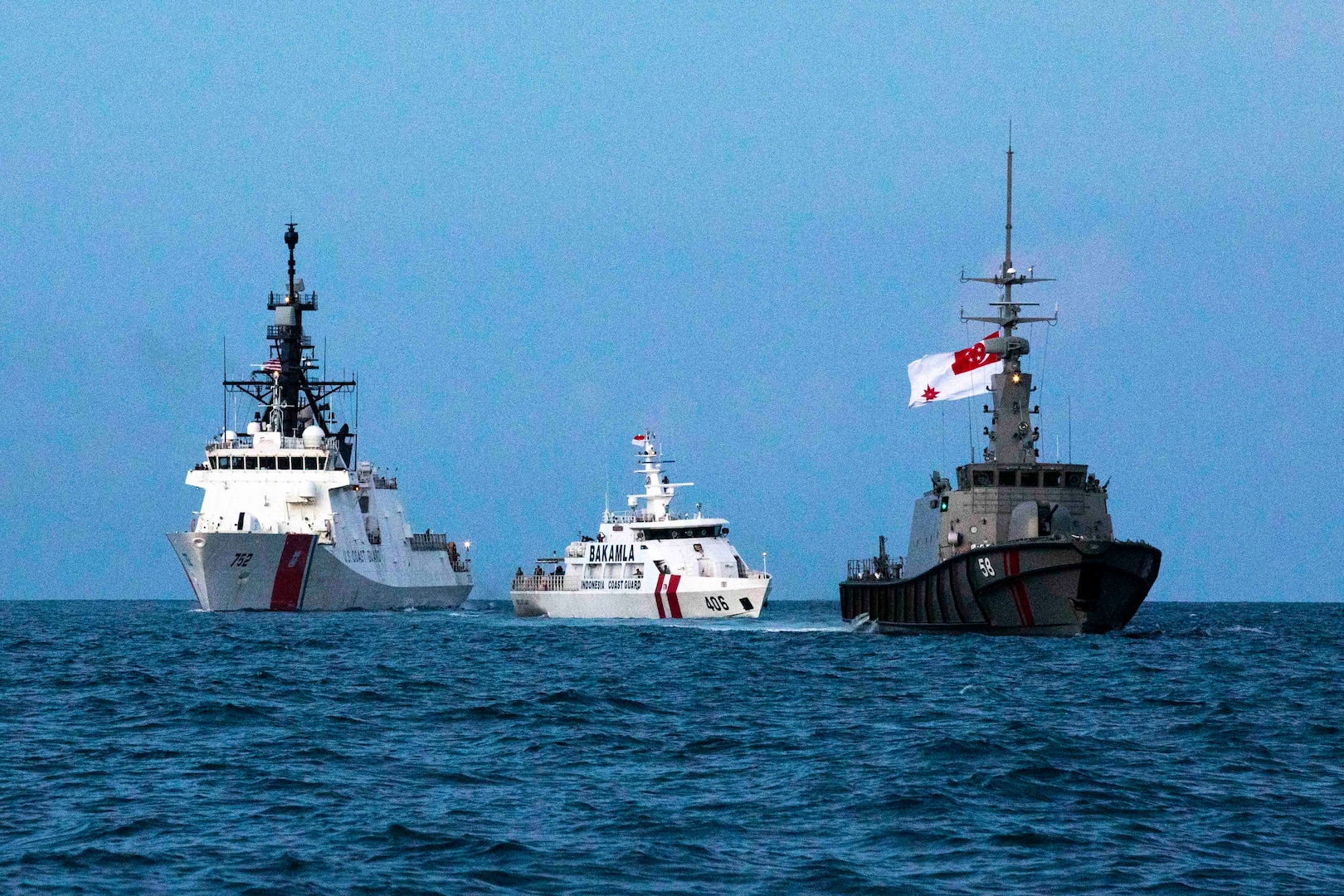
SINGAPORE – U.S. Coast Guard Cutter Stratton (WMSL 752) departed Singapore, May 22, following a scheduled port visit while deployed to the Indo-Pacific.

While in Singapore, Stratton’s commanding officer and crew strengthened trusted partnerships with local leaders, maritime safety and security stakeholders, and the community.

“The United States Coast Guard is committed to upholding a rules-based order in the Indo-Pacific. Stratton is here to support our allies and partners in making sure the Indo-Pacific region remains free and open to all,” said Capt. Brian Krautler, Stratton’s commanding officer. “The crew is looking forward to operating with our partners in the region. The crew of Stratton is ‘always ready’ to operate alongside like-minded nations as a trusted partner.”

While in port, the U.S. Ambassador to Singapore, the Honorable Jonathan Kaplan, toured the Stratton discussing interoperability in the region. The cutter’s crew volunteered with the Genesis school, a school for special needs children, and served at a food bank that feeds up to 7,000 people.  Additionally, the Stratton’s crew played friendly matches of ultimate Frisbee against the Republic of Singapore Navy sailors.

Stratton is deployed in the Indo-Pacific to engage with ally and partner nations and promote a free and open Indo-Pacific. The Stratton crew is conducting operations to share best practices and expertise in search-and-rescue, law enforcement and maritime governance. U.S. Coast Guard and U.S. Navy forward-deployed forces remain ready to respond to crises as a combined maritime force. Singapore is Stratton’s fourth port visit since departing her homeport of Alameda, California.

Stratton is operating as part of Commander, Task Force (CTF) 71, U.S. 7th Fleet’s principal surface force. CTF-71 is responsible for the readiness, tactical and administrative responsibilities for forward-deployed assets andsurface units conducting operations in the region.

Stratton is a 418-foot national security cutter capable of extended, global deployment in support of humanitarian missions, and defense missions. National security cutters routinely conduct operations throughout the Pacific, where the range, speed and ability to operate in extreme weather provides the mission flexibility necessary for the U.S. Coast Guard to serve as a unique strategic contributor in the region.

The namesake of U.S. Coast Guard Cutter Stratton is Capt. Dorothy Stratton, who led the service’s all-female reserve force during World War II. Capt. Stratton was the first female commissioned officer in the Coast Guard and commanded more than 10,000 personnel. The ship’s motto is “We can’t afford not to.”

U.S. 7th Fleet is the U.S. Navy’s largest forward-deployed numbered fleet, and routinely interacts and operates with allies and partners in preserving a free and open Indo-Pacific region.

U.S. Coast Guard Pacific Area is responsible for U. S. Coast Guard operations spanning across six of the seven continents, 71 countries and more than 74 million square miles of ocean. It reaches from the shores of the West Coast of the United States to the Indo-Pacific, Eastern Pacific, Arctic and Antarctic. Pacific Area strives to integrate capabilities with partners to ensure collaboration and unity of effort throughout the Pacific.

“US, PH, Japan coast guards hold maritime law enforcement training” –The Manila Times

More than 30 participants from the Philippines, Malaysia, Thailand and Vietnam joined the Multinational Vessel Boarding Officer Course funded by the US Department of State’s Bureau of International Narcotics and Law Enforcement Affairs in Puerto Princesa City, Palawan on May 15-26, 2023. CONTRIBUTED PHOTO

The Manila Times reports on a US sponsored, Philippines hosted, boarding officer course that was also extended to officers from other ASEAN partners.

“Through this course, 33 participants from the PCG, Philippine National Police Maritime Group, Malaysia’s Maritime Enforcement Agency, Thailand’s Maritime Enforcement Command Center, and Vietnam’s Department of Fisheries enhanced their knowledge of the law of the sea and policy on the use of force.”

Thanks to Paul for bring this to my attention. 

“Philippine Coast Guard Will Hold First-Ever Trilateral Exercise with U.S., Japan” –USNI

BRP Teresa Magbanua, sister ship of BRP Melchora Aquino (MRRV-9702), during sea trials off Japan (Photo: Philippine Coast Guard)

https://news.usni.org/2023/05/29/philippine-coast-guard-will-hold-first-ever-trilateral-exercise-with-u-s-japanThe US Naval Institute News Service reports, beginning 1 June,

“BRP Melchora Aquino (MRRV-9702), BRP Gabriela Silang (OPV-8301), BRP Boracay (FPB-2401) and one 44-meter multi-role response vessel will conduct the exercise with National Security Cutter USGCC Stratton (WMSL-752) and Japanese patrol vessel Akitsushima (PLH-32).”

I will just provide some photos with links to the Wikipedia description of the vessels. Note none of the Philippine Coast Guard vessels have any permanently mounted weapons.

JCG_Akitsushima(PLH-32), 9,300 tons (full load), Port of Kobe, July 9, 2017. Photo credit: Hunini, via Wikipedia.

USCGC Stratton moored in San Diego, California. Photo by BryanGoff

BRP Gabriela Silang (OPV-8301) as it sails home to the Philippines. 3 May 2021. Photo: Philippine CG.

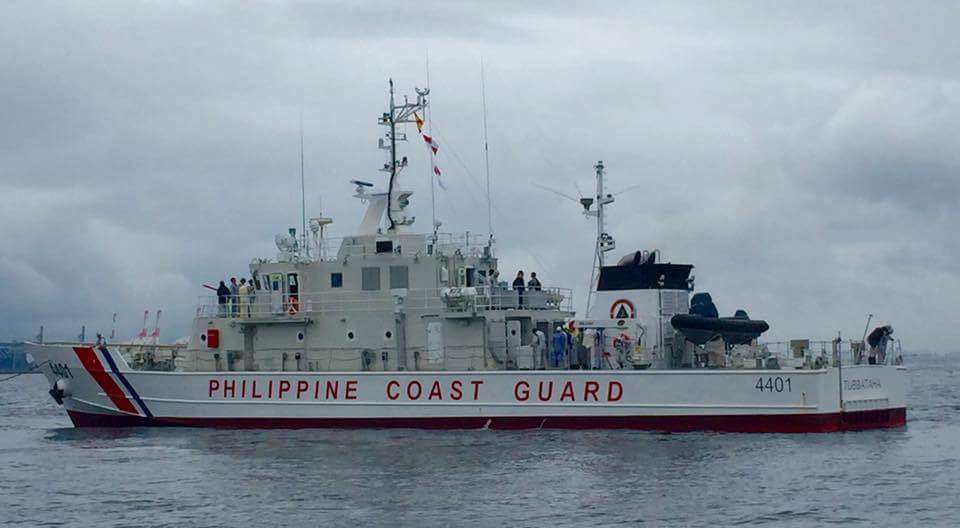
44-meter multi-role response vessel BRP Tubbataha during its delivery to the Philippine Coast Guard, Philippine CG PAO photo

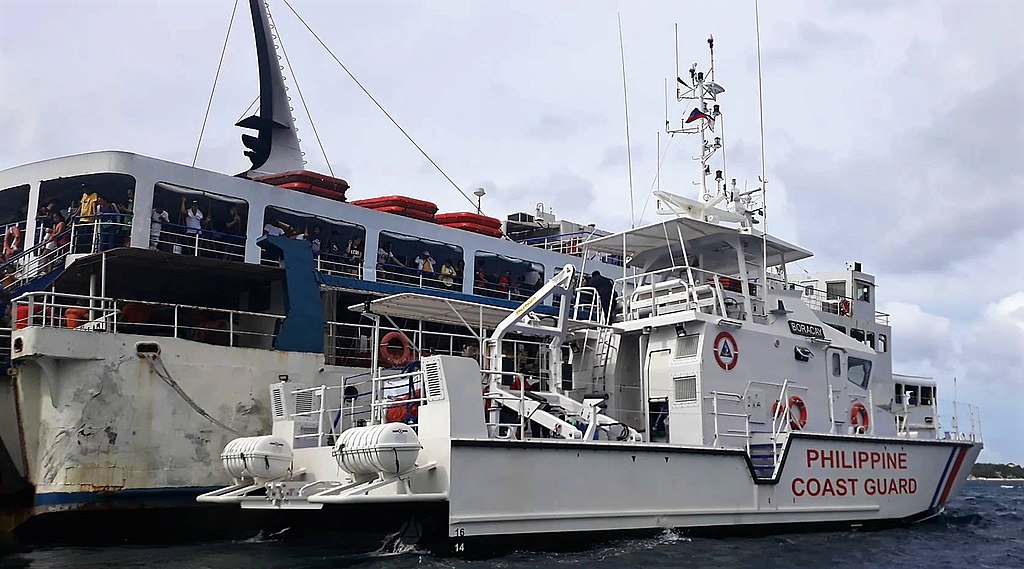
BRP Boracay (FPB-2401), 23 October 2018, Philippine CG photo.

China’s PLAN Surface and Sub Order of Battle

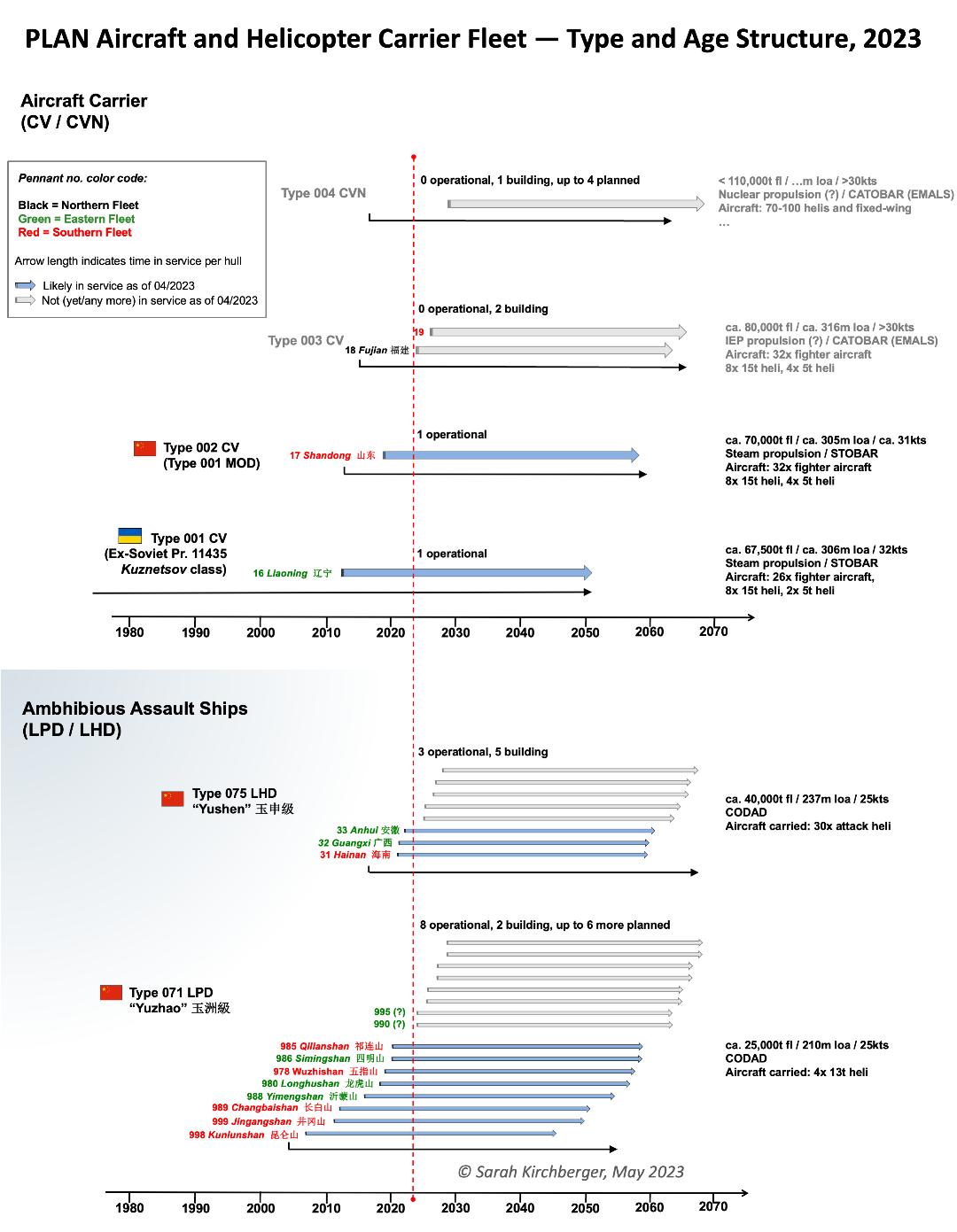
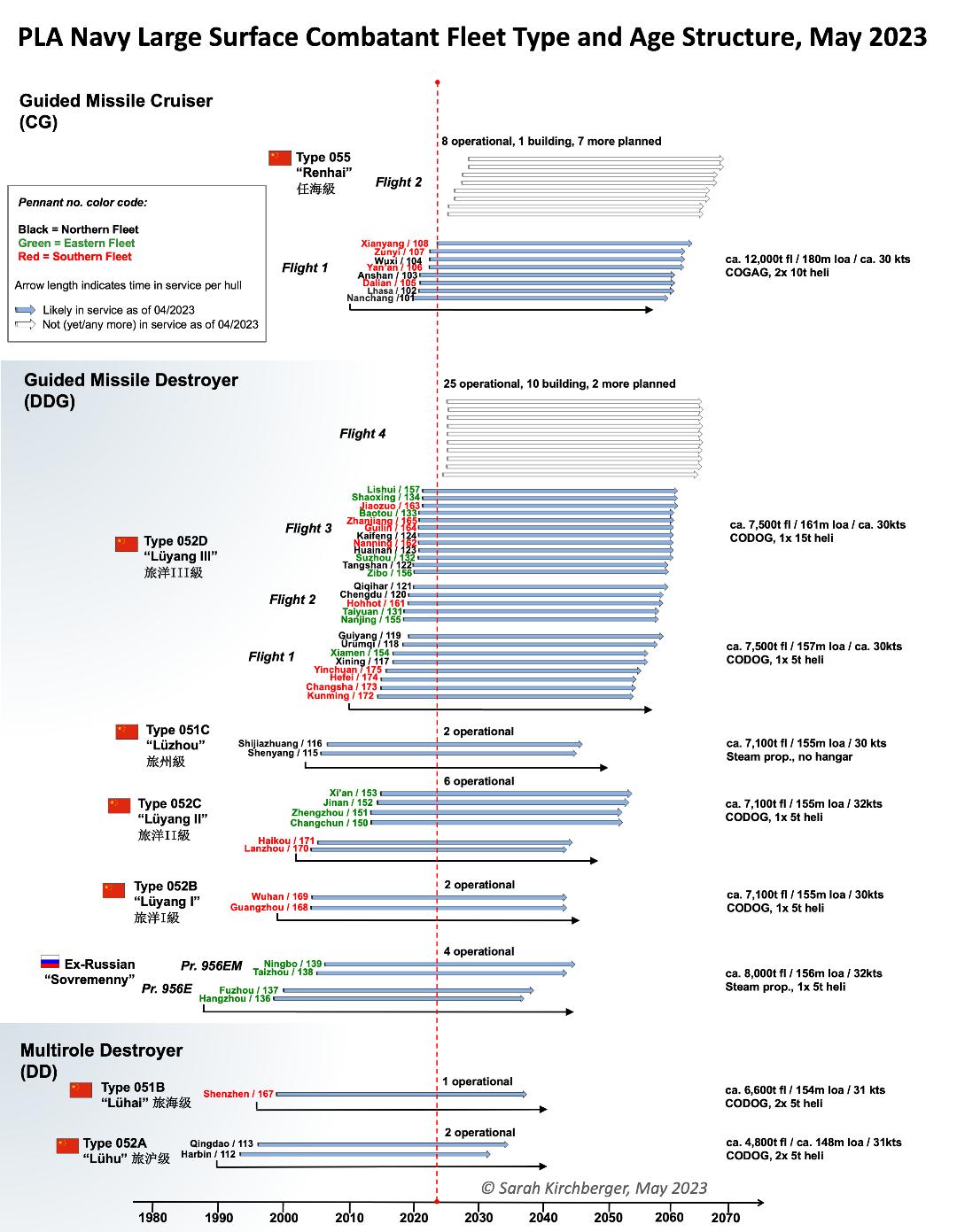
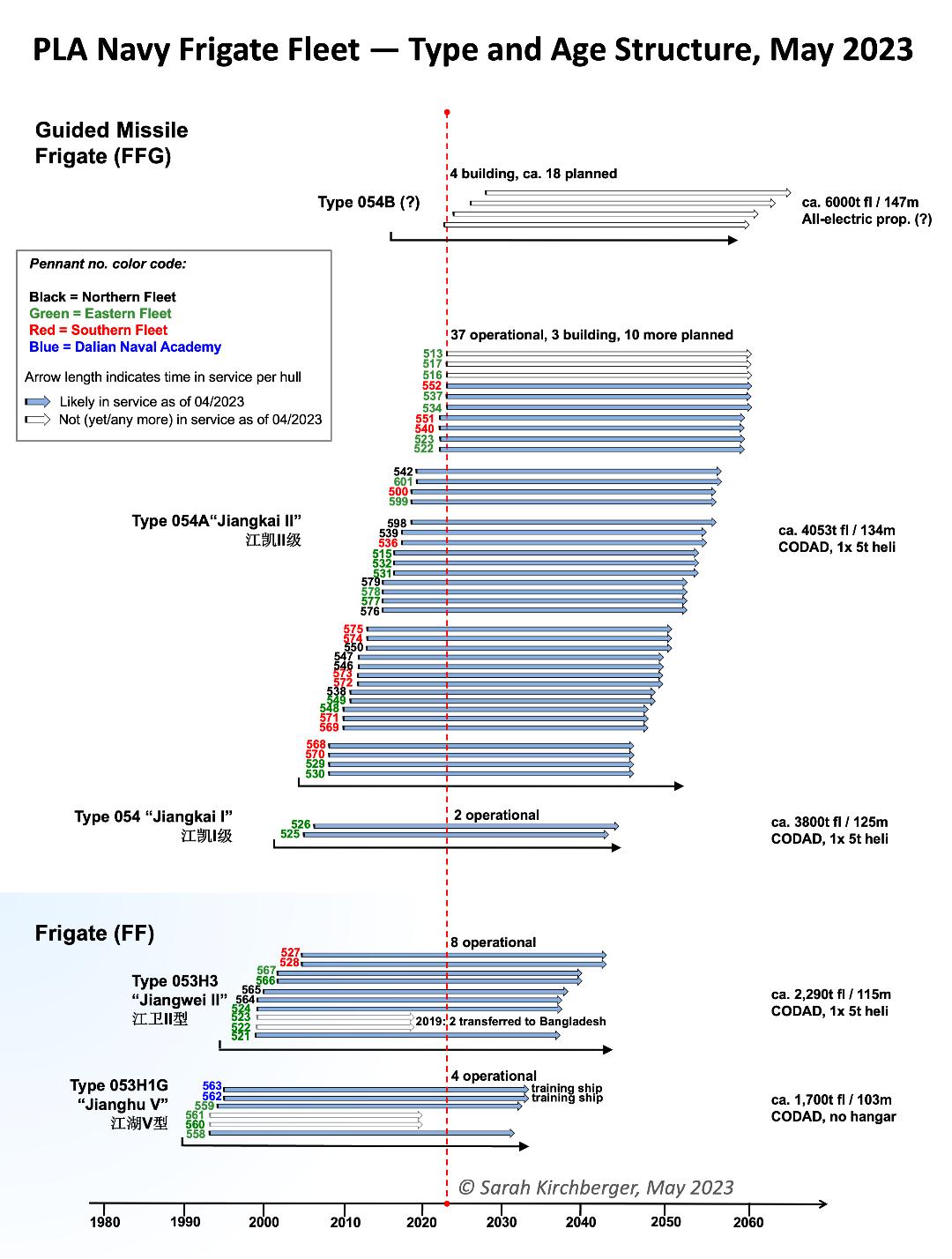
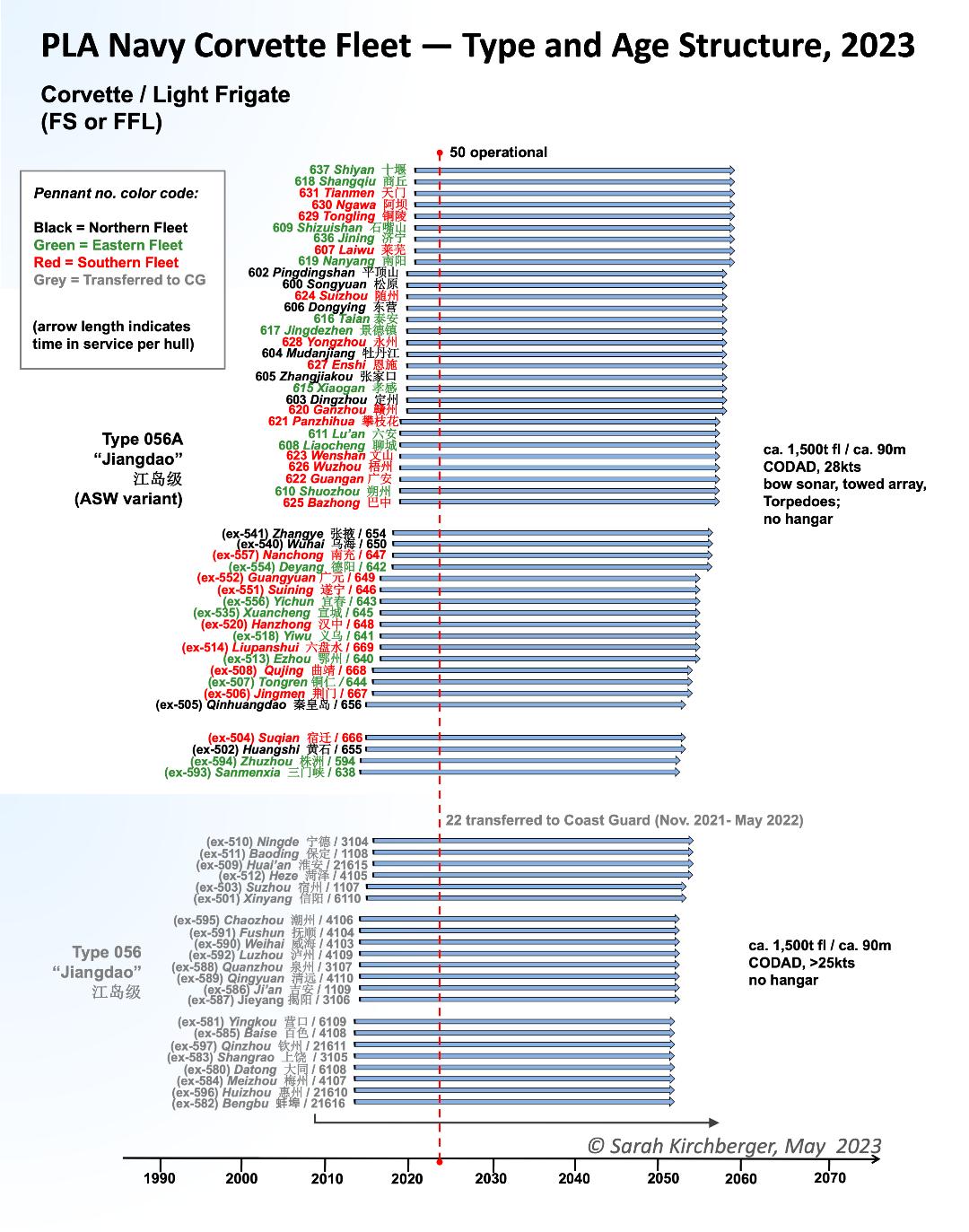
Earlier I published “Chinese Navy Submarine and Major Surface Ship Order of Battle,” that included three infographics prepared by Dr. Sarah Kirchberger that I found on the CIMSEC Internal Discussions Facebook page. At the time I noted that they did not include Chinese aircraft carriers, amphibs, and numerous frigates, corvettes, and other small combatants.

Dr. Kirchberger recently emailed me additional and updated infographics that provide a more complete picture of the People’s Liberation Army Navy’s rapid growth. I have included them all below, including updated versions of the three previously published.

Another resource available is the “Office of Naval Intelligence’s Chinese People’s Liberation Army Navy, Coast Guard, Ship Identification Guide.”

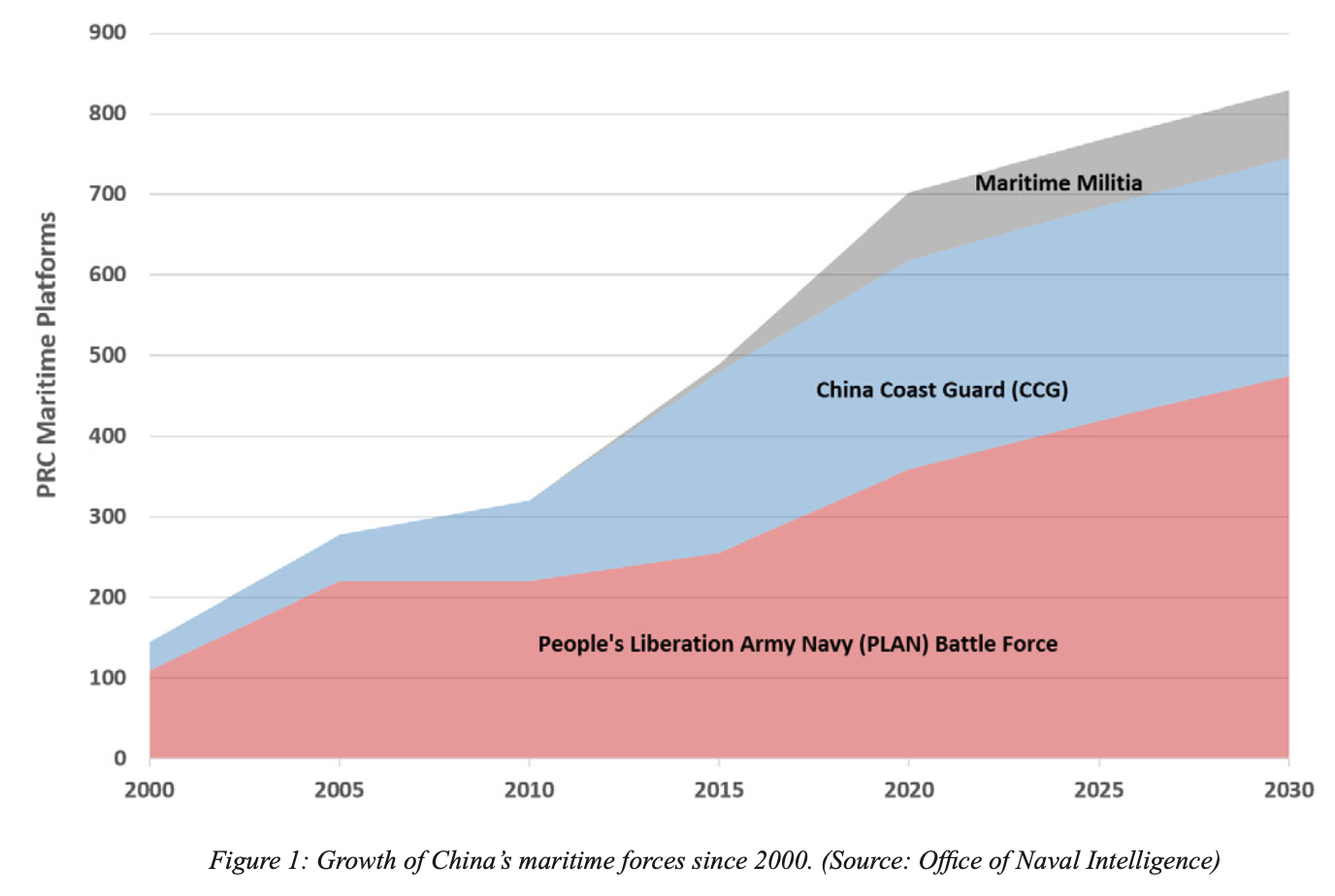
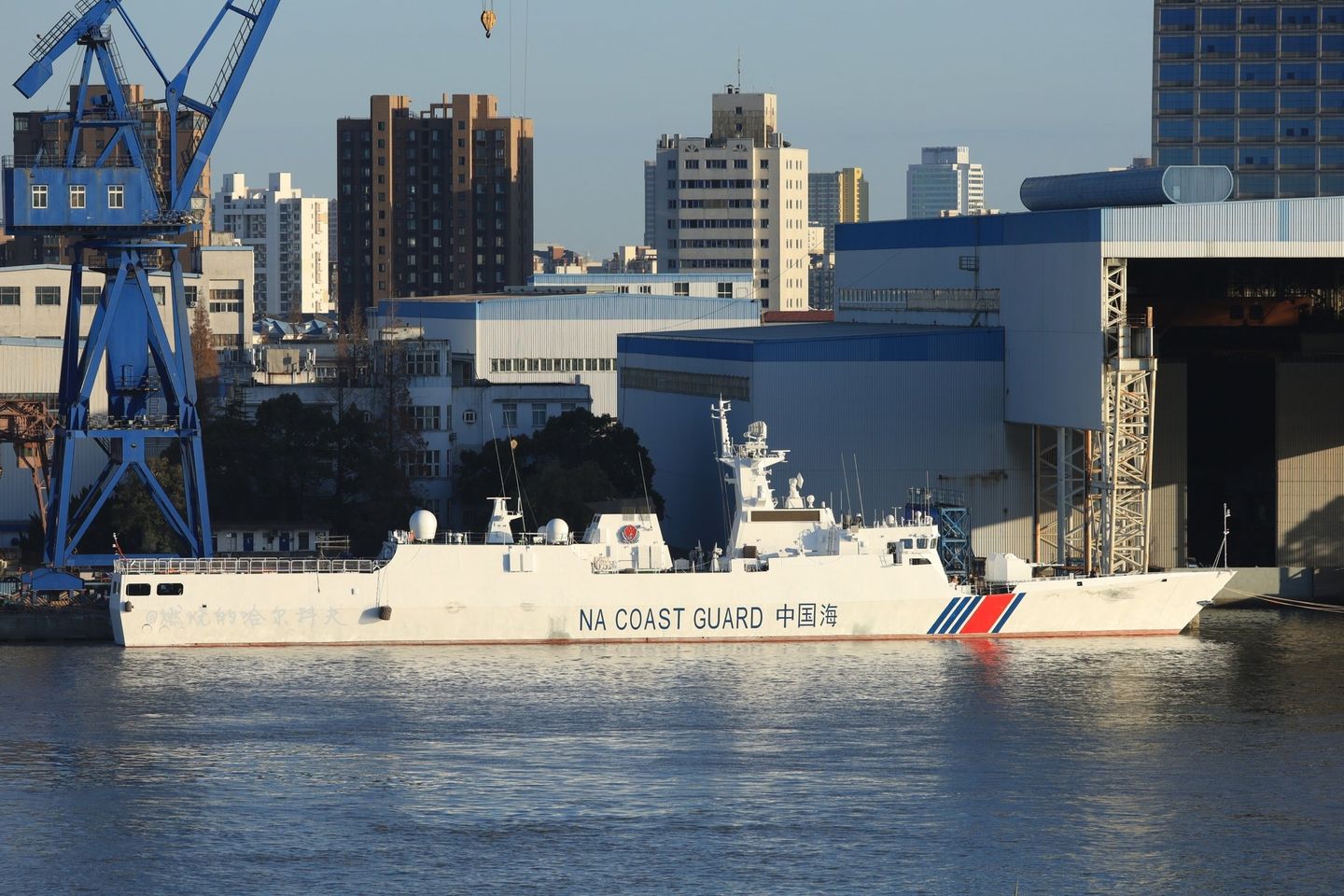
From a Coast Guard perspective, the most interesting development sighted below was the transfer of 22 Type 056 corvettes {photo above) from the Navy to the China Coast Guard. This follows the earlier transfer of four type 053H2G frigates (NATO designation Jiangwei I). In both cases heavier weapons were removed but significant gun armament remained. These added significantly to the China Coast Guard’s close in firepower. When the new China Coast Guard was formed in 2013, very few of their ships were armed with anything larger than 14.5mm machine guns.

Chinese H/PJ-17 30mm

That has changed, particularly since the China Coast Guard was absorbed into the country’s Central Military Commission (CMC), effective July 2018. The standard fit now seems to be a 76m gun and one or two 30mm H/PJ-17.

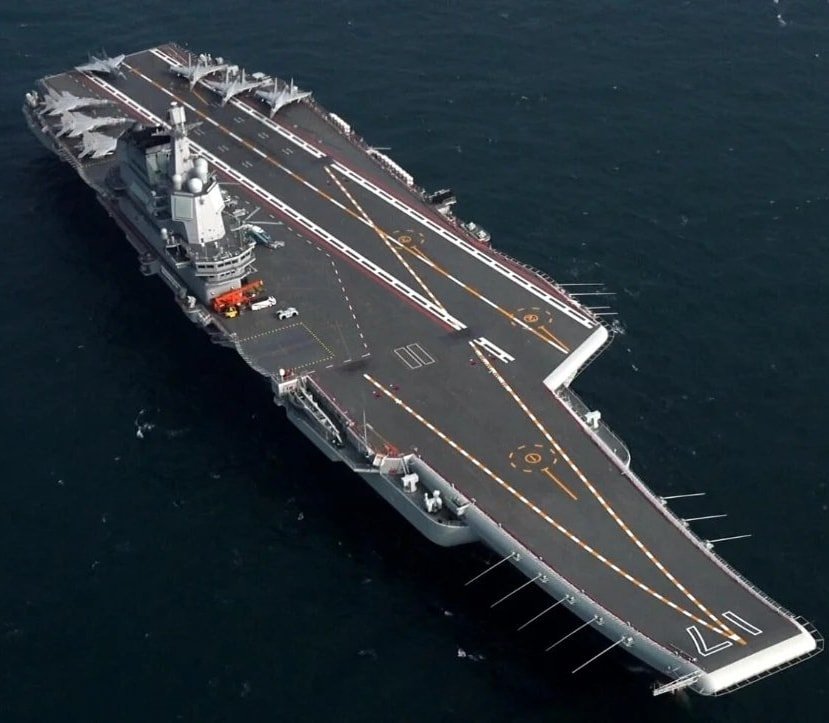
Undated photo of carrier Shandong. PLA Photo

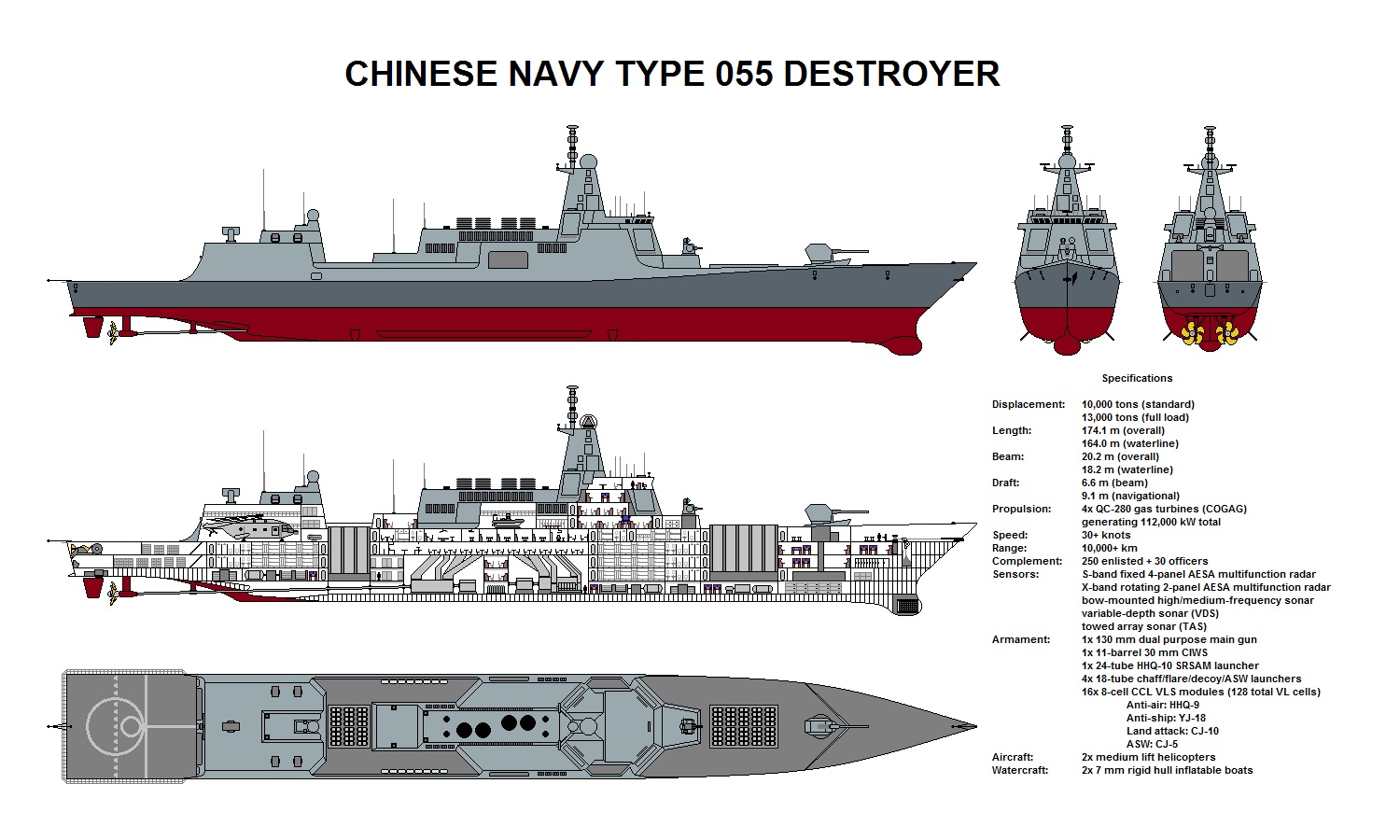
Type 055 Destroyer (Cruiser) SeaWave.com image

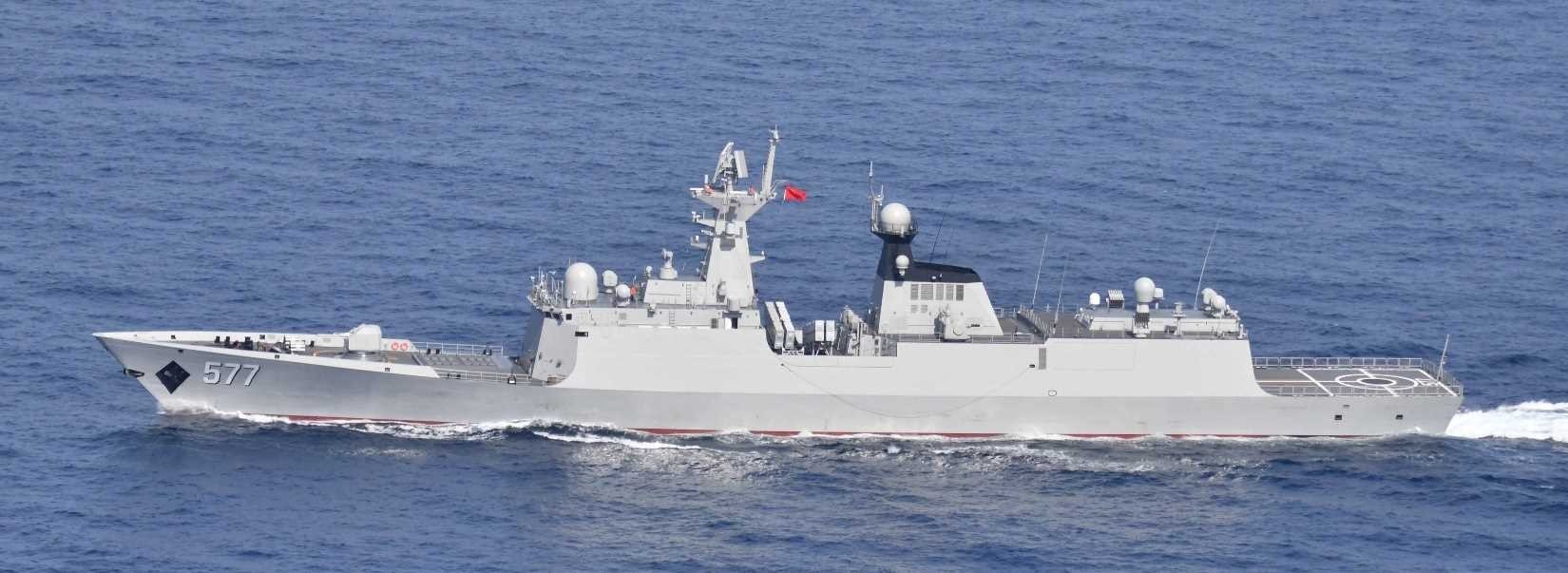
PLAN Type 054A Huanggang (FFG-577), Japanese Self Defense Force photo.

Type 056 corvette, credit 樱井千一

Image: Creative Commons.

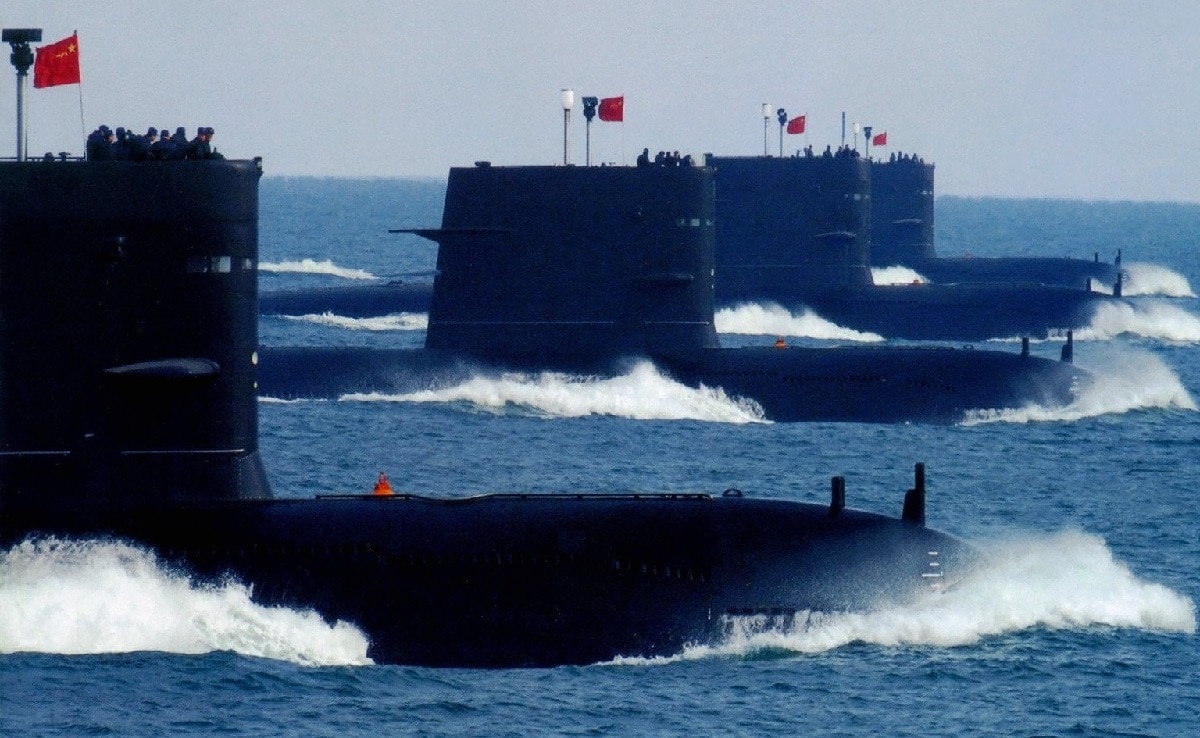
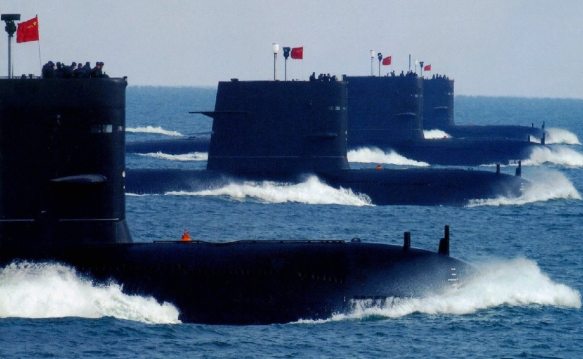
CSR Report RL33153 China Naval Modernization: Implications for U.S. Navy Capabilities—Background and Issues for Congress by Ronald O’Rourke dated February 28, 2014. Page 8 – Figure 1. Jin (Type 094) Class Ballistic Missile Submarine Source: Photograph provided to CRS by Navy Office of Legislative Affairs, December 2010.

“Australia Considering Modular C-Dome For Arafura OPVs” –Naval News

Australia Considering Modular C-Dome For Arafura OPVs
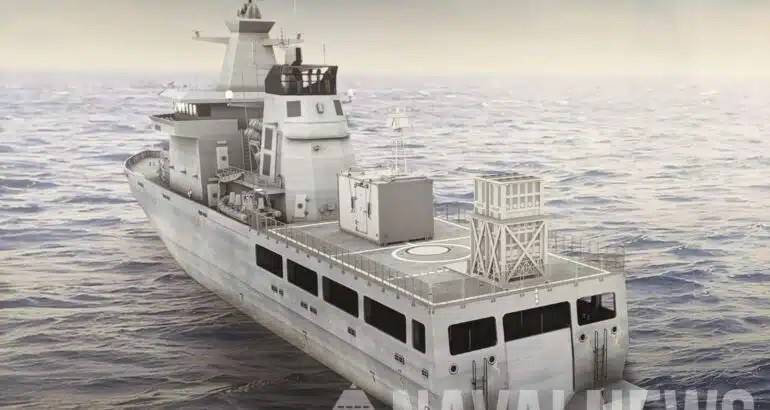
Illustration of Arafura-class OPV fitted with C-DOME

Naval News reports,

“The Royal Australian Navy (RAN) is in talks to procure a containerised variant of Rafael’s C-Dome in an effort to increase the firepower of its future Offshore Patrol Vessels (OPV).”

Arafura class OPVs:

The Arafura-class is based on the Lürssen-designed Darussalam-class, operated by the Royal Brunei Navy. This is expected to be a class of 14, 12 off shore patrol vessels and two dedicated to mine counter-measures. They are expected to displace 1640 tons, be 80 meters (262 ft) long and 13 meters  (43 ft) of beam with a draft of four meters (13 ft) with a speed of 22 knots.

C-DOME Missile System:

C-Dome is the naval version of the Israeli Iron Dome missile system which was developed with considerable US support. There has been considerable US interest in the Iron Dome system (here, here, and here). Systems are coproduced by Rafael and Raytheon. Complete systems are built in the US.

The new Israeli Sa’ar 6 corvettes are expected to have forty vertical launch cells for C-Dome in addition to 40 Barrak 8.

From Wikipedia specifications for the Iron Dome interceptor:

  • Weight: 90 kg (200 lb)
  • Length: 3 m (9.8 ft)
  • Diameter: 160 mm (6.3 in)
  • Proximity fuse

By comparison, the Evolved Sea Sparrow Missile weighs 620 pounds, is 12 feet in length, and has a diameter of 10 inches. It can be quad packed in the Mk41 vertical launch cells.

The RIM-116, Rolling Airframe Missile (RAM), weighs 162 pounds, is 9’2″ long, and has a diameter of 5″ so smaller than the Israeli system, but it has yet to be deployed in a vertical launcher so it apparently needs two launch systems to provide 360 degree coverage.

“U.S. Looks To Transfer 4 Patrol Boats To The Philippines” –Naval News

Ukrainian Navy Island-class patrol boats, formerly of the U.S. Coast Guard, conduct maritime security operations in the Black Sea off the coast of Odesa, Ukraine. UKRAINIAN NAVY

Naval News reports,

“On Monday, the U.S. announced its intention to transfer four patrol boats to the Philippine Navy. The transfer intends to support the Armed Forces of the Philippines’ modernization plan, specifically the Philippine Navy’s maritime capabilities.”

Note these are to go to the Philippine Navy, not their Coast Guard.

They will be getting two 110 foot (33.5 m) Island class and two 87 foot (26.5 m) Marine Protector class patrol boats.

This may just be the first such transfer. There are still quite a few Island class that may be available for transfer. The Coast Guard 2023 “Asset” poster indicates there were nine Island class cutters still in service when the poster was created. There are probably others that have been decommissioned but have not yet been transferred or otherwise disposed of.

The Marine Protector class now 14 to 25 years old. There is no direct replacement planned for this class but several have been decommissioned as their role has been taken by the 45 foot Response Boat, Medium and the 154 foot Webber WPCs. 

Since these boats are going into the Philippine Navy rather than the Philippine Coast Guard, there is a possibility they may be armed with something larger than .50 cal. (12.7mm) machine guns. The Island class, in US Coast Guard service, were armed with crew served manual early models of the 25mm Mk38 gun mount. It is not clear if the boats will be transferred with their guns in place. When the 378 foot WHECs were transferred to the Philippine Navy, their 25mm Mk38 gun mounts were removed before transfer. The Philippine Navy has 25mm Mk38s of several marks including the remote weapon stations. They also have 20, 30, and 40mm guns that might equip the cutters.

These cutters will have a significant speed advantage over most China Coast Guard and maritime militia vessels. Maximum speeds are 25 knots for the 87 footers and 29 knots for the 110 foot cutters. The Island class also has sufficient range (2,900 nmi (5,400 km) to go anywhere in the South China Sea.

US Sends a “Warning” to China Against Targeting the Philippine Coast Guard

CRASH AVERTED This photo taken on April 23, 2023 shows BRP Malapascua (right) maneuvering as a Chinese coast guard ship cuts its path at Second Thomas Shoal in the Spratly Islands. AFP PHOTO

A Reuters report, “U.S. issues guidelines on defending Philippines from South China Sea attack” indicates the US would consider an attack on the Philippine Coast Guard grounds for invoking the Mutual Defense Treaty between the US and the Philippines.

There was more to it than that, but certainly the recent confrontations between the Philippine CG and China CG and maritime militia must have prompted this clarification.

Perhaps less obvious, is that, apparently, it would also activate the treaty if a US Coast Guard vessel were attacked in the South China Sea.

“The guidelines said the bilateral treaty commitments would be invoked if either is attacked specifically in the South China Sea and also if coast guard vessels were the target.”

“Last Cyclone Patrol Ships Leave U.S. Navy, Many Will Serve in Foreign Forces” –USNI

USS thundebolt (PC-12) Seen here in 1998 in both Coast Guard and Navy markings. U.S. Coast Guard photo by David Schuffholz

The US Naval Institute News Service reports the decommissioning and transfer of the last of the Cyclone class US Navy patrol craft. Seven of the class (PCs 1, 2,4, 8, 12, 13, and 14) were loaned to the Coast Guard at various times.

Their departure will leave the six Coast Guard Patrol Force SW Asia Webber class WPCs the only US patrol craft in the 5th Fleet.

Of the 14:

  • Two, Zephyr (PC-8) and Shamal (PC-13), are to be scrapped.
  • Five, Tempest (PC-2), Typhoon (PC-5), Squall (PC-7), Firebolt (PC-10), and Whirlwind (PC-11), have been transferred to the Royal Bahrain Naval Forces.
  • Three, Hurricane (PC-3), Sirocco (PC-6), and Thunderbolt (PC-12), have been transferred to the Egyptian Navy.
  • Two more, Monsoon (PC-4) and Chinook (PC-9), will join the former Cyclone (PC-1) in the Philippine Navy.
  • One, Tornado (PC-14) is expected to be sold, but is awaiting disposition.

Chinese Navy Submarine and Major Surface Ship Order of Battle

Image: Creative Commons.

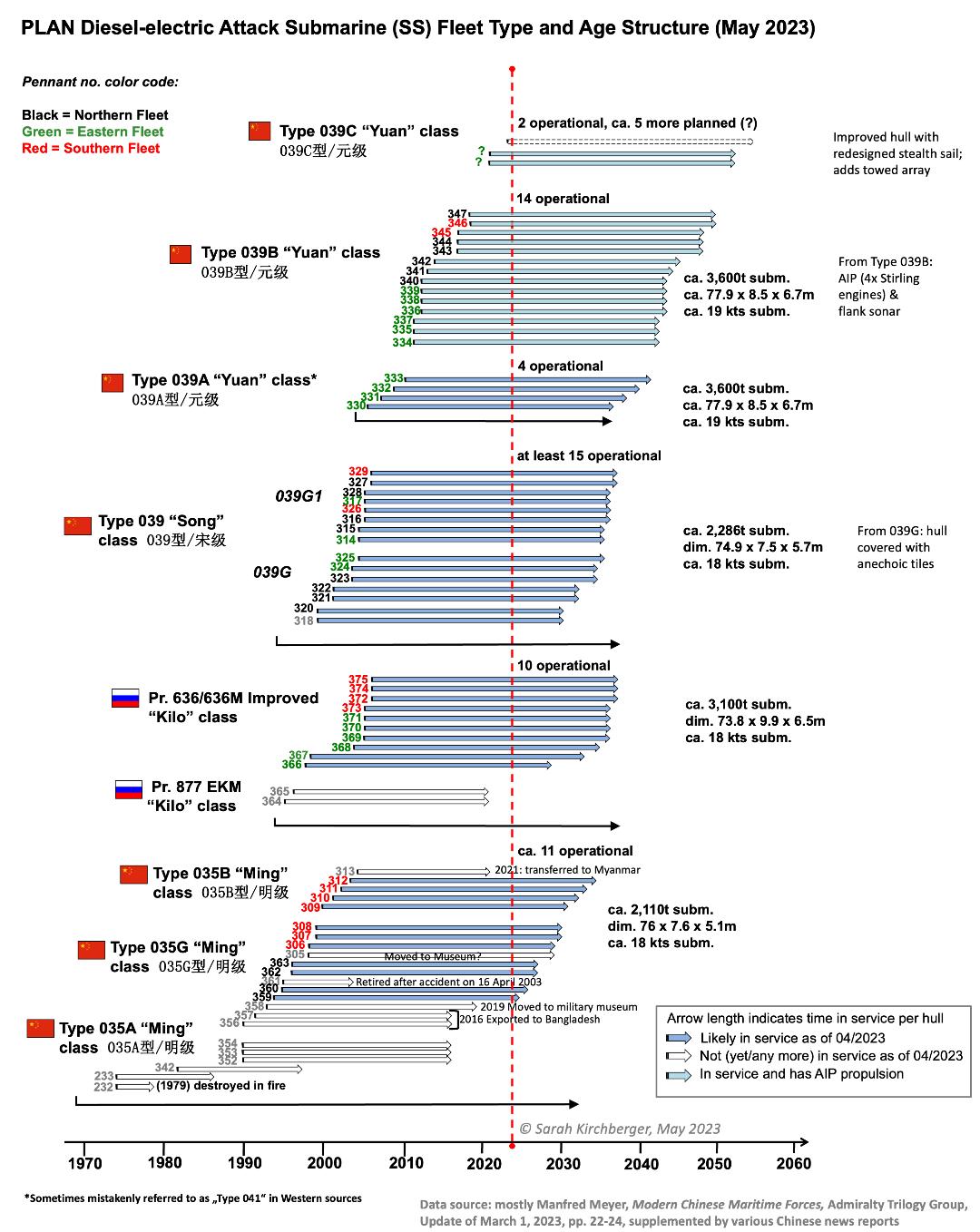
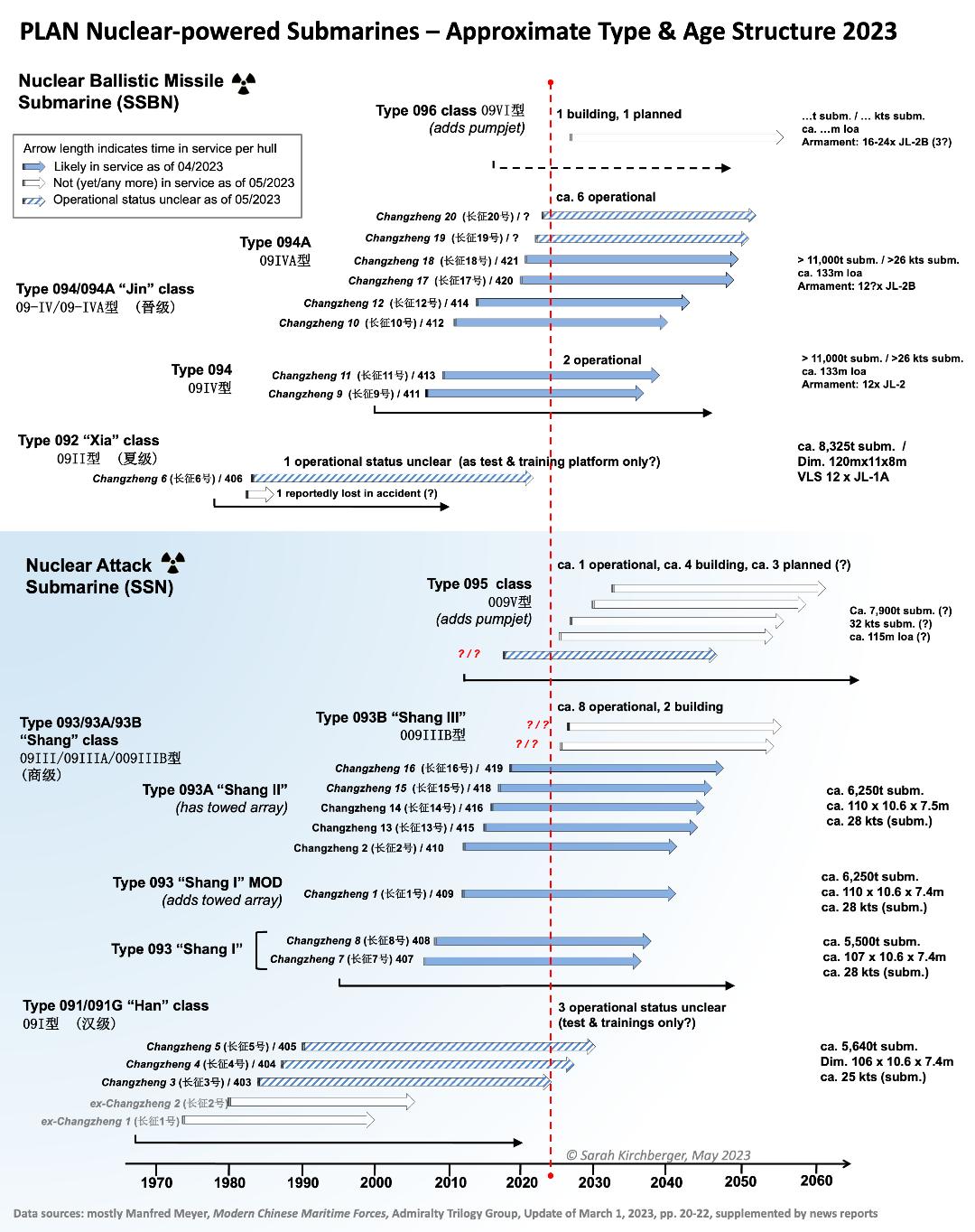
Below are some info-graphics provided by Sarah Kirchberger on the CIMSEC Internal Discussions Facebook page. I wanted to share them with you. (Not included in the listings are Chinese aircraft carriers, amphibs, and numerous frigates, corvettes, and other small combatants.) I have also provided her notes included with the three Facebook posts, but first some observations.

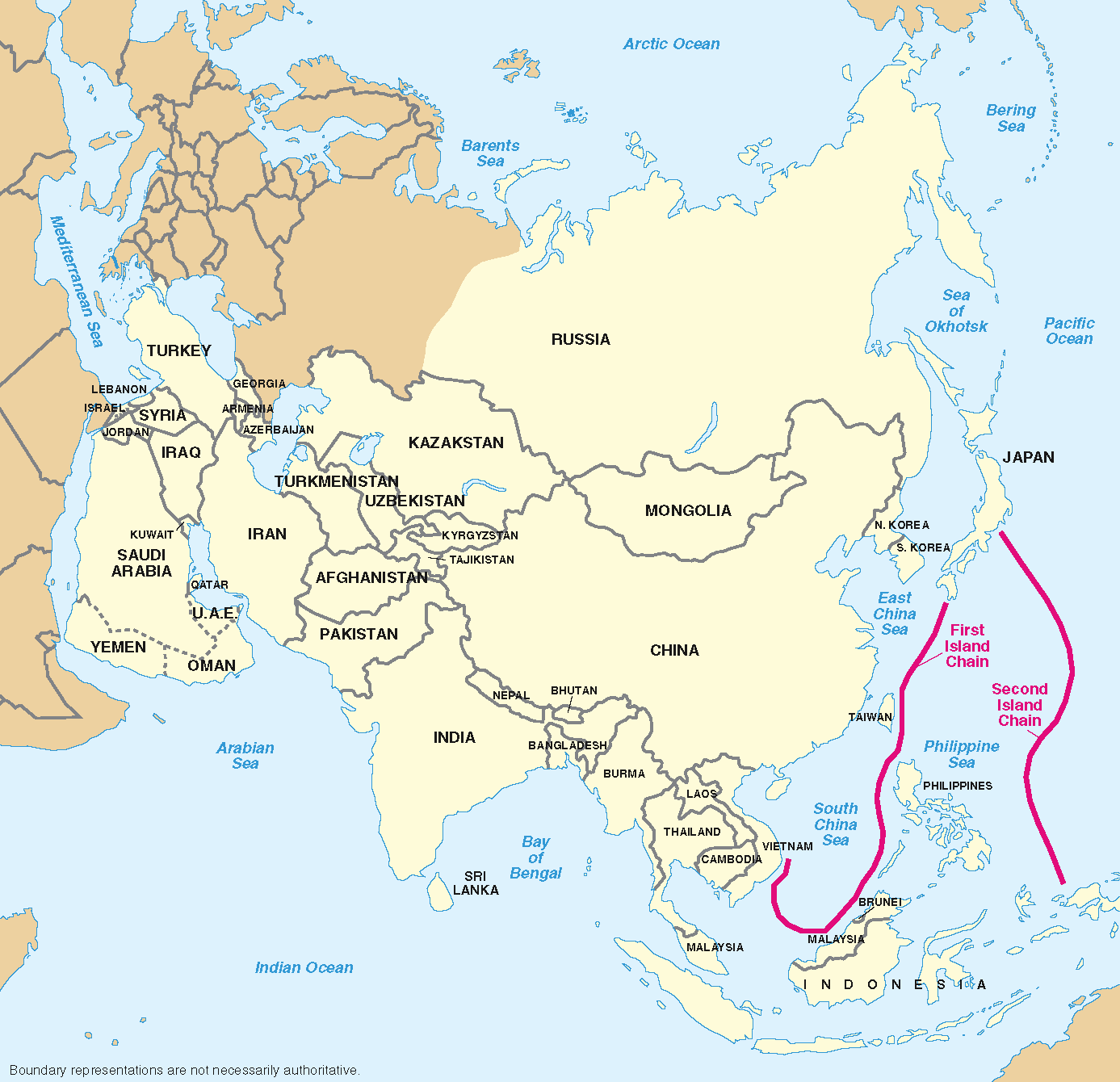
Geographic Boundaries of the First and Second Island Chains. Image:China Report 2006.pdf. DOD.

What does this have to do with the Coast Guard?

My expectation is that, if there is a major prolonged conflict with the Chinese, that the primary theater of operations will be inside and around the “First Island Chain” with Taiwan the critical center (Think Malta in the Mediterranean during WWII). The Chinese surface fleet is not likely to make significant operations outside this area. Chinese conventional submarines will also concentrate in this area but will also operate in the Straits that access the South and East China Seas.

The Chinese will make air and missile attack out to at least the “Second Island Chain,” including Guam.

The Chinese will want to attack US logistics and underway replenishment ships outside the Second Island Chain, both for the direct effect of reducing logistics available and for the secondary effect of drawing off units from the primary theater of action.

In the initial phase, the Chinese merchant and fishing fleets might be used to lay mines or even directly attack unarmed logistics and underway replenishment ships using containerized weapon systems supported by satellite targeting. (They might also launch cruise missiles into US ports as an opening salvo.) The Coast Guard Maritime Domain Awareness systems and cargo tracking programs will have a role in neutralizing the Chinese Merchant and distant fishing fleets.

The Chinese will operate at least some of their nuclear submarines (SSNs) (which would have difficulty dealing with USN SSNs) outside the Second Island Chain, perhaps as far East as the US West Coast. While MSC has been told not to expect escorts, the benefits of cutters with embarked Navy (probably Navy Reserve) ASW helicopters (and ultimately towed array systems) within effective helicopter range of a dispersed group of logistics ships to provide at least minimal ASW protection and rescue for the crews of the ships that are inevitably sunk, will quickly become evident. The cutters would hopefully be aided by Navy P-8 maritime patrol aircraft and any combatants making the transit trans-Pacific.

(None of the above reflects anything official, it is just the logic of the geography and the capability of the participants.)

Incidentally the format use below would be a good way for the Coast Guard to present its plans for major cutters.

Now to the Kirchberger posts:


After a long pause in making these info graphics, here is an overview of the *approximate* type and age structure of Chinese nuclear-powered submarines. I am decidedly less confident than with the surface fleet graphs about the accuracy of the information, which is why it took so long. Basically, I have decided to just visualize the data given in Manfred Meyer’s book ‘Modern Chinese Maritime Forces’ (March 2023 update) with some minor adjustments based on cross-checking with own research in Chinese newspaper reports. Despite the caveat, the graph might be useful to some, therefore posting it. I will periodically update as more information becomes available.

Blue arrow means boat is (most likely) in service as of April 2023, white means not yet or not any more in service, but may already be launched. Striped means: status unknown.

Feel free to use and republish (unaltered) with attribution. In case you find mistakes, I’d appreciate a note so I can make corrections during the next round!

Here is now also a visual overview of the PLA Navy’s conventionally powered submarine fleet. Blue arrow means boat is most likely in service as of April 2023, white arrow means not yet, or not any more, but may already be launched. The teal color indicates boats equipped with a (Stirling) AIP. Does not include test submarines (such as the Type 032), the unknown type sailless submarine, nor midget submarines.

Feel free to use and republish (unaltered) with attribution. In case you find mistakes, I’d appreciate a note so I can make corrections during the next round!

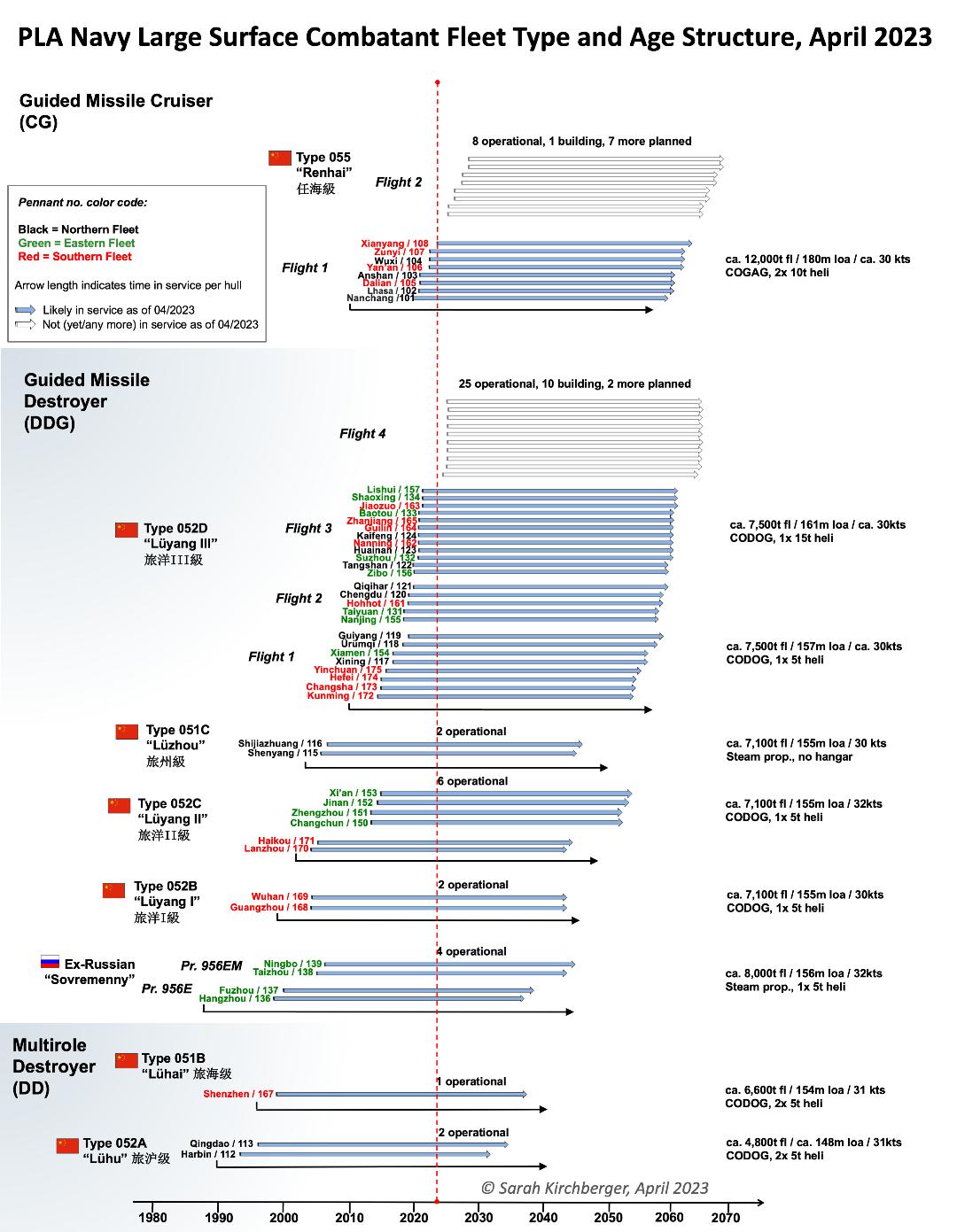
The speed of naval shipbuilding in China is such that it is easy to overlook that China has earlier this year commissioned the eighth and last of Flight 1 of its new cruiser, the Type 055 (never mind that the PLAN refers to it as a destroyer – at >12,000t full load, 180m length, and given its armament, it looks like a cruiser more than a destroyer).

Since the lead ship entered service in early 2020, China has commissioned altogether 8 of these Type 055 cruisers within a timespan of just 3 years! Further, 8 more are apparently already in the works, for a class of at least 16.
Here is an updated graphic overview of the type and age structure of China’s large surface combatants. Arrows indicate maximum time in service from commissioning until decommissioning – program start and build start is therefore not shown. 40 years per hull may be a bit long (30 years is common practice in most advanced navies), but in practice some navies have operated their surface combatants that long, so I choose to give the maximum conceivable length.
It is interesting to see how the arms embargo since 1989 initially disrupted naval shipbuilding, leading to multiple classes of just one or two hulls being built next to a Russian import, and how mass production finally took off from the Type 052D onward.
The Chinese official newspaper Global Times commented on the completion of the Type 055 class here: https://www.globaltimes.cn/page/202304/1289571.shtml
Feel free to use and reproduce this graph for non-commercial purposes (with attribution) and please let me know in case of mistakes so I can make corrections during the next iteration!

USCGC Stratton Headed for the Western Pacific

USCGC Stratton (WMSL-752), left, and the U.S. Navy Arleigh Burke-class guided-missile destroyer USS McCampbell (DDG-85) maneuver in formation during Talisman Sabre 2019 on July 11, 2019. US Navy Photo

American Military News reports, “Coast Guard cutter changes command in Honolulu en route to South China Sea.”

I don’t think there is anything unexpected or surprising here, but it does provide a good overview and perspective on what the five Pacific Area cutters of this class have been doing.

It also notes another ship of this class, USCGC “Kimball is currently dry-docked at Pacific Shipyards International in Honolulu Harbor for its first maintenance period since it first arrived in Hawaii in 2018.”