“How a new Vietnam-Indonesia deal will affect South China Sea disputes” –Defense News

Defense News reports that Vietnam and Indonesia have agreed on demarcation of their respective EEZs where they had previously been in dispute.

Peaceful settlement of conflicting SE Asian nation claims would go a long way toward presenting a united front against China’s expansive 9 Dash Line claims and clarify IUU fisheries enforcement.

“Practically, the successful Indonesia-Vietnam EEZ [exclusive economic zone] demarcation will help both countries to resolve illegal, unreported, and unregulated (IUU) fishing, which has been a serious bilateral irritant and a broader issue involving third-party countries, including China and Thailand,” according to Bich Tran, a visiting fellow writing in the Fulcrum, a publication of the ISEAS—Yusof Ishak Institute in Singapore.

“Philippines Says China Ship Used Laser Against Coast Guard” –Real Clear Defense

RealClearDefense reports,

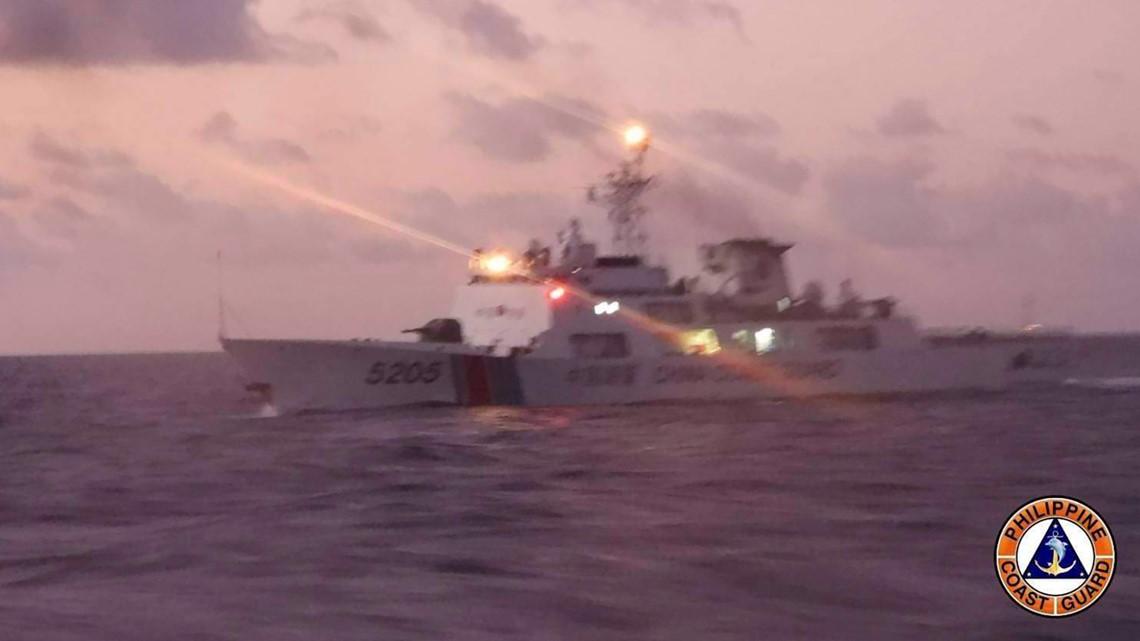
 “The Philippines on Monday accused a Chinese coast guard ship of hitting a Philippine coast guard vessel with a military-grade laser and temporarily blinding some of its crew in the disputed South China Sea, calling it a “blatant” violation of Manila’s sovereign rights.”

The incident occurred near Second Thomas Shoal, as the Philippine cutter BRP Malapascua was escorting a resupply mission to the BRP Sierra Madre, a Philippine LST deliberately, permanently grounded on Second Thomas Shoal. (Video here). Apparently the resupply effort was turned back.

Philippine CG statement on the incident here.

None of the Philippine Coast Guard cutters seem to be armed with anything larger than a .50 cal. machine gun, so they are at a disadvantage in facing down a large China CG cutter armed with a 76 mm gun, like the one in the photo above.

Upgrades to the Philippine WHECs

BRP Ramon Alcaraz (former USCGC Dallas) equipped with new Sea Giraffe multi-mode radar in Cebu.

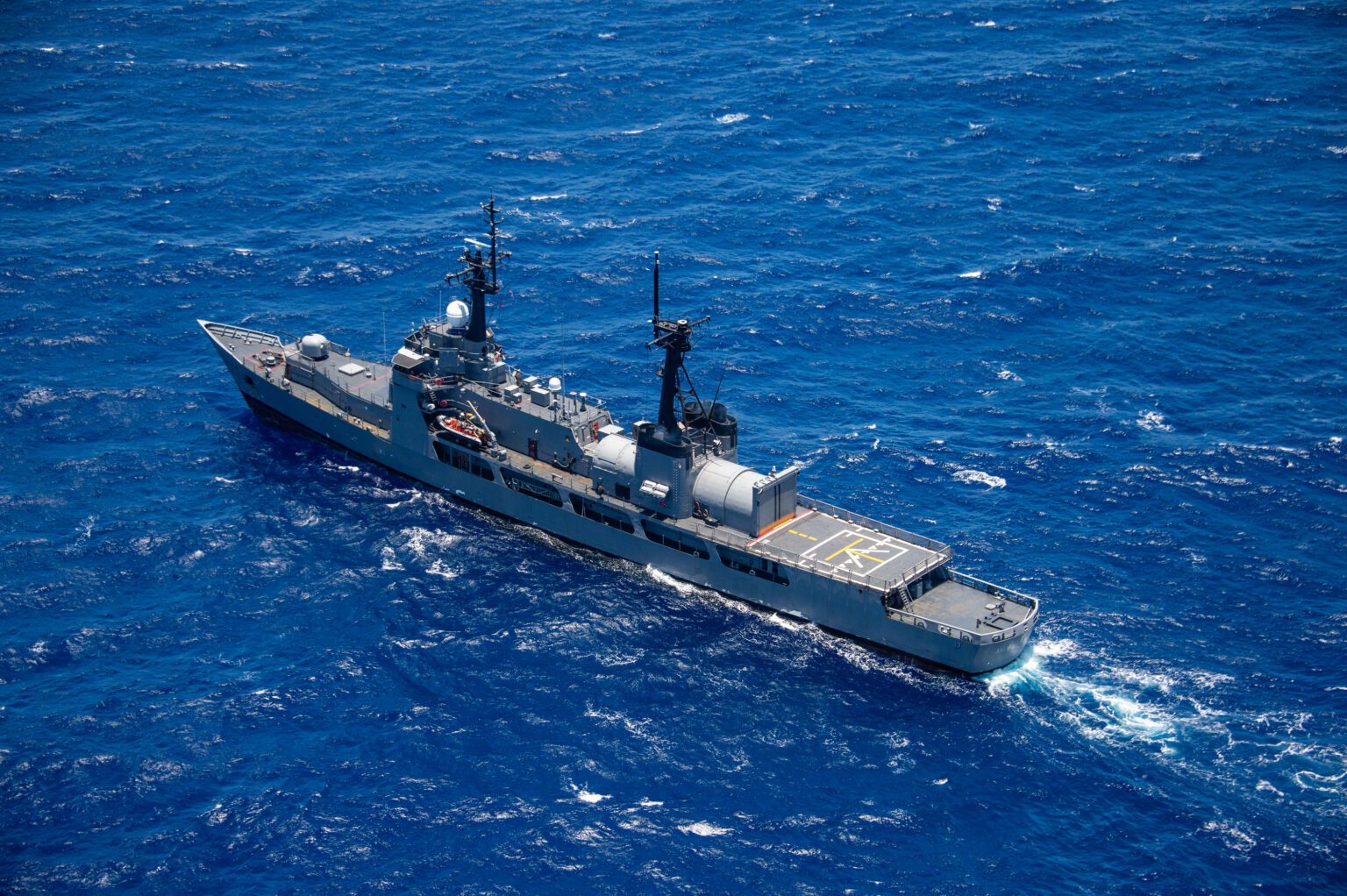
NavyRecognition reports, “China Coast Guard try to intercept Philippine Navy’s BRP Andres Bonifacio.” We talked about this incident earlier, but this report also includes information about the upgrades to the former US Coast Guard cutter. We did talk about upgrades earlier, but this has more specifics, particularly in regard to the sonar. All three of the Philippines’ former cutters are being upgraded.

The OPV is equipped with various sensors and processing systems, including the Naval Shield Baseline 2 Integrated Combat Management System, a Saab AB AN/SPS-77 Sea Giraffe AMB 3D air/surface search radar, a Furuno FAR3220BB 25KW X-band navigational radar, a Sperry Mk 92 Mod 1 Fire Control System, and an ELAC Hunter 2.0 hull-mounted sonar.

BRP Andres Bonifacio is armed with a Mk 75 Oto Melara 76mm Compact gun, two Mk 38 25mm autocannons, six M2HB Browning .50 caliber guns, and two USN-Mark 36 SRBOC (Super Rapid Blooming Offboard Countermeasures) mortar-type launching systems.

The combat management system, AN/SPS-77, sonar, and 25mm Mk38 Mod2/3s are all upgrades since the hand-over. I also found some additional information, that also mentioned Radar Electronic Support Measure (R-ESM), a new Identification Friend or Foe (IFF), and the SeaFLIR 230 electro-optical/infra-red (EO/IR) system.

The AN/SPS-77 is also used on Independence class LCS and will equip the US Coast Guard Offshore Patrol Cutter.

The sonar is by a German company and offers mine avoidance and torpedo detection as well as passive and active submarine and UUV detection capabilities. We don’t know which of the various sized transducers associated with this system was chosen. Transducers of 4 kHz to 30 kHz are available that span the range from low frequency long range systems to relatively short ranged high frequency systems. A medium frequency seems most likely.

Some of these upgrades, particularly the multimode radar, support helicopter operations. The Philippine Navy currently has two AW159 Wildcat helicopters with significant ASW and anti-surface capability. So far these are the only Philippine aircraft with an ASW capability and they may be based on other Philippine Navy warships.

The upgrades were done in South Korea. The Philippine military seems to have developed a relationship with South Korea. The Philippine Navy has purchased two 2600 ton light frigates from S. Korea and has contracts out for two 3200 ton corvettes and six 2400 ton 94.4 meter Offshore Patrol Vessels.

The three Philippine ships are probably now the best equipped of the 12 former US Coast Guard 378s currently serving in five different navies and coast guards, but there are still some desirable possible additions, including anti-ship cruise missiles (ASCM), close in weapon systems (CIWS), light weight ASW torpedoes, and towed array sonars.


Philippines Standing Up to China? Joint Patrols?

Philippine Navy frigate BRP Andrés Bonifacio (FF 17), the former USCGC Boutwell, participates in a group sail during the Rim of the Pacific (RIMPAC) exercise off the coast of Hawaii, July 26, 2018. (U.S. Navy photo by Arthurgwain Marquez)

A couple of recent reports seem to indicate the Philippines is becoming more aggressive in the protection of their EEZ.

Marine Link reports, “Philippines Coast Guard Boosts South China Sea Presence.”

“The Philippine Coast Guard has stepped up its presence in the disputed South China Sea by deploying additional vessels and conducting more sorties and overflights to protect maritime territory and the country’s fishermen, its chief said on Monday.”

gCaptain reports, “Philippine Navy Says China Tailed Its Warship.”

“The navy’s BRP Andres Bonifacio was conducting a patrol and search mission on Feb. 1 when it was monitored and tailed by the Chinese vessels near the reef, which is within the Philippines’ 200-nautical mile exclusive economic zone, said Armand Balilo, a spokesman for the coast guard. The militia boats “even conducted an intercept course,” he added.”

That the Philippine Navy is sending one of its largest ships (painted gray), the former USCGC  Boutwell, to confront Chinese trespassing is, I believe, a change from their previous policy.

Since the US and the Philippines have agreed to resume joint patrols, I would not be surprised to see a US Coast Guard cutter backstopping a Philippine CG cutter as it boards and perhaps seizes a Chinese fishing vessel. There are certainly plenty of them that are violating Philippine law.

“China Accused of Building on Unoccupied Reefs in South China Sea” –gCaptain

Satellite images obtained by Bloomberg News depict physical changes to a layered land feature at Sandy Cay between 2009 and 2021. Credit: Bloomberg

gCaptain reports,

China is building up several unoccupied land features in the South China Sea, according to Western officials, which they said was part of Beijing’s long-running effort to strengthen claims to disputed territory and potentially bolster its military presence in a region critical to global trade.

Apparently, China is not satisfied with the military outposts they have created in the South China Sea and are in the process of creating more. These actions may be taken by the Chinese both in support their systematic theft of EEZ resources from other nations and as support for a future blockade of Taiwan.

Certainly, these will be upgraded to military installations just as has been done with other artificial islands.

The nations whose EEZs are being violated by these activities have an opportunity to put a stop to it, while they are being done by fishing vessels, before there is a Chinese military presence, if they act quickly and aggressively to stop this illegal activity.

“Document: Office of Naval Intelligence’s Chinese People’s Liberation Army Navy, Coast Guard, Ship Identification Guide” –USNI

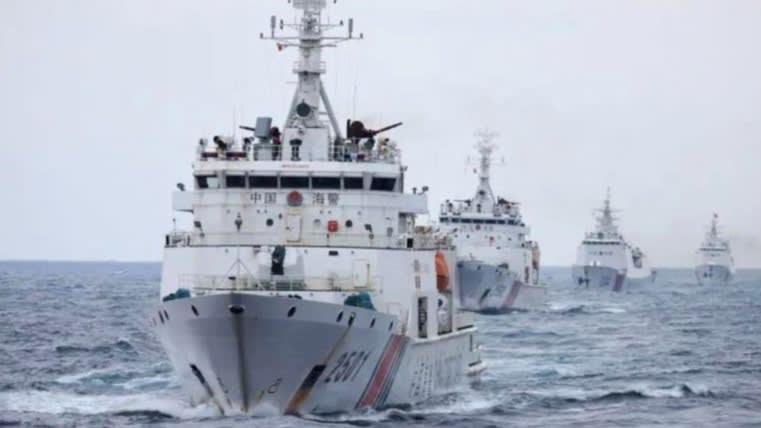
This Chinese Coast Guard ship is equipped with weapons believed to be 76-millimeter guns. © Kyodo

The US Naval Institute’s News Service reports the availability of a new document, “Office of Naval Intelligence’s Chinese People’s Liberation Army Navy, Coast Guard. and Government Maritime Forces 2022-2023 Recognition and Identification Guide.

You cannot actually read much of it on the USNI site, but you can download a copy here. You’ll need to expand it to read much of the information.

From a Coast Guard perspective, there are a couple things to note.

First is the sheer number of China Coast Guard cutters. China’s internationally recognized EEZ is less than 8.5% that of the US. Even if their expansive unrecognized claims were included, their total EEZ would be less than 20% that of the US. But according to the guide, they have over 200 cutters of 60 meters (197 feet) in length or greater (225 by my quick count). The US Coast Guard by comparison has 57: 37 patrol cutters, three icebreakers, 16 buoy tenders, and the barque Eagle.

Second, China has other agencies that apparently do coast guard work, that also have their own ships including the Sansha City Patrol, China, and the Maritime Safety Agency which, alone, has over 40 ships 60 meters or greater in length.

“Damen Lays Keel Of First OPV 2600 For Pakistan Navy” –Naval News

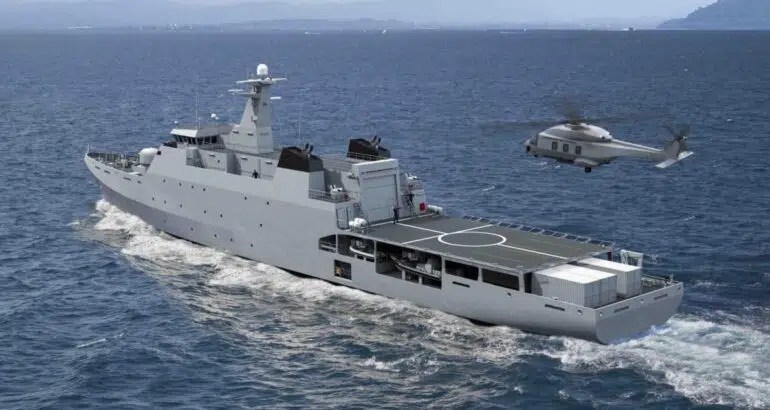
OPV 2600 multi-mission patrol vessel rendering (Source: Damen)

Naval News reports,

On October 12, 2022, Damen Shipyards ceremonially laid the keel of the first multi-purpose patrol vessel OPV 2600 for the Pakistan Navy. At the same ceremony, the first steel plates were cut for the construction of the second OPV 2600.

This is only the latest in a long line of Damen OPVs. Details of this 98 meter, 2600 ton, 24 knot design can be found here. Get an overview of their OPV programs here.

“Russia’s new maritime doctrine: adrift from reality?” –IISS

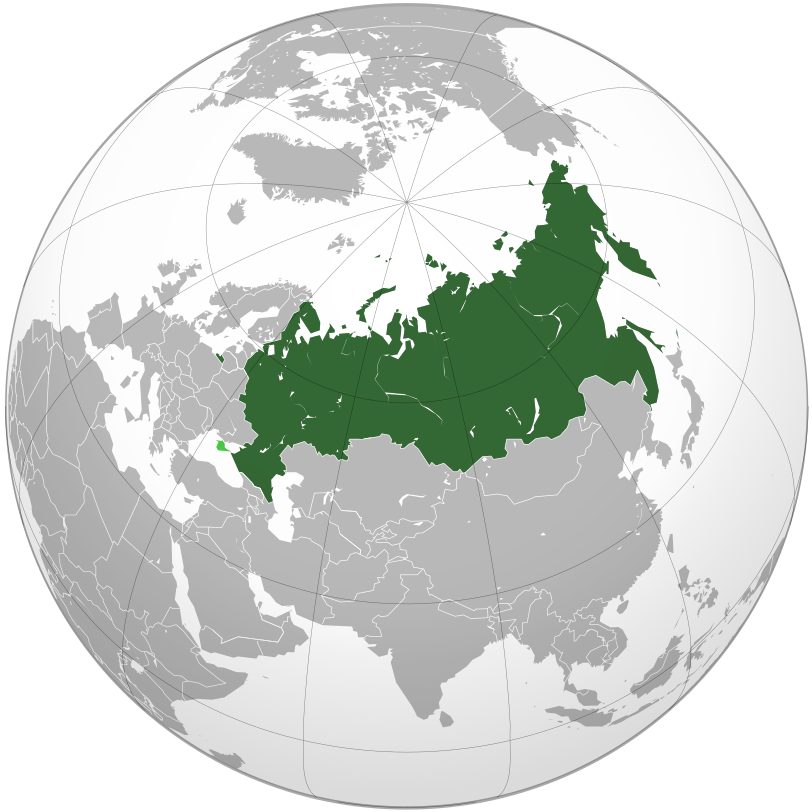
Russian Federation claimed territory. Disputed territory in light green.

The International Institute for Strategic Studies (IISS) has published a short look at Russia’s new maritime doctrine.

There are couple of things that caught my attention in the critique.

  • The Arctic, now comes first, replacing the Atlantic, and
  • No mention of China as a significant ally, while there is a reference to  partnerships and cooperation with India, Iran, Saudi Arabia and others.

The doctrine does not overtly acknowledge a diminished role for Russia on the world stage, but these actions may reflect that realization.

The Arctic: 

“In terms of the regional priorities of Russian naval activities, there is a reordering compared to 2015, with the Atlantic dropping from first to third on the list. The first priority is now the Arctic, with the promise of strengthened capabilities for the Northern and Pacific fleets in response to threats in the region.”

Emphasis on the Atlantic is inherently offensive, because they have to transit long distances through hostile waters to have an impact there. After all Russia has no Atlantic coast line. Access from either the Baltic or Black Sea looks increasing problematic.

Emphasis on the Arctic is primarily defensive. The Arctic is critical to Russia’s economy.  It is their front door. It is their longest border. Its Northern Sea Route is the strongest link between more populous industrialized European Russia and the sparsely populated Russian Far East, and with increasingly open water, the Arctic coast is increasingly exposed.

The Doctrine points out “…the ‘global naval ambitions’ of the United States, NATO activities close to Russia and at sea, an increase in foreign naval presence in the Arctic and efforts to weaken Russia’s control of the Northern Sea Route as the key challenges.” 

The US has made it clear it would like to conduct “Freedom of Navigation” exercises along the Northern Sea Route (which would require Coast Guard icebreakers). Russia has seen her control of the Northern Sea Route as a money maker and they are not eager to see it turned into open sea.

Notably China’s national interest is in opening the route to international traffic.

China: 

“…potential cooperation with China… is strikingly absent from the new doctrine.”

This and upgrades to Russia’s Pacific Fleet, along with improvements to the Northern Sea Route, may reflect a realization that perhaps China will not always be a friend, and ultimately China may turn on them.

A Second Analysis: 

There is a much more detailed analysis of the document here, done by Indian authors. This second analysis seems to confirm greater emphasis on the Arctic and discomfort with the isolation of the Russia’s eastern regions.

“In the 2015 doctrine, the Arctic was at second place after the Atlantic, which has been positioned at third place in the 2022 doctrine. Though the present sequencing may be in no specific order, it may also point to the priority of focus, as the Artic has found detailed mention as indicated earlier. It is evident that Russia recognises the Arctic not only as an area for global economic competition but as an area of military competition as well. The 21 focus areas enunciated for the Arctic region indicate a more positive and perhaps even aggressive approach as they:

—Posit Russia in the lead position in many areas of common regional interest.

—Espouse nuances of control, especially regarding foreign presence and shipping (particularly naval activities).

—Lay emphasis on protection of Russian sovereignty, especially resources.

—Indicate a growing focus on developing the requisite capacity and capability.”

When the Russian Empire fought the Russo-Japanese War (1904-1905), Russia was a great power and appeared to have many advantages, but its logistical links with its Asian holdings were weak. Apparently this is still the case.

Placement of the Pacific at second place is, perhaps, indicative of the Russian approach to the ‘Indo-Pacific’, enunciated in 2012 by the Russian president as the ‘pivot to Asia’, which was aimed at promoting modernisation of the economy. The term ‘pivot to Asia’ is, perhaps, reflective of the belief that “Russia, like China, still strongly opposes the idea of the Indo-Pacific”.
However, Russia will engage nations with which it has long standing strategic relations, like India. Hence, the 2022 doctrine retains the term ‘Asia-Pacific’, and focuses on “overcoming the economic and infrastructural isolation of the Far East from the industrialized regions of the Russian Federation, establishing sustainable sea (river), air and rail links with cities and towns in Siberia and the European part of the Russian Federation, including the development of the Northern Sea Route: This focus apparently seeks to strengthen the ‘pivot to Asia’ strategy, which was termed as a failure, especially due to “Russia’s lack of a comprehensive approach to overcoming the social and economic hardships faced by its least developed regions, namely Siberia and the country’s Far East”.

No Longer a Great Power: 

Despite its ambitions, Russia is not the Soviet Union and is no longer a Great Power. It is a middle weight power with a lot of nuclear weapons, many of which are aging. Potential military power is largely based on economic power, and Russia’s GDP is similar to that of Canada, Italy, Brazil, or South Korea. Even adjusted for “Purchase Power Parity (PPP),” Russia is only number six, behind China, the US, India, Japan, and Germany. In terms of PPP Russia’s GDP is only 14.5% that of China and 17.2% that of the US. Differences are even greater in terms of nominal GDP, 9.2% that of China and 7.2% that of the US.

As systems built during the Soviet era wear out and become increasingly obsolete, Russia’s military power is rapidly fading.

This is not to say that, during a war, Russia would not send at least some submarines into the Atlantic, but they cannot realistically deny the US and NATO control of the North Atlantic. Their SSNs will likely be more more concerned with protecting their SSBNs.

Russian and Soviet Naval thinking has long had an emphasis on coastal defense, that we saw in construction of a large fleet of torpedo and missile boats, corvettes, and light frigates. We still see that in the Karakut and Buyan-M class corvettes, and the retention of large numbers of Soviet era corvettes and light frigates, while they have not laid down a single carrier, cruiser, or destroyer since the fall of the Soviet Union. Even their frigates are smaller than their European counterparts.

Russia, it seems, is desparately trying to maintain its image as a great power, hoping no one, particularly China, will notice, but it simply does not have the means.

“Coast Guard Cutter Midgett arrives in the Western Pacific” –PacArea

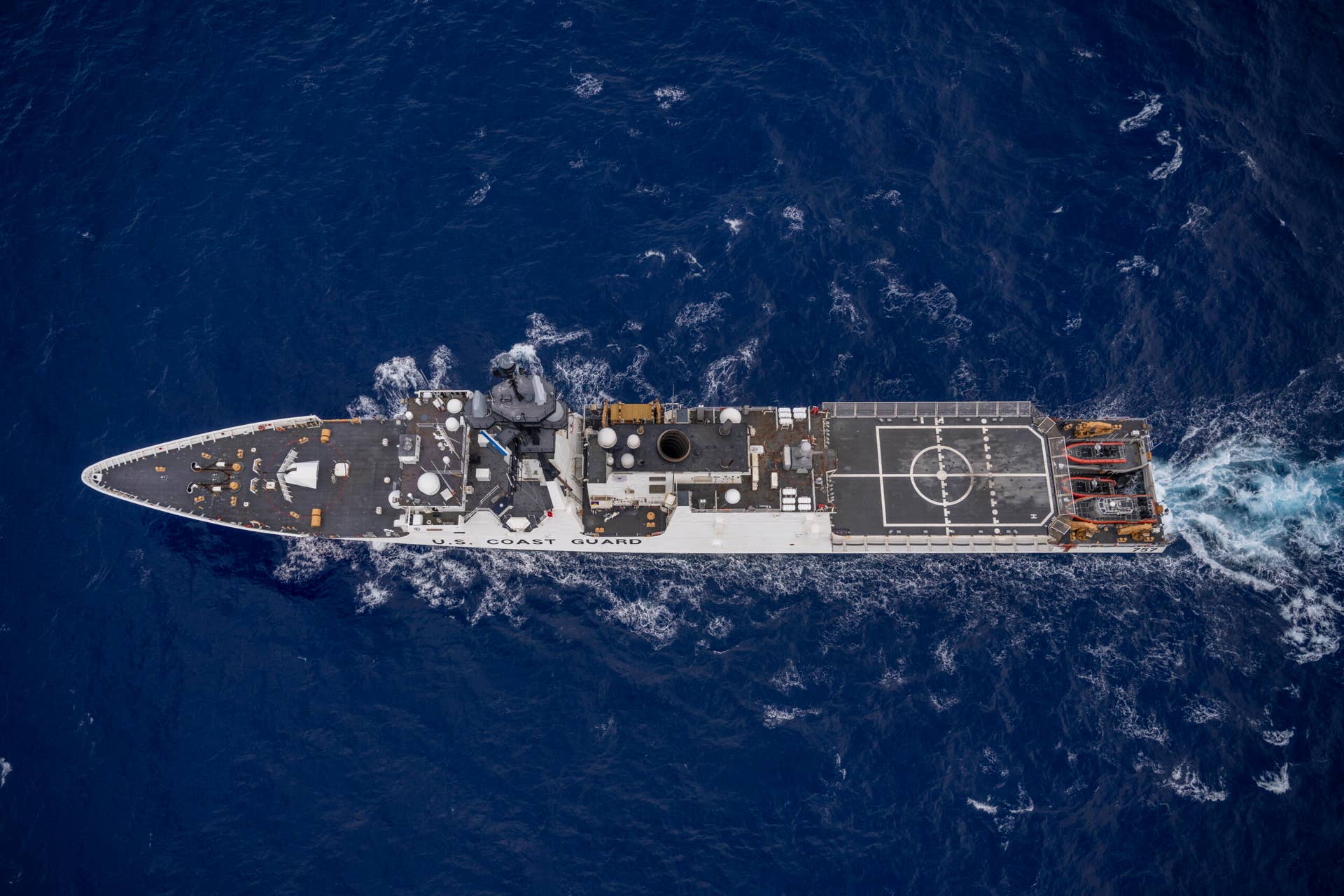
PACIFIC OCEAN (July 30, 2022) U.S. Coast Guard Legend-class cutter USCGC Midgett (WMSL 757) transits the Pacific Ocean during Rim of the Pacific (RIMPAC) 2022. Twenty-six nations, 38 ships, three submarines, more than 170 aircraft and 25,000 personnel are participating in RIMPAC from June 29 to Aug. 4 in and around the Hawaiian Islands and Southern California. The world’s largest international maritime exercise, RIMPAC provides a unique training opportunity while fostering and sustaining cooperative relationships among participants critical to ensuring the safety of sea lanes and security on the world’s oceans. RIMPAC 2022 is the 28th exercise in the series that began in 1971.(U.S. Coast Guard photo by Petty Officer 3rd Class Taylor Bacon)

Only weeks after having completed participation in RIMPAC2022, Honolulu based USCGC Midgett begins a “months-long” deployment in the Western Pacific.

News Release

August 31, 2022
U.S. Coast Guard Pacific Area

Coast Guard Cutter Midgett arrives in the Western Pacific

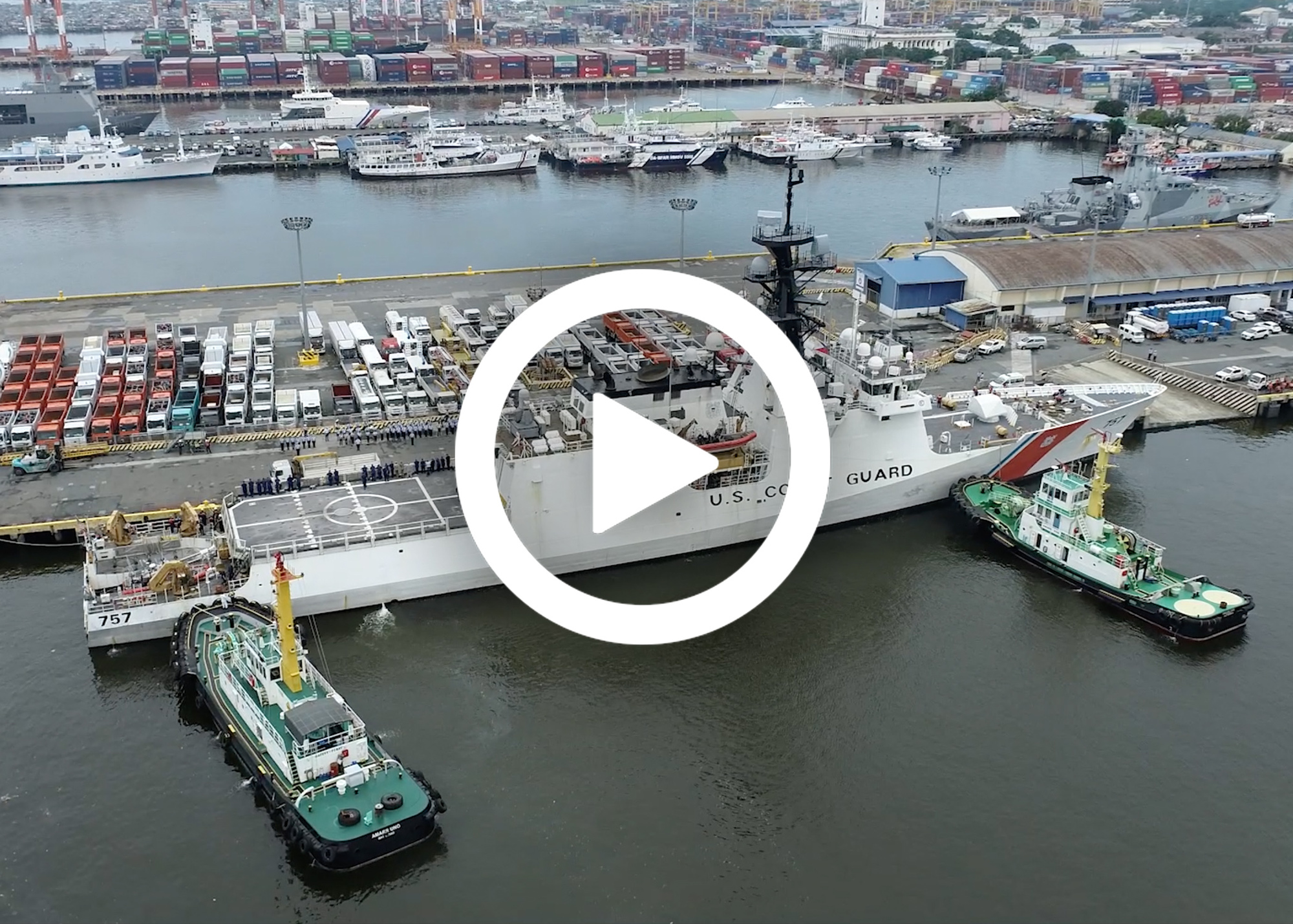
VIDEO: Coast Guard Cutter Midgett arrives in the Western Pacific

Coast Guard Cutter Midgett arrives in Manila, Philippines Coast Guard Cutter Midgett arrives in Manila, Philippines Coast Guard Cutter Midgett arrives in Manila, Philippines

Editors’ Note: Click on images to download high resolution version.

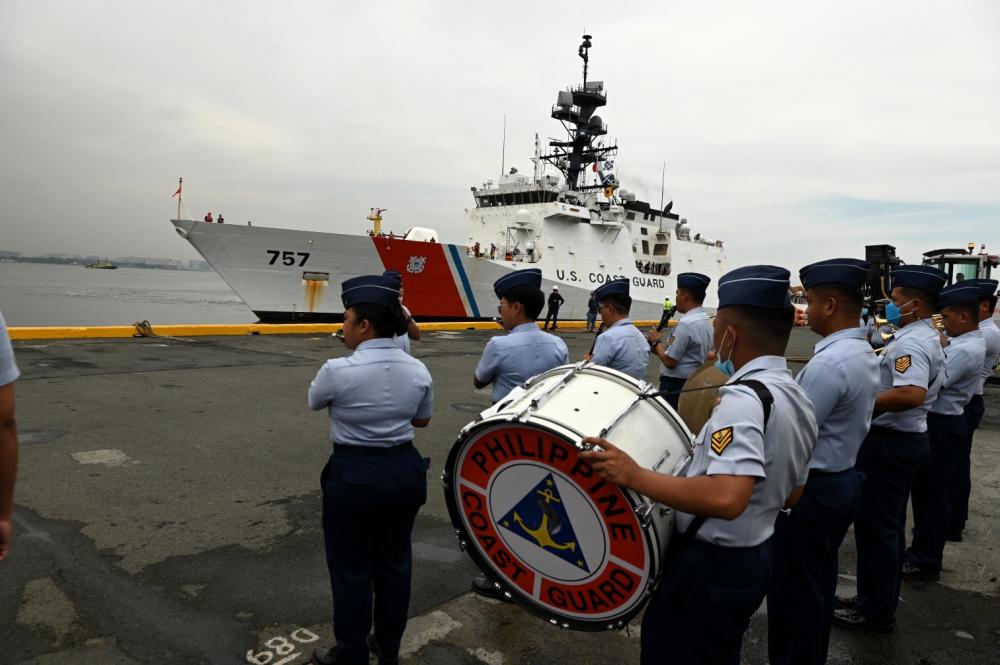
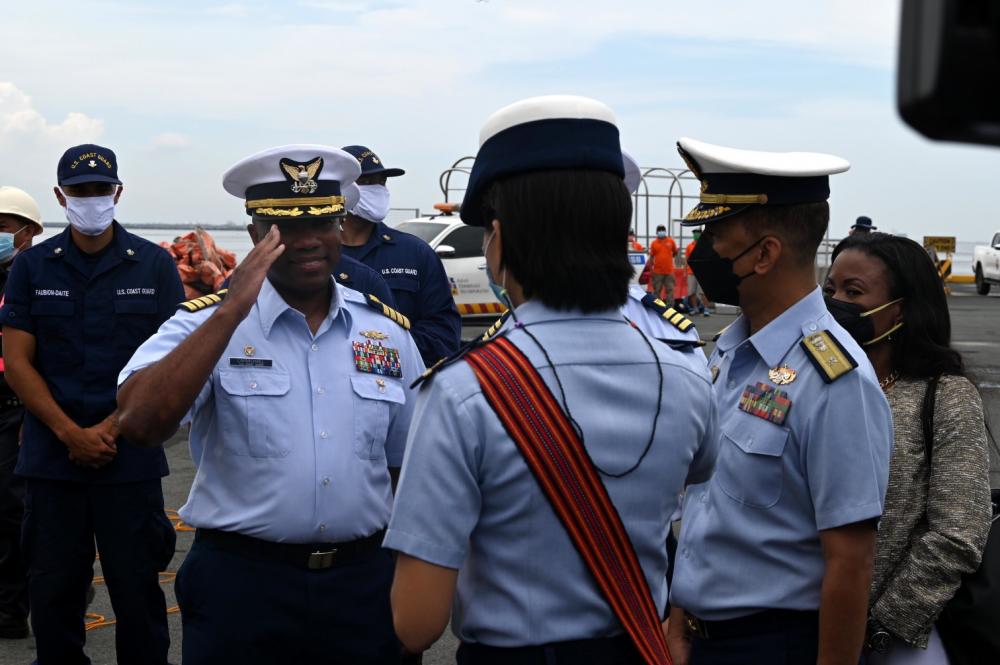
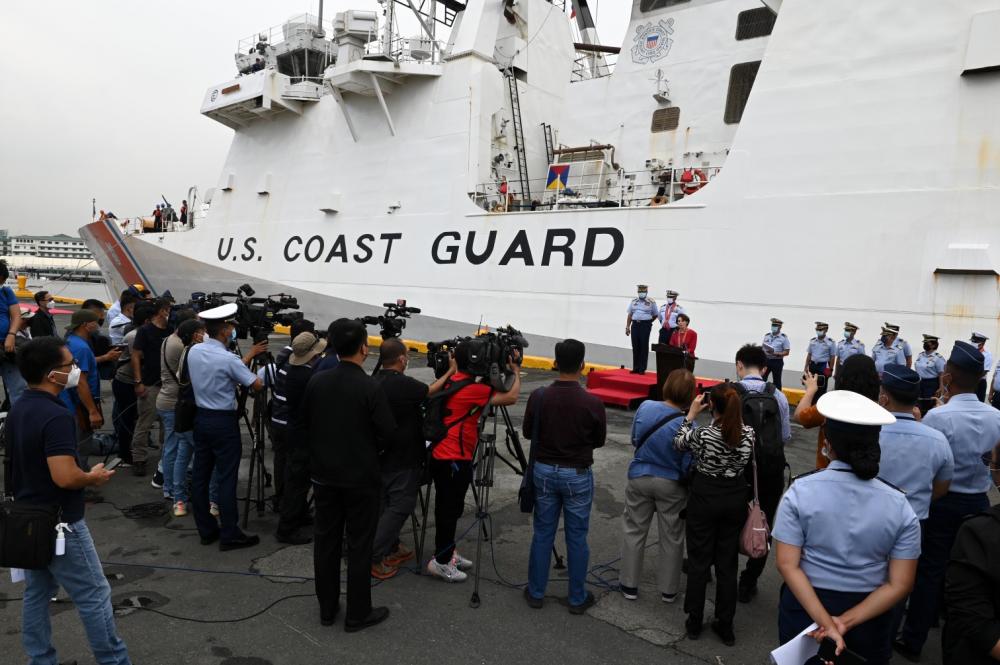
MANILA, Philippines – The U.S. Coast Guard Cutter Midgett (WMSL 757) arrived in Manila Tuesday for its first international port call during the crew’s months-long Western Pacific deployment to the region.

Midgett’s crew will conduct professional exchanges and operate with the Philippine Coast Guard as part of an at-sea search-and-rescue exercise while in Manila, building upon the strong partnership between the two nations.

Midgett is operating in support of United States Indo-Pacific Command, which oversees military operations in the region.

Operating under the tactical control of Commander, U.S. 7th Fleet, the cutter’s crew plans to engage in professional and subject matter expert exchanges with regional partners and allies and will patrol and operate as directed during their Western Pacific deployment.

The Coast Guard provides expertise within the mission sets of search and rescue; illegal, unreported and unregulated fishing; maritime environmental response; maritime security; maritime domain awareness; aviation operations; interoperability; and humanitarian assistance and disaster relief.

As both a federal law enforcement agency and a branch of the armed forces, the Coast Guard is uniquely positioned to conduct non-escalatory defense operations and security cooperation in support of combatant commanders on all seven continents. The service routinely provides forces in joint military operations worldwide, including the deployment of cutters, boats, aircraft and deployable specialized forces.

“Engaging with our Philippine Coast Guard partners is truly an honor,” said U.S. Coast Guard Capt. Willie Carmichael, commanding officer of the Midgett. “Together we will continue to build strong relationships and learn from each other. Our deep-rooted partnership will combine the best of both our Coast Guards and the planned search-and-rescue exercise and professional exchanges are a great opportunity for us keep the Indo-Pacific region open and free.”

The U.S. Coast Guard has a 150-year enduring role in the Indo-Pacific. The service’s ongoing deployment of resources to the region directly supports U.S. foreign policy and national security objectives in the Indo-Pacific Strategy and the National Security Strategy.

Since 2019, the Coast Guard Cutter Bertholf (WMSL 750), Stratton (WMSL 751), Waesche (WMSL 751) and Munro (WMSL 755) have deployed to the Western Pacific.

Commissioned in 2019, Midgett is one of two Coast Guard legend-class national security cutters homeported in Honolulu. National security cutters are 418-feet long, 54-feet wide, and have a 4,600 long-ton displacement. They have a top speed in excess of 28 knots, a range of 12,000 nautical miles, endurance of up to 90 days and can hold a crew of up to 170.

Midgett is the second cutter named after Rear Admiral John Midgett, whose family has a long legacy in the Coast Guard and our services precursor – the U.S. Life Saving Service.

National security cutters feature advanced command and control capabilities, aviation support facilities, stern cutter boat launch and increased endurance for long-range patrols to disrupt threats to national security further offshore.

“Singapore’s Police Coast Guard deploys multilayered tactics to defend coastline” –Indo-Pacific Defense Forum

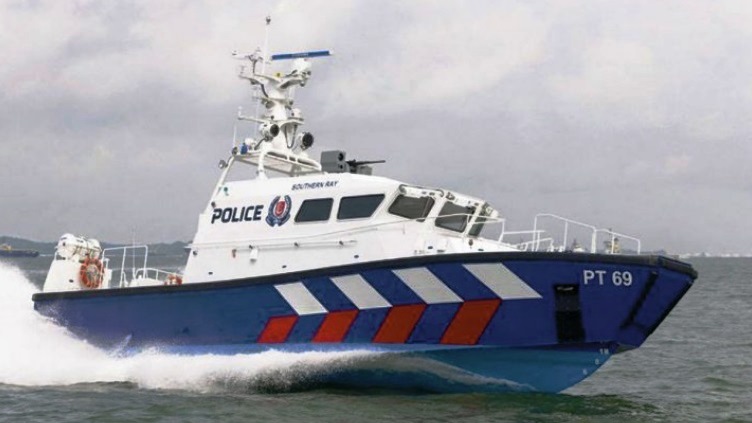
Indo-Pacific Defense Forum takes a look at Singapore’s Police Coast Guard, apparently prompted by a July 2022 report commissioned by the Korea Institute for Maritime Strategy and titled “Second Amongst Equals? The Police Coast Guard within Singapore’s Maritime Security Architecture.” Wikipedia has a more detail.

(They have a very different sort of “racing stripe” to identify their vessels, apparently replacing a more conventional white/red/white stripe on blue hull about a decade ago.)

Singapore has a very small EEZ, 1,067 sq.km. That of the US is 10,638 times larger, but those waters are extremely important, highly congested, and have had a long history of piracy. IUU, terrorism, and particularly illegal imigration are continuing concerns.

The largest Singapore Police Coast Guard vessels are similar in size to the 110 foot WPBs. Most of their vessels are relatively fast (35 to 55 knots) and for a “police” organization, well armed. The Singapore Navy handles some missions that we would consider Coast Guard missions, including operation of Offshore Patrol Vessels.