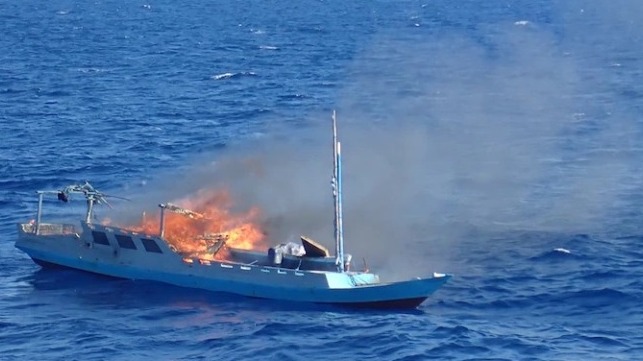
Australia Destroys Chinese and Indonesian F/Vs Caught Illegally Fishing

This isn’t new, the reports date from November 2021, here and here, but I had not heard about it previously.

The practice isn’t unique to Australia. Indonesia famously, routinely blows up fishing vessels caught fishing illegally in Indonesian waters and I found this 2015 report that Palau had burned four Vietnamese fishing vessels.

Thanks to Lee for bringing this to my attention. 

“Indonesia spearheading regional cooperation in South China Sea” –Indo-Pacific Defense Forum

Indonesian Maritime Security Agency vessel KN Tanjung Datu, left, sails alongside U.S. Coast Guard Cutter Stratton during joint exercises in the Singapore Strait in August 2019. IMAGE CREDIT: PO1 LEVI READ, USCG

The Indo-Pacific Defense Forum reports,

Indonesia is reaching out to its South China Sea neighbors to foster harmony on maritime sovereignty issues and enhance cooperation among regional coast guards, analysts say. The nation engaged closely with Vietnam in late 2021 and plans to add five countries to the collaborative effort in 2022.

It appears Indonesia is working with its SE Asian neighbors to resolve their bilateral maritime territorial disputes based on UNCLOS and develop multi-lateral agreement.

This would allow the ASEAN nations to present a united front, to push back against China’s expansive claims. It might even lead to something like my proposed Combined Maritime Security Task Force.

Indo-Pacific Strategy of the United States

U.S. Coast Guard Cutter Munro and Japan Coast Guard Patrol Vessel Large Aso, transit together in formation during a maritime engagement in the East China Sea Aug. 25, 2021. U.S. Coast Guard members aboard the Munro deployed to the Western Pacific Ocean to strengthen alliances and partnerships and improve maritime governance and security in the region. (Photo courtesy of Japan Coast Guard)

The Whitehouse has issued a new Indo-Pacific Strategy, and it specifically mentions the US Coast Guard.

The document calls out China for its aggressive behavior,

This intensifying American focus is due in part to the fact that the Indo-Pacific faces mounting challenges, particularly from the PRC. The PRC is combining its economic, diplomatic, military, and technological might as it pursues a sphere of influence in the Indo-Pacific and seeks to become the world’s most influential power. The PRC’s coercion and aggression spans the globe, but it is most acute in the Indo-Pacific. From the economic coercion of Australia to the conflict along the Line of Actual Control with India to the growing pressure on Taiwan and bullying of neighbors in the East and South China Seas, our allies and partners in the region bear much of the cost of the PRC’s harmful behavior. In the process, the PRC is also undermining human rights and international law, including freedom of navigation, as well as other principles that have brought stability and prosperity to the Indo-Pacific.

It recognizes the value and values of our allies and partners,

For centuries, the United States and much of the world have viewed Asia too narrowly—as an arena of geopolitical competition. Today, Indo-Pacific nations are helping to define the very nature of the international order, and U.S. allies and partners around the world have a stake in its outcomes. Our approach, therefore, draws from and aligns with those of our closest friends. Like Japan, we believe that a successful Indo-Pacific vision must advance freedom and openness and offer “autonomy and options.” We support a strong India as a partner in this positive regional vision. Like Australia, we seek to maintain stability and reject coercive exercises of power. Like the ROK, we aim to promote regional security through capacity-building. Like ASEAN, we see Southeast Asia as central to the regional architecture. Like New Zealand and the United Kingdom, we seek to build resilience in the regional rules-based order. Like France, we recognize the strategic value of an increasing regional role for the European Union (EU). Much like the approach the EU has announced in its Strategy for Cooperation in the Indo-Pacific, American strategy will be principled, long-term, and anchored in democratic resilience.

It calls for action in five areas:

  1. ADVANCE A FREE AND OPEN INDO-PACIFIC
  2. BUILD CONNECTIONS WITHIN AND BEYOND THE REGION
  3. DRIVE REGIONAL PROSPERITY
  4. BOLSTER INDO-PACIFIC SECURITY
  5. BUILD REGIONAL RESILIENCE TO TRANSNATIONAL THREATS

There is mention of the Coast Guard is in the section “BOLSTER INDO-PACIFIC SECURITY” on page 13.

We will also innovate to meet civilian security challenges, expanding U.S. Coast Guard presence, training, and advising to bolster our partners’ capabilities. We will cooperate to address and prevent terrorism and violent extremism, including by identifying and monitoring foreign fighters traveling to the region, formulating options to mitigate online radicalization, and encouraging counterterrorism cooperation within the Indo-Pacific. And we will strengthen collective regional capabilities to prepare for and respond to environmental and natural disasters; natural, accidental, or deliberate biological threats; and the trafficking of weapons, drugs, and people. We will improve cybersecurity in the region, including the ability of our partners to protect against, recover from, and respond to cybersecurity incidents.

Coast Guard roles presumably extend beyond interdiction and fisheries to include assistance with intelligence, port security, and maritime industry cybersecurity.

The strategy refers to ten lines of effort that are to be pursued in the next 12 to 24 months. The first is “Drive New Resources to the Indo-Pacific” (p.15),

Building shared capacity requires the United States to make new regional investments. We will open new embassies and consulates, particularly in Southeast Asia and the Pacific Islands, and increase our strength in existing ones, intensifying our climate, health, security, and development work. We will expand U.S. Coast Guard presence and cooperation in Southeast and South Asia and the Pacific Islands, with a focus on advising, training, deployment, and capacity-building. We will refocus security assistance on the Indo-Pacific, including to build maritime capacity and maritime-domain awareness.

Sounds like this may include Coast Guard attachés attached to diplomatic staffs and possibly some new basing.

There is a second line of effort that will undoubtably involve the Coast Guard, “Partner to Build Resilience in the Pacific Islands” (p.17),

The United States will work with partners to establish a multilateral strategic grouping that supports Pacific Island countries as they build their capacity and resilience as secure, independent actors. Together, we will build climate resilience through the Pacific Region Infrastructure Facility; coordinate to meet the Pacific’s infrastructure gaps, especially on information and communications technology; facilitate transportation; and cooperate to improve maritime security to safeguard fisheries, build maritime-domain awareness, and improve training and advising. We will also prioritize finalization of the Compact of Free Association agreements with the Freely Associated States.

A Maritime Executive post, New U.S. Indo-Pacific Strategy Singles Out China’s “Coercion”, notes,

In the security arena, the new strategy reiterates that the United States has maintained “a strong and consistent defence presence necessary to support regional peace, security, stability, and prosperity”, pointing to the South China Sea and the East China Sea as a priority. However, it is interesting that while the document underscores the importance of freedom of navigation in the Indo-Pacific, not a single paragraph mentions the US Freedom of Navigation Operations Program (FONOPS) carried out by the US Navy, which has stirred controversy. Conversely, the strategy emphasises the importance of the Coast Guard to lead maritime security cooperation in the region, in “advising, training, deployment, and capacity-building … including to build maritime capacity and maritime-domain awareness”. Indeed, in 2021, the US Coast Guard announced a joint maritime training centre with the Indonesian Coast Guard in Batam.

The emphasis on coast guard cooperation can be seen as a positive gesture since it will be less provocative and sensitive compared to a military presence in the region. And more importantly, coast guard operations in Southeast Asia are very much required to tackle maritime security threats such as illegal fishing.

Thanks to Paul for bringing this to my attention. 

“Use the Coast Guard for Freedom of Navigation Operations” –USNI

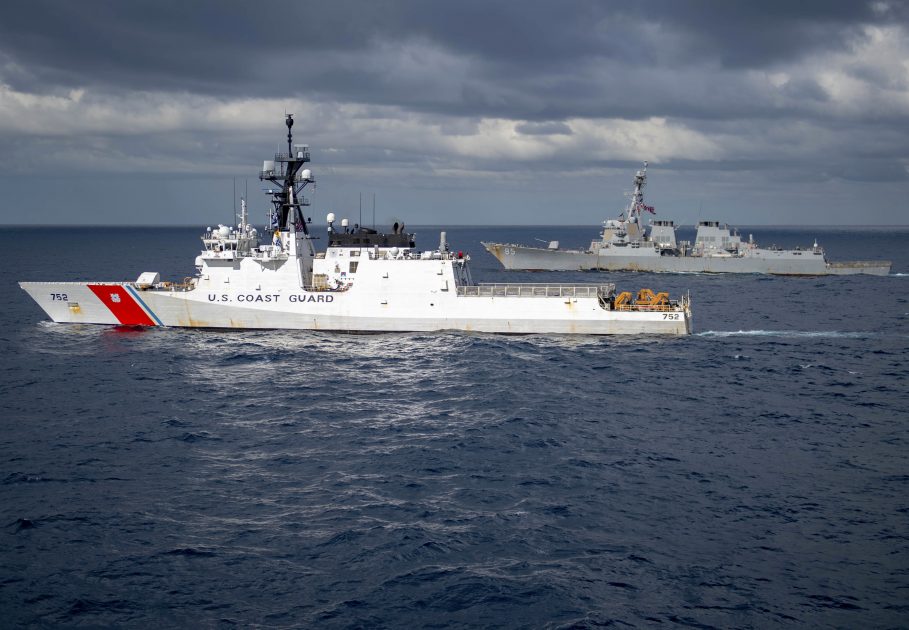
USCGC Stratton (WMSL-752), left, and the U.S. Navy Arleigh Burke-class guided-missile destroyer USS McCampbell (DDG-85) maneuver in formation during Talisman Sabre 2019 on July 11, 2019. US Navy Photo

The December 2021 issue of US Naval Institute Proceedings has an article that suggests, “NSCs and OPCs are ideal vessels to take over FONOPs.”

Why do the authors, two Navy LCdr. and a Marine Capt., think this? They contend:

  • Their destroyers are overworked.
  • The Navy is having a hard time keeping their ships maintained.
  • Cutters are less intimidating
  • and less expensive
  • If the Chinese start playing bumper boats with Destroyers, they might damage expensive equipment. “…if a ship from the Chinese Navy, Coast Guard, or maritime militia were to ram a U.S. vessel conducting a FONOP, the ensuing visuals, narratives, and potential loss of combat capability would be starkly different between a Navy gray hull and a Coast Guard white hull.”

They talk about using LCS as an alternative, but then denigrate the possibility,

The Navy has rightfully used littoral combat ships (LCSs) to conduct limited FONOPs in the South China Sea, somewhat relieving overworked destroyers like the USS John S. McCain. However, the smaller LCS’s myriad of problems, curtailed acquisition numbers, and early retirement of the first four hulls mean the Navy will soon have to lean even more heavily on larger and generally older ships. With only 10 to 14 cruisers and destroyers available to Seventh Fleet at any given time, the Navy can ill-afford to use these high-demand, low-density, Aegis ships for FONOPs.

This, in spite of the fact, that LCS have only recently begun making regular deployments to the Western Pacific and LCSs are being added to the fleet at a rate of four per year.

First, I have no problem with Cutters doing FONOPs when they are in the Western Pacific, but that should not be the only reason, they are there.

US Navy ships are not overworked. That is a fiction. Having looked at the “USNI News Fleet and Marine Tracker” over many years, I can say, Navy ships are typically deployed about one third of the time, and they are underway only about 25% of the time, far less than Coast Guard cutters. That is not to say the people are not overworked, by burdensome administrative and overly broad qualification requirements for their junior officers. The ships are behind in maintenance because of lack of support, not time underway. Ships don’t need to spend 75% of their time, tied up in maintenance, to remain effective.

In war time, well over half the navy should be underway and forward deployed. The fact that they cannot support a much smaller forward presence, of which much of the time is not underway, in peacetime, points to a serious deficit in the Navy’s support structure. Where are the repairs ships, the tenders, the floating dry docks that allow a navy to be truly expeditionary?

If the Navy does not want to use carriers, cruisers, or destroyers for FONOPs because they are afraid of having them damaged, there are other alternatives. They could use amphibs: LHAs, LHDs, LPDs, and LSDs. They could use Military Sealift Command ships. MSC ships are clearly not as intimidating as carriers, cruisers, and destroyers. Were they to be damaged “the ensuing visuals, narratives, and potential loss of combat capability would be starkly different…” 

I would suggest using the new Navaho class tug and salvage ships. They are an excellent choice for playing bumper boats. They have strong steel hulls and are powerful enough to tow a nuclear-powered carrier. Their hulls are reinforced to allow hull to hull contact with other ships. Plus, they are a lot less expensive. Even less expensive than a Coast Guard cutter.

But really, using tugs or cutters to do FONOP kind of misses the point. The Chinese and the Russians are not upset because foreign ships are transiting waters they claim. They are upset because foreign warships are transiting the waters the claim. If we stop sending warships into the waters they claim, we are creating a defacto case that they have a right to such exclusion. That Coast Guard cutters may not be considered warships would weaken our case that, foreign warships in these waters is the norm.

“First Images Of New Inlay Class Warship For Myanmar Navy” –Covert Shores

Myanmar UMS Inlay (54), 12 March 2018, Indian Navy Photo

Covert Shores reports sighting of a second Inlay class, a locally built offshore patrol vessel. This prompted a look at this class and the Myanmar Navy, which turns out to be surprisingly strong, with an apparently capable domestic shipbuilding capability.

Myanmar seems to have been in the news a lot lately, and it has not been “good news.” Like many other nations in Asia, particularly SE Asia, they have been building Offshore Patrol Vessels. Reportedly the Myanmar Coast Guard was established only months ago, in Oct. 2021, but it appears these OPVs will serve with their Navy. Myanmar Coast Guard floating units appear to be limited to four very old patrol boats.

Reportedly these Inlay class Offshore Patrol Vessels displace 1500 tons, but I suspect that is not their full load displacement. They are similar in size to the 1.800 ton 270 foot WMECs, slightly shorter, 265’9′ (81 meters vs 82.3) and a bit broader of beam (41′ vs 38’/12.5 vs 11.6 meters). Speed is essentially the same at 20 knots. The bridge does seem surprisingly large.

Reportedly the Myanmar vessels can hangar a Eurocopter AS365 Dauphin, that is essential the same as an H-65. Also, reportedly there is a launch ramp for a RIB in the stern. There might be a boat davit on the starboard side, but I have not seen a good photo of the starboard side. There is a large opening on the starboard side superstructure aft, that mirrors the one visible on the port side.

Apparently, the weapon forward of the bridge is a Soviet era twin 57mm. The weapon might be ancient, but it is probably still very effective at short ranges.

The Myanmar Navy is more impressive than I would have expected, and many of their ships are built locally. As noted in the headline post, they just got their second submarine, one Russian built via India and now one from China. They have a 12,400 ton S. Korean built LPD. They are building their fourth domestically built frigate, to add to two overage Chinese built frigates. They have three domestically built 1,100 ton corvettes. They have twenty vessels similar in size to the Webber class but much more heavily armed, including five armed with Anti-Ship Cruise Missiles, and two slightly larger, 500 ton Fast Attack Craft also armed with ASCMs. These are in addition to six older Chinese built Houxin class missile boats.

All total, they appear to have 21 surface combatants armed with Anti-Ship Cruise Missiles, primarily the Chinese made C-802, which is roughly equivalent to the US made Harpoon.

Myanmar has also begun to build 600 ton, 63 meter, high speed “sub chasers” to replace eight, now overage, Chinese built Hainan class. The new ships are equipped with the same twin 57mm mount that also equips the new OPVs.


“US Navy Seizes Weapons from Fishing Vessel in the Arabian Sea” –DVIDS

U.S. Navy Seizes 1,400 Assault Rifles During Illicit Weapons Interdiction

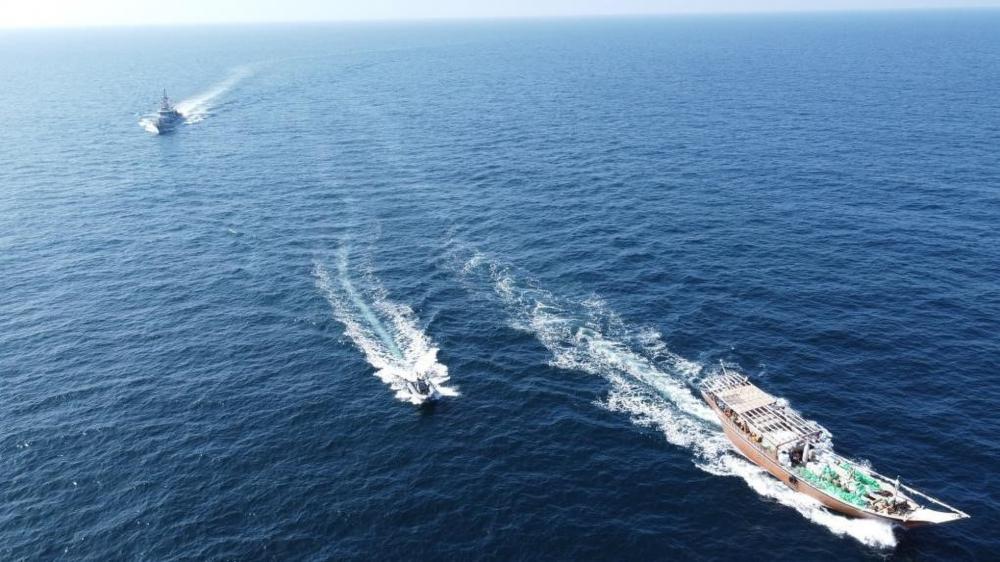
NORTH ARABIAN SEA (Dec. 20, 2021) U.S. service members from patrol coastal ship USS Typhoon (PC 5) interdict a stateless fishing vessel carrying illicit weapons while transiting international waters in the North Arabian Sea, Dec. 20. (U.S. Navy photo)

Below is a press release from Defense Visual Information Distribution Service (DVIDS). The boarding team was apparently Coast Guard. It’s likely the Webber class WPCs assigned to PATFORSWA will be doing this sort of work since the Navy PCs are being decommissioned.


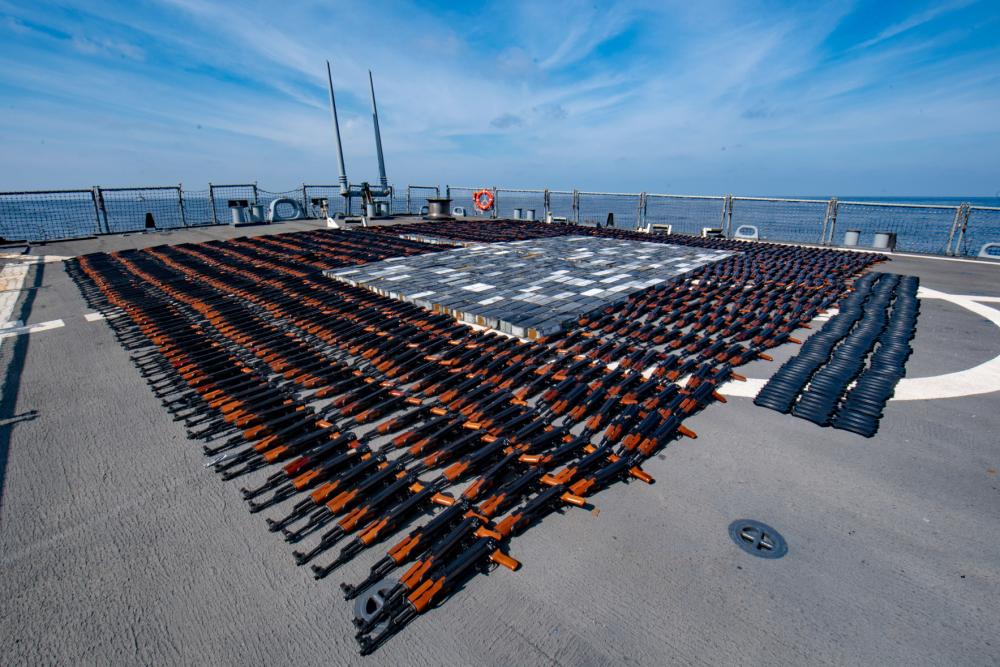
U.S. 5th Fleet ships seized approximately 1,400 AK-47 assault rifles and 226,600 rounds of ammunition from a stateless fishing vessel during a flag verification boarding in accordance with customary international law in the North Arabian Sea, Dec. 20.

U.S. Navy patrol coastal ships USS Tempest (PC 2) and USS Typhoon (PC 5) found the weapons during a search conducted by embarked U.S. Coast Guard personnel. The illicit weapons and ammunition were later transported to guided-missile destroyer USS O’Kane (DDG 77) where they await final disposition.

The stateless vessel was assessed to have originated in Iran and transited international waters along a route historically used to traffic weapons unlawfully to the Houthis in Yemen. The direct or indirect supply, sale or transfer of weapons to the Houthis violates U.N. Security Council Resolutions and U.S. sanctions.

The vessel’s five crew members identified themselves as Yemeni nationals and will be returned to Yemen.

After removing the crew and illicit cargo, U.S. naval forces determined the stateless vessel was a hazard to navigation for commercial shipping and sank it.

U.S. naval forces regularly perform maritime security operations in the Middle East to ensure the free flow of legitimate trade and to disrupt the transport of illicit cargo that often funds terrorism and other unlawful activity. U.S. Navy warships operating in the U.S. 5th Fleet region have seized approximately 8,700 illicit weapons in 2021.

Guided-missile cruiser USS Monterey (CG 61) seized dozens of advanced Russian-made anti-tank guided missiles, thousands of Chinese Type 56 assault rifles, and hundreds of PKM machine guns, sniper rifles and rocket-propelled grenade launchers from a stateless vessel transiting the North Arabian Sea in May.

In February, guided-missile destroyer USS Winston S. Churchill (DDG 81) seized a cache of weapons off the coast of Somalia, including thousands of AK-47 assault rifles, light machine guns, heavy sniper rifles, rocket-propelled grenade launchers and crew served weapons. The inventory also included barrels, stocks, optical scopes and weapon systems.

The U.S. 5th Fleet area of operations encompasses approximately 2.5 million square miles of water area and includes the Arabian Gulf, Gulf of Oman, Red Sea, parts of the Indian Ocean and three critical choke points at the Strait of Hormuz, Suez Canal and Strait of Bab al Mandeb.

U.S. Navy Seizes 1,400 Assault Rifles During Illicit Weapons Interdiction

NORTH ARABIAN SEA (Dec. 21, 2021) Illicit weapons seized from a stateless fishing vessel in the North Arabian Sea are arranged for inventory aboard guided-missile destroyer USS O’Kane’s (DDG 77) flight deck, Dec. 21. (U.S. Navy photo by Mass Communication Specialist Seaman Elisha Smith)

“Time to Revise the Japan Coast Guard Act?” –The Diplomat

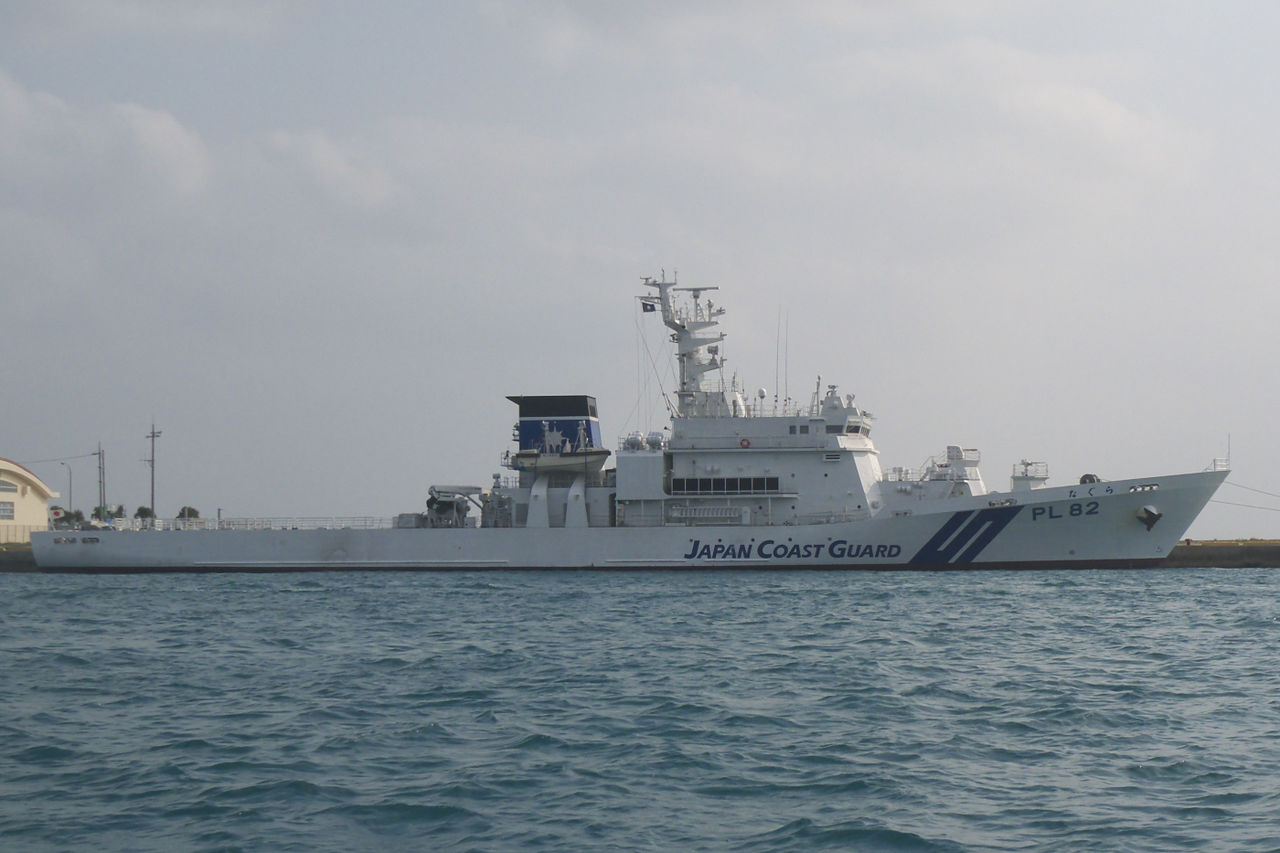
Japan Coast Guard patrol vessel PL82 Nagura at the Port of Ishigaki. Photo from Wikipedia Commons, by Yasu

The Diplomat reports that Japan is considering changes to their laws governing the Japan Coast Guard.

One proposal seeks to add “maintenance of  territorial sea integrity” and “security of territorial sea” to the Act’s mission, while another seeks to moderate the prerequisites allowing harm through use of weapons by Coast Guard officers. All of these proposals seek to give the JCG more muscle.

I don’t have a feel for what the actual proposed changes are, but I do know the Japan Coast Guard does not have the same close relationships with the Japanese Navy (Maritime Defense Force) that the USCG enjoys with the USN. It is not a military service. They don’t share equip or even use the same fuel. You can bet they don’t share the same communications systems. This means that the organization is not as useful as it might be in wartime, and, of more immediate concern, it means coordination in crisis is far more difficult.

Currently none of the Japan Coast Guard vessels have weapons larger than 40mm, and very few have an air search radar or any kind of AAW firecontrol system. If Japanese Self Defense Forces are not immediately available as backup, it might be hard not to feel intimidated by better armed China Coast Guard vessels, particularly if supported by aircraft.

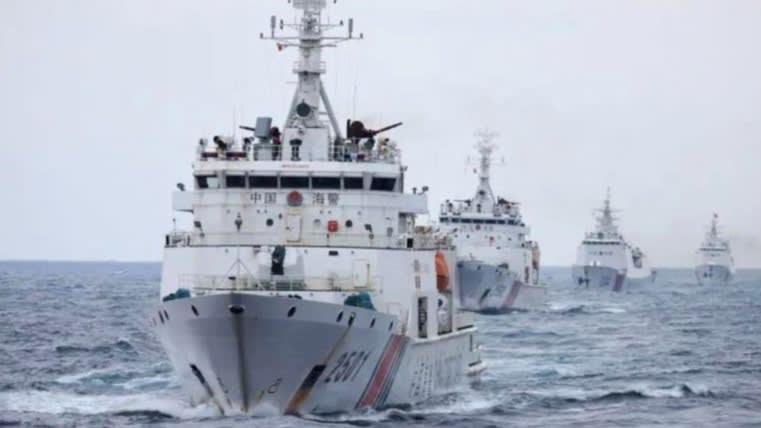
This Chinese coast guard ship is equipped with weapons believed to be 76-millimeter guns. © Kyodo

Up-Gunning the China Coast Guard–Add 22 New Type 056 Corvettes

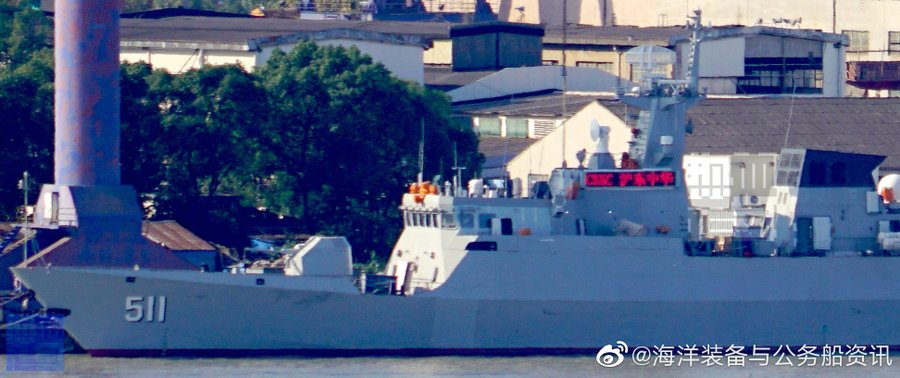
Type 056 corvette, credit 樱井千一

We have a report from Defence.PK, that 22 PLAN Type 056 corvettes are being transferred to the China Coast Guard. These ships are the early models that were completed without the more sophisticated anti-submarine warfare capabilities of the Type 056A. Rather than upgrade them, the Chinese Navy will build 22 additional Type 054A Frigates.

Reportedly they are adding a LED billboard and the missiles are being removed. Probably the torpedoes as well. But that still leaves a 120 round/minute 76 mm gun and a pair of 30mm Guns.

The China Coast Guard already has more large cutters than the US Coast Guard, despite of the fact that their EEZ is less than 20% that of the US, even if all their outrageous claims were accepted. But most of these cutters have no guns of 20mm or larger. 22 AK-176 76mm guns and 44 30mm Guns will substantially increase the China Coast Guard’s firepower.

These 1500 ton 25 knot ships are a handy size for an area like the South China Sea.

Unlike the US Coast Guard, the China Coast Guard tends to operate their cutters in groups. Three of these, snuggled up to you, at close range, could be very intimidating even to a DDG like those the US Navy uses for Freedom of Navigation Exercises. For relatively unarmed Asian Coast Guard cutters, it would be much more so.

Chinese Naval Forces don’t have a lot of naval victories in their past so the Battle of Paracel Islands, where they defeated the Vietnamese by opening fire at very close range, must assume outsized importance in their imagination.

Image

I note, the cutters China used when they recently turned back a Philippine resupply effort in the South China Sea, included at least one armed with a 76mm gun.

In case you missed it, below is a statement from the US Ambassador to the Philippines (and to China).

“VESSEL REVIEW | KOLACHI – NEW LARGE PATROL VESSEL FOR PAKISTAN MARITIME SECURITY AGENCY” –Baird Maritime

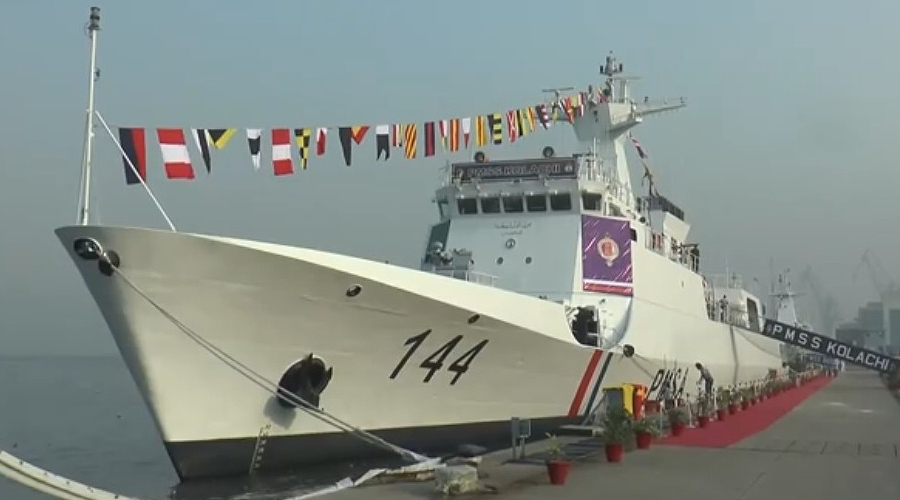
Photo: PMSA

Baird Maritime reports delivery of a Chinese designed Offshore Patrol Vessel to the Pakistan Maritime Security Agency (PMSA), the maritime safety and law enforcement arm of the Pakistan Navy. This second ship was reportedly built in Pakistan while the first was produced in China.

This ship may look a bit familiar. It appears to be a variant of the Type 056 corvette. 72 of the corvettes were inducted into the Chinese PLA Navy between 2013 and 2019. Variants of the class also serve with the Bangladeshi and Nigerian Navies and the China Coast Guard.

There is a Pakistani Coast Guards distinct from the PMSA, but it falls under the authority of the Pakistani Army and functions more like Customs and Border Protection and its Air and Marine Unit, being limited to operations on shore and within the 12 mile limit.

“Coast Guard cutter returns home following Western Pacific deployment” –News Release

Coast Guard Cutter Munro (WMSL 755) crewmember Petty Officer 2nd Class Kurt Chlebek, a boatswains mate, is greeted by his dog after Munro returned to their homeport in Alameda, California, Oct. 20, 2021, following a 102-day, 22,000 nautical mile multi-mission deployment. Munro’s crew departed Alameda in July for a Western Pacific patrol and operated in support of United States Indo-Pacific Command, which oversees military operations in the region. U.S. Coast Guard photo by Chief Petty Officer Matt Masaschi.

Wrap-up of USCGC Munro’s recent deployment to the Western Pacific.

united states coast guard

News Release

Oct. 20, 2021
U.S. Coast Guard Pacific Area

Coast Guard cutter returns home following Western Pacific deployment

Photo of U.S. and Japan Coast Guard vessels
Coast Guard Cutter Munro crew returns home following 102-day, 22,000 nautical mile multi-mission Western Pacific deployment Coast Guard Cutter Munro crew returns home following 102-day, 22,000 nautical mile multi-mission Western Pacific deployment

Editors’ Note: Click on images to download high resolution versions.

Alameda, Calif. – The U.S. Coast Guard Cutter Munro (WMSL 755) and crew returned to their Alameda homeport Wednesday following a 102-day, 22,000-nautical-mile deployment to the Western Pacific.

Munro departed Alameda in July to the Western Pacific to operate under the tactical control of U.S. Navy 7th Fleet to promote a free and open Indo-Pacific.

“Munro’s deployment demonstrated the Coast Guard’s unique authorities in support of the Indo-Pacific command,” said Vice Adm. Michael F. McAllister, commander Coast Guard Pacific Area. “Joint operations help strengthen our partnerships through search and rescue, law enforcement, marine environmental response and other areas of mutual interest which preserve a stable and secure global maritime environment.”

Munro’s crew executed numerous cooperative engagements, professional exchanges and capacity building efforts with naval allies and partners, including the Japan Coast Guard, Japan Maritime Self Defense Force, Philippine Coast Guard and Bureau of Fisheries and Aquatic ResourcesRoyal Australian Navy, and Indonesia Maritime Security Agency.

“Our relationships in the Western Pacific are stronger today, and our partners are unified in their commitment to security,” said Capt. Blake Novak, commanding officer of Munro. “It was an incredible opportunity for our crew to participate alongside allies, sharing search and rescue and law enforcement concepts to promote peace, prosperity, and the sovereign rights of all nations.”

As both a federal law enforcement agency and an armed force, the U.S. Coast Guard is uniquely positioned to conduct defense operations in support of combatant commanders on all seven continents. The service routinely provides forces in joint military operations worldwide, including the deployment of cutters, boats, aircraft, and deployable specialized forces.

Munro is one of four 418-foot national security cutters homeported in Alameda. National security cutters like Munro feature advanced command and control capabilities, aviation support facilities, stern cutter boat launch, and increased endurance for long-range patrols, enabling the crews to disrupt threats to national security further offshore.

Photos from the Munro’s deployment are available here.