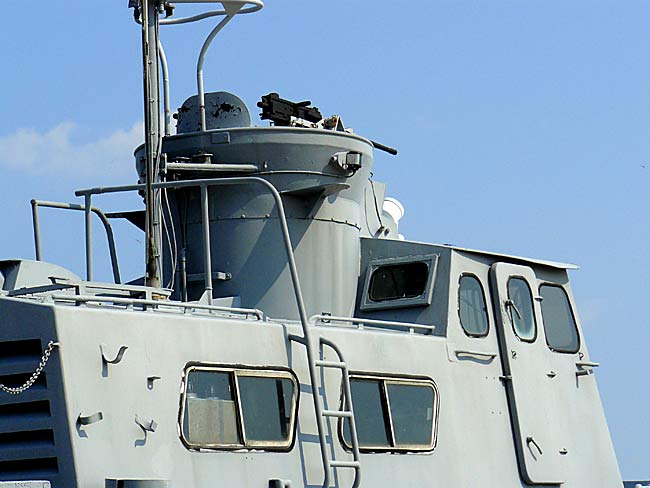
We Need the Ship to Accomplish the Mission, the Gunner Protects the Ship, So We Need to Protect the Gunner

Crew Served Weapons protection by Kinetic Protection LLC on USN CV.

I have been talking about the need to protect the gunners for our crew served gun mounts since 2013. We revised the topic in 2016, in 2019, and in 2021.

With the current Conflict in the Mid-East, there is perhaps more reason than ever to take another look.

I am particularly concerned about the need to protect gunners at crews served weapon stations (normally .50 caliber machine guns) on the PATFORSWA cutters, against the kinds of 12.7mm and 14.5mm machine guns commonly mounted on the Islamic Revolutionary Guard Corps Navy’s thousands of inshore attack craft. To me the powerful 14.5x114mm round might be regarded as the pacing threat and probably the largest weapon we could provide protection against (MIL-STD-3038 Type XI class B armor).

I would really like to see the crew served weapons replaced by remote weapons stations, but if we are not going to do that, we at least need to protect the gunners.
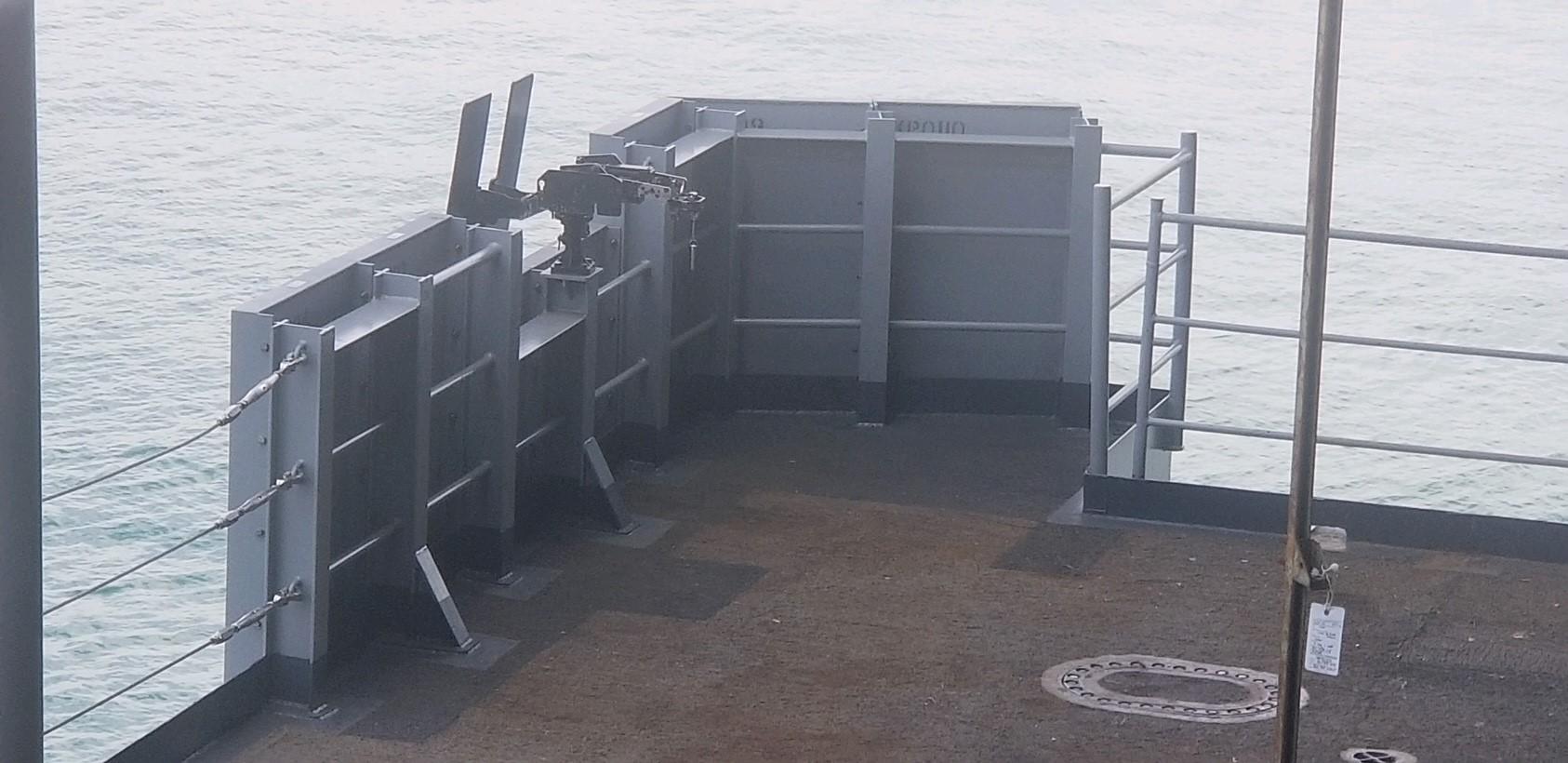
Crew Served Weapons protection by Kinetic Protection LLC on USN aircraft carrier. Similar protection, with modifications for intended arc of fire for the after .50 caliber gun mounts on the PATFORSWA FRCs which are mounted on the aft corners of O-1 Deck seems appropriate. This mount, on a carrier is relatively low, to allow the gunner to depress the gun, raising the inboard end of the gun, and still aim at targets close aboard to engage targets at very close range. Mounts on cutter might be higher to permit a smaller cutout since the gun would not have to be depressed at as great an angle.

I had an opportunity to talk to the CEO and representatives of Kinetic Protection, LLC who provide the only currently Navy recognized ballistic shielding for crew served weapons that meet DOD requirements (MIL STD 3038 and MIL PRF 32379).
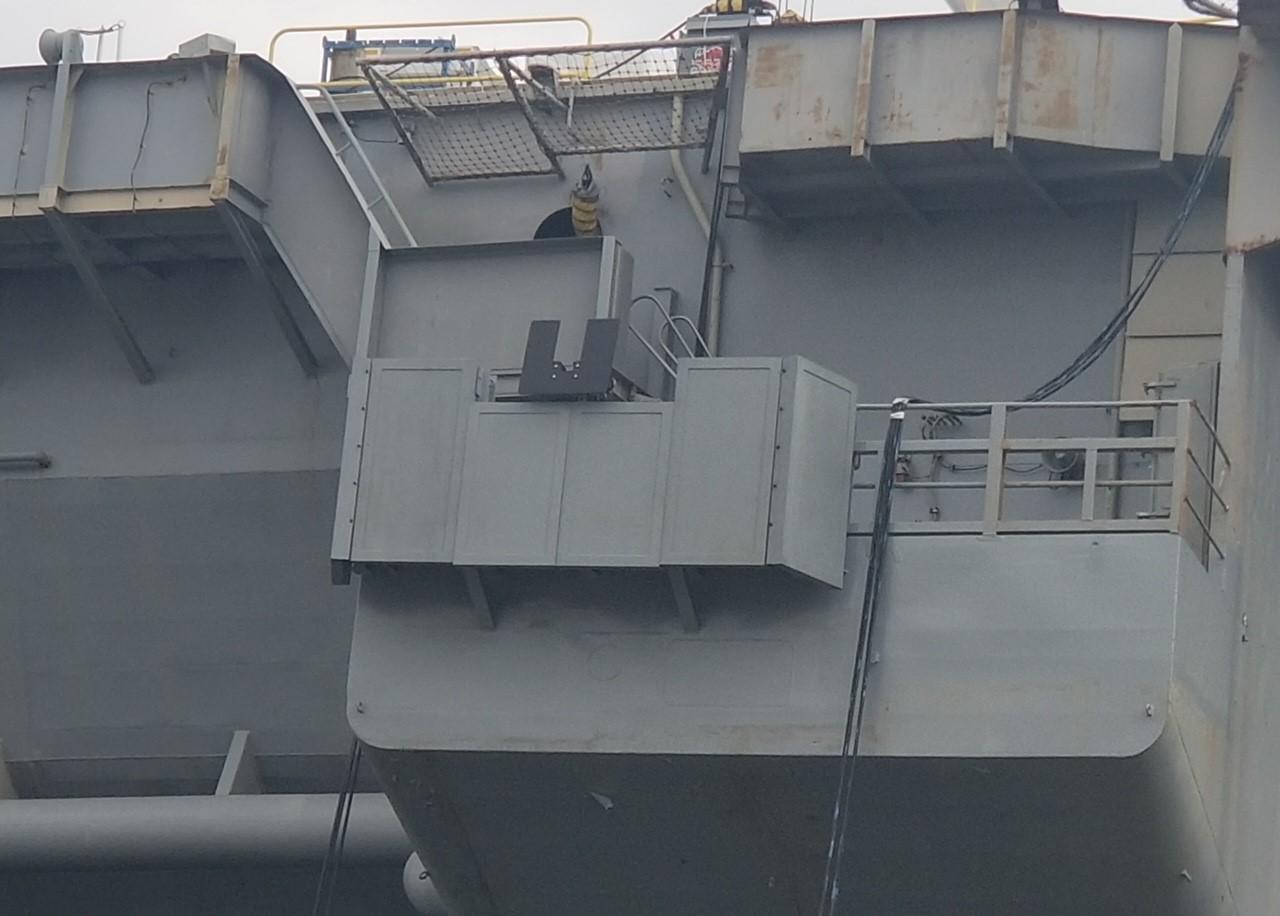
Crew Served Weapons protection by Kinetic Protection LLC on USN aircraft carrier.

I was surprised to learn that their product is metallic rather than a composite. I was told this was because composite armor was found to deteriorate due to environmental exposure while the metallic plates have a 25 year life.

Their armor is customizable by ship class and can be bolt-on or permanently installed. It can be various lengths but currently they have been making sections 30 inches wide and 30, 35 and 60 inches long.

The armor weighs about 20 pounds per square foot so it looks like we could provide 12.5 to 14.6 sq. feet of protection (two panels 30×30 or 30×35 inches) for each of the four crew served weapons positions for a total of about 1200 pounds of additional weight. This should not be a problem, considering how many people are frequently crammed on these small ships when they are used to repatriate aliens.

While considering how to help these ships survive in conflict, there are other things we can do to make the weapons more effective, like stabilizing systems and better sights.

The USCGC Oliver Henry (WPC 1140) in Manus, Papua New Guinea, Aug. 14, 2022 (U.S. Coast Guard photo by SW3 Victor Villanueva, NMCB-FOUR). Enlarging this photo by touching on it provides a view of both the forward and after crew served mounts located on the O-1 deck and the probable location of armor to protect the gunners. It is not clear if the current aft positions would allow the weapons to point directly astern, but every effort should be made to provide maximum arcs of fire. Pipe guards could be installed to prevent guns being depressed far enough to fire into the ship or personnel on the main deck.

This kind of protection used to be common. I have included some examples below.

A 20mm gun tub. The steps allowed the gunner, strapped to the gun, to point the weapon from the horizon to near vertical.

Ballistic Protection for .50 Caliber Gun Crews

The video above is titled as a Mk38 Mod3 Live Fire, but I would like to point out the ballistic protection that is provided the .50 cal. gun crew. The .50 gun shoot starts at time 1:10 and you get a good view of the ballistic protection beginning at time 1:37.

Yes, this is a pet peeve of mine. I have posted about ballistic protection before, here, here, here. and here.

As yet I have seen no ballistic protection for Coast Guard gun crews other than small shields attached to the mounts that provide no protection for the lower body and only very limited coverage for the gun crew (as in the photo below). Clearly suitable protection is available.

Having a gun crew standing out on deck using deadly force without providing easily available protection is not just dangerous to the gun crew, in some cases it may endanger the mission, if the gun crew is disabled.

Air-cooled 0.50″ (12.7 mm) Browning Machine Gun. Picture taken aboard USS Fife DD-991 on 4 July 2002. US Navy Photograph No. 020704-N-0156B-002.

RE: 25mm Mk38 Mod3, I see there was a contract issued recently for more of these systems, for the USN and the Philippines, so DOD certainly has not moved on to a 30mm Mk38 Mod4 yet. (Late addition, see my comment below.)

Below is the written material that accompanied the video.

CARAT Indonesia 2018: GUNEX (B-Roll)

B-Roll of a live-fire exercise conducted with the Indonesian Navy during Cooperation And Readiness Afloat Training (CARAT) 2018. CARAT Indonesia, in its 24th iteration, is designed to enhance information sharing and coordination, build mutual warfighting capability and support long-term regional cooperation enabling both partner armed forces to operate effectively together as a unified maritime force.

INDONESIA, 08.13.2018, Video by Senior Airman Dhruv Gopinath ••♦♦

The Mk 38 MGS is a low cost, stabilized self-defense weapon system that dramatically improves ships’ self-defense capabilities in all weather conditions, day or night. Installed aboard 14 different classes of U.S. Navy ships and U.S. Coast Guard cutters, it is used extensively by the U.S. military as well as by NATO forces.

A major upgrade to the Mod 3 is the system’s advanced electro-optical/infrared (EO/IR) sensor which provides 330-degree surveillance capability and three fields of view. The superior optics allow sailors to monitor the seas and respond to threats even in extremely low light conditions with the benefits of a low contrast, low light level color day camera and an eye-safe laser range finder.

While the EO/IR sensor system is integrated with the Mod 3’s state-of-the-art fire control system, the Mk 38 Mod 3 is unique from other naval weapons because its surveillance system moves separately from the gun system, preventing adversaries from easily knowing they have been detected.

The Mk 38 Mod 3 also provides a range of 2.5 kilometers and selectable rates of fire from single to 180 rounds per minute, and fires all U.S. Navy-approved 25mm ammunition. It can be remotely operated from the combat information center or other protected ship structures, allowing operators to remain safe and out of harm’s way.

“Republic Of Singapore Navy Stands Up New Maritime Security And Response Flotilla” –Naval News

Note the graphic may be distorted here, click on it for a better view. 

Naval News reports that the Singapore Navy has formed a new “Maritime Security and Response Flotilla.”

“As part of the restructured Maritime Security Command, the new MRSF is set up to better trackle evolving maritime threats that have grown in scale and complexity, particularly in the Singapore strait area. According to a recent French Navy report on worldwide maritime piracy and robbery, robbery is on the rise in South East Asia, particularly in the Straits of Singapore and Malacca.”

Aside from a pair of tugs, the primary assets of the new flotilla are four renovated and renamed Fearless Class patrol craft that will fill the function until a new class is completed (expected in 2026).

Perhaps most interesting, are the changes made to the vessels for their new role. These include enhanced communications equipment, a long range acoustic device and laser dazzler system, installation of a fender system, and modular ballistics protection–and a red racing stripe.

The Fearless Class patrol craft: Twelve vessels commissioned 1996-98. All out of service by the end of 2020, replaced by eight Littoral Missions Ships.

  • Displacement: 500 tons fl
  • Length: 55 m (180 ft)
  • Beam: 8.6 m (28.2 ft)
  • Draft: 2.2 m (7.2 ft)
  • Speed: 36 knots
  • Propulsion: 16,860 HP, two KaMeWa waterjets
  • Range 1,800@15 knots

Singapore also has a Police Coast Guard as part of its Police Force with patrol craft of up to 35 meters in length.

Protecting the Gunner, Protects the Ship, Protects the Mission

190703-N-LN093-1104
COLONIA, Yap (July 3, 2019) Mark VI patrol boats, assigned to Coastal Riverine Squadron (CRS) 2, Coastal Riverine Group 1, Det. Guam, arrive to Colonia, Yap. CRG 1, Det. Guam’s visit to Yap, and engagement with the People of Federated States of Micronesia underscores the U.S. Navy’s commitment to partners in the region. The Mark VI patrol boat is an integral part of the expeditionary forces support to 7th Fleet, capability of supporting myriad of missions throughout the Indo-Pacific. (U.S. Navy photo by Mass Communication Specialist 2nd Class Jasen Moreno-Garcia/Released)

OK, This is a pet peeve of mine, but to me, not providing ballistic protection to the crews of deck mounted .50 calibers, that we make a target by putting them on exposed crew served mounts, is irresponsible and frankly, lazy and unconscionable. It is just not that hard.

We have talked about this before, here, and here.

If you look at the photo above, you will see simple flat plates outboard of the .50 caliber mounts. Now look at the photo below (you might need to click on the photo to enlarge it). There is no comparable protection. This does not have to be heavy if you think that might be a problem. Kevlar reinforced plastic can provide protection against machinegun fire.

The Coast Guard Cutter Lawrence Lawson crew mans the rail during sea trials off the coast of Miami, Florida, on Dec. 12, 2016.  (U.S. Coast Guard photo by Eric D. Woodall)

There is talk of escorting merchant ships through the Straits of Hormuz. I don’t know if our WPBs there have any form of ballistic protection, but the pictures I have seen in the past showed no such protection.

This is about more than simply protecting the gunner. The gunner protects the ship; the ship is needed for the mission. Take out the gunner, the ship is vulnerable. If the ship is vulnerable, it may not be able to complete the mission.


New Light Weight Armor–Army Times

The spheres inside the composite metal foam absorb the energy of a bullet. (North Carolina State University)

Army Times has a story about a new form of armor that might be use to provided repeated protection against small arms and fragments.

A 7.62mm rifle round will go through 3 inches of steel, so a catcher material is put behind the steel, he said. (This is probably incorrect. Probably should have been 0.3 inches–Chuck)

“When the bullet hits the ceramic, it stops and absorbs the energy,” Portanova said. “The problem is you can only shoot it once because then it’s cracked.”

Composite metal foam, however, has a bunch of hollow spheres inside. When struck with a bullet, the spheres are crushed, similar to bubble wrap.

Because of its resilience, you can hit it numerous times,  Portanova said.

Researchers at the directorate have helped make the material lighter and also stop bigger threats.

“It would only be slightly more expensive and will weight half or one-third of what they’re hanging on the side of a Humvee.”