“UNITAS LXIV to begin in Colombia” –USNAVSOUTH/4TH FLEET PUBLIC AFFAIRS

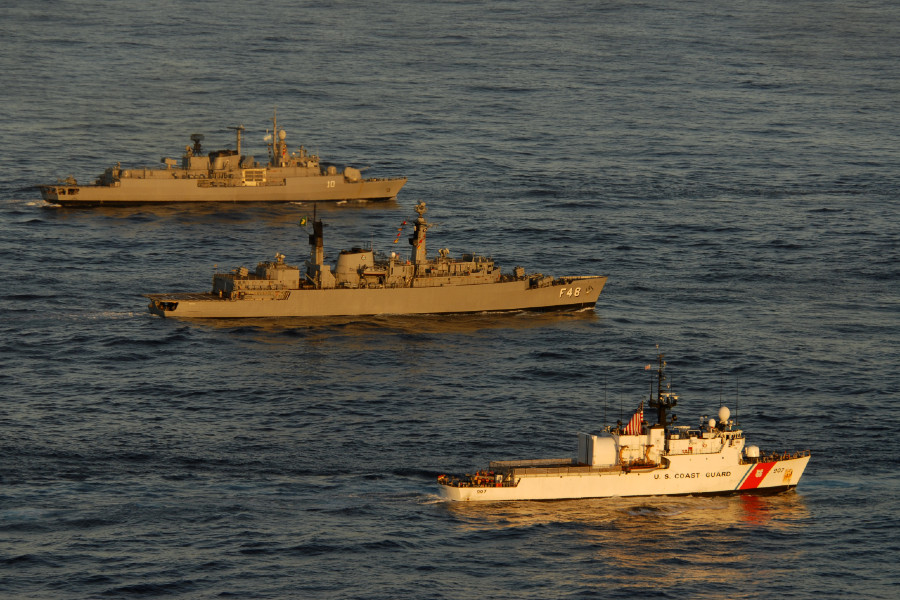
The US Coast Guard cutter USCGC Escanaba (WMEC 907), Brazlian Navy ship BNS Bosisio (F 48) and Argentinian navy ship ARA Almirante Brown (D-10) move into formation for a photo exercise during the Atlantic phase of UNITAS 52 on May 4, 2011. The formation included a total of ten ships from the US, Brazil, Mexico and Argentina. (Photo: US Navy/Mass Communication Specialist 1st Class Steve Smith)

Below is a news release announcing the start of exercise UNITAS LXIV (64 if you are not up on your Roman numerals). There is no mention of Coast Guard participation, but maybe they “simply forgot us.” Think we can bet there are some Coasties involved.

Britain’s Royal Navy also sent one of their highly regarded destroyers, HMS Dauntless.

With 26 surface vessels and three submarines participating, I think this is larger than most of the recent UNITAS exercises. In 2022 it was 19 ships, one submarine, 21 aircraft, accounting for approximately 5,500 total military personnel.

This year will see an attempt at large scale integration of unmanned systems into the exercise by 4th Fleet.


July 11, 2023

UNITAS LXIV to begin in Colombia

By USNAVSOUTH/4TH FLEET PUBLIC AFFAIRS

– U.S. Navy and Marine forces are set to arrive in Cartagena in support of UNITAS LXIV, the world’s longest-running multinational maritime exercise in the world, scheduled to start July 11, 2023.

The Colombian navy will host this year’s UNITAS, which will feature 26 warships/vessels, three submarines, 25 aircraft (fixed wing/helicopter), and approximately 7,000 people from 20 partner nations. Forces will conduct training operations off the coast of Cartagena, Colombia, and ashore in Covenas and Barranquilla, Colombia, through July 21. This year marks the 64th iteration of the exercise. Additionally, this year Colombia will celebrate the bicentennial of its navy, a historical milestone commemorating 200 years of the country’s maritime forces.

“UNITAS is so much more than a two week exercise. All participating nations have given much time, energy and effort into the months of planning leading up to what will be one of the most complex UNITAS to date,” said Rear Admiral Jim Aiken, commander U.S. Naval Forces Southern Command/U.S. 4th Fleet. “Utilizing air, surface, sub-surface, and unmanned assets, and land units, UNITAS will provide the multinational force a challenging environment in which to conduct training across the full spectrum of maritime operations. UNITAS strengthens maritime partnerships, enhances proficiency and improves interoperability of the participating forces, which is why so many partner nations are taking part this year.”

As part of the U.S. Navy’s future hybrid fleet, the Chief of Naval Operations has tasked U.S. 4th Fleet to scale unmanned platforms to the fleet level. An addition to this year’s UNITAS will include the integrated operations of unmanned air, surface, and subsurface systems into the exercise. UNITAS’ challenging training address key aspects of multinational and combined operations such as technology standardization and common operating procedures.

“This is our first opportunity to integrate unmanned systems into our operations at sea,” said Rear Adm. Aiken. “UNITAS has often served as a test bed for technology, so it is appropriate that we begin our unmanned integration campaign to operationalize the hybrid fleet here in UNITAS.”

In addition to the United States, UNITAS LXIV will bring together 19 nations from all over the world to train forces in joint maritime operations that enhance tactical proficiency and increase interoperability. Participating nations include Belize, Brazil, Canada, Chile, Colombia, Dominican Republic, Ecuador, France, Germany, Honduras, Jamaica, Mexico, Panama, Peru, Paraguay, Spain, South Korea, United Kingdom, United States, and Uruguay.

Following the UNITAS LXIV Opening Ceremony on July 12, the in port phase of the exercise will feature subject matter expert exchanges, professional symposia, ship rider exchanges, and operations meetings. During this time, Marines and Sailors will conduct expeditionary training events in Covenas to include riverine operations and diving and salvage operations.

During the UNITAS LXIV Underway Phase, forces will participate in events testing all warfare operations, to include live-fire exercises such as a SINKEX and an amphibious ship-to-shore landing and force retraction.

“Marines and Sailors from across the United States will travel to Colombia to not only train alongside our partner nations’ militaries, but to hone the skills required to operate as part of a larger maritime force focused on sea control and sea denial,” said Lt. Gen. David G. Bellon, commander, U.S. Marine Corps Forces, South, and U.S. Marine Corps Forces, Reserve. “We will be exercising command and control from a forward position as Marines set up and employ Expeditionary Advanced Base Operations to enhance naval capabilities as part of UNITAS.”

U.S. forces participating in UNITAS LXIV include USS New York (LPD 21), USS Cole (DDG 67), USS Little Rock (LCS 9), USS Pasadena (SSN 752), and USNS Burlington (T-EPF 10). Other U.S. participants include Patrol Squadron Five (VP 5), Mobile Diving and Salvage Unit (MDSU) 2, Explosive Ordnance Disposal Mobile Unit (EOD) 612, Mine Countermeasures Group 3, (MCMGRU 3), Expeditionary Mine Countermeasures EOD Company 61 (EODMU 61), East-coast based Naval Special Warfare units, Helicopter Sea Combat Squadron 22 (HSC 22), Helicopter Maritime Strike Squadron 70 Detachment 2 (HSM 70 Det 2), Joint Communications Support Element (JCSE), Fleet Surgical Team (FST) Eight, and the Meteorological Environmental Team (MET). U.S. Marine forces include 3rd Battalion, 23rd Marine Regiment (3/23), 4th Amphibious Assault Battalion (4th AABn), 8th Combat Logistic Battalion (CLB 8), 4th Combat Engineer Battalion (4th CEB), Marine Medium Tiltrotor Squadron 774 (VMM 774), Marine Light Helicopter Attack Squadron 775 (HMLA 775), Marine Aerial Refueler Transport Squadron 234 (VMGR-234), Marine Aircraft Control Group – 48 (MACG-48), and Marine Fighter Attack Squadron 112 (VMFA-112). Finally, Commander, Destroyer Squadron 40, (COMDESRON 40), Commander, Amphibious Squadron Four (COMPHIBRON FOUR), U.S Marine Corps Forces South (MARFORSOUTH), Special Operations Command South (SOCSOUTH), USNAVSOUTH/FOURTHFLT, and U.S. Southern Command (USSOUTHCOM) are participating in UNITAS LXIV.

UNITAS, which is Latin for unity, united, or oneness, was conceived in 1959 during a previous era of strategic competition when representatives at the first Inter-American Naval Conference in Panama agreed to conduct an annual maritime exercise with one another. Prior to UNITAS I in 1960, U.S. Chief of Naval Operations Adm. Arleigh Burke reviewed preparations for the multinational exercise. He commended planners for their progress, especially in building compatible communication systems among navies, and predicted that UNITAS would build strong relationships among Sailors of the Western Hemisphere.

U.S. Naval Forces Southern Command/U.S. 4th Fleet supports U.S. Southern Command’s joint and combined military operations by employing maritime forces in cooperative maritime security operations to maintain access, enhance interoperability, and build enduring partnerships in order to enhance regional security and promote peace, stability and prosperity in the Caribbean, Central and South American region.

U.S. Marine Corps Forces, South is the Marine Corps component to U.S. Southern Command, is responsible for planning exercises, operations, and overall Marine Corps support for the SOUTHCOM assigned area of responsibility.
“SouthCom Needs an Oiler” –USNI

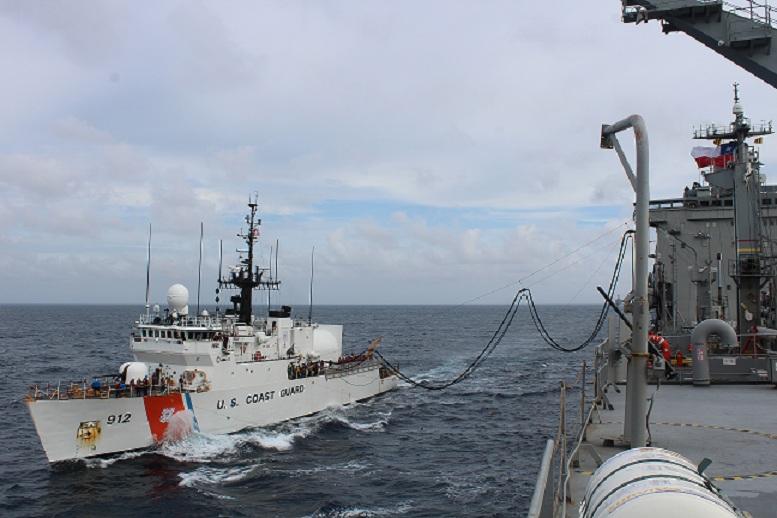
USCGC Legare WMEC-912 refueling from Chilean Navy Oiler Almirante Montt

The October issue of US Naval Institute Proceedings has an article advocating regular assignment of a Navy Underway Replenishment (UNREP) vessel to support drug interdiction operations in the Eastern Pacific. The authors are serving Coast Guard officers,

  • Captain Michael Cilenti, U.S. Coast Guard, a career cutterman, a staff director at the White House Office of National Drug Control Policy, and 

I would say “Amen!”

The article notes this would allow interdiction operations to become less predictable and would reduce time spent in transit to and from station. This could improve and speed handling of detainees. The unrep ships might even conduct some drug enforcement operations themselves.

The authors make a very good point, about the need for more underway replenishment ships,

“Some may push back against additional oiler deployments to SouthCom, citing a lack of available assets. But replenishment at sea—referred to as the Navy’s secret weapon by Admiral Chester Nimitz during World War II—will no doubt be foundational to any future conflict. If the Navy has too few assets to meet steady-state peacetime operations, how would it be able to support even short-term sustained combat operations in the far-flung corners of the globe?”

The title calls for an oiler (T-AO), but the article also mentions ” a T-AKE or allied oiler.” One of the Lewis and Clark class T-AKE dry cargo ships is actually a good option because, even though they carry only “limited quantities of fuel,” their 23,450 barrel capacity is enough to refuel a Bertholf class National Security Cutter more than four time from absolutely empty and they can simultaneously provide virtually every other type of stores that might be required.

Another way to achieve the same objective might be for the US Navy to transfer one or two Henry J. Kaiser class oilers to Colombia as they are replace by newer ships and work cooperatively with them.

I would note that, this would not only help Coast Guard cutters, it would also help Navy ships doing drug interdiction missions, which are typically Freedom class Littoral Combat Ships. They have far less range than the large cutter do. Allied vessels doing drug enforcement in the Eastern Pacific might also benefit.

An underway replenishment ship might also make use of Webber class cutters (FRCs) for drug interdiction more efficient, mitigating their limited endurance. While I would expect methods for replenishment directly from the underway replenishment ship would be developed, their availability would also encourage use of larger cutter to refuel and resupply the patrol craft. The underway replenishment ship might also provide aviation support for the FRCs that have no organic air support.

NSC#9, USCGC Stone, Completes First Patrol Since Commissioning, Spends Time with Colombian Friend

Below is a news release from Atlantic Area reporting USCGC Stone’s return from a patrol in the Eastern Pacific. It seems to have been a successful but fairly routine EastPac with a couple of items of note. In addition to drug interdiction, this patrol put some emphasis on Illegal, Unregulated, Unreported (IUU) fishing.

While this was Stone’s first operational mission since commissioning, she had already completed an unusual South Atlantic mission before commissioning.

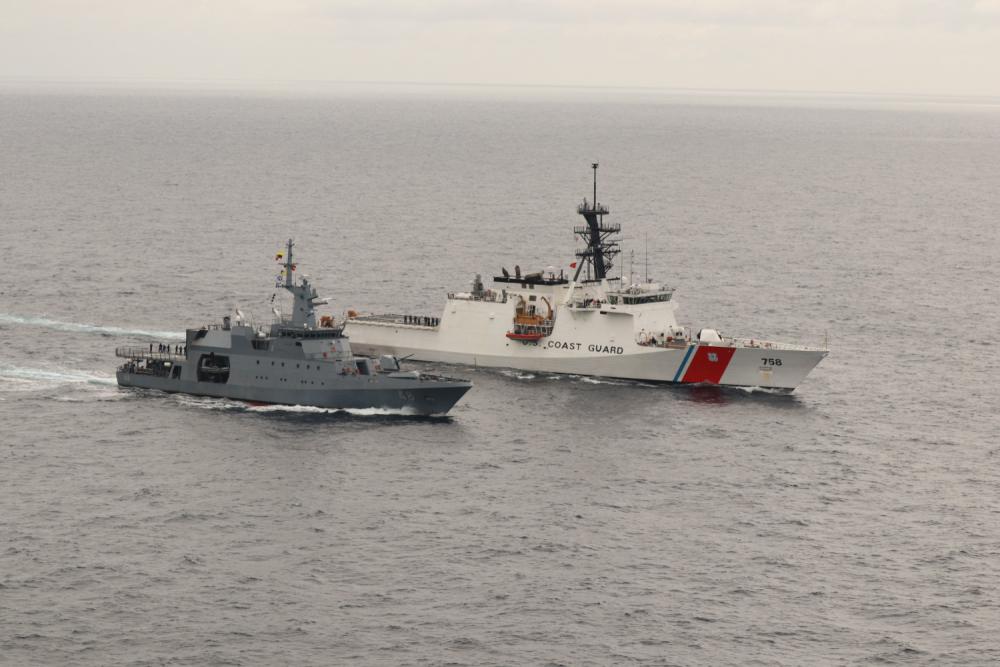
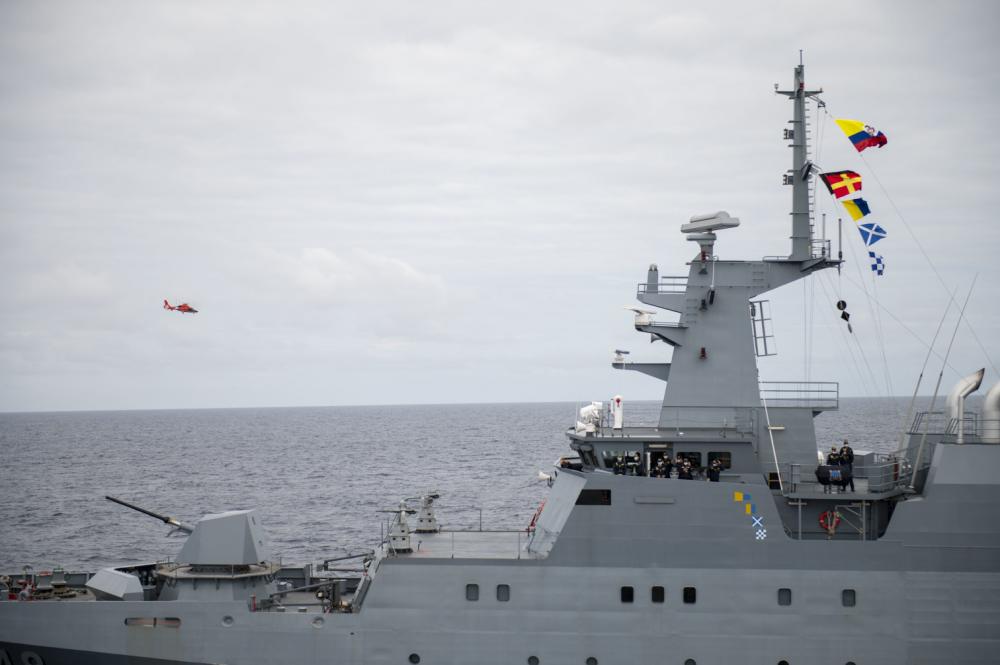
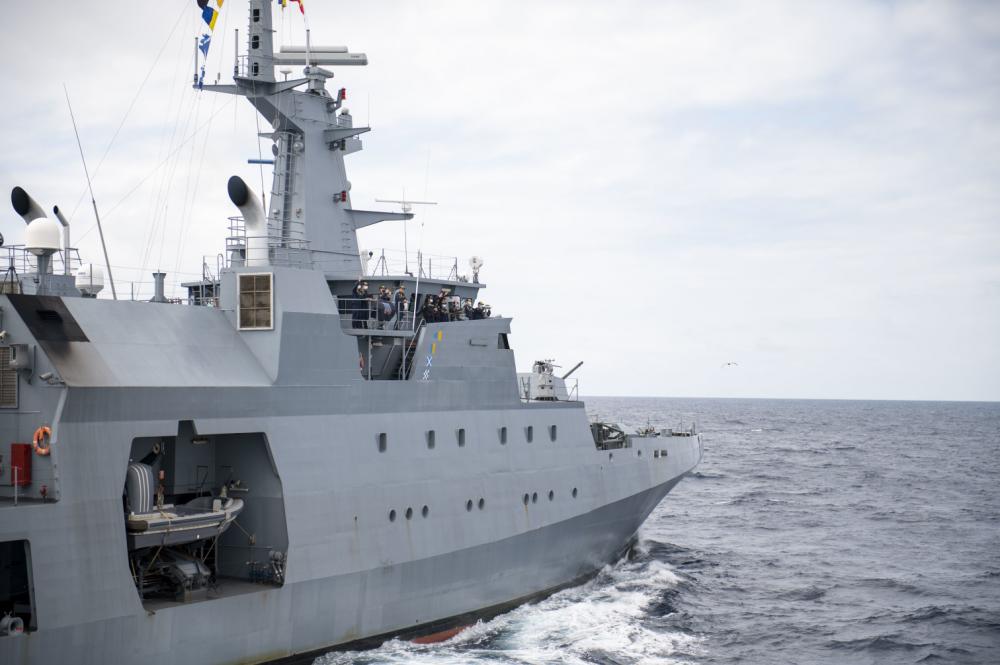
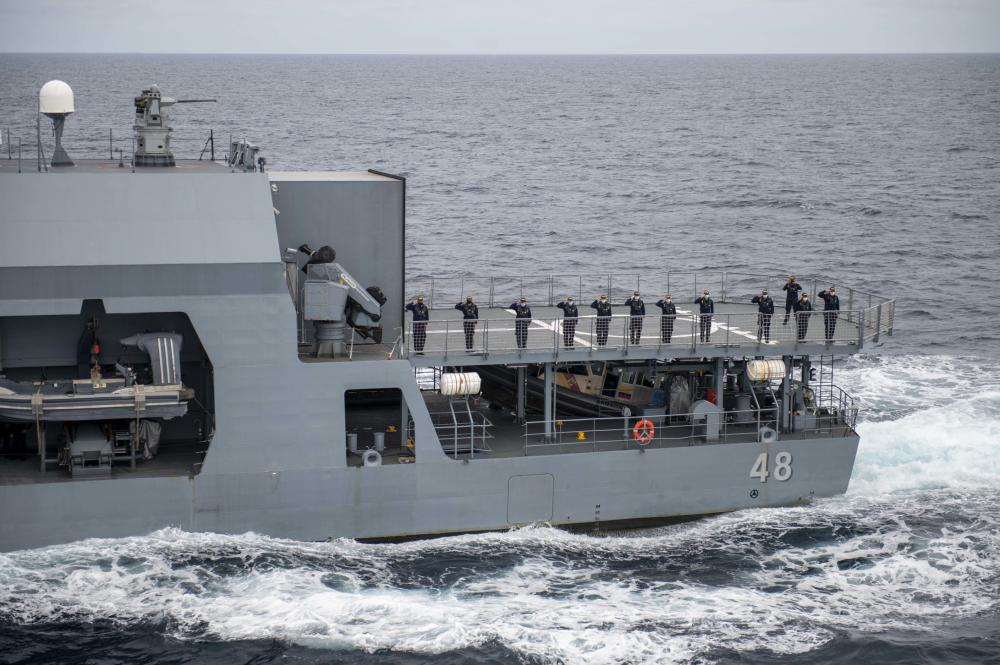
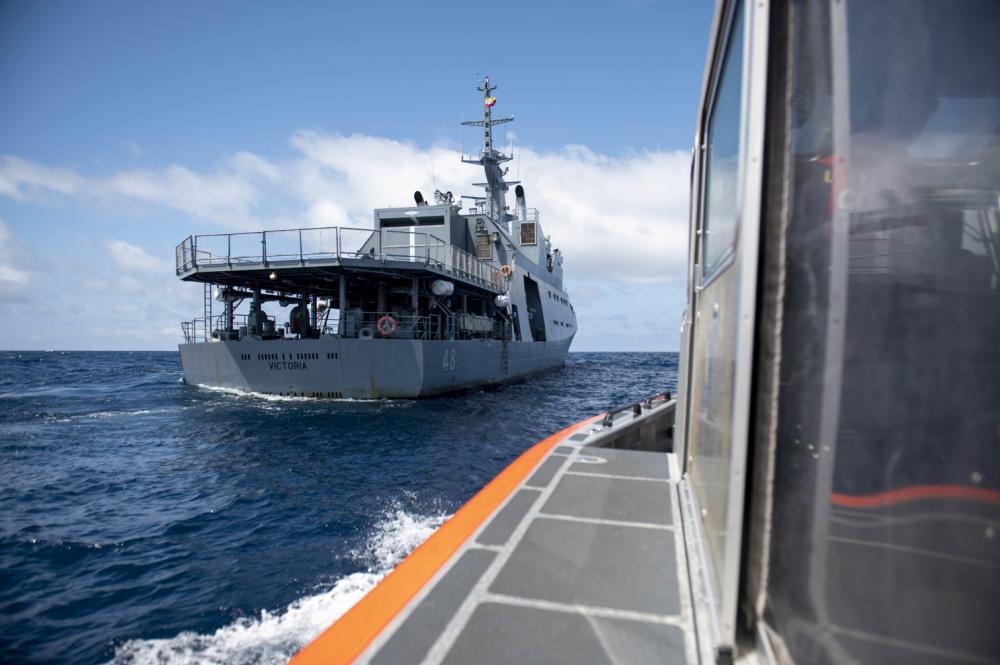
I also wanted to make sure you did not miss the photos of Colombia’s 80 meter Fassmer OPV that operated with Stone. (Some of the photos were found here.) The Fassmer OPV is also operated by Chile and a slightly longer (86 meter) version is operated by Germany. 

As can be seen, this 80.6 meter (264.4′) vesselp ca n operate and hangar a helicopter and has provision for three boats including one on a stern ramp. This one is armed with a medium caliber gun (76mm), what appears to up to 22 knots and have a range of 8,600 nautical miles (15,900 km). These are about the size of Bear class WMECs, and except for EW, equipment and capabilities sound similar to the Offshore Patrol Cutter (OPC). The Fassmer design, is probably not as capable of continuing to operate boats and helicopter in as severe weather and probably does not have as large a hangar. Also, the flight deck does not look as large, but the Colombian ship does include a stern boat ramp not included in the OPC.

Some of the Chilean ships of this class are ice-strengthened.

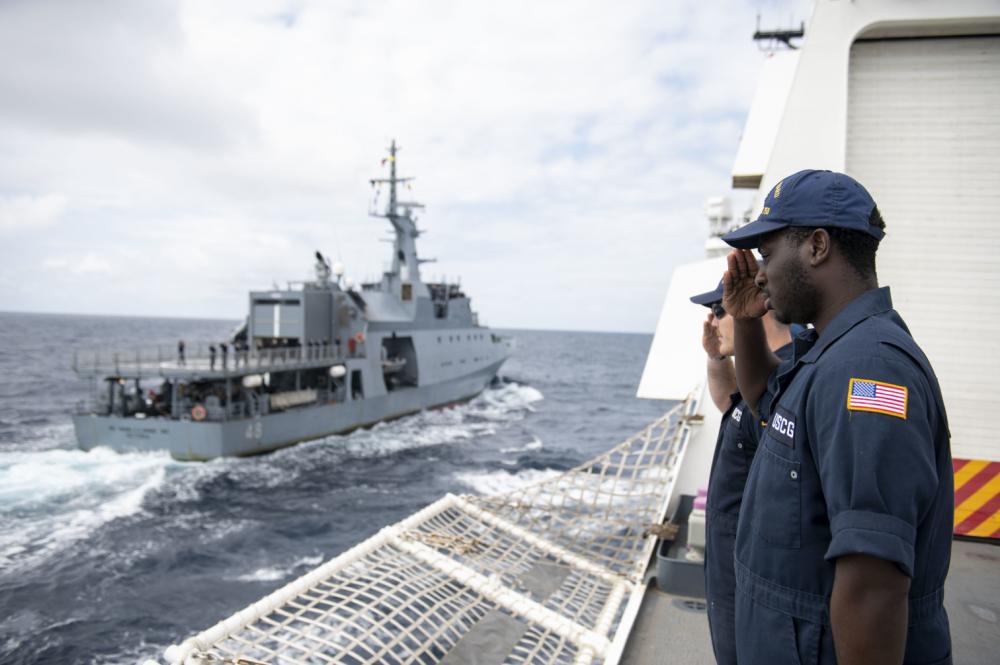
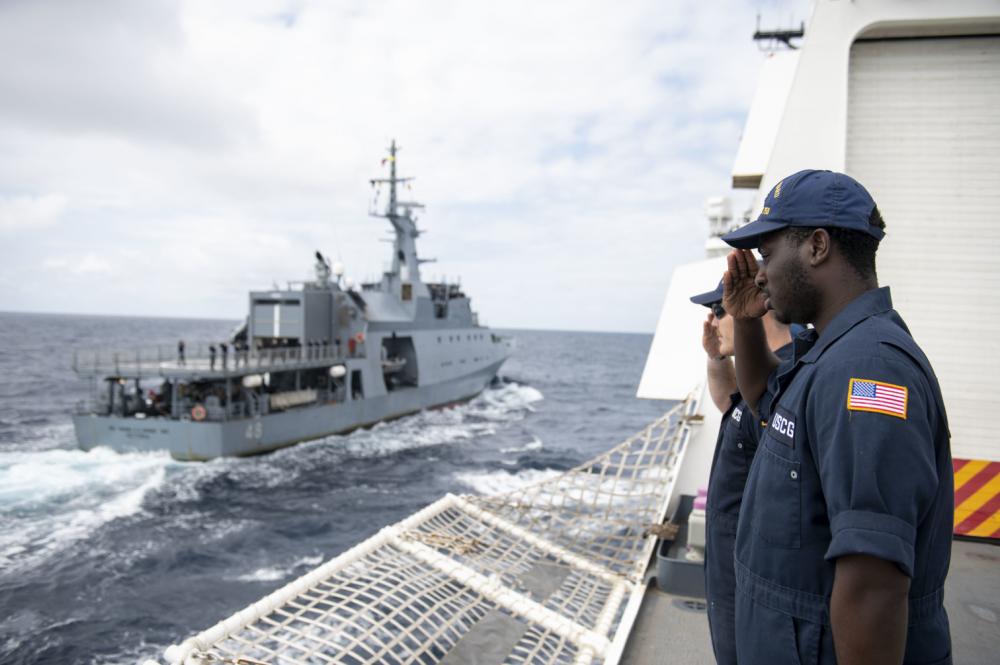
The crews of U.S. Coast Guard Legend-class national security cutter USCGC Stone (WMSL 758) and the Colombian navy OPV-80 offshore patrol vessel ARC Victoria (PZE-48) conduct passing exercises in the Eastern Pacific Ocean, Dec. 4, 2021. The U.S. and Columbia have signed agreements on trade, environmental protection, asset sharing, chemical control, ship-boardings, renewable and clean energy, science and technology, and civil aviation. (U.S. Coast Guard photo by Petty Officer 2nd Class Shannon Kearney)

U.S. Coast Guard, Colombian navy conduct exercises, personnel transfers in Eastern Pacific Ocean

U.S. Coast Guard, Colombian navy conduct exercises, personnel transfers in Eastern Pacific Ocean

U.S. Coast Guard, Colombian navy conduct exercises, personnel transfers in Eastern Pacific Ocean

U.S. Coast Guard, Colombian navy conduct exercises, personnel transfers in Eastern Pacific Ocean

U.S. Coast Guard, Colombian navy conduct exercises, personnel transfers in Eastern Pacific Ocean

U.S. Coast Guard, Colombian navy conduct exercises, personnel transfers in Eastern Pacific Ocean

News Release

U.S. Coast Guard Atlantic Area

USCGC Stone returns to homeport after 61-day patrol working with partners

USCGC Stone partners with US, Panamanian, Costa Rican representatives, fishery experts to conduct Illegal, Unreported, Unregulated fishing patrols U.S. Coast Guard, National Oceanic and Atmospheric Administration attend International Illegal, Unreported, Unregulated Fishing Symposium in Ecuador USCGC Stone (WMSL 758) and the Colombian navy OPV-80 offshore patrol vessel ARC Victoria (PZE-48) 

Editors’ Note: To view more or download high-resolution imagery, click on the photos above.

NORTH CHARLESTON, S.C. — USCGC Stone (WMSL 758) returned to their homeport in Charleston following a 61-day patrol in the Caribbean Sea and Eastern Pacific Ocean in support of the U.S. Coast Guard Pacific Area, the U.S. Coast Guard’s Joint Interagency Task Force South, and the U.S. Coast Guard Eleventh District.

Stone’s crew successfully interdicted two suspected drug smuggling vessels, recovering approximately 2,246 pounds of cocaine and 4,870 pounds of marijuana with an estimated combined street value of $57.1 million. The cutter’s crew subsequently transferred 20 suspected narcotics smugglers to the Seventh Coast Guard District and U.S. Drug Enforcement Administration personnel, signaling the culmination of a successful joint interagency effort in the Eastern Pacific.

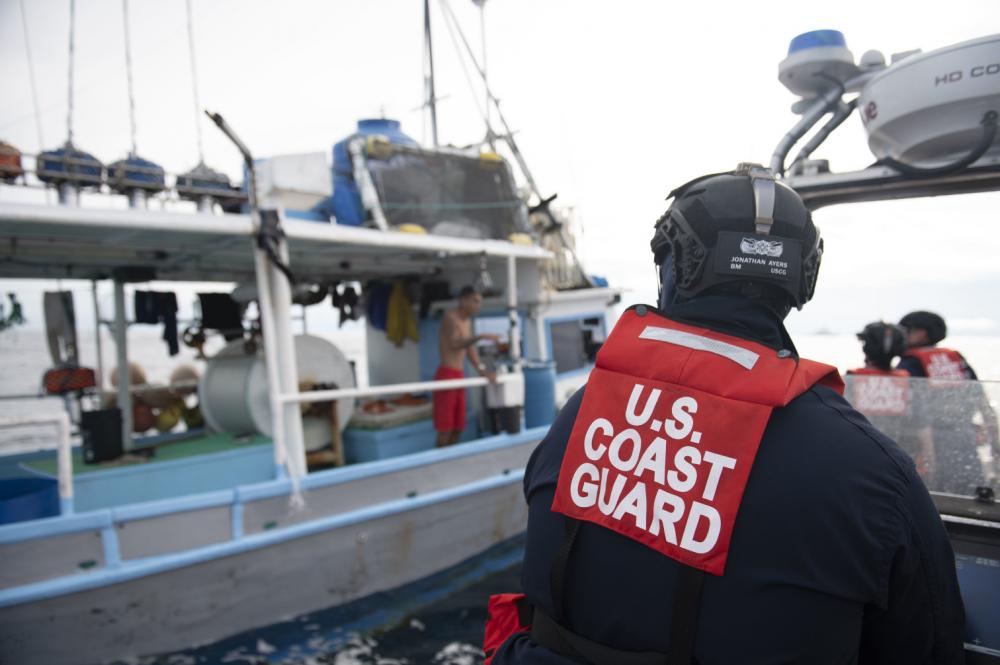
The Stone embarked observers from Panama, Costa Rica, Colombia, Ecuador, and the National Oceanic and Atmospheric Administration to perform joint operations to combat illegal, unreported, and unregulated fishing (IUUF) and conduct counter-drug operations off the coast of South America.

An embarked MH-65 helicopter aircrew from the U.S. Coast Guard’s Helicopter Interdiction Tactical Squadron was integral in counter-drug operations. Interagency partners provided additional aerial surveillance and reconnaissance support throughout the patrol.

During the cutter’s port call in Manta, Ecuador, Stone’s commanding officer, Capt. Clinton Carlson, attended an international IUUF symposium with Arthur Young, the embarked National Oceanic and Atmospheric Administration enforcement officer, to share experiences and increase awareness of the regional issue. The crew of the Stone also participated in a friendly soccer match with Cuerpo de Guardacostas de la Armada personnel from the local coast guard station while in Manta.

“This is our crew’s first patrol outside of their initial shakedown cruise, and I am extremely proud of the dedication and pride they have shown toward getting qualified to conduct the missions expected of a national security cutter crew,” said Carlson. “Throughout these past months, everyone aboard displayed enthusiasm during the drills we’ve run every week and have proven that through teamwork and a shared understanding of the mission, we can accomplish even the most difficult tasks. I am honored to lead this impressive crew of Coast Guard women and men.”

The fight against drug cartels in the Eastern Pacific Ocean and the Caribbean Sea requires unity of effort in all phases from detection, monitoring, and interdictions, to criminal prosecutions for these interdictions by United States Attorney’s Offices from the Middle District of Florida, the Southern District of Florida and the Southern District of California. The law enforcement phase of counter-smuggling operations in the Eastern Pacific Ocean is conducted under the authority of the Eleventh Coast Guard District, headquartered in Alameda. The interdictions, including the actual boardings, are led and conducted by U.S. Coast Guard members.

The Stone is the ninth Legend-class national security cutter in the Coast Guard fleet and currently homeports in Charleston, South Carolina. The national security cutters can execute the most challenging national security missions, including support to U.S. combatant commanders.

The Charleston-based Legend-class cutters fall under the command of the U.S. Coast Guard Atlantic Area. Based in Portsmouth, Virginia, U.S. Coast Guard Atlantic Area oversees all Coast Guard operations east of the Rocky Mountains to the Arabian Gulf. In addition to surge operations, they also allocate ships to work with partner commands and deploy to the Caribbean and Eastern Pacific to combat transnational organized crime and illicit maritime activity.