Looking Back on the Last 30 Years

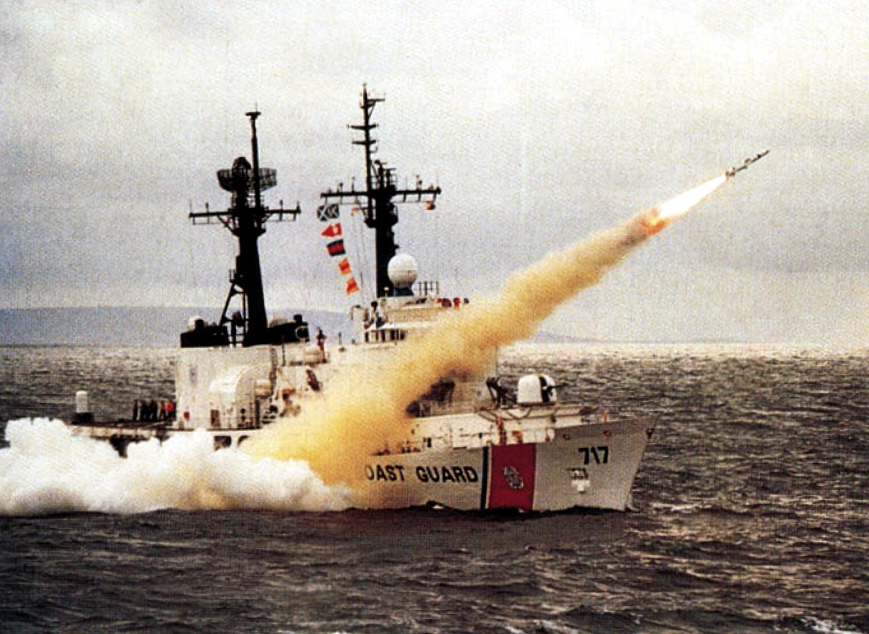
USCGC Mellon seen here launching a Harpoon anti-ship cruise missile in 1990.

The Coast Guard took full advantage of the “peace dividend” when the Soviet Union collapsed back in 1991 (the year I retired). All ASW equipment was removed. That was 30 years ago, so virtually every active duty Coast Guardsman has never been in the service when it had a defined war time mission.

The Chinese naval build up has changed the circumstance that made that shedding of capabilities logical.
The Navy decommissioned many ships. The Coast Guard retained its ships but no longer saw a need for Harpoon, sonar, torpedo tubes, etc.
For some reason they did retain Electronic Warfare capability and CIWS. I am not sure that makes sense unless there is a plan to reintroduce warfare capabilities.
The National Security Cutters are really to well equipped and more capable than their peacetime missions would require. Like the down graded post FRAM 378s, the NSCs have ESM/ECM, a first rate fire control system, helicopter support facilities that exceed our normal requirements, a  Phalanx CIWS, and a speed of over 25 knots. Those capabilities only make sense if additional upgrades are expected in time of war. We know that the NSCs were designed to accept 12 Mk56 VLS, but that alone does not make sense because that would only improve its defensive capabilities.
I sometime get the feeling we want our ships to look like warships, but we don’t really care if they are effective warships.
You don’t need to defend against cruise missile unless you are engaged in a warfare mission.
We do seem to have embraced Gray Zone missions, including Cyber. That is all to the good, but I still don’t see that we are actively engaged in “Defense Readiness,” which, to me means planning for how we can help in an existential conflict with a near peer adversary, specifically now China and/or Russia.
I also don’t see that we have fully embraced the counter-terrorism mission either, since we don’t have what it takes to deal with a terrorist attack on a US port using a medium to large size vessel. Our countermeasures are just too week. We are barely equipped to take on terrorist using personal watercraft.
Modular sensors and weapons and coordination with the Navy Reserve appear to offer a way to prepare at minimal day to day cost, but we don’t seem to be exploiting these options. Our reservist do deploy on military missions, but are we really prepared to reorder our mission priorities and assume a significant role in naval warfare? Do we have plans as to how we will upgrade our ships? How we will train operators of equipment we don’t currently have?
Shortly before I retired the US and its allies defeated the Soviet Union without going to war, because we were ready to fight. At that time we knew the Coast Guard’s missions would include escorting convoys to Europe. Since then we have had three decades without a significant naval challenge, but that has ended. It is time to embrace the fact that the Coast Guard is a military service at all times and find our place in the plans for any future struggle.

“SOVEREIGN IMMUNITY POLICY” and a Bad Example

1970 – editorial cartoon run during the Kudirka Incident. Credit New York Times

A recent ALCOAST restates the Sovereign Immunity Policy with regard to Coast Guard vessels and aircraft. This is particularly relevant for units operating in the Persian Gulf and South China Sea, but it applies everywhere.

Since we operate mostly in US waters or nearby high seas, application may seem unlikely to most, but this is not just academic. For a real world example that caused the Coast Guard great embarrassment, let’s not forget the Simonas “Simas” Kudirka incident.

united states coast guard

R 061626Z OCT 21
FM COMDT COGARD WASHINGTON DC
TO ALCOAST
BT
UNCLAS
ALCOAST 370/21
SSIC 3128
SUBJ: SOVEREIGN IMMUNITY POLICY
A. U.S. Navy Sovereign Immunity Policy, NAVADMIN 165/21
B. The United Nations Convention on the Law of the Sea
C. The Commanders Handbook on the Law of Naval Operations,
COMDTPUB P5800.7 (series)
D. United States Coast Guard Regulations 1992, COMDTINST M5000.3
(series)
E. Foreign Port Calls, COMDTINST 3128.1 (series)
1. This ALCOAST restates U.S. Coast Guard sovereign immunity
policy. The policies reflected in this document are based on
longstanding principles of international law. Accommodating
foreign State demands that undermine these policies not only erodes
protections in that particular situation but also risks establishing
precedent that may have long-term and wide-ranging negative effects.
Therefore, commanders, commanding officers, officers-in-charge, and
aircraft commanders must adhere to the policies outlined in this
message. This message echoes policies outlined in REF (A), U.S.
Navy’s sovereign immunity policy, given the sovereign immune status
shared by vessel and aircraft of both services.
2. Under customary international law, and consistent with REFs
(A)-(E), manned and unmanned vessels and aircraft owned or
operated by a State, and used, for the time being, only for
government non-commercial service, are entitled to sovereign
immunity. Accordingly, such vessels and aircraft, wherever located,
are immune from arrest, search, and inspection by foreign
authorities, including inspections by or under the supervision of a
competent authority of areas, baggage, containers, conveyances,
facilities, goods or postal parcels, and relevant data and
documentation thereof for most purposes. Moreover, such vessels and
aircraft are exempt from certain foreign taxes, duties, or fees, as
well as foreign regulations that require flying a foreign State’s
flag or setting a compulsory pilotage requirement. Customary
international law further grants to commanding officers, officers-
in-charge, aircraft commanders, and masters the right to protect the
identity of personnel, stores, weapons, and other property aboard a
sovereign immune vessel or aircraft, as well as exclusive control
over any person aboard a sovereign immune vessel or aircraft
concerning acts performed aboard.
3. Although immune from arrest by foreign authorities, U.S. Coast
Guard vessels and aircraft shall comply with host country
requirements regarding traffic control, health, customs, and
immigration, to the extent such requirements do not contravene U.S.
Coast Guard sovereign immunity policy. In many instances, this
message and its references dictate how the U.S. Coast Guard complies
with such requirements. Noncompliance with any such requirement may
be subject to diplomatic complaint or host country orders to leave
its internal waters, territorial sea, or national airspace, but does
not change this policy’s requirements. Because adhering to this
policy may result in a country’s refusal or expulsion of an aircraft
or vessel, commanders must work with their legal counsel and embassy
teams early to understand port and airfield requirements including
international agreements or other arrangements which may apply.
4. Asserting sovereign immunity is a privilege of the U.S.
Government. Thus, waiver is not within the discretion of a
officer, officer-in-charge, or aircraft commander. An officer
exercising Tactical Control (TACON) is delegated authority to
interpret sovereign immunity policy consistent with overarching U.S.
Government policies and shall be notified by lower echelons via the
chain-of-command regarding challenges to asserting sovereign
immunity that cannot be resolved in favor of the policies set forth
in this message. Where TACON can execute this policy without
conflict with this message, no waiver is required. However, except
as provided herein, any action that may constitute a waiver or
potential waiver of sovereign immunity must be coordinated with
COMDT (CG-5R) in advance.
5. It is U.S. Government policy to assert full sovereign immunity
for U.S. Coast Guard manned and unmanned vessels, including cutters
and small boats, and aircraft. In addition to the general
privileges and obligations discussed in paragraphs 2 and 3 of this
message, which apply in full, the following guidance also applies:
   a. Searches, Inspections, and Requests for Information.
Per REF (D), paragraphs 4-1-28, and 4-2-10, and REF (E), commanding
officers, officers-in-charge, and aircraft commanders must not
permit a vessel or aircraft under their command to be searched or
inspected on any pretense whatsoever by foreign authorities or
organizations, nor permit any person within their vessel or
aircraft’s confines to be removed by foreign authorities. U.S.
authorities may themselves conduct consent, command authorized, or
other lawful searches or inspections and preserve evidence without
foreign officials being present, but evidence seized must not be
turned over to foreign authorities absent specific direction by
higher authority. Commanding officers, officers-in-charge, and
aircraft commanders must not provide vessel or aircraft documents
or other vessel- or aircraft-specific information (excluding a
vessel’s public characteristics for purposes of appropriate pilotage
or berthing) to foreign authorities and organizations without the
approval of higher authority via the chain-of-command.
   b. Taxes and Fees. Payment of fines or taxes is prohibited
regardless of reasons offered for imposition. Appropriate charges
for pilots, tugboats, sewer, water, power and other required goods
or services may be paid.
     (1) Unless there is an international agreement to the
contrary, commanding officers, and officers-in-charge must refuse
to pay any tax or revenue-generating fee imposed on a U.S. Coast
Guard vessel or aircraft by a foreign sovereign. These taxes,
including port taxes, port tariffs, port tolls, port security
surcharges, port dockage fees, and other similar taxes or fees, are
impermissible. Commanding officers and officers-in-charge may pay
reasonable charges for goods and services requested and received,
less taxes and similar charges. If requested to pay an
impermissible tax or fee, commanding officers and officers-in-charge
should request an itemized list of all charges, pay reasonable
charges for goods and services requested and received, and explain
that under customary international law, sovereign immune vessels are
exempt from foreign taxes and fees.
     (2) If port authorities directly insist on payment of an
impermissible tax or fee, commanding officers and officers-in-charge
should seek assistance from higher authority and U.S. Embassy via
the chain-of-command. Whether the U.S. Coast Guard will directly
pay an impermissible tax or fee is a matter of overarching U.S.
Government policy. This decision may be based on other concerns
such as operational needs, contracting principles, and potential
fiscal liability.
     (3) If such taxes or fees are levied indirectly through a
Husbanding Service Provider (HSP) as part of a foreign fixed price
contract, such tax or fee may be paid as part of the contract price.
   c. Crew Lists
     (1) Commanding officers and officers-in-charge must not
provide a list of crew members (military and/or nonmilitary) or
passengers aboard a vessel to foreign officials under any
circumstances. In response to a crew list request, the host nation
should be informed that the United States exempts foreign sovereign
immune vessels visiting the United States from the requirement to
provide crew lists in accordance with (IAW) the same sovereign
immunity principles claimed by United States sovereign immune
vessels. When a host country maintains a demand for a crew members
list as a condition of entry into a port or to satisfy local
immigration officials upon arrival, seek guidance from higher
authority via the chain-of-command.
     (2) Absent an international agreement, a commanding officer
or officer-in-charge of a vessel may provide information about
personnel going ashore for a temporary time and for unofficial
purposes (e.g. liberty) to comply with a host country’s immigration
laws. However, if information is provided, it should include the
minimum amount of information required to comply with the host
country’s laws, and include no more than names (without rank), place
of birth, date of birth, and sex. A commanding officer should not
provide foreign officials with other sensitive or personal
information, such as social security numbers, rank, addresses, or
other specific information. Such liberty lists are not the same as
crew lists, even though they may contain the names of all
crewmembers.
   d. Quarantine and Health Information Requirements
     (1) Under REFs (D) and (E), commanding officers, officers-
in-charge, and aircraft commanders must comply with all domestic or
foreign State quarantine regulations for the port within which the
vessel is located that do not contravene this sovereign immunity
policy.
     (2) IAW REFs (C) and (D), while commanding officers,
officers-in-charge, and aircraft commanders must not permit
inspection of their vessel or aircraft, they must afford every
other assistance to health officials, U.S. or foreign, and must
give all information required, insofar as permitted by military
necessity and security requirements. To avoid restrictions imposed
by quarantine regulations, the commanding officer should request
free pratique (clearance granted a ship to proceed into a port after
compliance with health or quarantine regulations) IAW that port’s
sailing directions.
   e. Flying Foreign State Flags. While sovereign immune vessels
are exempt from foreign regulations that require flying a foreign
State flag, U.S. Coast Guard sovereign immune vessels may fly
State flags to render honors IAW REF (D). Regional practices to
display marks of respect for host nations vary, and commanding
officers and officers-in-charge must consult with the operational
chain-of-command, theater- and fleet-specific guidance, and local
embassies for further guidance if host nation officials raise the
issue.
   f. Environmental Mishaps in Foreign Waters. If, after an oil
or hazardous substance spill in foreign territorial or internal
waters, a commanding officer or officer-in-charge determines foreign
authorities need more information to properly respond to the spill
and prevent serious environmental damage, the commanding officer or
officer-in-charge may release information similar to that releasable
to U.S. authorities. Before releasing spill-related information to
foreign authorities, the commanding officer or officer-in-charge
must seek guidance from higher authority via the chain-of-command
and, if release is deemed appropriate, inform the foreign
authorities that the ship or vessel is a sovereign immune vessel of
the United States and that spill-related information is being
voluntarily provided to help minimize environmental damage.
   g. Compulsory Pilotage. Article 4-2-3 of REF (D) authorizes
commanding officers and officers-in-charge of vessels to employ
pilots when, in the commanding officer’s or officer-in-charge’s
judgement, such employment is necessary. Inherent in such
discretion is the authority to refuse use of a pilot or to disregard
such pilot’s advice regarding a vessel’s safe navigation.
Accordingly, U.S. vessels may, but are not required to, employ
pilots as prudent. Except as provided in article 4-2-4 of REF (D),
commanding officers may, but are not required to, allow a pilot
onboard. If a nation sets pilot employment as a condition for
entering port or transiting their waters contrary to REF (D),
commanding officers must inform foreign authorities that the ship
or vessel is a sovereign immune vessel of the United States and
that pilotage services are being accepted voluntarily and not as
a condition of entry.
6. Commanders, commanding officers, officers-in-charge, and
aircraft commanders must adhere to the policies outlined in this
message and seek guidance from higher authority via the chain of
command in the event of ambiguity or prior to taking any action
that might constitute a waiver of sovereign immunity.
7. POC: CDR J. R. Styron, COMDT (CG-LMI-R), phone (202) 372-3798,
or by global email.
8. RDML Scott R. Clendenin, Assistant Commandant for Response Policy
(CG-5R), sends.
9. Internet release is authorized.

“Taming Atalanta” –US Naval Institute, Naval History Magazine

Rum Runner Atalanta and Coast Guard Destroyer Ericsson (CG-5)

The US Naval Institute has a nice piece of Coast Guard history available from the latest Naval History magazine. It concerns a very fast, armored rum runner, and how it was ultimately brought to heal.

There is also a story in the same issue of Naval History about Alaska Patrol fisheries enforcement by USCGC Confidence in the 1970s, probably 1975-77. I had left Confidence in 1974.

USCGC Confidence (WMEC619) on Alaska Patrol. Photo by Commander Tom Martin, U.S. Coast Guard (Retired)

Two stories from the “Old Days.”

The Hamilton Class 378 foot WHECs, an Appreciation

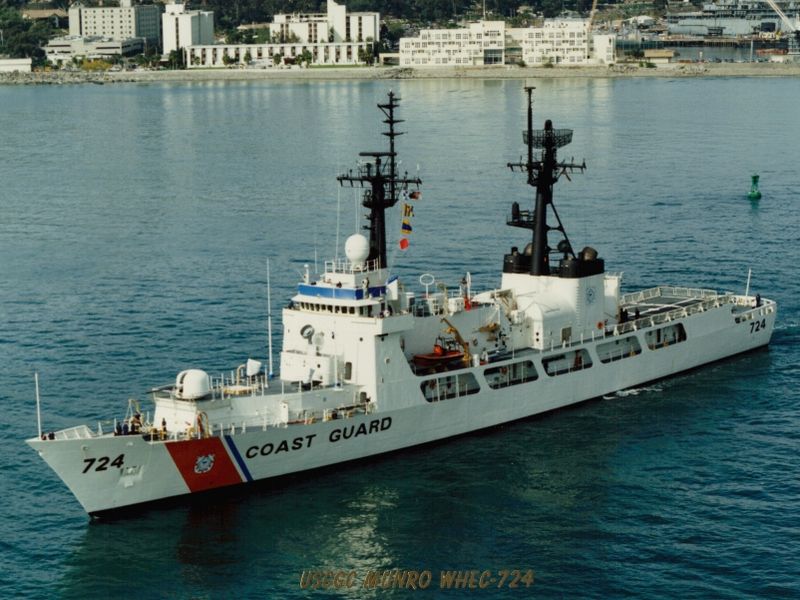
USCGC Douglas Munro (WHEC-724)

The Navy League’s magazine, Seapower, reports that the last of the US Coast Guard’s Hamilton class 378 foot WHECs, Douglas Munro, will be decommissioned at the end of the month.

The designers of these ships certainly made them aesthetically pleasing, and the preliminary design work was done in house by Coast Guard engineers.

The 378s were the crowning achievement of a recapitalization program begun in the late 1950s that resulted in the 82 foot Point class patrol boats, the 210 foot Reliance class WMECs, and ultimately the 378 foot Hamilton class WHECs, all built to preliminary designs developed in house.

Between October 1960 and August 1970 the Coast Guard commissioned 79 Point class WPBs. The Point class followed closely on the heals of the 95 foot WPB, the last of which had been commissioned in July 1959.

Between June 1964 and July 1969 we commissioned 16 Reliance class WMECs. Between February 1967 and March 1972 we commissioned 12 Hamilton class WHECs.

So between Oct. 1960 and March 1972 the Coast Guard commissioned 107 new patrol cutters. In 1967 alone we commissioned 17 Point class WPB. 1968 was the peak year for the larger cutters. In that year the Coast Guard commissioned four 378s and seven 210s. (Makes it clear we should be able to complete more than two Offshore Patrol Cutters per year, doesn’t it?)

USCGC Gallatin WHEC -721 (378), USCGC Rockaway WHEC-377 (311), and USCGC Spencer WHEC-36 (327)

When the 378s were built, the WHEC designation had just recently been coined. 36 ships were classed as WHECs, six 327 foot 2,656 ton full load Secretary class cutters, 18 Casco class 311 foot 2,529 ton cutters, and 12 Owasco class 255 foot 1,978 ton cutters. The plan was to build 36 of Hamilton class to replace all of them, but the termination of the Ocean Station program resulted in only twelve being built. The 378s were 15 to 54% larger than the ships they replaced at 3,050 tons full load, and they were a much more advanced design.

CODOG Propulsion:

The COmbined Diesel or Gas turbine (CODOG) propulsion was a bold choice in the early 1960s. The Royal Navy had commissioned their first combatants with gas turbines (combined with steam) in 1961  The US Navy would not complete their first gas turbine powered Perry class frigate until 1977. (I think you can see the influence of the Hamilton class in the design of the Perry class frigates.) A pair of Danish Frigates, the Peder Skram class, would also use the same FT-4 turbines, but the first of that class was laid down only four months before Hamilton, so it was more contemporary than predecessor. 49 months after Hamilton was laid down, the Canadian laid down the first of the Iroquois class destroyers that used more powerful versions of the FT-4 in a COGOG arrangement with smaller 7500 HP Allison gas turbines. We would see the FT-4 gas turbine again in the Polar class icebreakers beginning in 1976.

The Coast Guard had done some experimentation with gas turbines. As built, USCGC Point Thatcher (WPB-82314), commissioned in Sept. 1961, was equipped with controllable pitch props and two 1000 HP gas turbines (later replaced by two 800 HP diesels that would became standard in the class). The first five 210 foot cutters of the Reliance class, commissioned June 1964 to February 1966, had two 1,000 HP gas turbines in addition to two 1,500 HP diesels, that they retained until they received major renovations 1985-1990.

The Hamilton Class’s Navy contemporaries were the 3,371 ton full load Garcia and 4,066 ton Knox class frigates (classified as Destroyer Escorts until 1975). Those ships were larger and used high temperature and pressure steam propulsion to produce 35,000 HP (compared to 36,000 for the 378s on their turbines). The frigates used only a single shaft for a speed 27 knots. The Hamiltons’ turbines gave them a two knot speed advantage, while their diesels gave them more than double the range. Two shafts gave them a greater degree of redundancy.

ASW Capability: 

While the contemporary Garcia and Knox class were much better equipped for ASW, the newly commissioned 378s, with their AN/SQS-38 sonar and helicopter deck were not only larger and faster, but also compared favorably as ASW ships to all but the newest Navy Destroyer Escorts (those completed 1963 and later).

CGC DALLAS (WHEC-716)… Vietnam… During seven combat patrols off the coast of Vietnam, Dallas undertook 161 gunfire support missions involving 7,665 rounds of her 5-inch ammunition. This resulted in 58 sampans destroyed and 29 Viet Cong supply routes, bases, camps, or rest areas damaged or destroyed. Her 5-inch (127 mm) guns made her very valuable to the naval missions in the area. Original 35mm Slide shared by Capt W.F. Guy, USCG… Circa May 1970.

Electronic Warfare, Gun and Fire Control: 

The 378s introduced the post WWII Coast Guard to electronic warfare with the WLR-1.

Unlike the earlier WHECs, the 378s were completed with the Mk56 gun firecontrol system which was much more capable than the short to medium range Mk52 used by the older cutters. Their 5″/38s proved useful when deployed to Vietnam. Below is quoted from Wikipedia’s description of USCGC Morgenthau‘s Vietnam deployment.

From records compiled by then-Lieutenant Eugene N. Tulich, Commander, US Coast Guard (Ret), Morgenthaus Vietnam numbers included: Miles cruised – 38,029 nautical miles (70,430 km; 43,763 mi); Percentage time underway – 72.8%; Junks/sampans detected/inspected/boarded – 2383/627/63; Enemy confirmed killed in action (KIA) 14; Structures destroyed/damaged – 32/37; Bunkers destroyed/damaged – 12/3; Waterborne craft destroyed/damaged – 7/3; Naval Gunfire Support Missions (NGFS) – 19; MEDCAPS (Medical Civic Action Program) – 25; Patients treated – 2676.

The FRAM:

During the late 1980s the Reagan administration was pushing for a 600 ship Navy. The FRAM of the Hamilton class was one of the small ways the Coast Guard played a part in the competition that may have driven the Soviet Union into dissolution.

While the 378s would still might not have been first class fighting units, electronic warfare was brought up to date, a newer air search radar, a modern gun, and firecontrol was installed. Harpoon anti-ship cruise missiles were add along with a Close in Weapon System (CIWS), a hangar was added and the ships were equipped to operate with a LAMPs I ASW helicopters.

Ultimately, following the collapse of the threat from the Soviet Union, the ASW equipment and anti-ship cruise missile were removed, but benefits of modernization, remained.

The After Life: 

These ships are now 49 to 54 years old and, thanks to the hard work of their crews over a half century, they are still doing good work, no longer for the US Coast Guard, but for Navies and Coast Guards around the world. Virtually all of their contemporaries have gone to the ship breakers, as have many younger ships.

BRP Andrés Bonifacio (FF-17), the former USCGC Boutwell.

  • Hamilton (715), Dallas (716), and Boutwell (719) serve in the Philippine Navy.
  • Mellon (717) serves in the Bahrain Naval Force
  • Chase (718) and Gallatin (721) serve in the Nigerian Navy
  • Sherman (720) serves in the Sri Lanka Navy
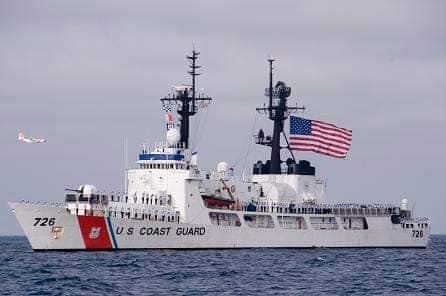
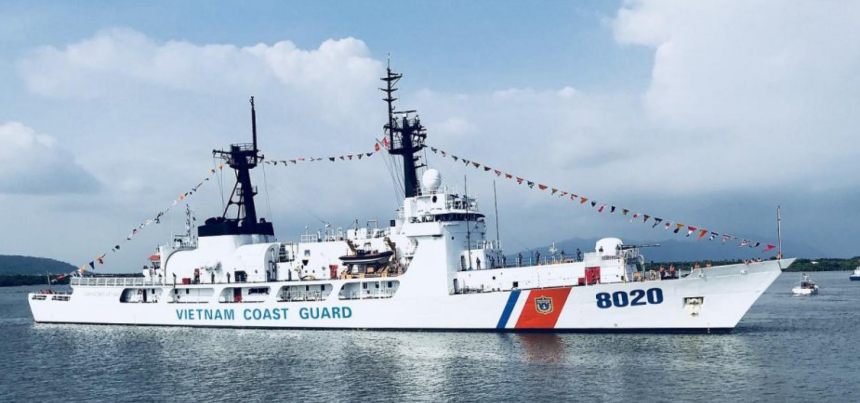
  • Morgenthau (722), Midgett (726), and Munro (724) serve or will serve in the Vietnam Coast Guard
  • Rush (723) and Jarvis (725) are in the Bangladeshi Navy

The Vietnam Coast Guard patrol vessel CSB-8020, formerly the US Coast Guard cutter Morgenthau (Photo: Vietnam Coast Guard)

“Watch: PBS’s “The Codebreaker” premiers Monday, Jan. 11” –MyCG

MyCG reports that PBS will be airing a program about the namesake for the 11th National Security Cutter, codebreaker Elizebeth Smith Friedman.

If you would like to find the program, the post has a link I am duplicating below:

This is an episode of the series “American Experience.”

If you miss it on the 11th, it will be rebroadcast on Tuesday, Jan. 12, and Wednesday, Jan. 13.

How Spencer Became the Coast Guard’s Top U-Boat Killer, Thank You Royal Navy

US Coast Guard crew of cutter Spencer watched as a depth charge exploded near U-175, North Atlantic, 500 nautical miles WSW of Ireland, 17 Apr 1943. Photo by Jack January

Wanted to pass along a bit of Coast Guard history I found on Uboat.net. Below is their list of “Notable Events involving Spencer.”

It really looks like Spencer got a lot of her ASW training from the British Royal Navy, operating in company with British, Canadian, and USN escorts, against small World War I vintage British H class submarines.


23 Mar 1942
HMS H 50 (Lt. H.B. Turner, RN) conducted A/S exercises off Lough Foyle with USCGC Spencer and USS Gleaves. (1)

26 Aug 1942
HMS H 32 (Lt. J.R. Drummond, RN) conducted A/S exercises off Lough Foyle with HMS Yestor (Lt. R.C. Holt, RNVR), HMS Beverley (Lt. R.A. Price, RN), USS BabbittUSS SpencerHMCS Collingwood (T/A/Lt.Cdr. W. Woods, RCNR) and HMCS Trillium (T/Lt. P.C. Evans, RCNR). (2)

22 Dec 1942
HMS H 34 (Lt. G.M. Noll, RN) conducted A/S exercises off Lough Foyle with HMS Fowey (Cdr.(Retd.) L.B.A. Majendie, RN), HMS Carnation (Lt. A. Branson, RNR), HMS Black Swan (Cdr. T.A.C. Pakenham, RN), HMS Tango (T/Lt. J. Hunter, RNR), USS SpencerUSS Badger and HMCS Trillium (T/Lt. P.C. Evans, RCNR). (3)

23 Dec 1942
HMS H 34 (Lt. G.M. Noll, RN) conducted A/S exercises off Lough Foyle with USS SpencerHMCS Dauphin (T/Lt. R.A.S. MacNeil, RCNR) and HMS Tango (T/Lt. J. Hunter, RNR) plus ships from the 37th Escort Group. (3)

9 Feb 1943
HMS H 33 (Lt. M.H. Jupp, DSC, RN) conducted A/S exercises off Lough Foyle with HMS Poppy (Lt. N.K. Boyd, RNR), HMS Dianella (T/Lt. J.F. Tognola, RNR) and USS Spencer. (4)

10 Feb 1943
HMS H 28 (Lt. K.H. Martin, RN) conducted A/S exercises off Lough Foyle with USS Spencer. (5)

10 Feb 1943
HMS H 44 (Lt. I.S. McIntosh, RN) conducted A/S exercises off Lough Foyle with HMCS Dauphin (T/Lt. M.H. Wallace, RCNR), HMCS Trillium (T/Lt. P.C. Evans, RCNR), HMS Ness (Lt.Cdr. T.G.P. Crick, DSC, RN), HMS Philante (Capt. A.J. Baker-Cresswell, DSO, RN), HMS Folkestone (Cdr.(Retd.) J.G.C. Gibson, OBE, RN), USS SpencerUSS Campbell and HMCS Rosthern (T/Lt. R.J.G. Johnson, RCNVR). (6)

8 Mar 1943
German U-boat U-633 was sunk in the North Atlantic south-west of Iceland, in position 58.21N, 31.00W, by depth charges from the US Coast Guard cutter USCGC Spencer.

23 Mar 1943
HMS H 28 (Lt. K.H. Martin, RN) conducted A/S exercises off Lough Foyle with HMS Mallow (T/A/Lt.Cdr. H.T.S. Clouston, RNVR), HMS Myosotis (T/Lt. R. Lugg, RNR), HMS La Malouine (T/Lt. V.D.H. Bidwell, RNR), HMS Dianthus (T/A/Lt.Cdr. N.F. Israel, RNR) and USS Spencer. (7)

17 Apr 1943
German U-boat U-175 was sunk in the North Atlantic south-west of Ireland, in position 47.53N, 22.04W, by depth charges and gunfire from the US Coast Guard cutter USCGC Spencer.