Another New Coast Guard

German Navy blog Marine Forum reports,

“27 Jan….KENYA
“The government has announced plans to establish a coast guard to supplement the Kenya Navy … will patrol Kenya’s territorial waters and safeguard marine interests in its exclusive economic zone … money set aside for an offshore patrol vessel (no details) already under construction in India.”

I have to think most smaller countries don’t really need a Navy–they do need a Coast Guard.

Kenya is in East Africa. They have been helpful in countering piracy primarily based in Somalia.

New International Cooperation

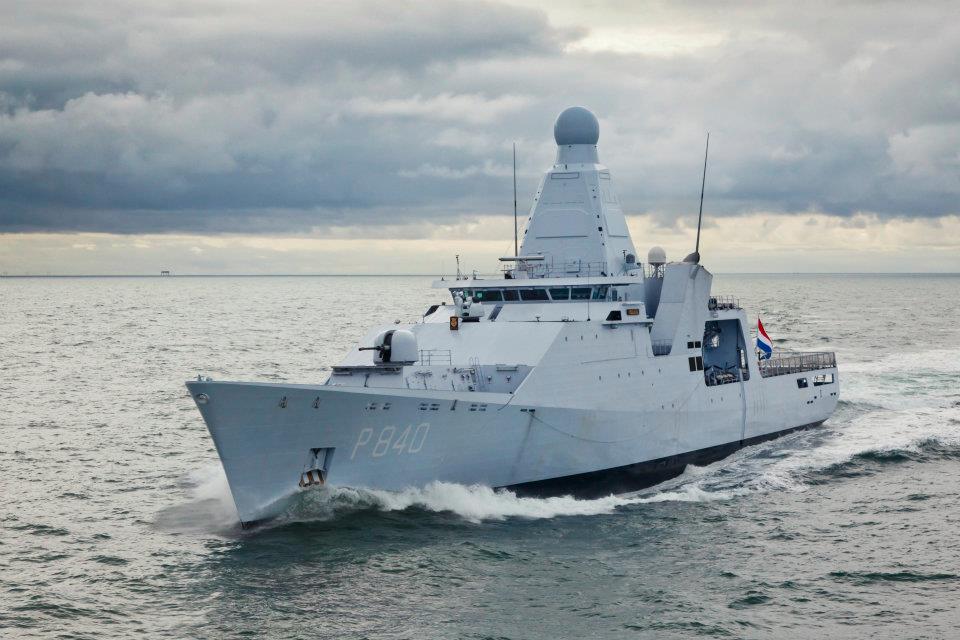
File:HNLMS Holland.jpg
Photo credit: DelamontagneNL, via Wikipedia, Zeeland’s sistership HNLMS Holland
Putting Law Enforcement Detachments on foreign ships is now relatively routine, but a reader (thanks Gils) has informed me of a new level of cooperation. “HNLMS Zeeland, one the new Dutch (Holland class–Chuck) OPVs, left for the Dutch Caribbean yesterday. They will first go to Key West to pick up a USCG helicopter.
Additionally he tells me, “On January 11 the Facebook page of the Dutch MoD in the Caribbean & Caribbean Coast Guard (section) posted the following text: Yesterday a formal agreement has been agreed upon between the United States and the Netherlands to station helicopters from the U.S. Coast Guard on Dutch ships engaged in counter-narcotics operations.  The ultimate form of cooperation for safety on and from the sea!”
The Holland class are a new class of relatively large OPVs. At 3,750 tons full load they are sized between the Hamilton class and the Bertholfs. Zeeland was commissioned only last year. Deliveries of new NH90 NATO frigate helicopters to the Netherlands Navy have been delayed, this explains the need for a Coast Guard helicopter.

New Chinese Cutters–How Many?–Sorry, I’ve Lost Count

The China Defense Blog has three new posts with several photos of new Chinese Coast Guard Cutters.

The first is news of the award of a contract for four new 5,000 ton cutters. and while the text says they will be similar to an earlier 5,000 ton cutter (CMS01), the illustration that accompanies the story shows a very different ship, in many ways similar to the National Security Cutter. It appears there is a medium caliber gun on the bow. (This would be a significant but not unexpected change for the Chinese Coast Guard.) There is a frame over what appears to be a stern ramp not unlike that on the NSC. The hull shape also appears similar to the NSC.

The second post reports the commissioning of the second of two 4,000 cutters commissioned this month.

A third post asks, “What would a 12,000 ton Coast Guard Cutter Look Like?” reports as was reported here earlier, China’s intention to build the world’s largest Offshore Patrol Vessel. They don’t have any illustration of the new ship, but they do say it will have a 76mm gun, two 30mm, facilities to support two Z-8 helicopters, and a top speed of 25 knots.The size of the helicopters is notable. The Z-8 is a large, three engine, 13,000 kg helicopter based on the Aérospatiale SA 321 Super Frelon. The transport version of this helicopter can transport 38 equipped troops. The same airframe is also used for SAR, ASW, and vertical replenishment. The post also says it shows photos of new 3,000 ton cutters, but all the photos except those of hull number 3306 were referred to elsewhere as 4,000 ton cutters.

New hull numbers seen in this series of posts are 1401, 2401, 3401, 3306, and MSA-01). Unlike most earlier Chinese cutters, all of these ships have helicopter decks.

This is the fruition of their earlier stated ambition to build 36 cutters in three years for the Chinese Maritime Surveillance Agency (CMS, only one of four agencies that combined to form their Coast Guard).

Chinese to Build World’s Largest Cutter

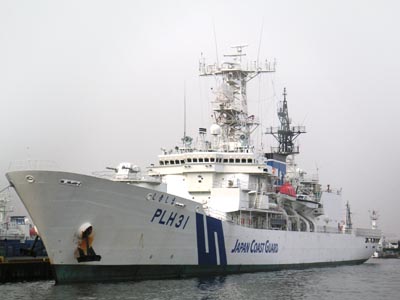
File:JapanCoastGuard Shikishima.jpg
Japanese Coast Guard Cutter Shikishima, this class of two are currently the largest offshore patrol vessels in the world. Photo from Japanese Wikipedia; ja:ファイル:JapanCoastGuard Shikishima.jpg

German Navy blog “Marine Forum” reports (21 January) that the

China Ship-building Industry Corporation has been contracted with developing and building a 10,000-ton and another 4,000-ton surveillance ship.
(rmks: for paramilitary China Coast Guard or China Marine Surveillance)

Meanwhile, in a move designed to bolster their claims in the South China Sea, they also report,

With Vietnam: China will expand paramilitary infrastructure at Sansha City (Paracel Archipelago) in the South China Sea … permanently base a 5,000-ts patrol ship (rmks: prob. China Marine Surveillance – CMS) and begin regular patrols.

Don’t expect China’s new 10,000 ton cutter to look like a US Coast Guard Cutter. The Chinese seem to measure their Coast Guard primarily in comparison to the Japanese Coast Guard which has until now operated the largest cutters in the world, two 9,350 full load, Shikishima class high endurance helicopter carrying cutters. Like their Japanese counterparts, they are likely to be built to merchant standards, will be only lightly armed, but will have excellent aviation facilities. The additional tonnage is likely to give them an advantage if they get in a “shoving match” with opposing coast guards, and they are likely to have a secondary military transport role. With a relatively large number of boats, they could probably land a fair number of personnel in a relatively short time. By way of comparison the National Security Cutters are 4,500 tons full load.

Two More WHECs, if You Please–Philippines?

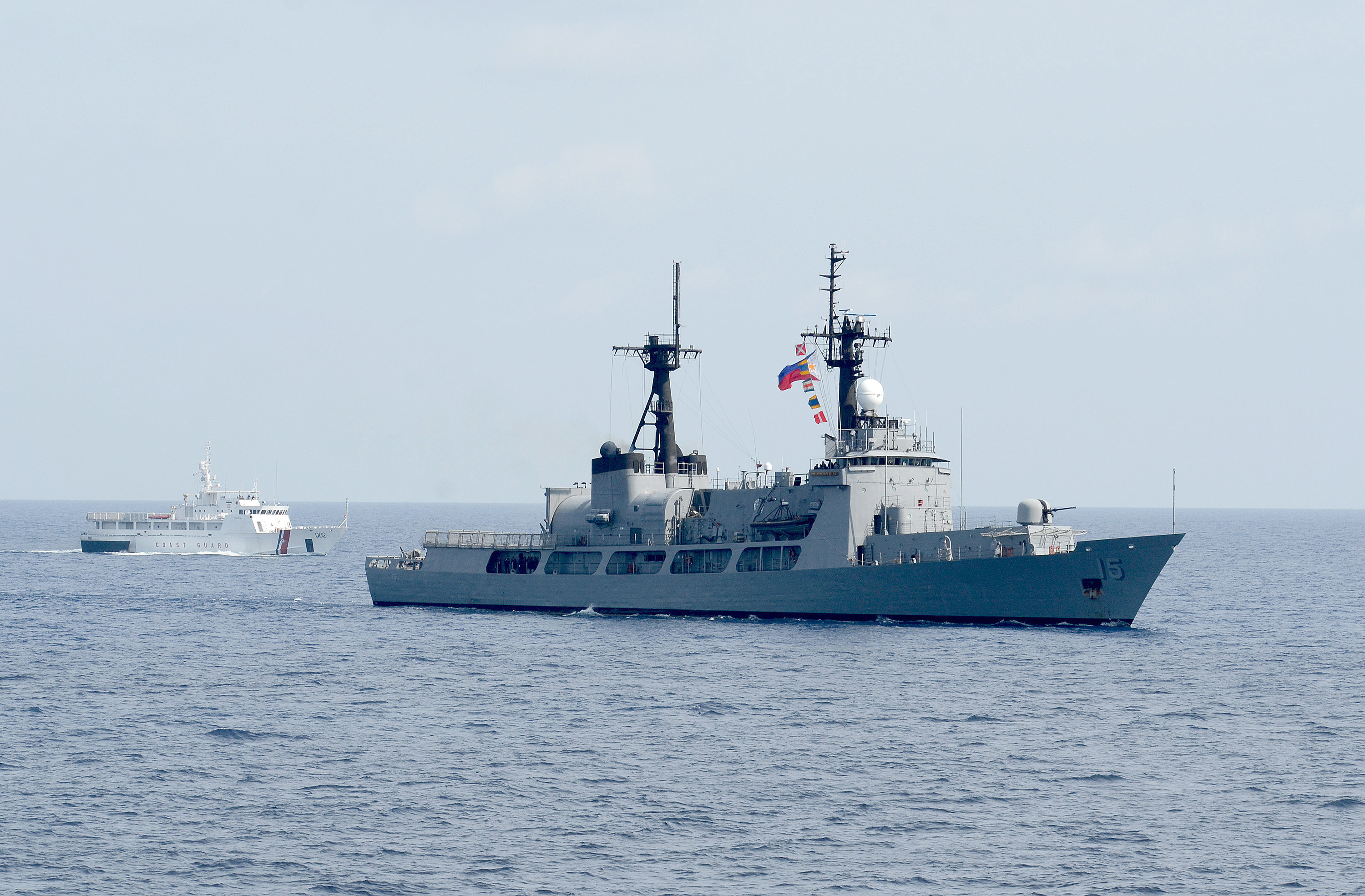
File:PF-15 and SARV-002 CARAT 2013.jpg

Photo Credit: United States Navy with the ID 130629-N-YU572-530, by Mass Communication Specialist 1st Class Jay C. Pugh, PHILIPPINE SEA (June 29, 2013) The Philippine Coast Guard vessel Edsa (SARV 002), left, and the Philippine Navy frigate Gregorio Del Pilar (PF 15) steam in formation during Cooperation Afloat Readiness and Training (CARAT) Philippines 2013.

Global Post is reporting the Philippines is looking for two more “frigates” from the U. S. It is not clear they are referring to Hamilton Class Cutters, but it seems likely. Referring to the two WHECs they already have, the article states,

“The Philippines has already acquired two refurbished American frigates in the past two years, and they now lead patrols in the South China Sea.”

The request might conceivably refer to retiring Perry Class navy frigates, but that would introduce an additional set of systems to the Philippine Navy and the gas turbine powered FFG-7s are not as economical to operate as the normally diesel powered Hamiltons with their combined diesel or gas turbine (CODOG) power plant. The redundancy offered by the cutters’ four engine, two shaft power plant may also be seen as an advantage over the FFG-7’s two engine, single shaft propulsion.

More Chinese Misbehavior in the South China Sea

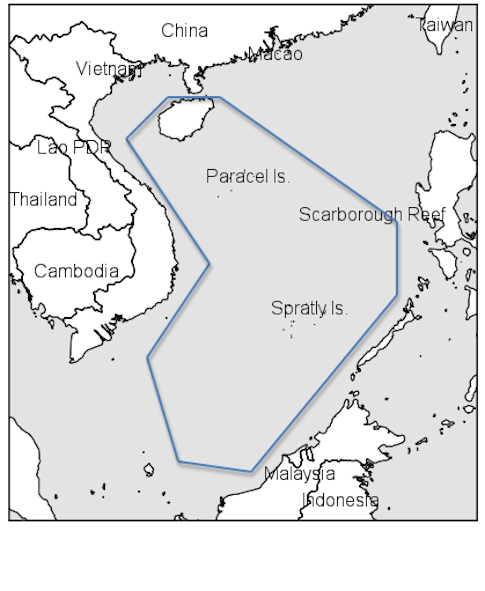
China imposes fishing curbs: New regulations imposed Jan. 1 limit all foreign vessels from fishing in a zone covering two-thirds of the South China Sea.

Credit for Chart: “China Orders Foreign Fishing Vessels Out of Most of the South China Sea,” The Washington Free Beacon

China is again pushing for a “new norm” that would make the South China Sea essentially Chinese sovereign territory. In clear violation of the United Nations Convention on Law of the Sea, the Province of Hainan has declared that, as of Jan. 1, all foreign vessels must get their permission to fish in approximately two thirds of the South China Sea including waters that are clearly within the Exclusive Economic Zones of the Philippines, Vietnam, Brunei, and Malaysia, an area reportedly five times the size of the state of Texas.

In addition to the report credited below the illustration, here is a Wall Street Journal Report and Reuters reports the diplomatic sparing between the US and China.

Their likely instrument in this push is the newly organized Chinese Coast Guard. Naval War College professor James R. Holmes, offers some thoughts on “The Return of China’s Small Stick Diplomacy in South China Sea.”

French to Build New Multipurpose Vessels

NavyRecognition has information on a new class of vessels the French Navy is building,

“…According to the French Procurement Agency (DGA), these vessels:
– have the ability to project 20 personnel (joint, police or gendarmerie) with two 4×4 vehicles along with their weapons and ammunition.
– will ensure the evacuation of citizens and have the ability to deploy and support divers and equipment (including drones) to conduct underwater interventions.
– Under the state action at sea, they will provide fisheries police missions, and contribute to the fight against illegal immigration, drug trafficking and piracy.”
– They will assist ships in distress and participate in safeguarding people and property, through their firefighting means and towing capacity of up to 30 tons

They are planning three with an option for a forth. The French have the second largest EEZ in the World, only slightly smaller than that of the US, and in many places it is based around small isolated islands.

These vessels, which appear to be based on Offshore Petroleum Industry Support ship designs, will likely replace existing fishery protection vessels that are themselves former trawlers and hydrographic survey ships. They will also likely be tasked with a variety of Coast Guard like missions including disaster response.