Indian CG Commisions their Eighth “FRC”

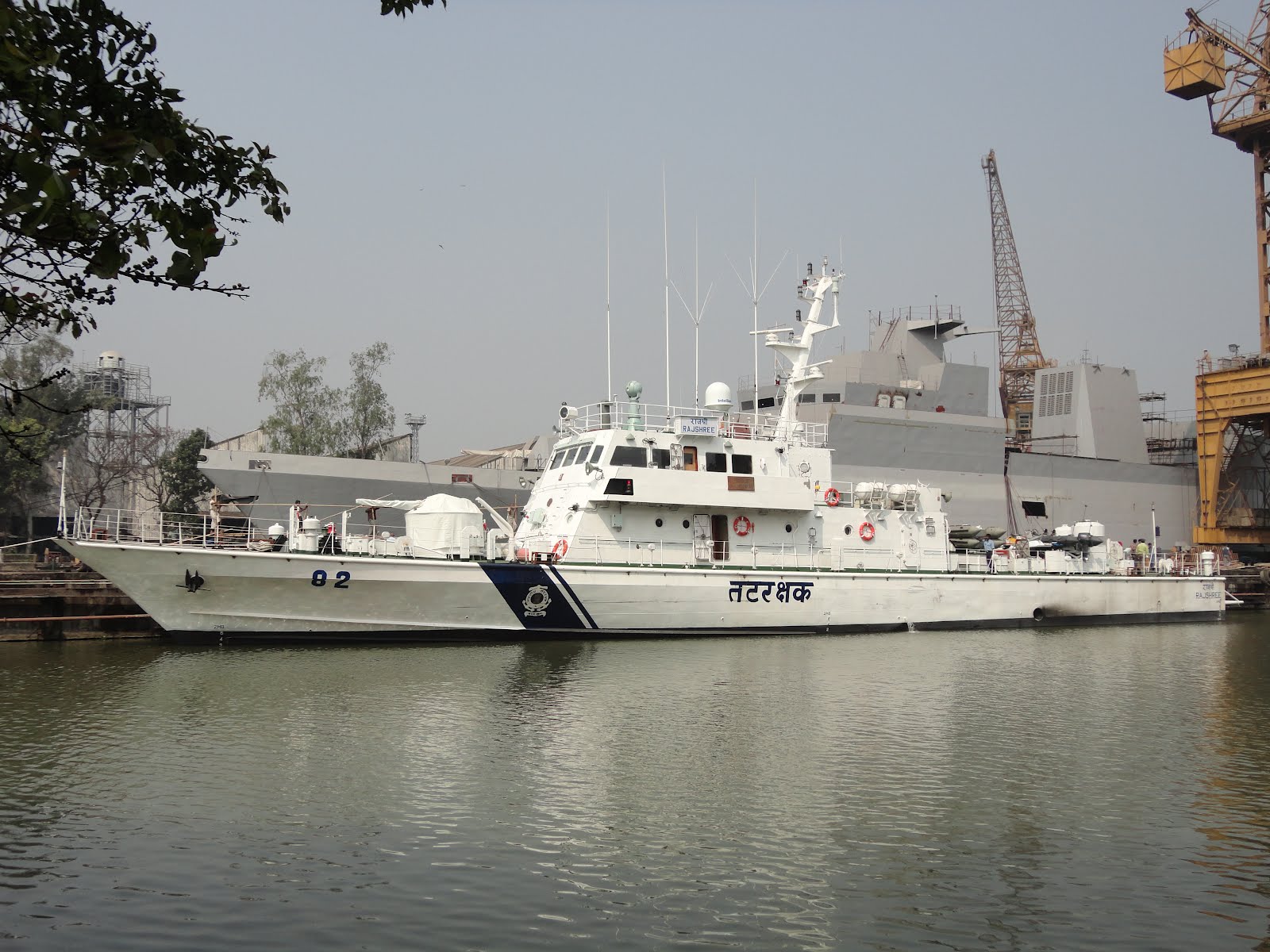
Photo: Rajshree class IPV (Wiki Info) Click on the photo for larger size

Indian Coast Guard is on a roll. NetIndian is reporting they have just commissioned their eighth new Inshore Patrol Vessel, CGS Rajdhwaj, essentially a fast response cutter, except that theirs is a bit larger, faster, and more heavily armed. Doesn’t have quite the range though. The ship is the last in the series of eight.

The first of these Rajshree-class Inshore Patrol Vessels was commissioned only in Feb. 2012.

Santa Claus is Canadian?

gCaptain is reporting that Canada is laying claim to the North Pole as part of their Continental shelf. But so are Denmark and Russia.

The US can’t make claims to an extended continental shelf beyond their EEZ because they have not yet ratified the UN Convention on Law of the Sea (UNCLOS).

Good news is looks like all parties are willing to take it to court rather than fight over it.

Attack on LNG Terminal, Yemen

There has been a report that Yemen’s navy destroyed a boat attempting to attack Yemen’s LNG export terminal.

Yemen’s coast guard is largely equipped with equipment from the USCG’s Foreign Military Sales program, including two 87ft Marine Protector WPBs and twelve 25 ft Defender class patrol boats. Would not be surprised if they were involved.

DOD Arctic Strategy

Nov. 22 the DOD released its Arctic strategy. The news release is here. but I have quoted it in full below:

“Department of Defense Announces Arctic Strategy

“Today the Department of Defense released its Arctic Strategy during a speech by Secretary of Defense Chuck Hagel at the Halifax International Security Forum in Nova Scotia, Canada. The strategy document may be viewed at http://www.defense.gov/pubs/2013_Arctic_Strategy.pdf.

“Secretary Hagel’s speech can be read here.”

The strategy itself is actually pretty short, only 16 glossy pages. The readers digest version breaks down to, the DOD will work with allies and partners both internationally and domestically to assure the Arctic remains,

“…a secure and stable region where U.S. national interests are safeguarded, the U.S. homeland is protected, and nations work cooperatively to address challenges.”

The Coast Guard released its own, much more detailed strategy earlier, reported here.

Worth noting, DOD Strategy’s definition of the Arctic, like that of the National and Coast Guard strategies, extends well south of the Arctic Circle:

“The DoD strategy uses a broad definition of the Arctic, codified in 15 U.S.C. 4111, that includes all U.S. and foreign territory north of the Arctic Circle and all U.S. territory north and west of the boundary formed by the Porcupine, Yukon, and Kuskokwim Rivers; all contiguous seas, including the Arctic Ocean and the Beaufort, Bering, and Chukchi Seas, and the Aleutian islands chain.”

This might be of particular interest to the Coast Guard:

“Department will work through the North American Aerospace Defense Command (NORAD) to maintain air tracking capabilities in the Arctic. As the maritime domain becomes increasingly accessible, the Department will seek to improve its maritime detection and tracking in coordination with DHS and other departments and agencies as well as through public/private partnerships. The Department of the Navy, in its role as DoD Executive Agent for Maritime Domain Awareness, will lead DoD coordination on maritime detection and tracking. Where possible, DoD will also collaborate with international partners to employ, acquire, share, or develop the means required to improve sensing, data collection and fusion, analysis, and information-sharing to enhance domain awareness appropriately in the Arctic. Monitoring regional activity and analyzing emerging trends are key to informing future investments in Arctic capabilities and ensuring they keep pace with increasing human activity in the region over time.”

There is a footnote on page ten of the document (page 12 of the pdf) that might provide a justification for DOD funding of icebreakers for the Coast Guard:

“11As expressed by Commander, U.S. Pacific Command (USPACOM), Commander, U.S. Transportation Command (USTRANSCOM), and Commander, USNORTHCOM, in a May 2008 memorandum, the United States needs assured access to support U.S. national interests in the Arctic. Although this imperative could be met by regular U.S. Government ships in open water up to the marginal ice zone, only ice-capable ships provide assured sovereign presence throughout the region and throughout the year. Assured access in areas of pack ice could also be met by other means, including submarines and aircraft.”

Getting Outflanked along the California Coast

FierceHomelandSecurity is reporting the Coast Guard and Customs and Border Protection are admitting that Pangas smuggling north from Mexico are going around existing patrols. Shouldn’t surprise anyone, there is a lot of money in it. In addition to drugs they could be  smuggling terrorist just as easily.

Perhaps we need a few of those Webber Class WPCs in the Pacific. Reportedly the administration is taking another look at border security. Its time to make our case that the water side is way too porous.

Norway Buying New SAR Helos

Always nice to know what the other guy is doing. DefenseUpdate is reporting the Norwegians are planning on replacing their current SAR helicopters with a fleet of at least 16 three engine Agusta Westland AW101s. Contract includes an option for an additional six.

Perhaps it is noteworthy that they are still using a version of the HH-3 which the USCG replaced two decades ago. With H-3s still in use by Norway, the UK, and Canada, perhaps we are not doing so badly.

The specs are impressive:

“As a medium/heavy multi-role platform AW101 has a large cabin that can carry 30+ survivors, SAR equipment and crew, and the cabin can be reconfigured in flight to meet mission requirements. crashworthy seats or 16 stretcher patients. The helicopter is powered by three GE CT7-8E engines, but can also cruise with one engine idling, to extend range or endurance of 750 nm (over 1300 km). High cruise speed, all weather operating capability, high reliability and safety are among its main advantages. The company also offers a special variant for Combat Search and Rescue missions, for which the AW101 can be equipped with up to 3 window and door mounted guns, Defensive Aids Suite and air-to-air refueling equipment.”

The AW101 is a very large, fast, long ranged helicopter. It is also in service with the Canadians in a SAR role. It has experienced a number of problems, that now appear to have been resolved. Below are characteristic of the AW101 in its Canadian CH-149 form followed by those of the Coast Guard’s MH-60 taken from their Wiki descriptions.

CH-149 General characteristics

  • Crew: 5 (Aircraft Commander, First Officer, Flight Engineer, 2 SAR Techs)
  • Capacity:
    • 30 seated troops or
    • 45 standing troops or
    • 16 stretchers with medics
  • Length: 22.81 m (74 ft 10 in)
  • Height: 6.65 m (21 ft 10 in)
  • Empty weight: 10,500 kg (23,149 lb)
  • Max takeoff weight: 14,580 kg (32,143 lb)
  • Powerplant: 3 × General Electric T700-T6A1 turboshaft, 1,286 kW (1,725 hp) each
  • Main rotor diameter: 18.59 m (61 ft 0 in)

    Performance

  • Never exceed speed: 309 km/h (192 mph; 167 kn)
  • Range: 1,389 km (863 mi; 750 nmi)
  • Service ceiling: 4,575 m (15,010 ft)
  • Rate of climb: 10.2 m/s (2,010 ft/min)
  • Wing loading: 53.8 kg/m2 (11.0 lb/sq ft)
  • Power/mass: 0.2849 kW/kg (0.174 shp/lb)

HH-60J General characteristics

  • Crew: Four (pilot, co-pilot, two flight crew)
  • Length: 64 ft 10 in (19.76 m)
  • Rotor diameter: 53 ft 8 in (16.36 m)
  • Height: 17 ft (5.18 m)
  • Empty weight: 14,500 lb (6,580 kg)
  • Max. takeoff weight: 21,884 lb (9,926 kg)
  • Powerplant: 2 × General Electric T700-GE-401C gas turbines, 1,890 shp (1,410 kW) each

    Performance

  • Maximum speed: 180 knots (205 mph, 333 km/h)
  • Cruise speed: 140 knots (160 mph, 260 km/h)
  • Range: 700 nautical miles (802 mi, 1,300 km)
  • Service ceiling: 5,000 ft hovering (1,520 m)

Note this is for the HH-60, not the characteristics as modified to MH-60J and that the criteria for service ceiling are different.

A Bigger Motor Lifeboat

gCaptain is reporting Dutch Naval Architects (including some from Damen), “have teamed up to design and build the next-generation of all-weather fast rescue lifeboats for the Royal Netherlands Sea Rescue Institution (KNRM).” It features an “Axe-bow” which is claimed to reduce pitching and allow higher speeds in a seaway. They also expect the boat to be much quieter. If you look at the stern, there is what appears to be, an innovative scoop for picking up people in the water.
The full post, includes lots of pictures and data. At 19.3 meters (63 feet), the boat is a lot bigger than either the 47 foot MLB or the 45 foot RB-M. It is also considerably larger in displacement. It is a bit faster than the MLB, but slower than the RB-M.

World’s Largest Floating Structure

gCaptain reports on progress on Shell’s Floating Liquified Natural Gas Facility being built in South Korea, “a 488 meter (1600 feet long–Chuck), 600,000 dwt vessel that will eventually be moored offshore Australia to produce, liquefy, store, and offload natural gas.” (includes video)

With the US producing and exporting natural gas perhaps we will be seeing one of these off the US coast. If we do, it may represent a whole new set of challenges for the Coast Guard.

“Boat Lift” in the Med

Defensenews reports the Italian Coast Guard seems to be contending with their own version of a “boat lift” as refugees from the chaotic and poverty ridden areas of Africa and the Middle East attempt to make it to more prosperous areas.

Typical Migrant Interdiction Operation (MIO)–unsavory operators, overloaded unseaworthy vessels equal mass drownings.

Drug Sub Builder Held

Slate.com is reporting the man behind the building of three true submarines intended for smuggling drugs is facing trial, and many of those who worked with him have either been tried or taken plea bargains.

If you want a refresher on the result of his efforts, there is pretty good info on one of the submarines that he produced here.

We have talked about these before and their implications for the Coast Guard. Related:

Helping Build and Maintain Narco-subs

New Type Narco Sub–a “Snot Boat?”

Narco Sub Photos and Video re Evolution of Semi-Submersibles

A True Narco Submarine–Counter Measures?