The UK is reportedly contracting out for SAR helo services previously provided by the RAF and Royal Navy.
Note, they are still flying the H-3, replaced in USCG service by the H-60 beginning in 1990.

The UK is reportedly contracting out for SAR helo services previously provided by the RAF and Royal Navy.
Note, they are still flying the H-3, replaced in USCG service by the H-60 beginning in 1990.
gCaptain has an interesting take on an incident that occurred off India when Italian soldiers, acting as armed guards on a merchant ship, fired on and killed fishermen apparently in the mistaken belief that they were pirates.
Apparently the Canadians have a different view of the probability of a maritime security threat than our own DHS. A post on cimsec.org talks about it, and the possibility of more international coordination.
Up to six Chinese law enforcement agency vessels, roughly analogous to Coast Guard Cutters, have entered the territorial waters of islands administered by Japan, and Japanese Coast Guard Cutters responded. It does not look like the disagreement is going to go away quietly. Anti-Japanese anger is being nurtured in China. Both China and Japan are preparing for a leadership change, and no one wants to look weak.
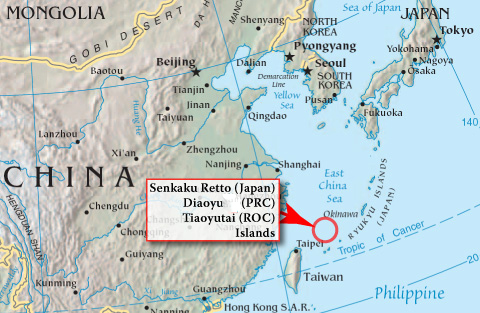
Illustration: from CIA map
A good summary of events is here. A second source indicates the Chinese have “1,000” fishing vessels en route.
“And, whether we like it or not, Washington is involved.“
The Chinese have taken an additional step and filed a claim on the islands with the UN describing its interpretation of where the baselines are drawn and enacted a national law that,
“prohibits foreign warships and vessels from entering the waters around the Diaoyu Islands without permission from the Chinese government.”
This seems to reflect China’s broader interpretation of the ability of a state to restrict access to its EEZ.
If the situation were not complicated enough, don’t forget there is a third party here, who are also inserting themselves in the mix. Taiwan also claims these islands and have also sent their Coast Guard into the area.
Photos of some of the players here.
The Brits are planning a new class of frigate, the Type 26, that has some interesting features.
The ship is going to be a close contemporary of the Offshore Patrol Cutter with both the new frigate and the OPC programs scheduled to deliver their first ship in 2020. The Type 26 is expected to displace 5,400 tons full load, so it is about 20% larger than the National Security Cutters and perhaps twice the size of the OPC. Still some of the thinking might be applicable.
Propulsion:
“For propulsion, BAE has opted for a conventional but upgraded hybrid system combining gas turbines for top speeds and diesel generators for a fuel-efficient quiet mode, and these generators will provide significantly higher speeds than those of the Type 23.”
The 4,300 ton Type 23 cruises 7,800 miles at 17 knots so presumably they are talking about 20 knots or more on diesel-electric alone, for this relatively large ship. Like the now 22 year old type 23s, they will replace, the Type 26s’ generators will supply power for both propulsion and hotel services.
Boats, Mission Modules, and Aircraft:
“For greater flexibility of the combat systems, the ship will have an integrated mission bay and hangar, allowing the Navy to more easily deploy varying numbers of helicopters, unmanned aerial vehicles (UAVs) and boats according to the situation.”
The frigate, like many new designs, incorporates provision for reconfigurable space. What they have done differently is make this space adaptable for trade-offs among helicopters, unmanned vehicles (air, surface, and sub-surface), and boats.
Computer Systems:
“This basically means having a single computer system that can support the multiple pieces of software used throughout the ship, rather than installing separate hardware systems and local area networks from each supplier.
“Using blade server technology originally developed for the banking industry to provide reliable, high-power processing, the computing environment will be able to run different “virtual” operating systems to cope with the variety of programmes the ship will use, from navigation to combat management.”
Common hardware sounds like a great idea, but some are already questioning the choice of a Windows operating system.
More:
There are lots of conceptual drawings, a couple of videos, and additional links along with exhaustive comment (over 500) here.
The specs for the Offshore Patrol Cutter have not been made available to the general public, but the Commandant recently remarked that he hoped to repeat the success of the Webber Class Fast Response Cutter (FRC) procurement by doing something similar with the Offshore Patrol Cutter (OPC) in terms of using a parent craft approach (sorry can’t find the link).
Last time the acquisitions Directorate (CG-9) published a list of shipbuilders interested in the OPC project there were twelve, Austal, BAE, Bath Iron Works, Bollinger, Derecktor, Eastern Ship Building Group, Marinette Marine, General Dynamics NASSCO, Northrop Grumman, Todd Pacific, Signal International, and VT Halter Marine. Some of these ship builders are very experienced and are more than capable of starting a design from scratch, but others either already have international partners or, having no experience in building this type of ship, are likely to seek a partner.
What similar designs have been built recently that might be adapted to create an OPC?
The OPCs are much more complex than the FRCs and even in that case, there were substantial changes to the parent craft required to create the Webber class. Speed was increased substantially, compartmentation was improved, and it was more heavily armed, so we should not expect a carbon copy of any existing design.
Many of these designs have all their propulsion machinery in a single compartment. At least one appears to have all its ship’s service generators in one compartment. (I believe the OPC spec rules out both of these vulnerabilities, but these are things that can be changed.) Other changes are also likely to be required to comply with American Bureau of Shipping (ABS) Rules for Building and Classing Naval Vessels (NVR).
Very few meet the range requirement. Even fewer are equipped with an icebelt.
Still it might be interesting to see what is currently on the market.
For reference I am going to provide the length and beam (in meters) of the some familiar ships.
Of these the 327 at 100×12.5 might serve as a sort of benchmark in that we know from experience with these ships, it is possible to create a very comfortable and seaworthy ship of this size, while smaller ships have not been totally satisfactory for the service envisioned.
The FFG also serves as a benchmark in that it shows that a ship with a 13.7meter beam can have a hanger that can house two H-60s, not a requirement for the OPC, but perhaps a good option, particularly with the Navy increasing the size of the Firescout to that of a full size helicopter.
It appears that international partners could include:
Some of these builders have more than one design that might be considered.
Damen
Damen appears particularly well placed, having provided the parent craft for the Fast Response Cutter. They have two potential parent craft, the Holland Class (108×16) and the Sigma series (Ship Integrated Geometrical Modularity Approach) of corvettes and light frigates.

As suggested by the illustration above, Thales already has an interest in offering the Holland class as the OPC. It was shown off recently in Key West. It shares many of the characteristics of the OPC including an emphasis on seakeeping and ballistic protection for key areas of the ship. At 3,750 tons, it is also the largest ship we will discuss in this post and probably the most expensive. Reportedly the mast and its associated sensors account for a sizable fraction of the ship’s cost, but also provide almost Aegis like capability. Its combined electric or diesel (CODELOD) propulsion system make loitering and slow cruise operations particularly economical. Still they would need greater range, possibly greater speed and an ice belt to satisfy the requirements for the the OPC, so might end up even larger.

Mr Wim Kosten,maritimephoto.com Source: Maritimephoto.com
Of the Sigma series, the Indonesian variant (105×13) looks closest to the OPC. Eight ships have been built or are building for Morocco and Indonesia, and apparently four more are planned for Vietnam. They appear to emphasize warship characteristics but are not built to naval standards and when the Netherlands decided to build their own offshore patrol vessels they rejected the Sigmas in favor of the Holland class. It is shorter ranged and its inclusion of only two very powerful diesels does not appear likely to be economical. Still the size looks right; it is “modular,” perhaps modifications are possible.
Navantia
Navantia, a very large and active builder of warships, including Aegis equipped frigates and LHDs for the Spanish and Australian Navies, has been very active in producing offshore patrol vessels recently.

They are producing a series of series of nine multipurpose ships for the Spanish Navy identified as Buque de Acción Marítima or “BAM” (93.9×14.2). “Modular design enables the ships to be modified for purposes outside main missions such as hydrographic research, intelligence gathering, diving support and salvage operations.” As built they have the range required for the OPC. They have a hybrid propulsion system, but speed is only a little over 20 knots.
They have also produce two classes of four each for the Venezuelan Navy. The largest of these are the 2400 ton Guaiquerí class patrol vessels (99×13.6)

Photo: Venezuelan OPV built by Navantia. via Wikipedia
They don’t have the range required, only 3500 nmi, or of course an icebelt, but otherwise they appear very close to the OPC including a 25 knot top speed.
If Navatia could combine the speed of the Guaiquerí with the range and economy of the BAM, they might have a winner.
DCNS

Obviously DCNS also has an interest in the OPC project. They have been pushing their Gowind family of vessels as both OPCs, corvettes and light frigates. The L’ Adroit (87×11) is probably too small to meet the OPC requirements, but the larger version (107×16) beginning offered to Malaysia appears much closer.

Gowind model at Boustead stand during DSA 2012
(picture: Navy Recognition)
BAE
A BAE design (90.5×13.5) built for Trinidad and Tobago, has been sold to Brazil and they expect to build five more of the ships, while a very similar BAE design, HTMS Krabi, is being built in Thailand. These ships don’t meet the range requirement, don’t have a hanger, and are limited to a 7 ton helicopter. Could the design be modified?
BAE also have in their portfolio the Lekiu_class_frigate (106×12.75) which does have a hangar. Two were completed for Malaysia in 1999. Two more of an updated design are proposed. These ships have a powerful CODAD (Combined Diesel and Diesel) powerplant that is good for 28 knots. Reduced power could still satisfy the OPC requirement.
Fassmer

Fassmer (Germany) appears to be primarily a builder of work boats and small craft, but they have had success with their 80 meter OPV design being adopted by Argentina, Chile, and Colombia for construction in country.
They have proposed some larger designs (pdf), but I’m not sure they bring much additional experience to the table.
Blohm + Voss “MEKO”
 Blohm + Voss is a warship maker with experience going back a hundred years. They have a series they refer to as MEKO that includes a range of designs that have been built for several countries. These include six “MEKO 100” 98×14.3 design built for Malaysia and MEKO 200 series that includes 25 ships built for five different countries including CODAD as well as CODAG versions. (More pictures here)
Hyundai (S. Korea)
Hyundai is primarily a commercial ship builder, but they might choose to offer a variant of their recently completed Inchon Class frigate (114×14).
STX (S. Korea)
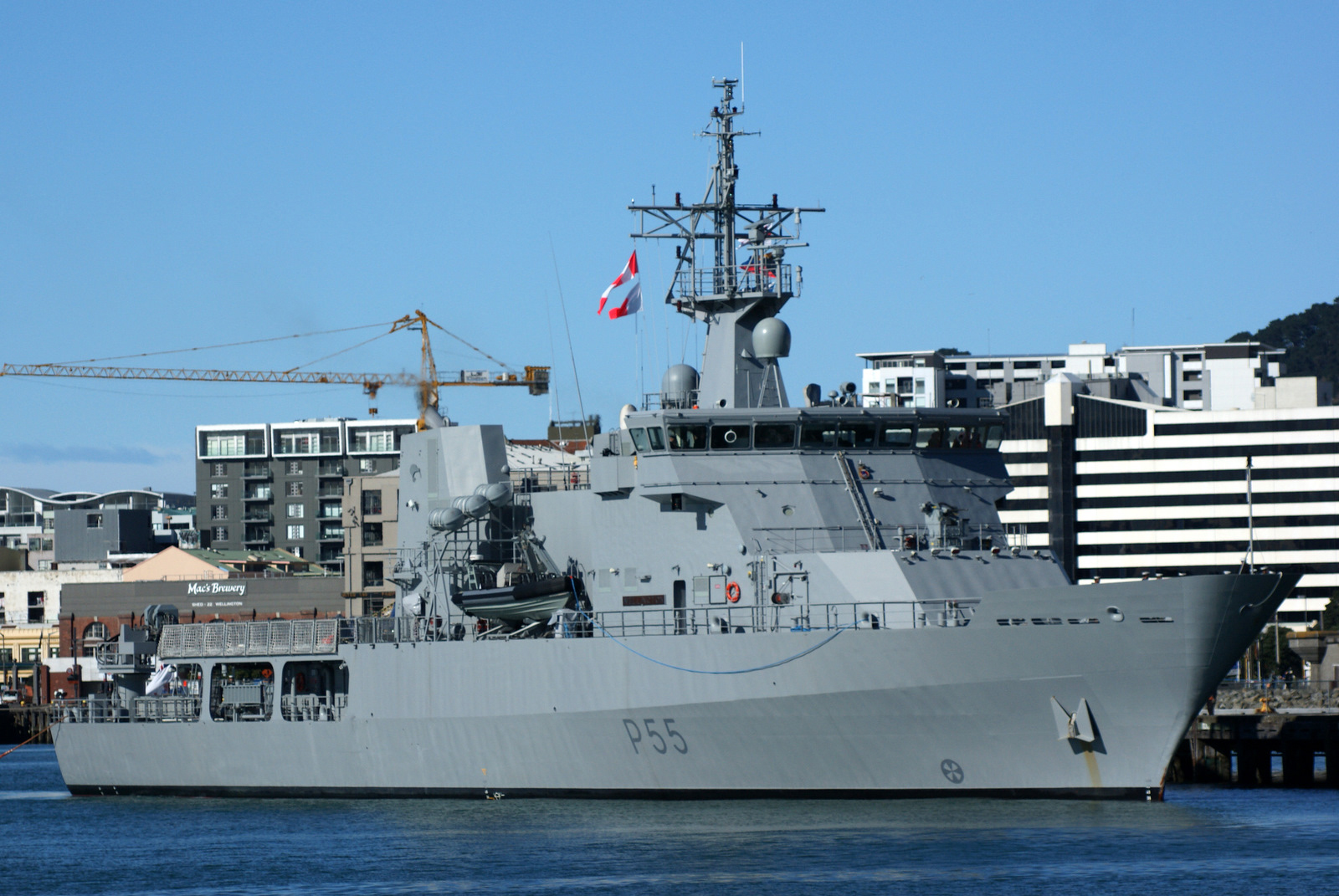
STX (S. Korea, France Finland, Romania, Canada and US) is an extremely successful commercial ship builder with divisions all over the world. They have built cutters for the S. Korean Coast Guard and warships for France and Finland. The New Zealand Protector class (85×14) was designed by their Canadian division. It is unique in having an icebelt, but reportedly the ship turned out heavier than intended and the icebelt is lower than it should be.
Others
An outside chance is a design based on the Turkish Milgem (100×14.4).

MILGEM Photo: Turkish Naval Forces
I’m still a fan of the Danish Thetis (112×14.4) although I don’t think it will be in the running. It is a simple but roomy ship but the yard that built it is now out of business, so it has no advocate.

Photo: Thetis
Another way to approach the problem might be to consider the 327 or 378 as parent craft.
Ratification of the Law of the Sea Treaty always seemed like a good thing. Both the Commandant and the CNO support it.
I can’t claim to have a full understanding of the treaty, but I have begun to get inklings of why others have reservations about it. As in all things legal, it is subject to interpretation, and the interpretation of others do not necessarily match our own.
In the interest of having a balance view, you might want to spend a few minutes reading what Peter Brookes, a former deputy assistant secretary of defense, has to say about why its not a good idea.
The right of innocent passage seems to be one of the things that is subject to interpretation, and it is not just China and developing countries that see things differently. So do the Canadians. (More here, here, and here.)
As we have noted, the Chinese have a number of agencies that have duties that are assigned to the Coast Guard in the US. There have been calls for reorganization before. Now “The Global Times,” reports that Luo Yuan (Luo), a CPPCC member and major general of the PLA Academy of Military Sciences, has also proposed establishment of a national coast guard. He is interviewed here.
He also has some strong words for Vietnam and the Philippines, and of course accuses the US of meddling.
Informationdissemination took a comprehensive look at their vessels here.

This is the second of two parts. The first part focusing on what I believe are the current shortfalls in the US Navy force structure is here.
Since part one, additional cuts to the Navy’s plans have been announce. Attack submarines which have an important ASW role are now expected to decline from a current 55 to 40 in 2030 and all SSGNs will be removed from service. Additionally the Navy will prematurely retire seven cruisers and two amphibious warfare ships. The planned five year building program is going from 57 ships to 41.
Now we will look more closely at what Coast Guard Cutters may be called upon to do in future conflicts, what changes to our existing force might be prudent, and desirable characteristics for future cutters. Continue reading
 Chuck Hill's CG Blog