Special Purpose Craft – Heavy Weather 2nd Generation (SPC-HWX II)

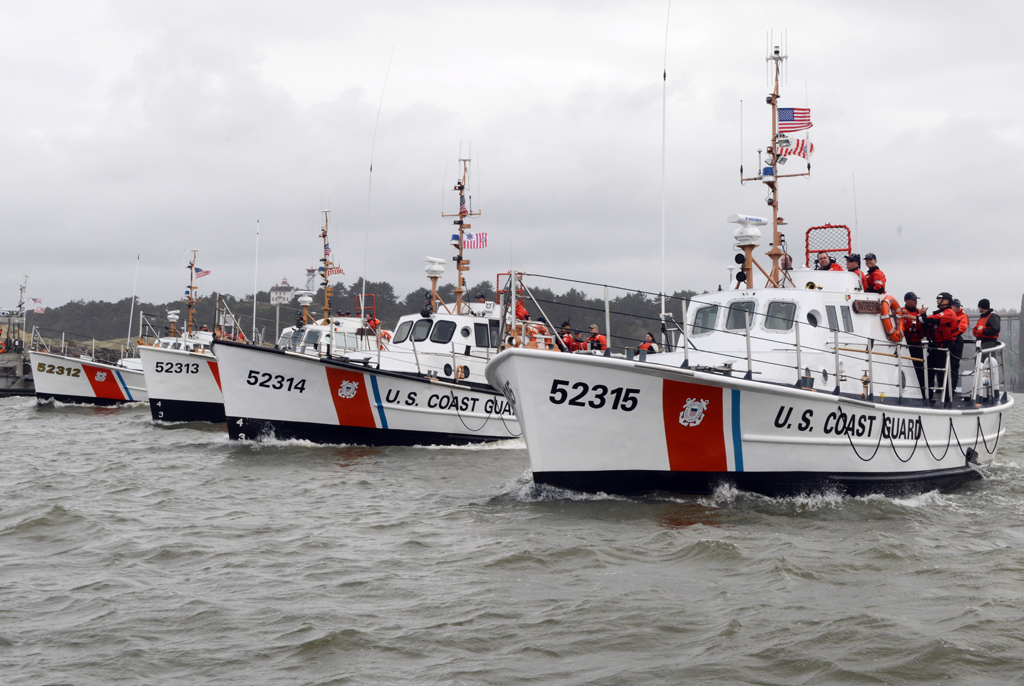
Being Replaced: Coast Guard crew members aboard four 52-foot Motor Life Boats and one 47-foot Motor Life Boat transit in formation outbound of Yaquina Bay, Ore., April 9, 2019. The four 52-foot MLBs are the only active vessels of their kind and the crews are assigned to different units across the Pacific Northwest, which is why having all four together for the roundup was a rare occurrence. (U.S. Coast Guard photo by Petty Officer 3rd Class Trevor Lilburn)

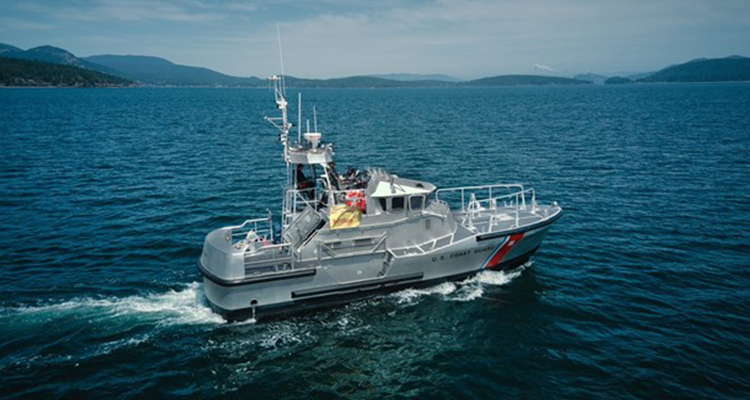
The Acquisitions Directorate has announced the release of a request for proposal for six boats to replace the 52 foot MLBs which were taken out of service more than three years ago. You can find the RFP here.

The proposal should give the Coast Guard some very capable craft. I did not read the entire 196 pages front to back, but I did manage to find out some of the capabilities included in the specifications.

First some limits:

  • Length 64 feet or less
  • Beam 22 feet or less
  • Draft 7 feet or less

Other characteristics:

  • Speed: at least 20 knots
  • Cruise Speed: 16 knots
  • Minimum Speed: 5 knots or less
  • Range: 500 nautical miles
  • Crew: Minimum 4

Missions:

  • SAR is number one, but also
  • Marine Safety
  • Law Enforcement
  • Ports Waterways and Coastal Security
  • Marine Environmental Protection
  • plus, anything else they might use it for.

Capabilities:

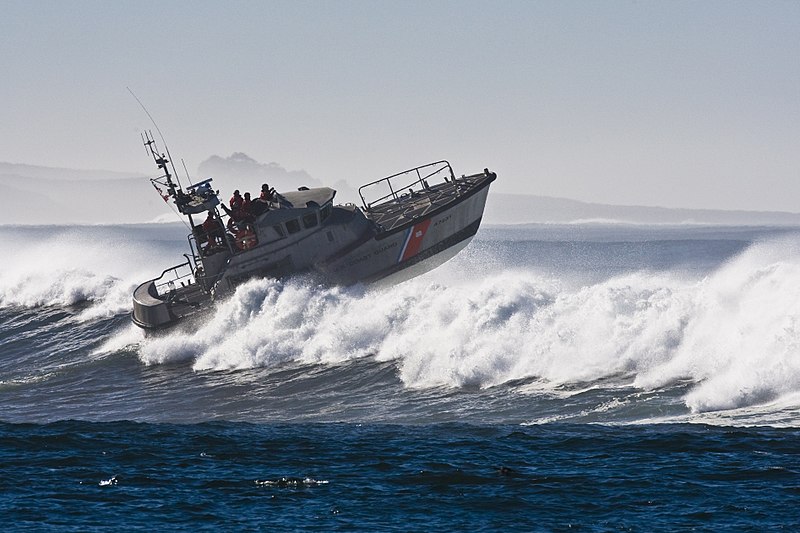
They are expected to operate in 35′ seas, 60 knot winds, and 25′ surf.

The boats will support a relief crew of four for missions that last more than 10 hours in calm waters or more than six hours in more demanding conditions. There is also seating for five survivors for a total of 13 seats. Berthing is limited to four.

The boats will have both open and enclosed bridges. It will be equipped with a bow thruster, recovery wells on either side and a powered towline reel.

Communications include satellite phone, and if I understand correctly, encrypted voice and data.

In addition to radar, sensors will include Electro Optics and Infra-Red (EO/IR).

Maybe We Need More than Six:

As I have noted before, such vessels could replace 87 foot WPBs that are approaching the end useful life in at least some ports and do it with a smaller crew and probably better seakeeping. They might not encounter 25 foot surf as frequently as the those in the Pacific Northwest, but the capability to deal with heavy weather will be there when needed. They don’t have the endurance of WPBs but when cases extend beyond their endurance, FRCs should take over. I do hope they are a bit faster than 20 knots, after all the 47 footers can do 25 knots.


Canadian Coast Guard Bay Class Motor Lifeboats–MLB and WPB Replacement?

Canadian Coast Guard vessel CCGS Garbarus Bay | Photo credit: Mel & Jer Creative

Recent reports of the delivery of CCGS Garbarus Bay prompted me to look again at the Canadian Coast Guard Bay class motor lifeboats. They are considerably larger than the USCG 47 foot MLBs. I was also reminded; we have not heard anything recently about replacements for the now retired 52 foot MLBs. The 87 foot WPBs are also nearing the end of their useful life. A large, reasonably fast MLB like the bay class could replace the 52 foot MLBs and some of the WPBs. (In other places we may need a different kind of WPB replacement.) With their smaller crew, be less expensive to operate than the WPBs. These could be the true “Fast Response Cutters” capable of responding in extreme weather when a Response boat medium or even an 87 footer could not. Might even call them Response Boat, Large.

The Canadians are procuring 20 of these large MLBs. The vessel’s particulars are as follows:

  • Displacement: 62.5 tons (47 foot MLBs are 18 tons; 87 footers are 91 tons)
  • Length overall: 19.0 meters (62′)
  • Length DWL: 17.5 meters (57.4′)
  • Beam: 6.3 meters (21′)
  • Depth at midship: 2.58 meters
  • Hull draft, nominal: 1.67 meters (5.5′)
  • Power: 2,400 kW (about 3,200 HP, more than the 2,950 HP of the 87 foot WPBs and more than three times the power of the 47 footers)
  • Speed: 23.5 kts

According to Wikipedia,

They are capable of operating in 12-metre (39 ft) waves, and in wind conditions at 12 on the Beaufort scale. The vessels’ hulls will be aluminum, not FRC (fibre reinforced composite), as with the original Severn design.

Canadian Coast Guard vessel CCGS Chedabucto Bay | Photo credit: Chantier Naval Forillon

“First 47-foot motor lifeboats delivered following design modification to service life extension program” –CG-9

U.S. Coast Guard photo.

Below the line is the latest Acquisitions Directorate report on the 47 foot MLB life extension program. Previous reports containing additional information are:


First 47-foot motor lifeboats delivered following design modification to service life extension program

The Coast Guard’s In-Service Vessel Sustainment (ISVS) Program in partnership with the Boat Acquisition Program completed service life extension program (SLEP) work on a ninth and 10th 47-foot motor lifeboat (MLB) in June.

The SLEP work package for these two MLBs incorporated design modifications to address operational test and evaluation (OT&E) findings. The extra time and resource investment to develop and refine solutions from the OT&E findings for these two boats should reduce future MLB SLEP durations.

Based on the OT&E findings, the additional work completed on these MLBs encompassed a reconfiguration of the open and enclosed bridge areas, revised console configuration on the open bridge and revised exterior lighting. Further repairs under the SLEP included engine control system modifications to improve speed and responsiveness in hazardous surf conditions as well as extensive hull plating replacement.

For efficiency, the SLEP work is being conducted in two locations, one on each coast, and each facility worked on one of the MLBs incorporating the OT&E production modifications.

On the West Coast, the work was completed in Bellingham, Washington, on June 14, 2023. This MLB was the first post-SLEP boat delivered to Station Umpqua River along the Central Oregon coast.

On the East Coast, the work was completed in the newly opened facility in Portland, Connecticut, on June 9, 2023. This boat is the second post-SLEP MLB delivered to Station Barnegat Light, New Jersey.

SLEP work extends an asset’s service life by replacing obsolete, unsupportable or maintenance-intensive equipment with standardized configuration. The 47-foot MLB SLEP was initiated to extend the useful life of the MLB fleet by 20 years through 2047. The SLEP timeline remains on schedule to place up to 107 MLBs back to full operational capability prior to 2030.

For more information: In-Service Vessel Sustainment Program and Boat Acquisition Program pages

“VESSEL REVIEW | FELIX SAND – FAST COASTAL RESPONSE BOAT FOR GERMAN SEA RESCUE SERVICE” –Baird Maritime

Response boat Felix Sand, German Maritime Search and Rescue Service (Deutsche Gesellschaft zur Rettung Schiffbruchiger; DGzRS), a maritime search and rescue (SAR) charity.

Baird Maritime reports delivery of a large and very capable, self-righting SAR boat.

The Coast Guard is in the market for replacements for the 52 foot MLBs. Now this is, at 90 feet long, a good deal larger than the 64 foot maximum length replacement currently envisioned. At 120 tons, its larger than the 87 foot, 91 ton Marine Protector class WPBs, but in many ways, it’s probably more capable than either.

Compared to the 52 foot MLB’s planned replacement, it has longer range, probably higher sustained speed in adverse conditions, greater towing capacity, and a daughter boat capable of getting into the shallows. It also has a fire monitor and medical facilities.

Compared to the 87-footer, it appears more seaworthy. Though nominally slower than the Marine Protector class, it is probably capable of maintaining higher speed in rough conditions. It carries more fuel, 18,000 liters (4,755 gallons) vs 9464 liters (2,500 gallons), giving it a greater range at a higher speed, 900 nautical miles at 15 knots vs 882 at 10. Perhaps more impressive is the claim of a 600 nautical mile range at 24 knots. It also has bow thruster.

Something like this could replace both the 52-foot MLBs and at least some of the 87-foot WPBs. In addition to the Pacific NW, they would be a welcomed addition in Alaska or along the Maine coast.

The remarkable thing I see in the specs, is the crew, only four, about the same as the 52-footers. That would be a substantial savings relative to the ten-person crew of the WPBs.

Incidentally Fassmer is the designer of an apparently very successful class of Offshore Patrol Vessels used by Colombia, Chile, and Germany.


Now It Is Really Time to Replace the 52 Foot MLBs

Coast Guard crew members aboard four 52-foot Motor Life Boats and one 47-foot Motor Life Boat transit in formation outbound of Yaquina Bay, Ore., April 9, 2019. The four 52-foot MLBs are the only active vessels of their kind and the crews are assigned to different units across the Pacific Northwest, which is why having all four together for the roundup was a rare occurrence.
(U.S. Coast Guard photo by Petty Officer 3rd Class Trevor Lilburn)

Just got this comment from Peter on an earlier post,

All four 52 footers are officially retired today. They are all currently underway to rendezvous at Station Cape Disappointment. The Intrepid left Coos Bay yesterday, the Victory left Yaquina Bay at 0200 this morning and the Invincible will leave later today.

The end of a era.

This certainly was not unexpected, and we have had some indication the Coast Guard is looking for replacements. My Feb. 2021 post on the topic included a number of comments and referenced earlier posts and possible alternatives.

As seems to be too frequently the case, we have waited too long to look for a replacement for a system obviously approaching the end of its useful life. There should not have been a gap in providing a replacement. Additionally, in many locations, a faster more capable large MLB could also serve as a replacement for 87 foot WPBs–also approaching the end of their useful life.  This could be a larger program than just five boats.

Looking at Replacing the 52 Foot MLBs

Coast Guard crew members aboard four 52-foot Motor Life Boats and one 47-foot Motor Life Boat transit in formation outbound of Yaquina Bay, Ore., April 9, 2019. The four 52-foot MLBs are the only active vessels of their kind and the crews are assigned to different units across the Pacific Northwest, which is why having all four together for the roundup was a rare occurrence.
(U.S. Coast Guard photo by Petty Officer 3rd Class Trevor Lilburn)

It looks like the Coast Guard may be finally looking at replacing the 52 foot Motor lifeboats.

“The U. S. Coast Guard (USCG) is conducting market research in preparation for the replacement of four Special Purpose Craft – Heavy Weather (SPC-HWX).  The primary purpose of the SPC-HWX is to conduct Search and Rescue (SAR) missions in extreme weather conditions to include surf and extreme seas and be able to tow larger fishing vessels.  Other missions will include Ports, Waterways, and Coastal Security (PWCS) and law enforcement.  These boats will replace 52-foot SPC-HWX boats that were built in the 1950s and are increasingly difficult to maintain.  The SPC-HWX boats will be deployed to four USCG stations in the Pacific Northwest.  A preliminary table of requirements that outlines the features desired in a new SPC-HWX is attached…”

We could see this coming. One has already been taken out of service. They are approaching 60 years old, and, while they have warranted affection from those that have served on them, we can certainly do better. We have been discussing possible replacements for over seven years, here, here, here, here, and here

There are two specifications that I saw as unnecessarily limiting, first the dimensions, length, 64′, beam, 22′ max with fendering, draft 7′, and secondly the maximum speed, 25 knots. Are the maximum dimensions based on infrastructure limits, or are we unnecessarily limiting our choices? Limits on length in particular might preclude use of innovations like the Axe Bow. We really should not have to specify a maximum length, unless there are limits on supporting facilities. Competition will inevitably favor smaller craft as long as they can meet the other specifications. Higher speed is desirable and attainable, so why not add 30 knots as an objective speed and provide an incentive in the contract for reaching speeds over 25 knots. On the other hand the RFI include nothing about noise of G-force limits.

This RFI only refers to replacing the four 52 footers, but in many places, a larger, relatively fast motor lifeboat could be a suitable replacement for the 87 foot WPBs, after all you can expect heavy weather from time to time, anywhere the Coast Guard operates. If the Coast Guard does see the advantage of replacing WPBs with these larger MLBs, it is also possible to make this type of vessel ice-capable for operation in Alaska and and other Northern ports.

There should be no problem finding a builder with the appropriate experience. I expect  Vigor now owner of the former Kvichak Marine Industries, Seattle, WA will be a bidder.

I do hope someone will look at the RAFNAR hull form.

Thanks to Lee for bringing this to my attention. 

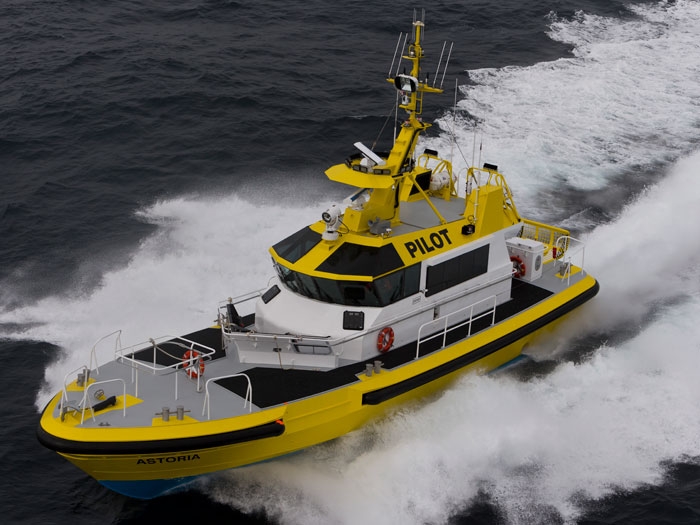
“VIDEO: New pilot boats enter service in Port of Los Angeles” –Marine Log

Just wanted to pass along this video of new pilot boats for Los Angeles found on MarineLog. Requirements for pilot boats can be similar to those for motor lifeboats. As the 52 footers are reaching the ends of their very long lives, with one taken out of service already, these might be worth a look. In some places a motor lifeboat larger than 44, might effectively replace 87 foot Marine Protector class patrol boats as well. Specs are here.

The designer of these boats, Carmarc, in the UK, also designed a larger, self-righting 29 knot 75’6″ pilot boat that was built by Kvichak Marine Industries, Seattle, WA, now Vigor, Ballard, for the Columbia River Bar Pilots. Kvichak Marine was the developer of the Response Boat, Medium, also a Carmarc design.

MARCH 19, 2014 — Seattle headquartered Kvichak Marine Industries has delivered Astoria, a self-righting 75 ft 6 in all-aluminum pilot boat, to the Columbia River Bar Pilots (CRBP) of Astoria, OR.

47 Foot MLB Service Life Extension Program

47-Foot Motor Life Boat (MLB) 47231 from Station Morrow Bay, 4 Dec 2007. Photo by Mike Baird

MarineLink reports on the Coast Guard’s service life extension program for the 47 foot motor life boats.

“In the summer of 2020, Birdon America delivered the first of the upgraded 47 MLBs which was accepted by the U.S. Coast Guard. It had passed or exceeded all the U.S. Coast Guard requirements under the contract. Birdon will now proceed with the service life extension of over 100 of these vessels built between 1997 and 2003. Work on the first boat was completed at the All-American Marine yard in Bellingham, Wash. Other west coast boats will follow. The 47 MLBs on the east coast will be upgraded at an east coast yard beginning in 2022…a pair of US-built, 6-cylinder, Cummins QSC8.3-M engines were chosen for the repower as part of the MLB Service Life Extension Program (SLEP). These EPA3-rated engines have four valves per cylinder and produce 530 BHP each at 2,600 RPM. They replace the original 435-hp Detroit 6V92TA mains. The new engines exceed the contracted requirements in terms of noise reduction and fuel economy.”

Thanks to Lee for bringing this to my attention. 

49 Foot Ice Capable Self-Righting Boat

Estonian builder Baltic Workboats has delivered a newbuild vessel to Szczecin Pilot, a Polish harbour pilots’ association that operates primarily in the Szczecin-Swinoujscie region.

Baird Maritime brings us a report on a boat with characteristics very similar to a Motor Lifeboat, but with an additional capability I had not even thought about for this type vessel until now. It is ice capable.

“The hull is reinforced to withstand light ice conditions relevant to the southern Baltic and Danish waters, a necessity for the vessel’s operational area of Poland’s Świnoujście and Szczecin harbours. She can handle 30 centimetres (about 12 inches–Chuck) of broken ice or five centimetres (about 2 inches–Chuck) solid ice at up to five knots.”

The boat’s surface piercing bow design is claimed to reduce vertical acceleration 40% and improve fuel economy up to 30%.

Dimensions are:

  • Length: 14.95 m (49′)
  • Beam: 4.5 m (14’9″)
  • Draft: 1.33 m (4’4″)

Max Speed: 27 knots

The wheelhouse offers nearly 360-degree visibility. The captain has a center position with uninterrupted views of the deck and boarding areas with additional skylight windows.