“Coast Guard Cutter Bertholf arrives in Singapore”

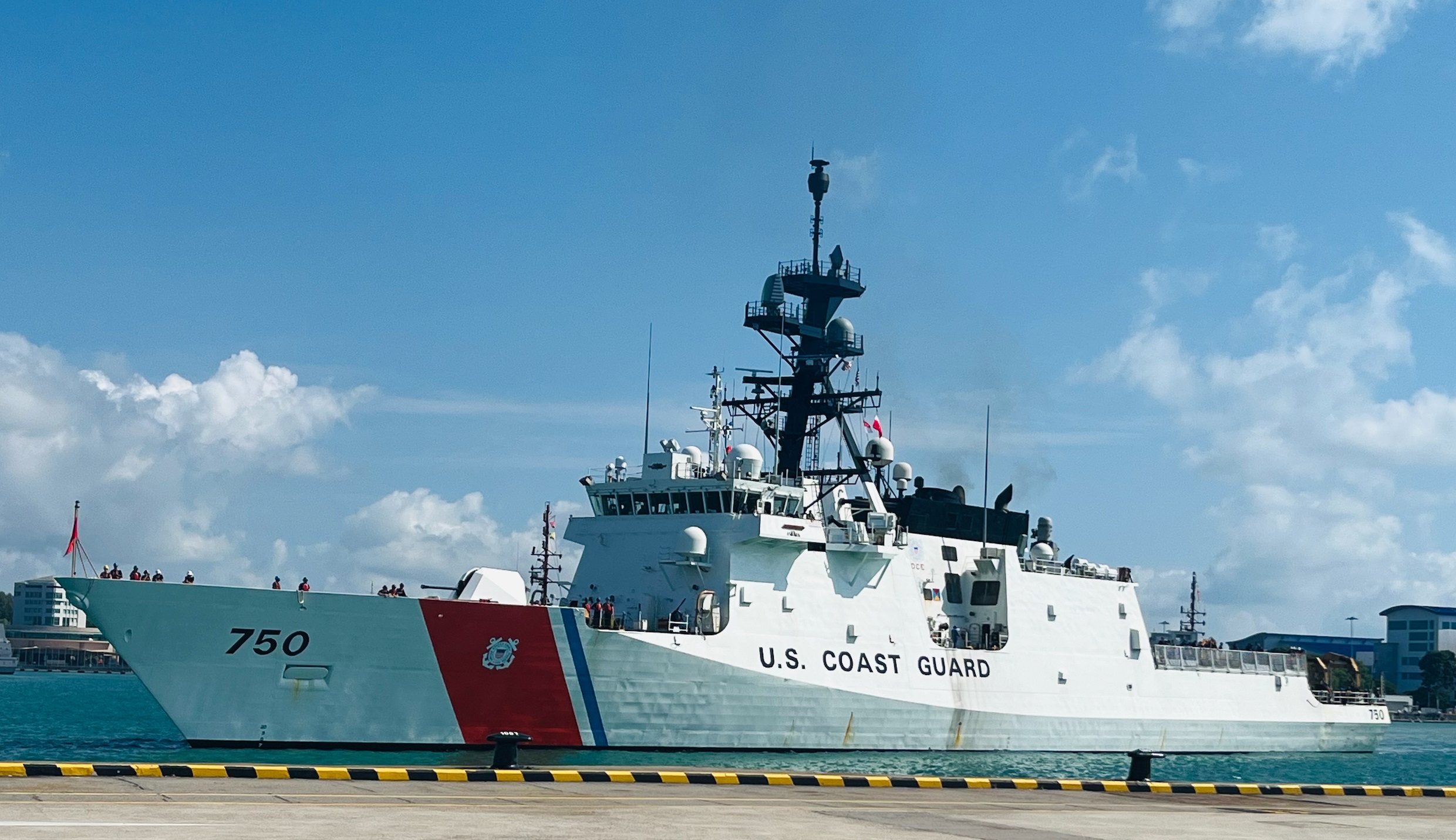
U.S. Coast Guard Cutter Bertholf (WMSL 750) arrives at Changi Naval Base in Singapore, Feb. 25, 2024. The Bertholf moored next to USS Gabrielle Giffords (LCS 10), a U.S. Navy Littoral Combat Ship, also in the region to support an open Indo-Pacific region. (U.S. Coast Guard photo by Cmdr. Trevor Parra)

Below is a US Coast Guard news release. You can find more photos at the link. 


March 5, 2024

Coast Guard Cutter Bertholf arrives in Singapore

SINGAPORE – U.S. Coast Guard Cutter Bertholf (WMSL 750) and crew arrived in Singapore, Feb. 25, after transiting more than 8,000 nautical miles over 30 days from San Diego, Calif.

During the visit to the Republic of Singapore, the crew of the cutter is scheduled to participate in several professional engagements and at-sea exercises.

The two-day professional meetings will allow for collaboration, exchanges of best practices, and operational planning for the scheduled two-day exercises at-sea with the Republic of Singapore Navy vessel, Guardian. In addition to the Republic of Singapore Navy, the crew of the Bertholf intend to work with the Singapore Police Coast Guard and Malaysia Maritime Enforcement Agency.

“The crew of the Bertholf is excited to be in Singapore and looking forward to the many events with the crew of the Republic of Singapore Navy, Police Coast Guard, and Malaysia Maritime Enforcement Agency,” said U.S. Coast Guard Capt. Billy Mees, commanding officer of the Bertholf. “The Indo-Pacific region is a dynamic environment and fostering partnerships with our allied nations helps ensure we improve maritime governance in these crucial economic waterways.”

Bertholf is one of four National Security Cutters homeported in Alameda. The U.S. Coast Guard currently maintains 10 National Security Cutters. Bertholf is operating as part of Commander, Task Force (CTF) 71, U.S. 7th Fleet’s principal surface force, promoting a free and open Indo-Pacific, strengthening partner networks, and enhancing maritime safety and security.

Bertholf is the first legend-class national security cutter and has a range of 12,000 nautical miles, endurance of up to 90 days and can hold a crew of up to 170. Coast Guard Cutter Bertholf is homeported in Alameda, Calif.

“Replacing a Legend: The Next Generation National Security Cutter” –USNI

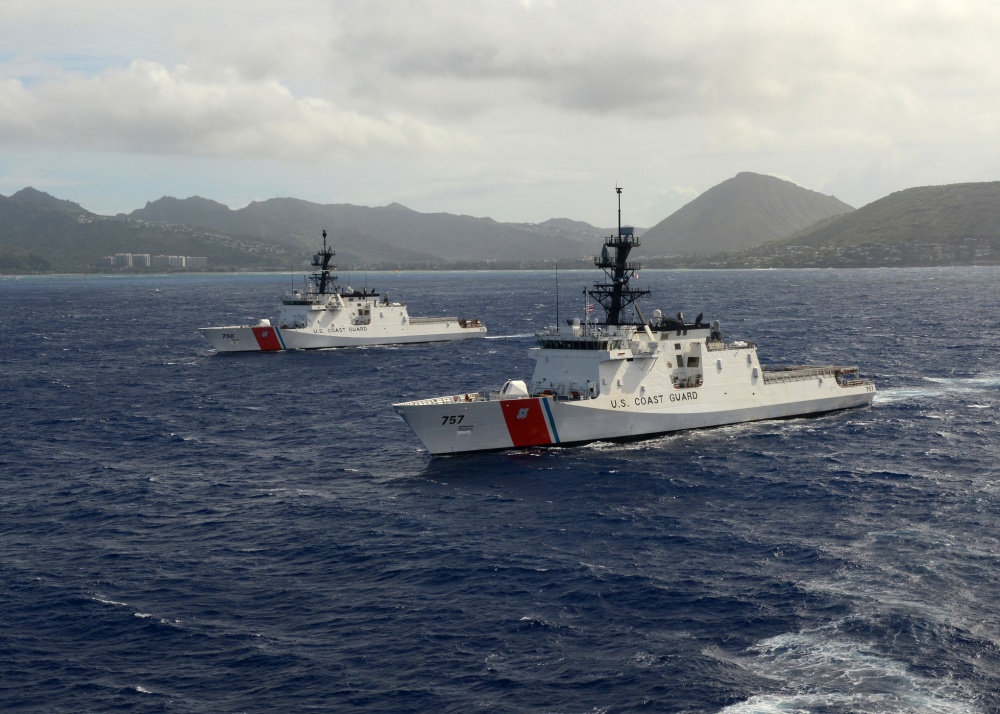
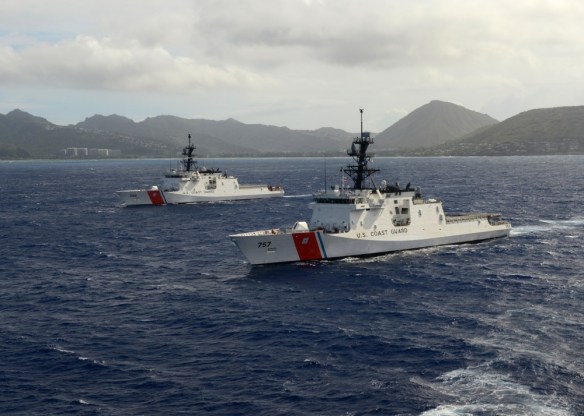
The crews of the Coast Guard Cutters Midgett (WMSL 757) and Kimball (WMSL 756) transit past Koko Head on Oahu, Hawaii, Aug. 16, 2019. The Kimball and Midgett are both homeported in Honolulu and two of the newest Coast Guard cutters to join the fleet. (U.S. Coast Guard photo by Petty Officer 3rd Class Matthew West/Released)

Sorry, this is late. I got bogged down in details. So, this is a streamlined commentary, but I hope still relevant. 

The December 2023 issue of US Naval Institute Proceedings has an article by Lieutenant Brian Adornato, U.S. Navy Reserve, suggesting it is time to consider designing a replacement for the Bertholf class National Security Cutters.

He points out that, based on the history of the Offshore Patrol Cutter and the Polar Security Cutter, it now typically takes 14 years from project initiation to commissioning.

“The Coast Guard began discussions with industry regarding the medium-endurance cutter replacement, the offshore patrol cutter (OPC), in 2010. The first OPC is scheduled to commission in 2024.2 The initial integrated product team for the next heavy ice breaker, the polar security cutter (PSC), was assembled in 2013, and the first ship is scheduled for delivery in 2028.3 The first NSC was commissioned in 2008 with a service life of 30 years, so the Coast Guard must start the process now to field the NSC(X) in 2038.

The Coast Guard is going to have to change its behavior if we are going to start replacing National Security Cutters (NSC) when they are “only” 30 years old. But even if we don’t, that doesn’t mean we should not be considering new cutter designs.

The first NSC was commissioned more than 15 years ago so its concept and requirements really originated more than 20 years ago and there is still one more ship that has not been delivered yet.

The OPCs’ concept was firmed up more than 10 years ago and the last is not expected to be delivered until 2038. That would be more than 25 years from concept to deployment of the last ship. I don’t think it will happen. I don’t think it should happen. It would be putting our collective brains on cruise control.

Instead, we should periodically reevaluate. One design may not be the most economical way to meet all our needs where weather, endurance, speed, and facilities vary from location to location. Trying to meet the most demanding requirements of every possible environment may preclude building enough ships to do all the missions well.

We know the Coast Guard has completed a new Fleet Mix Study. It has not been made public, but you can bet it suggests we need more large patrol ships. The original 2009 Fleet Mix Study indicated we would need 66 large cutters (NSCs and OPCs) to meet all our statutory mission requirements, and if anything, our commitments seem to have increased.

In 2000, when the program of record was being formulated, the Coast Guard had 44 patrol ships of six classes, each over 1000 tons full load. (12 x 378s, 13 x 270, 16 x 210, Alex Haley, Acushnet, and Storis).

Ships were distributed in recognition of their relative strengths and weaknesses. Stout, very sea worth, but relatively slow ships, Alex Haley, Acushnet, and Storis were based in Alaska to do fisheries patrol. 10 of 12 WHEC378s were assigned to the Pacific to take advantage of their long legs and seakeeping to conduct Alaska Patrol and deal with the great distances in the Pacific. 210s were generally assigned to where the weather was more benign, so that their small size was not a significant disadvantage. 270s, more seaworthy than the 210s, but not really suitable for Alaska Patrol, were generally assigned to more Northerly East Coast homeport from which they did fisheries and drug enforcement.

The original Program of record would have provided only two classes totaling 33 large patrol ships (8 NSCs and 25 OPCs). Congress has added three NSCs so it looks like we are working toward 36 (11 NSCs and 25 OPCs)

Once the announced decommissionings are completed, looks like we will have 33 (10 NSCs, 13 x 270s, Alex Haley, and 9 x 210s). I don’t expect any numerical increase as the last NSC and OPCs are completed and WMECs are decommissioned. Certainly, if we proceed as planned, we can’t expect to have even 36 until the completion of the OPC program in 2038.

The last Fleet Mix Study did not attempt to identify minimum requirements for different mission sets, rather it considered using only the NSC, OPC, and FRC as possible alternatives. This meant that the cutters might be “over qualified,” for specific missions and locations, because alternatives with different sets of characteristics were not considered. Being overbuilt may not sound like a bad thing, but if it means you can’t build as many ships as you need, it is.

The out years on the contracts we have are options. If the Coast Guard determines that it would be better served by contracting for a different design in the out years, the Coast Guard is free to do so, and, at this time, there are not even options for the last ten OPCs.

We know change is the only constant. Demands on the Coast Guard change. What the Coast Guard does changes. Technology options change. Threats change. I would argue the Defense Readiness mission has taken on increased urgency.

We need to reevaluate periodically. We really should have at least two broad classes of patrol cutters, the larger more capable ship that can operate in the most demanding environments and a second more numerous type to operate in the more typical circumstance. You can’t really say that is the case if we only have NSCs and OPCs, their size and capabilities are too similar. I am not a particular fan of the HEC/MEC designations, but it is a familiar construct that conveys the idea (why not WPL and WPM, Coast Guard Patrol Large and Patrol Medium).

Designs need to be reevaluated at least every ten years, we might decide to continue to build what we are building, but that should be a conscious decision, not just sleepwalking.

We could do it as rotating five year programs. I would suggest we need a true medium cutter than can be built in larger numbers than the OPC first and then look at designs for a new large cutter. That would still give us time to go through all the steps that seem to be necessary to design and contract for a ship.

The designs of the NSC and OPC were about ten years apart and it has now been more than ten years since the design of the OPC. We should not let our design and contracting skills atrophy. It is time to at least start the process to see if we cannot come up with a better design to address our changing requirements.

We should never stop building patrol cutters. I suspect we need more than 60. We really should be producing two per year, either one large patrol cutter and one medium patrol cutter or two medium patrol cutters every year.

“SNA 2024: Adaptable Deck Launcher, MK 70 Missile Launcher, PAC-3 Missile and SPY-6 Radar” –Video

The video above is from Naval News via Youtube.

Just wanted to point out that, should a need arise to equip the NSCs, OPCs, or even icebreakers for combat, there are two options in the video above:

As to alternatives, on the NSCs, we know they were designed to be able to accept twelve MK56 VLS and could probably accept eight Mk41 VLS in their normal deck penetrating configuration. Using quad packed ESSMs this could allow them to carry up to 32 ESSMs or alternately perhaps 16 ESSMs and four vertical launch ASROC. (Since the latest versions of the ESSM are fire and forget weapons that no longer require an “illuminator,” it now requires less supporting electronics and can engage more than one target at a time.) 

I know of no information publicly available that suggests planned upgrades for the OPCs, although I did speculate, “What Might a Wartime OPC Weapons Fit Look Like?

The Mk70 would probably just be a temporary install on the flight deck to meet the requirements of a planned operation, but there is little doubt we could put at least four strike length four tube launchers, on NSCs, OPCs, or icebreakers.

For the OPC, the Adaptable Deck Launcher is a possible more permanent installation and would probably be mounted on the Focs’le. Weight and space requirements might mean a trade-off would be required. Loss of the 57mm in exchange for even four Mk41 tubes might be worthwhile, but we might also consider replacing the gun with eight deck penetrating Mk41 cells. If Strike length cells proved impossible, tactical length cells could still provide weapons with anti-air, anti-surface, and ASW capabilities we do not have with the 57mm.

Potential Mk41 VLS weapons load outs for tactical and strike length launchers.


“Coast Guard releases request for proposal for maritime unmanned aircraft system services” –CG-9

The unmanned aircraft sensor payload capability is varied based on the Coast Guard’s desired mission and search conditions: MWIR 3.5 is a mid-wave infrared for thermal imaging capability, for use at night or periods of low visibility; EO-900 is a high-definition telescopic electro-optical (EO) imager to zoom in on targets at greater distance; and ViDAR is a visual detection and ranging wide-area optical search system that is a comprehensive autonomous detection solutions for EO video. Courtesy Photo.

Below is a news release from the Acquisitions Directorate (CG-9). The solicitation is for Group 2 or 3 UAS.

The minimum performance specifications are not particularly demanding, including:

  • 50 knot cruise speed,
  • 70 knot dash speed,
  • 12 hours daily continuous coverage, but that could include two sorties,
  • Range 40 nmi in clear conditions, 35 nmi in light rain,
  • Operate from a flight deck 80 x 48 feet (Host Cutter drawings provided are for NSC, but also presumably OPCs. Not likely for icebreakers or Alex Haley because they have no air search radar, see below) within limits:  pitch +/- 3 degrees, roll +/- 5 degrees.
  • The UA must have space, weight, and power to concurrently operate vendor
    provided: Electro-Optical (EO) sensor, Infra-Red (IR) sensor, AIS, VHF/UHF
    communications relay, aeronautical transponder, and non-visible IR marker for
    the required flight endurance. (I found no minimum payload weight.)

There are some interesting specifications that may reflect how the systems are used.

  • The UA must provide a non-visible, near-IR marker or FDA approved illuminator to
    aid manned assets using NVDs for target acquisition at night
  • The UAS must be capable of operations in light icing conditions defined as
    accumulation of ¼ inch of ice in 15-20 minutes (Objective)(so not a minimum requirement–Chuck)
  • The UA must have an Infrared (IR) anti-collision lighting subsystem (providing a night visibility range of 3+ statute miles) producing energy emitted in a 360-degree pattern around the UA +30 degrees (above) and -30 degrees (below) the horizontal plane of the UA. The IR-light intensity must be at least of a Class B Night Vision Imaging System (NVIS) radiant intensity (NRIb) of 2.31 E -04 NRI. The Ground Control Station must have the capability to turn the IR anti-collision light on or off.
  • In addition to other sensor requirements identified in this document, when such a
    system is commercially available, the UA must be capable of incorporating a
    collision avoidance system (i.e. Detect and avoid (DAA) or Sense and avoid (SAA)
    systems) to extend the UA’s range beyond the host cutter’s air search radar
    envelope while maintaining compliance with international due regard. (Objective) (Not a minimum requirement. Meaning we will likely be operating these systems without a sense and avoid system, so will have to operate within the range of the cutter’s air-search radar. Also precludes operating these systems on vessels without an air-search until such a system is installed–Chuck)
  • At an operating altitude of 3,000 feet when the UAS is directly overhead of the target of interest (no slant range), the UA must be acoustically non–detectable per MIL STD-1474 (series), Level 1, requirements (quiet rural area with the closest heavily used highway and community noises at least 2.5 miles away)
  • The Contractor provided Datalinks must be capable of operating, with
    unobstructed Line of Sight (LOS), at a minimum range of 40 nautical mile
    (NM) (threshold) / 100 NM (Objective).

This sounds very much like a continuation of the Scan Eagle operations already being conducted on National Security Cutters (here, here, here, here, and here). Forgive me if I point out that I recommended we try this system back in 2011, five years before we actually did.


Coast Guard releases request for proposal for maritime unmanned aircraft system services

The Coast Guard released a request for proposal (RFP) Dec. 12 for maritime unmanned aircraft system (MUAS) services capable of deploying from Coast Guard cutters. The services sought are for contractor-owned, contractor-operated intelligence, surveillance and reconnaissance.

Requirements for the MUAS include fully automated flight operations, a minimum 12 hours of flight time a day, ability to be launched and recovered from the host cutter flight deck, and ability to provide services 24 hours a day, seven days a week. The MUAS must be capable of carrying a payload including electro-optical and infrared sensors and communications relay and be capable of providing surveillance, detection, classification and identification for all of the host cutter’s operational missions.

The Coast Guard plans to award one indefinite-delivery, indefinite-quantity firm fixed price contract. Initially, the contract will be used to continue UAS capability on the national security cutter (NSC) class; however, the contract could be used to support additional cutter classes in the future.

The full RFP is available here. Responses are due by 1 p.m. EST Jan. 11, 2024.

For more information: Unmanned Aircraft Systems Program page

“Coast Guard Cutter Calhoun arrives to new homeport in Charleston” –News Release CG News

USCGC Calhoun 759 arrives Charleston.

Below is a news release from Coast Guard News. Once again, a new cutter is put to work even before commissioning.

Dec. 3, 2023

Coast Guard Cutter Calhoun arrives to new homeport in Charleston

NORTH CHARLESTON, S.C. — The crew of the U.S. Coast Guard Cutter Calhoun (WMSL 759) arrived at their homeport in North Charleston, Sunday, after delivery from Ingalls Shipbuilding and supporting missions throughout the Coast Guard’s Seventh and Eighth districts.

The Coast Guard accepted the delivery of the 10th national security cutter (NSC) on Oct. 13, 2023, after the initial christening ceremony in Pascagoula, Mississippi, June 4, 2022.

Calhoun is the fourth Legend-class NSC to be homeported in North Charleston, joining Coast Guard Cutters Hamilton (WMSL 753), James (WMSL 754), and Stone (WMSL 758).

Calhoun’s crew began deploying to Pascagoula in March 2023. Following an intense 37-day post-delivery period, Calhoun supported the Coast Guard’s Eighth District in response to an oil discharge approximately 20 miles northeast of the mouth of the Mississippi River in the Gulf of Mexico. Calhoun remained on scene for 48 hours, providing key offshore command and control capability to the multi-agency response.

“Our crew members have more than earned their time back home,” said Capt. Timothy Sommella, commanding officer of Calhoun. “Most of our crew has surged the past 18 months in support of other Coast Guard units to meet global commitments. The most recent deployment of over 120 days to the Gulf Coast for the cutter’s delivery and acceptance was particularly challenging but tremendously satisfying. We finally sailed away as a crew for the first time with the same commitment to excellence and determination that the ship’s namesake, the first Master Chief Petty Officer of the Coast Guard, Charles L. Calhoun, displayed during his distinguished Coast Guard career. We are incredibly thankful this time of year for the personal and professional support from our friends and loved ones who stood with us, and we will continue to forge those bonds, whether at sea or ashore.”

During the remainder of Calhoun’s first patrol, Calhoun provided a forward presence in support of Homeland Security Task Force-Southeast and Operation Vigilant Sentry within the Coast Guard Seventh District’s area of responsibility to deter irregular migration and save lives in the South Florida Straits while testing its vital equipment, systems, and completing required training.

“It is a privilege to be a part of such an amazing team of professionals,” said Senior Chief Petty Officer Aaron Deluca, Calhoun’s command senior enlisted leader. “Having completed the challenges of acceptance, training, and sailing one of the most technologically advanced assets in the Coast Guard, I am excited to bring cutter Calhoun to its homeport and the community of Charleston.”

Calhoun is named to honor the first Master Chief Petty Officer of the Coast Guard, Charles L. Calhoun, who was from Ocean City, Maryland. During Calhoun’s tenure, he was responsible for improving and developing many of the Coast Guard’s administrative and people-focused programs, resulting in better communications and retention efforts within the enlisted community.

Calhoun is the newest 418-foot, Legend-class cutter to join the Coast Guard fleet. The Legend-class cutter program leads the Coast Guard’s ongoing surface fleet recapitalization and, when combined with the future offshore patrol cutters, will comprise the Coast Guard’s offshore response capability for decades to come. The cutter’s primary missions are counterdrug operations, migrant interdiction, living marine resources, defense readiness, and command and control in support of U.S. Coast Guard operations worldwide and here at home.

For information on how to join the U.S. Coast Guard, visit GoCoastGuard.com to learn about active duty, reserve, officer, and enlisted opportunities. Information on how to apply to the U.S. Coast Guard Academy can be found here.

“U.S. Coast Guard Cutter Kimball returns home following 85-day Bering Sea patrol” –CG News

Below is a news release from Coast Guard News. Looks like Kimball had an unusual Alaska Patrol, responding to the wildfire on Maui, to terminating an unsafe voyage, to shadowing a Russian naval exercise.


 Nov. 2, 2023

U.S. Coast Guard Cutter Kimball returns home following 85-day Bering Sea patrol

HONOLULU — The U.S. Coast Guard Cutter Kimball (WMSL 756) returned home to Honolulu, Wednesday, after an 85-day multi-mission patrol covering 14,000 nautical miles spanning from the Hawaiian Islands to north of the Arctic Circle.

The crew provided search-and-rescue coverage and conducted living marine resources (LMR) and counter Illegal Unreported and Unregulated (IUU) Fishing operations during the patrol following their actions responding to the Maui wildfires.

Kimball departed August 8 for the Aleutian Island chain and later that evening, the cutter received a report of people in the water attempting to escape a raging wildfire on Maui. The cutter shifted to the tactical control of Sector Honolulu and altered course to support the mass search and rescue efforts. Arriving on scene within hours, Kimball assumed the role of On Scene Commander of Coast Guard Station Maui, Coast Guard Cutter Joseph Gerczak (WPC 1126), and Air Station Barbers Point MH-65s, who collectively searched 790 square nautical miles, saved 17 lives, and assisted approximately 40 survivors ashore. During Kimball’s three days on scene, their crew launched two cutter small boats for over 25 combined hours and deployed the cutter’s UAS drone for over 8 hours of flight time, conducting search and rescue and damage assessment support.

After being relieved by Juniper, Kimball’s crew transited north to support the Coast Guard’s 17th District by providing search-and-rescue coverage and conducting LMR and counter IUU-Fishing patrols spanning the Northern Pacific Ocean, Bering Sea, and the American Arctic.

Operating under Operation Alaskan Groundfish Enforcer, Kimball ensured compliance with all federal fisheries conservation laws and safety requirements by completing 10 LMR boardings on fishing vessels in the Bering Sea. Kimball issued eight citations and one termination for gross violation of U.S. and international regulations. This resulted in the Kimball escorting the fishing vessel back to the nearest port and ensured they corrected their discrepancies.

As the sole U.S. military asset in the Bering Sea, Kimball diverted to provide presence alongside the U.S. domestic fishing fleet in the remote region of the U.S. Arctic upon receiving intelligence of a Russian military exercise within the U.S. Exclusive Economic Zone (EEZ). Kimball’s presence ensured the safety of 23 mariners while they worked within the U.S. EEZ near Russian warships as part of Operation Frontier Sentinel.

“I couldn’t be prouder of Kimball’s crew,” said Capt. Bob Kinsey, Kimball’s commanding officer. “They were able to showcase the true value that the national security cutter brings to such a dynamic area of responsibility. The crew’s diversity of skill harnessed our Coast Guard authorities and capabilities to provide tangible lifesaving results, from responding to the tragic fires in Maui to providing an influential presence in the Chukchi Sea and American Arctic to preserving the livelihoods of our Bering Sea fishermen through the enforcement of federal safety and living marine resources laws.”

To ensure crew preparation and proficiency, Kimball conducted numerous flight operations with MH-65 Dolphin and HH-60 Jayhawk helicopters and aircrews from U.S. Coast Guard Air Station Kodiak, resulting in the qualification of eight pilots and recertification of Kimball’s crew.

While in Dutch Harbor, Alaska, Kimball’s crew engaged with the local community by participating in sports at the community center, conducted cutter tours, and volunteered for community events. Notably, Kimball assisted the Museum of the Aleutians in relocating fragile gray whale fossils for a new exhibit. Kimball also met with the mayor of Dutch Harbor to discuss how the Coast Guard and the town can continue strengthening their relationship.

Commissioned in 2019, Kimball is the Coast Guard’s seventh national security cutter. National security cutters are the largest and most technologically sophisticated cutters in the Coast Guard’s white-hull fleet. National security cutters can operate in the most demanding open ocean environments, including the Bering Sea’s hazardous fisheries and the Southern Pacific’s vast approaches, where much of the American narcotics trafficking occurs. With robust command, control, communication, computers, intelligence, surveillance and reconnaissance equipment, stern boat launch and aviation facilities, as well as long-endurance station keeping, National security cutters are an afloat operational-level headquarters for complex law enforcement and national security missions involving multiple Coast Guard and partner agency participation.

-USCG-

“Coast Guard Cutter Procurement: Background and Issues for Congress, Updated Oct 19, 2023” –CRS

US Capital West Side, by Martin Falbisoner

The Congressional Research Service has again updated their “Report to Congress on Coast Guard Cutter Procurement”. (This link will always take you to the most recent edition of the report.) My last post on this evolving document was in reference to a August 30, 2022 update. I have reproduced the one-page summary in full below. It gives a good picture of where we are.

I will try to provide a little more detail after I get a chance to read the full report. Until then, remember that the full price of the ships includes much more than just the shipyard’s building costs. In addition to government furnished equipment, it includes the crew cost before the ship is accepted, their accommodations at the building site, and their training and travel. It may also include supporting shoreside infrastructure.


Summary
The Coast Guard’s program of record (POR), which dates to 2004, calls for procuring 8 National Security Cutters (NSCs), 25 Offshore Patrol Cutters (OPCs), and 65 Fast Response Cutters (FRCs) as replacements for 90 aging Coast Guard high-endurance cutters, medium-endurance cutters, and patrol craft.

National Security Cutters are the Coast Guard’s largest and most capable general-purpose cutters; they are replacing the Coast Guard’s 12 Hamilton-class high-endurance cutters. NSCs have an estimated average procurement cost of about $670 million per ship. Congress has fully funded the procurement of 11 NSCs—three more than the 8 in the Coast Guard’s POR—including the 10th and 11th in FY2018, which (like the 9th NSC) were not requested by the Coast Guard. The Coast Guard’s proposed FY2024 budget requests $17.1 million in procurement funding for the NSC program for post-delivery activities for the 10th and 11th NSCs, and for class wide activities. Nine NSCs have entered service; the Coast Guard accepted delivery of the 10th on October 13, 2023, and plans to commission it into service in 2024. The 11th is under construction.

Offshore Patrol Cutters are intended to replace the Coast Guard’s 29 aged medium-endurance cutters. Coast Guard officials describe the OPC program and the Polar Security Cutter (PSC) program (which is covered in another CRS report) as the service’s highest acquisition priorities. The first four OPCs are being built by Eastern Shipbuilding Group (ESG) of Panama City, FL. The Coast Guard held a full and open competition for a new contract to build the next 11 OPCs (numbers 5 through 15). On June 30, 2022, the Coast Guard announced that it had awarded a fixed-price incentive (firm target) contract to Austal USA of Mobile, AL, to produce up to 11 offshore patrol cutters (OPCs). The Coast Guard’s proposed FY2024 budget requests $579.0
million in procurement funding for the construction of the sixth OPC, the procurement of Long Lead Time Materials (LLTM) for the seventh OPC, and other program costs.

One oversight issue for Congress concerns substantial cost growth and schedule delays in the OPC program. A June 2023 Government Accountability Office (GAO) report on the OPC program states “The OPC’s total acquisition cost estimate increased from $12.5 billion to $17.6 billion between 2012 and 2022. The program attributes the 40 percent increase to many factors, including restructuring the stage 1 contract [for OPCs 1 through 4] and recompeting the stage 2 requirement [for OPCs 5 through 15] in response to a disruption caused by Hurricane Michael, and increased infrastructure costs for homeports and facilities, among other things. In addition, the program incurred a 1.5-year delay in the delivery of the first four OPCs due to Hurricane Michael and issues related to manufacturing the cutter’s propulsion system. GAO also found indicators that the shipbuilder’s significant level of complex, uncompleted work may lead to further delays.”

Fast Response Cutters are considerably smaller and less expensive than OPCs; they are replacing the Coast Guard’s 49 aging Island-class patrol boats. The Coast Guard’s FY2020 budget submission estimated the total acquisition cost of the 58 cutters intended for domestic use at $3.748 billion, or an average of about $65 million per cutter. A total of 65 FRCs have been procured through FY2023. As of August 10, 2023, 53 FRCs have been commissioned into service. The Coast Guard’s proposed FY2024 budget requests $20.0 million in procurement funding for the FRC program; this request does not include funding for procuring any additional FRCs. The Coast Guard’s FY2024 Unfunded Priorities List (UPL) includes, as one of its items, an unfunded priority for procuring four more FRCs (which would be the 66th through 69th in the program) for a combined procurement cost of $400.0 million, or an average of $100 million per
cutter, to provide increased Coast Guard presence and engagement with allied and partner countries in the Indo-Pacific region

NSC #10 Delivered

Former Master Chief of the Coast Guard, Vince Patton, reported his attendance at the delivery ceremony for the tenth National Security Cutter on the Coast Guard Retired Veterans Facebook page,

“An enjoyable day with the crew of the USCGC CALHOUN as it has officially been signed over to the USCG today. The CALHOUN will be officially commissioned on April 20, 2024 in Baltimore, MD.”

The ship is expected to be homeported in Charleston, SC.

“US Coast Guard cutter provides presence during Russian military exercise in Bering Sea ” –D17

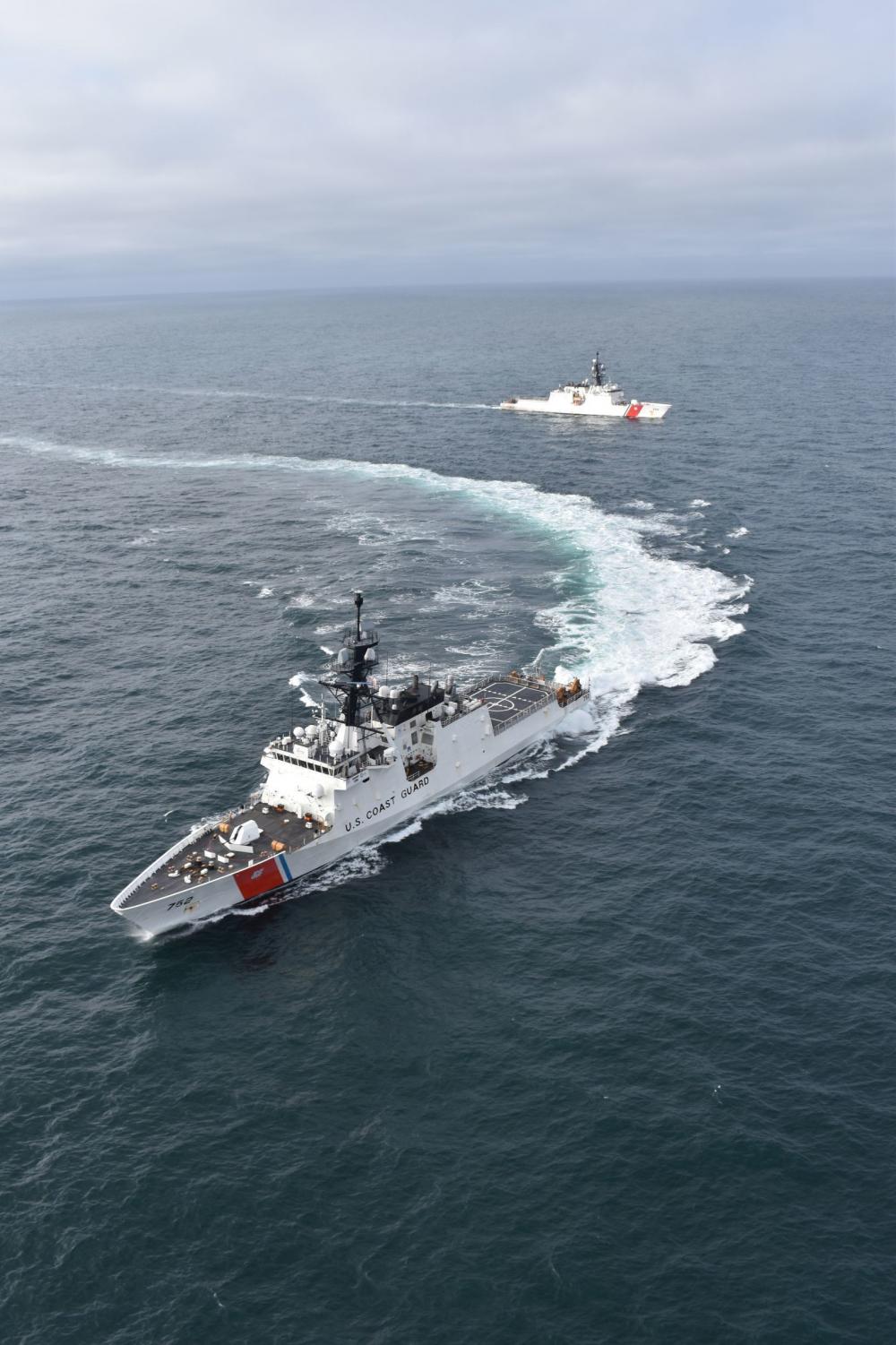
U.S. Coast Guard Cutters Stratton (WMSL 752) and Kimball (WMSL 756) steam in formation while patrolling the U.S.-Russian Maritime Boundary Line (MBL), in the Bering Sea, Sept. 26, 2022. This marked the first time two national security cutters jointly patrolled the MBL above the Arctic Circle. (U.S. Coast Guard courtesy photo).

Below is a District 17 (Alaska) News Release

Sept. 18, 2023

US Coast Guard cutter provides presence during Russian military exercise in Bering Sea

D17 Public Affairs

JUNEAU, Alaska – The crew of Coast Guard Cutter Kimball (WMSL 756), in coordination with U.S. Northern Command, provided U.S. presence during a Russian military exercise in the Bering Sea, Friday.

The Kimball patrolled in the vicinity of U.S. fishing vessels conducting their work in international waters within the U.S. exclusive economic zone (EEZ) during ongoing Russian military operations, which included the launch of a missile, approximately 300 miles southwest of St. Lawrence Island.

“Though military operations and exercises in international waters are lawful,” said Rear Adm. Megan Dean, Seventeenth Coast Guard District commander, “we will continue to ensure there are no disruptions to U.S. interests or commerce in the maritime environment around Alaska.”

On Sept. 10, an urgent warning of navigational dangers advisory message, known as a HYDROPAC, was released through the National Geospatial Agency regarding Russian military operations in the Bering Sea. The area of the HYDROPAC includes a portion of the U.S. EEZ southwest of St. Lawrence Island along the U.S./Russia Maritime Boundary Line and remains in effect through Sept. 24.

The Coast Guard notified vessels and the commercial fishing industry operating in the vicinity of the HYDROPAC, and made notifications to federal, state and tribal governments about the exercise. The Coast Guard continues to provide notifications throughout the maritime and fishing industry by all available means.

The Kimball, a 418-foot legend-class national security cutter homeported in Honolulu, Hawaii, is currently operating under the Seventeenth District’s Operation Frontier Sentinel.

Operation Frontier Sentinel is a Seventeenth Coast Guard District operation designed to meet presence with presence and ensure there are no disruptions to U.S. interests in the Alaskan maritime environment. The Coast Guard routinely patrols international waters under the service’s statutory authorities to ensure maritime safety and security of the U.S. maritime industry, to protect U.S. sovereign rights and to promote international rules-based order. Coast Guard presence ensures due regard for all lawful uses of the seas.

“USNI News Fleet and Marine Tracker: Aug. 21, 2023”

USCGC Munro (WMSL-755) escorts USNS Fisher (T-AKR-301) in the East China Sea on Aug. 12, 2023. US Navy Photo

Looking at the latest US Naval Institute “Fleet and Marine Tracker,” I am a bit surprised to see there are still 3 Navy ships operating under 4th Fleet, presumably doing drug interdiction. This is an uptick.

Again, they report on atypical Coast Guard operations:

  • Legend-class National Security Cutter USCGC Munro (WMSL-755) departed South Korea last week and is in the Korea Strait. (As I mentioned earlier, there is a possibility, cutters may encounter the new North Korean corvettes.)
  • Coast Guard Cutter USCGC Healy (WAGB-20) continues its work in the Beaufort Sea. Healy is on a five-month deployment in partnership with ONR and the National Science Foundation.
  • Coast Guard Cutter USCGC Forward (WMEC-911) is currently supporting Operation Nanook. Operation Nanook is an annual Canadian-led exercise that fosters international cooperation and shared responsibility in the Arctic and the northern Atlantic Regions. The cutter recently made a port call in Nuuk, Greenland.

You can use Control F “USCGC” if you want to quickly find the Coast Guard cutters mentioned in the USNI posts.

PATFORSWA is mentioned again.

The link in the Healy entry, “U.S., Canadian Icebreakers Conduct Operation, Rendezvous en Route to Arctic Ocean” is interesting, plus there is more in the USNI post including an “adorable” polar bear photo.