US Navy Securing the Southern Border?

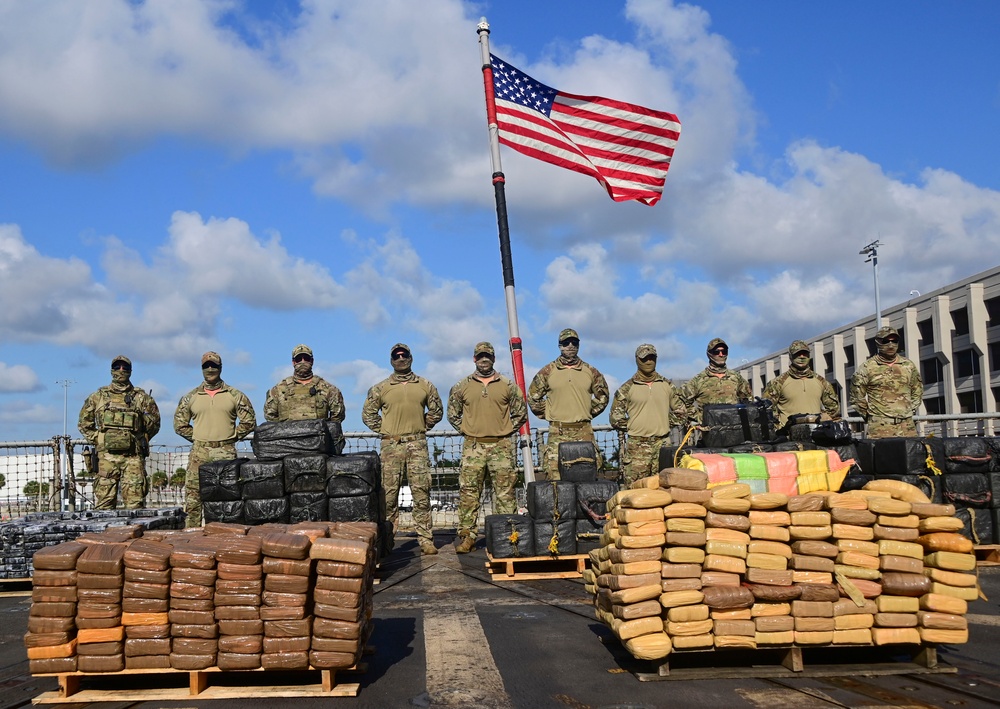
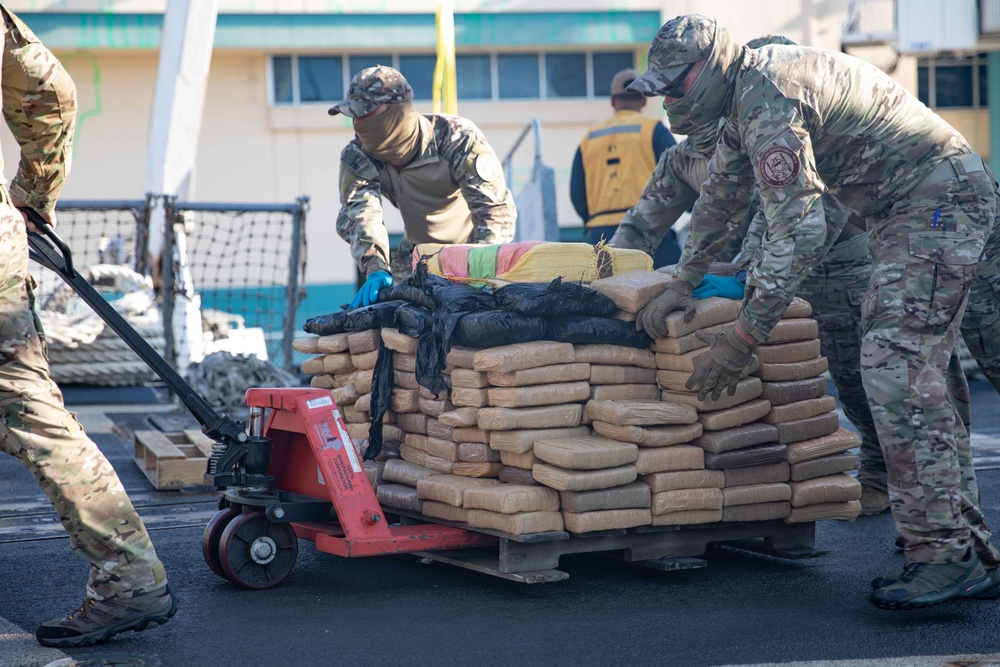
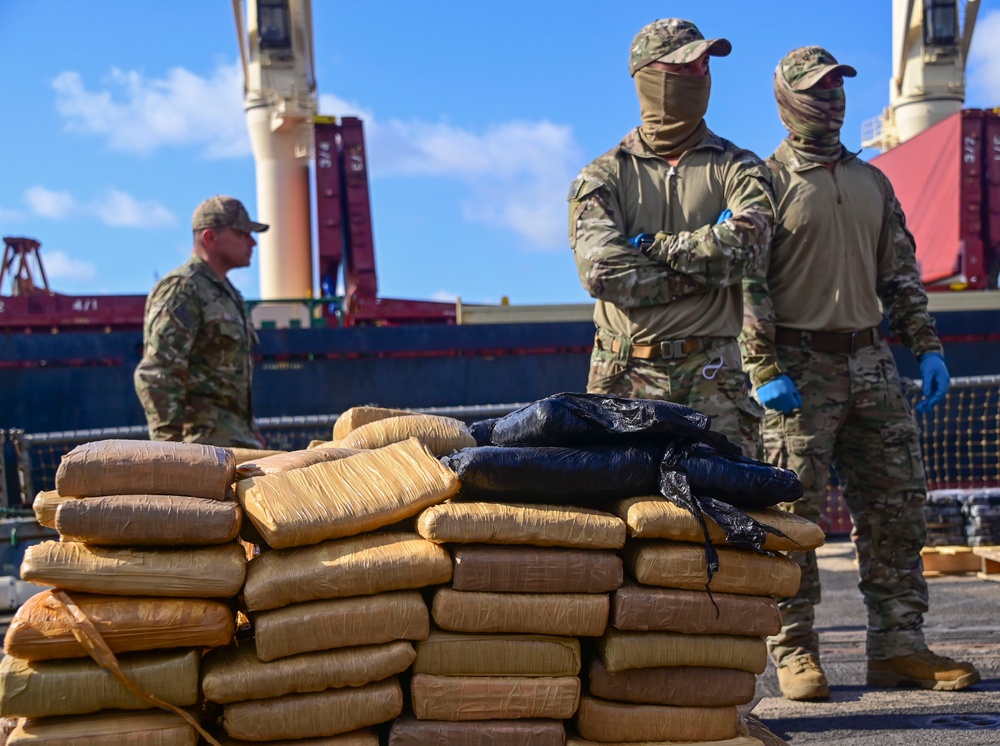
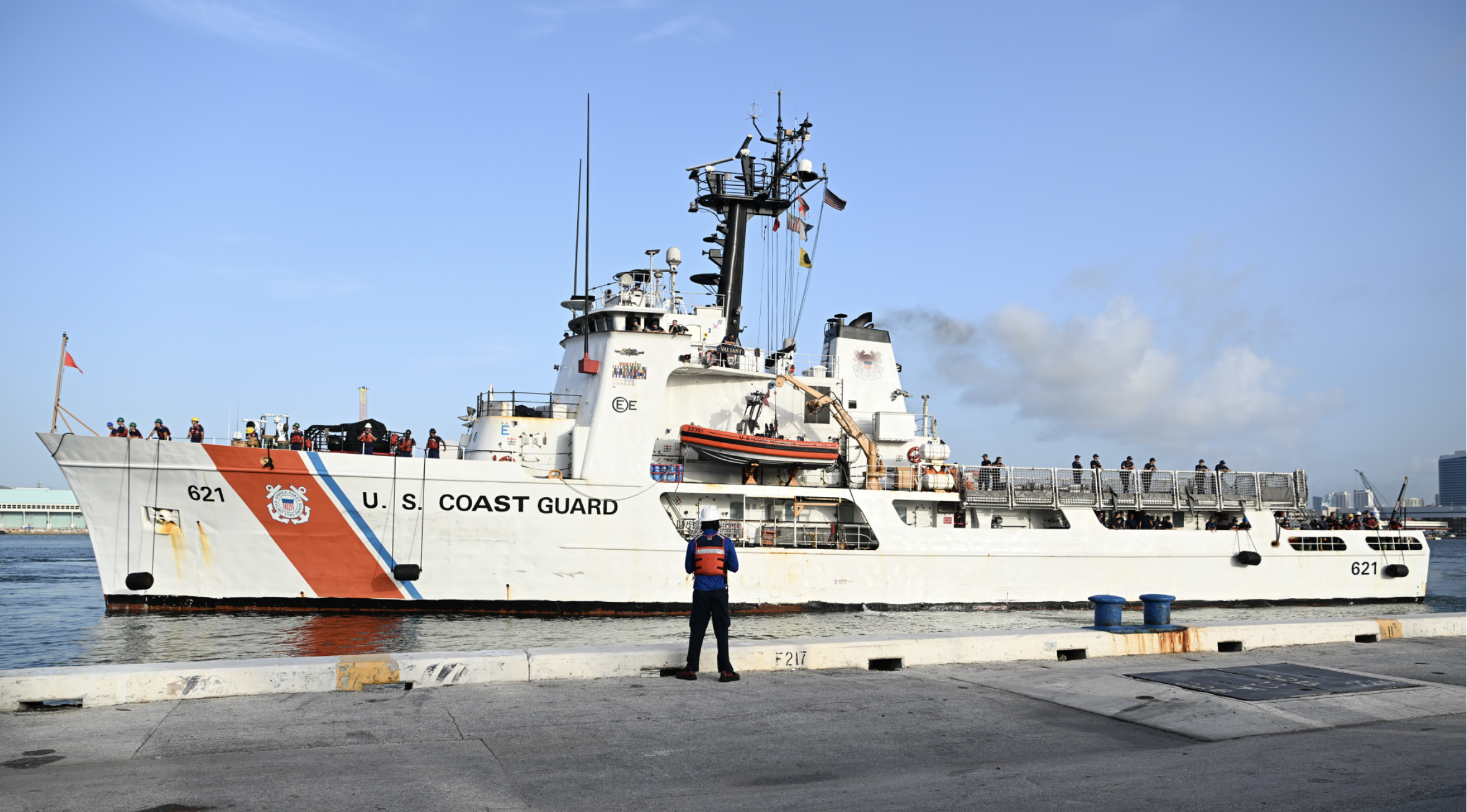
USCGC Valiant (WMEC 621) crew moors at Port Everglades in Fort Lauderdale, Florida, June 6, 2025. The Valiant crew offloaded more than $132 million in illicit drugs interdicted in the Caribbean Sea. (U.S. Coast Guard photo by Petty Officer 1st Class Diana Sherbs)

Below the line is a Coast Guard News release. 

It includes a report of offload of drugs seized by USS Gravely.

Since March the Navy has kept two or three ships deployed to “secure the Southern Border” against illegal immigration and drug smuggling.

Departures of US Navy destroyers were widely reported, frequently with implications that the Coast Guard had not been paying attention to the Southern border or that the Coast Guard was incapable. Center for Strategic and International Studies stated,

First and foremost, the deployments send a powerful signal that the United States is taking border security, and the Western Hemisphere more broadly, seriously. In a statement from U.S. Northern Command (NORTHCOM) upon deployment of the Spruance, the ships will “restore territorial integrity at the U.S. southern border” and will support operations related to “combating maritime related terrorism, weapons proliferation, transnational crime, piracy, environmental destruction, and illegal seaborne immigration.” The tasking of some of the United States’ most exquisite naval capabilities to support Southwest border operations accordingly provides yet another indicator that a strategic pivot to the Western Hemisphere in general, and the U.S.-Mexico border in particular, is well underway.

The DDGs are marvelous ships as demonstrated by their performance against the Houthis in the Red Sea. Their more sophisticated sensors were also touted, but the results have been underwhelming.

Results:

So what happened? Let’s give credit where credit is due.

Guided missile destroyers involved, as far as I can determine, have been USS Gravely, USS Spruance, USS Stockdale which replaced Spruance in mid April, USS Cole which very recently replace Gravely, and Sampson which just replaced Stockdale.

As far as I can tell, the interdiction of 840 pounds of cocaine valued $13.7M by USS Gravely, which deployed March 15, reported below, is the only interception of drugs reported by a destroyer in the almost three months since their intervention began.

By comparison:

USS Minneapolis-Saint Paul (LCS-21) which deployed March 25 has made three interdictions. USS Charleston Deployed May 21. I presume she is replacing Minneapolis-Saint Paul. The first two resulted in seizure of 580 kilograms (1,279 pounds) of cocaine valued at $9,463,860 and 1,125 kilograms (2,480 pounds) of marijuana valued at $2,807,360. I was not able to find similar figures for the third.

In an earlier post I posted the results of drugs landed on thirteen different occasions from February 13 to May 2, 2025 comparing interdictions in the Eastern Pacific with those made in the Atlantic, Gulf, and Caribbean. In total 168,574 pounds or more than 84 tons, valued at $1,702.9 million. There have been additional offloads since then including the one below.

That is 196 times as much as was seized by Navy Destroyers. Only a very small part of which was marijuana rather than cocaine, none of which was seized in the Eastern Pacific. Notably no Fentanyl was included.

Our Canadian and Netherlands Navy partners each seized more contraband than the US Navy this period.

Why the poor showing?:

Functionally the DDGs should have been at least as effective as other units doing this mission, so why weren’t they more effective?

I think because they were looking in the wrong place.

Early announcements seem to indicate they primarily being deployed primarily to interdict immigrants with drug interdiction a secondary mission, but as I noted in the earlier post,

Perhaps surprisingly, cutters in the Western Atlantic areas looking for drugs don’t intercept many migrants and cutters looking for migrants don’t find much in the way of drugs or even migrants. There were four WMEC patrols identified as looking for migrants. None of the four found any drugs. One intercepted no migrants. The three remaining patrols intercepted a total of 184.

The West coast deployment seems to have been in vicinity of San Diego. Most drug interdictions in the Pacific happen off the Central and South American coast.

There has been something of a surge in maritime illegal migrant interdictions on the West Coast but they have been concentrated close to shore near San Diego and the Mexican border, using recreational style small craft, but the totals are still relatively small.

As far as I have heard (and I think I would have) none of the US Navy ships have intercepted any immigrants.

Other thoughts:

Any assistance the Navy might provide is always welcome, but any implication that the Coast Guard has not been working the problem with considerable success, limited only by resources available, is unfair. There simply is no such thing as 100% secure.

The Navy has also provided additional ISR resources. Both the Navy and Coast Guard can only benefit from better Maritime Domain Awareness even if the information is used for different purposes.

Having an alert, active DDG positioned off US naval bases (like San Diego) might be a good idea since, as yet, we really have no land based missile defenses capable of countering cruise missiles that might be launched from container ships in an initial surprise attack.


June 6, 2025

Coast Guard offloads more than $138 million in illicit drug interdictions in Caribbean Sea

Coast Guard Seventh District – 786-367-7649

MIAMI –U.S. Coast Guard Cutter Valiant’s crew offloaded 17,450 pounds of cocaine and 2,585 pounds of marijuana worth $132 million, Friday, at Port Everglades.

U.S. Coast Guard Cutter Vigorous crew offloaded approximately 840 pounds of cocaine worth an estimated $6.2 million, Thursday, at Coast Guard Base Miami Beach.

The seized contraband was the result of six interdictions in the Caribbean Sea by Coast Guard and interagency partners.

“I am incredibly proud of our Valiant team and how they exemplify American values. They sacrifice time away from their families and when necessary, put themselves in harm’s way to secure our borders and protect the American people,” said Cmdr. Matthew Press, commanding officer of Valiant. “Collaborating with the United States Navy, Royal Canadian, and Royal Netherlands Navies, our multinational team disrupted transnational criminal organizations making the world a safer place.”

On May 19, a maritime patrol aircraft located a suspicious vessel approximately 85 miles north of Aruba. Valiant’s crew interdicted the vessel and seized approximately 2,645 pounds of cocaine.

On May 22, a maritime patrol aircraft located a suspicious vessel approximately 170 miles north of Aruba. Valiant’s crew interdicted the vessel and seized approximately 7,750 pounds of cocaine.

On May 25, a maritime patrol aircraft located a suspicious vessel approximately 290 miles south of the Dominican Republic. USS Gravely’s crew and embarked U.S. Coast Guard Law Enforcement Detachment 401 interdicted the vessel and seized approximately 840 pounds of cocaine. The narcotics were transferred to the Vigorous.

On May 29, a maritime patrol aircraft located a suspicious vessel approximately 140 miles south of the Dominican Republic. His Majesty’s Canadian Ship William Hall’s crew and embarked Coast Guard LEDET 103 interdicted the vessel and seized approximately 750 pounds of cocaine. The narcotics were transferred to the Valiant.

On May 29, a maritime patrol aircraft located a suspicious vessel approximately 15 miles north of Venezuela. The Royal Netherlands Navy ship HNLMS Friesland crew and embarked Coast Guard LEDET 404 interdicted the vessel and seized approximately 4,050 pounds of cocaine and 2,585 pounds of marijuana. The narcotics were transferred to the Valiant.

On May 31, a maritime patrol aircraft located a suspicious vessel approximately 185 miles north of Colombia. HMCS William Hall’s crew and embarked Coast Guard LEDET 103 interdicted the vessel and seized approximately 2,250 pounds of cocaine. The narcotics were transferred to the Valiant.

The following crews assisted with interdiction operations:

Detecting and interdicting illicit drug traffickers on the high seas involves significant interagency and international coordination. Joint Interagency Task Force-South, in Key West, conducts the detection and monitoring of aerial and maritime transit of illegal drugs. Once an interdiction becomes imminent, the law enforcement phase of the operation begins, and control of the operation shifts to the U.S. Coast Guard for the interdiction and apprehension phases. Interdictions in the Caribbean Sea are performed by members of the U.S. Coast Guard under the authority and control of the Seventh Coast Guard District, headquartered in Miami.

These interdictions relate to Organized Crime Drug Enforcement Task Forces’ Strike Force initiatives and designated investigations. OCDETF identifies, disrupts, and dismantles the highest-level criminal organizations that threaten the United States using a prosecutor-led, intelligence-driven, multi-agency approach. Additional information about the OCDETF program can be found at https://www.justice.gov/OCDETF.

USCGC Valiant is a 210-foot medium endurance cutter homeported in Jacksonville under U.S. Coast Guard Atlantic Area Command.

USCGC Vigorous is a 210-foot medium endurance cutter homeported in Virginia Beach, Virginia under U.S. Coast Guard Atlantic Area Command.

For breaking news, follow us on X (formerly Twitter). For additional information, find us on Facebook and follow us on Instagram.
“USS Minneapolis-Saint Paul Makes Multiple Drug Busts” –4th Fleet

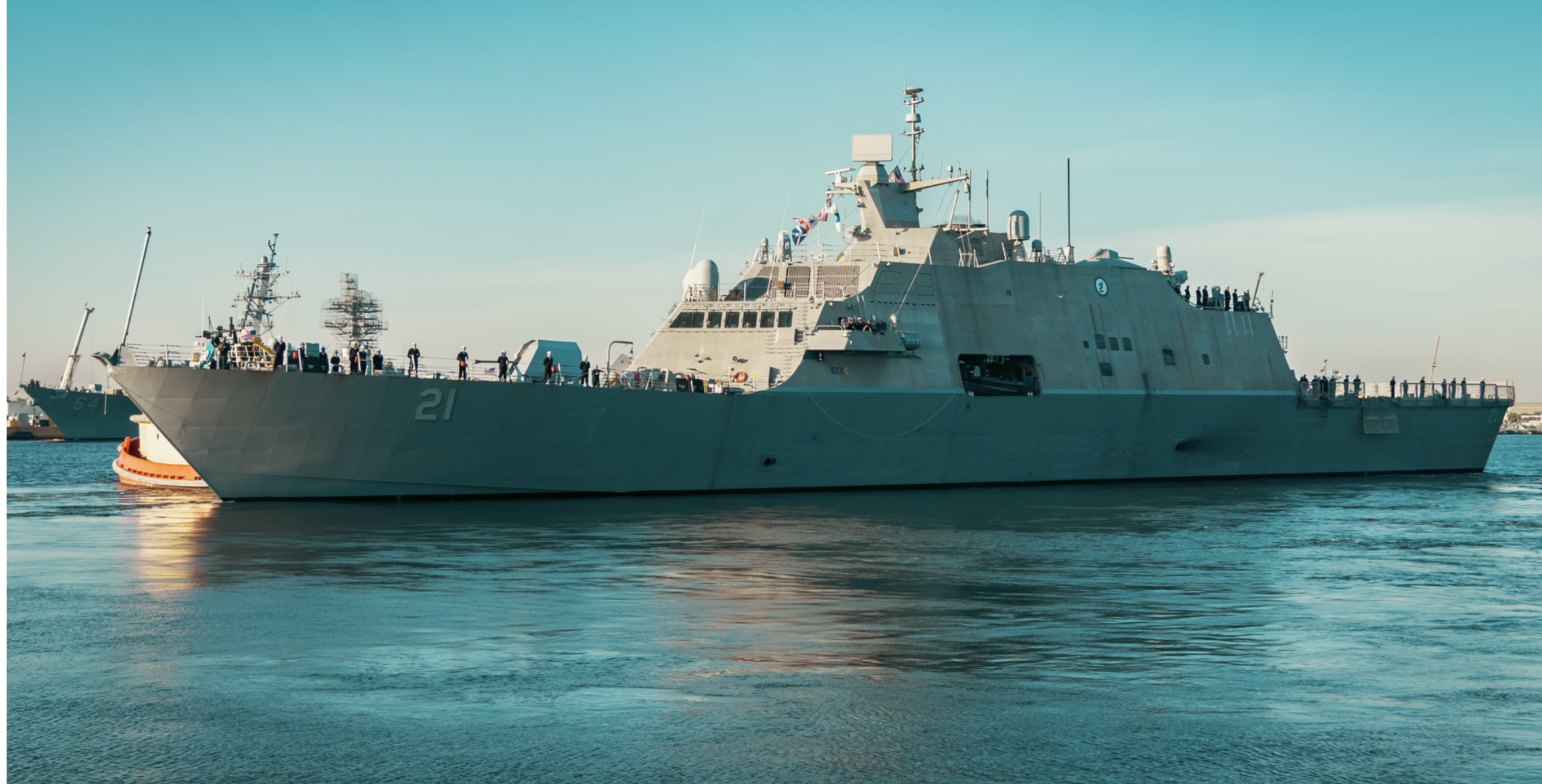
250326-N-OZ224-3072 NAVAL STATION MAYPORT, Fla. (Mar. 26, 2025) – The Freedom-class littoral combat ship USS Minneapolis-Saint Paul (LCS 21) departs Naval Station Mayport for her maiden deployment, Mar. 26, 2025. LCS 21 is deploying to the U.S. 4th Fleet area of operations is support of counter-illicit drug trafficking operations. (U.S. Navy photo by Mass Communication Specialist 1st Class Brandon J. Vinson)

Below is a news release from USNAVSOUTH/4TH FLEET

Good to see Navy participating, and doing so with their units most appropriate for the drug interdiction mission.

The additional USN assets that have seen much press coverage lately are positioned primarily to intercept migrants rather than drugs.

Patrols in the Caribbean, like this one, can certainly help with drug interdiction, but the Caribbean is pretty well covered. The area of greatest need for additional larger, sea-going, drug interdiction assets is in the Eastern Pacific. The Navy does not seem eager help in this area.

USS Minneapolis-Saint Paul (LCS 21) was commissioned 21 May, 2022. This was her first deployment.


April 17, 2025

USS Minneapolis-Saint Paul Makes Multiple Drug Busts

Minneapolis-Saint Paul, with an embarked U.S. Coast Guard (USCG) Law Enforcement Detachment (LEDET) and Helicopter Maritime Strike Squadron (HSM) 50, Detachment Three, made the two busts in the Caribbean, taking out vessels through a combination of air and surface operations.

The busts resulted in the confiscation of 580 kilograms (1,278.9 lbs; $9,463,860) of cocaine and 2,480 pounds of marijuana. ($2,807,360). “The USS Minneapolis-Saint Paul executed their duties seamlessly in the combined effort to protect the homeland from illicit maritime trafficking.” said Rear Adm. Carlos Sardiello, commander of U.S. Naval Forces Southern Command/U.S. 4th Fleet. “Working in coordination with the Coast Guard and our joint partners, we look forward to seeing continued measurable impact delivered by the professional and talented crew of the USS Minneapolis-Saint Paul across the region.”

“We train diligently and stand ready to execute interdiction missions at moment’s notice, said Minneapolis-Saint Paul commanding officer Cmdr. Steven Fresse, “To be able to make an immediate impact so early on during our maiden deployment is a testament to the hard work and skills of the ship’s crew.”

USS Minneapolis-Saint Paul is currently assigned to Commander, Task Force 45 (CTF 45). CTF-45 is the 4th Fleet surface task force charged with executing combined naval operations, building and strengthening Latin American, south of Mexico, and Caribbean maritime partnerships, and acting as a DoD ready service provider to Joint Interagency Task Force – South in support of counter illicit-drug trafficking operations in the Central and South American waters.

The U.S. Coast Guard is simultaneously a military service and the United States’ lead federal maritime law enforcement agency with authority to enforce national and international laws on the high seas and waters within U.S. jurisdiction. Coast Guard LEDETs regularly deploy aboard U.S. Navy and foreign allied navy ships, and during these deployments the LEDETs, under U.S. law, board vessels, seize illegal drugs and apprehend suspects. These forces also work closely with other regional partner nation coast guards and naval forces to provide support to visit, board, search and seizure operations within partner nation territorial waters. Once an interdiction becomes imminent, the law enforcement phase of the operation begins, and control of the operation shifts to the U.S. Coast Guard for the interdiction and apprehension phases. Interdictions in the Caribbean Sea are performed by members of the U.S. Coast Guard under the authority and control of the Seventh Coast Guard District, headquartered in Miami.

U.S. Naval Forces Southern Command/U.S. 4th Fleet supports U.S. Southern Command’s joint and combined military operations by employing maritime forces in cooperative maritime security operations to maintain access, enhance interoperability, and build enduring partnerships in order to enhance regional security and promote peace, stability and prosperity in the Caribbean, Central and South American region.

“U.S. Navy Expands Maritime Border Security Mission with USS Stockdale Deployment” –gCaptain

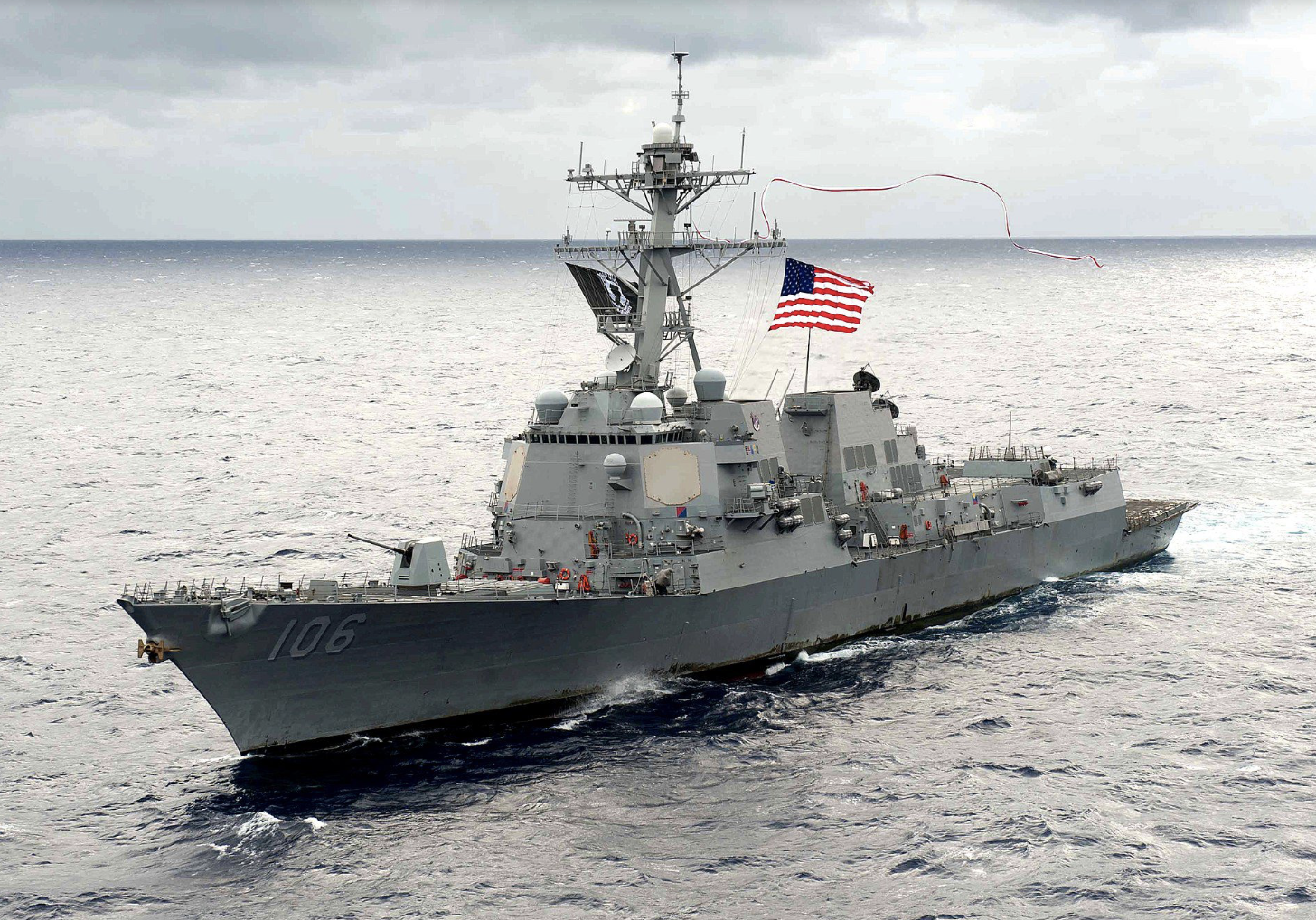
USS Stockdale (DDG 106). U.S. Navy File Photo

gCaptain reports,

“The US Navy continues to strengthen its southern border security presence with the deployment of USS Stockdale (DDG 106), which departed Naval Base San Diego on April 11, 2025. The Arleigh Burke-class guided-missile destroyer takes over duties from USS Spruance in supporting U.S. Northern Command’s (USNORTHCOM) border security operations.”

There has been a long standing pattern of cruisers and destroyers deploying with and staying close to carriers, but increasingly it seems, the Navy is also using cruisers and destroyers as independent units and not just in support of Coast Guard interdiction efforts.

In addition to USS Spruance (DDG-111) and its replacement, USS Stockdale (DDG-106) on the West Coast and USS Gravely (DDG-107) on the Gulf coast supporting the Coast Guard, on March 15 USS Truxtun (DDG 103) departed Norfolk for independent operations. USS Chosin (CG-65) was in Panama and USS Normandy was off Guyana.

These are large and powerful ships, each with 90 to 122 vertical launch cells, some of which may be loaded with Tomahawk land attack cruise missiles.

Those operating off the US coast also provide a degree of protection US ports do not normally have.

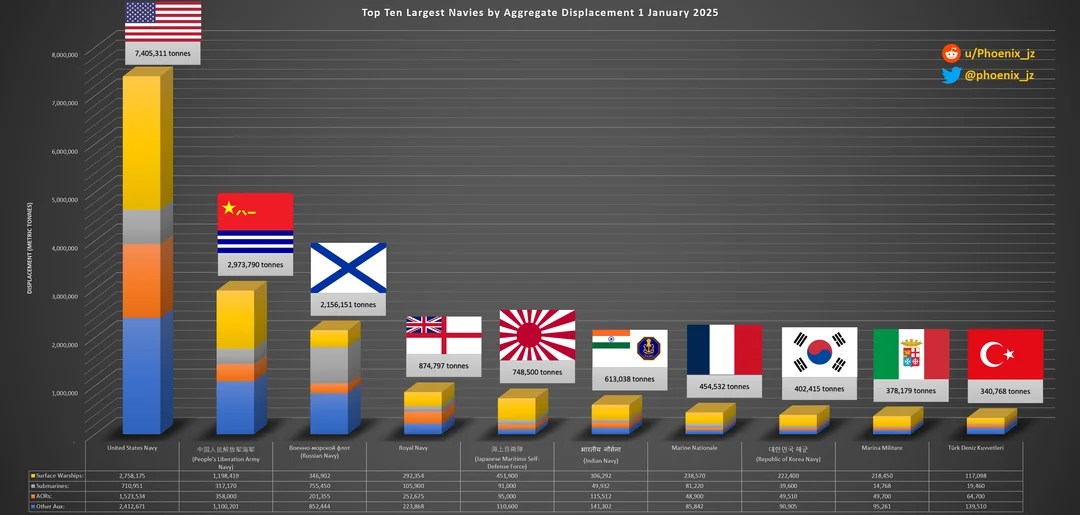
“Top Ten Navies by Aggregate Displacement, 1 January 2025” –Analysis and diagram by Phoenix_jz

This is becoming an annual thing. I do not know but he has produced a version of the graphic above annually and provides brief additional analysis. I just pass it along. You can check out the entire accompanying discussion here.

The graphic above will be hard to read unless you click on it to enlarge.

Again, the author also listed Navies 11–20 in the comments, “No.11 to 20 are as follows for 1 January 2025;”

  • 11: Indonesia – 330,200t
  • 12: Taiwan – 276,166t
  • 13: Egypt – 232,046t
  • 14: Spain – 229,373t
  • 15: Germany: 226,952t
  • 16: Australia: 216,594t
  • 17: Greece – 189,184t
  • 18: Brazil – 163,805t
  • 19: Chile – 161,404t
  • 20: Canada – 143,242t

Note, Coast Guards are not included in this analysis. This leads to some distortion since navy operated Offshore Patrol Vessels (OPVs) and patrol craft are counted as combatants, but coast guard operated OPVs and patrol craft are not counted at all. The US, China, Russia, Japan, India and South Korea all have substantial sea-going coast guards, notably the UK and France do not. The Indian Navy in particular has a large number of Navy operated OPVs and patrol craft.

Just for reference the US Coast Guard’s projected eleven NSC and 25 OPC program alone would amount to 173,000 tons not to mention icebreakers, buoy tenders, and patrol craft. The total projected 64 Fast Response Cutters would add 23,360 tons.


Hello all!

The fourth edition of my top ten navy list arrives with 2025! For those unfamiliar, here are links to 20222023, and 2024, with a general explainer for the whole concept in that first 2022 edition.

The long and short of it is that this graph reflects a personal tracker I keep of almost every large and moderately sized navy, and calculates the aggregate displacement of these navies. It’s not a perfect way to display the size of navies – far from it in fact – but it is at least more representative than counting numbers of hulls alone, in my opinion.

To break down what each of these categories mean;

  • Surface Warships is an aggregate of all above-water warships and major aviation and amphibious assault platforms. This category includes CVNs, CVs, CVLs, LHDs, LHAs, LPDs, CGs, DDGs, FFGs, corvettes, OPVs, CPVs, lighter patrol craft, and MCM vessels.
  • Submarines is what it says on the tin – SSBNs, SSGNs, SSNs, SSKs, and for select nations where applicable (and where information is available), special purpose submarines. Please note dedicated training submarines are counted separately.
  • AORs includes all major fleet replenishment vessels (coastal vessels do not count, however).
  • Other Auxiliaries is a very wide net that essentially captures everything else. Special mission ships, support vessels, minor amphibious assault vessels (LSDs, LSTs, LCAC’s, LCM’s, LCU’s), training vessels, tugs, coastal support vessels, hydrography ships – all essential parts of navies, but generally often paid less attention to as they’re not as flashy as the warships proper.

Interesting trends in data that I thought I would share for various navies, and thoughts and observations otherwise;

The USN’s position remains unimpeachable, and record a slight increase in both overall tonnage (+11,983t, or 0.16%) and numbers of vessels (net +2), commissioning an LPD, a destroyer, an SSN, and three LCS against the decommissioning of four Ticonderoga-class ‘cruisers.’ It is interesting to note that with these commissioning’s, there are only two more LCS – one of each class – and two remaining Flight IIA Burke’s left to enter service before the torch is entirely passed to the Flight III Burke (ten of which are currently building or fitting out) and other future platforms. Only nine of the venerable Ticonderoga-class remain in service.

The PLAN (China–Chuck), no one will be surprised to hear, increases in displacement again this year, though the on-paper 74,350t (+2.56%) from last-years figure does include some ‘fluff’ – I corrected the displacement of the Type 055 up 1,000t and split off the Type 052D’L’ (12) from the Type 052D’s, which netted +9,800t for the PLAN from thin air. 2024 was a relatively light growth year for the PLAN, with only a two new major warships entering service – the first Batch IV Type 052D and the first Type 054B. That being said, several ships are in advanced stages of trials and likely follow in very early 2025 (the second Type 054B and two other Batch IV Type 052D). There is also an addition of at least one new Type 039C SSK – though for full transparency, while I have three vessels listed presently, there is probably ±2 boat margin of error given the difficulty with tracking individual PLAN boats with open-source data. The rest of the increase comes from the auxiliary category in general, with the most notable of these being a second Type 927 ARS (submarine rescue ship, different from the AGOS formerly dubbed Type 927 but now Type 816). I have also struck a pair of Type 053 variants that have clearly left service.

Despite the modest growth, 2024 has been a big year for PLAN-related shipbuilding, crowned by the launch of the Type 076 LHD – a unique catapult-equipped amphibious assault ship – but one that has also seen the launch of the second Type 055 Batch II (with two more in build) and two more Type 052DL destroyers. Additionally, three Type 054AG frigates have been launched – a new, lengthened variant of the Type 054A, able to handle the Z-20 helicopters (also accommodated by the Type 055 and 052DL destroyers). The production of these additional ships and the absence of additional Type 054B builds has been a curious development that may signal the 054B as more of a transitional design, like the original Type 054 frigates, instead of a design the PLAN intends to produce at large scale (as with the Type 054A).

What is more consequential than any of these, however, is the continued launches of what is generally believed to be Type 093B SSNs from Bohai. 2024 may have seen up to three launches this year, indicating a similar pace of 2-3 boats per year as last year. This would mean that since the spring of 2022, five to seven Type 093B have been launched, compared to four American SSNs in the same period. It remains to be seen if these SSNs will just be built in a limited number, as has been the case in the past, or if the PLAN is adopting a more continuous production model for their SSN fleet (as practiced by the United States).

The VMF  (Russia–Chuck) has also seen a very slight uptick in 2024, of 3,605t (+0.17%). Combat losses in 2024 were less severe for the Russian navy than in the first two years of the Russo-Ukrainian War, but still notable. In 2024, Ukrainian forces sank two corvettes, an OPV, and an LST in the Black Sea. Despite this, arguably the largest blow Russian naval forces suffered this year was the collapse of the Assad regime in Syria and the naval base it allowed Russia at Tartus. While Russia appears to be sounding out Libyan National Army under Gen. Haftar to use Tobruk as a base (Cyrenaica, Libya), this will not be able to replace the facilities that had been built up at Tartus.

Russia’s most notable additions to its fleet this year include a fifth Yasen-M SSGN, a second Lada-class SSK, and a new Project 21180M icebreaker. Three new corvettes entered service, though this did not offset losses given the retirement of six other corvettes in addition to combat losses. The growth in the submarine force has been offset by retirements of not just aging Project 877 Kilo’s, but also the first of the deeply unsatisfactory Lada-class.

The British Royal Navy sees a reduction for a third year in a row, with 2025 looking to include an even sharper decline given cuts announced late this year. 2024 reductions include two Type 23 frigates (Argyll and Westminster) and all but the last Sandown-class MCM (HMS Bangor). This equals a drop of 11,072t tons (-1.25%).

An additional Type 23 frigate, as well as both Albion-class LPDs and the two Wave-class AORs will be decommissioned in early 2025. This is more a reduction on paper than in practice given the condition of the vessels, which had little to no chance of ever returning into service. It should be noted that while this is a cut in platforms, the up to £500M the British MoD expects to save on maintenance and refit costs for these vessels over the next five years will remain within the MoD for investment in other programs.

Perhaps the most perilous malfeasance facing the Royal Navy at present is the plight of the Royal Fleet Auxiliary, which for want of pay raises competitive with commercial shipping continues to hemorrhage mariners.

“Top Ten Navies by Aggregate Displacement, 1 January 2024” –Analysis and diagram by Phoenix_jz

Two years ago, I did a post with a similar title from the same source. Somehow, I missed the 2023 edition. As I said in the earlier post, I don’t know , but the data appears to be credible, and it looks like readers are checking his figures. 

It is very difficult to read the tonnages at the bottom of the graph unless you are using a computer and click on the graph to see it in a larger size. 

The creator’s notes and some additional comments are below. 


Hello all!

Well, 2024 is upon us, and as such so is the third edition of my top ten navy list. For those unfamiliar, here are links to 2022 and 2023, with a general explainer of the whole concept in the 2022 version.

The long and short of it is that this graph reflects a personal tracker I keep of almost every large and moderately sized navy, and calculates the aggregate displacement of these navies. It’s not a perfect way to display the size of navies – far from it in fact – but it is at least more representative than counting numbers of hulls alone, in my opinion.

To break down what each of these categories mean;

  • Surface Warships is an aggregate of all above-water warships and major aviation and amphibious assault platforms. This category includes CVNs, CVs, CVLs, LHDs, LHAs, LPDs, CGs, DDGs, FFGs, corvettes, OPVs, CPVs, lighter patrol craft, and MCM vessels.
  • Submarines is what it says on the tin – SSBNs, SSGNs, SSNs, SSKs, and for select nations where applicable (and where information is available), special purpose submarines. Please note dedicated training submarines are counted separately.
  • AORs includes all major fleet replenishment vessels (coastal vessels do not count, however).
  • Other Auxiliaries is a very wide net that essentially captures everything else. Special mission ships, support vessels, minor amphibious assault vessels (LSDs, LSTs, LCAC’s, LCM’s, LCU’s), training vessels, tugs, coastal support vessels, hydrography ships – all essential parts of navies, but generally often paid less attention to as they’re not as flashy as the warships proper.

Interesting trends in data that I thought I would share for various navies, and thoughts and observations otherwise;

The USN is, unsurprisingly, still top dog by a huge margin. In spite a net decommissioning of five ships this year, the USN has grown overall by about 32,000 tons – four ‘cruisers’, two SSNs, four LCS, and five patrol craft decommissioned against the introduction of three destroyers, an SSN, five LCS, and a replenishment ship. It is worth noting that 2023 is the first year since 2010 that the USN has commissioned three destroyers in a year, though a repeat performance in the next couple years is unlikely – these ships were launched in 2020 and 2021, and only one destroyer per year was launched in 2022 and 2023.

No one will be surprised to hear that the PLAN has grown for the nth consecutive year, adding the final Type 055 batch I and the remaining Type 054A Batch V, for almost 50,000 tons of new surface combatants. Much of the remaining increase in displacement for this year (which totaled nearly 90,000 tons) reflected a steady pace of modernization in mine warfare, landing forces, and logistical support/other auxiliaries. As with last year, the number of minor patrol craft continue to plummet as the PLAN continues to divest many of its obsolescent brown-water combatants, or relegates them to training duties.

Moving on to ongoing construction, progress on the new destroyer batches continues at pace. At least two Type 055 Batch II appear to be under construction, and the overall number of Type 052D Batch IV appears to be at least ten. The first ship actually launched at the very end of 2022 (at Jiangnan), and two further have been launched by the same yard as well as three at Dalian. Two more remain under construction at each yard. The first of these ships to be launched appears to be on trials and will likely commission this coming year. The Type 054A program of the navy appears to have finally wrapped up (construction of the hull for the China Coast Guard continues), and the Type 054B program has continued at pace if not scale – two ships were launched this year, but modules of further units have been scarce. Rounding things out for major surface vessels, a new Type 075 LHD was launched this past December. Conspicuously absent has been sightings of any modules for new carriers. Considering Fujian (Type 003) began construction at some point from 2015 to 2017, one has to wonder if we will see China launch another carrier before the end of the decade.

Perhaps most consequential of all, however, has been the completion of new production facilities at Bohai and a resumption of Type 093 SSN launches. The first of the new Type 093B launched in 2022, and has been followed up by two more launches this year (possibly up to three). A sustained pace of two submarines a year, or even just three submarines every two years, would quickly add up could see anywhere from nine to eleven new SSNs launched by the end of 2027, and in service by early 2030s. Only time will tell what the actual drumbeat of production will be.

Russia’s VMF woes in the Black Sea have continued unabated, except less at sea and largely fueled by the Franco-British SCALP cruise missile. The most dramatic loss by far was the destruction of the Project 636.3 ‘Improved’ Kilo Rostov-on-Don in drydock at Sevastopol, but similar attacks claimed the destruction or constructive loss of a Karakurt-class corvette (under construction, not in service) and two Ropucha-class LSTs. The infamous TB-2 made a brief return to destroy a Serna-class LCU, and two other LCU’s may have finally become the first victims of Kamikaze USVs this past November, for a total of 11,407 tonnes lost.

In regards to the more regular cycle of commissioning and decommissioning, one frigate, one MCM vessel, and three corvettes were brought into service, as well as a new SSGN, SSBN, and SSK each. Against this a corvette, SSGN, SSBN, and SSK were decommissioned. Overall, in spite of losses the VMF managed a net gain of 6,324 tonnes of surface warships and submarines. Anyone who checks against my figures from last year will note that the increase in the VMF’s overall tonnage this year is far more substantial, due to the auxiliary category. Though some of this was from new vessels, this was mostly down to a badly needed overhaul and reorganization of that part of my tracker, particularly for the tug fleet. Did you know the Russian navy tug fleet displaces more than either the Argentine or Canadian navies? Now you do! Seriously – it would be the 20th largest navy in the world by itself.

As a final note on the VMF – it is worth remembering that ships commissioned in the Russian navy are not always actually in service, as ships can often languish in near-terminal refits or simply be left inactive without a formal decommissioning. Almost half the remaining Projekt 877 Kilo’s, for example, appear to be inactive at this point (5 of 10).

(In comments the author noted the following, “Russian naval losses during the war have totalled 13 vessels for 29,870 tonnes. Quite a bit – but also only about 1.4% of their current overall tonnage.” –Chuck)

The British Royal Navy observes a second year of marginal reduction in overall tonnage (-2,640t, or -0.3%), losing another Type 23 frigate as well as the last Echo-class survey ship. Against this the RFA brought into service the first MROSS, ProteusProteus represents a considerable increase in subsurface capability, though the loss of a frigate with no replacement ship to replace it for another thee to four years is painful, especially given how many of the remaining eleven ships are deep in LIFEX/Post-LIFEX refits. With that said, their new frigate programs are moving on steadily. Steel was cut on two new frigates this year – the future HMS Birmingham (4th Type 26) and HMS Active (2nd Type 31), bringing the total construction volume to five frigates building and one fitting out.

The JMSDF continues to grow, albeit at a more moderate pace this year (+6,530t, or +0.9%), inducting a new Mogami-class frigate and Taigei-class attack submarine, while shifting another Oyashio-class from the active fleet to a training role. Two more FFM were launched this year, though surprisingly they have not started construction on the next pair. This past November, it was announced that the Mogami-class FFM would be curtailed at 12 units (of 22 planned), and followed on by an evolution of the design known as FMF-AAW. The FMF-AAW will feature greater air and surface warfare capabilities. Twelve such ships are planned.

The Indian Navy’s growth in 2023 was far less dramatic than in 2022, but still noteworthy (+9,200t, or +1.5%), as adding a new conventional attack submarine and destroyer to the fleet has finally pushed them over the 600,000-tonne line.

The Marine Nationale grew by almost 9,000 tonnes (2.1%) this year, largely down to the retirement and replacement of a patrol ship, nuclear attack submarine, and tugs with an equal number of replacements. Though it is worth noting that the new attack submarine is not fully operational yet – that will happen in 2024 – so technically the MN’s attack submarine fleet is really four boats at this point in time.

The saga of eight and ninth place swapping around continues, as the ROKN has managed to move back to the position of eighth largest navy in the world. In 2023 they added a net 15,374t (+4.3%), commissioning four Daegu-class frigates, a second KSS-III class attack submarine, an MCM vessel and a pair of LCACs, against the decommissioning of two corvettes and five PKM’s.

In contrast, the Marina Militare continues to feel the bite from the two FREMM sold to Egypt, as well as delays in brining the LHD Trieste into service – intended for 2023 but again pushed back, now to the spring of 2024. The first PPA ‘Light+’, Raimondo Montecuccoli, was brought into service in 2023 – an OPV on paper, but light frigate in practice. Against this one of the elderly Maestrale-class frigates, Zeffiro, was retired, as was one of the fleet’s AORs (Vesuvio) and a water tanker (Bormida), resulting in a real drop of 7,073 tonnes (-1.9%). The drop seen versus the chart versus last year is more dramatic (totals 16,632 tonnes), which reflects both cleaning up data on old auxiliary platforms for which information is scarce, and correcting some minor sheet errors, which totaled 9,559 tonnes.

The outlook should be looking up in the future – as previously mentioned, the LHD Trieste should enter service this year, as should the fourth and fifth PPA. The first of two replacement FREMM (GPe) was launched in late 2023 and a second will follow this spring, with both being slated to enter service in 2025 alongside the sixth PPA and second Vulcano-class replenishment ship – barring any delays.

Finally, the Indonesian Navy saw another year of growth, adding a net 9,930 tonnes (+3.1%), with another hospital ship commissioned, a new survey ship, corvette, and two new MCM vessels and FACs each, as well as several patrol boats. The TNIAL continues a steady program of domestic construction of patrol craft, and construction is ongoing on two Iver Huitfelt derivative frigates, with the keel of the first vessel laid down this past August. They have also cut steel on a new hydrography ship, which will launch in Indonesia and complete fitting out in Germany.

What comes next in terms of major platforms for the TNIAL is somewhat up in the air. As with the year prior, there has been no progress made on the procurement of six FREMM from Italy, despite a contract being signed two and a half years ago (June 2021). In spite of this, they have expressed interest in procuring two PPA to bolster their patrol fleet. In the interest of expediting procurement, they are looking at two ‘Light+’ configuration vessels currently fitting out at Muggiano – Marcantonio Colonna (due for delivery to the MMI in the latter half of 2024) and Ruggiero di Lauria (due for delivery to the MMI in mid-2025). According to the General Manager of Fincantieri’s Naval Vessels Division, Dario Deste, a contract for the two vessels could be signed in the first half of 2024.

(In answer to a question the author added this in the comments–Chuck)

No.11 to 20 are as follows for 1 January 2024;

  • 11: Turkey – 297,298t
  • 12: Taiwan – 268,958t
  • 13 Egypt – 232,046t
  • 14: Spain- 229,373t
  • 15: Germany – 226,655t
  • 16: Australia – 224,074t (decided to add the National Support Squadron, which added about 30kt)
  • 17: Greece – 189,184t
  • 18: Brazil – 162,29t
  • 19: Chile – 161,404t
  • 20: Argentina – 138,620t
(A reader, , added this–Chuck)

Listed by ranking for this year:

Nation Change from 2023 (tonnes) 2023 Ranking Change from 2022 (tonnes) 2022 Ranking
United States +55,658 1st +250,308 1st
China +93,567 2nd +99,299 2nd
Russia + 211,333 3rd +166,682 3rd
United Kingdom -2,640 4th -5,815 4th
Japan +6,530 5th +23,790 5th
India +9,200 6th +62,349 6th
France +8,925 7th +12,145 7th
South Korea +15,374 9th +7,153 8th
Italy -16,632 8th -3,452 9th
Indonesia -70 10th +17,709 10th

Probably not surprising given all these nations are competing more or less with each other, but the rankings have basically remained the same except for Italy and South Korea trading places in 2023, then reverting to their 2022 places again this year. Nobody previous top 10 navy has left the club either.

However, do note that not all of the year-to-year tonnage differences are due to actual changes in fleet size/composition. As Phoenix mentioned in his post, the Russians in particular got a huge tonnage jump this year because he changed the way he counts auxiliaries, and given the discrepancy between his reported +32k figure for the USN and the numbers, there’s probably some math correction involved there too.


“USS Farragut, Coast Guard offloads more than $69 million in illegal narcotics” –D7

190914-N-KK394-029.MAYPORT, Fla. (Sept. 14, 2019) The Arleigh Burke-class guided-missile destroyer USS Farragut (DDG 99) departs Naval Station Mayport. (U.S. Navy photo by Mass Communication Specialist 2nd Class Anderson W. Branch/Released)

Below is a District Seven News Release. Just wanted to point out a couple of things.

Unlike most of these offloads, this one involved only drugs seized by a single ship. Second it is unusual that drugs are offloaded from a Navy ship. Probably a good idea to let them get the more visible credit that comes with the offload once in a while. 

This destroyer did four intercepts, so they certainly deserve a lot of credit, along with the HSM-60 helicopter and CG LE detachments.

Would have been nice to know how many days they were doing the drug interdiction mission.


 April 5, 2023

USS Farragut, Coast Guard offloads more than $69 million in illegal narcotics

Seventh Coast Guard District

A member of U.S. Coast Guard Law Enforcement Detachment 406 offloads interdicted narcotics aboard USS Farragut (DDG 99) in Port Everglades, Florida, April 4, 2023. The offloaded drugs were seized from four go-fast smuggling interdictions by crew members of Coast Guard LEDET 406, Navy Combat Element (CEL) and Helicopter Maritime Strike Squadron Six Zero (HSM-60) in the Eastern Pacific Ocean. (U.S. Coast Guard photo by Petty Officer 2nd Class Laticia Sims)Members of U.S. Coast Guard Law Enforcement Detachment 406 pose for a photo with $69 million in illegal narcotics aboard USS Farragut (DDG 99) in Port Everglades, Florida, April 4, 2023. The offloaded drugs were seized from four go-fast smuggling interdictions by crew members of Coast Guard LEDET 406, Navy Combat Element (CEL) and Helicopter Maritime Strike Squadron Six Zero (HSM-60) in the Eastern Pacific Ocean. (U.S. Coast Guard photo by Petty Officer 3rd Class Eric Rodriguez) Members of U.S. Coast Guard Law Enforcement Detachment 406 push bales of illegal narcotics aboard USS Farragut (DDG 99) for a drug offload in Port Everglades, Florida, April 4, 2023. The offloaded drugs were seized from four go-fast smuggling interdictions by crew members of Coast Guard LEDET 406, Navy Combat Element (CEL) and Helicopter Maritime Strike Squadron Six Zero (HSM-60) in the Eastern Pacific Ocean. (U.S. Navy photo by Mass Communication Specialist 2nd Class Chelsea Palmer) https://d1ldvf68ux039x.cloudfront.net/thumbs/photos/2304/7724658/1000w_q95.jpg Bales of illegal drugs, worth an estimated $69 million, are offloaded off USS Farragut (DDG 99) in Port Everglades, Florida, April 4, 2023. The offloaded drugs were seized from four go-fast smuggling interdictions by crew members of Coast Guard LEDET 406, Navy Combat Element (CEL) and Helicopter Maritime Strike Squadron Six Zero (HSM-60) in the Eastern Pacific Ocean. (U.S. Navy photo by Mass Communication Specialist 2nd Class Chelsea Palmer)


MIAMI — The crew of USS Farragut (DDG 99) offloaded approximately 2,314 kilograms of cocaine and 1,986 pounds of marijuana worth a combined $69 million in Port Everglades, Florida Tuesday. The suspected smugglers will face prosecution in federal court by the Department of Justice.

The offloaded drugs were seized from four go-fast smuggling vessel interdictions by the Farragut crew with an embarked Coast Guard Law Enforcement Detachment (LEDET) 406 and Navy Combat Element (CEL) One from the “Jaguars” of Helicopter Maritime Strike Squadron Six Zero (HSM-60) in the Eastern Pacific Ocean.

“We were proud to work with the U.S. Coast Guard on the frontline of the threat that transnational drug trafficking presents to national security,” said Cmdr. Nicholas Gurley, commanding officer of USS Farragut. “Our experienced crew, HSM-60 CEL One and the members of our LEDET were essential to the success of this operation.”

Numerous U.S. agencies from the Departments of Defense, Justice, and Homeland Security, along with allied and international partners, cooperate in the effort to combat transnational organized crime. The fight against drug cartels in the Caribbean and Eastern Pacific Ocean is coordinated by Joint Interagency Task Force-South, based in Key West, and requires a unity of effort in all phases, from detection and monitoring to interdiction and apprehension and finally to criminal prosecution by international partners and U.S. Attorneys’ Offices. The law enforcement phase of counter-smuggling operations in the Eastern Pacific Ocean is conducted under the authority of the Eleventh Coast Guard District, headquartered in Alameda, California. The interdictions, including the actual boardings, are led and conducted by members of the U.S. Coast Guard.

The Coast Guard is both a military service and the nation’s primary maritime law enforcement agency. For information on how to join the U.S. Coast Guard, visit www.GoCoastGuard.com to learn about active duty and reserve officer and enlisted opportunities. Information on how to apply to the U.S. Coast Guard Academy can be found at http://www.uscga.edu. For breaking news, follow us on Twitter. For additional information, find us on Facebook and Instagram.

New Format–USNI News Fleet and Marine Tracker: July 11, 2022

The latest “USNI News Fleet and Marine Tracker” includes additional summary information that is more informative.

Ships Underway

Total Battle Force Deployed Underway
298
(USS 241, USNS 57)
110
(USS 73, USNS 37)
 60
(44 Deployed, 16 Local )

Ships Deployed by Fleet

2nd Fleet 3rd Fleet 4th Fleet 5th Fleet 6th Fleet 7th Fleet Total
0 11 2 13 26 58 110

For the last several weeks, information about how many ships were deployed and how many underway was missing entirely.

I had been following how many ships were deployed to 4th Fleet because in most cases those ships were assisting in drug interdiction, but recently that information was not listed. That is back. Two ships are deployed to 4th Fleet which was typical of earlier information.

From prior information, I had concluded that US Navy ships were deployed about a third of the time and underway about a quarter of the time. That is far less underway time than I believe is typical for Coast Guard cutters. We frequently hear that US Navy ships are overworked. I would not dispute that, but it does seem that underway time is not the reason they are overworked. New information included in this latest “Fleet and Marine Tracker” gives even clearer insight into how much time US Navy’s commissioned ships spend deployed and underway. For the first time there is a breakdown of ship type as either USS or USNS.

USNS ships are only 19.1% of the “Battle Force.” but they are 33.6% of the ships deployed. 64.9% of USNS ships are deployed.

Commissioned ships (USS) are 80.9% of the “Battle Force,” but only 66.4% of those deployed. Less than a third, 30.3% of commissioned ships, are deployed.

Only 20.1% of the “Battle Force” was underway. We don’t have a USS/USNS breakdown for ships underway. If we assume the 44 ships deployed and underway was in the same proportion as those simply deployed, then there were probably 29 USS ships deployed and underway. While unlikely, the 16 ships underway locally might all be USS ships, so at most 45 USS ships, 18.7% of commissioned ships might have been underway.

If the Navy wants to reduce the workload on their sailors, they probably cannot do it by reducing deployments and underway time. My own experience was that we got a lot more done while underway than while inport.

There is a second observation that is particularly important for war planning. The USNS fleet is strained to support current deployment levels. If we have a near peer conflict in the Western Pacific, we would probably want to approximately double the number of commissioned ships deployed to about 60% with about 50% of commissioned ships actually continuously underway, almost three times what we are seeing now.

Those ships will need underway replenishment.

That means that both, we need to substantially increase the number of support ships, just to fully use the combatants we already have, and that the support ships we do have are precious and need to be protected. The Coast Guard may have a role in providing at least some of that protection.

How The Fleet Forgot to Fight” –CIMSEC

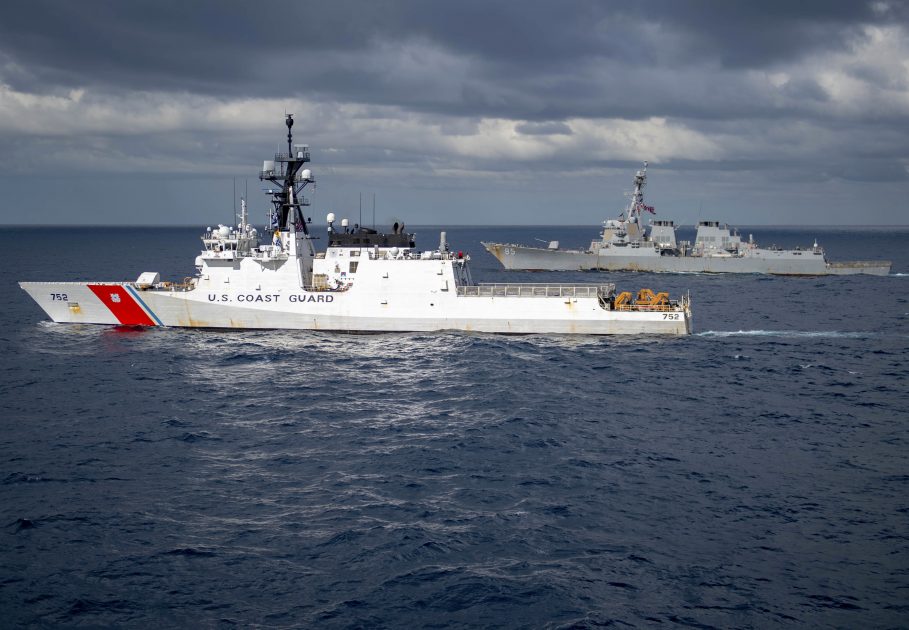
USCGC Stratton (WMSL-752), left, and the U.S. Navy Arleigh Burke-class guided-missile destroyer USS McCampbell (DDG-85) maneuver in formation during Talisman Sabre 2019 on July 11, 2019. US Navy Photo

Currently the CIMSEC web site is migrating to a new server so it is off line, but they have provided something a shorthand critique of how some think the Navy has fallen short, since the collapse of the Soviet Union.

The Coast Guard still has Defense Readiness as one of its eleven missions. We in the Coast Guard are highly dependent on the Navy helping us know what needs doing, but I don’t think we should fail to think for ourselves.

This short five page outline of what the Navy has been doing wrong may be helpful because we have probably been making some of the same mistakes, not just in our preparation to fight a “near peer” major conflict, but in our response to the terror threat, and perhaps in our on-going war with drug smugglers.

“Nordic Allies Help Navy Improve Ship Ops in Icy Waterways as Arctic Competition Heats Up” –Military.com

http://www.state.gov/e/oes/ocns/opa/arc/uschair/258202.htm . This map of the Arctic was created by State Department geographers as part of the U.S. Chairmanship of the Arctic Council.

Military.com has a report on the Navy’s increased activity above the Arctic Circle, at least on the Atlantic side. (Still have not seen much from PACFLT.) Remarks are quoted from Adm. Robert Burke, commander of U.S. Naval Forces Europe-Africa and Allied Joint Command Naples. The discussion was primarily about working with allies, but he does not fail to mention the Coast Guard. 

“Responding to a question on whether the Navy needs to have icebreakers or hardened vessels as it increases its Arctic presence, Burke said he would leave the question “up to the force providers,” adding that ship drivers are getting good at maneuvering in the challenging Arctic environment.

“He said also that icebreaking is the U.S. Coast Guard’s “core business … today, anway,” and the Navy and Coast Guard work together in many areas worldwide.

“”We’ve got great partners in the U.S. Coast Guard. … You know, if it stays in their core mission or we do some sort of shared thing, it’s going to work great,” Burke said.”

The Coast Guard, with only two polar icebreakers, has none based on the Atlantic side. We have had some indication the Coast Guard intends to base one or more of its planned three medium icebreakers (aka Arctic Security Cutters) on the Atlantic side.

To put my comment above in context, LANTFLT has much more reason for operating in the high North than PACFLT. On the Atlantic side, Russia’s most important naval bases are above the Arctic Circle, off the Barents Sea. On the Pacific side, the primary Russian naval bases are over 800 nautical miles below the Arctic Circle around Petropavlovsk-Kamchatsky. So the difference is perhaps understandable.

Coast Guard Cutter + Navy Reserve + Mission Module = ASW

The US is seriously short of Anti-Submarine Warfare escort vessels, but a little forethought and some cooperation between the Navy Reserve and the Coast Guard could seriously reduce the deficit, without a huge impact on either the Navy or the Coast Guard’s peacetime budget, operations, and manning.

It is a simple concept, a payload/platform solution. The Navy provides the payload. The Coast Guard provides the platform and drives “the truck.” It would allow the Coast Guard to have an important wartime role without significantly increasing its manning or training requirements. The costs to the Navy would be minimal and it would allow them to exploit their reserve pool of trained ASW personnel long before additional ships could be built.

In peacetime, the Coast Guard has been placing detachments on Navy ships. In wartime, Navy detachments could be placed on Coast Guard ships.

The essential elements are:

  • 36 Coast Guard Cutters, 11 National Security Cutters and 25 Offshore Patrol Cutters built, building, or planned.
  • Navy Reserve Helicopter Maritime Strike (HSM) aircraft and crews
  • An ASW mission module for each cutter
  • Navy personnel (active or reserve, officer and enlisted) trained and experienced in operating the ASW mission module equipment and ASW operations

The Threat:

If we have a non-nuclear war with a near peer, e.g. China or Russia, it is almost certain we will need more Anti-Submarine Warfare escort vessels than we currently have. The Chinese have almost 80 submarines  (60 conventional and about 19 nuclear) and they are doubling their capacity for building nuclear submarines. Russia has about 63 submarines, mostly nuclear.

US Navy ASW escorts, we are short:

The Navy’s force level goal is 156 surface combatants, out of the projected fleet of 355. These would include 104 large surface combatants (LSC, cruisers and destroyers) and 52 small surface combatants (SSC, LCS and frigates), but so far, there is no clear path to that goal. The Navy’s fleet will vary over time, but for the foreseeable future it will include less than 120 surface combatants. These include fewer than 90 cruisers and destroyers. A total of 35 LCS are built or funded, but it appears four of those may be decommissioned. Only ten LCS will be equipped as ASW escorts. The FFG(X), now FFG-62 program, is expected to produce 20 FFGs, but that program, is unlikely to produce its first ten ships before 2029.

The “Battle Force 2045” plan, which was never approved by DOD, projects a need for 60 to 70 Small Surface Combatants.

In any case we are going to short of escorts. A little over two years ago, the Military Sealift Command was told that ‘You’re on your own’: US sealift can’t count on Navy escorts in the next big war.

That is really not a good plan. We already have a minimal number of logistics support vessels and only a small pool of American mariners to sail them. Maritime Patrol Aircraft might be able to provide some degree of protection for transiting logistics vessels but one thing they cannot do, is rescue mariners from ships that are inevitably sunk. Coast Guard ships might be able to rescue mariners, but without ASW equipment, they themselves would be vulnerable.

The Mission: 

I would not expect the cutters to be on the forward edge of battle, but by providing escort service from the Continental US to forward logistics bases, they would free more capable assets for areas where the threat level, particularly the air threat, is higher.


The Cutters: 

The Coast Guard has or is building two classes of cutters that might be useful as ASW escorts, the Bertholf class National Security Cutters (NSC) and the Argus class Offshore Patrol Cutters (OPC).

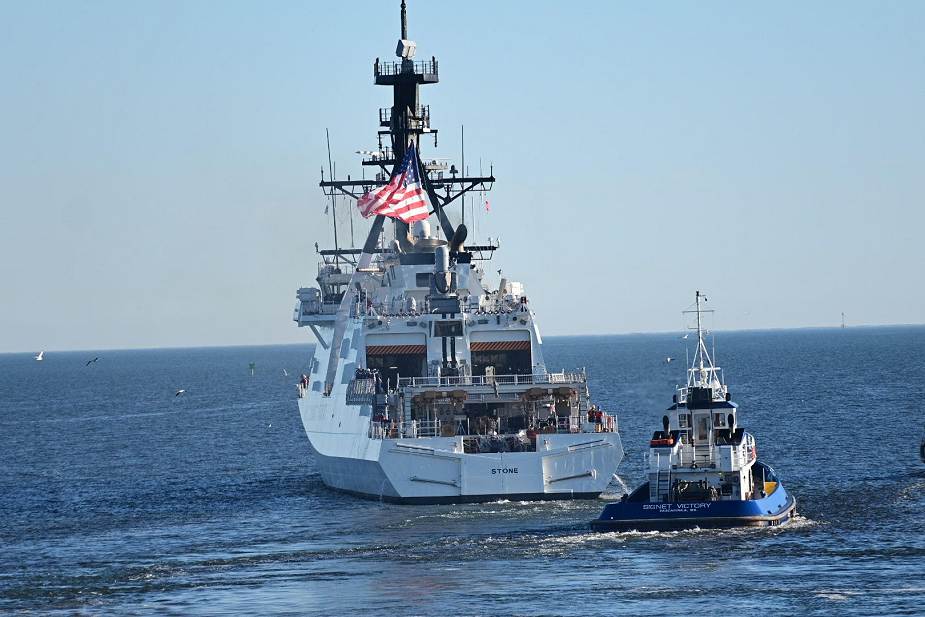
USCGC Stone, the ninth National Security Cutter. Dual helicopter hangars clearly visible.  (Huntington Ingalls photo)

Nine NSCs have already been completed. Two more are building or on order. Though they lack any current ASW capabilities, the Bertholf class National Security Cutters are in many ways already equipped to serve as frigates. A modified version of the design was apparently a contender for the FFG(X) program. They are a bit faster than the new FFGs and have a longer range and greater endurance. They have a flight deck and hangars capable of handling two MH-60s or one MH-60 and UAS. Like the new frigate and the LCSs, they have a 57mm Mk110 gun, but with a better fire control system than found on the LCSs, that includes a SPQ-9B Fire Control Radar. They also have a Phalanx CIWS and a sensitive compartmented intelligence facility (SCIF). They were designed with provision to accept twelve Mk56 VLS and Evolved Sea Sparrow Missiles. Their equipment includes:

  • EADS 3D TRS-16 AN/SPS-75 Air Search Radar
  • SPQ-9B Fire Control Radar
  • AN/SPS-79 Surface Search Radar
  • AN/SLQ-32B(V)2
  • 2 × SRBOC/ 2 × NULKA countermeasures chaff/rapid decoy launchers
  • AN/UPX-29A IFF
  • AN/URN-25 TACAN
  • MK 46 Mod 1 Optical Sighting System (WMSL 750 – 753)
  • MK 20 Mod 0 Electro-Optical Sighting System (WMSL 754 – 760)
  • Furuno X and S-band radars
  • Sea Commander Aegis derived combat system
  • Link-11 and Link-16 tactical data links

The Offshore Patrol Cutters are only slightly less capable than the National Security Cutters. They are about the same size at 4,500 tons full load. Speed is lower at 22+ knots sustained. They also have a 60 day endurance and an over 10,000 mile range. They are designed to support and hangar both a helicopter and a UAS, but while they clearly could hangar a MH-60R, it is not clear if it could also support an MQ-8. It is currently unclear if they will have a SCIF as built, but they have space for one. Their equipment includes:

  • Saab Sea Giraffe AN/SPS-77 AMB multi-mode naval radar
  • AN/UPX-46 IFF
  • AN/URN-32 TACAN
  • MK 20 Mod 1 EOSS
  • Link 22 Tactical Data Link
  • AN/SLQ-32C(V)6 Electronic Warfare System
  • 2 x MK 53 Mod 10 NULKA Decoy Launching Systems

Navy Reserve Helicopter Maritime Strike (HSM) squadron(s):

HSM squadrons fly both the MH-60R and MQ-8 Fire Scout UASWikipedia reports there are currently 18 HSM squadrons. They are now the only provider of shipboard airborne ASW capability. Only one of those is a Reserve squadron. Reportedly the Navy currently has 34 excess MH-60R which could equip virtually all the large cutter currently planned.

The ASW Mission Module:

The Navy apparently intends to equip ten LCS with ASW mission modules. But the new FFG-62 class will share the same ASW equipment including the TB-37U MFTA (Multi-Function Towed Array) which takes the form of a three inch cable towed behind the ship. The LCS ASW module also includes a variable depth sonar, the AN/SQS-62. This may or may not be required for the cutters’ open ocean escort mission. Even 36 complete ASW modules at the current cost of 19.8M would cost less than a single new FFG.

AN/SQS-62 Variable Depth Sonar intended for Littoral Combat ships. Photo Raytheon.

Manning the ASW Modules:

There are at least two possible sources of crews to man the ASW modules:

  • Active duty personnel assigned to rotational crews of LCS and FFGs
  • Navy Reservists

All LCS are now expected to be manned by rotating Blue and Gold crews. A similar scheme is being considered for the FFGs. Upon mobilization it is likely crew rotations will stop. That may mean experienced ASW officers and crew will be available to serve on similarly equipped ASW capable cutters.

As of Sept 30, 2019, the Navy’s Ready Reserve Force included over 100,000 members, 59,658 Selected Reservists (SELRES) and 44,020 Individual Ready Reservists (IRR). Currently I doubt there are organized reserve units prepared to operate ASW mission modules, but that might be a future option that would allow them to operate with cutters during training and exercises, while maintaining their training using simulators. There will certainly be recently separated IRR members, trained in the operation of the relevant systems who could be recalled to active duty.

Conclusion: 

This is a simple low cost way to add about 30% more ASW capable surface combatants to the fleet, putting it much closer to its projected requirements. They may not be ideal ASW escorts, but they may be good enough to make a difference.