“North American Arctic defense could shape outcome of Indo-Pacific conflict” –Indo-Pacific Defense Forum

A U.S. Army Green Beret observes an incoming CH-47 Chinook helicopter during Operation Polar Dagger in Wales, Alaska, in August 2024. IMAGE CREDIT: SPC. BRYON DAVIDSON/U.S. ARMY

The Indo-Pacific Defense Forum reported on a Special Operations Command North (SOCNORTH) exercise,

“To address growing concerns in the Arctic, SOCNORTH recently executed two phases of Operation Polar Dagger, an operational series that demonstrates rapidly deployable, joint SOF capabilities throughout the North American Arctic. It forms the basis of options to deter, disrupt and deny adversary activity in support of U.S. Northern Command’s (USNORTHCOM) layered defense of the U.S. homeland…

“In 2023 and 2024, SOCNORTH and the U.S. Navy partnered to deploy the amphibious transport dock ship USS John P. Murtha and the USS John L. Canley, an expeditionary sea base vessel that supports SOF operations and other maritime missions, to the Bering Sea and the Arctic Circle to support Operation Polar Dagger. USSOF is enhancing its navigation expertise in Arctic terrain and has demonstrated the ability to thrive in the region by executing long-range movements, maritime interdiction operations, rapid infiltration/exfiltration, air-to-ground integration, critical infrastructure defense, domain awareness, and medical evacuation validation, among other engagements.”

(I suspect what this means is that USS John P. Murtha participated in 2023 and USS John L. Canley participated in 2024. Both could not have participated both years.)

A lot of the post is an attempt to explain to an Indo-Pacific audience why a NORTHCOM exercise should be important to them.

Observations: 

It appears that Polar Daggar is a part of the larger NORTHCOM NOBLE DEFENDER exercise. This is apparently a regular annual exercise. NORTHCOM’s on-line magazine reported on the 2023 exercise.

“U.S. Army and Navy assets conduct an interdiction operation in the Bering Sea in July 2024.” Note how flat the seas are. That’s not normal. They did do this in July. You can’t count on seas like this. IMAGE CREDIT: SENIOR AIRMAN JOHNNY DIAZ/U.S. AIR FORCE

There is a serious problem here because there was apparently no Coast Guard participation in these exercises. The Navy’s Pacific Fleet almost never has surface ships anywhere near the Arctic. If you have an urgent need for a ship to do something in the Bering Sea, the Coast Guard is really the only option most of the time. SOCNORTH should be learning how they can exploit Coast Guard resources including ships, boats and aircraft. If you want maritime interdiction in the Bering Sea, if you want maritime domain awareness, who should NORTHCOM call? –the Coast Guard.

Want to fly a “Night Stalker” helicopter off of a ship? Want to launch ATACMS from the Chukchi Sea or maybe Tomahawk or SM-6 from a Mk70 launcher? You could put it on the flight deck of a cutter. 

Need follow-up logistics for paratroopers dropped into an isolated coastal location? Coast Guard.

A satellite image of Shemya Island. What is now called Eareckson Air Station, with its lengthy runway, is seen along the southern edge. Google Earth

Not enough Air Force transports available when you need to move troops to reinforce Shemya? Kodiak C-130Js can help with that.

Cutter might even put a landing party ashore to provide quick protection for a critical facility and stand offshore to provide some AAW protection with its 57mm.

East-Coast-based U.S. Naval Special Warfare Operators (SEALs) conduct an over the beach infiltration on Shemya Island, Alaska, Sept. 6, 2023, as part of Operation Polar Dagger. During the operation, special operations forces projected the ability of U.S. forces to defend critical infrastructure, enhanced all-domain awareness, demonstrated operational reach, and strengthened our understanding of activity in the Arctic. (U.S. Navy photo by Mass Communication Specialist 2nd Class Matthew Dickinson)

In 2023, Special Forces operating from USS John P. Murtha (LPD-26) did an infiltration exercise. A cutter could have done the same thing, and it probably would have been more realistic since an LPD is unlikely to be available.

Any surface or land action at the start of a conventional conflict against Russian and/or China that involves the Arctic is likely to be a surprise involving small units, probably involving covert actions from unconventional platforms, paratroopers, and small unit insertions. At least initially, it will be a “run what you brung” war. We will have to fight with what we have and effectively the Coast Guard is the surface navy for Alaska.

The “Center of Gravity” for the theater is likely to be the Bering Strait. As long as the US controls the strait, the Northern Sea Route will be useless for traffic between the Russian North coast and China or the Russian Pacific Coast.

The photo that leads off this post was taken at Wales, Alaska, population 145, 111 miles (179 km) northwest of Nome. The location is significant in that it is on the Eastern edge of the Bering Strait. It appears someone has recognized the significance of the location.

“Army Long Range Missile Launcher Spotted on Navy Littoral Combat Ship” –USNI

An Army MK 70 missile launcher on the flight deck of Littoral Combat Ship USS Savannah (LCS-28) in San Diego, Calif. Photo obtained by USNI News

The USNI News Service reports,

A portable missile launcher capable of firing a combination of long-range anti-ship and anti-air weapons was spotted this week undergoing testing aboard a Littoral Combat Ship in San Diego, Calif., according to photos provided to USNI News.

Based on a series of photos reviewed by USNI News, the launcher is a Lockheed Martin MK 70 containerized vertical launching system that is capable of firing both a Raytheon Standard Missile 6 and a Tomahawk Land Attack Missile. It was spotted on the flight deck of Independence-class LCS USS Savannah (LCS-28), which was pier-side in San Diego, according to a USNI News review of the images.

If you can operate Army missile launchers from an LCS you can also operate them from a Coast Guard cutter.

This could be particularly useful in Alaska where there are no Navy ships and limited road infrastructure. Launchers could be flown to meet cutters already in Alaskan waters long before Navy ships could reach the area.

“NPS Research on Coast Guard Icebreaker to Enhance Arctic Readiness” –Marine Link

During a seven-week Arctic transit aboard the U.S. Coast Guard icebreaker USCGC Healy (WAGB 20), Dr. Nita Shattuck from the Naval Postgraduate School (NPS) will study the impact of the extreme environment on crew performance and potential mitigations. Additional research includes assessment of an Amos01 3D printer installed by David Dausen from NPS’ Consortium for Advanced Manufacturing Research and Education (CAMRE), and specially instrumented to measure the impact of adverse Arctic sea conditions.

Marine Link reports the Naval Post Graduate School is doing some interesting studies on the working environment experienced by USCGC Healy’s crew.

To study the effects of these conditions on a ship’s crew at sea, Shattuck and her team will collect physiological data from the Healy’s crew members. Using innovative wearable technology, they will continuously monitor physiological processes such as sleep, heart rate, heart rate variability, respiration, oxygen saturation, and skin temperature. Study participants indicate that the rings are an improvement over wrist-worn wearables. The team will also use other sensors to monitor ambient light, noise levels, motion, and vibration aboard the ship.

The report also mentions that Healy will be going to Tromsø, Norway. How they get there will be interesting. Will they go the Northwest Passage through the Canadian EEZ or the Northern Sea Route through Russia’s EEZ?

“Media Advisory: Coast Guard cutter to return home following 97-day multi-mission Arctic deployment” –PACAREA

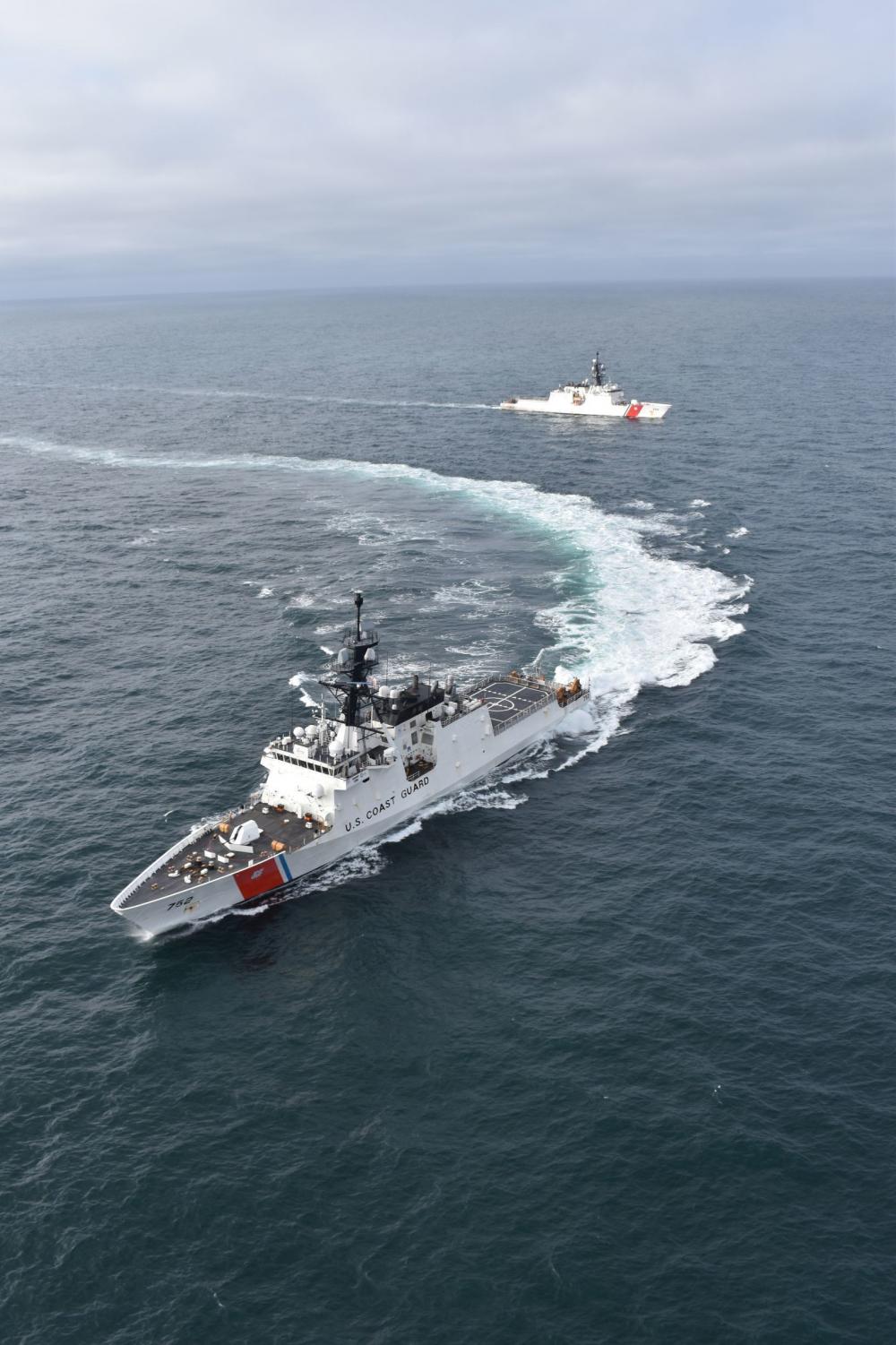
U.S. Coast Guard Cutters Stratton (WMSL 752) and Kimball (WMSL 756) steam in formation while patrolling the U.S.-Russian Maritime Boundary Line (MBL), in the Bering Sea, Sept. 26, 2022. This marked the first time two national security cutters jointly patrolled the MBL above the Arctic Circle. (U.S. Coast Guard courtesy photo).

This isn’t like the Alaska Patrols I went on, which concentrated on the Aleutians/Bering Sea and never went much North of the Arctic Circle. This patrol went across the top of Alaska and apparently, this is getting to be more common.

Media Advisory

Nov. 22, 2022
U.S. Coast Guard Pacific Area

Media Advisory: Coast Guard cutter to return home following 97-day multi-mission Arctic deployment

Coast Guard cutter returns home following 97-day multi-mission Arctic deployment

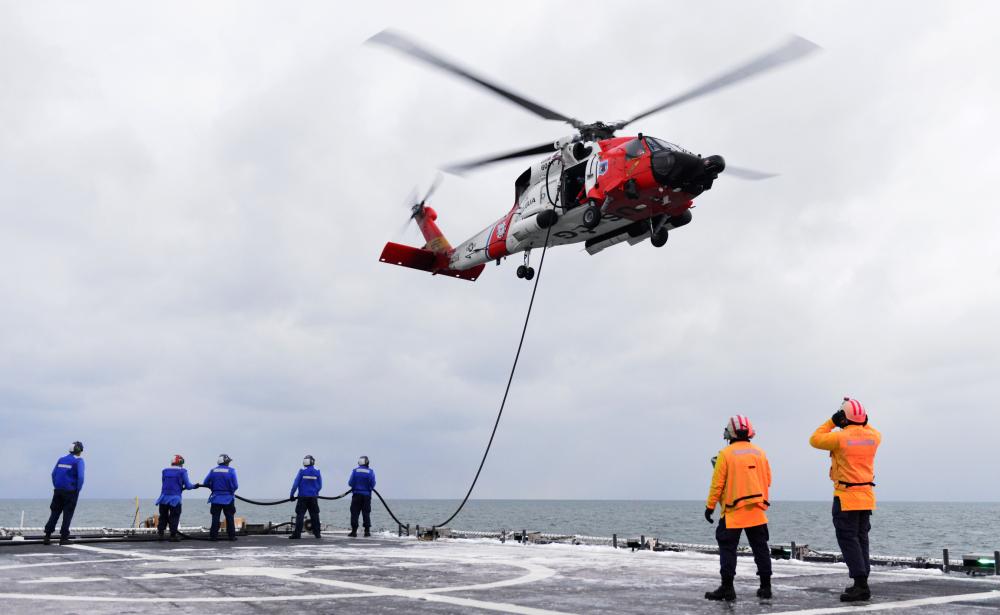
USCGC Stratton conducts operations offshore Little Diomede, Alaska Coast Guard cutter returns home following 97-day multi-mission Arctic deployment USCGC Stratton conducts flight operations while underway in Arctic Ocean

Editors’ Note: Click on images to download high resolution version.

Who: U.S. Coast Guard Cutter Stratton (WMSL 752) and crew

What: Return home from multi-mission Arctic deployment

When: Wednesday, Nov. 23, 2022 at 9 a.m.

Where: Coast Guard Base Alameda, 1 Eagle Rd., Alameda, CA, 94501

ALAMEDA, Calif. — The Coast Guard Cutter Stratton (WMSL 752) and crew are scheduled to return to Alameda, Wednesday, following a 97-day multi-mission deployment to the Arctic Ocean and Bering Sea.

The cutter and crew departed Alameda in August to project U.S. sovereignty throughout U.S. Arctic waters, provide search-and-rescue capabilities in the region, meet with Alaskan communities and conduct an Arctic search-and-rescue exercise with international partners.

Stratton operated along the length of the U.S.-Russian maritime boundary line (MBL) from the Diomede Islands to well above the Arctic Circle, while they patrolled within the U.S. Arctic zone. Stratton also patrolled the U.S.- Canadian MBL in the Beaufort Sea, providing Coast Guard presence in the distant regions of the Arctic.

“I’m extremely proud of this crew and all they have accomplished,” said Capt. Stephen Adler, Stratton’s commanding officer. “The U.S. Coast Guard provides the Nation’s most active and visible maritime presence in the high latitudes, and coordinates with our international partners through joint exercises and professional exchanges to maintain a safe and prosperous Arctic region. The Coast Guard remains ‘Always Ready’ to preserve and protect our northern shores and waters. As more ships and people move into the Arctic, the Coast Guard will be there to ensure safety of navigation and preserve our national sovereignty, as it always has. The crew has truly lived up to our ship’s motto of, ‘We Can’t Afford Not To’ throughout our patrol.”

Stratton is one of four 418-foot national security cutters (NSC) homeported in Alameda. National security cutters are capable of extended, worldwide deployment in support of homeland security and defense missions. These cutters and crews routinely conduct operations from South America to the Arctic, where the combination of range, speed, and ability to operate in extreme weather provides the mission flexibility necessary to conduct vital strategic missions.

Media are encouraged to contact Coast Guard Pacific Area Public Affairs at pacificareapublicaffairs@uscg.mil to arrange an escort on Base Alameda to attend the ship’s arrival. Adler and crew will be available for interviews following the ship’s arrival.

“Royal Bahamas Defence Force makes huge surge in migrant apprehensions” –The Watch

NorthCom’s online magazine, “The Watch,” reports,

The Royal Bahamas Defence Force (RBDF) announced that its migrant apprehensions increased dramatically in 2021 when compared with the previous year.

RBDF Commodore Raymond King said during a January 2022 news conference that detainments in the Bahamas increased by 456% in the past year, according to The Tribune, a Bahamian newspaper. King said the RBDF is faced with “people  smugglers” who are using more sophisticated methods to evade authorities.

This is really a success story with strong USCG involvement. There was also success reported in discouraging illegal fisheries poaching.

Related:

“MASTERING EXPEDITIONARY IUU FISHERIES ENFORCEMENT IN THE BAHAMAS” –CIMSEC

“U.S. upgrades Bahamas’ maritime security” –The Watch

Damen to Build New Patrol Boats for Bahamas

“An Arctic presence grows more important for U.S. and its partners” –The Watch

This map show the exclusive economic zones (EEZs) within the Arctic: Canada (purple), Greenland (orange), Iceland (green), Norway (turquoise), Russia (light blue), and USA (dark blue). As sea ice reduces there will be more opportunity for ice to drift from one EEZ to another, which has implications for the potential spread of pollutants.
Credit: DeRepentigny et al., 2020

NORTHCOM’s on-line magazine, The Watch, has a short post about the Arctic.

I would note that most of the discussion centers on the Atlantic side of the Arctic, whereas the Coast Guard concentration has primarily been on the Pacific side. We have seen some indications there may be Coast Guard Arctic capable assets on the Atlantic side in the future. Not too early to think about that.

The Coast Guard has had good relations with the Russians in the Arctic because of a common interest in fisheries, SAR, and environmental protection. That is all to the good. At some future date, the Coast Guard will probably do a Freedom of Navigation Exercise through the at least parts of the Northern Sea Route. Hopefully we can find ways to, perhaps, disagree amicably as we have with the Canadians in regard to the Northwest Passage.

“U.S. upgrades Bahamas’ maritime security” –The Watch

Source: CIA, The World Factbook, 2004.

NORTHCOM’s on-line magazine, “The Watch,” reports,

“The United States recently bolstered maritime security in the Bahamas by delivering a radar system to its partner in the Caribbean region.

“The U.S. $2.4 million-dollar MSS (Maritime Surveillance System–Chuck) is part of a commitment of more than $10 million to empower the Bahamas to better ensure the safety and security of its vast archipelago, the news release said. The radar is the second MSS installed with funding from USNORTHCOM, the first having become operational on the island of Great Inagua in 2019. Third and fourth systems have been proposed for Ragged Island and Great Exuma.”

There is more of course.

Now, do we have comparable systems on Puerto Rico and the American Virgin Islands?

Defending the Homeland

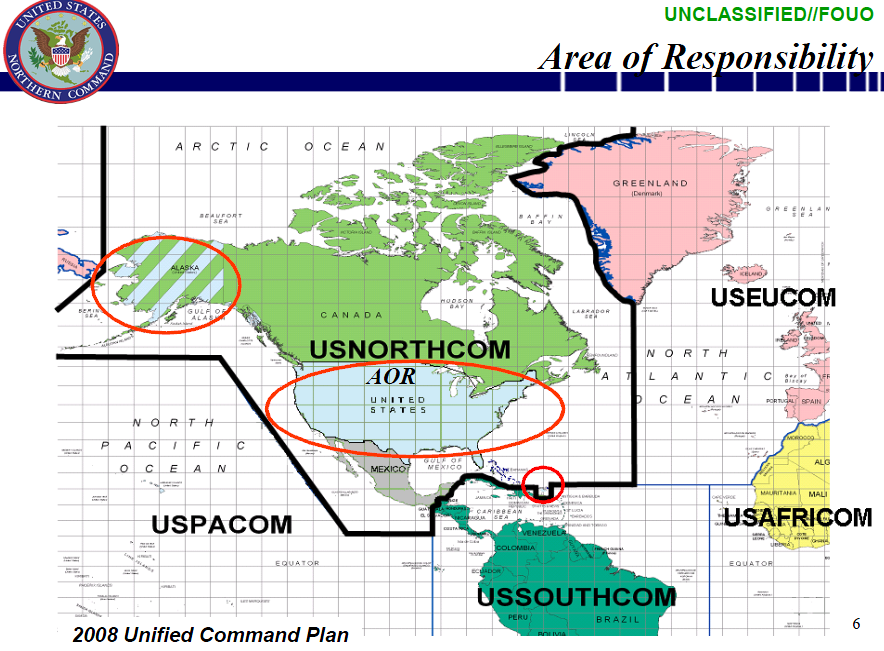
Air Force Magazine talks about how decisions are made when it comes to defending the “Homeland”. It is pretty unwieldy now, but there is hope that it can be streamlined.

The Coast Guard needs to be part of this, both as Maritime Domain Awareness sensors, and as potential response assets.

As new systems are designed, we need to make sure the Coast Guard is included.