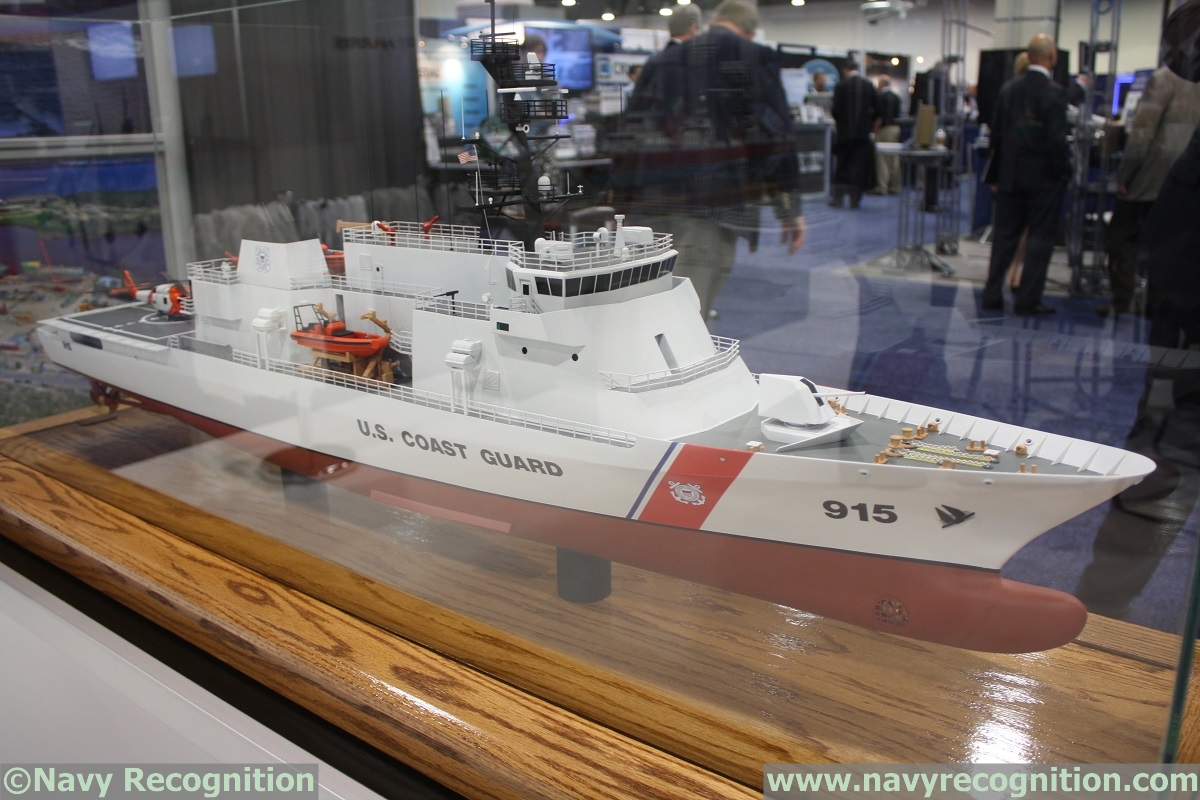
Poland looking for OPCs

ProposedPolishCorvette

Rolls Royce proposal

Poland is planning some ships that have many similarities to the Offshore Patrol Cutters. We have talked about these a little already, in the context of an unconventional hull form offered by ThyssenKrupp Marine Systems (TKMS) that promises better fuel economy. Our friend at Thinkdefence talks about another proposal from Rolls Royce. He also provided a link to a more detailed description of the program.

The intention is apparently to produce three “Miecznik” corvettes and three “Czapla” patrol ships (with mine countermeasures) with the two classes sharing a common platform. ThinkDefence reports the key features of Rolls Royce’s corvette version as follows:

“It is 99.7 metres long and displaces just over 2,400 tonnes. Accommodation for 60 crew and an additional 30 personnel is included and the ship is said to have a 28 day endurance. With a CODLOD propulsion system its design top speed is 25 knots. Weapons and sensors include a 76mm Oto Melara gun, twin MSI 30mm automatic cannons, two quad NSM missile launchers, MU90 torpedo launchers and four Sylver A35 cells for quad packed VL-MICA anti-aircraft missiles; Smart-S 3D radar, Thales optronic systems and Kingclip sonar.”

Substituting some equivalent US systems, I think that would represent a good approximation of how a war ready OPC might be equipped.

Apparently they intend to order one ship a year beginning with the corvettes in 2017. That starts them on nearly the same schedule as the OPCs. Which will be finished first? Unfortunately the Poles will probably see their first ship before we see the first OPC.

Rolls Royce CDV 4


Australia to Build OPVs

Australia has been talking about getting new ships for sometime, but recently they announced a policy of “continuous shipbuilding” in an effort to maintain a domestic  warship building capability.

While submarines and frigates have gotten most of the press, and will get most of the money, they also intend to build Offshore Patrol Vessels (OPVs) to replace their Armidale class patrol craft, which have proven not quite up to the demanding missions they have been assigned. (They will also be building patrol boats to be distributed to Pacific island nations.)

“The construction of offshore patrol vessels to replace the Armidale class has also been moved forward to 2018.”

2018 puts them two years ahead of the Frigates, so this may be a lead in for the more sophisticated project. I suspect they will be strongly influenced in the selection of their OPV by New Zealand’s experience. due to the frequent contact and cooperation between the Australian and New Zealand Navies.

The New Zealand OPVs, HMNZS Otago and Wellington, appear to be progenitors of Eastern’s OPC proposal, so there is a good chance the Australians will be building something like the OPC. The CG should make its selection of the final OPC design about a year before Australia has to make their OPV design selection, so perhaps they could benefit from the Coast Guard’s selection process.

ASuW Hellfire Test Success–Operational Late 2017

Navyrecognition reports that a successful test of modified Hellfire missiles for use in the Surface to Surface Missile Module (SSMM) planned for the Littoral Combat Ship has paved the way for operational deployment of the system in late 2017.

We have talked about these missiles before. They seem to be an ideal way to deal with the threat of small, fast, highly maneuverable boats that might be employed by terrorists, and absent more effective weapons, may provide some capability against even large vessels. Unlike gun systems, they promise high first round accuracy and lethality, with very little chance of a round going astray and hitting something unintended.

The projected SSMM would provide storage and launch facilities for up to 24 rounds. 24 rounds would weigh only about 2500 pounds. The launcher and support systems is unlikely to weigh more than that, suggesting and all up weight of about 5000 pounds, far less than either the 76mm Mk75 gun or the 57mm Mk110 (two and a half tons compared to eight or nine tons). Both of these guns are commonly used on missile and patrol boats smaller than the Webber class WPCs. Also unlike a gun system, the SSMM is unlikely to require any significant deck reinforcement.  It would almost certainly fit on all large cutters and perhaps the WPCs and WPBs as well. (It should be included on Offshore Patrol Cutters from day 1.) If the 24 round system is too large to be comfortably carried by smaller cutters, it is likely a smaller, say four round, system could be quickly and economically developed for Coast Guard use and perhaps for the Navy’s MkVI patrol boat as well.

If we take the Ports, Waterways, and Coastal Security mission seriously we really should be looking seriously at acquiring these systems, not just for the new ships as they are built, but also for the existing fleet with the idea that the systems would be transferred to the newer ships as the older ones are replaced.

The Navy should be willing to pay for these systems under existing inter-service agreements.

As noted before, if we need to stop a terrorist attack, we are far more likely to have a WPC or WPB on scene than a larger cutter. For this reason, arming some the Webber class in each homeport should be the first priority. Unfortunately the Webber Class are not geographically wide-spread, so we should look at mounting systems on existing MECs and WPBs to insure all potential targets have some protection until the entire fleet is armed.

I would say there are places where they might be mounted on Coast Guard stations ashore, to act as gate keepers for the ports against clandestine attacks, but coast defense is still an Army mission. Perhaps this is something we should be talking about too. If not Coast Guard manned defenses (which is probably the proper solution), then perhaps placement of unused SSMMs with their associated Navy crews on Coast Guard facilities or small detachments of army troops with their weapons to perform this function.

Document Alert–Coast Guard Cutter Procurement

USNI news service has posted a copy of the Congressional Research Services latest take on the Coast Guard Vessel recapitalization program, “Coast Guard Cutter Procurement: Background and Issues for Congress.”  As usual their “Specialist in Naval Affairs,” Ronald O’Rourke, has done an excellent job and by simply stating the facts has made a strong case for recapitalization.

There are some criticisms implicit in the recitation of events thus far. I think it is apparent that the Crew Rotation Concept is proving an embarrassment, in that while we have now had three operational “National Security Cutters” for some time, there has been no attempt to validate the concept, and no attempt to repudiate this relic of the Deepwater program. The concept is a non-starter we have discussed several times. Ships are not cars in a motorpool. You cannot swap entire crews and expect good results. Time to piss or get off the pot. This bad news is not going to get better with age.

Limited progress on UAVs was also discussed.

Small Unmanned Aerial Systems (sUAS)

sUAS

An AeroVironment Puma All-Environment small unmanned aircraft system is launched from Coast Guard Cutter Chock as part of the Research and Development Center’s Robotic Aircraft for Maritime Public Safety (RAMPS) project. U.S. Coast Guard photo by Petty Officer 2nd Class Luke Clayton.

The Acquisitions Directorate reports that the Coast Guard is at least looking at small UAS (UAVs for us traditionalists).

“The demonstrations are part of the RDC’s Robotic Aircraft for Maritime Public Safety project, which aims to determine the risks, benefits and limitations of operating commercial off-the-shelf sUAS technology in conjunction with Coast Guard cutters other than the national security cutter.”

Tests of seven systems were conducted on USCGC Chock (WYTL 65602), a 65 foot tug, so you know the systems had to be small. In fact, I have radio controlled airplanes bigger than these. Still, hopefully these are smarter.

An interesting aspect of the trials is that it included test specifically intended to determine if the sUAS would be useful in finding a person in the water. To do this they used a dummy with an enhanced IR signature comparable to that of a person they refer to as a “thermal Oscar.”

While UAVs of this size may have uses, ultimately, I think they will find that the system we need will be something with a radar that will fit on a Webber class, that means something similar to Scan Eagle. Smaller vessels don’t actually need their own UAS, they can be supported by UAS from ashore. Perhaps every SAR station should be able to launch their own UAS to get to scene before the boat arrives. That would require SAR stations to coordinate with Air Traffic Control. USCGC Chock’s sistership, 65 foot tug, USCGC Swivel, by Windwork50

Authorization Bill Has Some Surprises

Federal Times is reporting the contents of the Coast Guards latest authorization bill, and there are some surprises.

The item I was particularly pleased to see, was a apparent interest in something I feel should be more closely watched, cutter days available.

Part of that requirement would be to implement a standard for tracking the number of days Coast Guard cutters are in operation at sea, and include days in which cutters are undergoing maintenance or repair.

That should be revealing. In considering what should be expected, I would suggest we look back a few years, say take a five year average from 1998 to 2002 as a baseline.

There are lots of other proposed changes, not the least is that it is to cover two years. I suggest you check it out.

CG making progress in reducing acquisition risks for OPCs–DHS IG

IMG_4134

Photo: Eastern’s proposed Offshore Patrol Cutter (OPC) concept. One of three shipyards contending for the contract

FierceHomelandSecurity is reporting,

“An internal audit says that the Coast Guard is making progress in reducing acquisition risks of more than two dozen offshore patrol cutters, but it’s still too early to tell whether the service has fully implemented two risk mitigation recommendations that were previously made by the inspector general.

“One recommendation directs the Coast Guard to make sure it’s achieved a level of “design maturity” in its engineering plans, meaning that the designs are fully developed prior to construction.

“The other instructs the service to ensure that “low-rate initial production” – that is producing enough quantities of cutters to test, evaluate and approve before full production – are supported by an operational assessment. This assessment evaluates proposed cutter designs against operational requirements and identifies risks.

The Commandant has said they have looked so closely at the designs that they questioned the number of water fountains (scuttlebutts for the sailors). That sounds like design maturity, but then the purpose was to save money, not to ensure operational competence. I would hope we have done that as well. We are certainly taking long enough to make sure the designs are mature.

I would take issue with the statement, “Under a two-phase strategy, the service plans to acquire 25 OPCs to replace an equal number of medium endurance cutters.” These 25 ships are intended to replace 32 WMECs, four of which have already been decommissioned, 13 270s, 16 210s, the Alex Haley, Acushnet, and Storis. In 2000 we had 44 large cruising cutters; if the program of record is fully implemented we will have only 33. The misguided “Crew Rotation Concept” which, even if it works, will not give us the same number of ship days away from home port as 44 ships, even if we have to pay for 44 crews, is biting us. (Note, it appears to me this statement was made by FierceHomelandSecurity rather than as part of the IG report.)

The DHS IG report referred to, regarding the OPCs, is this document, “Verification Review of U. S. Coast Guard’s Acquisition of the Sentinel Class Fast Response Cutter (OIG-12-68),” that can be accessed through the FierceHomelandSecurity post.

The alarming aspect of this, is the insistence on “low rate production” until the design is tested. It seems we have been planning low rate production all along, with only one ship per year to be funded for the first three years, and no more than two per year after that, meaning with production of 25 ships, we will not see the last ship delivered until 2035. That sounds pretty low rate to me.

If we fund as expected (one per year for three years, then two per year), there will be a shift to funding two ships per year before the first ship has completed testing. Is two ships per year a high rate which the IG might oppose? Is there any possibility that after testing we might be able to build OPCs at a rate higher than two per year (as we really should)?

I have still heard no suggestion that the Coast Guard will take advantage of the multi-year/block buy procurement that Congress has authorized for the OPC, nor have they requested authority for Multi-Year procurement of the Webber class WPCs which certainly qualify as a mature and tested program.

There was a time when the Coast Guard took delivery of 28 ships in nine years.  It really looks like the we are going to need similar surge in the future to prevent a collapse of our capabilities.

GAO makes astounding discovery

With an amazing grasp for the obvious, the GAO has once again reported (pdf) that the Coast Guard is not getting, or expected to get, the money it needs to fund its program of record in a timely manner.

“…the Coast Guard’s acquisition needs are not affordable based on past and expected future funding levels.”

Basically they are repeating their findings for the past several years, and as always their solution to not making the goal, is to move the goal post.

“GAO found in June 2014 that budget officials have acknowledged that the Coast Guard’s current plan for developing new, more capable assets is not affordable given current and expected funding levels. For the past 5 years, GAO has found that the Coast Guard’s acquisition funding has fallen short of what it estimates it needs to fully recapitalize its assets. The Coast Guard has responded by annually delaying or reducing its capability. The Coast Guard and the Department of Homeland Security (DHS) have taken some steps to address these affordability issues, but as yet these efforts have not led to the types of significant trade-off decisions among resources and needs that would improve the long-term outlook of the Coast Guard’s acquisition portfolio.”

Frankly the Congressional Research Service, reports written by Ronald O’Rourke, are far more informative, and despite his position mandated neutrality, more supportive of the Coast Guard, but still this document does have some interesting observations.

Fixed Wing Aircraft

The Coast Guard has a Program of Record goal of 52,400 flight hours for its fixed wing assets. Currently the fleet performance is 38 percent short of this flight hour goal, but even if all currently planned assets are procured, we will still be 18 percent short of the flight hour goal. How come? First, instead of getting 36 C-144s we will be getting only 32 aircraft, 18 C-144s and 14 C-27J. The award winning C-144 acquisition program has been suspended even though the Coast Guard knew they were going to be at least four planes short. Second, instead of the 1,200 hours per year per Medium Range Search (MRS) Aircraft, the Coast Guard has decided it can expect only 1,000 hours per year.

The GAO reports the Coast Guard plans to complete a fixed-wing fleet mix analysis by 2019, which will revisit the current flight hour goal.

“The Coast Guard has begun to rewrite its mission needs statement and concept of operations and plans to complete this effort by 2016. The Coast Guard plans to complete its full fixed-wing fleet mix analysis, which includes the assets it estimates will best meet these needs, by 2019, but has not set forth specific timeframes for completing key milestones. We recommended in our March 2015 report that the Secretary of Homeland Security and the Commandant of the Coast Guard inform Congress of the time frames and key milestones for completing the fleet mix study, including the specific date when the Coast Guard will publish its revised annual flight hour needs and when it plans to inform Congress of the corresponding changes to the composition of its fixed-wing fleet to meet these needs. DHS concurred with our recommendation but did not provide specific time lines for meeting this recommendation. The bill for the Coast Guard Authorization Act of 2015, introduced in April 2015, requires a revised Coast Guard fixed-wing aircraft fleet mix analysis to be submitted to congressional transportation committees by the end of fiscal year 2015.”

OPCs/WMECs:

The report raises for the first time I have seen in official documentation, the possibility that some WMECs will have to be retired well before replacement. They report that currently there is no plan to extend the service life of these legacy assets and no money programmed in the five year capital investment plan. As a result the CG “faces a potentially significant capability gap.”

NSCs:

All though the National Security Cutters have all been funded, they may yet adversely effect future AC&I budgets.

As we also reported in June 2014,  further changes may be needed due to issues discovered through operating the NSC, which could result in the Coast Guard having to spend even more money in the future to ensure the NSC fleet meets requirements and is logistically supportable.

“For example, the cutter is experiencing problems operating in warm climates, including cooling system failures, excessive condensation forming puddles on the deck of the ship, and limited redundancy in its air conditioning system affecting use of information technology systems. According to operational reports from a 2013 deployment, the Commanding Officer of an NSC had to impose speed restrictions on the vessel because of engine overheating when the seawater temperature was greater than 68 degrees. In addition, cold climate issues on the cutter include a lack of heaters to keep oil and other fluids warm during operations in cold climates, such as the arctic. Further, Coast Guard operators state that operating near ice must be done with extreme caution since the ice can move quickly and the NSC could sustain significant damage if it comes in contact with the ice. In June 2014 we reported that while senior Coast Guard officials acknowledged that there were issues to address, they stated that the Coast Guard has not yet determined what, if any, fixes are necessary and that it depends on where the cutter ultimately operates.”

Webber Class WPCs:

In April 2015, the Coast Guard accepted delivery of the 13th of 58 FRCs and now has 32 of the cutters on contract. As we reported in April 2015, the Coast Guard is introducing additional competition into this purchase by recompeting the construction contract for the remaining 26 vessels; this contract is planned to be awarded in fiscal year 2016. According to the Coast Guard, the FRC has already been used to rescue over 400 undocumented immigrants, seize nearly $20 million in contraband, and apprehend several suspected drug smugglers. The fiscal year 2016 Capital Investment Plan includes $1.47 billion over the next 5 years to continue purchasing these assets by which time the Coast Guard plans to have fielded 42 FRCs.


The Future:

As I noted earlier, we have to look beyond these programs and the GAO addresses this concern.

“…senior Coast Guard officials have stated a need for over $2 billion per year, but the Coast Guard has received $1.5 billion or less over the past 5 years. The President’s budget requests $1 billion for fiscal year 2016. In an effort to address the funding constraints it has faced annually, the Coast Guard has been in a reactive mode, delaying and reducing its capability through the annual budget process but without a plan to realistically set forth affordable priorities. The Coast Guard, DHS, and Office of Management and Budget officials have acknowledged that the Coast Guard cannot afford to recapitalize and modernize its assets in accordance with the current plan at current funding levels. Efforts are underway to address this issue, but so far, these efforts have not led to the difficult trade-off decisions needed to improve the affordability of the Coast Guard’s portfolio. We recommended in 2014 that the Coast Guard develop a 20-year fleet modernization plan that identifies all acquisitions needed to maintain the current level of service—aviation and surface— and the fiscal resources needed to buy the identified assets. We recommended that the plan should consider trade-offs if the fiscal resources needed to execute the plan are not consistent with annual budgets. The Coast Guard concurred with our recommendation, but its response did not fully address our concerns or set forth an estimated date for completion.

“In June 2014, we also reported that the Coast Guard faces a potentially expensive recapitalization of other surface assets, such as the polar icebreakers and its fleet of river buoy tenders, as these assets continue to age beyond their expected service lives and, in some cases, have been removed from service without a replacement. These issues pose additional potential challenges to the affordability of the Coast Guard’s overall acquisition portfolio.”

Icebreakers—According to program officials, due to funding constraints, the Coast Guard chose not to invest in either of its heavy icebreakers as they approached the end of their service lives. Thus, both heavy icebreakers were out of service from 2010 to 2013 and the Coast Guard could not complete missions, such as resupplying a science laboratory in Antarctica. The Coast Guard has recently returned one of these heavy icebreakers back to service, but still has one fewer heavy icebreaker than it has historically operated and several fewer than it needs, according to the Coast Guard’s June 2013 heavy icebreaker mission need statement. The fiscal year 2016 President’s Budget asks for $4 million for continued preparatory studies to develop a cost estimate, among other things. The associated fiscal year 2016 Capital Investment Plan contains $166 million for polar icebreakers over the next five years but does not identify what this money is for, though it is far short of the estimated $831 million needed to build the vessel. The Coast Guard is currently working with several U.S. government agencies to develop requirements and establish a plan to build a heavy icebreaker that could be jointly funded by the U.S. government agencies that need the asset to accomplish its missions.

River Buoy Tenders—”The Coast Guard is facing a gap in its river buoy tender fleet and has yet to formalize an acquisition project to replace this fleet—a project estimated to cost over $1.5 billion.”

HH-60 and HH-65 Helicopter Fleets—”The HH-60 and HH-65 helicopter fleets will approach the end of their lifespans between 2022 and 2026 and will need to either be replaced or have a service life extension performed to keep them operational. Regardless of the future path, significant acquisition dollars will be required to maintain annual flight hours for the next 20 years, according to Coast Guard program officials.”

Observations:

When the GAO says, “We recommended in 2014 that the Coast Guard develop a 20-year fleet modernization plan that identifies all acquisitions needed to maintain the current level of service (emphasis applied, Chuck)—aviation and surface— and the fiscal resources needed to buy the identified assets” it gives the impression they are not looking at the benefit side of the cost/benefit equation. It also looks like they may be ignoring the changes in the world since the legacy fleet was built. After all, when the 210s and 378s were built there, was no Exclusive Economic Zone and the territorial sea was 3 miles. 9/11 was still decades in the future. Our Navy was many times larger and it had units based all along the coast in almost every major port.

On the other hand they may be giving us a criteria for defining how fast existing resources should be provided. If we say resource hours should never drop below those provided by the legacy fleet, then really it looks like we need to build faster.

The units that the Coast Guard is currently building are obviously more capable than the units they are replacing and with the possible exception of the National Security Cutter (NSC), they are also going to be more expensive to man and operate.

The Bertholf class NSCs are about 50% larger than the 378s, but at least they have a smaller crew.

The OPC appear to be likely at least 50% larger than the 270 and possibly as much as three times the size of the 210s. They will likely have crews at least as large as the 270s, and significantly larger than the 210s.

The Webber class are more than twice as large as the Island class and have a crew almost half again as large.

I do believe there are reasons for this apparent growth, but it means the Coast Guard does need more money than it has in the past. Coast Guard leadership may have felt that they had been assured that funding for these more expensive assets would be available, given approval of the original Deepwater program and the revised post 9/11 upgraded Deepwater program, but while the money may come, the most expensive part of the program, the offshore patrol cutter, is only being funded in dribs and drabs.

Too often it seems we emphasize the good things the service has done for the country and left unsaid the failures, lost opportunities, and the very real risks we take when the service is not properly funded.

It appears that for several years, perhaps more than a decade, the resource hours from Coast Guard assets, may fall below those of the legacy fleet, either because assets must be decommissioned without replacement, or because of unplanned maintenance requirements. If we could establish a consensus that at least resources hours available should not be allowed to fall below those that were provided by the legacy fleet, we would have a convincing argument for more reasonable funding levels.

The Coast Guard’s Missing Links–the Commandant

The Coast Guard Compass has published a post by the Coast Guard Commandant Adm. Paul Zukunft arguing for Offshore Patrol Cutter. This is obviously a topic close to my heart, and I don’t think anyone will mind if I quote it here whole cloth.

“Twenty miles east of the Dominican Republic, the Coast Guard Cutter Charles Sexton rescued 117 people from a dangerously overcrowded 30-foot makeshift craft. Hours later, the Coast Guard Cutter Stratton interdicted $14 million worth of cocaine and apprehended three suspected smugglers. In two days, on two coasts, two assets proved the multi-mission might of the U.S. Coast Guard as crews saved lives, secured our border and severed cash flows to a transnational criminal enterprise.

“The Charles Sexton, a 154-foot fast response cutter, and the Stratton, a 418-foot national security cutter, are part of the Coast Guard’s persistent presence, patrolling and protecting more than 95,000 miles of coastline and 4.5 million square miles of the U.S. Exclusive Economic Zone – home to our Nation’s precious resources, including our oil, natural gas, fish and mineral reserves. The vastness of this area, paired with our array of missions, requires a network of Coast Guard surface and air assets on shore and at sea to preserve America’s security and prosperity.

“Missing from this network – the necessary link between the national security cutter’s open ocean endurance and the fast response cutter’s littoral presence – is the offshore patrol cutter. The offshore patrol cutter will promote governance and provide capability on our oceans – the gateway for U.S. economic growth, opportunity and prosperity. It is here, beyond 50 nautical miles from U.S. shores, where national interests in the U.S. maritime domain require the Coast Guard’s unique blend of authorities. And, it is the offshore patrol cutter that will protect our sovereign interests, enforce laws, save lives, protect fisheries, secure offshore energy resources and provide command and control for major response and contingency operations.

“Currently, the 1960s-era 210-foot and the 1980s-era 270-foot medium endurance cutters are the link between the Coast Guard’s national security cutters and fast response cutters. However, this link is under untenable strain, characterized by decreasing readiness and skyrocketing maintenance costs. In the last two years, four of these aging ships had to be pulled out of service for emergency repairs, straining our ability to support and maintain other ships and aircraft, impacting crew safety and quality of life and diminishing the Coast Guard’s ability to project U.S. authorities and respond to crisis in the maritime domain. This past weekend, I went aboard our newest medium endurance cutter, Coast Guard Cutter Mohawk in Key West, Florida. Mohawk was commissioned in 1991 and will continue to serve our Nation until it is replaced with the next generation of offshore patrol cutters close to five decades after she began her service.

“I carried these thoughts with me as I set foot aboard the Coast Guard Cutter Robert Yered, one of our newest fast response cutters. Leaping forward nearly half a century from our oldest ships, the Robert Yered’s modern, high-tech systems are fully interoperable with our partners in the interagency and international community as it executes missions across our littorals. This nimble fast response cutter is not, however, without its limitations. It cannot launch and recover aircraft – a necessary capability in the Coast Guard’s operational network of assets – and has limited range and endurance relative to our major cutters. The Coast Guard must have flight deck capable ships with robust command and control capabilities exactly where we need them, from the farthest reaches of the transit zone off of Central America to our northernmost borders off of Alaska. The offshore patrol cutter is designed to fill this need.

“Our aging platforms do not suffer from neglect. Coast Guard men and women consistently demonstrate exceptional commitment and innovation to sustain a medium endurance cutter fleet that has served admirably for more than five decades. In fact, our first medium endurance cutter went to sea the very same year the first Mustang rolled off Ford’s assembly lines. Unlike antique cars, however, which are often restored at great expense and used for the occasional fair weather Sunday drive, the increasingly expensive ships of America’s Coast Guard are painstakingly maintained and regularly put to work in the harshest maritime conditions.

“Indeed, not having reliable use of these aged medium endurance cutters, the linchpin of our operational network, puts us at a disadvantage at a time when we are needed most. Given the complex threats facing the Nation today, we simply do not have the luxury of storing them in the garage.

“The U.S. Coast Guard has a proud history spanning nearly 225 years. We have won federal acquisition awards, maintained clean financial audits and earned a reputation for responsible stewardship. We cannot afford to dull our operational edge and jeopardize our Service to Nation any longer. The Nation deserves better, and the offshore patrol cutter is the answer.”


LCS/SSC/Frigate and the OPC

DefenseNews is reporting that “Pre-preliminary design and system selection for the frigate will be completed in October 2015,” Chris Johnson, a spokesman with the Naval Sea Systems Command, said May 28.

I don’t think it should be too much of a stretch, that the systems on the OPC should include a subset of those to be used on the frigate, with another subset of the frigate’s systems planned into the ships for inclusion if conditions warrant the upgrade. Design for Wartime, but equip for peacetime.