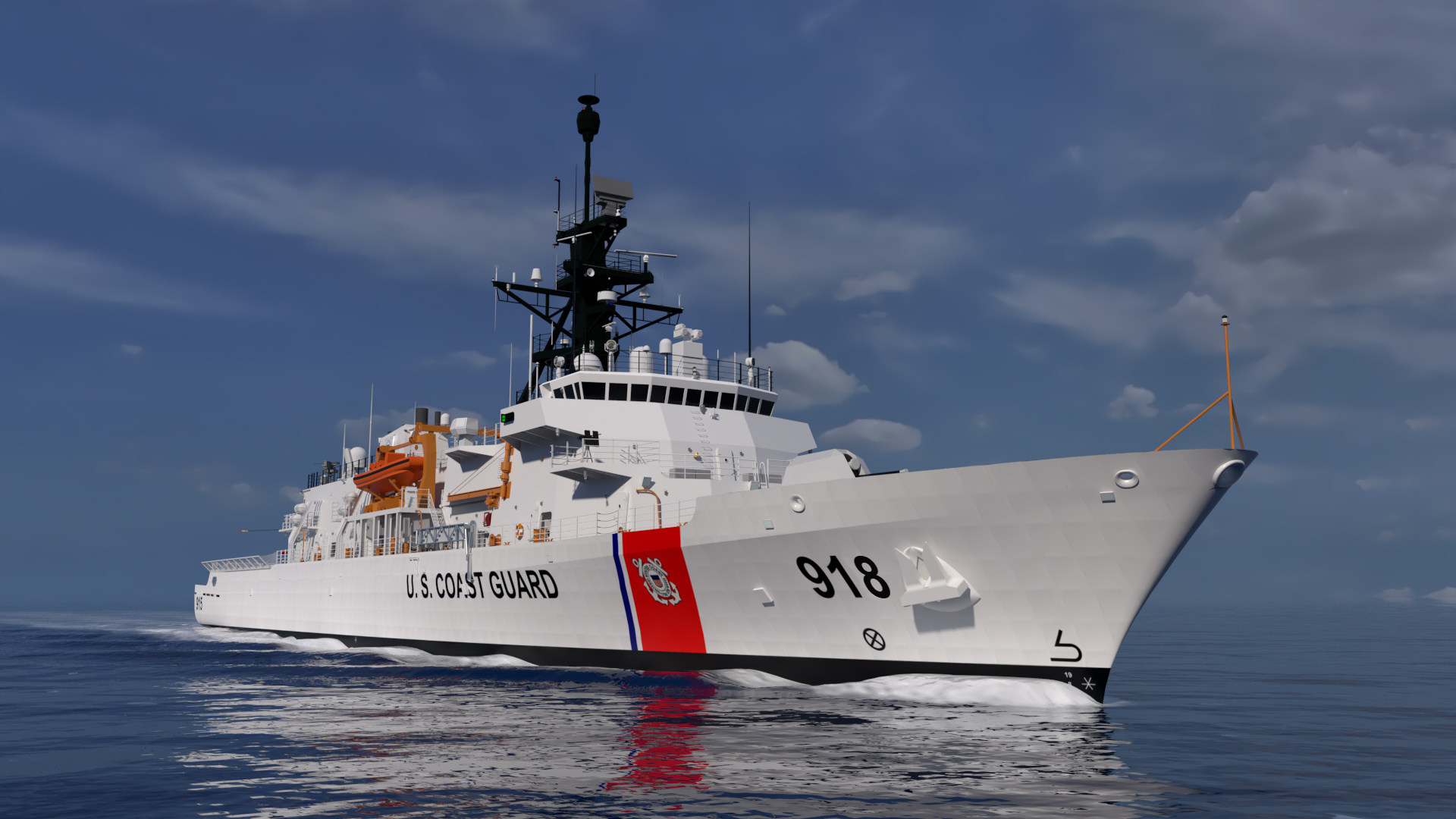
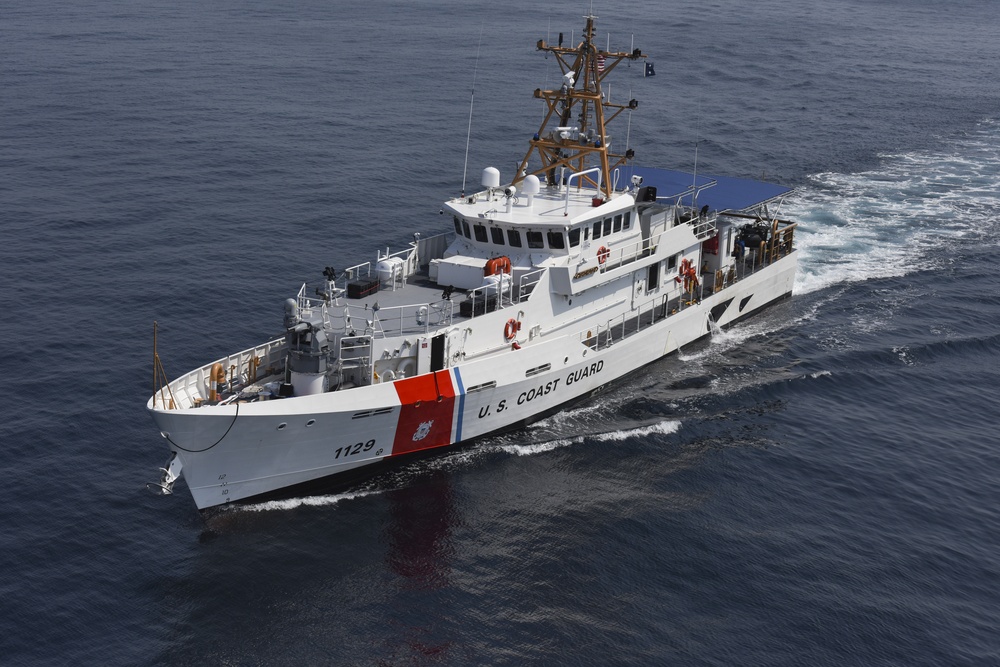
“SOLICITATION FOR SUBJECT MATTER EXPERTS (SME) TO ASSESS THE OFFSHORE PATROL CUTTER” –ALCOAST

Some of you might be interested in responding to this. It also seems to suggest the future USCGC Argus is pretty far along.

Maybe something similar was done earlier, but it seems late in the game to do this sort of design review. Even so, seems like a good idea. Maybe not too late to incorporate ideas in the “B class” OPCs.

As you all probably know by now, I don’t think any current or planned cutter meets the implicit requirement of being able to forcibly stop any ship, regardless of size, and my belief this is entirely possible for cutters as small as patrol boats (WPBs).

R 241556Z AUG 22 MID200080150110U
FM COMDT COGARD WASHINGTON DC
TO ALCOAST
BT
UNCLAS
ALCOAST 307/22
SSIC 5102
SUBJ:  SOLICITATION FOR SUBJECT MATTER EXPERTS (SME) TO ASSESS
THE OFFSHORE PATROL CUTTER
1. This ALCOAST solicits volunteers to participate in a six-day
Offshore Patrol Cutter (OPC) Operational Assessment (OA) in Panama
City, FL from 31 October to 05 November 2022. The OA is a review
and analysis of cutter design data to determine the operational
capability and effectiveness expected to be delivered by an OPC.
2. Background: The OPC will constitute a significant percentage of
the USCG’s major cutter fleet, and is designed to have new
capabilities for maritime homeland security, law enforcement and
national defense missions. OPCs, designated as the Maritime
Security Cutter, Medium (WMSM), will replace existing Medium
Endurance Cutters (WMECs) and fill a critical operational gap
between the USCG’s Fast Response Cutter (FRC) and the National
Security Cutter (NSC). The first OPC will be delivered in FY 2023.
3. The OA, facilitated by the Operational Test and Evaluation Force
(OPTEVFOR), is primarily a tabletop documentation review by
experienced active duty members who are currently serving, or have
recently served on WMECs, WHECs, WSMLs, or have experience with
planned OPC systems and major cutter support. The OA will also
provide SMEs an opportunity to walk an OPC currently in production
to supplement their assessment of capabilities. SME input will
assist OPTEVFOR in assessing suitability of systems on an OPC and
will culminate in an OA report submitted to the Vice Commandant and
DHS’ Office of Test and Evaluation to assess OPC capabilities.
4. Following are the OPC assessment groups and the corresponding SME
experience needed for the OA:
a. DECK – Current or recent major cutter First Lieutenant (BOSN).
Boatswain’s Mate with current or recent major cutter experience as
Deck Leading Chief Petty Officer. Enlisted ratings with current or
recent major cutter experience as coxswain, boarding officer, boat
deck operator/supervisor/safety, flight deck crew, and underway
replenishment crew/supervisor/safety.
b. ENGINEERING – Current or recent major cutter Engineer Officer,
Main Propulsion Assistant, and Damage Control Assistant. Senior
enlisted with current or recent experience as Engineering Leading
Chief Petty Officer. Machinery Technicians, Electrician’s Mates,
Electronics Technicians, and Damage Controlmen with current or
recent major cutter experience.
c. OPERATIONS – Current or recent major cutter Commanding
Officer, Executive Officer, Operations Officer, and Electronic
Materials Officer. Boatswain’s Mates with current or recent major
cutter experience with navigation duties and visual signaling.
Operations Specialists with current or recent major cutter
experience with Sea Commander and electronic warfare systems.
Electronics Technicians with current or recent major cutter
experience with electronics systems maintenance. Information
Systems Technician with current or recent major cutter experience.
Intelligence Specialist with recent major cutter intelligence
support experience.
d. SUPPORT – Current or recent major cutter Support Officer.
Storekeeper, Yeoman, Culinary Specialist, and Health Services
Technician with current or recent major cutter experience. Port
Engineer, Asset Manager, Availability Project Manager, and Logistics
Specialist with current or recent experience in supporting major
cutters.
e. WEAPONS – Current or recent major cutter Weapons Officer, and
Tactical Action Officer or Combat Systems Officer. Electronics
Technicians with current or recent major cutter experience as Mk 48
GWS operators/maintainers. Gunner’s Mates with current or recent
major cutter experience maintaining and operating Mk 110, Mk 38, and
small arms maintenance.
f. AVIATION – Current or recent major cutter Helicopter Control
Officer and Landing Signals Officer. Helicopter pilots with current
or recent shipboard deployments as Senior Aviator or HITRON pilot.
Enlisted aviation ratings with current or recent experience in major
cutter deployments with responsibilities for aircraft maintenance.
5. Volunteers must be available for the entire six-day event and be
free of normal duties to allow focus on this Operational Assessment.
Participants can anticipate travel on 30 October and 06 November.
SMEs will be provided read-ahead documents in preparation for their
role to ensure the OA is completed within the allotted time. A
detailed schedule of events will be provided via email after
participants have been identified.
6. Interested participants should contact the OPC Sponsor’s
Representative, LT Sam Williams, by 19 September 2022 via email,
noting relevant experience and desired mission area from paragraph
7. Members must include a copy of their employee summary sheet from
CGBI in-board view as an attachment. Email must be forwarded from
your unit CO or XO to demonstrate command approval for
participation. COMDT (CG-9322) will issue travel orders to members
selected to participate.
8. Point of contact: LT Sam Williams, COMDT (CG-751), 202-372-2324,
Samuel.N.Williams@uscg.mil.
9. RADM Todd C Wiemers, Assistant Commandant for Capability (CG-7),
sends.
10. Internet release is authorized.
Why Did USCGC Midgett Embark an ASW Helicopter For RIMPAC 2022?

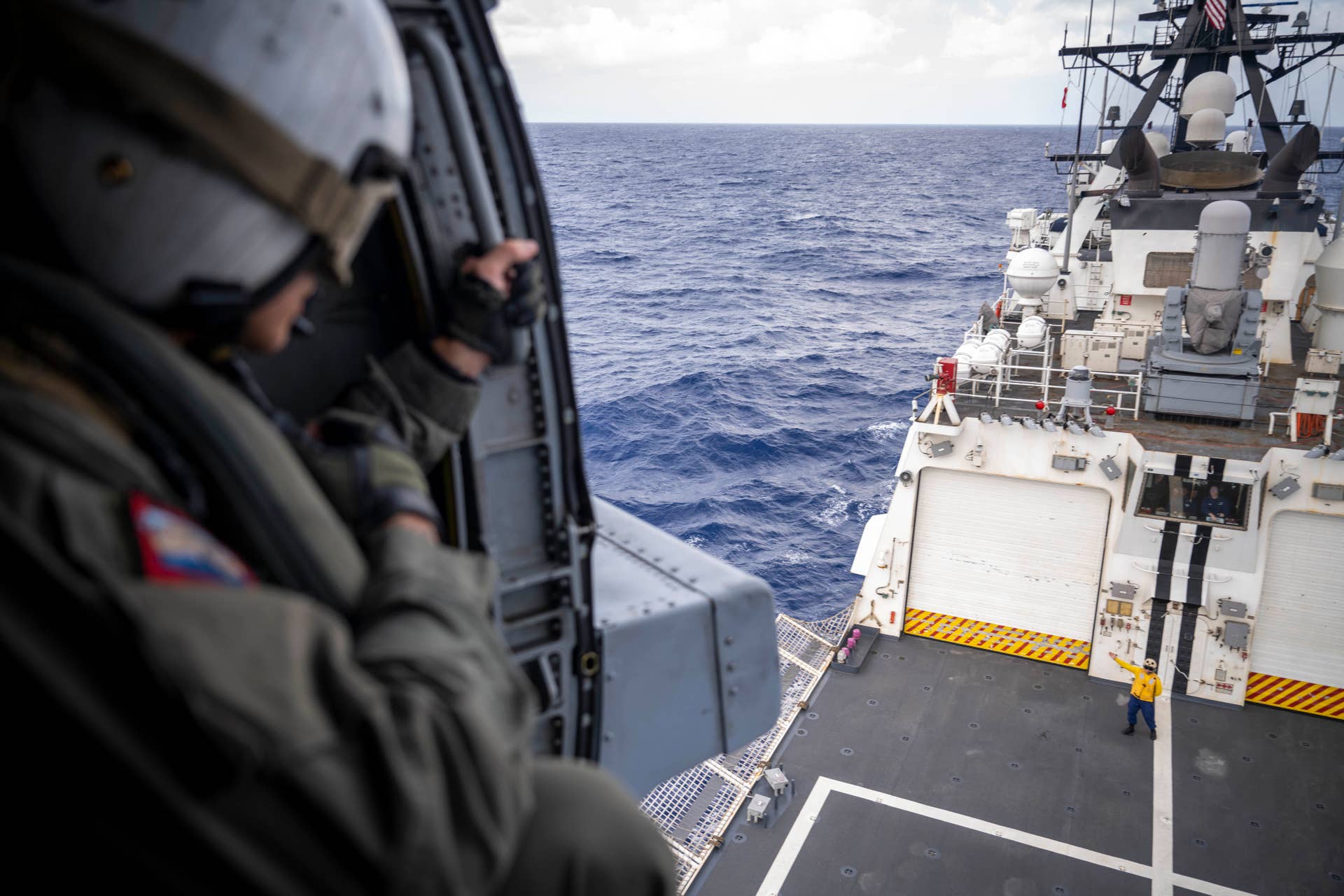
PACIFIC OCEAN (July 30, 2022) U.S. Navy Petty Officer 1st Class Humberto Alba, a naval aircrewman tactical-helicopter, attached to Helicopter Maritime Strike Squadron (HSM) 37, deployed on U.S. Coast Guard Legend-class cutter USCGC Midgett (WMSL 757), looks down at a USCGC crewmember after taking off during flight operations during Rim of the Pacific (RIMPAC) 2022. (U.S. Coast Guard photo by Petty Officer 3rd Class Taylor Bacon)

The Drive reported on Cutter Midgett’s participation in RIMPAC 2022 with a look at flying Navy MH-60R ASW helicopters from the National Security Cutters. I wanted to talk about why this might have been done, but first let’s clarify something.

This and other reports may have left the impression that a Coast Guard Officer leading a task force at RIMPAC was a first and that it was the first time a Navy H-60 had flown from an NSC. Neither is not really the case.

  • During RIMPAC 2020, USCGC Munro embarked a Navy MH-60S, the surface warfare and logistics counterpart to the MH-60R. It is not clear if they ever hangared it.
  • Reportedly USCGC Bertholf headed a Task Force during RIMPAC2018.
  • In RIMPAC 2014 USCGC Waesche also headed a task force. “The maritime interdiction operation involving the Chinese destroyer, frigate and oiler was referenced in December by the Navy as being under the Coast Guard cutter Waesche and including two Royal Brunei Navy ships, a French frigate, a U.S. frigate and the Pearl Harbor-based cruiser USS Port Royal.”

Since NSCs are skippered by Captains, while the US Navy and our allies captain Burke class DDGs and similar ships with commanders, it is not uncommon for the Coast Guard commanding officer to be the senior officer among the captains of a group ships, if there is no commodore assigned. So, frequently, the Coast Guard CO is task force commander by default. This happened to 327 skippers early in WWII as well. For a period, Spencer’s CO was an escort group commander until the Navy assigned a Commodore. Fortunately Spencer got some good training allowing her to sink two of the less than 40 U-boats sunk by US surface ships.

So what was the reason an ASW helicopter was embarked on Midgett? The Coast Guard’s motivation and the Navy’s?

Could be as simple as because they could, but I don’t think so. Both services expected to get something out of this.

Interoperability is always nice, so Navy helo on CG cutter allows both to get some training. Still think there must be more to it than that.

The Navy wants to more widely distribute their forces so this might have been something of a dry run to see what they could do in terms of command and control from a Frigate sized ship and crew.

For the Coast Guard, it could have been an opportunity to get used to operating an H-60 with folding tail from a Bertholf class. It was certainly a rare opportunity to exercise LINK 16. We might have wanted to find out if a system included in the MH-60R should also be included in Coast Guard H-60s.

Or it might have been a first small step toward reviving a Coast Guard ASW mission. Unless the National Security Cutters could operate an ASW helicopter there would be no point in trying to add an additional ASW capability such as a towed array. Confirming ship/helo compatibility would be a first step, along with identifying what changes might be necessary to provide for the helicopters’ additonal needs for weapons, sonobuoys, etc.

Maybe Supporting MH-60R helicopters is reason enough

The US Navy has alot of H-60s. The numbers I have seen are 237 MH-60S (the surface warfare and logistics type) and 291 MH-60Rs (the multi-mission/ASW type). It is probably a bit less than that now, but about 500 plus the MQ-8 helicopter drones that they will also want to take to sea.

The Navy obviously does not have as many ships capable of hosting H-60s as they would like. Every US Navy surface combatant commissioned in the 21st century (DDG and LCS–there have been no cruisers or frigates) has had the capability to hangar two H-60s, and the planned FFGs will have this capability as well.

Navy requirements seem to be always changing,

  • The proposed 355 ship navy included 104 large surface combatants (cruisers and destroyers) plus 52 small surface combatants (frigates and LCS).
  • The latest from July 2022 calls for 96 large and 56 small.

Let’s say a minimum of 116 ASW capable escorts, probably about 120. Right now they have about 90 with no ASW capable LCS, 22 cruisers all now 22 to 36 years old (five of which are slated for retirement in the current budget), and about 70 Burke class DDGs of which 13 will reach 30 years old by the end of 2025 while the first FFG is not expected until 2026. Clearly the number is ASW capable escorts is unlikely to increase significantly any time soon and number may actually decline.

So how many MH-80R/MQ-8 spots are there?

The ten carriers typically host about six MH-60R. The cruisers and Burke class flight IIA and III have two each, but 28 of the Burke class DDGs (Flights I and II), almost a third of our large surface combatants, have flight decks and LAMPS ASW electronics, but no hangar. So roughly 72 ships with 204 spots. Eleven National Security Cutters would provide 22 additional spots, about a 11% increase. The Offshore Patrol Cutters protentially offer another 25 spots about 12% more.

With the Navy hoping to more widely distribute their surface combatants, rather than keeping them firmly attached to a carrier, a couple of additional MH-60Rs could substantially improve ASW capabilities of a small surface action group (SAG).


“Eastern Shipbuilding protesting Austal’s cutter win, cites ‘unfair competitive advantage’” –Breaking Defense

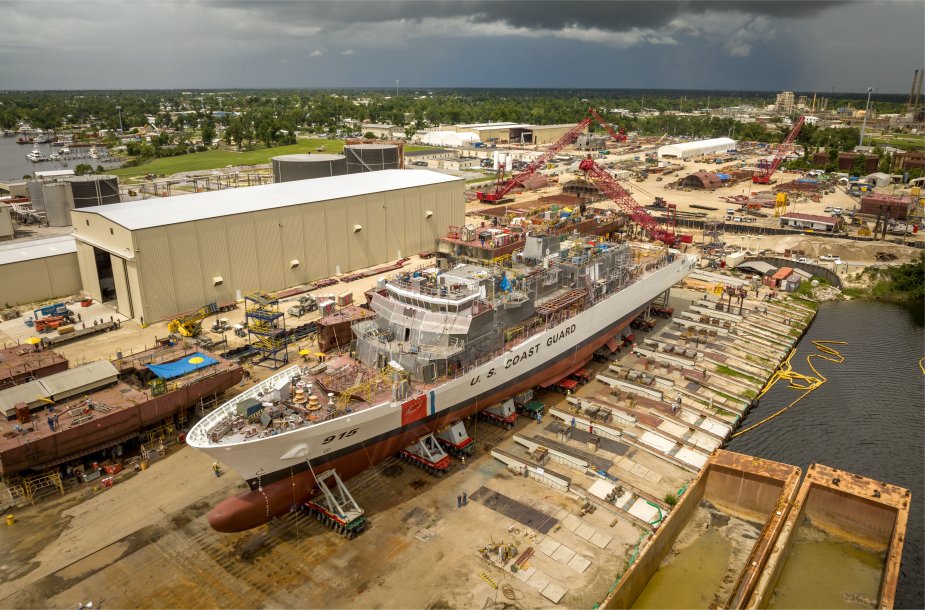
Future US Coast Guard’s Heritage class cutter Argus (Picture source: Eastern Shipbuilding Group)

Breaking Defense reports,

WASHINGTON: Eastern Shipbuilding Group is formally protesting a Coast Guard shipbuilding contract potentially worth billions that was awarded late last month to Austal USA, in part due to what ESG claims was an “unfair competitive advantage and conflict” among other issues.

This may further delay this much delayed program. Can’t help but wonder if OPC #1, the future USCGC Argus, will be delivered before the end of FY2022 as it had been scheduled. If not, it is going to undermine Eastern’s case as to their own competence.

Thanks to Lee for bringing this to my attention. 

“EASTERN SHIPBUILDING GROUP ANNOUNCES KEEL AUTHENTICATION FOR THIRD UNITED STATES COAST GUARD OFFSHORE PATROL CUTTER INGHAM (WMSM-917)” –News Release

Eastern Shipbuilding Group, Inc. photo

Below is a news release from Eastern Shipbuilding, quoted in full.

FOR IMMEDIATE RELEASE

         July 15, 2022

EASTERN SHIPBUILDING GROUP ANNOUNCES KEEL AUTHENTICATION FOR THIRD UNITED STATES COAST GUARD OFFSHORE PATROL CUTTER INGHAM (WMSM-917)

PANAMA CITY, FL – Today, Eastern Shipbuilding Group, Inc. (ESG) hosted the keel authentication ceremony for the U.S. Coast Guard’s future Offshore Patrol Cutter (OPC), USCGC INGHAM (WMSM-917), the third vessel in the new Heritage Class built at the Nelson Street facility. The presiding official for the U.S. Coast Guard was Rear Admiral Chad L. Jacoby, Director of Acquisition Programs & Program Executive Officer (CG-93). Congressman Neal Dunn (FL – 2nd District) was the senior official in attendance.

“Today marks another pivotal milestone in the legacy of the Heritage Class Offshore Patrol Cutters constructed here in Panama City as we now have three OPCs in full production on time and on budget. I’m proud of our workforce for delivering shipbuilding excellence to the men and women of the USCG,” said ESG President Joey D’Isernia.

The ship’s sponsor is Alaskan Senator Lisa Murkowski, a member of the Senate Appropriations Committee, and strong advocate for the national defense and coastal priorities in the Pacific and Arctic regions. USCGC INGHAM will be homeported in Kodiak, Alaska with Senator Murkowski’s signature welded on the keel. She has worked to ensure that those stationed there will have new housing, an updated Child Development Center, and a new fuel pier.

“Thank you to the U.S. Coast Guard and Eastern Shipbuilding Group for inviting me to join a maritime honored tradition—by serving as the ship’s sponsor to the newest Coast Guard Cutter Ingham. I commend the hundreds of skilled professionals at Eastern Shipbuilding Group there in Panama City, Florida building this vessel. You are experts at your craft and have shown true resilience through the pandemic, supply chain challenges, and a category 5 hurricane. The Offshore Patrol Cutter Ingham will have tremendous capabilities and will be protecting our interests in the Pacific Ocean for decades to come,” said Senator Murkowski.

Each of the new Heritage Class Offshore Patrol Cutters aptly represent a naval tradition of naming ships for previous vessels. Three U.S. Revenue Service Cutters and one highly distinguished U.S. Coast Guard Cutter bearing the name Ingham are etched in United States history. The first Ingham was named in honor of U.S. Secretary of the Treasury Samuel D. Ingham and was bestowed with the axiom “semper paratus” in 1836, nearly 60 years before the U.S. Coast Guard adopted this motto in 1896. The most recent, USCGC Ingham (WHEC 35), served for over 50 years from 1936 to 1988 in the North Atlantic, Pacific and Caribbean during World War II, executing vessel escorts, weather patrols and anti-submarine missions. It assisted weather stations and performed search and rescue during peacetime, and it conducted dozens of naval gunfire support missions during the Vietnam War. At her decommissioning, she was the oldest cutter in commission, the most decorated vessel in the U.S. Coast Guard fleet, the last active warship to sink a WWII U-boat, and was the only cutter to be awarded two Presidential Unit Citations. The future USCGC INGHAM (WMSM-917) will carry that legacy for the next forty years.

“Over the course of the life of the USCG there have been four vessels to proudly carry the name INGHAM. Those vessels were crewed by sailors that were hardened by the sea and strove to accomplish their missions to the best of their ability, often at their own peril. These feats were accomplished using knowledge, skill, and a desire to do the best in all situations. Excellence is the direct outcome of their culture and a legacy we pass to the newest vessel to bear the great name INGHAM; WMSM-917. Semper Paratus,” said Bruce “Beemer” Yokely,  President  of Ingham Association.

Joey D’Isernia was accompanied on the podium by Rear Admiral Jacoby and Karlier Robinson, the expert welder charged with welding the sponsor’s initials onto the ceremonial keel authentication plate.

The keel authentication, also known as keel laying, represents the ceremonial start of a ship’s life by commemorating the assembly of the initial modular construction units. Historically, to attest that the keel was properly laid and of excellent quality, the shipbuilder would carve their initials into the keel. This practice is commemorated by welding the ship’s sponsor’s initials into the keel authentication plate.

About Eastern Shipbuilding Group, Inc.

Eastern Shipbuilding Group, Inc. (ESG) is a leading shipbuilder with operations on the Florida Gulf Coast. ESG is the largest private sector employer in Bay County and is a 2017 recipient of the U.S. Department of Homeland Security Small Business of the Year award. They build world class vessels for national defense and commercial clients, including the U.S. Coast Guard’s Heritage Class Offshore Patrol Cutters. With three shipyards and a portfolio of over 350 vessels, ESG is known as one of the most diverse vessel construction companies. www.easternshipbuilding.com

To download photos (credit Eastern Shipbuilding Group, Inc.): https://www.dropbox.com/t/IQ45S8jy2FPw8pDQ

“Eastern Shipbuilding Group takes next step for first Heritage class cutter Argus” –Navy Recognition

Future US Coast Guard’s Heritage class cutter Argus (Picture source: Eastern Shipbuilding Group)

Navy Recognition reports,

According to a tweet published by Eastern Shipbuilding Group on July 12, 2022, the company successfully transferred Offshore Patrol Cutter (Heritage class cutter) Argus Hull 1 to launch position and shifted Hull 2 for the next phase of production at Berard Transportation.

This is a routine report of progress, though it has been a long time coming, but one thing caught my eye,

“She is able to reach a top speed of 24.5 knots (45.4 km/h)…”

I had been disappointed when the request for proposal specs identified 22 knots as the acceptable threshold for speed. 25 knots was identified as the goal and I always felt it should have been the threshold. Even a couple of knots makes a big difference in their potential use as escort vessels. What we have seen repeatedly is 22.5 knots from official sources. Official sources do tend to be very conservative. Looking at the combination of length, displacement, horsepower, it has always seemed to me, they should make 24 to 25 knots max, at least in most circumstances. (Some WWI light cruisers were closely analogous.)  The Wikipedia entry for the Heritage class cutters has reported a maximum speed of 24.5 for some time. Hopefully the Navy Recognition report is based on an Eastern Shipbuilding news release and represents their best estimate of maximum speed. I am hoping we get some reports of actual maximum speed from the sea trials.

Austal Awarded Contract for Offshore Patrol Cutter Stage 2

Below is the announcement from Coast Guard headquarters. Some comments first.

The contract award, $208.26 million, does not actually include construction of the first cutter, presumably that will be included in the FY2023 budget. The potential value of up to “$3.33 billion if all options are exercised” equates to an average cost for 11 ships of $303M each. Keep in mind, that does not include government furnished equipment and other cost that go along with building new ships, including the precommissioning crew and its support and infrastructure improvements that may be required to accommodate these substantially larger ships. 

Given that Eastern, builder of the first four OPCs, did not win the contract, and the contract allows “flexibility to propose and implement new design elements that benefit lifecycle cost, production and operational efficiency and performance” then we can expect to have A-class and B-class OPCs. 

Considering that the Independence class LCS program is ending, this is an extremely important win for Austal and vendicates their decision to invest in steel shipbuilding.


 News Release

U.S. Coast Guard Headquarters

Coast Guard awards contract for Stage 2 of the Offshore Patrol Cutter Acquisition

WASHINGTON – The Coast Guard awarded a fixed-price incentive (firm target) contract to Austal USA of Mobile, Ala. to produce up to 11 offshore patrol cutters (OPCs). The initial award is valued at $208.26 million and supports detail design and long lead-time material for the fifth OPC, with options for production of up to 11 OPCs in total. The contract has a potential value of up to $3.33 billion if all options are exercised.

In 2019, the Coast Guard revised the OPC acquisition strategy to mitigate emergent cost and schedule risk by establishing a new, full and open competition for OPCs five and through 15, designated as Stage 2 of the overall program. Informed by industry feedback received through a robust engagement strategy, the Coast Guard released a request for proposal Jan. 29, 2021, for OPC Stage 2 detail design and production. The Coast Guard’s requirements for OPC Stage 2 detail design and production were developed to maintain commonality with earlier OPCs in critical areas such as the hull and propulsion systems, but provide flexibility to propose and implement new design elements that benefit lifecycle cost, production and operational efficiency and performance.

“The offshore patrol cutter is absolutely vital to Coast Guard mission excellence as we recapitalize our legacy medium endurance cutters, some of which are more than 50 years old,” said Adm. Linda Fagan, commandant of the Coast Guard. “The OPCs are the ships our crews need to protect our national security, maritime safety and economic prosperity. I look forward to the new cutters joining our fleet.”

The 25-ship OPC program of record complements the capabilities of the service’s national security cutters, fast response cutters and polar security cutters as an essential element of the Department of Homeland Security’s layered maritime security strategy. The OPC will meet the service’s long-term need for cutters capable of deploying independently or as part of task groups and is essential to stopping smugglers at sea, interdicting undocumented non-citizens, rescuing mariners, enforcing fisheries laws, responding to disasters and protecting ports.

More information about the award can be found here.

“Coast Guard modifies offshore patrol cutter contract to complete installation of the combat and radar systems” -CG-9

OPC “Placemat”

Below is a post from the  Acquisitions Directorate (CG-9). I had never heard of the “Athena combat weapons system” so “Googled” it. The most common thing that came up was an Army laser weapons program. I don’t really think that is what they talking about, but I could be wrong. The post does call it a “weapons system.” I think it may be the Leonardo ATHENA® (Architecture & Technologies Handling Electronic Naval Applications) Combat Management System (CMS). Leonardo’s web page on the system indicates it is the CMS used on the FREMM frigate which is the parent craft for new USN FFG. Maybe the Navy liked the CMS as much as they liked the ship.

The CMS on the Bertholf class cutters is an Aegis based system. I have not heard anything about its application to the offshore patrol cutter (OPC).

Late Addition: Got this, thanks to Timothy H,

AEGIS Athena Baseline 9G
May be an image of text
That is good news, since it means there will be commonality between the systems on the NSCs and the OPCs.

The Coast Guard modified its current contract with Eastern Shipbuilding Group (ESG) May 20 so installation of the Athena combat weapons system and multi-mode radar system will be completed during the production phase of the offshore patrol cutter (OPC). The Athena system, radar and armament of the OPC are provided to the Coast Guard as Navy type-Navy owned government furnished equipment.

Prior to this modification, installation of both systems was to occur after contract delivery while each cutter was in its homeport. The Navy has completed development, integration and testing of the Athena and radar systems, enabling the Coast Guard to shift to production-phase installation. Performing this work prior to delivery reduces the technical risks associated with post-delivery installation and delivers mission-ready OPCs to the fleet as soon as possible.

The first four OPCs are currently in production at ESG’’s shipyard in Panama City, Florida.

The OPC meets the service’s need for cutters capable of deploying independently or as part of a larger task force and is essential to stopping smugglers at sea, rescuing mariners, enforcing fisheries laws, responding to disasters, interdicting undocumented individuals and protecting the nation. The acquisition of 25 OPCs will complement the capabilities of the service’s national security cutters and fast response cutters as an essential element of the Department of Homeland Security’s layered maritime security strategy.

For more information: Offshore Patrol Cutter Program page

Contract Award for the Fourth Offshore Patrol Cutter

Photo: Rendering of the future USCGC RUSH (WMSM 918) provided by Eastern Shipbuilding Group, Inc. Click on the photo for a better view. 

Below is a press release from Eastern Shipbuilding Group. To review the situation, the Coast Guard is expected to make a decision in the near future regarding the award of the next batch of Offshore Patrol Cutters. Eastern is one of the competitors.

FOR IMMEDIATE RELEASE

         April 26, 2022

Eastern Shipbuilding Group, Inc. Announces Construction of the U.S. Coast Guard’s Fourth Offshore Patrol Cutter

PANAMA CITY, FL – Today, Eastern Shipbuilding Group, Inc. (ESG) announced the U.S. Coast Guard has awarded a contract to begin construction of the fourth Heritage Class offshore patrol cutter (OPC), the future USCGC RUSH (WMSM 918).

The OPC will form the backbone of the service’s future fleet around the globe. ESG has worked hard to earn this opportunity and is honored to be chosen to perform this important work for the United States. ESG, in collaboration with its partners, produced the winning design of the OPC and was awarded detail design and construction of the first hulls in 2016. The new OPC designs reflect cutting-edge technology and will replace the service’s 270-foot and 210-foot medium endurance cutters, which are becoming increasingly expensive to maintain and operate.

“This follow-on award signifies the OPC team and our partners continue to provide quality craftsmanship and unparalleled service. We have a focused vision to support the OPC Program with shipbuilding excellence and provide the country with a long-term industrial capability that can produce exceptional vessels that support national security interests,” said Joey D’Isernia, President of Eastern Shipbuilding Group, Inc.

As prime contractor, ESG has successfully achieved program goals and mitigated the impacts of COVID-19 and current supply chain challenges. It expects to christen the first vessel this year, is nearly halfway through completion of the second vessel, and will host the keel authentication of the third OPC in a few weeks. The pace of production accelerates with each vessel that comes online.

“We utilized state of the market technology, design, and construction methodologies to offer a more capable vessel than legacy assets currently in service. The innovations built into the OPCs were designed for sustainability and endurance and come from the ingenuity of the best engineers and manufacturers in the world. We thank the hundreds of partners and employees in the thirty-four states supporting us in this effort,” continued D’Isernia.

Construction is taking place at ESG’s Nelson Street Shipyard in Panama City, Florida, a facility that is optimized for multi-hull construction of the Offshore Patrol Cutter and dedicated to supporting the U.S. Coast Guard.

ESG survived the third largest U.S. hurricane in 2018 and has fully rebuilt its operational facilities. The company made many infrastructure investments from $50 million in state appropriations and economic development grants that benefit the OPC project with enhanced manufacturing capabilities and efficiencies that reduce cost and schedule risk. These infrastructure investments include an aluminum fabrication facility specifically designed to support full construction of the OPC aluminum superstructure in a covered and controlled environment. ESG has also completed launch way upgrades, upland bulkhead upgrades, construction platen expansions, and waterway deepening projects to further enhance ESG’s capability to launch and deliver two OPC sized vessels per year.

At its Allanton Shipyard, ESG has constructed a state-of-the-art C5ISR Production Facility to conduct testing and integration of navigation, communication, and command and control, equipment, and simulators on premises prior to final installation on the vessel.

Major Cutter Homeports

“Coast Guard Cutter Forward and Coast Guard Cutter Bear, homeported in Portsmouth, Virginia, finish an at-sea transfer while underway on a two-month patrol. Coast Guard Cutter Forward returned to homeport on April 10, 2021.” (U.S. Coast Guard photo)

Recently I had to look up homeports of WMECs. I found that there did not seem to be a single comprehensive up to date list. Seemed it might be useful to share the list. I have added the Bertholf class and what we know about the basing of the Offshore Patrol Cutters as well. These are not district assets, but I found it convenient to group them by homeport district. The numbers in parenthesis are the hull numbers. First some observations.

OBSERVATIONS:

The intent is to split the Bertholf class, almost evenly between the Atlantic and Pacific Areas: five (45%) to LANTAREA and six (55%) to PACAREA.

The vast majority of medium endurance cutters are assigned to LANTAREA. All 100% of the 270s and 24 (86%) of 28 total.

Despite the fact that the vast majority of the US EEZ and territorial sea (84%) falls under the Pacific Area Commander, the vast majority of large patrol cutters are based in the Atlantic Area. This is, at least in part, due to the Alien Migrant and Drug interdiction missions. It is counter intuitive, but Charleston, SC is closer to the Eastern Pacific Drug transit zones than San Diego, CA.

Once the first four OPCs reach their bases in San Pedro and Kodiak, the Pacific Area will once again have ten “high endurance cutters,” as they did before recapitalization began.

WHO BUILT THEM?:

The entire Bertholf class has been built by Huntington Ingalls of Pascagoula, MS. The lead ship was laid down in 2005 and commssioned in August 2008. The tenth is expected to be delivered 2023. The eleventh, maybe 2024.

The Bear class WMEC270s were built by two different builders. The first four ships (901-904) were built by Tacoma Boatbuilding, Tacoma, WA, with Bear laid down in August, 1979 and the last of the four commissioned in December, 1984. The remaining nine were built by Derecktor Shipbuilding, Middleton, RI. The first of these laid down June, 1982, and the last of the nine completed in March 1990.

The 16 Reliance class WMEC210s were built by four different builders, with the first laid down in May 1963 and the last commissioned August 1969, less than six years and three months later.

  • The first three, 615-617, were built by Todd Shipyards, Houston, TX.
  • The fourth, 618, by Christy Corp., Sturgeon Bay, Wis.
  • Five, 619, 620, and 628-630, were built at the Coast Guard Yard, Curtis Bay, MD.
  • Seven, 621-627, were built by American Shipbuilding, Lorain, OH.

WMEC 622 and 628 have since been transferred to Sri Lanka and Colombia respectively. All underwent a major maintenance availability at the Coast Guard Yard between 1984 and 1998.

THE FORCE LAYDOWN:

FIRST DISTRICT: 2 WMEC270s

  • US Naval Shipyard Portsmouth, Kittery, ME: two WMEC270s: Tahoma (908), Campbell (909)

FIFTH DISTRICT: 9 WMEC270s, 2 WMEC210s

  • Portsmouth, VA: 9 WMEC270s: Bear (901), Escanaba (907), Forward (911), Harriet Lane (903, currently in SLEP at CG Yard), Legare (912), Northland (904), Seneca (906) , Spencer (905), Tampa (902)
  • Virginia Beach, VA: WMEC210s: Dependable (626), Vigorous (627)

SEVENTH DISTRICT: 3 National Security Cutters (2 more under construction), 2 WMEC270s, 5 WMEC210s

  • Charleston, SC: 3 NSCs: Hamilton (753), James (754), Stone (758), (two more NSCs building: Calhoun (759), Friedman (760))
  • Naval Station Mayport: 1 WMEC210: Valiant (621)
  • Cape Canaveral: 2 WMEC210s: Confidence (619), Vigilant (617)
  • Key West: 2 WMEC270s: Mohawk (913), Thetis (910)
  • St. Petersburg: 2 WMEC210s: Resolute (620), Venturous (625)

EIGHTH DISTRICT: 4 WMEC210s

  • Pensacola: WMEC210s: Dauntless (624), Decisive (629), Diligence (616), Reliance (615)

ELEVENTH DISTRICT: 4 National Security Cutters

  • Alameda, CA: 4 NSCs: Bertholf (750), Waesche (751), Stratton (752), Munro (755)

THIRTEENTH DISTRICT: 3 WMEC210s

  • Astoria, OR: 2 WMEC210s: Alert (630), Steadfast (623)
  • Port Angeles, WA: 1 WMEC210: Active (618)

FOURTEENTH DISTRICT: 2 National Security Cutters

  • Honolulu, HI: 2 NSCs: Kimball (756), Midgett (757)

SEVENTEENTH DISTRICT

  • Kodiak, AK: 1 WMEC283: Alex Haley (WMEC-39)

OFFSHORE PATROL CUTTER HOMEPORTS

We have heard where the first six OPCs are expected to be homeported.

  • Argus (915) and Chase (916) will go to San Pedro, CA
  • Ingham (917) and Rush (918) will go to Kodiak, AK
  • Pickering (919) and Icarus (920) will go to Newport, RI


“Coast Guard to host groundbreaking ceremony at Base Boston for Fast Response Cutter pier construction” –News Release

Below is a First District news release. This is good news for those hoping to see some new cutters in New England. We have known for a while that Webber class FRCs were going to Boston, but the surprise I see here is, “…$35 million recapitalization of current Coast Guard facilities at Base Boston and acquisition of six new Fast Response Cutters (emphasis applied–Chuck) at a cost of $380 million.”

This follows the pattern we have seen lately of these vessels being clustered, rather than being widely distributed in ones and two.

Base Boston (photo above) must certainly have much to recommend it, but as a high-cost area, it seems likely it will host no large patrol cutters in the future. It was once homeport to several High Endurance Cutters. Until recently, it hosted three WMEC270s, Escanaba, Seneca, and Spencer. All three have since moved to Portsmouth, VA. We already know the Coast Guard plans to base OPCs #5 and #6 in nearby Newport R.I. at the former US Navy base, where there had been no large cutters.

Wikipedia has a good list of Webber class WPCs and their homeports. It does not reflect the addition of two more ship to the program of record, FRCs #65 and #66, in the FY2022 budget, but it does list 64 named vessels and homeports for 50 cutters including two expected to be homeported in Boston, USCGC William Chadwick (WPC-1150) and USCGC Warren Deyampert (WPC-1151), expected to arrive in the second half of 2022. Homeports are not yet identified for 16 ships. Four of those are presumably going to Boston so where are the remaining 12 going? One is each is expected to go to Seward and Sitka. Two will go to Kodiak. That leaves eight. Some may be added to already identified homeports. One of the 50 identified includes the first ship going to St. Petersburg, FL. St. Pete will likely get at least two more. Assuming that is the case that leaves six. We also know that two will go to Astoria, Oregon. That leaves four. The recent addition of two was probably with the intention of stationing them in America Samoa. Two there would only leave two which might go to previously identified homeports, so we may not see any additional homeports added.

News Release

U.S. Coast Guard 1st District Northeast

Media Advisory: Coast Guard to host groundbreaking ceremony at Base Boston for Fast Response Cutter pier construction

Editors’ Note: Media interested in attending are requested to RSVP at 617-717-9609 by 4 p.m., April 13, and should arrive no later than 9:45 a.m., Thursday.

FRC

BOSTON —The Coast Guard is scheduled to hold a media event for the Coast Guard Fast Response Cutter Homeport Groundbreaking Ceremony at Base Boston, Thursday.

WHO: Rear Adm. Thomas Allan, commander, Coast Guard First District, Massachusetts Governor Charlie Baker, Congressman Stephen Lynch, and Mayor of Boston, Michelle Wu.

WHAT: Coast Guard Fast Response Cutter Homeport Groundbreaking Ceremony

WHEN: Thursday, April 14, 2022, at 10 a.m.

WHERE: Coast Guard Base Boston, 427 Commercial Street, Boston, MA 02109

This ceremony marks the starts of a large Coast Guard investment in the Northeast with a $35 million recapitalization of current Coast Guard facilities at Base Boston and acquisition of six new Fast Response Cutters at a cost of $380 million. The FRCs are the Coast Guard’s newest cutter class replacing the Legacy Island Class Patrol Boats and will operate throughout the Coast Guard’s First District from New York, to the Canadian border. 

These cutters are designed for missions including:

  • search and rescue
  • fisheries law enforcement
  • drug and migrant interdiction
  • port, waterways, and coastal security
  • national defense

In addition, the Coast Guard will increase personnel presence in the area with 222 new Coast Guard members to crew and maintain the cutters. These new crews are expected to have an annual economic impact of $45 million on the local economy.