Taiwan Commissioned Two WHECs

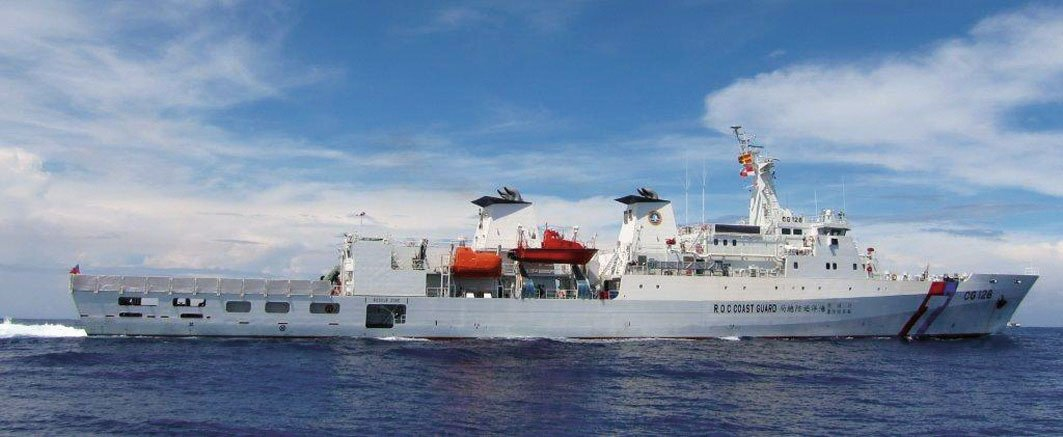
ROCcutterYILAN(CG128)

Photo: Yilan (CG 128). (Taiwan Coast Guard Administration)

I mentioned this earlier in a comment on an earlier post, but Jane’s has more detail and much better pictures. Back on June 8, Janes 360 reported that Taiwan’s Coast Guard administration has commissioned two new 3,000 ton, 119 meter (390 foot) helo capable cutters, Yilan (CG 128) and Kaohsiung (CG 129), with a speed of 24 knots and a range of up to 10,000 miles.

Taiwan, along with Mainland China, supports the concept of the Nine Dash Line, but they have a particular beef with Japan. regarding the Senkakus Islands as they are known in Japan or the Diaoyutais as they are known in China and Taiwan, about 120 nautical miles (220km) northeast of Taiwan.

The other area where these might be assigned is protection of the area around Taiping Island, the largest of the Spratly Islands in the South China Sea (at least before the Chinese began reclamation) which the Taiwanese have garrisoned.

ROCcutterKAOHSIUNG(CG129)

Photo: Kaohsiung (CG 129). (Taiwan Coast Guard Administration)

According to the Diplomat,

“Since 2008, Taiwan’s Coast Guard Administration has been engaged in a 37-ship building program totaling 17,000 tons at a cost of  approximately NT$ 24 billion ($782 million).”

Document Alert: U.S. Department of Defense’s Asia-Pacific Maritime Security Strategy

The US Naval Institute News Service has made available the U.S. Department of Defense’s Asia-Pacific Maritime Security Strategy.

I have only scanned it, but it does mention the Coast Guard in the context of freedom of navigation exercises and capacity building for our allies.


Armed Helos on Philippine 378s

a

Photo: A Philippine Navy weaponized AW109 helicopter on board the frigate BRP Ramon Alcaraz (formerly the USCGC Dallas (WHEC-716)). Source: Philippine Navy

Janes is reporting that the two former USCG 378s, that are now in the Philippine Navy, will be operating “weaponised” AW109 helicopters.

This is the same helicopter that saw service as the U.S. Coast Guard MH-68A Stingray airborne use of force helicopters. It is smaller than the MH-65, with about two thirds the gross weight and horsepower.

The weaponised versions carry two 12.7 mm machine gun pods, each with launchers for three 70 mm laser-guided rockets (on each pod–Chuck). The aircraft can also be configured to carry a sonobuoy dispenser for anti-submarine warfare operations.

The laser guided rockets will probably be “APKWS II” used by the USN and US Marines, but there are a number of similar systems that convert unguided 70 mm Hydra rockets to small passive laser-guided missiles.

It is not clear if these aircraft will also have the .50 cal. sniper rifle or door mounted 7.62 mm machine gun like those on Coast Guard airborne use of force helos. If they have at least the door mounted machine gun, I would think that seven round rocket pods would be preferable to the .50 cal. gun pods with only three missiles each. If there is no door-mounted machine gun and there is a need to fire warning shots, then perhaps use only one .50 cal gun pod and one seven round rocket pod.

China CG gets Surplus PLAN Frigates

Recent spotter pictures from China show that the four Type 053H2G Frigates (NATO designation Jiangwei I) belonging to the People's Liberation Army Navy (PLAN or Chinese Navy) have been transfered to the China Coast Guard (CCG) and are being converted into patrol vessels.

Navy recognition is reporting that all four type 053H2G frigates (NATO designation Jiangwei I) have been transferred to the Chinese Coast Guard, contributing to the already feverish build up of this service. These 115 meter (376 foot),  2,200 ton, 27 knot, helo deck and hangar equipped, diesel powered ships entered service with the Chinese Navy (PLAN) between 1991 and 1994, so while far from new, by USCC standards, they should have considerable life remaining. The design seems quite appropriate for a cutter.

The fact that the PLAN is willing to give up these ships suggest both the pace of modernization of the PLAN and the priority given to bulking up their Coast Guard.

The conversion apparently results in the removal of all the primary weapons including a twin 100mm gun, anti-air and anti-surface missiles, and anti-submarine weapons.

But the ships will not be unarmed, and how they are armed may suggest how Chinese Coast Guard vessels, which were essentially unarmed in the past, may be armed in the future.

The guns that remain are four twin 37mm type 76A mounts. Positioned as they are, this will allow at least two twin mounts to be pointed at any direction, and in perhaps most cases three twin mounts. The projectile weight is about 1.6 pounds; rate of fire is 375 rounds/minute/barrel. They have a range of 9,400 meters and an effective range of 3,500 meters, with a 1600 round ready service capacity at each twin mount.

While these weapons are obviously limited in range, at close quarters they would be extremely dangerous.

In an earlier post I used the weight of projectiles a ship could shoot per minute as one measure of the possible effectiveness of a weapon system. By that measure four 37mm firing 375 one-point-six pound projectiles per minute would mean the capability of firing 2400 pounds of projectiles per minute. This is more than a single 57mm Mk110 (1160 pounds), a 76mm Mk75 (1120 pounds), or even a 5″/62 Mk45 mod4 (1400 pounds).

Why did they retain all four mounts? It would not have been hard to remove two of the four mounts and still retain, what many would see as more than adequate law enforcement firepower, but we probably should not read too much into the retention of all four mounts; it was the easier option, and they may be seen as nothing more than on board spares. They certainly have retained a fierce capability to engage at anything less than 4,000 yards. I would not mind seeing similar redundancy on USCG cutters for our peacetime missions..

The deletion of the ASW equipment certainly suggest the new, more militarized, Chinese Coast Guard does not see itself as ASW capable, and the removal of the 100mm guns suggest they don’t expect to be used as a Naval Gun Fire Support asset.

Changing EEZs

PacificEEZ

Pacific Exclusive Economic Zones. David Butler/Globe staff, click on the chart to enlarge

An interesting discussion in the Boston Globe about how to deal with potential changes in the world’s Exclusive Economic Zones as rising sea levels change the shape of land areas, perhaps resulting in the complete disappearance of some sovereign nations.

One of the possibilities is that the EEZs may be frozen in their current configuration and become an asset of the population, even after the land becomes uninhabitable or disappears completely, and that this asset may be sold, traded, or leased away. We know territorial sovereignty can be sold, after all, the US benefited from the Louisiana Purchase and Seward’s Folly (Alaska).

A Chinese Corporation has been attempting to build a new port complex on “reclaimed” land in Sri Lanka. “Located next to the Colombo Port, the US$1.4 billion project will add about 233 hectares of reclaimed land to the capital and house luxury office buildings, apartment blocks, a golf course, a water sport area, medical facilities, education institutions, hotels, a theme park and marinas.” The project is on hold right now, but if it goes forward, the Chinese firm would be granted  20 hectares (49.4 acres) on an outright basis and 88 hectares (244.6 acres) on a 99-year lease.

This is not a transfer of sovereignty, and  Sri Lanka is not in any danger of disappearing, but it does indicate the scope of China’s interest in the area and, located right off the Southern tip of India,  it is sure to feed into India’s fears of being surrounded by a Chinese “string of pearls.”

Potentially more serious is the decision of the government of the Maldives, “The law passed by the Parliament will now allow absolute foreign ownership of land in Maldives if the investment is above USD 1 billion. The caveat to the law is that 70% of the land has to be reclaimed from the sea.”

The Maldives, with an average elevation of 1.6 meters,  is one of those island nations that are in danger of being adversely effected by rising see levels. If anyone takes the Maldives up on their offer, it will probably be the Chinese, who have already shown a lot of interest in the Indian Ocean island nation. Again this is not a transfer of sovereignty, but it may be a harbinger of things to come

(Beside it really wanted everyone to see the chart of Pacific EEZs. A lot of that is US EEZ.)

Electronic Monitoring of the Tuna Fleet

Bairdmaritime reports,

“NOAA Fisheries has completed the first fleet-wide implementation of electronic monitoring in the United States.

“As of June, electronic monitoring is required on all vessels fishing with pelagic longline gear in the Atlantic and Gulf of Mexico. Electronic monitoring is intended to provide an effective and efficient way to monitor and verify Atlantic bluefin tuna catches in the pelagic longline fishery.”

Electronic monitoring replaces on board observers.

A couple of things come to mind.

  • Would be great if all F/V were monitored electronically so that we would not have to go looking for them. Air Searches would them be primarily to determine if there are F/Vs out there that are not tagged electronically.
  • We still need to check them underway to make sure they are not exceeding limits by offloading catch before returning to port.
  • What about the Pacific where there is a very valuable tuna fishery that is seldom sees a cutter?

Long Range Interceptor In Action

I would not normally talk about a routine law enforcement action, but this video has some interesting aspects.

Stratton recently intercepted a second semi-submersible, that had been spotted by a Navy patrol aircraft, arresting its four crewmembers and recovering 12,000 pounds of its 16,000 pound cargo of Cocaine, before the semi-submersible sank under tow.

What I wanted to point out in the video was:

First, the instrumentation on the 35 foot Long Range Interceptor ship’s boat (time 1:12). (Correction–I made and error here, this is actually the instrumentation on a 26 foot “Over-the-Horizon (OTH) IV” of which the Coast Guard has procured 101.) It looks a lot like the “glass cockpit” of a modern light plane. Long Range Interceptors are only deployed by the Bertholf class National Security Cutters. (The OTH-IV is operated from the NSCs, WHECs, WMECs, and WPCs. Anyone know if they are also operated from WAGBs and WLBs?)

Second, was the way the boat was recovered in the stern ramp of Stratton (2:25 to 3:00). Note there is no one in the bow to attach the line that will pull the boat up onto the ramp. In 2013 we had a fatality on the Waesche because the automatic capture mechanism was not working properly and Petty Officer Travis Obendorf was on the bow of the boat. You can access the accident report here.

Australia to Build OPVs

Australia has been talking about getting new ships for sometime, but recently they announced a policy of “continuous shipbuilding” in an effort to maintain a domestic  warship building capability.

While submarines and frigates have gotten most of the press, and will get most of the money, they also intend to build Offshore Patrol Vessels (OPVs) to replace their Armidale class patrol craft, which have proven not quite up to the demanding missions they have been assigned. (They will also be building patrol boats to be distributed to Pacific island nations.)

“The construction of offshore patrol vessels to replace the Armidale class has also been moved forward to 2018.”

2018 puts them two years ahead of the Frigates, so this may be a lead in for the more sophisticated project. I suspect they will be strongly influenced in the selection of their OPV by New Zealand’s experience. due to the frequent contact and cooperation between the Australian and New Zealand Navies.

The New Zealand OPVs, HMNZS Otago and Wellington, appear to be progenitors of Eastern’s OPC proposal, so there is a good chance the Australians will be building something like the OPC. The CG should make its selection of the final OPC design about a year before Australia has to make their OPV design selection, so perhaps they could benefit from the Coast Guard’s selection process.