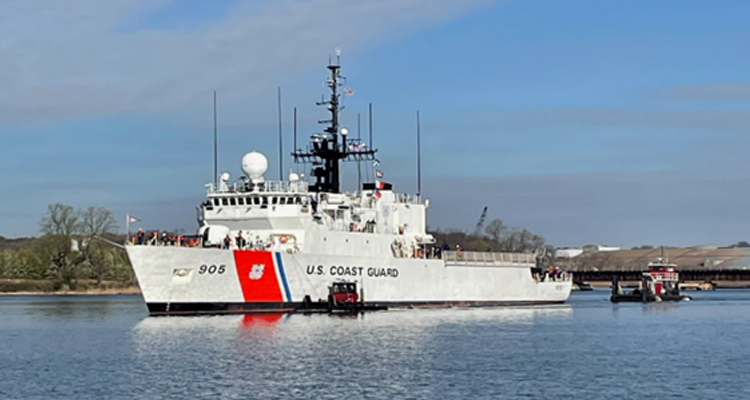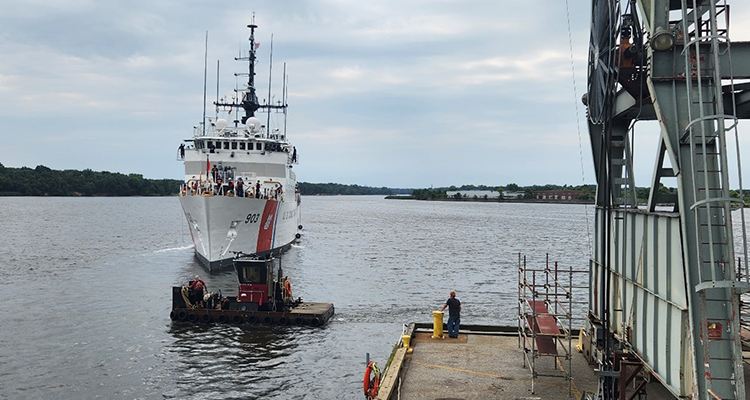
“Coast Guard Cutter Polar Star Returns to Seattle after 308 days” –USCG News

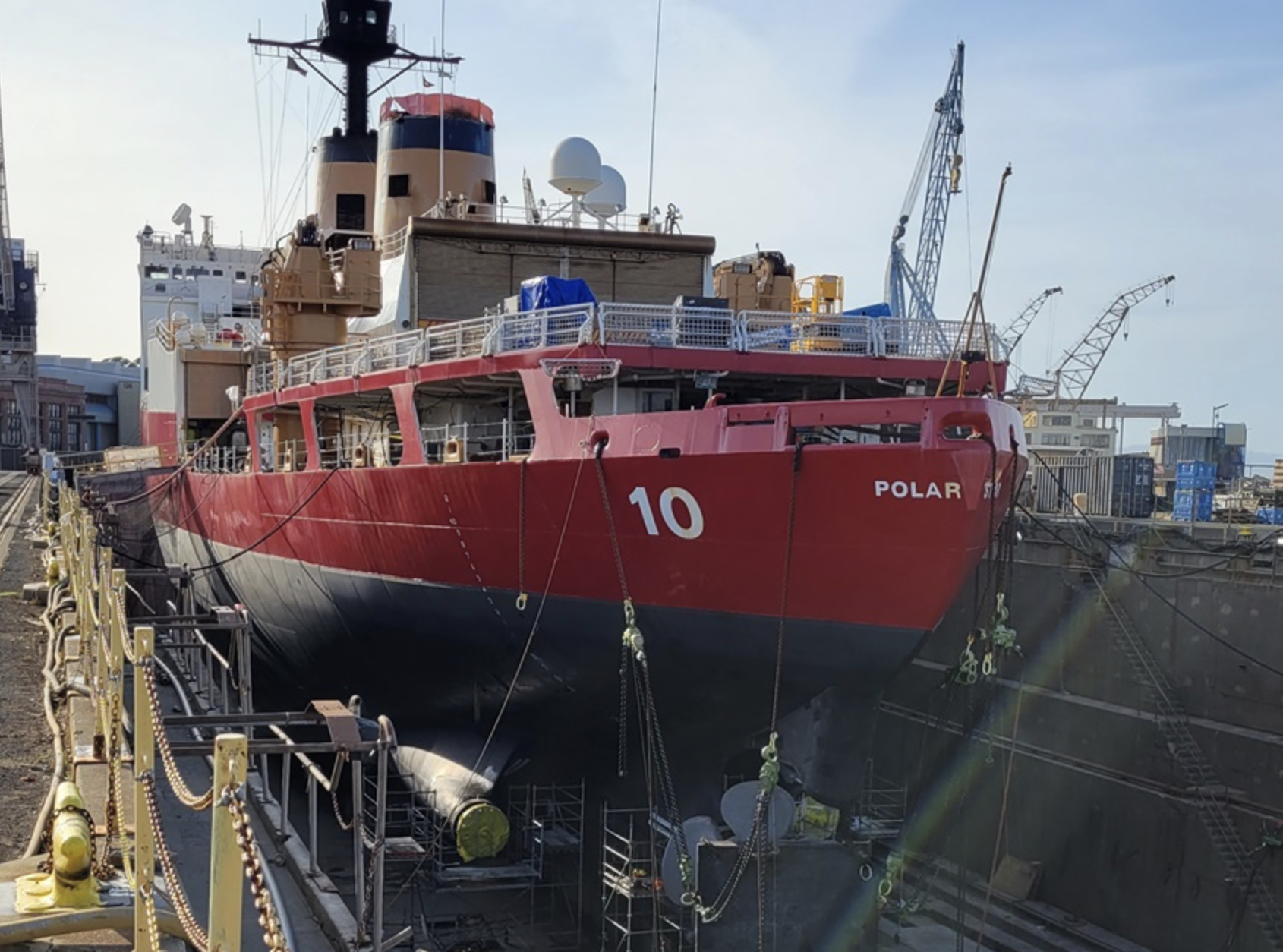
The rudder of the USCGC Polar Star (WAGB 10) is being removed while in a Vallejo, Calif., dry dock, April 1, 2025. The maintenance work completed over the past five years recapitalized integral systems, including propulsion, communication, and machinery control systems. (U.S. Coast Guard photo by Seaman Nestor Molina)

Below is a Coast Guard News Release.

The Coast Guard did a Service Life Extension Program on a 49 year old ship because its replacement is still not ready. Let that sink in for a while.

In addition to the work listed in the release, they removed the centerline shaft for servicing and inspection, exchanged all three propellers, and renewed both forward and aft main deck surfaces.

The ship has not seen its homeport for ten months and the intention is to do the same sort of five year phased SLEP on USCGC Healy, meaning she will have similar long periods away from homeport. At least she is at an age where SLEP is appropriate.

Ships should be home-ported in places they can be worked on.

50 year old ships should be the exception not the rule.


Sept. 25, 2025

Coast Guard Cutter Polar Star Returns to Seattle after 308 days

SEATTLE — After 308 days away from its Seattle home port, the 49-year-old U.S. Coast Guard Cutter Polar Star (WAGB 10) and crew returned home Tuesday. 

Upon completing Operation Deep Freeze (ODF) 2025, Polar Star returned directly to Mare Island Dry Dock in Vallejo, Calif., to complete the final year of a five-year Service Life Extension Program (SLEP).

Polar Star’s SLEP completion comes at a time when the Polar Regions are becoming more consequential, and the demand for U.S. Coast Guard presence, leadership, and vigilance continues to grow.

The maintenance work completed over the past five years recapitalized integral systems, including propulsion, communication, and machinery control systems. These efforts are designed to extend the cutter’s service life as the Coast Guard begins construction of its first Polar Security Cutter. Until PSCs becomes operational, Polar Star will remain the only U.S. icebreaker capable of completing the annual breakout of McMurdo Sound, Antarctica in support of the U.S. Antarctic program (USAP).

“Much has been asked of this ship over the past five decades,” said Capt. Jeff Rasnake, Polar Star’s commanding officer. “The completion of this extensive five-year maintenance and recapitalization project is a major milestone in enabling Polar Star’s operations into the future.”

Polar Star’s SLEP has been completed in five phases to maintain its operational capability to complete annual polar deployments. Phase Five, the last phase in its SLEP, began March 30, 2024, focusing on these projects:

  • Gyro repeater recapitalization to ensure that these critical pieces of navigation equipment are updated to modern standards, enabling safe navigation of the cutter.
  • Ancillary pumps and motors recapitalization through the replacement of critical main propulsion and auxiliary systems with modern supportable units.
  • Heating, ventilation, and air conditioning systems refurbishments; multiple zones were refurbished with ventilation trunks, fans, and heaters to improve air circulation and maintain a comfortable living environment for the ship’s crew during extended deployments.

The completion of Polar Star’s five-year SLEP underscores the importance of the annual ODF mission, the U.S. military support mission for the USAP, which facilitates the transport of personnel, equipment and supplies required to maintain the U.S.’s strategic presence in Antarctica. Having participated in a majority of these missions since they began in the 1950s, the U.S. Coast Guard will continue to support the U.S.’s continued presence on the Antarctic continent as part of the Joint Task Force – Support Forces Antarctica.

Work completed in Phase Five took 175 days and represented an additional $12.7 million investment in the U.S. Polar capability. While at Mare Island, Polar Star received support from both Coast Guard Base Seattle and Base Charleston’s Naval Engineering Departments to perform a center section overhaul on one of Polar Star’s nine main diesel engines. In parallel with this work, members from the Coast Guard Yard in Baltimore completed vital work on the ship’s sanitary systems.

Additional major work completed includes removing the centerline shaft for servicing and inspection, exchanging all three propellers, and renewing both forward and aft main deck surfaces.

“This is a tremendous ship, and it is in better shape today than it was ten years ago,” said Rasnake. “That’s a testament to the unrelenting efforts of the crew, the enduring support of our mission partners, and the renewed enthusiasm and investment in our nation’s polar icebreaking capabilities.”

Commissioned in 1976, Polar Star is 399 feet, weighing 13,500 tons with a 34-foot draft. Despite reaching nearly 50 years of age, Polar Star remains the world’s most powerful non-nuclear icebreaker with the ability to produce up to 75,000 shaft horsepower.
“Coast Guard Cutter Spencer completes service life extension program” –CG-9

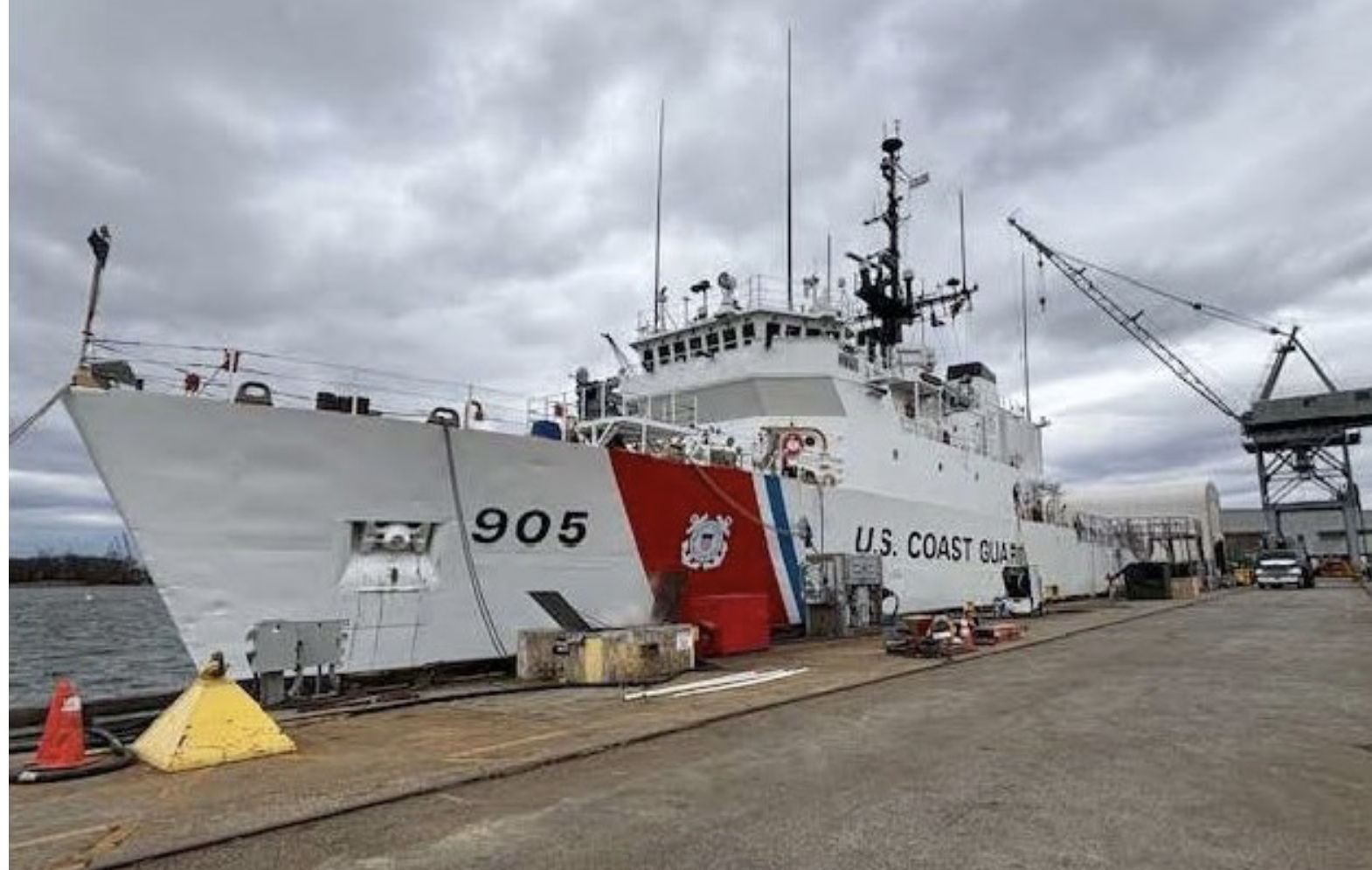
Coast Guard Cutter Spencer, at Coast Guard Yard in Baltimore, prepares for sea trials at the conclusion of its service life extension work. U.S. Coast Guard photo.

Below is a news release from the Acquisition Directorate (CG-9).

As can be seen in the accompanying photo, the 76mm Mk75 gun and Mk92 fire control systems have been removed, replaced by a 25mm Mk38, presumably a Mod3. The AN/SLQ-32 antennas remain. There is now, apparently, no multi-function/air search radar capability.

All six ships chosen for SLEP were “B Class” 270s built by Robert Derecktor Shipyard. Unlike the four “A Class” ships they are able to operate MH-60 helicopters.

USCGC Spencer had been home-ported in Portsmouth VA, but I suspect she like USCGC Harriett Lane will be transferred to the Pacific Area.


Coast Guard Cutter Spencer completes service life extension program

Coast Guard Cutter Spencer, a 270-foot Famous-class medium endurance cutter, departed Coast Guard Yard in Baltimore on March 8, 2025, having successfully completed its 20-month service life extension program (SLEP).

Managed by the Coast Guard’s In-Service Vessel Sustainment (ISVS) Program, the SLEP ensures mission readiness, improves reliability and reduces maintenance costs of the Coast Guard’s operational fleet. The program extends the service life of legacy cutters by replacing obsolete, unsupportable or maintenance-intensive systems, enabling the cutter to continue meeting mission demands in the most cost-effective manner.

The SLEP for the medium endurance cutters includes updates and replacements of electrical power generation and distribution systems, main diesel propulsion engines, and gun weapon systems. Spencer is the first of six medium endurance cutters scheduled to receive all major system overhauls including new main propulsion engines. This intensive work, which began in July 2023, will allow the cutter to operate for an additional decade, sustaining operational capability as the Coast Guard transitions to the offshore patrol cutter (OPC) fleet.

“These cutters have been essential for Coast Guard operations for over four decades, conducting missions from drug interdiction and fisheries enforcement to search and rescue,” said Kenneth King, ISVS program manager. “Investing in their sustainment is critical to ensuring these cutters remain operationally relevant and capable of executing the service’s most demanding missions until the next generation – the OPCs – are fully deployed.”

Five additional medium endurance cutters – Legare, Campbell, Forward, Escanaba and Tahoma – will complete SLEPs by 2030. Seneca and Harriet Lane previously served as prototypes for the electrical and structural work but did not receive new engines. Harriet Lane also served as the prototype for the MK38 gun weapon system.

For more information: In-Service Vessel Sustainment Program page and Offshore Patrol Cutter Program page

U.S. Coast Guard Heavy Icebreaker Returns to the U.S. (but Not to Homeport) Following Completion of Antarctic Mission

The U.S. Coast Guard Cutter Polar Star (WAGB 10) sails under San Francisco’s Golden Gate Bridge after its 138-day deployment to Antarctica for Operation Deep Freeze 2024, March 31, 2024. The cutter will soon enter a Northern California drydock for phase four of its five-year service life extension program to prepare the cutter for the following year’s Operation Deep Freeze, which is the annual logistical support mission provided by the Department of Defense to the National Science Foundation, managed by the U.S. Antarctic Program. (U.S. Coast Guard photo by Seaman Autumn Riewestahl)

Below is a Coast Guard News release. Note that while Polar Star has returned to the US, she did not return to Seattle, her homeport. Once again Polar Star will spend much of her inport time, probably the majority, away from homeport. Last year, in 2023, it was 19 weeks. The year before that, 2022, it was at least 146 days. I couldn’t find the figure for 2021, but I am sure it was similar. The decision not to change the ship’s homeport to the Bay Area, when they knew how much time the ship would spend away from homeport seems to me, cruel and unusual. I hope we never do this again.


April 4, 2024

U.S. Coast Guard heavy icebreaker returns to the U.S. following completion of Antarctic mission

SAN FRANCISCO – The Coast Guard Cutter Polar Star (WAGB 10) and crew returned to the United States Sunday, following a 138-day deployment to Antarctica to support Operation Deep Freeze 2024.

This deployment marks the Polar Star’s 27th journey to Antarctica in support of Operation Deep Freeze, an annual joint military service mission to resupply the United States Antarctic stations, in support of the National Science Foundation (NSF) – the lead agency for the United States Antarctic Program (USAP). This year also marks the 64th iteration of the annual operation.

The Polar Star crew departed Seattle bound for Antarctica on Nov. 15, 2023, traveling more than 27,500 miles through the North Pacific, South Pacific, Indian, and Southern Oceans, as well as the Bering Sea and Gulf of Alaska, which included stops on four continents.

While en route to Antarctica, the Polar Star made three logistical stops in Pearl Harbor, Hawaii, Sydney, and Hobart, Australia. In Hobart, the cutter and crew hosted the U.S. Ambassador for Australia, Caroline Kennedy, Australian members of parliament, Australian and Tasmanian government representatives, and local industry partners.

After arriving in Antarctica, the cutter broke a 38-mile channel through fast ice up to 12 feet thick, creating a navigable route for cargo vessels to reach McMurdo Station. The Polar Star and crew executed three close-quarters ice escorts for cargo vessels through difficult ice conditions to guarantee the delivery of nine million gallons of fuel and 80 million pounds of cargo to advance scientific endeavors in the most remote region of the world. The cutter departed the Antarctic region on Feb. 14 after 51 days of operations in support of Operation Deep Freeze 2024.

On the return journey, the Polar Star evaded a severe bomb cyclone in the Southern Ocean and had stops in Auckland, New Zealand, Yokosuka, Japan, and Dutch Harbor, Alaska. The Polar Star’s stop in Yokosuka consisted of a media visit and formal reception hosted aboard the cutter, where the crew conducted professional exchanges with senior maritime representatives from the United States, Japan, Australia, and New Zealand, underscoring the importance of collaboration within the Indo-Pacific to promote security and stability across the region.

“The successful completion of this mission stands as a testament to the relentless commitment and selflessness exhibited by our crew,” said Capt. Keith Ropella, Polar Star’s commanding officer. “Despite adverse weather, difficult ice, and formidable mechanical challenges, the crew of Polar Star not only achieved their mission but did so with remarkable expertise and teamwork, proof of their devotion to duty and dedication to their shipmates.”

Operation Deep Freeze is the annual logistical support mission the Department of Defense provides to the NSF, which the USAP manages. This includes strategic and tactical inter-theater airlift and airdrop coordination, aeromedical evacuation support, search and rescue response, sealift, seaport access, bulk fuel supply, port cargo handling, and transportation requirements supporting the NSF. This unique mission demonstrates U.S. commitment to the Antarctic Treaty and scientific research programs. The Polar Star and crew contribute to this yearly effort by breaking the solid ice channel to clear the way for supply vessels.

The Polar Star is now in Vallejo, California, for phase four of its five-year Service Life Extension Project (SLEP). SLEP was awarded to Mare Island Dry Dock, LLC to recapitalize targeted systems, including the propulsion, communication, and machinery control systems, and conduct significant maintenance to extend the cutter’s service life. The Coast Guard will mitigate the risk of lost operational days due to unplanned maintenance or system failures by replacing obsolete, unsupportable, or maintenance-intensive equipment. Each phase is coordinated so that operational commitments, like Operation Deep Freeze missions in Antarctica, will still be met.

The Seattle-based Polar Star is the United States’ only asset capable of providing access to both Polar Regions. The cutter is a 399-foot heavy polar icebreaker commissioned in 1976. It weighs 13,500 tons, is 84 feet wide, and has a 34-foot draft. The six diesel and three gas turbine engines produce up to 75,000 horsepower.

“Coast Guard Yard removes two 27-ton engines as part of medium endurance cutter service life extension program” –CG-9

Coast Guard Cutter Spencer approaches the pier at Coast Guard Yard in Baltimore. Service life extension program work on the medium endurance cutter will last 15 months. U.S. Coast Guard photo.

Below is a news release from the Acquisitions Directorate (CG-9). Included is a statement that USCGC Campbell will be the next WMEC to undergo SLEP. Check out the video linked below.


Workers at Coast Guard Yard in Baltimore remove a 27-ton main diesel engine from Coast Guard Cutter Spencer. U.S. Coast Guard photo by Lt. Charles Lortz, In-Service Vessel Sustainment Project Residence Office Baltimore.

On Nov. 8, personnel at Coast Guard Yard in Baltimore achieved a milestone in the 270-foot medium endurance cutter service life extension program (SLEP) by safely removing the two main diesel engines from Coast Guard Cutter Spencer. The engines each weigh 54,000 pounds – or 27 tons – and this is the first lift of this weight that has been conducted at Coast Guard Yard in more than a decade. This also is the first time Yard personnel have removed an engine from a 270-foot medium endurance cutter.

To gain the necessary access, workers removed the extendable aircraft hangar and cut through two decks. View a time-lapse video of the process here.

While Coast Guard Cutters Seneca and Harriet Lane served as prototypes for the electrical and structural work and installation of a new gun weapons system, Spencer is the first Coast Guard Famous-class medium endurance cutter to receive all major SLEP work items, including replacement of the main diesel engines. The SLEP work will sustain the cutters’ capabilities, enabling them to meet mission needs until they are replaced by offshore patrol cutters. This program is part of the In-Service Vessel Sustainment (ISVS) Program, the Coast Guard’s strategic class-by-class evaluation of its vessels to determine what major maintenance and upgrades are necessary for each class of cutters to reach or extend their service lives.

Spencer has been in service since June 1986, and the original engines provided nearly 90,000 hours of operational service prior to their removal.

As the next phase in the SLEP, two new ALCO 251 engines will be installed. The engines removed from the Spencer will be remanufactured by Fairbanks Morse Defense and installed on the next medium endurance cutter to go through the SLEP, Coast Guard Cutter Campbell.

Coast Guard Yard is the service’s sole shipbuilding and major repair facility and part of the Coast Guard’s core industrial base and fleet support operations.

For more information:In-Service Vessel Sustainment Program page

“Coast Guard completes work on service life extension program prototype” –CG-9

Coast Guard Cutter Harriet Lane departs Coast Guard Yard in Baltimore Aug. 3, 2023, after undergoing 15 months of In-Service Vessel Sustainment Program production work. The service life extension program for this cutter entailed 113 work items, worth $21 million, which included a new electrical system and an MK38 Mod 3 gun weapon system, a first for the medium endurance cutter class. Both Coast Guard Cutters Seneca and Harriet Lane served as medium endurance cutter prototypes for new electrical and structural work and Harriet Lane served as the gun weapons systems prototype.

For more information: In-Service Vessel Sustainment Program page


Above is an announcement by the Acquisitions Directorate (CG-9). As I noted in a July post about the WMEC270 Service Life Extension program, there are still some unknowns regarding the program. The photo above may answer some of those questions.

As expected, a Mk38 gun mount has replaced the 76mm Mk75. The CG-9 post indicates the installed mount is the 25mm Mk38 Mod3, and that there is one and only one mount. The Mk92 fire control system has apparently been removed and I see no apparent new radar that would replace its air search and approach control capability. It also appears the SLQ-32 has been removed.

It appears the Mk38 Mod3 is mounted on an elevated platform about four feet above the foc’sle deck. This should provide both a better field of fire and a degree of protection from green water coming over the bow, though I felt it should have been raised a full deck.

Harriet Lane was a prototype, but it wasn’t one of the six to get the complete SLEP. They are to be Spencer, Legare, Campbell, Forward, Escanaba and Tahoma.

Harriet Lane is expected to change homeports to the Pacific and be dedicated to operations in the Western Pacific.

I think it perhaps unfortunate, that the ship that may be placed in a position where it will need to face down China Coast Guard cutters armed with 76mm guns has lost hers. Perhaps it should not matter, but it may be more difficult to act boldly when your adversary can hurt you badly, from a distance, with impunity.

“Coast Guard begins production phase of medium endurance cutter service life extension program” –CG-9

Coast Guard Cutter Spencer approaches the pier at Coast Guard Yard in Baltimore. Service life extension program work on the medium endurance cutter will last 15 months. U.S. Coast Guard photo.

Below is a release from the Acquisitions Directorate, CG-9.

I would note that all six ships getting this service life extension are “B class” 270s, built by Robert Derecktor Shipyard, Middletown, RI, numbers 905, 907, 908, 909, 911, and 912. Unlike the first four “A class,” these have a stronger flight deck, capable of supporting H-60s.

This release clarifies a lot about the SLEP program, but there are still some unknowns.

Reportedly the 76mm Mk75 gun and presumably the associated Mk92 firecontrol system will be removed. A Mk38 gun mount would presumably replace the 76mm, but it is not clear if any additional radar would be added to replace the air search and approach control functions that were provided by the Mk92. “Harriet Lane served as the gun weapons system prototype,” but I have not seen any post conversion photos of Harriet Lane that might show us the new sensor/weapon combination. Harriet Lane is expected to change homeports from Norfolk to Honolulu early in FY2024. Harriet Lane is an “A class” 270.

I also wonder if the SLQ-32 electronic warfare systems will be retained? Will the gun be the same 25 mm we have on the Webber class, or will at least some get the 30mm Mk38 mod4?


Coast Guard begins production phase of medium endurance cutter service life extension program

July 14, 2023

The service life extension program (SLEP) for the 270-foot Famous-class medium endurance cutters (MECs) moved to the production phase July 1 with the start of industrial work on Coast Guard Cutter Spencer.

Four main areas are being addressed during this SLEP, encompassing electrical, weapons system, engine and structural areas. Coast Guard Cutters Seneca and Harriet Lane served as prototypes for the electrical and structural work; Harriet Lane served as the gun weapons system prototype. Work on Seneca ran from July 2021 to March 2022; Harriet Lane work began March 2022 and is scheduled to be completed in August 2023.

Spencer will be the first hull to receive all major work items, including new main diesel engines. The work is scheduled to last 15 months.

SLEP work on the 270-foot MECs is planned through spring 2028 on five additional hulls: Legare, Campbell, Forward, Escanaba and Tahoma. The work involves targeted system replacement to address system reliability, supportability and obsolescence. SLEP work is completed at Coast Guard Yard concurrently with regular maintenance activities to achieve overall schedule and cost savings. The work will facilitate continued MEC operations during the service’s transition to the future offshore patrol cutter class.

In-Service Vessel Sustainment is the Coast Guard’s strategic class-by-class evaluation of its vessels to determine what major maintenance and upgrades are necessary for them to reach or extend their service lives.

For more information: In-Service Vessel Sustainment Program page

“SOLICITATION FOR 270′ WMEC SUBJECT MATTER EXPERTS (SME)” –ALCOAST

“Coast Guard Cutter Forward and Coast Guard Cutter Bear, homeported in Portsmouth, Virginia, finish an at-sea transfer while underway on a two-month patrol. Coast Guard Cutter Forward returned to homeport on April 10, 2021.” (U.S. Coast Guard photo)

This caught my attention, because I was not sure if the SLEP for 270s had begun. Apparently we are still in the planning stage.

Good to see deck plate users are being asked their opinion.

Maybe questions like the need for an multifunction radar, electronic warfare systems, and type and number of weapons are still open. See “Don’t Neuter the Medium-Endurance Cutter Fleet” –USNI

It would be nice if these ships came out of SLEP with some enhancements, not just reduced capabilities. The ability to operate UAS and enhanced EO/IR capabilities come to mind.

united states coast guard

R 051250Z NOV 21
FM COMDT COGARD WASHINGTON DC
TO ALCOAST
BT
UNCLAS
ALCOAST 406/21
SSIC 5102
SUBJ: SOLICITATION FOR 270′ WMEC SUBJECT MATTER EXPERTS (SME)
1. This ALCOAST solicits volunteers to participate in a three-day
270′ Medium Endurance Cutter (WMEC) Service Life Extension Project
(SLEP) Operational Assessment (OA) in Portsmouth, VA from 25-27
January 2022. The OA is a review and analysis of intended work
items to determine the operational capability and effectiveness
expected to be delivered during the upcoming WMEC 270 SLEP. The
OA will be used to identify equipment or process discrepancies that
may degrade mission efficiency, and assesses the effectiveness and
suitability of a system or service during the WMEC 270 SLEP.
2. Background: The WMEC 270 SLEP is essential to maintaining viable
platforms while OPCs are being constructed so as not to have a gap
in offshore operational capacity.
3. The OA is a tabletop documentation review by experienced active
duty members who are currently serving, or have recently served on
WMEC 270s. SMEs will assist the Operational Test Director (OTD) in
determining suitability of system changes during the WMEC 270 SLEP.
An OA report will be submitted to the Vice Commandant and DHS’
Office of Test and Evaluation to assess the WMEC 270 SLEP proposal.
4. The OA mission areas are grouped below.
    a. Operations. Comprised of CO/XO, OPS, ET, and OS. This group
will focus on mobility, command and control, and launch and recovery
of cutter boats and helicopters.
    b. Deck. Comprised of 1LT, GM with Mk 38 Mod 2/3 experience, and
Deck BM. This group will focus on anchoring, launch and
recovery of cutter boats and helicopters, and employment of
the new 270 SLEP weapon suite.
    c. Engineering. Comprised of EO, AUXO, ENG, MK, and EM. This
group will focus on launch and recovery of cutter boats, the new
SLEP Electrical Power System, equipment and machinery maintenance
and repair, reliability, maintainability, and engineering casualty
control.
    d. Support. Comprised of F&S, and SK. This group will focus on
logistics supportability.
    e. Aviation. Comprised of helicopter pilots with ship deployment
experience. This group will focus on helicopter launch and recovery.
5. Personnel required.            Rate/Rank         Required Experience
CO                  1                     O-5/O-6               270′ WMEC CO
XO                  1                     O-4/O-5               270′ WMEC XO
EO                  2                     O-3/O-4               270′ WMEC EO
OPS                1                     O-3/O-4               270′ WMEC OPS
AUXO              2                     O-1/O-2              270′ WMEC AUXO
HH-65 PILOTS  2                     O-3/O-4              270′ WMEC Deployed
ENG                2                      CWO                   NESU/MPA
F&S                 1                      CWO                   SUPPO
BM (Deck)        2                      E-5/E-6               270′ WMEC
EM                   2                     E-5/E-6                270′ WMEC
ET                    1                     E-5/E-6                270′ WMEC/ESU
GM                   2                     E-5/E-6                MK38 Mod 2/3
MK                   2                     E-5/E-6                 270′ WMEC/MAT
OS                   1                      E-6/E-7                 270′ WMEC
SK                   1                      E-5/E-6                  270′ WMEC
6. Volunteers must be available for the entire three-day event.
SMEs will be provided read-ahead documents in preparation for
their role to ensure the OA is completed within the allotted
time. A detailed schedule of events will be provided via email
after participants have been identified.
7. Interested participants should contact the 270′ WMEC SLEP
Sponsor’s Representative, LTJG Louie Wu, by 10 December 2021 via
email. Member must include a copy of their employee summary sheet
from CGBI in-board view as an attachment and desired mission area
from paragraph 4. Email must be forwarded from your unit CO or XO
to demonstrate command approval for participation. COMDT (CG-9322)
will issue travel orders to members selected to participate.
8. Point of contact: LTJG Louie Wu, COMDT (CG-751), 202-372-2360,
Louie.Wu@uscg.mil.
9. RDML Todd C Wiemers, Assistant Commandant for Capability
(CG-7), sends.
10. Internet release is authorized.

The Hamilton Class 378 foot WHECs, an Appreciation

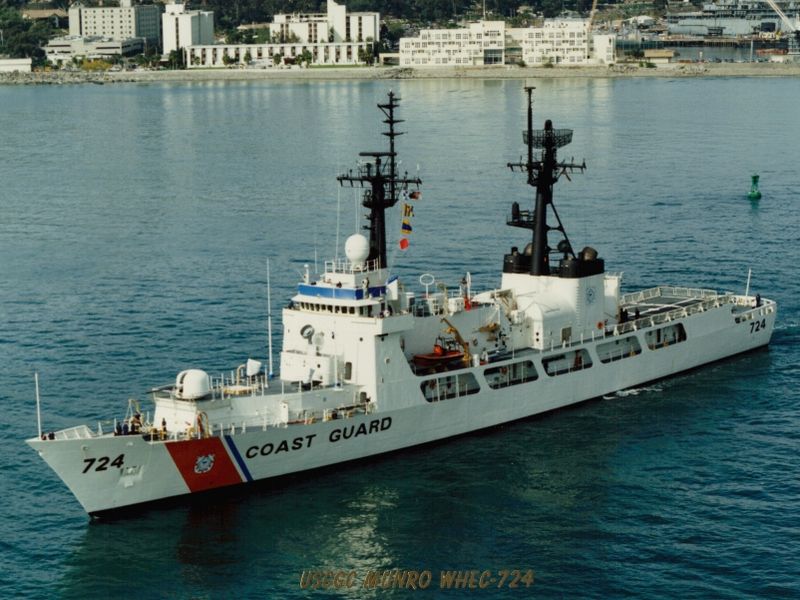
USCGC Douglas Munro (WHEC-724)

The Navy League’s magazine, Seapower, reports that the last of the US Coast Guard’s Hamilton class 378 foot WHECs, Douglas Munro, will be decommissioned at the end of the month.

The designers of these ships certainly made them aesthetically pleasing, and the preliminary design work was done in house by Coast Guard engineers.

The 378s were the crowning achievement of a recapitalization program begun in the late 1950s that resulted in the 82 foot Point class patrol boats, the 210 foot Reliance class WMECs, and ultimately the 378 foot Hamilton class WHECs, all built to preliminary designs developed in house.

Between October 1960 and August 1970 the Coast Guard commissioned 79 Point class WPBs. The Point class followed closely on the heals of the 95 foot WPB, the last of which had been commissioned in July 1959.

Between June 1964 and July 1969 we commissioned 16 Reliance class WMECs. Between February 1967 and March 1972 we commissioned 12 Hamilton class WHECs.

So between Oct. 1960 and March 1972 the Coast Guard commissioned 107 new patrol cutters. In 1967 alone we commissioned 17 Point class WPB. 1968 was the peak year for the larger cutters. In that year the Coast Guard commissioned four 378s and seven 210s. (Makes it clear we should be able to complete more than two Offshore Patrol Cutters per year, doesn’t it?)

USCGC Gallatin WHEC -721 (378), USCGC Rockaway WHEC-377 (311), and USCGC Spencer WHEC-36 (327)

When the 378s were built, the WHEC designation had just recently been coined. 36 ships were classed as WHECs, six 327 foot 2,656 ton full load Secretary class cutters, 18 Casco class 311 foot 2,529 ton cutters, and 12 Owasco class 255 foot 1,978 ton cutters. The plan was to build 36 of Hamilton class to replace all of them, but the termination of the Ocean Station program resulted in only twelve being built. The 378s were 15 to 54% larger than the ships they replaced at 3,050 tons full load, and they were a much more advanced design.

CODOG Propulsion:

The COmbined Diesel or Gas turbine (CODOG) propulsion was a bold choice in the early 1960s. The Royal Navy had commissioned their first combatants with gas turbines (combined with steam) in 1961  The US Navy would not complete their first gas turbine powered Perry class frigate until 1977. (I think you can see the influence of the Hamilton class in the design of the Perry class frigates.) A pair of Danish Frigates, the Peder Skram class, would also use the same FT-4 turbines, but the first of that class was laid down only four months before Hamilton, so it was more contemporary than predecessor. 49 months after Hamilton was laid down, the Canadian laid down the first of the Iroquois class destroyers that used more powerful versions of the FT-4 in a COGOG arrangement with smaller 7500 HP Allison gas turbines. We would see the FT-4 gas turbine again in the Polar class icebreakers beginning in 1976.

The Coast Guard had done some experimentation with gas turbines. As built, USCGC Point Thatcher (WPB-82314), commissioned in Sept. 1961, was equipped with controllable pitch props and two 1000 HP gas turbines (later replaced by two 800 HP diesels that would became standard in the class). The first five 210 foot cutters of the Reliance class, commissioned June 1964 to February 1966, had two 1,000 HP gas turbines in addition to two 1,500 HP diesels, that they retained until they received major renovations 1985-1990.

The Hamilton Class’s Navy contemporaries were the 3,371 ton full load Garcia and 4,066 ton Knox class frigates (classified as Destroyer Escorts until 1975). Those ships were larger and used high temperature and pressure steam propulsion to produce 35,000 HP (compared to 36,000 for the 378s on their turbines). The frigates used only a single shaft for a speed 27 knots. The Hamiltons’ turbines gave them a two knot speed advantage, while their diesels gave them more than double the range. Two shafts gave them a greater degree of redundancy.

ASW Capability: 

While the contemporary Garcia and Knox class were much better equipped for ASW, the newly commissioned 378s, with their AN/SQS-38 sonar and helicopter deck were not only larger and faster, but also compared favorably as ASW ships to all but the newest Navy Destroyer Escorts (those completed 1963 and later).

CGC DALLAS (WHEC-716)… Vietnam… During seven combat patrols off the coast of Vietnam, Dallas undertook 161 gunfire support missions involving 7,665 rounds of her 5-inch ammunition. This resulted in 58 sampans destroyed and 29 Viet Cong supply routes, bases, camps, or rest areas damaged or destroyed. Her 5-inch (127 mm) guns made her very valuable to the naval missions in the area. Original 35mm Slide shared by Capt W.F. Guy, USCG… Circa May 1970.

Electronic Warfare, Gun and Fire Control: 

The 378s introduced the post WWII Coast Guard to electronic warfare with the WLR-1.

Unlike the earlier WHECs, the 378s were completed with the Mk56 gun firecontrol system which was much more capable than the short to medium range Mk52 used by the older cutters. Their 5″/38s proved useful when deployed to Vietnam. Below is quoted from Wikipedia’s description of USCGC Morgenthau‘s Vietnam deployment.

From records compiled by then-Lieutenant Eugene N. Tulich, Commander, US Coast Guard (Ret), Morgenthaus Vietnam numbers included: Miles cruised – 38,029 nautical miles (70,430 km; 43,763 mi); Percentage time underway – 72.8%; Junks/sampans detected/inspected/boarded – 2383/627/63; Enemy confirmed killed in action (KIA) 14; Structures destroyed/damaged – 32/37; Bunkers destroyed/damaged – 12/3; Waterborne craft destroyed/damaged – 7/3; Naval Gunfire Support Missions (NGFS) – 19; MEDCAPS (Medical Civic Action Program) – 25; Patients treated – 2676.

The FRAM:

During the late 1980s the Reagan administration was pushing for a 600 ship Navy. The FRAM of the Hamilton class was one of the small ways the Coast Guard played a part in the competition that may have driven the Soviet Union into dissolution.

While the 378s would still might not have been first class fighting units, electronic warfare was brought up to date, a newer air search radar, a modern gun, and firecontrol was installed. Harpoon anti-ship cruise missiles were add along with a Close in Weapon System (CIWS), a hangar was added and the ships were equipped to operate with a LAMPs I ASW helicopters.

Ultimately, following the collapse of the threat from the Soviet Union, the ASW equipment and anti-ship cruise missile were removed, but benefits of modernization, remained.

The After Life: 

These ships are now 49 to 54 years old and, thanks to the hard work of their crews over a half century, they are still doing good work, no longer for the US Coast Guard, but for Navies and Coast Guards around the world. Virtually all of their contemporaries have gone to the ship breakers, as have many younger ships.

BRP Andrés Bonifacio (FF-17), the former USCGC Boutwell.

  • Hamilton (715), Dallas (716), and Boutwell (719) serve in the Philippine Navy.
  • Mellon (717) serves in the Bahrain Naval Force
  • Chase (718) and Gallatin (721) serve in the Nigerian Navy
  • Sherman (720) serves in the Sri Lanka Navy
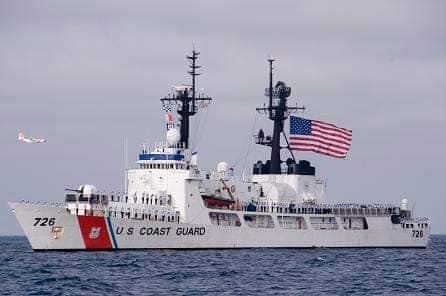
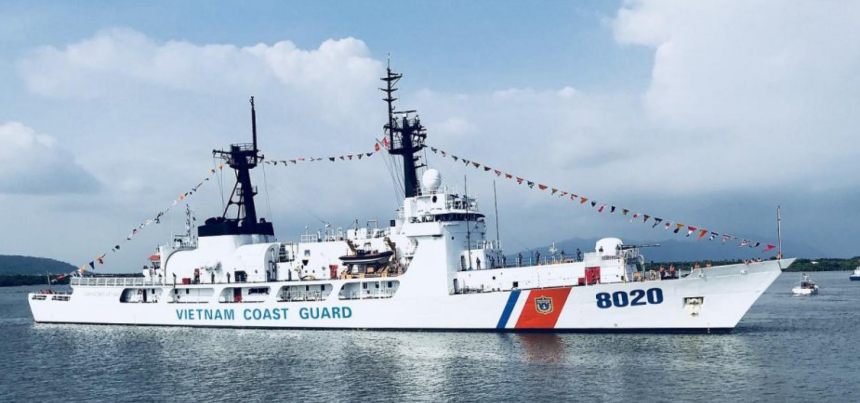
  • Morgenthau (722), Midgett (726), and Munro (724) serve or will serve in the Vietnam Coast Guard
  • Rush (723) and Jarvis (725) are in the Bangladeshi Navy

The Vietnam Coast Guard patrol vessel CSB-8020, formerly the US Coast Guard cutter Morgenthau (Photo: Vietnam Coast Guard)

47 Foot MLB Service Life Extension Program

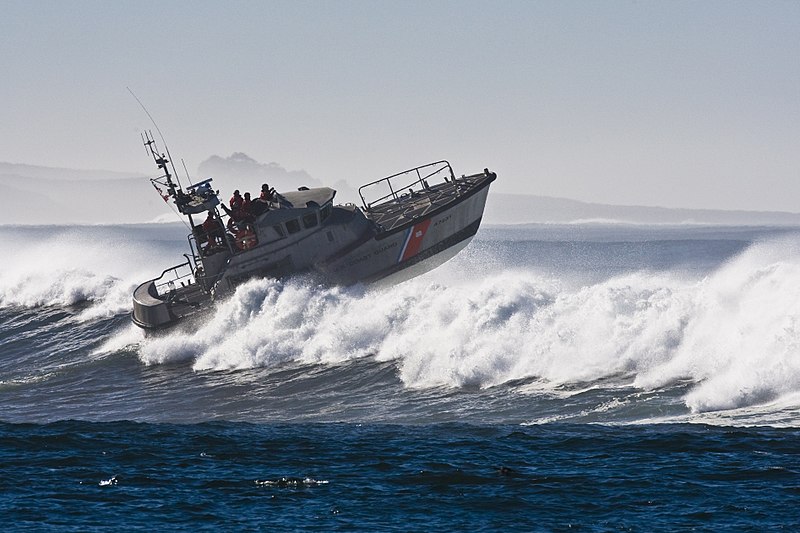
47-Foot Motor Life Boat (MLB) 47231 from Station Morrow Bay, 4 Dec 2007. Photo by Mike Baird

MarineLink reports on the Coast Guard’s service life extension program for the 47 foot motor life boats.

“In the summer of 2020, Birdon America delivered the first of the upgraded 47 MLBs which was accepted by the U.S. Coast Guard. It had passed or exceeded all the U.S. Coast Guard requirements under the contract. Birdon will now proceed with the service life extension of over 100 of these vessels built between 1997 and 2003. Work on the first boat was completed at the All-American Marine yard in Bellingham, Wash. Other west coast boats will follow. The 47 MLBs on the east coast will be upgraded at an east coast yard beginning in 2022…a pair of US-built, 6-cylinder, Cummins QSC8.3-M engines were chosen for the repower as part of the MLB Service Life Extension Program (SLEP). These EPA3-rated engines have four valves per cylinder and produce 530 BHP each at 2,600 RPM. They replace the original 435-hp Detroit 6V92TA mains. The new engines exceed the contracted requirements in terms of noise reduction and fuel economy.”

Thanks to Lee for bringing this to my attention.