“‘Strategic’ Cruise Missile Tested From North Korea’s New Corvette” (Corvette with Nuclear Capable Cruise Missile?) –The Drive

The Drive reports.

“North Korea’s state-run media has released new photos of the country’s most modern surface combatant, known in the West as the Amnok class corvette, which is also the largest operated by the Korean People’s Navy. Of particular interest is that the warship is armed with cruise missiles, which can likely be fitted with nuclear warheads, adding yet another platform to North Korea’s diverse and growing strategic arsenal.”

Cutters doing UN sanctions enforcement in the East China Sea might run into one of these.

This coast guard cutter sized vessel, one of four being built, which is reportedly 77 meters (253′) in length, is interesting for its combination of possible nuclear capability with old tech.

Aside from the cruise missiles, which may not have been accurate, this corvette includes four heavy gatling style machine guns (two 30mm and two 14.5mm) which would be very dangerous at short range. For mid-range, the mid 20th century 100mm gun looks rather crude, but it does throw a 34.4 lbs. (15.6 kg) projectile up to 24,323 yards (22,241 m). That is almost seven times heavier and about 6,000 yards further than the 57mm.

The portholes look out of place and may mean the ship is not fully airconditioned.

“Japanese icebreaking research vessel project moves ahead” –Marine Log

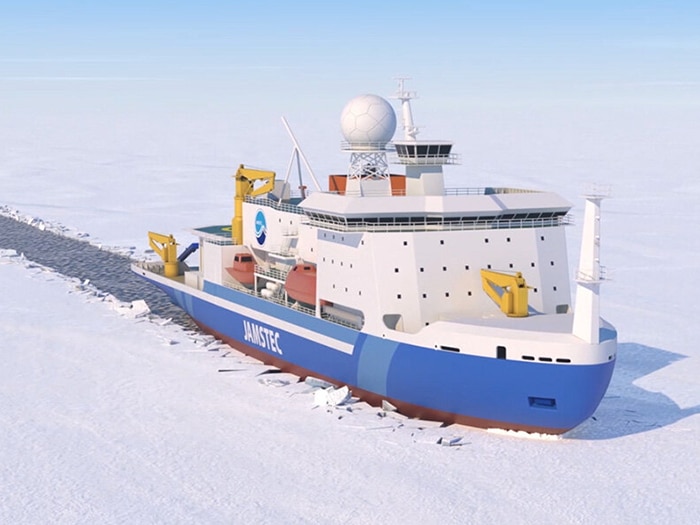
Icebreaking research vessel
MOL is to deploy an outfitting crew to the shipyard building Japan’s first icebreaking research vessel

Marine Log reports,

JAMSTEC (Japan Agency for Marine-Earth Science and Technology) has taken another step forward on the build of Japan’s first research vessel with icebreaking capabilities. The icebreaking research ship is on order at Japan Marine United’s Isogo shipyard in Yokohama where, as of last month, the design of the hull structure was nearing completion…The LNG dual-fueled Polar Class 4 ship will have a total length of 128 meters, a width of 23 meters, an international gross tonnage of about 13,000 tons, and a crew of 99 people. It will be to break sea ice with a thickness of 1.2 meters at a speed of 3 knots, and will be equipped with drones, unmanned probes, and Doppler radars used for weather observations.

That is 420 feet in length and 75’5” in beam. USCGC Healy is the same length, but 82′ (25 meters) in beam, and 16,000 tons, so they are pretty close. If I interpreted correctly, this would be considered at the low end of the medium icebreaker class by the USCG. Like Healy, this ship uses shaft driven propellers.

There are diagrams of the ship here.

“Japan to supply 5 countries with free patrol boats to counter China” –Navy Recognition

Japanese Aso-class patrol vessel Dewa. (Picture source: Japanese government)

Navy Recognition reports,

For 2024, the OSA (Japan’s Official Security Assistance program–Chuck) has earmarked nations such as Vietnam, Indonesia, the Philippines, Papua New Guinea, Mongolia, and Djibouti. Notably, the first three have ongoing maritime disputes with China in the South China Sea…To strengthen its oversight of territorial waters and skies, Japan is considering equipping these nations with patrol boats, radar tech, drones, and communication tools.

While the US has transferred a lot of overage Coast Guard cutters, the Japanese generally supply new ships on very favorable financial terms. This helps maintain Japan’s shipbuilding capacity.

Japan has already supplied the Philippines with two large patrol cutters and ten smaller patrol craft. Japan has an agreement with Vietnam to build six cutters based on the Aso class pictured above. Japan has gifted at least one older cutter to Malaysia

It is not clear if the patrol boats mentioned in the title are actually free or if they refer to new or previously arranged programs.

Thanks to Lee for bringing this to my attention. 

“Prototype work begins on the Coast Guard’s newest heavy polar icebreaker” –CG-9

A quarter and a dime are used to demonstrate the difference in the hull thickness of a PSC as compared to other Coast Guard cutters. U.S. Coast Guard Photo.

Below is a report from the Acquisitions Directorate (CG-9). Nice to see some movement now that Bollinger has taken over the project.


Bollinger Mississippi Shipbuilding began cutting steel July 24, 2023, on the first prototype module that will become the foundation of a new polar security cutter (PSC), the first heavy icebreaker to be built in the United States in 50 years. Up to eight modules will be constructed in Pascagoula, Mississippi, to prototype the shipbuilding processes and techniques that will be used when production of the first PSC begins in 2024.

“We’re relearning how to build this type of ship,” said PSC program manager Capt. Eric Drey, describing the construction approach being employed by Bollinger during the prototype phase.

The progressive crawl-walk-run approach consists of verifying the processes utilized during the build to ensure design completeness. This includes unit readiness reviews, ensuring engineering, computer aided design systems accurately transfer numerical control data to automated production machinery and slowing down early prototype module build times to maximize learning and enable improvements in the downstream production, engineering, and planning processes. Each module requires approximately four months of labor, during which time the shipyard will continue recruiting and training additional members of the workforce to manage the transition to production of the lead hull as the prototype modules are completed.

The hull of a heavy polar icebreaker is required to be much thicker than other Coast Guard cutters because of the pressure exerted on the ship by the surrounding ice. Deeper, more closely spaced structural stiffeners inside the hull ensure the ship doesn’t crumple when it encounters large ice floes, and the hull itself is constructed of 1 1/2-inch-thick steel alloy that remains flexible even in extremely low temperatures.

“It’s the first heavy icebreaker built by our nation in 50 years,” said Drey. “It’s not just a big day for the Coast Guard, but a big day for the nation.” The PSCs will be multi-mission cutters capable of supporting all Coast Guard statutory missions executed in the polar regions.

The Coast Guard’s operational polar icebreaking fleet currently consists of one heavy icebreaker, the 399-foot Coast Guard Cutter Polar Star that was commissioned in 1976, and one medium icebreaker, the 420-foot Coast Guard Cutter Healy that was commissioned in 1999.

Coast Guard mission demand in the polar regions is growing as environmental and economic activities continue to increase. The Coast Guard has identified a need for new polar icebreakers to assure year-round access to the polar regions and to provide self-rescue capabilities. PSCs enable the United States to maintain defense readiness in the Arctic and Antarctic regions; enforce treaties and other laws needed to safeguard both industry and the environment; provide ports, waterways and coastal security; and provide logistical support – including vessel escort – to facilitate the movement of goods and personnel necessary to support scientific research, commerce, national security activities, and maritime safety.

For more information: Polar Security Cutter Program page.

“CUTTER 37: THE LAST SHIP STANDING” –Coffee or Die

USCGC Taney, probably early 1944, equipped with four 5″/38s. She was in this configuration less than a year before being converted to an amphibious force flagship.

Coffee or Die has an article published on Coast Guard Day about the former USCGC Taney (WPG/WHEC-37), the last US warship to have survived Japan’s December 7, 1941 attack on Hawaii (there may still be a tug as well). It may not be the most accurate history (“USS Constellation…one of the original six frigates of the US Navy” –no that was a different ship, there are minor errors as well), but it is entertaining, including some first-person accounts that convey why ships of this class were so loved.

Since we are now seeing long delays in our ship building, it’s worth noting that she was built in the Philidelphia Navy Ship Yard. Four 327 foot cutters, Campbell (32), Duane (33), Ingham (35), and Taney (37), were laid down in a dry dock on 1 May 1935. All four were launched simultaneously 3 June 1936, 13 months later. All four were commissioned less than 18 months after the keels were laid, Taney taking the longest. Campbell was commissioned only 412 days after being laid down.

About a thousand years ago (1982-84) I was XO on the Duane. I loved that ship. Twelve years ago, I did a post on the class: 327s–Why Were They So Successful?

There is also this post about a sister ship: How Spencer Became the Coast Guard’s Top U-Boat Killer, Thank You Royal Navy

“GAO: Polar Security Cutter Design Won’t Complete Until 2024, Delivery of First Hull Estimated in 2028” –USNI

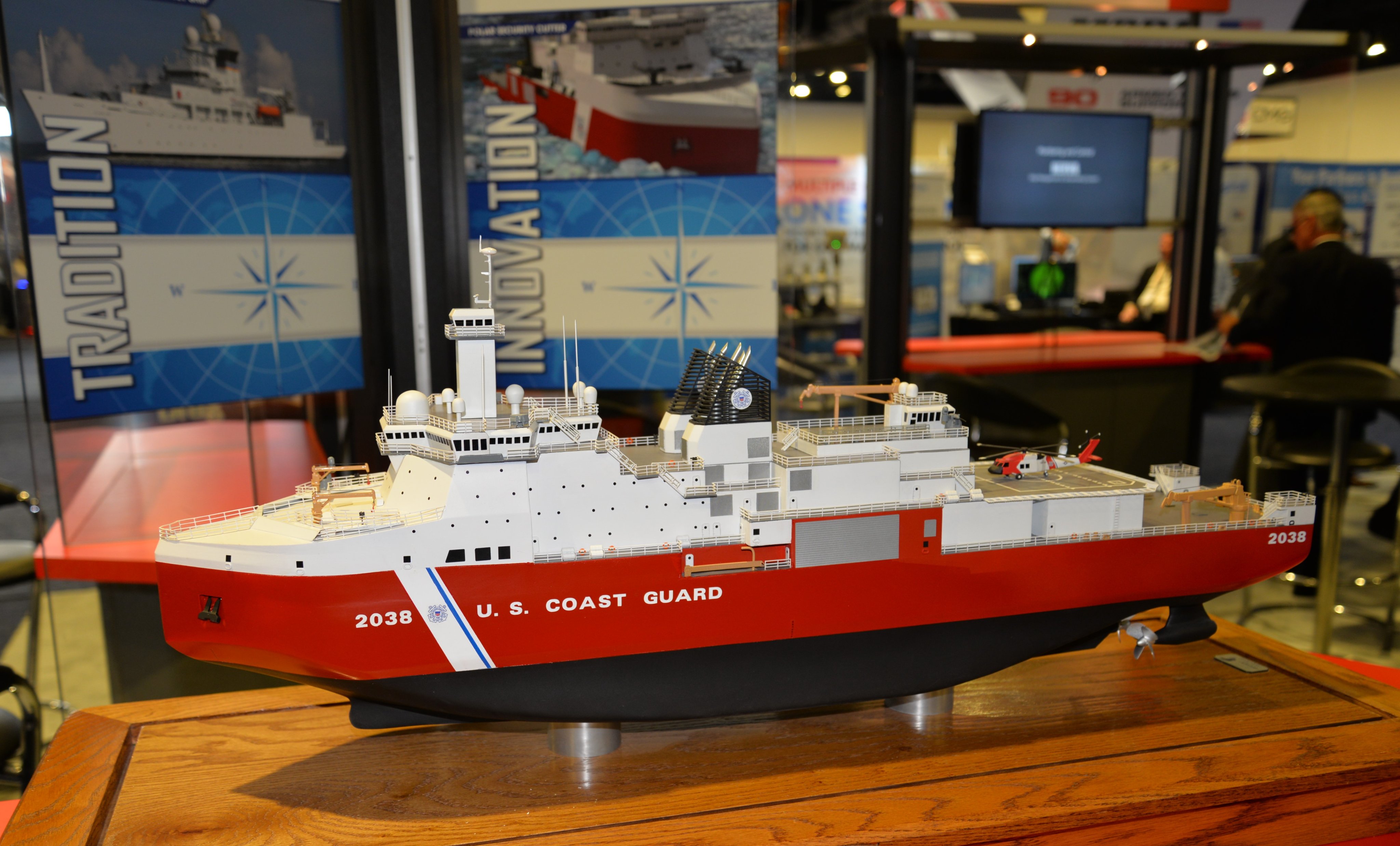
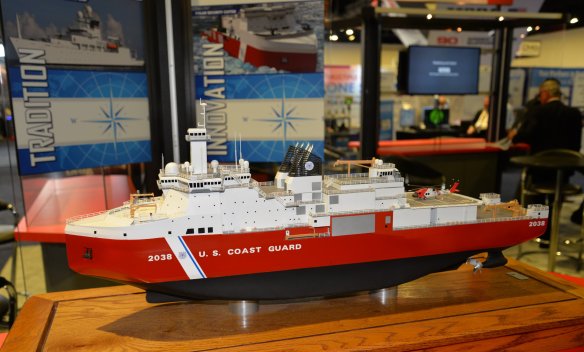
Photo of a model of Halter Marine’s Polar Security Cutter seen at Navy League’s Sea-Air-Space Exhibition have surfaced. Photo credit Chris Cavas.

The US Naval Institute news service reports,

According to the estimate from GAO, which cites Coast Guard and Navy officials, as well as shipbuilders – the final design for the 23,0000-ton ice breaker won’t be complete until next March. Construction is scheduled to start shortly after the design is approved. Coast Guard commandant Adm. Linda Fagan told Congress last month that the delivery of the first hull is expected in 2028.

This goes back to the fact that while the Polar Security Cutter was supposed to have been based on a proven design of a successful icebreaker, in fact the selected shipyard used a design that never got past the preliminary design stage.

But really, the problem goes back much further than that.

Polar Star was commissioned in 1976. A new class of ships typically takes ten years from concept to commissioning. 30 years is a generally expected lifespan for military ships. That suggests the program to replace the Polar class should have begun in 1996. Not even close. A replacement program was not initiated until 2012. By then the High Latitude Study had identified the need for three heavy and three medium icebreakers in 2010. Launching the Polar Security Cutter (PSC) program in 2012 should have given us an icebreaker in 2022. In 2016 a Polar Icebreaker Operational Requirements Document was issued. Arguably the High Latitude Study should have simultaneously launched both a heavy and a medium icebreaker procurement program.

13 years after the High Latitude Study identified the need, we have seen no movement in an effort to procure medium icebreakers.

In the movie “King Richard,” about Richard Dove Williams Jr., father of tennis players Venus Williams and Serena Williams, he is quoted as saying, “If you fail to plan, you plan to fail.”

This was not a problem with Congress.

We have failed to plan.

The only fleet mix plan we have ever done is now 12 years old. In the interim, much has changed.

There is not now, nor has there ever been, a 30 year ship building plan or any kind of comprehensive long range plan comparable to the Navy force structure and shipbuilding plans which the Navy revises every few years.

The first National Security Cutter was ordered in 2001 but was not commissioned until 2008. The first four were commissioned at essentially two year intervals, but even after that, it has taken nine years to complete next six. Looks like the eleventh ship will not be finished until 2025. When the first Hamilton Class WHEC was decommissioned, it was 44 years old. When the last one was decommissioned, it was almost 50 years old.

The Coast Guard currently has 27 WMECs, every single one of them is over 30 years old. 14 of them are over 50 years old. The average age is about 46.4 years. That is the fruit of poor planning.

We did not plan to run ships for 50 to 60 years, but we also have had no plan that defined when they would be decommissioned, that would have informed when replacements had to be completed.

Planning for the Offshore Patrol Cutters (OPC) began with the Deepwater Program. Concepts were revised in light of the terrorist attacks on Sept. 11, 2001. The acquisition process for the OPC began at least as early as 2010. At that time, we thought all would be delivered by 2027 (and here). The first ship was supposed to have been delivered in calendar year 2019. Now we plan on continuing to build them until 2038 meaning this acquisition program is supposed to run 28 years. 28 years building the same ship without looking at mission and technology changes?

We should decide right now that once we get some experience with the first OPCs, we will start looking at the next class of cutters. It might replace the OPC in future year budgets, or it might be built along with additional OPCs. We might even decide the OPC is exactly what we need to continue building, but we need to reevaluate. Cutter design should evolve. There should be improvements. There should be new capabilities.

The Coast Guard enjoys bipartisan Congressional support. We need to educate the administration, the Congress, and the GAO about our needs, but first we need to decide what they are, because we don’t really know.

We can start by identifying when ships will be decommissioned. The prospect of loss can be a strong incentive for funding their replacements.

We need a new Fleet mix analysis, one that actually looks at our missions, geographic distances and a range of possible solutions.

We also need a long term plan for our major capital resources, particularly the ships and aircraft.


“Orizzonte Sistemi Navali Signs Contract For New Italian Navy OPVs” –Naval News

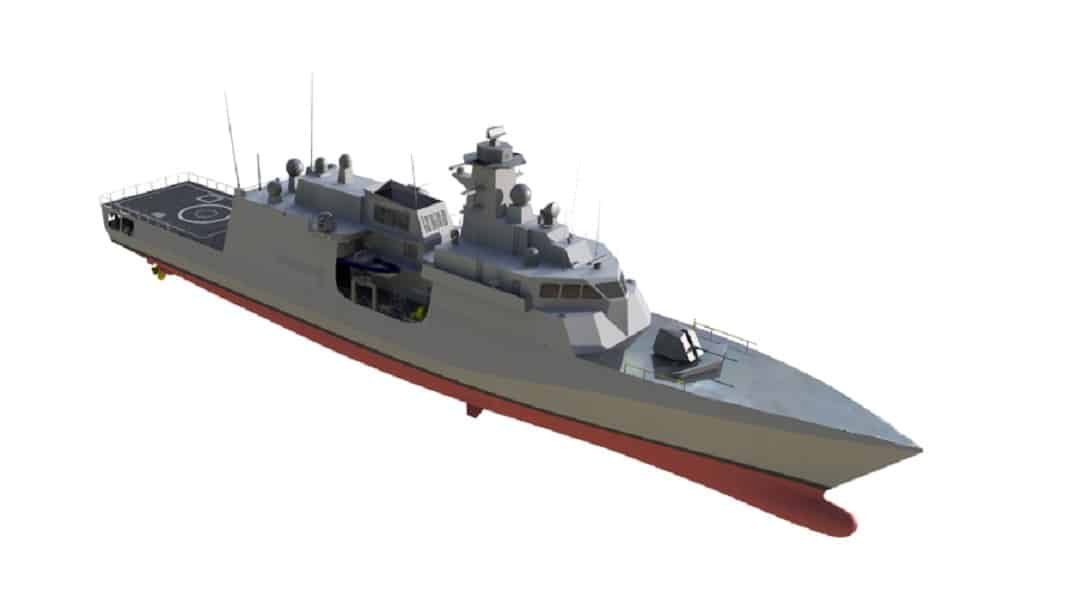
Drawing of the OPV by Fincantieri

Naval News reports,

As part of the Italian Navy OPV (Offshore Patrol Vessel) acquisition programme Orizzonte Sistemi Navali (OSN), the joint venture between Fincantieri and Leonardo… has signed a contract with the Italian Secretariat General of Defence and National Armaments Directorate for the construction of three next generation patrol vessels, with the options for a further three units and infrastructural upgrades required for the naval bases in Augusta, Cagliari and Messina, where the vessels will be based.

Fincantieri is the parent company of the Marinette based shipyard that has been building Freedom class LCS and will be building the US Navy’s new frigates. That shipyard also built USCGC Mackinaw, the 16 Juniper class WLBs, and the 14 Keeper class WLMs.

I am a little surprised by this. It had been reported that the six ships of the Sirio class and Cassiopea class would be replaced by 3,000 ton units of the European Patrol Corvette (EPC) program. This “PPX” program would be the third Italian Navy “patrol” vessel class being built concurrently along with the EPC and the Thaon di Revel class (also known as PPA for ‘Pattugliatore Polivalente d’Altura – Multipurpose Offshore Patrol Vessel’).

The description looks like a pretty typical modern, medium size OPV with an approximate length of 312′ (95 meters), a displacement of 2,300 tons and accommodations for 97. It appears the probable armament is a 76mm gun and a pair of 20 to 30mm mounts (probably the new Lionfish 30mm). That is a size the US Coast Guard might consider for operating in Atlantic Area, if we wanted to increase the total number of larger patrol cutters above the 36 currently planned.

No information was provided about the speed or range. Italian Navy ships tend to have relatively short range because they are designed to operate in the Mediterranean. I would guess range will be about 4,000 miles at about 14 knots. Speed will probably be about 24 knots.

“Israeli Navy reveals Reshef corvette plans” –Naval News

An illustration and infographic of the Reshef class corvette (Credit: Israeli Navy)

Naval News reports,

The Israeli Navy is looking to have the first of its new Reshef class corvettes in service at the start of 2027…Speaking at the CNE 2023 conference in Farnborough on 24 May, Commander Yonatan Kudish also revealed that the Reshef vessel will be assembled from hull modules built overseas by a US shipbuilder.

Eight ships are planned to replace eight Sa’ar 4.5 missile boats currently in service with the Israeli Navy. In addition to a 76mm gun, a pair of 30mm remote weapon stations, and anti-ship missiles (presumably Gabriel V), they are expected to have C-Dome missiles, the naval version of Iron Dome as well.

It appears the Israelis are rebranding their helicopter deck as a “multi-purpose mooring deck.” There does not seem to be a hangar.

Compared to the Sa’ar 4.5s they are replacing, they are more than twice the displacement, and 3 or 4 knots slower.

These will be marketed internationally as Offshore Patrol Vessels (OPV) as well as Missile Corvettes depending on how they are equipped, though they seem to be a little small for an OPV on most of the world’s oceans. A 1,000 ton displacement as shown in the graphic would suggest they are smaller than the Coast Guard’s 210 foot WMECs despite a greater length (about 250 feet), but that might not be their full load displacement.

The fact that they are slower than the vessels they replace seems to reflect the diminished value of a high maximum speed since long range missiles and aircraft have replaced other surface vessels as the primary threat. On the other hand, seakeeping, endurance, range, and high cruise speed are probably more important now. Even so the Sa’ar 4.5s had very good cruising range for such small ships (4,800 nautical miles (8,900 km) at 19 knots). Their replacements may not offer any improvement.

First of Ten Turkish Hisar-class OPV is ready to launch

A rendering showing the design of the Hisar-class OPV (ASFAT image)

Naval News reports,

The Turkish Navy’s first-ever offshore patrol vessel (OPV), the Hisar-class project’s lead ship was spotted at the Istanbul Naval Shipyard. The future TCG Akhisar (P-1220) is ready for launch.

The Hisar-class OPV is being built using the “fitted for but not with” concept, which allows for the integration of newly developed indigenous weapon and sensor systems. The OPV, which can accommodate a total of 104 people, will have a range of 4500 nautical miles with its CODELOD (COmbined Diesel-eLectric Or Diesel) main propulsion system.

Specifications:

  • Overall length: 99,56 meters
  • Beam: 14,42 meters
  • Draft: 3,77 meters
  • Maximum speed: 24 knots
  • Displacement: 2300 tons

Türkiye has begun to be a significant arms exporter including the export of warships. These are likely to be well received when offered for export.

Depending on how it is equipped, these could also fill the role of a corvette or light frigate.

Developed as a variant of the MİLGEM-class corvettes, the Hisar class OPV has been redesigned with a different main propulsion system and a different structural and general layout concept, allowing it to be built in a shorter time and at a lower cost.

I have come to see ships of about 2500 tons, 100 meter (328′) in length, and 25 knots as something of an ideal modern OPV. This is very close to that. Personnel accommodations allow a reasonable crew size and range is adequate. Its CODELOD (COmbined Diesel-eLectric Or Diesel) main propulsion system sounds like current best practices. It has a helicopter deck and hangar. What is not clear, is how good the accommodations for boat launch and recovery are–critical because boats are a primary tool for OPV missions, and if it can also accommodate a UAS system in addition to the helicopter. This is rapidly becoming a highly desirable capability.

“Editor’s Notes: Why the Coast Guard Lags When It Comes to Unmanned Systems” –National Defense

Eagle Eye UAS, part of the “Deep Water” Coast Guard recapitalization plan.

National Defense has a post that traces the Coast Guard’s two-decade effort to put unmanned aircraft on cutters.

But here is where I confess that this article is not really about the Eagle Eye. Sorry to say that it was all a bit of misdirection, because this article is really about one of the nation’s greatest but chronically underfunded assets: the United States Coast Guard.

National Defense since the Eagle Eye’s cancellation has written dozens of articles about the service’s effort to deploy UAVs. Over and over again, the only reason cited for the Coast Guard being the “have-not” of the services when it comes to drones was funding.

It is a good article, but I think the conclusion of the article is wrong. To paraphrase Jimmy Buffett (“wasting away in Margaritaville”) it’s our own damn fault.

Too long we seemed to glory in doing more with less. Too many years we went without bothering to submit an unfunded priorities list. We really haven’t changed our program of record since the rethink prompted by 9/11 more than two decades ago. We fired the Deepwater program contractors in 2012, but we are still working on their program. There have been changes around the edges, more NSCs, more FRCs, but those changes were not the result of a Coast Guard masterplan. They were ad hoc and frequently driven by Congressional interests.

Congress keeps telling us our planning is out of date. We have not done a fleet mix study since 2011 and even that one only considered the types of platforms already in the program of record without any consideration of alternative types.

Despite repeated Congressional calls for a new Fleet Mix Study, there is none.

Despite repeated Congressional calls for a 20- or 30-year ship building plan, there is none.

We still have not reached the number of medium range fixed wing search aircraft that were in the Program of Record and apparently have not plan to do so.

The Coast Guard has not been transparent in publicly reporting their measures of effectiveness. We don’t see reports like this one anymore. I have not been able to make reports like these (here, here, and here) since 2010.

We have failed to field any shore based maritime search UAS system, a capability that was included in the Deep Water program, while Japan, Thailand, India, the Netherlands, Belgium, and the UK have already done so. This in spite of the fact that we have been piddling around with CBP’s MQ-9 program for well over a decade.

Regional Maritime Domain Awareness programs are being implemented all over the world, but if we have such a program with Mexico and Canada no one seems to know about it.

Planning for the medium Icebreakers could have proceeded in parallel with planning for the heavy icebreakers. We know we need them, but I have seen no indication that we have started looking seriously at the possibilities.

We have not talked about the possibly devastating effects the delays in the OPC program are going to have, that would justify increasing the pace of construction to more than two per year.

We still have not adequately addressed the water borne terrorist threat to our ports. Since we never have its easy to continue to ignore.

Despite demands for reports from field units, for whatever reason, the “puzzle palace” is not making public the kind of analytics required to justify significant departures from what we did last year, so we keep stumbling along from one budget to the next.