
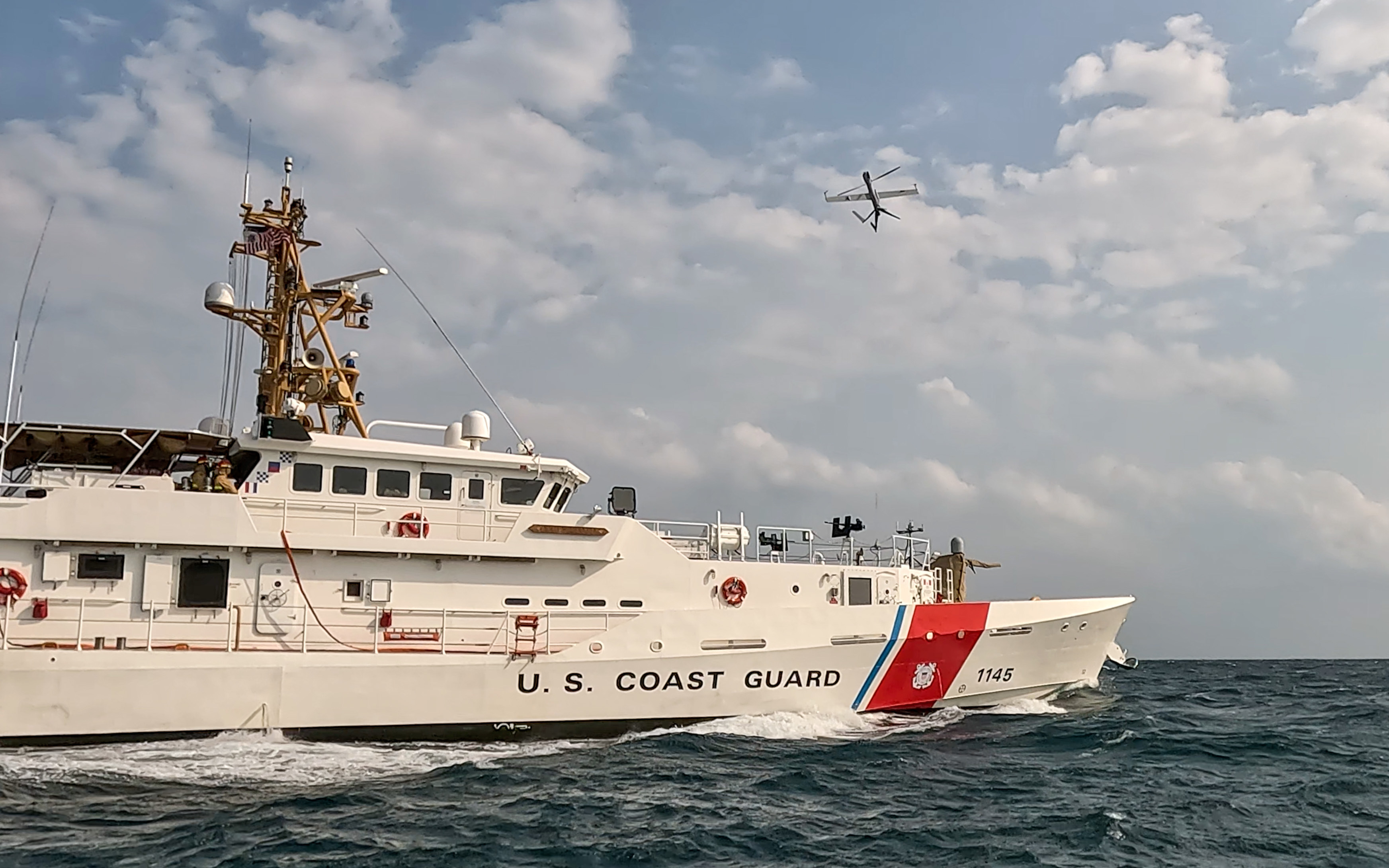
221207-N-NO146-1001 ARABIAN GULF (Dec. 7, 2022) An Aerovel Flexrotor unmanned aerial vehicle (UAV) takes off from U.S. Coast Guard fast response cutter USCGC Emlen Tunnell (WPC 1145) transiting the Arabian Gulf, Dec. 7. U.S. 5th Fleet’s Task Force 59 launched the UAV during Digital Horizon, a three-week event focused on integrating new unmanned and artificial intelligence platforms, including 10 that are in the region for the first time. (U.S. Navy photo)
We have begun to see very capable, vertical takeoff and landing (VTOL) unmanned air systems that fall into the DOD Group Two standard.
- Weight: 21 to 55 pounds (10 to 25 kg)
- Nominal operating altitude: <3500 feet or 1 km above ground level.
- Speed: <250 knots
Recently Elbit Systems reported they would be providing a Group 2 VTOL to the Israeli Army, and we have the photo above of an Aerovel Flexrotor taking off from a Webber class patrol craft,
These small, unmanned air systems (UAS), which can combine sophisticated sensors and endurance of four to over 24 hours, may be better search platforms than our H-65 helicopters.
Group 2 UAS are even smaller than the Martin V-Bat. It appears, they might be able to operate from Webber class cutters. Operating UAS from the Webber class on a regular basis would provide them much of the air search advantage of larger flight deck equipped cutters.
Below is a news release on another aircraft in this class, the Edge Autonomy VXE30. The VIDAR sensor referred to in the news release, is also used on the Scan Eagle (a catapult launched Group 2 UAS) used on National Security Cutters. There is more on the unmanned VXE30 here.

Edge Autonomy’s VXE30 UAS. The VXE30 vertical take-off and landing (VTOL) solution is the latest and most advanced version of the “Stalker” series of small uncrewed aerial systems (sUAS) from Edge Autonomy.
Sentient’s AI-enabled ViDAR optical sensors soar on Edge Autonomy’s VXE30 “Stalker” UAS in successful live demonstrations
ViDAR – Sentient’s AI-enabled wide area motion imagery deployed for real-time maritime surveillance at the edge
VIRGINIA BEACH, Va. (Aug 29, 2023) – Sentient Vision Systems (Sentient) has successfully completed live demonstrations of its AI-enabled ViDAR (Visual Detection and Ranging) payload deployed on Edge Autonomy’s VXE30 UAS. The VXE30 vertical take-off and landing (VTOL) solution is the latest and most advanced version of the “Stalker” series of small uncrewed aerial systems (sUAS) from Edge Autonomy. When coupled with Sentient’s ViDAR, the VXE30 provides a passive, wide area search capability, enabling it to serve a myriad of maritime operations. The joint capability will be on display at DSEI 2023, 12-15 September in London.
ViDAR, developed by Sentient, utilizes AI; Computer Vision, and Machine Learning integrated with Electro-Optic and Infrared (EO/IR) sensors to passively detect objects that are difficult to spot by the human eye or recognize on a conventional radar. With these enhanced capabilities, Stalker will be more capable of accurately detecting and locating people, objects, and vessels (day and night) far from the operator.
ViDAR has been deployed on intelligence, surveillance, and reconnaissance missions (ISR), maritime patrol and border protection, as well as search and rescue missions since 2015. ViDAR is proven to be effective in challenging maritime conditions up to Sea State 6 (very rough with waves 13 to 20 feet high/ 4 to 6 meters).
Sentient has successfully evolved ViDAR into a compact, lightweight, low power form factor—low SWaP (size, weight, and power) — suitable for deployment on small Group 2 / NATO Class 1 UAS such as the VXE30. Its successful integration onto the VXE30 demonstrates its broad operating envelope and ability to provide unprecedented long-endurance imaging capability in contested environments all around the world.
Joshua Stinson, Edge Autonomy’s Chief Growth Officer said, “The integration of ViDAR onto the VXE30 is an essential part of our UAS deployment program. ViDAR’s passive detection system will further the VXE30’s capabilities to remain undetected in a contested environment while carrying a powerful maritime detection sensor that provides a real-time picture of the maritime domain. This capability could make all the difference in a mission’s success.”
Paul Harris, Sentient’s VP of Business Development agreed and said, “We are delighted to be working with Edge Autonomy to demonstrate how effective ViDAR is at increasing the utility of the small and agile VXE30 for the challenges of the modern battlespace. We look forward to displaying our joint capabilities at DSEI.”
With close to 4,500 systems deployed, Sentient’s AI-enabled sensor edge solutions for wide area motion imagery are proven for detection in missions worldwide.
——–ends——–
About Sentient Vision Systems www.sentientvision.com
Sentient Vision Systems specializes in passive, modular optical sensors for persistent, wide area motion imagery. Sentient’s artificial Intelligence (AI)-enabled edge solutions better detect and identify small objects in real time, on land and at sea. With more than 20 years of development in moving target indication, AI computer vision and machine learning, Sentient has deployed thousands of systems worldwide in the field of Intelligence, Surveillance, Search and Rescue, enhancing situational awareness, accelerating informed decisions, and saved numerous lives. Follow Sentient on LinkedIn , Vimeo, YouTube and Twitter
About Edge Autonomy www.edgeautonomy.io
Edge Autonomy is a leader in providing innovative autonomous systems, advanced optics, and resilient energy solutions to the U.S. Department of Defense, the U.S. Federal Civilian Agencies, allied governments, academic institutions, and commercial entities. Edge Autonomy draws on a 34+ year history of aerospace engineering, advanced manufacturing expertise, and technologically advanced manufacturing. With headquarters in San Luis Obispo, CA, and key production capabilities abroad, Edge Autonomy’s 400+ team members deliver results in multiple markets. Follow Edge Autonomy on LinkedIn, Facebook and Twitter.
 Chuck Hill's CG Blog