SNA 2020 Virtual Tour

Again, I as many of you, was not able to attend the Surface Navy Symposium. Fortunately a number of videos are available to give us a taste of what went on.

Below are three videos from Naval News followed by a video of a panel discussion provided by Defense News.

The “Day 1” video includes:

01:09 – Austal HSSV high speed support vessel
03:55 – Update on the Littoral Combat Ship program with NAVSEA
05:40 – NSM firing from USS Gabriele Giffords
06:58 – Northrop Grumman SEWIP Block 3 EW system
09:47 – Raytheon SPY-6 family of radars

The “Day 2″ video covers:

00:57 – Fincantieri Marine Group FFG(X) Frigate based on Italian Navy FREMM
04:34 – Fujitsu collaborative table for JMSDF AEGIS destroyers & Japan AEGIS Ashore
05:53 – Raytheon SM-3 Block IIA ballistic missile interceptor

The “Day 3” video reports on:

00:59 – BAE Systems double docking of Arleigh Burke-class destroyers
01:54 – BAE Systems precision guided munition for 5 Inch gun: Hyper Velocity Projectile & Vulcano
02:31 – Fincantieri Marinette Marine shipyard expansion plan for FFG(X) frigate
06:08 – L3Harris FVR-90 future vertical lift VTOL UAV
08:26 – General Dynamics NASSCO John Lewis-class TAO 205
09:23 – Titanium 3D printing

The panel discussion, “Building the Future Fleet” is a bit over 90 minutes. Most of it is Navy of course. If you are a regular reader here, I don’t think you will hear much new about the Coast Guard. Rear Admiral Douglas M. Schofield (CG-9) is on the panel and began speaking at time 6:00–11:00. He also speaks briefly at 1:00:30 and answers the last question at about 1:28:30.

Huntington Ingalls still provided no information on their proposal for the FFG(X) program.

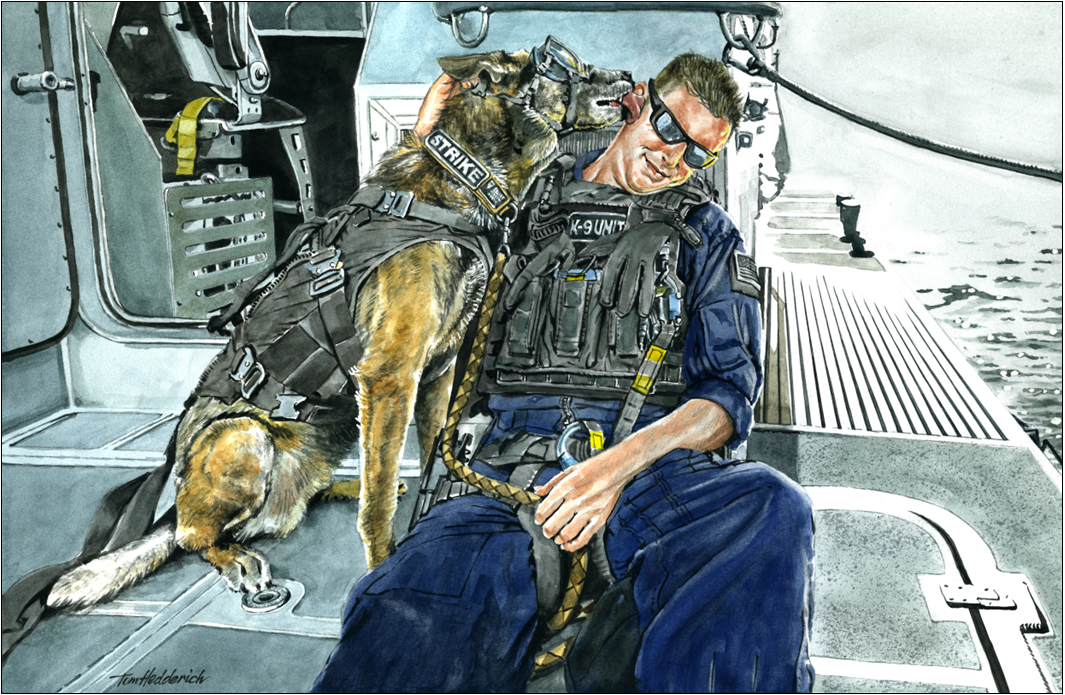
“Busting Smugglers & Breaking Codes” –Naval History Magazine

Unfortunately the source of this artwork was not available. 

The US Naval Institute’s Naval History Magazine, February 2020 edition, has an interesting article about the many changes that the Coast Guard went through as a result of Prohibition. You can read it online here.The section on code breaking is perhaps the most surprising.

During Prohibition, in its largest law enforcement mission ever, the Coast Guard made thousands of apprehensions. It also experienced its largest fleet expansion outside the world wars. And the service saw many firsts, including the first time Coast Guard crews manned Navy warships, and the permanent establishment of an aviation branch. It also saw extensive use of the radio and RDF and the founding of the Coast Guard Intelligence Office, one of the day’s leading federal intelligence branches. All these factors shaped the service into a force better prepared for its next great challenge—World War II.

A Coast Guard Sixbitter, 75 foot patrol boat.

“Coast Guard MH-65 program moves into full rate production” –CG-9

This from the Acquisitions Directorate (CG-9):

Coast Guard MH-65 program moves into full rate production

H65

The Coast Guard MH-65 short range recovery helicopter program began full rate production of the MH-65E configuration in November 2019. CGNR 6522 was the first MH-65 to enter the composite shop phase in the program depot maintenance overhaul. U.S. Coast Guard photo.


The Coast Guard MH-65 short range recovery helicopter program began full rate production of the MH-65E configuration Nov. 21, 2019, with the transfer of CGNR 6522 to the Aviation Logistics Center (ALC) in Elizabeth City, North Carolina. Two additional aircraft – CGNR 6514 and CGNR 6593– were transferred to the ALC production line in December 2019 and one – CGNR 6507 – was transferred in January 2020. The program is executing concurrent Service Life Extension Program (SLEP) work and avionics upgrades for the MH-65E conversion on the entire fleet.

Full rate production means that the ALC will transition to producing MH-65Es at a rate of 22 aircraft per year.

The avionics upgrades include reliability and capability improvements for the Automatic Flight Control System; installation of a digital cockpit display system and an upgraded digital weather/surface search radar; integration of a robust command, control, communications, computers, intelligence, surveillance and reconnaissance suite; and modernization of the digital flight deck with Common Avionics Architecture System, common with the Coast Guard H-60 medium range recovery helicopter and similar Department of Defense aircraft. Once the upgrades are complete, the helicopter is redesignated an MH-65E.

At the same time, the Coast Guard is completing SLEP activities to replace five major structure components: the nine-degree frame, canopy, center console floor assembly, floorboards and side panels. These mission-critical improvements are designed to extend the service life of the helicopter by 10,000 flight hours.

The avionics upgrades and SLEP are being completed at the same time to achieve schedule and cost efficiencies.

The Coast Guard plans to convert all 98 aircraft to the MH-65E configuration by fiscal year 2024.

For more information: MH-65 program page

“Coast Guard is Refining FY 2021 Funding Pitch” –USNI

The Coast Guard Cutter Healy breaks ice around the Russian-flagged tanker Renda 250 miles south of Nome Jan. 6, 2012. The Healy is the Coast Guard’s only currently operating polar icebreaker. The vessels are transiting through ice up to five-feet thick in this area. The 370-foot tanker Renda will have to go through more than 300 miles of sea ice to get to Nome, a city of about 3,500 people on the western Alaska coastline that did not get its last pre-winter fuel delivery because of a massive storm. If the delivery of diesel fuel and unleaded gasoline is not made, the city likely will run short of fuel supplies before another barge delivery can be made in spring. (AP Photo/US Coast Guard – Petty Officer 1st Class Sara Francis) NY112

The US Naval Institute news service based on comments by Vice Commandant Charles Ray, during the 2020 Surface Navy Association Symposium, reports that the Coast Guard is putting more emphasis on addressing long standing short falls in shore-side facilities. They are also attempting to improve communications with particular reference to communications in the Arctic.

The Arctic comms issue definitely caught the eye of commenters. Don’t overlook the comments.

China Maritime Safety Agency to Build 10,700 Ton Cutter

This is not the ship discussed here, but is similar in size.   Photo from http://defence-blog.com/news/photos-charge-of-the-10000-ton-china-coast-guard-cutter.html  

South China Morning Post reports that the China Maritime Safety Administration has started work on their largest cutter ever, 10,700 tons. That is more than twice the size of the National Security Cutters and if they are using light displacement as is frequently done in Asia, it may be three times as large.

At 165 metres (540 feet) long and 20.6 metres wide, the vessel will weigh in at 10,700 tonnes and be large enough to accommodate several types of helicopters. According to earlier reports it is expected to be completed by September next year.

China’s Maritime Safety Agency was the only one of five Chinese Maritime agencies that did coast guard type work, that was not incorporated into the China Coast Guard. Unlike the China Coast Guard, the Maritime Safety Agency is still a civilian agency. They have a fairly large fleet and their vessels are unarmed.

The Japanese and South Koreans also build large cutters, but not this large.

“Guardian” (General Atomic MQ-9) –DmitryShulgin

GA-ASI Concludes Successful Series of MQ-9 Demonstrations in Greece

Dmitry Shulgin reports on the recent demonstration of the Maritime version of General Atomic’s MQ-9 Remotely Piloted Air System and its “Detect and Avoid” system held in Greece for European Defense Officials.

The Coast Guard has had a notional requirement for shore based Unmanned Aircraft Systems (UAS) that goes back at least to the beginnings of the Deepwater program, two decades ago.

The most significant block to the wide spread use of UAS has been fear of mid air collisions with manned aircraft, because they could not “See and Avoid.” The General Atomic claims they have solved this problem with a Detect And Avoid (DAA) system.

The DAA system consists of an air-to-air radar integrated with Traffic Alert and Collision Avoidance System (TCAS II), and Automatic Dependent Surveillance-Broadcast (ADS-B). The DAA system enables safe flight of an MQ-9 in civil airspace, and can even detect air traffic that is not actively transmitting its position.

The Coast Guard has yet to procure a land based long duration UAS for Maritime Domain Awareness. Congress has been pushing the Coast Guard to pursue this capability. There have been some tentative steps, here and  here. It appears there are now off the shelf options.

“Currently GA-ASI aircraft systems support the Italian Air Force, the UK Royal Air Force, the French Air Force, and the Spanish Air Force. The Ministry of Defence for the Netherlands has selected MQ-9 for the Royal Netherlands Air Force, and the Government of Belgium has approved Belgian Defense to negotiate the acquisition of GA-ASI’s MQ-9B. In early December, the Australian Government announced selection of MQ-9B for the Australian Defence Force under Project Air 7003. GA-ASI RPAS are operated by the U.S. Air Force, U.S. Army, U.S. Marine Corps, U.S. Department of Homeland Security and NASA.”

The equipment included in the Guardian version of the MQ-9 is impressive, in addition to High-Definition/Full-Motion Video Optical and Infrared sensors, it includes Raytheon’s SeaVue multi-mode, maritime surface-search radar that is claimed to provide continuous tracking of maritime targets and correlation of Automatic Identification System (AIS) transmitters with radar detections and an Inverse Synthetic Aperture Radar (ISAR) mode that facilitates classification of vessels which are beyond optical sensor range.

For the demonstration, GA-ASI partnered with SES, a leading satellite communications (SATCOM) operator and managed services provider, with over 70 satellites in Geostationary Orbit (GEO) and Medium Earth Orbit (MEO). SES provided the GEO satellite connectivity that enabled the MQ-9 to operate securely with a high capacity datalink, enabling real-time transmission of sensor data from the aircraft, and extending its effective operational range far beyond that of «line-of-sight» datalinks.

Meanwhile, the Navy is supposed to be deploying a fleet of MQ-4C Triton UAS to complement their new P-8 maritime patrol aircraft. Some will be based in Mayport, NAS Point Mugu, Hawaii, and Guam. If their “Board Area Maritime Surveillance (BAMS)” system provides comprehensive coverage of the US EEZ and the drug transit zones, and if they share their information with the Coast Guard, maybe we don’t need our own assets, I have my doubts. If not, perhaps it is time for a Request for Proposal?

“Coast Guard releases final request for proposal for industry studies” –CG-9

OPC “Placemat”

The following is from the Acquisitions Directorate (CG-9) web site. Final responses are required by 31 Jan. 2020. Will see equal urgency in the award?

The Coast Guard released a final request for proposal (RFP) Jan. 10, 2020, for industry studies to support offshore patrol cutter (OPC) follow-on production. The RFP is available here.

This release follows the Industry Day event held Dec. 11, 2019, and the release of the draft RFP.

The deadline to submit responses to the final RFP is Jan. 31, 2020.

The Coast Guard plans to acquire 25 OPCs. The cutters will replace the 270-foot and 210-foot medium endurance cutters, which are becoming increasingly expensive to maintain and operate. The OPCs will bridge the capabilities of the national security cutters, which patrol the open ocean, and the fast response cutters, which serve closer to shore.

For more information: Offshore Patrol Cutter program page

Looking into this a little further, we find the notional delivery dates and construction schedule show one OPC delivered per year beginning in 2022, continuing through 2028 (#1-7), including the first four from Eastern. Then two per year 2029–2036 (#8-23), follow by one in 2037 and one in 2038. (Why the drop back in delivery rate at the end of the program is a bit hard to understand.)

“BATTLE OF THE BASTIONS” –War on the Rocks

Source: Image generated by Allison Lacey.

War on the Rocks has an interesting piece on the apparent development of a Bastions as both defensive and offensive positions.

Bastions are not a new development. World War II offers many examples of both success and failure. Singapore was a British bastion in WWII lost to the Japanese. One could say that Pearl Harbor was a bastion attacked December 7,1941. Malta was a bastion that was besieged for 29 months, from which the British attacked Axis supply lines to North Africa by submarine, surface ship, and aircraft.

The Japanese had Rebaul and Truk as well as many additional fortified island bases. As they pushed further from the homeland, the protected perimeter increased and consequently defenses became thinner and more porous. The US bypassed many of these, leaving them to “wither on the vine.” The months long battle between what became the US bastion at Guadalcanal and Tulagi in the Southern Solomon Islands and the Japanese at Rebaul, New Britain was a good example of a battle between Bastions.

What has changed is the range of influence these bastions now have. Bastions in the South China Sea can now reach Guam with both ballistic missiles and air launched cruise missile.

The Coast Guard is already at two of locations sighted as existing or possible future bastions, Guam and Bahrain.

2020 Coast Guard Outlook

The crews of the Coast Guard Cutters Midgett (WMSL 757) and Kimball (WMSL 756) transit past Koko Head on Oahu, Hawaii, Aug. 16, 2019. The Kimball and Midgett are both homeported in Honolulu and two of the newest Coast Guard cutters to join the fleet. (U.S. Coast Guard photo by Petty Officer 3rd Class Matthew West/Released)

The 2020 Coast Guard Outlook is on line. Can’t say I have read it. There are 127 pages, but looks like there may be some good stuff here.

“Coast Guard to hold memorial service for (20) lost Oregon, Washington Coast Guardsmen” (and four mariners)

Passing along this press release. A potent reminder. 

united states coast guard

News Release

U.S. Coast Guard 13th District PA Detachment Astoria
Contact: Coast Guard PA Detachment Astoria
Office: (503) 861-6380
After Hours: (206) 819-9154
PA Detachment Astoria online newsroom

Coast Guard to hold memorial service for lost Oregon, Washington Coast Guardsmen

Members of the Patriot Guard Riders display American flags in a show of respect for the Coast Guardsmen and fishermen who have lost their lives along the Columbia and Quillayute River bars during a memorial ceremony at Coast Guard Station Cape Disappointment, Jan. 10, 2016. Gordon Huggins, the only surviving crewmember from the capsizing and loss of the 52-foot Motor Life Boat Triumph, January 12, 1961, receives a hug from an attendee of the annual Triumph Memorial ceremony held at the Lewis & Clark Interpretive Center in Ilwaco, Wash., January 13, 2018. Maritime Enforcement Specialist 2nd Class Doug Bruene, Machinery Technician 2nd Class Justin Finney and Seaman Mitch Miller from Coast Guard Station Cape Disappointment in Ilwaco, Wash., prepare to cast a wreath and flowers into the water during a memorial service for the crews of the 52-foot motor lifeboat Triumph and the fishing vessel Mermaid, Jan. 12, 2013.

Editors’ Note: Click on images to download high resolution version.

WARRENTON, Ore. — The Coast Guard is scheduled to host a memorial service Saturday at 10 a.m., at the Lewis & Clark Interpretive Center in Ilwaco, Washington, in tribute to Coast Guardsmen and mariners who lost their lives during seven separate tragic incidents that occurred along the Washington and Oregon coasts.

Family, friends, media, former and current Coast Guardsmen and fellow mariners are invited to attend the short ceremony and pay their respects. Scheduled events include remarks from former shipmates; land and sea wreath ceremonies; and a traditional-bell ringing after each name is read in remembrance.

“Memorials provide an important link to the past, and it is important to honor those who made the ultimate sacrifice,” said Capt. Jeremy Smith, commander, Coast Guard Sector Columbia River. “These memorials allow us to remember the bravery and courage of those who have come before us, while also reminding us of the risks and dangers of our chosen profession.”

Personnel at Coast Guard Station Cape Disappointment host this memorial service annually at the beginning of the New Year in honor of Coast Guardsmen who paid the ultimate sacrifice.

Along with all of those lost at sea, the memorial service recognizes:

  • The four lives lost, all Coast Guardsmen aboard Motor Life Boat 36384, Feb. 5, 1946, during search efforts for two crab boats near Ocean City, Washington. The crab boats were later discovered to be safely anchored inside Willapa Bay.
  • The seven lives lost, five Coast Guardsmen aboard the 52-foot Motor Life Boat Triumph and two mariners aboard the 38-foot fishing vessel Mermaid, Jan. 12, 1961, during the attempted rescue of fishermen aboard the Mermaid near the Columbia River Bar.
  • The three lives lost of 10 Coast Guardsmen aboard the Coast Guard 41-foot Utility Boat 41332, Nov. 15, 1977, during night navigation training near the Columbia River Bar.
  • The one life lost, Coast Guard aviator #911 aboard Coast Guard helicopter 1353, Nov. 14, 1981 during night search efforts for a fishing vessel in distress off the coast of Coos Bay, Oregon.
  • The three lives lost, one Coast Guardsman and two mariners, Jan. 11, 1991, during rescue operations, of the 75-foot fishing vessel Sea King, in which two Sea King crewmembers were rescued near the Columbia River Bar.
  • The three lives lost, all Coast Guardsmen aboard Motor Life Boat 44363, Feb. 12, 1997 during rescue operations of two crewmembers aboard the 31-foot sailing vessel Gale Runner near the Quillayute River Bar.
  • The three lives lost, all Coast Guard aviators aboard Coast Guard helicopter 6017, July 7, 2010, near La Push, Washington. The helicopter crashed while transiting between Astoria, Oregon, and Sitka, Alaska.