The National Strategy

The Administration has published a new “National Security Strategy of the United States.” You can see it here. Much has been made of the fact that it identifies China and Russia as adversaries. Not surprisingly it also calls out Iran, North Korea, and Jihadist Terrorist, but also transnational criminal organizations. (No mention of domestic terrorists.)

China and Russia challenge American power, influence, and interests, attempting to erode American security and prosperity. They are determined to make economies less free and less fair, to grow their militaries, and to control information and data to repress their societies and expand their influence. At the same time, the dictatorships of the Democratic People’s Republic of Korea and the Islamic Republic of Iran are determined to destabilize regions, threaten Americans and our allies, and brutalize their own people. Transnational threat groups, from jihadist terrorists to transnational criminal organizations, are actively trying to harm Americans. While these challenges differ in nature and magnitude, they are fundamentally contests between those who value human dignity and freedom and those who oppress individuals and enforce uniformity.

I did an electronic search (control f) for “Coast Guard” and there was no mention. None of the other armed services were mentioned either. An electronic search for “homeland security” found the following: 

DISRUPT TERROR PLOTS: We will enhance intelligence sharing domestically and with foreign partners. We will give our frontline defenders— including homeland security, law enforcement, and intelligence professionals—the tools, authorities, and resources to stop terrorist acts before they take place.

COMBAT RADICALIZATION AND RECRUITMENT IN COMMUNITIES: The United States rejects bigotry and oppression and seeks a future built on our values as one American people. We will deny violent ideologies the space to take root by improving trust among law enforcement, the private sector, and American citizens. U.S. intelligence and homeland security experts will work with law enforcement and civic leaders on terrorism prevention and provide accurate and actionable information about radicalization in their communities.

A search for “maritime” found the following:

Adversaries target sources of American strength, including our democratic system and our economy. They steal and exploit our intellectual property and personal data, interfere in our political processes, target our aviation and maritime sectors, and hold our critical infrastructure at risk. All of these actions threaten the foundations of the American way of life. Reestablishing lawful control of our borders is a first step toward protecting the American homeland and strengthening American sovereignty.

Secure U.S. Borders and Territory…State and non-state actors place the safety of the American people and the Nation’s economic vitality at risk by exploiting vulnerabilities across the land, air, maritime, space, and cyberspace domains. Adversaries constantly evolve their methods to threaten the United States and our citizens. We must be agile and adaptable.

BOLSTER TRANSPORTATION SECURITY: We will improve information sharing across our government and with foreign partners to enhance the security of the pathways through which people and goods enter the country. We will invest in technology to counter emerging threats to our aviation, surface, and maritime transportation sectors. We will also work with international and industry partners to raise security standards.

Keep America Safe in the Cyber Era…America’s response to the challenges and opportunities of the cyber era will determine our future prosperity and security . For most of our history, the United States has been able to protect the homeland by controlling its land, air, space, and maritime domains. Today, cyberspace offers state and non-state actors the ability to wage campaigns against American political, economic, and security interests without ever physically crossing our borders. Cyberattacks offer adversaries lowcost and deniable opportunities to seriously damage or disrupt critical infrastructure, cripple American businesses, weaken our Federal networks, and attack the tools and devices that Americans use every day to communicate and conduct business.

Moreover, deterrence today is significantly more complex to achieve than during the Cold War. Adversaries studied the American way of war and began investing in capabilities that targeted our strengths and sought to exploit perceived weaknesses. The spread of accurate and inexpensive weapons and the use of cyber tools have allowed state and non-state competitors to harm the United States across various domains. Such capabilities contest what was until recently U.S. dominance across the land, air, maritime, space, and cyberspace domains. They also enable adversaries to attempt strategic attacks against the United States—without resorting to nuclear weapons—in ways that could cripple our economy and our ability to deploy our military forces. Deterrence must be extended across all of these domains and must address all possible strategic attacks.

RETAIN A FULL-SPECTRUM FORCE: The Joint Force must remain capable of deterring and defeating the full range of threats to the United States. The Department of Defense must develop new operational concepts and capabilities to win without assured dominance in air, maritime, land, space, and cyberspace domains, including against those operating below the level of conventional military conflict. We must sustain our competence in irregular warfare, which requires planning for a longterm, rather than ad hoc, fight against terrorist networks and other irregular threats.

Priority Actions POLITICAL: Our vision for the Indo-Pacific excludes no nation. We will redouble our commitment to established alliances and partnerships, while expanding and deepening relationships with new partners that share respect for sovereignty, fair and reciprocal trade, and the rule of law. We will reinforce our commitment to freedom of the seas and the peaceful resolution of territorial and maritime disputes in accordance with international law. We will work with allies and partners to achieve complete, verifiable, and irreversible denuclearization on the Korean Peninsula and preserve the non-proliferation regime in Northeast Asia.

MILITARY AND SECURITY: We will maintain a forward military presence capable of deterring and, if necessary, defeating any adversary. We will strengthen our long-standing military relationships and encourage the development of a strong defense network with our allies and partners. For example, we will cooperate on missile defense with Japan and South Korea to move toward an area defense capability . We remain ready to respond with overwhelming force to North Korean aggression and will improve options to compel denuclearization of the peninsula. We will improve law enforcement, defense, and intelligence cooperation with Southeast Asian partners to address the growing terrorist threat. We will maintain our strong ties with Taiwan in accordance with our “One China” policy, including our commitments under the Taiwan Relations Act to provide for Taiwan’s legitimate defense needs and deter coercion. We will expand our defense and security cooperation with India, a Major Defense Partner of the United States, and support India’s growing relationships throughout the region. We will re-energize our alliances with the Philippines and Thailand and strengthen our partnerships with Singapore, Vietnam, Indonesia, Malaysia, and others to help them become cooperative maritime partners.
Europe

A search for Arctic found:

A range of international institutions establishes the rules for how states, businesses, and individuals interact with each other, across land and sea, the Arctic, outer space, and the digital realm. It is vital to U.S. prosperity and security that these institutions uphold the rules that help keep these common domains open and free. Free access to the seas remains a central principle of national security and economic prosperity, and exploration of sea and space provides opportunities for commercial gain and scientific breakthroughs. The flow of data and an open, interoperable Internet are inseparable from the success of the U.S. economy. and an open, interoperable Internet are inseparable from the success of the U.S. economy.

There was no mention of Antarctica, polar, or climate change.

Traffic and derivatives of it, e.g. trafficking or trafficers, are mentioned six times.

Cyber and its derivatives are mentioned 46 times.

Terror and its derivatives are mentioned 82 times.

Surface Navy Association

The Coast Guard National Cuttermen Chapter is part of the Surface Navy Association (SNA). SNA is having their annual symposium in January. If you are interested in going, you might want to register ASAP. The following from SNA.

Where: Hyatt Regency Crystal City
When: January 9-11, 2018
Theme: Surface Forces & Cross-Domain Integration

If you have not registered for the Symposium and plan to attend, we encourage you to register 2 p.m. EST on Tuesday 12 December to qualify for the Tier 2 pricing.  Once registration is confirmed a payment link will be sent to you to complete the process.  This payment must be completed by 2 p.m. EST on Wednesday, 13 December to qualify for this pricing. Payment submitted after 2 p.m. EST on December 13 will be raised to the Tier 3 prices.
If you have already registered and have not paid you have until Noon on Wednesday 13 December to make a payment at the Tier 2 levels.  After that time you will be bumped up to the next pricing tier.

Remembering, or Perhaps Losing the Memory, of Pearl Harbor

The video above is from last year. 

The Coast Guard Compass has a post in its Long Blue Line Series looking at the Coast Guard’s role in the events around Hawaii on December 7, 1941 and outlining Coast Guard activities leading up to and during World War II. The video above is from last year.

I looked back on previous posts on this topic, but unfortunately as a result of the Coast Guard’s migration of it’s on-line representation to new servers, it seems we have lost access to much of the historical material that was previously available, most notably the Coast Guard history Pearl Harbor index, as a result my previous posts which largely referred to this historical material now connect only to a singularly unhelpful page at Defense Media Activities.

For what it is worth, here are some previous commemorative post marking this day:

Hopefully I will address the Coast Guard’s Social media efforts relatively soon.

The 378 (WHEC) Project Group–On Facebook

See the source image

There is a group on Facebook with the stated intention of obtaining a Hamilton Class 378 foot WHEC for use as a museum exhibit to be added to the Coast Guard Museum in New London. I have provided a copy of their “about” statement below. You can find the group here:  https://www.facebook.com/groups/139110530178903/

We are a large group of Coast Guard Veterans in the process of acquiring a 378′ High Endurance Cutter to convert into a museum. The response from Veterans all over the country has been overwhelming. We are determined to succeed. We are a non-profit corporation with a board of directors. Our CEOs name is Steve Howard and he is presently with a Coast Guard Attorney in negotiations with Comandant Zukunft and MCPOCG Patton for one of four 378s still in service. MCPOCG Patton is also on the board of directors of the National Coast Guard Museum. He informed me that the museum wanted a 378 to display. The 378 is unique. It was the first warship, in both the Coast Guard  or Navy,  equipped with twin jet turbine engines, bow thrusters, variable pitch props, helicopter flight deck, aluminum superstructure and fly by wire helms. It also had stealth tech, forerunner of Littoral. They served with  distinction in Vietnam as well as their roles in search and rescue and law enforcement. At least on of these ships should be preserved and that is our mission. Won’t you please find it in your heart to either volunteer and/or donate. We are getting the paperwork done so that you can deduct your contribution from your taxes. Join us!

Senate Appropriations Committee Budget Recommendation

HMAS Success (AOR-304) refuelling probe goes in for a hook-up with the US Coast Guard Cutter USCGC Waesche (WMSL-751) as the Royal Australian Navy Auxilliary Oiler Replenishment Ship conducts a dual RAS (Replenishment at Sea) off the coast of Hawaii during the Sea Phase of Exercise RIMPAC 2014, 19 July 2014. (RAN Photo by Leading Seaman Brenton Freind RAN)

News on the FY2018 budget (edited for a Coast Guard readership):

“The Senate Committee on Appropriations today released the FY2018 chairmen’s recommendation and explanatory statement for the Department of the Homeland Security.”

Bill Highlights:

U.S. Coast Guard – $11.2 billion, including $7.3 billion to fully fund personnel and operations.  The Coast Guard once again set a record in FY2017 by interdicting nearly 500,000 pounds of cocaine on the high seas, and the bill recommends continued investment in the Coast Guard capabilities that are enabling this success.  The bill recommends $1.8 billion to continue a historic recapitalization of Coast Guard assets, including:
•    $540 million for construction of National Security Cutter 10.
•    $95 million for long lead time materials for National Security Cutter 11.
•    $450 million for construction of Offshore Patrol Cutter 1.
•    $50 million for long lead time materials for Offshore Patrol Cutter 2.
•    $240 million for four Fast Response Cutters.
•    $19 million to support Polar Icebreaker acquisition.
•    $6 million to accelerate recapitalization of the Inland River Tender fleet

This is good news with Acquisition, Construction, and Improvement funding near the $2B annually the Coast Guard really needs. A bit surprised at the continuation of the NSC program. Not that we can’t use them.

Thanks to Luke for bringing this to my attention. 

OPC “Placemat”

12 Coast Guardsmen receive Navy Combat Action Ribbon

PORTSMOUTH, Va. — Twelve Coast Guardsmen assigned to the Maritime Security Response Team in Chesapeake were presented with the Navy Combat Action Ribbon Tuesday by Vice Adm. Karl Schultz, commander, Coast Guard Atlantic Area.

The 12-man Coast Guard element was deployed aboard the USS Mason off the coast of Yemen last year when Houthi rebels attacked the USS Mason multiple times over a span of several days. During the multi-day attack, the rebels fired missiles at a group of U.S. Navy destroyers and other U.S. Navy vessels. In the engagements, the USS Mason screened the other vessels, employed effective countermeasures against the attacks and returned fire, allowing safe transit by the other vessels in the area.

“MSRT members are deployed to U.S. Central Command year round,” said Schultz. “This incident and awards are reminders of the Coast Guard’s dedication to supporting our DoD counterparts in protecting U.S. interests in the region.” 

The award marks the first time in more than 25 years the Navy has officially recognized a Coast Guard crew at sea for coming under enemy fire.

GAO Reports

Would like to call attention to a couple of GAO reports. Have to admit, I have not read the full reports, the first is 51 pages, the second, 61.

Regarding the first GAO report, it has now been seven years since I last saw a public statement of how the Coast Guard uses its assets and how well we reach our goals. More information, and more transparency would be good. We should not be afraid to say some goals are not being met because we simply do not have the asset. Some performance measures probably should be classified, but that does not apply to most of what we do. That is what classified annexes are for.

Regarding the second report, closing stations is one way to save money, but it is not the only way. It forfeits the advantages of proximity and redundancy. Analytically a two hour response time may be appealing, but some times it is really not good enough. We have experienced a number of natural disasters recently, I suspect we have benefited from having some overlap in our SAR capabilities. Perhaps we should look at scaling down staffing where there is overlapping capabilities rather than eliminating facilities all together.

Coast Guard: Actions Needed to Enhance Performance Information Transparency and Monitoring

What GAO Found

The U.S. Coast Guard’s (Coast Guard) performance goals generally align with its 11 statutory missions. However, GAO found that the goals representing 5 of the 11 missions do not fully address all related mission activities. For example, despite the Coast Guard’s mission to interdict all illegal drugs, the agency’s two performance goals related to that mission are for cocaine interdiction only, excluding many other substances. Developing new goals to address missions, or describing how existing goals sufficiently assess mission performance, could better convey the Coast Guard’s progress in achieving its missions to decision makers and the public. The Coast Guard also does not report all of its performance goals in publicly available documents, limiting congressional and public awareness of the Coast Guard’s ability to meet its missions.

The Coast Guard and the Department of Homeland Security (DHS) have processes intended to ensure the reliability of performance data for the seven selected goals that GAO reviewed. However, the Coast Guard does not consistently document its data limitations for internal and external audiences. For example, the Coast Guard did not document limitations with its performance goal regarding the number of detected incursions of foreign fishing vessels violating U.S. waters. While the Coast Guard reported taking steps to address data limitations with two of the seven selected performance goals that GAO reviewed, the extent of such limitations are not clearly documented. Assessing the extent to which performance data limitations are documented could provide greater transparency regarding the reliability of these data.

Additionally, for the same selected seven goals, GAO found that the Coast Guard documented an explanation for why it did or did not meet each performance goal reported to DHS, as well as corrective actions for each unmet goal. However, the Coast Guard’s corrective actions were not measurable and did not include time frames for implementation. For example, the Coast Guard did not report measurable actions or time frames for evaluating whether additional resources were needed to address its cocaine interdiction goal. The Coast Guard also did not document its efforts to monitor whether the corrective actions it developed for unmet performance goals were implemented or evaluate whether they had the intended effect. Documenting these efforts could enable the Coast Guard to determine whether these actions have been implemented, if they have mitigated any performance gaps, and continue to plan and prioritize its operations to target performance gaps, which is consistent with federal standards for internal control.

RECOMMENDATIONS

The Commandant of the Coast Guard should either develop new performance goals to address mission activity gaps, or explain in the Coast Guard’s Annual Performance Report (APR) why certain aspects of mission performance are measured while others are not. (Recommendation 1)

The Commandant of the Coast Guard, in coordination with the Secretary of Homeland Security, should make the Coast Guard’s future Annual Performance Reports publicly available on the Coast Guard’s website. (Recommendation 2)

The Commandant of the Coast Guard, should coordinate with the Secretary of Homeland Security, and assess the extent to which documentation on performance data reliability, including Performance Measure Definition Forums and DHS and Coast Guard APRs, contain appropriate information on known data reliability limitations, and update these documents, as needed, based on the results of the assessment. (Recommendation 3)

The Commandant of the Coast Guard should develop and document, in its APR or elsewhere, corrective actions for unmet performance goals that are measurable and include time frames for implementation. (Recommendation 4)

The Commandant of the Coast Guard should document, in its APR or elsewhere, its efforts to monitor and evaluate the implementation of corrective actions for unmet performance goals. (Recommendation 5)

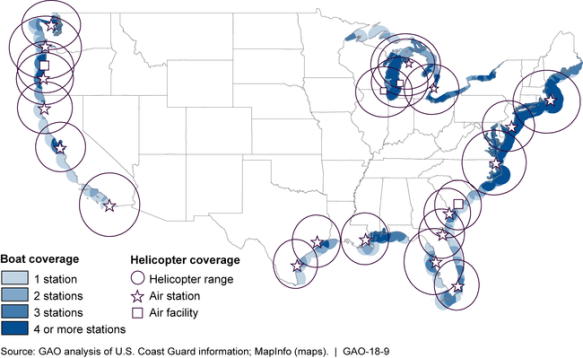
Coast Guard: Actions Needed to Close Stations Identified as Overlapping and Unnecessarily Duplicative

SAR Coverage

What GAO Found

GAO found that the U.S. Coast Guard has a sound process for analyzing its boat stations that includes clear and specific steps for analyzing the need for stations using terms that can be readily defined and measured. In 2013, following this process, the Coast Guard and its contractor identified 18 unnecessarily duplicative boat stations with overlapping coverage that could be permanently closed without negatively affecting the Coast Guard’s ability to meet its 2-hour search and rescue (SAR) response standard and other mission requirements. The process was designed to ensure the Coast Guard met or exceeded requirements to maintain SAR coverage and to account for such factors as boat downtime and surge capacity to respond to certain incidents. Further, the boat station analysis did not consider potential SAR responses by the Coast Guard’s air stations and facilities, which can provide additional overlapping coverage. Coast Guard officials said that the closures would, among other things, help improve operations by consolidating boat station caseloads to help ensure personnel were active enough to maintain training requirements.

In 2017, the Coast Guard affirmed that its leadership believes the 2013 study remains valid, but so far the agency has not taken actions to implement the closures identified by its sound process. Instead, the Coast Guard is recommending conversion of some year-round stations to seasonal stations that would operate during the summer. Coast Guard officials stated that seasonal closures are preferable to no action, given its limited resources, the significant overlapping SAR coverage, and potential to improve operations. However, permanently closing unnecessarily duplicative stations may better position the Coast Guard to improve its operations. It could also achieve up to $290 million in cost savings over 20 years, if stations were permanently closed.

RECOMMENDATIONS

The Commandant of the Coast Guard should establish and follow a sound air station optimization process similar to its process for analyzing boat stations to allow it to comprehensively analyze its need for air stations and air facilities and determine what changes may be needed. (Recommendation 1)

The Commandant of the Coast Guard should establish a plan with target dates and milestones for closing boat stations that it has determined, through its 9-step process and subsequent analysis, provide overlapping search and rescue coverage and are unnecessarily duplicative. (Recommendation 2)

The Commandant of the Coast Guard should take action to close the stations identified according to its plan and target dates. (Recommendation 3)


Guided Weapons Made Easy

APKWS launcher to be produced by Arnold Defense. Expected ready for production 2018.

Army Times is reporting that Arnold Defense is showing a system developed to allow the mounting of up to four Advanced Precision Kill Weapon System (APKWS II) 70mm laser guided rockets virtually anywhere there is a “universal gun mount,” including maritime applications. That sounds like the mounts for our .50 caliber machine guns.

APKWS is a kit that adds semi-active laser homing guidance to any Hydra rocket, a common unguided rocket normally used in large number for area suppression.

The launcher for up to four rockets, called Fletcher, is 6.5 feet long and has an empty weight of only 30 pounds. Each of the 2.75″ rockets when equipped with APKWS kits weighs about 32 pounds depending on warhead chosen, for an all up weight of about 158 pounds.

Range is at least 5,000 yards in surface to surface mode. The effect of a hit is similar to that of a 3″ (76.2 mm gun). This seems to be the weapon we need to quickly and reliably take out threats based on small, fast, highly maneuverable vessels with less likelihood of collateral damage than gun systems. It would probably deal effectively with larger vessels up to about 100 tons.

APKWS is in the Navy supply system. A contract in 2016 for the purchase of 5000 kits at a total cost of $133M yielded a unit cost of $26,600 and since then the unit price has reportedly deceased as production has increased. BAE is working up to a capacity of building 20,000 APKWS kits a year. They have already completed over 10,000. Arnold claims to have produced over 1.1 millilon rocket launchers since 1961.

The light weight offers several advantages. It would not have to be mounted all the time. It should be easy to remove and remount the launchers, or to move them between platforms. We would not necessarily need to load up all four tubes or have two launchers.

We would need to make sure the back blast points in a safe direction, perhaps mounting the launcher(s) on the stern. We would also need laser designators, but they readily available, and we probably should have them anyway, as a way of designating targets when we need to get help from our sister services.