Swarming for SAR

Our friend at the British Defense blog ThinkDefence has a short post regarding some experiments being undertaken by the Naval Postgraduate School in Monterey, California. They have reportedly succeeded in having 50 small unmanned aircraft operating cooperatively all under the control of one man.

The thing that caught my eye was this statement, “There are also algorithms for search-and-rescue operations, in which the flight pattern resembles that of foraging bees.”

The linked post is about doing SAR post natural disaster on land, but perhaps there are some possibility for the Coast Guard here.


Russia’s Plans for an Arctic Coast Guard

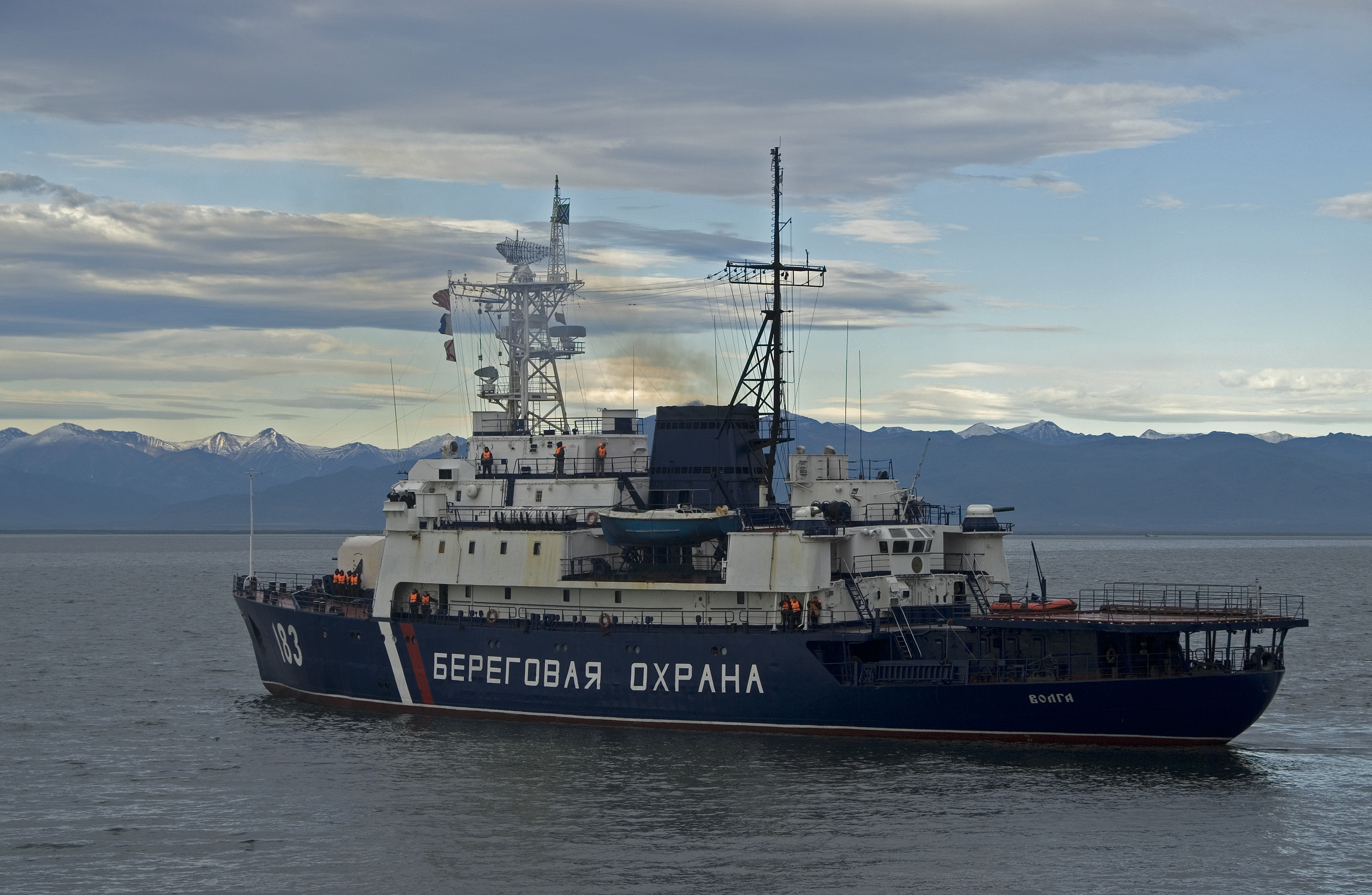
Photo: Russian Coast Guard Project 97P Border Patrol Vessel Volga (#183). The Russian Coast Guard is part of the Border Guard Service of Russia. This photo was taken by the crew of the USCGC Boutwell in Petropavlovsk, Russia during the North Pacific Coast Guard Forum in September 2007.

As is widely known Russia has plans to greatly expand use of the “Northern Sea Route,” the passage between the Atlantic and Pacific via the Arctic Ocean near Russia. To make this economical they are planning to greatly expand the presence of their Coast Guard in the Arctic. This includes a new class of ships.

“Efforts to build up an Arctic Coast Guard force have been ongoing since at least 2011, when the Federal Security Service (FSB) — the successor to the KGB, which oversees the Coast Guard and Border Guard services — ordered its first of a planned six “Ocean” patrol ships. The vessels, small ships with a displacement of 2,700 tons, are nevertheless built to withstand icy Arctic conditions.

The lead ship, known as “Polyarnaya Zvezda,” or North Star, has been completed and is undergoing final preparations for regular service in Kronstadt, near St. Petersburg. Two additional Ocean ships, known in Russia by their “Project 22100” designation, are under construction, and should be ready by 2019.

“Plans for new Arctic Coast Guard ships won’t stop with the completion of the Project 22100 class, according to Mikhail Barabanov, a naval expert at the Moscow-based Center for the Analysis of Strategies and Technologies (CAST).

“‘Construction is planned for several larger Coast Guard patrol ships with a displacement of 6,000 to 7,000 tons,’ Barabanov said, adding that the ships will double as icebreakers. Several design bureaus are now competing for tenders to design the ships, he said.

“The Coast Guard is also expanding its infrastructure along the Arctic frontier with a chain of 10 Coast Guard stations. These stations will be used to launch search and rescue operations if ships run into trouble.”

The Project 22100 ships sound a bit like the Offshore Patrol Cutters. Specs found here indicated a displacement of 2700 tons, length of 91.8 meters/301.2 feet, beam of 14.8 meters/48.6 feet, speed of 20 knots, a range of 12,000 miles, a crew of 41, and an armament of one 76mm and two 14.5mm, and accommodations for a Ka-27 (a 12,000kg/26,455 pound helicopter). The German Navy blog Marine Forum reported on 10 October that first of class “POLYARNAYA ZVEZDA completes four days of sea trials in the Gulf of Finland.” The next two ships are not expected to be commissioned until 2019.

Document Alert: “Coast Guard Polar Icebreaker Modernization: Background and Issues for Congress”

ice-breakers-540688_1280

The US Naval Institute News Service has provided access to a report to Congress, “Coast Guard Polar Icebreaker Modernization: Background and Issues for Congress,”by Ronald O’Rourke, Specialist in Naval Affairs, September 25, 2015.

I am repeating here the last two paragraphs of the Summary. I think they explain quite clearly the sad state of our icebreaker fleet.

“On September 1, 2015, the White House issued a fact sheet in conjunction with a visit to Alaska by President Obama indicating that the Administration, in its own internal planning, had at some point over the past two years deferred procurement of a new polar icebreaker to FY2022, but that this has now been changed to FY2020. The newly announced procurement date of FY2020 is a two-year acceleration from the previously unpublicized date of FY2022, and a two-year deferral from the FY2018 date implied in the FY2013 and FY2014 budget submissions. The fact sheet states that the Administration will also “begin planning for construction of additional icebreakers” beyond the one that the Administration proposes to procure in FY2020.
“A polar icebreaker procured in FY2020 might enter service in 2024 or 2025. Polar Star has been refurbished and reentered service in December 2012 for an intended period of 7 to 10 years—a period that will end between December 2019 and December 2022. Consequently unless the service life of Polar Star is further extended (or unless Polar Sea is repaired and returned to service), there will be a period of perhaps two to six years during which the United States will have no operational heavy polar icebreakers. The issue for Congress is whether to approve, reject, or modify the Administration’s plans for sustaining and modernizing the polar icebreaking fleet.”

New SeaPay

The Coast Guard has begun a new SeaPay system as reported by Coast Guard All Hands.

The new five-table system takes into consideration desirability of different cutter platforms, personnel tempo, deployment lengths and programmed operational hours.

“We made a conscious decision to shift most of the sea pay increases to mid-level enlisted paygrades in an effort to incentivize them to return to sea duty assignments,” said Master Chief Petty Officer of the Coast Guard Steven Cantrell. “A three-level system just wasn’t enough, and it didn’t allow flexibility to change with the times. These changes don’t take place in a vacuum – a lot of decision and a lot of discussion went into these just to get it right.”

This system is relatively complex, but it appears a realistic effort to achieve the stated goals.

Can’t help believe this only happened because we have a “Cutterman” as Commandant who understands that all sea duty is not equal.

The linked post includes the five pay charts.

Gaps in Coast Guard History

The US Naval Institute’s News Service has provided access to a Coast Guard report to Congress mandated in the Howard Coble Coast Guard and Maritime Transportation Act of 2014 (Pub. L. No. 113-281).

Not later than 1 year after the date of enactment of this Act, the Commandant of the Coast Guard shall submit to the Committee on Commerce, Science, and Transportation of the Senate and the Committee on Transportation and Infrastructure of the House of Representatives a report on any gaps that exist in writings on the history of the Coast Guard. The report shall address, at a minimum, operations , broad topics, and biographies with respect to the Coast Guard.”

The document is relatively short. There is a fairly long list of topics, but I’m not sure how useful it is. I am sure Bill Wells will have something to say about this.

It seems lately we have seen more from the Atlantic Area Historian than from the Coast Guard Historian.

It also seems the Coast Guard has not “weaponized” its history. The Coast Guard is not using it to enhance the image of the service.

Hybrid Electric Drive (HED)

800px-US_Navy_110918-N-BC134-014_The_Arleigh_Burke-class_guided-missile_destroyer_USS_Halsey_(DDG_97)_transits_the_Pacific_Ocean

US Navy photo, USS Halsey (DDG 97)

The US Naval Institute reports that the Navy intends to put auxiliary electric motors, or hybrid electric drive (HED) system, on 34 Burke Flight IIA guided missile destroyers (DDGs), by adding an electric motors to a preexisting quill drives in the main reduction gear. Reportedly these will power the vessels at up to 13 knots.

These systems will not only save money when the ships are cruising slowly, they will also allow them to remain on station longer.

Although the typical diesel power plant on cutters is more efficient at low speeds than the DDG’s gas turbines, a HED should also be applicable to Coast Guard cutters. We do seem to spend a lot of time cruising slowly. It would also provide a redundant propulsion system as a backup if the main engines were disabled. I am hoping there will be something similar on the Offshore Patrol Cutter.

Surgeries on Small Ships

The US Naval Institute News service reports a Navy lab is looking into whether surgeries could be performed on “small ships,” specifically the Littoral Combat Ships and the former “Joint High Speed Vessel.”

The select surgical procedures included in the study are stabilizing a fractured pelvis, treating a displaced femur fracture, treating an open wound of the abdominal wall, and a traumatic amputation of the leg. A medical team – consisting of a surgeon, a nurse, a surgical technician and an anesthesiologist – would conduct simulated surgeries in a realistic environment in up to sea state five conditions.

I am not sure why the Navy is doing this, and why specifically sea state five, there are going to be a lot of circumstances when the sea state is lower. Obviously surgeries have been done on small ships in the past. An appendectomy was famously performed on a submarine by a corpsman using a sharpened spoon (although subs have the advantage of being able to submerge out of severe sea conditions).

Perhaps they are talking about putting a surgical module on these ships, and maybe it might fit on Cutters. I’m still hoping the OPC will have some provision for using at least some of the LCS modules.

When we did Ocean Station, cutters deployed with Public Health Service doctors on board, and Midgett did have a SAR case involving a traumatic amputation of a leg in the Bering Sea while I was aboard, but I doubt we could justify regularly deploying with a surgical team. Still, there are circumstances like the 2010 Haiti earthquake when a surgical team and operating room on our cutters could be useful. Big hospital ships are great for some things, but in that case there were several smaller communities that also needed help. Some times you need the ability to spread the capability around.

Oman Buys “Cutter X”

AlOfougCorvetteSTM4Oman

Another country has begun procuring ships similar to my proposal for “Cutter X.” In this case it is four vessels for the Sultanate of Oman. The program is already well underway. Naval Technology reports two of the four ships have already been accepted and the remaining two should be delivered by the third quarter of 2016. Total cost was reportedly approximately $700M.

It appears that this class may have provided the basis for the design of Singapore’s slightly larger “Littoral Mission Vessel,” (LMV) we talked about earlier, the first of which was launched in July.)

These ships are intended to replace four much smaller 25 meter (82 foot) Al Seeb class patrol boats. In fact it appears that they will receive the names of the vessels they replace.

Power is two 20V8000 MTU diesels, providing roughly 24,000 HP, for a max speed of 25 knots. Endurance is reportedly 14 days with a range of 3,000 miles at 16 knots which should give a range of about 4,500 miles at a slower speed of 10-12 knots.

Armament is an Oto Melara 76mm and two Oto Melara 30mm remotely controlled machine guns.

A clear view of the ships mast, bridge, and electronics can be seen here.

Dimensions:

  • Length, 75 m (246 ft) (overall); 72 meters (236.2) (waterline)
  • Beam: 10.8 m (35.4 ft)
  • Draught: 3.3 m (10.8 ft)
  • Displacement: 1,250 tons

Gear That Does Not Fit

Recently the US Naval Institute put out a call for articles written by women. They got several on diverse subjects, but one in particular by a Coast Guard Academy graduate, Damage Control Assistant, boarding party member, and Diver got my attention, because it seems to indicate that, not only that we are not properly outfitting crew members that are smaller than average, but also that we may be putting their lives in dangers because they are not given gear that fits.